Introduction
Irritable bowel syndrome (IBS) is a chronic functional gastrointestinal (GI) disorder associated with abdominal pain, bloating and change in bowel habit, with either predominantly diarrhoea, constipation or a combination of both (Spiller et al. Reference Spiller, Aziz, Creed, Emmanuel, Houghton, Hungin, Jones, Kumar, Rubin, Trudgill and Whorwell2007). A clinical diagnosis of IBS is based on the identification of positive symptoms through diagnostic criteria and the exclusion of organic diseases and alarm symptoms, such as unexplained weight loss and rectal bleeding (Manning et al. Reference Manning, Thompson, Heaton and Morris1978; Drossman, Reference Drossman2006).
The prevalence of IBS ranges between 10 and 25% in community samples and it affects around 11% of the global population (Lovell & Ford, Reference Lovell and Ford2012; Canavan et al. Reference Canavan, West and Card2014). IBS has significant financial consequences, with direct costs per patient ranging from $1562 to $7547 per year, and indirect costs from $791 to $7737 per year (Nellesen et al. Reference Nellesen, Yee, Chawla, Lewis and Carson2013). Humanistic burdens of IBS include a negative impact on quality of life, social functioning and time off work (Spiller et al. Reference Spiller, Aziz, Creed, Emmanuel, Houghton, Hungin, Jones, Kumar, Rubin, Trudgill and Whorwell2007). Treatment for IBS relies on lifestyle advice, and medical and psychological therapies (Akehurst & Kaltenthaler, Reference Akehurst and Kaltenthaler2001; Talley et al. Reference Talley, Holtmann and Walker2015).
Current conceptualizations of IBS include the biopsychosocial model, which acknowledges the two-way communication between mind and body (Engel, Reference Engel1980; Drossman, Reference Drossman1998; Tanaka et al. Reference Tanaka, Kanazawa, Fukudo and Drossman2011). Psychological and social factors interact with physiological factors (e.g. intestinal inflammation, altered motility and bacterial flora) through the bidirectional communication between the central nervous system and the enteric nervous system (Jones et al. Reference Jones, Dilley, Drossman and Crowell2006; Surdea-Blaga et al. Reference Surdea-Blaga, Baban and Dumitrascu2012). More specifically, the biopsychosocial model suggests that biological and psychosocial predisposing factors in early life, such as genetics, heredity, trauma, and parental illness behaviours, increase people's susceptibility to develop IBS. Precipitating factors (e.g. lack of social support, stressful life events, gut infection) can closely precede and trigger IBS. Perpetuating factors, such as anxiety, depression, negative perceptions of symptoms and illness behaviours, contribute to the maintenance of symptoms over time (Deary et al. Reference Deary, Chalder and Sharpe2007; Hauser et al. Reference Hauser, Pletikosic and Tkalcic2014). Anxiety and depression are usually considered perpetuating factors of IBS symptoms but it is also possible that they act as predisposing or precipitating factors of IBS alongside other risk factors, such as an acute GI infection (Stermer et al. Reference Stermer, Lubezky, Potasman, Paster and Lavy2006; Hamilton et al. Reference Hamilton, Gallagher, Thomas and White2009; Marshall et al. Reference Marshall, Thabane, Garg, Clark, Moayyedi and Collins2010; Spiller & Lam, Reference Spiller and Lam2012).
Studies suggest that around 5 to 32% of patients develop IBS after GI infections (Thabane & Marshall, Reference Thabane and Marshall2009) but this percentage may be higher as GI infections tend to be under-reported by patients. It is still not clear whether post-infectious IBS (PI-IBS) is a different subgroup of patients suffering from IBS (Sundin et al. Reference Sundin, Rangel, Fuentes, Heikamp-De Jong, Hultgren-Hornquist, De Vos and Brummer2015). Research has found that a history of previous treatment of anxiety/depression is less correlated with PI-IBS than non-PI-IBS (Dunlop et al. Reference Dunlop, Jenkins and Spiller2003). Therefore, exploring the role of anxiety and depression as risk factors of IBS in both GI samples and population-based studies may contribute to understanding subgroup differences in IBS.
Although recent literature acknowledges the interplay between mind and body and describes the potential mechanisms underlying IBS pathophysiology (Stasi et al. Reference Stasi, Rosselli, Bellini, Laffi and Milani2012; Mayer et al. Reference Mayer, Labus, Tillisch, Cole and Baldi2015), in clinical practice some doctors still conceive IBS as a sole somatization of anxiety and depression (Dixon-Woods & Critchley, Reference Dixon-Woods and Critchley2000; Bijkerk et al. Reference Bijkerk, de Wit, Stalman, Knottnerus, Hoes and Muris2003; Lacy et al. Reference Lacy, Rosemore, Robertson, Corbin, Grau and Crowell2006). Indeed, patients feel that some doctors, because of their psychological view of the syndrome, do not take their symptoms seriously (Kennedy et al. Reference Kennedy, Robinson and Rogers2003).
It is well established that individuals with IBS have higher levels of anxiety and depression compared with healthy controls (Henningsen et al. Reference Henningsen, Zimmermann and Sattel2003; Fond et al. Reference Fond, Loundou, Hamdani, Boukouaci, Dargel, Oliveira, Roger, Tamouza, Leboyer and Boyer2014). Cross-sectional analyses report a positive association between IBS symptoms and anxiety and depression (Masand et al. Reference Masand, Kaplan, Gupta, Bhandary, Nasra, Kline and Margo1995; Mykletun et al. Reference Mykletun, Jacka, Williams, Pasco, Henry, Nicholson, Kotowicz and Berk2010; Phillips et al. Reference Phillips, Wright and Kent2013). However, these analyses cannot determine whether anxiety and depression increase the risk of developing IBS.
The purpose of this paper was to systematically review prospective studies investigating anxiety and depression as risk factors for the onset of IBS and to employ meta-analysis to understand the size of the effects. Quality assessment of studies was conducted to help understand any inconsistencies in data across studies. The research questions were: (1) are anxiety and/or depression significant predictors of IBS onset? (i.e. do they increase the risk of developing IBS?); (2) what is the size of the relative risk (RR) of anxiety and depression in the onset of IBS? Subgroup analyses were also planned to explore if (a) population-based v. GI samples, (b) type of anxiety/depression measurements, (c) IBS diagnostic criteria used and (d) length of follow-up affected the overall findings. The length of follow-up can help to elucidate the temporal effect of anxiety/depression in the development of IBS by studying their role as potential precipitating factors in the short and long term.
Method
The findings of this systematic review are reported in accordance with Preferred Reporting Items for Systematic Reviews and Meta-Analyses (PRISMA) guidelines and Guidelines for Meta-Analyses and Systematic Reviews of Observational Studies. The process followed an a priori established protocol.
Search strategy and study selection
Electronic databases (MEDLINE – Ebsco, EMBASE – Ovid, Web of Science – ISI Web of Knowledge, CINAHL – Ebsco, and PsychINFO – Ebsco) were searched systematically for studies published between database start to the 18 March 2015 by two authors (A.S. and P.W.). The reference lists of all eligible studies were also hand searched to identify further potential studies. Medical subject heading (MeSH) terms relevant to anxiety, depression and IBS were used in the search. The search strategies for each specific database are shown in online Supplementary Appendix S1.
Study selection
Studies were included if they met all the following criteria: (1) prospective cohort or case–control studies that investigated anxiety and/or depression measured at baseline and their relationship with a new diagnosis of IBS at a future time point; (2) population-based studies or studies with individuals with a GI infection aged 16 years or over; (3) studies that assessed anxiety and depression through validated psychometric measures or a structured clinical interview; (4) studies that established a diagnosis of IBS at the endpoint (at least 3 months post-baseline) based on: published diagnostic criteria, adapted published diagnostic criteria or a multi-item symptom questionnaire.
Exclusion criteria for this review were: articles that were not empirical studies; dissertation and conference abstracts; studies that included a treatment condition; studies that included IBS patients as a subgroup of a larger sample, where the results were not presented separately from the other participants; sample with a primary GI diagnosis that was not IBS; cross-sectional studies. Retrospective studies excluded from this review were defined as: (1) studies that assessed anxiety and/or depression pre-IBS onset when the participants already had IBS; (2) studies that assessed anxiety and/or depression levels longer than 4 months after the onset of the GI infection; (3) studies that retrospectively collected data from a database where the measures of anxiety/depression and the assessment of IBS were not standardized.
Two authors (A.S. and P.W.) independently screened titles and abstracts for inclusion. Disagreements occurred for 10 out of 5454 abstracts screened (0.2%). A total of 93 full texts were assessed for eligibility. Uncertainties regarding inclusion of studies were resolved through discussions between R.M.-M., A.S. and P.W.
Data extraction
Data extraction was conducted independently by two authors (A.S. and P.W.). Attempts were made to contact the authors by email where insufficient data were reported. Data were extracted from the included studies using a predefined Excel electronic template (see online Supplementary Appendix S2 for the variables extracted). Any discrepancies in data extraction were discussed between R.M.-M., A.S. and P.W.
Quality assessment
The methodological quality of the included studies was assessed independently by two authors (A.S. and S.W.) using an adapted version of the Black and Downs scale (Downs & Black, Reference Downs and Black1998) for observational studies. The adapted scale had an overall score of 29 points for the studies that included participants with gastroenteritis and an overall score of 27 for those studies with non-GI samples (see online Supplementary Appendix S3 for a detailed description of the scale and scoring).
Inter-rater agreement for categorical scorings on each item of the adapted scale was assessed using Cohen's κ. An intraclass correlation coefficient was calculated to assess inter-rater agreement for the entire scale (i.e. using the overall numerical scores). Statistical analyses were performed using SPSS version 22.0 (IBM, USA).
Quantitative synthesis
To ascertain whether anxiety and/or depression increased the risk of developing IBS, we used the metan command in STATA 11 (StataCorp, USA) to perform meta-analyses on RRs as the effect measure. We derived the summary estimate using a random-effects model (DerSimonian and Laird) with the estimate of heterogeneity being taken from the Mantel–Haenszel model (Sterne et al. Reference Sterne, Bradburn, Egger, Egger, Davey-Smith and Altman2001; Harris et al. Reference Harris, Bradburn, Harbord and Sterne2008). We reported 95% confidence intervals (CIs) for each study's RR and the pooled RR.
The heterogeneity was evaluated using the I 2 statistic, which provides a percentage of the variation attributable to the degree of differences between studies caused by factors other than sampling error. We used the following categories to interpret the levels of heterogeneity: low between 15–50%, moderate between 50–75% and high for 75% or over (Higgins et al. Reference Higgins, Thompson, Deeks and Altman2003). Subgroup analyses were conducted to explore the potential sources of heterogeneity between studies: studies including individuals with a GI infection v. non-GI samples, anxiety/depression assessment, IBS assessment and follow-up period.
Since the studies used different cut-offs to determine anxiety and depression caseness at baseline, we also conducted meta-analyses of continuous measures of anxiety/depression if enough data were reported or provided by the authors. Additional studies providing only continuous data were also included in this analysis. The metan command was used to calculate standardized mean differences by the method of Cohen. Random-effect models using the DerSimonian and Laird method were selected. Publication bias was assessed using funnel plots and the Egger test (Sterne & Harbord, Reference Sterne and Harbord2004).
Ethical standards
This research did not involve human or animal experimentation.
Results
Search strategy and study selection
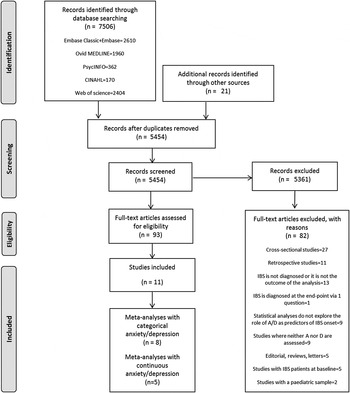
A total of 11 papers were included in this systematic review (see Fig. 1 for the flow diagram of systematic literature searches).
Flow diagram of systematic literature searches. IBS, Irritable bowel syndrome; A, anxiety; D, depression.

Overview of studies
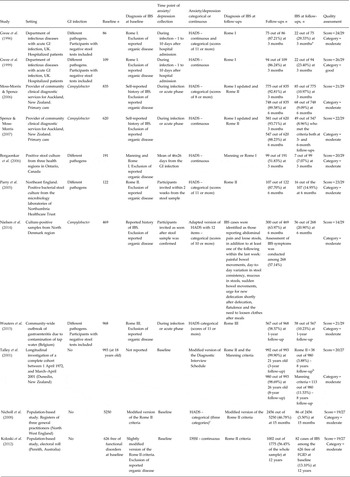
Of the 11 studies, eight recruited participants with a GI infection at baseline. From these eight studies, two recruited hospitalized patients. The remaining three were population-based studies (see Table 1 for details of the included studies and online Supplementary Appendix S4 for details of the baseline characteristics of the each study).
Characteristics of individual studies

GI, Gastrointestinal; IBS, irritable bowel syndrome; HADS, Hospital Anxiety and Depression Scale; DSSI, Delusion Symptom States Inventory; FGID, functional GI disorders.
a The incidence percentages for this review were calculated taking into account the number of participants who developed IBS at the endpoint out of the total number of participants who completed the follow-up questionnaire.
b This group includes those who met the Manning criteria as well.
c They converted the HADS scores into three categories based on the distribution of the participants’ score.
Assessment of anxiety and depression
Of the studies, nine used the Hospital Anxiety and Depression Scale (HADS; Zigmond & Snaith, Reference Zigmond and Snaith1983) at baseline to measure the levels of anxiety and depression (see details in Table 1). Nielsen et al. (Reference Nielsen, Engberg, Ejlertsen and Nielsen2014) used an adapted version of the HADS, which consisted of six depression-related items and six-anxiety related items. Each item score ranged between 0 and 3 and the overall score for each subscale ranged from 0 to 18. Table 1 shows the cut-off scores adopted in each study for cases of anxiety and depression. Koloski et al. (Reference Koloski, Jones, Kalantar, Weltman, Zaguirre and Talley2012) used 14 items from the Delusion Symptom States Inventory (class I, dysthymic disorders) to measure anxiety and depression (Bedford & Foulds, Reference Bedford and Foulds1977). Talley et al. (Reference Talley, Howell and Poulton2001) was the only study to use a defined mental health diagnosis using a modified version of the Diagnostic Interview Schedule (Robin et al. Reference Robin, Helzer, Goughan and Ratcliff1981).
Assessment of methodological quality
All the studies were of moderate quality except for Gwee et al. (Reference Gwee, Leong, Graham, McKendrick, Collins, Walters, Underwood and Read1999) which had good quality (see Table 1 and online Supplementary Appendix S5 for the detailed scores). The quality assessment found that some studies presented common limitations: they did not report enough information to determine the external validity of the study; they did not apply a rigorous assessment to exclude participants with IBS at baseline; they failed to conduct a power calculation; nor did they control adequately for potential confounders.
There was complete agreement between the two raters when scoring the items of the scale across studies except for minor discrepancies on two items: 7 (item 9 from the original scale) and 17 (adapted item for this review). Cohen's κ was 0.800 (s.e. = 0.186, p = 0.01) for item 7 and 0.831 (s.e. = 0.156, p = 0.000) for item 17, which indicated substantial agreement. The intraclass correlation coefficient of the adapted scale was 0.998 (95% CI 0.991–0.999, p = 0.000), which showed high reliability. After discussion, full agreement was reached between the two raters and minor wording amendments were implemented to item 17.
Quantitative synthesis findings
Anxiety – categorical
Seven studies were included in this meta-analysis with a total sample of 4810 subjects. Of these subjects, 325 developed IBS at the end point and 4485 did not develop IBS (see online Supplementary Appendix S6 for details of the data extracted from each study). The length of the follow-ups ranged from 3 months to 8 years with a median of 6 months. Five studies recruited participants with a GI infection (Gwee et al. Reference Gwee, Graham, McKendrick, Collins, Marshall, Walters and Read1996; Borgaonkar et al. Reference Borgaonkar, Ford, Marshall, Churchill and Collins2006; Moss-Morris & Spence, Reference Moss-Morris and Spence2006; Nielsen et al. Reference Nielsen, Engberg, Ejlertsen and Nielsen2014; Wouters et al. Reference Wouters, Van Wanrooy, Nguyen, Dooley, Aguilera-Lizarraga, Van Brabant, Garcia-Perez, Van Oudenhove, Van Ranst, Verhaegen, Liston and Boeckxstaens2015) and two were population-based studies (Talley et al. Reference Talley, Howell and Poulton2001; Nicholl et al. Reference Nicholl, Halder, Macfarlane, Thompson, O'Brien, Musleh and McBeth2008) (see Table 1 for characteristics of the included studies).
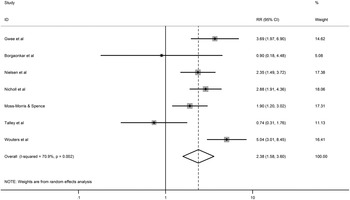
The overall risk of developing IBS at follow-up was more than double for those subjects who met the criteria of anxiety caseness at baseline compared with those who did not (RR 2.38, 95% CI 1.58–3.60). The I 2 showed moderate heterogeneity between studies (70.9%) (p = 0.002) (see Fig. 2 for the forest plot).
Forest plot: anxiety – categorical. RR, Relative risk; CI, confidence interval.

Fig. 2 shows that participants who met the criteria for anxiety caseness at baseline in the Wouters et al. (Reference Wouters, Van Wanrooy, Nguyen, Dooley, Aguilera-Lizarraga, Van Brabant, Garcia-Perez, Van Oudenhove, Van Ranst, Verhaegen, Liston and Boeckxstaens2015) study had five times the risk of developing IBS at the end point (RR 5.04, 95% CI 3.01–8.45). Interestingly, this is the only study that recruited participants during or soon after an epidemic outbreak of infectious gastroenteritis. The inhabitants were informed about being exposed to the contaminated water by the local authorities, which may have increased the anxiety levels of this specific sample during the recruitment phase. Furthermore, the Gwee et al. (Reference Gwee, Graham, McKendrick, Collins, Marshall, Walters and Read1996) study showed the second highest risk of developing IBS (RR 3.69, 95% CI 1.97–6.90). Participants were recruited whilst hospitalized due to a GI infection and this may be the reason for the higher risk compared with most studies.
In contrast to the overall effect, two studies found that anxiety decreased the risk of IBS although these results were not statistically significant. Talley et al. (Reference Talley, Howell and Poulton2001) showed a 26% reduced risk of developing IBS for the baseline anxiety cases (RR 0.74, 95% CI 0.31–1.76). This is the only study that used an adapted clinical structured interview schedule to assess anxiety disorders and very long-term follow-up of 8 years. However, this study did not report if they excluded individuals with IBS at baseline. Borgaonkar et al. (Reference Borgaonkar, Ford, Marshall, Churchill and Collins2006) showed a 10% decreased risk of IBS onset for those participants with anxiety caseness at baseline (RR 0.90, 95% CI 0.18–4.48). In terms of the methodology, the mean time between the GI infection and the baseline measurements of anxiety was 46 ± 26 days. This suggests that for some participants anxiety was measured post-infection rather than at baseline.
Sensitivity analysis
We conducted the same meta-analysis for anxiety – categorical excluding Talley et al. (Reference Talley, Howell and Poulton2001) (Rome criteria, episodic anxiety), as the methodology and follow-up period were distinctly different from the other studies. The effect of anxiety was slightly stronger (RR 2.80, 95% CI 1.99–3.94). According to the I 2, the heterogeneity between studies dropped from 70.9 to 56% (moderate heterogeneity) (p = 0.045).
We also conducted the same meta-analysis excluding Borgaonkar et al. (Reference Borgaonkar, Ford, Marshall, Churchill and Collins2006) as some of their participants completed the baseline measures post-infection. The RR of anxiety was slightly stronger (RR 2.51, 95% CI 1.66–3.82) and the heterogeneity remained practically stable (73.3%, p = 0.002).
In summary, our meta-analysis showed that the overall risk of developing IBS at follow-up was double for those subjects who met the criteria for anxiety caseness at baseline compared with those who did not. The different sensitivity analyses showed similar findings.
Depression – categorical
In all, eight studies were included in this meta-analysis with a total sample of 5007 subjects. From these, 342 developed IBS at the end point and 4665 did not develop IBS. See online Supplementary Appendix S7 for details of the data extracted. The length of the follow-up ranged from 3 months to 8 years, with a median of 6 months. Six studies recruited participants with a GI infection (Gwee et al. Reference Gwee, Graham, McKendrick, Collins, Marshall, Walters and Read1996; Parry et al. Reference Parry, Barton and Welfare2005; Borgaonkar et al. Reference Borgaonkar, Ford, Marshall, Churchill and Collins2006; Moss-Morris & Spence, Reference Moss-Morris and Spence2006; Nielsen et al. Reference Nielsen, Engberg, Ejlertsen and Nielsen2014; Wouters et al. Reference Wouters, Van Wanrooy, Nguyen, Dooley, Aguilera-Lizarraga, Van Brabant, Garcia-Perez, Van Oudenhove, Van Ranst, Verhaegen, Liston and Boeckxstaens2015) and two were population-based studies (Talley et al. Reference Talley, Howell and Poulton2001; Nicholl et al. Reference Nicholl, Halder, Macfarlane, Thompson, O'Brien, Musleh and McBeth2008) (see Table 1 for characteristics of the included studies).
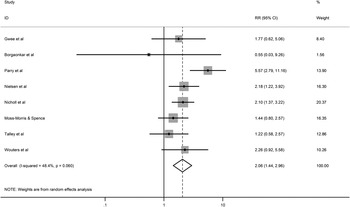
The overall risk of developing IBS at follow-up was double for those subjects who met the criteria for depression caseness at baseline compared with those who did not (RR 2.06, 95% CI 1.44–2.96). The I 2 showed low heterogeneity between studies (48.40%) (p = 0.06) (see Fig. 3 for the forest plot).
Forest plot: depression – categorical. RR, Relative risk; CI, confidence interval.

As shown in Fig. 3, the baseline depression cases in Parry et al. (Reference Parry, Barton and Welfare2005) presented almost six times the risk of developing IBS (RR 5.57, 95% CI 2.79–11.16). This very high risk is probably due to the fact that 2 out of 2 participants with depression caseness at baseline developed IBS at the endpoint compared with 14 out of 96 in the non-depression group.
On the other hand, in Borgaonkar et al. (Reference Borgaonkar, Ford, Marshall, Churchill and Collins2006), the participants who met the criteria for depression caseness at baseline had their risk of developing IBS reduced by 45% (RR 0.55, 95% CI 0.03–9.26) although this was not statistically significant. The wide CIs are probably explained by the fact that 0 out of the 16 depression cases at baseline developed IBS. As described above, the measurements of baseline depression were collected post-infection for some participants.
Sensitivity analysis
We conducted the same meta-analysis for depression – categorical excluding Talley et al. (Reference Talley, Howell and Poulton2001) (Rome criteria, episodic depression). The effect of depression was slightly stronger (RR 2.23, 95% CI 1.53–3.26). However, the heterogeneity remained practically stable from 48.4 to 46.1% (p = 0.085). The aforementioned drop in I 2 for anxiety was due to the non-overlap of the CI for the Talley study with the pooled effect. However, the CI does overlap for depression and this is why the I 2 percentage does not change.
We conducted the same meta-analysis excluding Parry et al. (Reference Parry, Barton and Welfare2005). The pooled RR still shows that depression is a predictor of IBS onset (RR 1.82, 95% CI 1.41–2.35). More importantly, the I 2 drops from 48.4 to 0% (p = 0.739).
We also conducted the same meta-analysis excluding Borgaonkar et al. (Reference Borgaonkar, Ford, Marshall, Churchill and Collins2006) as some of their participants completed the baseline measures post-infection. The RR of depression remained practically stable (RR 2.11, 95% CI 1.46–3.04) as well as the heterogeneity (52.2%, p = 0.051).
In summary, our meta-analysis showed that the overall risk of developing IBS at follow-up was double for those subjects who met the criteria for depression caseness at baseline compared with those who did not. The different sensitivity analyses showed similar findings.
Anxiety – continuous
In all, five studies provided continuous data for anxiety. The Koloski et al. (Reference Koloski, Jones, Kalantar, Weltman, Zaguirre and Talley2012) study was the only one not included in the previous meta-analyses where anxiety and depression were treated as categorical variables (see online Supplementary Appendix S8 for details of the data extracted and the forest plot). The results showed that there was a moderate effect of baseline anxiety as a predictor of IBS onset at follow-up. The pooled standardized mean difference was 0.62 (95% CI 0.39–0.84). The I 2 (51.00%) showed moderate heterogeneity between studies (p = 0.09).
Depression – continuous
A total of four studies provided continuous data for depression (see online Supplementary Appendix S9 for details of the data extracted and the forest plot). The results showed that there was a small effect of baseline depression as a predictor of IBS onset at follow-up. The pooled standardized mean difference was 0.32 (95% CI 0.16–0.47). The I 2 (7.6%) showed low heterogeneity between studies (p = 0.36).
Subgroup analyses
GI infection v. non-GI infection
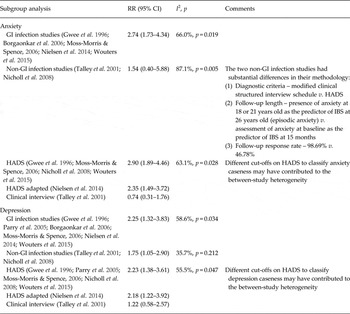
For both anxiety and depression, the risk of developing IBS was higher in those studies that recruited individuals with a GI infection at baseline compared with population-based studies (see Table 2 for detailed results). These results may be affected by the methodological differences of one of the non-GI infection studies (Talley et al. Reference Talley, Howell and Poulton2001), such as the use of a clinical structured interview to diagnose anxiety/depression and a longer follow-up length.
Results of subgroup analyses for both anxiety and depression

RR, Relative risk; CI, confidence interval; GI, gastrointestinal; HADS, Hospital Anxiety and Depression Scale; IBS, irritable bowel syndrome.
Type of anxiety/depression assessment
For both anxiety and depression, the risk of developing IBS was estimated to be higher when pooling studies that used the HADS compared with the one study that used a clinical diagnostic interview schedule (see Table 2 for detailed results). While this difference is not statistically reliable, it does suggest an interesting avenue for future research.
Type of IBS diagnostic criteria and follow-up length
Our subgroup analyses did not show clear patterns in terms of the IBS diagnostic criteria (Rome v. non-Rome) and length of the follow-ups (see online Supplementary Appendices S10 and S11 for forest plots).
Publication bias
Based on the funnel plots and the non-significant Egger test results for both anxiety (p = 0.278) and depression (p = 0.339), we concluded that there were no small-study effects (see online Supplementary Appendices S12 and S13 for detailed results).
Discussion
The main purpose of this systematic review was to ascertain whether prior anxiety and/or depression raise the risk of developing IBS.
Summary of results
Our meta-analyses showed that the overall risk of developing IBS at follow-up was double for those subjects who met the criteria for anxiety caseness at baseline compared with those who did not, with similar results for those subjects who were depression cases at baseline.
When treated as continuous variables, the results showed that there was a moderate effect of baseline anxiety and a small effect of baseline depression as predictors of IBS onset at follow-up. However, these two analyses included five and four studies, respectively, and the results are only exploratory.
The subgroup analyses for anxiety and depression treated as categorical variables showed two findings: (1) for both anxiety and depression, the risk of developing IBS was higher in those studies that recruited individuals with a GI infection at baseline and (2) for both anxiety and depression, the risk of developing IBS was higher in those studies that used the HADS compared with the one study that used a clinical diagnostic interview; however, this comparison between one study and the rest is not statistically reliable and needs to be confirmed in further studies using a psychiatric diagnosis.
PI-IBS v. non-PI-IBS cohorts
Our subgroup analyses suggested that both anxiety and depression played a stronger role in the onset of IBS in individuals with a GI infection at baseline compared with population-based studies. This could be attributed to other differences in methodology such as use of diagnostic interviews rather than self-report measures of depression and anxiety. However, it is possible that psychological factors have either a direct or indirect effect on the pathophysiology of PI-IBS. Wouters et al. (Reference Wouters, Van Wanrooy, Nguyen, Dooley, Aguilera-Lizarraga, Van Brabant, Garcia-Perez, Van Oudenhove, Van Ranst, Verhaegen, Liston and Boeckxstaens2015) proposed that anxiety may raise the risk of PI-IBS by directly increasing the susceptibility to develop a GI infection. Future research should move beyond animal models and explore the neurobiological mechanisms of the potential effects of depressive and anxious mood in the development of PI-IBS.
It could also be argued that the severity of the infection may cause or aggravate distress during the gastroenteritis. Nevertheless, these results are relevant as they suggest that those individuals who present with anxious or depressive mood during a GI infection are at increased risk of developing PI-IBS at a future time point. Therefore, the identification of these risk factors during the acute phase may be important to decrease the chances of developing IBS in a specific group of patients. Though most of the included studies had GI samples, this does not rule out that psychological distress plays a role in IBS more generally. Our meta-analyses showed that baseline anxiety and depression were risk factors of IBS onset at a future time point in two out of three population-based studies (Nicholl et al. Reference Nicholl, Halder, Macfarlane, Thompson, O'Brien, Musleh and McBeth2008; Koloski et al. Reference Koloski, Jones, Kalantar, Weltman, Zaguirre and Talley2012) (See Figs 2 and 3 and online Supplementary Appendices S8 and S9 for detailed results). The only study that found conflicting results for anxiety presented substantial methodological differences: a psychiatric diagnosis of anxiety/depression was used and it was not specified whether participants with IBS were excluded at baseline (Talley et al. Reference Talley, Howell and Poulton2001). Thus, future cohort studies should assess anxiety and depression through psychiatric diagnostic criteria as well and implement strict exclusion/inclusion criteria in order to confirm the role of anxiety/depression as risk factors in IBS (not PI-IBS).
Psychological distress v. psychiatric diagnosis
Of the 11 studies included in this review, nine used the HADS to measure anxiety and depression levels (see Table 1 for details). Norton et al. (Reference Norton, Cosco, Doyle, Done and Sacker2013) found that, even though the HADS addresses the concepts of autonomic arousal (anxiety) and anhedonia (depression), it has a general psychological distress factor which represents a shared variance between symptoms of depression and anxiety. This suggests that the HADS should be best used as a total score measuring general psychological distress rather than two separate precise measures of anxiety and depression.
In relation to our meta-analyses data, this suggests that generalized psychological distress is a predictor of IBS onset rather than specific diagnoses of anxiety and depression. Indeed, the mean and standard deviation of the HAD anxiety and depression subscales of the included studies were within normal or borderline abnormal ranges (see online Supplementary Appendix S14 for figures).
These findings highlight the potential importance of psychological distress, rather than psychopathology per se, in the development of IBS. Recent studies have attempted to explain the possible pathophysiological mechanisms linking distress to IBS through dysregulation of the brain–gut axis (Mayer & Tillisch, Reference Mayer and Tillisch2011). The autonomic nervous system response to stress or distress includes the release of corticotrophin-releasing factor (CRF) via the hypothalamic–pituitary–adrenal axis, which can (1) stimulate colonic motility via CRF1 receptors, (2) increase the activation of mast cells in the colonic mucosa, which in turn can enhance both abdominal pain and mucosal permeability and (3) promote low-grade inflammation/immune activation via cytokine stimulation, particularly during a GI infection (Spiller & Lam, Reference Spiller and Lam2012; Stasi et al. Reference Stasi, Rosselli, Bellini, Laffi and Milani2012). Thus, psychosocial distress can directly or indirectly affect motility, abdominal pain, secretion and immune function of the bowels as well as the perception of visceral stimuli.
Future research should focus on the neurobiological mechanisms underlying IBS onset and the potential role that abnormalities in central pain processing and cognitive functioning play in IBS onset as these are mediated by anxiety and depression (Kennedy et al. Reference Kennedy, Clarke, Quigley, Groeger, Dinan and Cryan2012).
Anxiety and depression alongside other risk factors
Although our meta-analysis findings suggest that anxiety and depression are significant risk factors for IBS (i.e. twofold increased risk), many of the included studies found that anxiety and depression were only two of a range of risk factors increasing the chances of developing IBS. Several of these studies explored the roles of other psychological factors including life events, perceived stress, negative illness beliefs, somatization (tendency to report general somatic symptoms), hypochondriasis, illness behaviours (characterized mainly by avoidance behaviours, health-seeking behaviours and all-or-nothing behaviours) in the onset of IBS (Gwee et al. Reference Gwee, Leong, Graham, McKendrick, Collins, Walters, Underwood and Read1999; Parry et al. Reference Parry, Barton and Welfare2005; Borgaonkar et al. Reference Borgaonkar, Ford, Marshall, Churchill and Collins2006; Moss-Morris & Spence, Reference Moss-Morris and Spence2006; Spence & Moss-Morris, Reference Spence and Moss-Morris2007; Nicholl et al. Reference Nicholl, Halder, Macfarlane, Thompson, O'Brien, Musleh and McBeth2008; Wouters et al. Reference Wouters, Van Wanrooy, Nguyen, Dooley, Aguilera-Lizarraga, Van Brabant, Garcia-Perez, Van Oudenhove, Van Ranst, Verhaegen, Liston and Boeckxstaens2015). There was insufficient commonality across studies to incorporate these within a meta-analysis. However, it is worth noting that in multivariate analyses considering anxiety and depression alongside these factors as well as biological factors, distressed mood was only one of many risk factors for IBS. In some instances, the significant relationship between anxiety and depression and IBS onset disappeared (Gwee et al. Reference Gwee, Leong, Graham, McKendrick, Collins, Walters, Underwood and Read1999; Borgaonkar et al. Reference Borgaonkar, Ford, Marshall, Churchill and Collins2006; Nicholl et al. Reference Nicholl, Halder, Macfarlane, Thompson, O'Brien, Musleh and McBeth2008; Wouters et al. Reference Wouters, Van Wanrooy, Nguyen, Dooley, Aguilera-Lizarraga, Van Brabant, Garcia-Perez, Van Oudenhove, Van Ranst, Verhaegen, Liston and Boeckxstaens2015).
Of the included studies, one found that exposure to two or more of the following factors identified 80.2% of all participants developing IBS: scoring in the highest third of the HAD anxiety subscale and Estimated Sleep Problems Scale, and in the highest two-thirds of the Somatic Symptoms Checklist and Illness Behaviour Scale (Nicholl et al. Reference Nicholl, Halder, Macfarlane, Thompson, O'Brien, Musleh and McBeth2008). Taken together, these findings argue against a simple somatization hypothesis, and highlight that multiple factors in addition to baseline distress influence the development of IBS.
These findings are in line with the biopsychosocial model, which suggests that genetics and environmental factors in early life may predispose to IBS and that cognitive, behavioural, emotional and biological/physiological factors (including GI infection) interact to precipitate and perpetuate symptoms and contribute to disability (Engel, Reference Engel1980).
Implications for future studies
In order to understand in more depth the role of anxiety and depression in IBS onset, it is essential to conduct more prospective studies with individuals free of IBS at baseline with large sample sizes ensuring a rigorous and standardized assessment of: (1) IBS at baseline (to exclude participants with IBS) and at the endpoint; (2) psychological distress and psychiatric diagnosis of anxiety/depression; (3) a well-defined multifactorial set of biopsychosocial predictors, which are tied in with specific theories of IBS aetiology. Furthermore, several long-term follow-ups across the same sample would help to determine the incidence and prevalence of IBS within the same cohort at different time points, as well as help to distinguish between factors that predispose or precipitate the condition and those that perpetuate the symptoms. The clinical exclusion of organic diseases through adequate medical tests and assessments would also strengthen the methodological quality of research.
Out of the 11 included studies, eight were conducted with individuals with a GI infection and our findings may be more representative of PI-IBS and the IBS diarrhoea subtype. Ideally, future longitudinal studies would measure anxiety and depression before GI infection onset in order to explore their role as risk factors of PI-IBS rather than possible co-morbidities that arise due to the presence of GI symptoms. However, studies such as these are extremely costly as they rely on broad population-based samples. For those recruiting a GI infectious cohort, anxiety and depression should be assessed as closely as possible to the GI infection onset or during the acute phase. As some studies included in this review reported that the mean duration of acute symptoms ranged between 7.3 and 12.4 days from onset in the group that developed IBS, baseline assessments should ideally be conducted within this 1- to 3-week window. More population-based studies are needed to confirm the role of anxiety and depression as predictors of IBS onset in non PI-IBS.
Implications for clinical practice
Promoting awareness about the potential role that anxiety and depression (or general distress) have on the development of IBS, in combination with biological factors and unhelpful illness cognitions and behaviours, may help to reduce the incidence of IBS onset in high-risk individuals (e.g. severe symptoms during a gastroenteritis, chronic abdominal pain, recent adverse life events).
Although the results suggest that targeting distress in early interventions may be helpful, psychotherapies that are designed to target primary anxiety and depressive disorders may not be the best treatments for IBS. Rather, treatments should focus on a range of factors which may perpetuate the syndrome including IBS-related beliefs and coping behaviours, alongside negative mood. The language used by clinicians and health professionals to promote preventative psychological interventions would benefit from incorporating the notion that although distress (feeling anxious and/or depressed) increases the risk of developing IBS, this does not suggest that patients have a mental health disorder rather than IBS. Distress, rather than psychopathology itself, seems to play a role in IBS onset and is one of a group of biopsychosocial risk factors which will be more or less significant in different individuals. Providing clear information to patients about the pathophysiological link between stress, anxiety, depression and the function of the bowel could improve the acceptance of behaviourally based treatments to prevent IBS, both amongst health professionals and patients.
Finally, better knowledge of the role of distress in IBS onset may have a positive impact on the way that clinicians explain the illness to patients when they are diagnosed, improving their understanding and acceptance of the condition, especially in those patients who perceive IBS as the sole result of psychological factors.
Strengths and limitations
Several measures were taken to improve the reliability of the systematic processes of this meta-analytic review. First, two authors conducted the electronic searches and assessed the abstracts and full-text articles independently against the inclusion criteria. Second, data extraction was conducted independently by two authors. Finally, the quality of the studies was assessed by two authors and an inter-rater reliability score was calculated.
We evaluated the methodological quality of the included studies using an adapted version of a reliable tool for observational studies. Tailoring the quality assessment tool is advised in the Cochrane handbook (Higgins & Green, Reference Higgins and Green2011) to best address the research aims of each systematic review. However, we cannot claim that the adapted tool is valid even if the inter-rater score showed high reliability. Furthermore, we cannot assume that each subscale contributes a similar weight to the overall quality of the studies.
Conclusions
To our knowledge, this is the first systematic review with meta-analysis that explored the role of anxiety and depression in the development of IBS using longitudinal studies with good-quality designs. The findings suggest that anxious and depressed mood provide a twofold risk for the onset of IBS. There is less support for the role of a definitive diagnosis of an anxiety or depressive disorder. Although anxiety and depression were found to be risk factors of IBS onset, the findings suggest that they are not univariate causes of IBS.
These findings may have implications for the development of interventions focused on IBS prevention and treatment. The role of negative affect should be considered alongside other psychological, behavioural and biological factors.
Supplementary material
The supplementary material for this article can be found at http://dx.doi.org/10.1017/S0033291716001987
Acknowledgements
We are particularly grateful to Dr Sam Norton for his valuable statistical advice.
T.C. receives salary support from the National Institute for Health Research (NIHR) Mental Health Biomedical Research Centre at South London and Maudsley NHS Foundation Trust and King's College London. The views expressed in this article are those of the authors and not necessarily those of the NIHR or the National Health Service.
This research received no specific grant from any funding agency, commercial or not-for-profit sector.
Declaration of Interest
One of the authors of this review (R.M.-M.) was involved with two of the included papers (one used in the meta-analysis of anxiety/depression treated as categorical variables and the other one included in the meta-analysis of anxiety/depression treated as continuous variables). However, all the statistical analyses were conducted independently by A.S. Five authors (A.S., R.M.-M., T.C., H.E., S.W.) are currently working on a randomized controlled trial assessing the clinical and cost effectiveness of cognitive–behavioural therapy in refractory IBS funded by the Health Technology Assessment (HTA) Programme. No other conflicts of interest are declared.