Introduction
Thanks to the seminal contribution of North and Weingast (Reference North and Weingast1989), the “Glorious” Revolution of 1688 is widely considered an institutional watershed in political history.Footnote 1 North and Weingast contend that, in sweeping away royal absolutism in favor of constitutional monarchy, the new parliamentary regime committed itself to “responsible” behavior that benefited the British people economically and politically. They provide a number of reasons for this. Regular Parliaments allowed a “natural diversity” of views to contend in policy formulation. Because government required the cooperation of the Crown and Parliament, pluralism restrained the supply of private benefits at public cost and safeguarded society from tyranny. The victorious Whig coalition imposed limited government and respect for the integrity of property rights on the Crown. Finally, a politically independent judiciary checked potential abuses by Parliament. Combined, these factors allowed North and Weingast to credit the revolution with restraining governmental abuses, establishing commitments to protect individual rights, and preparing the groundwork for a secularized state. Hence, the “first modern revolution” gains credit for laying the foundation for a secular, capitalist society governed by the rule of law (see also Pincus Reference Pincus2009).
Nevertheless, did the revolution really prevent the new regime from abusing its power, thereby paving the way for the general advance of British liberty? The “Whig interpretation” of history views the progression of British constitutionalism as the triumph of liberty, political consensus, and enlightenment (Butterfield Reference Butterfield1931). For generations the “Glorious” Revolution loomed large in that view of history but today that interpretation lies in tatters.Footnote 2 Despite having foresworn the teleological assumptions of the old school of thought, we contend that prevailing interpretations of the revolution informed by North and Weingast may still be too Whiggish.Footnote 3 Specifically, we challenge the widespread claim that the revolution unleashed a progressive secularization of the state resulting in freedom for religious minorities.
In making our argument, we take a “Three Kingdoms” perspective that, unlike North and Weingast, does not focus only on England when considering the political development of Britain but rather takes account of its composite monarchy (Harris Reference Harris1993, Reference Harris2006; Pincus Reference Pincus2009; Pocock Reference Pocock2005). We consider the implications of the revolution not only in terms of its putative benefits for England but also in terms of its consequences in the other two kingdoms that changed hands because of the ouster of James II (James VII in Scotland).
We show that the history of the Revolution of 1688 is more consistent with straightforward and parsimonious political selectorate theory (Bueno de Mesquita et al. Reference Bueno de Mesquita, Smith, Siverson and Morrow2003) than it is with the North and Weingast thesis. We further show that the depiction of Britain as secularizing polity that extended religious liberties because of the revolution is unsustainable. Rather than generally repressing what North and Weingast deem “irresponsible” (meaning injurious to the public good) governmental behavior in the critical domain of religious politics, we argue that the consequences of the revolution depended largely on which side of the Jacobite-Williamite conflict a group stood on during the events of 1688–91. Whereas groups that were part of the winning Williamite coalition reaped the rewards of victory, those that were on the losing Jacobite (after Jacobus, the Latinized from of James) side could count on little protection. They were in jeopardy of oppression at the hands of the new regime and its allies (see, e.g., Clark Reference Clark2000, Reference Clark2012; Harris Reference Harris1993, Reference Harris1999, Reference Harris2006; Miller Reference Miller1997; Raffe Reference Raffe2010a, Reference Raffe2010b, Reference Raffe2018; Stephen Reference Stephen2010). This was “irresponsible” policy not only because it infringed on individual liberty but also because it stirred grievances that fueled decades of political instability and repeated Jacobite insurrections against the state.
To evaluate our argument, we examine whether the revolution imposed constraints that advanced religious liberty. We focus on legislation governing religion in Scotland (first through the Scots Parliament and, after Union, in the British Parliament). The Scottish case shines light on three components of the debate surrounding the North and Weingast thesis that have received limited attention. The first concerns the central role of religion in the revolutionary crisis and the formation of a winning coalition. The second concerns the reestablishment of a Presbyterian monopoly and the lack of parliamentary restraint on religious persecution of its rivals. The third is that, rather than fostering consensus, the revolution fostered religious oppression that helped destabilize British politics for decades after 1688.
Whereas some may insist on limiting one’s perspective on the consequences of the revolution to the English case, politics in Britain took place in the context of its Three Kingdoms during this period. Politics in England influenced her neighbors, but politics in Scotland and Ireland also influenced English political development. Scotland was a religious battleground in the politics of the late Stuart era, which repeatedly spilled over into English politics. Scotland, of course, was a separate kingdom with its own parliament but it was increasingly entangled with England after the Stuart dynasty assumed the English throne in 1603. After the fall of James II/VII in 1688, William and Mary ruled it as a separate kingdom. After the union in 1707, Scotland joined the United Kingdom and her representatives sat in the British Parliament in Westminster. Across these periods, religious contention was militant and politically destabilizing.
Ironically, James II/VII’s policies attempted to defang religion politically but they generated instability and popular unrest that cost him his throne. After the revolution, religious politics remained militant and politically destabilizing, however. This is because the revolution instituted rules that favored particular groups (e.g., Protestant Dissenters, Presbyterians, Irish Protestants) and protected the interests of the established churches. That is very different from the putative advance of secularism and religious liberty hailed by many social scientists. In the Scottish case, the Crown suppressed the Scottish Presbyterians in favor of the Episcopalians prior to the revolution. After 1688, the winning Williamite coalition reinstated a militant Presbyterian monopolism in the established Scottish Church (or Kirk).
To prove our argument, we present narrative evidence concerning the politics of the revolution and its consequences. We also present a systematic examination of ecclesiastical legislation concerning Scotland introduced by the dominant rulers (Crown or Parliament) from 1560 (introduction of episcopacy) to 1864 (equal treatment to Episcopalians and Presbyterians) in the Scots, and after 1707, British Parliament. Our analysis shows that the revolution was not an institutional watershed in the context of religion or religious liberty. Legislation was religiously biased before the revolution and remained so after it.
Moreover, we show that political secularization, that is, the depoliticization of religion, elimination of identity rules that limited participation in the state, and the transition toward equitable treatment of religious groups under law, came about much later than the prevailing consensus around the revolution’s institutional consequences would suggest. Rather than the institutions arising out of the revolution, the final exhaustion of Jacobitism as a political movement, Presbyterian factionalism, and franchise extensions increasing the political representation of religious minorities worked together to secularize Britain. These transformations compelled Parliament to enact legislation reducing restrictions on excluded religious groups.
The North and Weingast Thesis Revisited
We are not alone in criticizing the North and Weingast thesis. Many scholars claim that they have misspecified mechanisms in their account of institutional transformation and Britain’s economic prosperity (Carruthers Reference Carruthers1990; Cox Reference Cox2012, Reference Cox2018; Ogilvie and Carus Reference Ogilvie, Carus, Aghion and Durlauf2014; Pincus and Robinson Reference Pincus, Robinson, Galiani and Sened2014; Stasavage Reference Stasavage2002). Against one of their central claims, some critics argued that property rights were secure before 1688. Others point toward the underlying power equilibrium in England as a source of the credible commitment to limit government and respect property rights. As Bas van Bavel (Reference Van Bavel2016: 214) notes of the current consensus among economic historians, “the Glorious Revolution, the growing security of property rights, and the growth of the capital market all were part of a much broader and more gradual process, starting at least in the sixteenth century.”
Nevertheless, much of the recent scholarship shares the notion that, by increasing parliamentary power, the revolution opened the way for political secularization and religious freedom. Although Greif and Rubin (Reference Greif and Rubin2015) rightly argue that religion was as the heart of the politics behind the revolution, they claim that government secularized after 1688. The revolution cemented a transition by which the British state shifted from sacred claims to authority to the rule of law and parliamentary consent in staking its legitimacy (Rubin Reference Rubin2017). This change advanced the country toward secularism and democracy. Gill (Reference Gill2008: 89) hails the Toleration Act of 1689 as a “milestone” in the history of religious liberty because it reduced religious conflict in favor of pragmatic considerations. Johnson and Koyama (Reference Johnson and Koyama2019: 174–79) see the revolution as a major step toward the reduction of religious influence in government and the triumph of general rules over older sectarian “identity rules.”
In short, despite criticism of many of North and Weingast’s (Reference North and Weingast1989) arguments, the claim that religious liberties advanced because of the revolution of 1688 is largely uncontested. However, a major flaw in North and Weingast’s original thesis is that the revolution had its moderate outcome because of a new elite consensus on limited government, capitalism, and the secularization of politics. The revolution was a happy child born of an “elite pact” that conspired to solve England’s financial difficulties, apply “appropriate” constraints on the Crown, and end religious conflict by deposing Stuart absolutism in favor of the limited monarchy of William and Mary. In establishing a credible threat to depose future monarchs who might indulge in “irresponsible behavior” in religious affairs, the Whig revolutionaries ensured the protection of personal liberties and instituted the stability and order that allowed the economy to thrive.
The political history of revolution does not support the driving role of elite consensus in its coming or its settlement. In spite of his sharing North and Weingast’s view that the fall of James II/VII had revolutionary implications for British political economy, historian Steve Pincus (Reference Pincus2009: 369) boldly states that, “The events of 1688–89 produced neither ideological nor political consensus.” Rather, the current consensus is that the revolution was the result of a bitter political conflict between opposing the parties and confessional groups that we coalesced into rival Jacobite and Williamite coalitions, formations that influenced the shape of the British polity for decades (Harris Reference Harris2006; Harris and Taylor Reference Harris and Taylor2013; Pincus Reference Pincus2009; Raffe Reference Raffe2018).
Although the new regime of William and Mary promised to protect the rights of Catholics in England and Ireland and the Episcopalians in Scotland, these commitments proved hollow. The new limited monarchy failed to persuade parliaments to pass substantial legislation protecting disfavored groups because the regime excluded these groups from the winning Williamite coalition (Raffe Reference Raffe2012). Parliaments did not commit to protect those outside of the established churches in the Three Kingdoms, save for dissenting Trinitarian Protestants in England, who received partial toleration by Parliamentary action as a reward for supporting the Williamite coup d’état in 1688. The Scots Parliament, dominated by Presbyterian radicals, rebuffed all William’s requests to relieve the oppressed Episcopalians. The Irish Parliament, dominated by vengeful Anglo Protestants, was punitively disposed toward the defeated Catholics.
The distinction between consensus and conflict matters because religion was the central issue in British politics before and after the revolution. Religious interests and identities created the most significant social cleavages in seventeenth- and eighteenth-century politics (Harris Reference Harris1993; Harris and Taylor Reference Harris and Taylor2013; Raffe Reference Raffe2018). The new power equilibrium brought forward by the Williamite coalition favored the Whig politicians, overseas merchants, and the commercial and banking interests celebrated by North and Weingast (Pincus Reference Pincus2009). It also favored its clients in the established Churches of England and Ireland, as well as the reestablished Presbyterian monopoly in the Church of Scotland (or Kirk). Generally speaking, in the settlement that followed the revolution those churches and sects that were part of the winning Williamite coalition, including Anglican Tory defectors from James II/VII, Protestant Dissenters, Irish Protestants, and Scottish Presbyterians, improved their position and enhanced their public influence. A host of restrictions and disabilities fell upon on the losers, including English Catholics, Stuart Loyalists, non-Trinitarian believers in England, Episcopalians and Dissenting Protestants in Scotland, and the Catholic majority and Dissenters in Ireland (Harris Reference Harris1993, Reference Harris2006; Miller Reference Miller1997; Raffe Reference Raffe2010a, Reference Raffe2010b, Reference Raffe2018; Stephen Reference Stephen2010).
Moreover, although the Williamite regime after 1688 increased parliamentary power at the expense of the Crown, it also relied on an alliance with state-established churches, as was the case with all of the later Stuart rulers and the Hanoverians (Clark Reference Clark2000, Reference Clark2012; Harris Reference Harris1993, Reference Harris1999, Reference Harris2006; Hempton Reference Hempton1996). Whereas some Protestant sects in England gained qualified toleration, the established churches were the great material beneficiaries of parliamentary rule: between 1688 and 1801, the real incomes of the highest officials (lords) of the Church of England nearly doubled (Greif and Rubin Reference Greif and Rubin2015: 13). In Scotland, the new regime benefited radical Presbyterians, who had been forceful opponents of Stuart religious policies, helped to overthrow Charles I, and abolished the episcopacy. Losers in the Restoration settlement that unseated them and restored episcopacy, they eagerly joined the Williamite coalition and backed the overthrow and exile of James II/VII, despite his efforts to court their support, in favor of the Protestant joint monarchy of William III and Mary II.
The new regime established a Presbyterian Kirk by act of the Scottish Parliament. Bishops were deposed and more than two hundred Episcopalian ministers were expelled, some of them by legislation, whereas others were purged by radical mobs (Raffe Reference Raffe2018; Stephen Reference Stephen2010). Ultimately, more than two-thirds of Episcopalian ministers were purged from the Kirk between 1689 and 1716, regardless of whether they were willing to swear an oath of allegiance to the new regime (Strong Reference Strong2002: 11). Although Presbyterian oppression was checked by Episcopal relief legislation after the Union of 1707, for a long time afterward a militant Calvinist ideology backed by Whig power continued to dominate Scottish politics and society and to suppress Episcopalianism (Raffe Reference Raffe2010b, Reference Raffe2012). If anything, the situation in Ireland was far worse. In that kingdom an Anglo “Protestant ascendancy,” backed by an established church, deprived the country’s majority consisting of Catholics and Dissenting Protestants of civil liberties for a century or more. The resulting grievances and unhealed social cleavages inspired ongoing unrest and repeated episodes of armed rebellions for decades after the revolutionary settlement in 1690 (Harris Reference Harris2006).
The Revolution of 1688 and the Logic of Winning Coalitions
Selectorate theory (Bueno de Mesquita et al. Reference Bueno de Mesquita, Smith, Siverson and Morrow2003) provides a firmer and more straightforward understanding of revolutionary situations like that of 1688–91 and their outcomes than does the North and Weingast model. In any given regime, rulers have a variety of motives, including the country’s welfare, national glory, personal aggrandizement, and so on, but all are attentive to political survival. To remain in power, they must satisfy at least part of the “selectorate,” those members of the polity who have a say in choosing leaders and a reasonable prospect of gaining access to the power and privileges in return. The “winning coalition” that backs an established regime is the subgroup of the selectorate that maintains the incumbent in power and, in exchange, receives benefits and preferment. Because political survival is foremost, every ruler wants a stable and secure winning coalition. Whereas having a very broad coalition might favor an incumbent, coalitions come at the cost of rewarding supporters. Leaders thus tend to prefer a minimum winning coalition—large enough to gain and remain in power but no larger—because coalition size determines the price that must be paid to maintain it.
In the late Stuart monarchy, the selectorate comprised the nobility, the gentry, the prelacy (high-ranking clerics in the established churches), and wealthy commercial interests (for description of the late Stuart polity, see Harris Reference Harris1993, Reference Harris2006 and Pincus Reference Pincus2009). A factor complicating the construction of winning coalitions in this era was the confessional divides that cut across the selectorate, pitting high church Protestants against Catholics, on the one side, and Dissenting Protestant sects against the establishment, on the other.Footnote 4 Confessional identities also shaped party politics. After the Stuart Restoration, the Whigs and the Tories defined an emerging party system. To simplify, Whigs stood for a limited monarchy and fierce anti-Catholicism, framed in terms of their hatred for “popery” at home and abroad. The Tories positioned themselves as loyal supporters of the Crown, centralized power, and the legitimacy of the Stuart restoration. The Tories were also fierce defenders of the Anglican Church establishment and its privileges.
Following the Stuart Restoration in 1660, Charles II and his successor James II/VII relied on a coalition that included the Anglican prelacy, the aristocracy, high church Tories in the gentry, and some sections of the urban commercial elite (Harris Reference Harris1993, Reference Harris2006; Pincus Reference Pincus2009). Nevertheless, after coming to power, James II/VII dangerously discarded some of his support in pursuit of a new pro-Catholic political strategy. In the wake of a disputed succession opposed by the Whigs on grounds of his Catholicism, James became the king of England, Scotland, and Ireland in 1685. James immediately pursued a new political course. He was so committed to depoliticizing the old religious cleavages and creating advantages for Catholics that he effectively alienated his Anglican allies and sought out new coalition partners among Dissenting Protestants, including sectarian Presbyterians who had helped overthrow his father in the Civil War (Harris Reference Harris2006; Pincus Reference Pincus2009: 166–67; Raffe Reference Raffe2015). James used royal prerogative to grant “indulgences” from legislation that had imposed various disabilities on groups outside the established Protestant churches. Dissenting groups and Catholics received substantial religious liberties under the terms of James’s edicts and his refusal to enforce penal statutes and religious tests on minorities.
However laudable from the perspective of religious liberty, from the perspective of selectorate theory, James’s strategy was dangerous. Selectorate theory predicts that when winning coalitions supporting an incumbent ruler shrink, political openings appear for challengers. Although James may have wanted to reshape British politics around a new, and ultimately broadened, winning coalition, doing so required an unwise gamble because it created incentives for supporters to defect from his coalition. Of course, given rigged institutions or control over the armed forces, it is possible for a ruler to govern with a minority coalition, as James attempted to do before his overthrow in 1688 (for outstanding narratives of these events, see Harris Reference Harris2006 and Pincus Reference Pincus2009).
Nevertheless, narrow coalitions are vulnerable and frequently unstable. To unseat an incumbent ruler, a challenger must assemble a coalition of her own and be able to make a credible commitment to defectors. Unless supporters of the incumbent believe that they will benefit if the challenger comes to power, they will not defect. Early in the revolution, William and his supporters induced the defection of powerfully placed Anglican Tories by promising to depose Catholic officeholders and uphold the status and threatened privileges of the Anglican Church. Such promises were highly credible given the Williamite coalition’s clear Whiggish hostility to “popery” and depiction of James’s use of royal powers to institute toleration as unconstitutional. By contrast, James’s commitments to Dissenting Protestants lacked credibility because of his clear pro-Catholic bias and the widely held belief that he hoped to re-Catholicize Britain. In short, Dissenters and Whigs despised James’s pro-Catholic leanings more than they appreciated tolerance. Far from overthrowing James in the hope of general tolerance, they sought greater repression of Catholics in England and Ireland through vigorous application of the Test Acts and Penal Laws. Scottish Presbyterians had the same antipathy to Catholics and hoped to avenge themselves against the Episcopalians (Pincus Reference Pincus2009: 198–203).
James’s toleration policies thus induced the defection of key elements of the ruling coalition that the post-Restoration Stuarts relied upon to remain in power. By threatening to reduce the monopoly benefits enjoyed by the Anglican Church in England (and its established counterparts in Scotland and Ireland), and refusing to enforce the penal statutes and religious tests on officeholding, James unintentionally persuaded leading high church Tories that their best interests would be served by defecting to the Whig-led Williamite coalition. The trigger for the defection was the untimely birth of a Catholic heir in June 1688, taken by Tories and Anglicans as an omen of future efforts to re-Catholicize Britain. Leading Anglican prelates and Tory defectors conspired with Whigs to topple James by inviting his Protestant daughter and Dutch son-in-law to invade England. When William arrived in southern England with a Dutch fleet and a large army, many of James’s remaining supporters, most crucially army officers, began to desert him. After some hesitation, James fled into French exile where he and his descendants vainly plotted their restoration. William and Mary accepted the crowns from Convention Parliaments in England and Scotland in early 1689. Although he apparently would have preferred wider-reaching toleration, having gained power thanks to a winning coalition that combined Anglican prelates, Presbyterian militants, and Whig notables it was inevitable that William’s promises to protect the rights of religious groups outside his coalition lacked force (Troost Reference Troost2005).
To be clear, the argument we are advancing differs from North and Weingast’s (Reference North and Weingast1989) in several crucial respects. They argue that the institutional innovations brought about by the revolution constrained the Crown, compelling it to obey procedural rules and respect property rights. The Crown’s “credible commitment” to limited government, which furthered the interests of capital, contributed to England’s future economic growth. As they put their central claims,
As Parliament represented wealth holders, its increased role markedly reduced the King’s ability to renege. Moreover, the institutional structure that evolved after 1688 did not provide incentives for Parliament to replace the Crown and itself engage in similar irresponsible behavior. (North and Weingast Reference North and Weingast1989: 804)
The commitment problem in the context of religious liberty is derivative of North and Weingast’s argument that the revolution forced the Crown to commit to uphold property rights and constrained the Crown’s irresponsible tax and debt policies. The new constitutional arrangements ensured that the Parliament could veto the Crown’s policies. As a result, the Crown could no longer impinge on individual rights (for a forceful criticism of this aspect of the thesis, see Pincus and Robinson Reference Pincus, Robinson, Galiani and Sened2014).
Why would the North and Weingast thesis lead us to expect political secularization in the first place? Their original concern was primarily with the institutional conditions for economic growth emerging from credible commitments that limit government abuses of power and secure property rights. However, an important, but less widely evaluated corollary of their argument, is that the revolution restrained parliaments, not just the Crown, from abuse of power and irresponsible trespass on individual freedoms. In fact, North and Weingast (Reference North and Weingast1989: 804, 817) are clear on this point: They claim that the institutional structure which evolved after 1688 did not provide incentives for parliaments to “engage in similarly irresponsible behavior,” as had the Crown, because of the “natural diversity of views in a legislature.”
If so, following North and Weingast’s logic, then religion should have been depoliticized because this putative diversity raised the cost of supplying private benefits through regulation, such as by religious preferment in government office holding, the maintenance of a monopoly church, or the enjoyment of benefices. Supplying private benefits at public cost required cooperation of the Crown, parliaments, and courts. Moreover, the commercially minded Whig coalition preferred limited government and limited political interference in economic affairs that would suggest that it would have also preferred to avoid costly meddling in religious affairs. Finally, the putative independence of the judiciary limited potential abuses by Parliament.
The problem is that, as Greif and Rubin (Reference Greif and Rubin2015: 35) rightly note, religion was at the very center of revolutionary politics, not peripheral to them. As current historiography shows, it was not the insecurity of property or the alleged impotence of the English Parliament that sparked the overthrow of James II/VII but rather the birth of a Catholic heir, policies removing disabilities on Catholics, and the bestowing of Crown patronage on them as royal favorites. Pocock (Reference Pocock2005: 117) see the swift formation of the winning Williamite coalition in the light of a panicked response to the “menace” of a “popish succession.” More broadly, James’s English opponents saw him as seeking an absolutist basis for legitimacy independent of Parliament and based on a renewed alliance with the Catholic faith (Greif and Rubin Reference Greif and Rubin2015; see also Pincus Reference Pincus2009). Where Greif and Rubin err is in their argument that James’s ultimate failure ensured that secular politics would prevail. Their interpretation makes the revolution an extension of the “secularizing” religious politics that scholars commonly associate with the Protestant Reformation (Becker et al. Reference Becker, Pfaff and Rubin2016; Clark Reference Clark2012). Rather, we will show that the Revolution of 1688 was a continuation of the confessional politics unleashed by the Reformation.
In fact, rather than secularization or the general advance of religious liberties, the institutional legacy of the revolution was biased in favor of the winning coalition. This presents a serious problem for any argument rooted in the North and Weingast thesis. The institutional changes that promote general welfare are those “whose rules apply uniformly to everyone in society, regardless of their identity or membership in particular groups” (Ogilivie and Carus Reference Ogilvie, Carus, Aghion and Durlauf2014: 49). In their comparative study of religious politics in early modern Europe, Johnson and Koyama (Reference Johnson and Koyama2019) strongly reinforce this point, showing that identity-based “inclusion rules” foster instability and retard the development of effective governance. Given this, the revolution cannot get credit for depoliticizing religion. Instead, it inspired decades of religious unrest and armed rebellion in the Three Kingdoms precisely because its settlement affirmed and reinforced identity-based inclusion rules.
Of course, the revolution did bring about some institutional constraints on religious politics, but chiefly on the behavior of the Crown. First, it established Church-Crown, if not, Church-State, separation. The Claim of Right limited the Crown’s control over state-run churches by dissolving the Ecclesiastical Commission setup by James II to control the Church of England. Secondly, the ability to influence tax and debt revenues using ecclesiastical nominations was also limited because of the English Parliament’s power to veto the Crown’s debt and tax policies. Finally, it constitutionally prohibited a Catholic from taking the throne and barred the king from appointing Catholics to offices in the church or government. Across the Three Kingdoms, the Williamite coalition enacted the key ecclesiastical reforms and constitutional safeguards demanded by its members but these did not include general safeguards on religious liberty or enact new identity rules that transcended confessional divisions (Harris Reference Harris2006; Pincus Reference Pincus2009; Raffe Reference Raffe2018; Stephen Reference Stephen2010).
Was the revolution similarly successful in resolving the commitment problem of parliaments in the context of religious politics? Contra North and Weingast, legislatures do not naturally contain a diversity of views, but are frequently captured by particular interests set upon advancing narrow or rent-seeking objectives rather than being constrained toward “responsible” government (Ogilvie and Carus Reference Ogilvie, Carus, Aghion and Durlauf2014). The historical record shows that in the wake of the Revolution of 1688, Church and state remained interdependent institutions of British governance. For sure, Whiggish defenders of the new regime claimed the established churches provided the foundation for a “fair and beautiful constitution”; not less than the “finest government under heaven” (Hempton Reference Hempton1996: 13). Nevertheless, this “sacred barrier” protected narrower interests. Whig patronage helped to secure ecclesiastical appointments and preferment. Attendance at established church services were legally required and membership remained a condition for public office well into the nineteenth century (Field Reference Field2008). Despite growing religious pluralism in Britain, a confessional state prevailed in which the ecclesiastical power of the established churches sought to monopolize organized religion long after 1688 (Clark Reference Clark2000).
In England, the victorious Williamites rewarded Dissenting Protestants who were part of their coalition. The English Parliament passed the Act of Toleration (1689), which allowed Dissenting Trinitarian Protestants the right to worship in England, although it otherwise generally reaffirmed the prerogatives of the Anglican Church (Field Reference Field2008). Radical Whigs might have gone further were but were checked by the Tories in the Williamite alliance and by Tory power in the House of Lords. In England, the Whigs tried to portray themselves less as usurpers who placed a Dutchman on the throne as they did English patriots restoring the post-1660 Restoration settlement. However, that moderate gloss could not possibly describe the situation in Scotland and Ireland. In those kingdoms, bitterer confessional conflicts motivated Williamite forces who were unconstrained by an upper house of Parliament (Harris Reference Harris1999).
Scotland’s militant Presbyterians pressed fully the opportunities presented by the fall of James. Proclaiming William their “Glorious Deliverer,” Presbyterians used the pulpit, political lobbying, and popular agitation to influence the settlement Parliament. They pushed through a program that included dismissal of the Episcopal bishops from the Kirk, thereby reversing the Crown’s previous policy of episcopacy, and allowed Episcopalian ministers to be purged (“rabbled” by sectarian mobs) from their parishes or deprived appointment in the Presbyterian-controlled Kirk (Harris Reference Harris1999; Raffe Reference Raffe2015, Reference Raffe2018; Stephen Reference Stephen2010). Beleaguered Episcopalians willing to swear oaths of loyalty to William and Mary appealed for accommodation within the established Kirk, but the Presbyterians pushed a maximalist agenda of the militant Covenanting variety. Episcopalians would have to wait until the 1707 union between Scotland and England created a unified Parliament to gain substantial protection.
In Ireland, the consequences of the revolution are well known and far worse. There, the overthrow of James II/VII led directly to a bitter civil war pitting Jacobite forces, backed by the majority Catholic population, against Williamite forces backed by the Protestant minority (Pincus Reference Pincus2009: 271–77). The victorious Williamite coalition then passed a series of penal acts that effectively dispossessed the Catholic elite, established an Anglican church in Ireland, and imposed harsh restrictions on Catholics and sectarian Protestants alike. In effect, the Revolution of 1688 cemented the rule of an Anglo “Protestant ascendancy” over a restive Irish colony (Harris Reference Harris2006: 422–76).
As a result, for decades after 1688 the conditions that obtained for most religious groups outside the established churches remained unfavorable, when not blatantly repressive. The irony, of course, is that the revolution to some degree halted movement toward greater religious pluralism in British public life. James’s religious policy effectively granted religious liberty to nearly all his subjects through his peremptory religious indulgences (Raffe Reference Raffe2015, Reference Raffe2018). Parliaments in each of the Three Kingdoms reversed his actions in the wake of the revolution.
The new regime’s repressive policies helped to nourish the grievances that made armed rebellion a standing threat from 1689 onward. In England, Jacobites conspired toward a Stuart restoration. In Scotland, the Scots Parliament, dominated by a Whig-Presbyterian alliance, was severe in its victory (Stephen Reference Stephen2010). Scotland became a tinderbox of rebellion. The Highland War of 1689–91, an attempted French landing in support of rebels in 1708, and three Jacobite wars in 1715, 1719, and 1745 gained much of their support from disaffected members of the religious groups discriminated against by the new regime (Harris Reference Harris1993: 208–29; Pittcock Reference Pittcock1998; Raffe Reference Raffe2012; Szechi Reference Szechi1994). In response, Presbyterian radicals portrayed themselves as “William’s most loyal subjects” and the only steady bulwark against Jacobitism (Stephen Reference Stephen2010: 21). Desperate for relief, some Episcopalians proclaimed themselves Williamites and appealed to the new king for help on grounds of their loyalty to the Crown and kinship to the Anglican Church. However, excluded from the winning coalition, their hopes for deliverance would be disappointed until after the death of William (Clarke Reference Clarke1990).
Narrative evidence will provide compelling support for our argument that the Revolution of 1688 generally failed to restrict repressive policies by parliaments in the religious sphere. The advantages enjoyed or disabilities borne by the members of religious groups depended largely whether they were part of the winning coalition of Whigs, Presbyterians, and Puritan sects that prevailed in 1688. However, to test our claim systematically, we evaluate Scottish religious legislation in the Scottish Parliament from 1560 to 1707 (Records of the Parliaments of Scotland to 1707) and, after 1707 following the union of the English and Scottish kingdoms, in the British Parliament in Westminster.
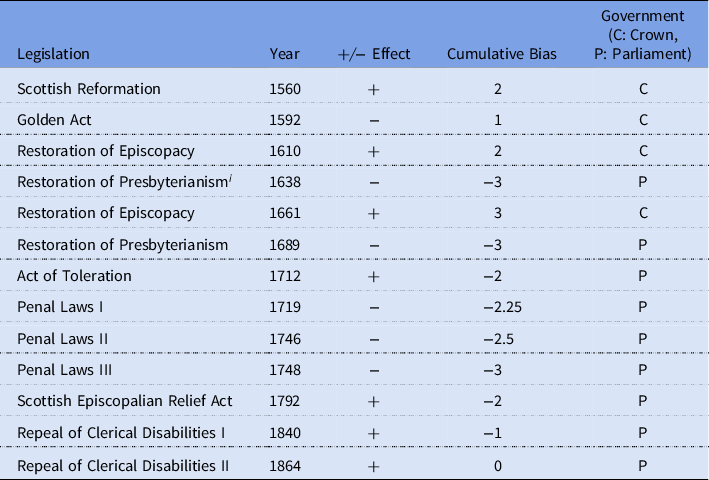
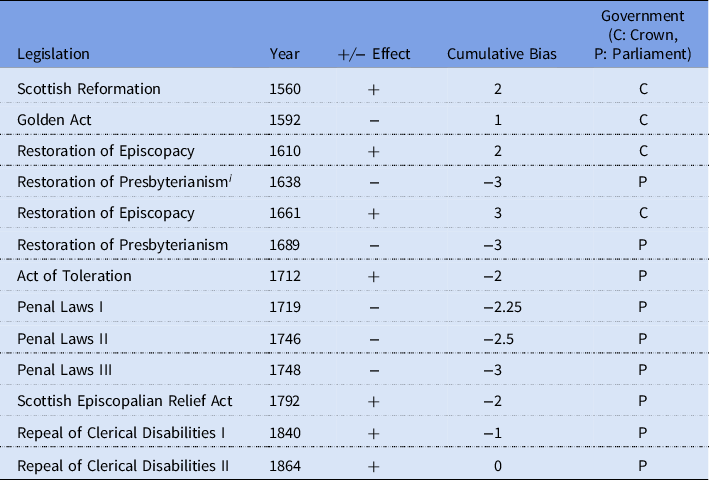
To support our argument further, we demonstrate that periods when the Crown dominated politics were the periods during which Presbyterians were suppressed and the periods of parliamentary dominated politics were typically the periods during which Episcopalians were suppressed. The institutional means of suppression were mainly legislative enactments that imposed restrictions on the functioning of the opposite church faction. Table 1 lists all acts relating to episcopacy passed by the Crown or the relevant parliament from 1560 until 1890. By categorizing legislation based on its degree of religious suppression, it is possible to elicit the extent of institutional bias during this period.
Acts Relating relating to Episcopacy episcopacy in Scotland
Source: Reynolds (Reference Reynolds1912: 287-2–89); see also Brown et al. (Reference Brown, Mann and Tanner2007–2014).
Notes: The Restoration became effective when the Westminster Confession was adopted by the Scottish Parliament in 1649.
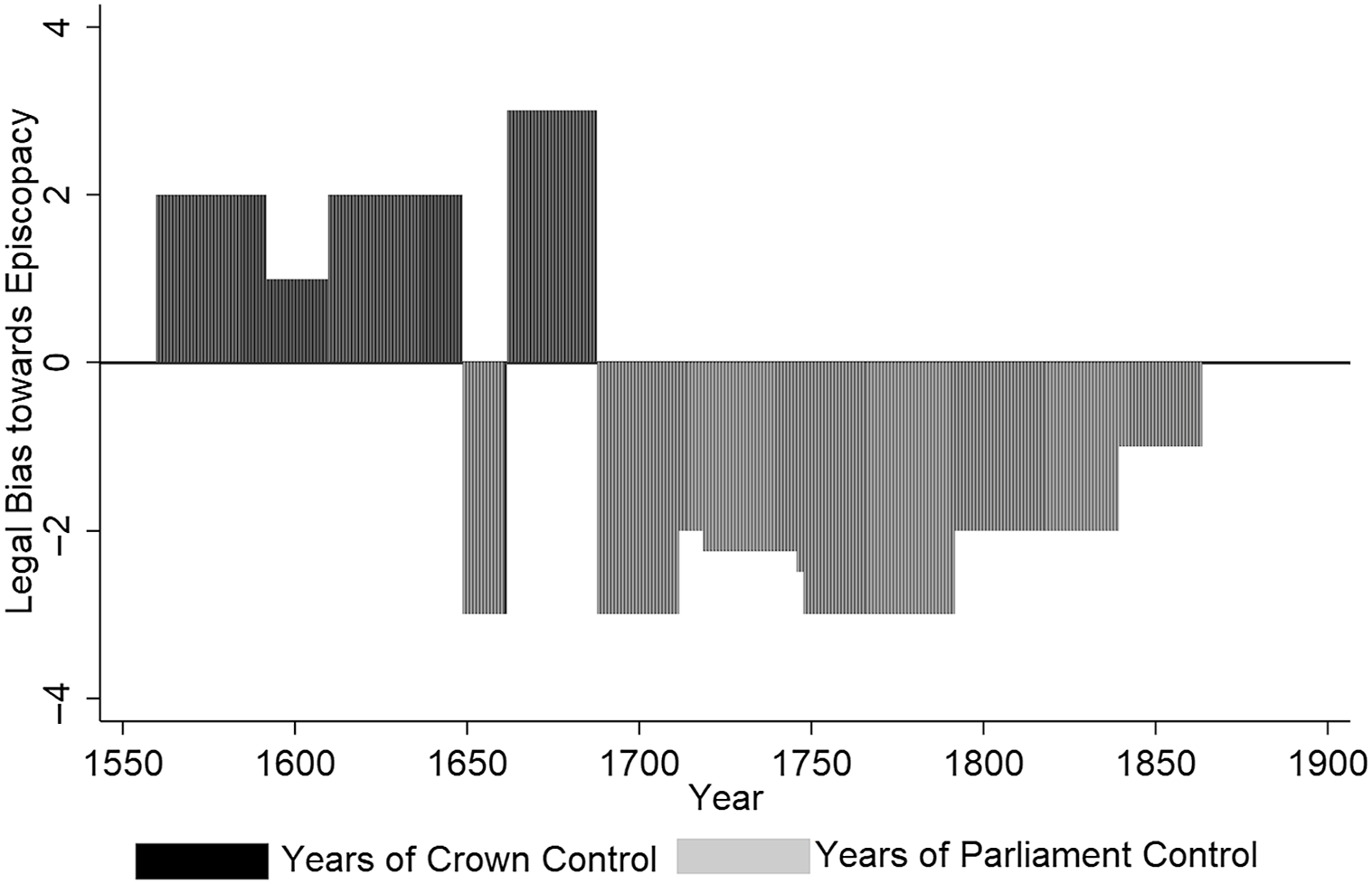
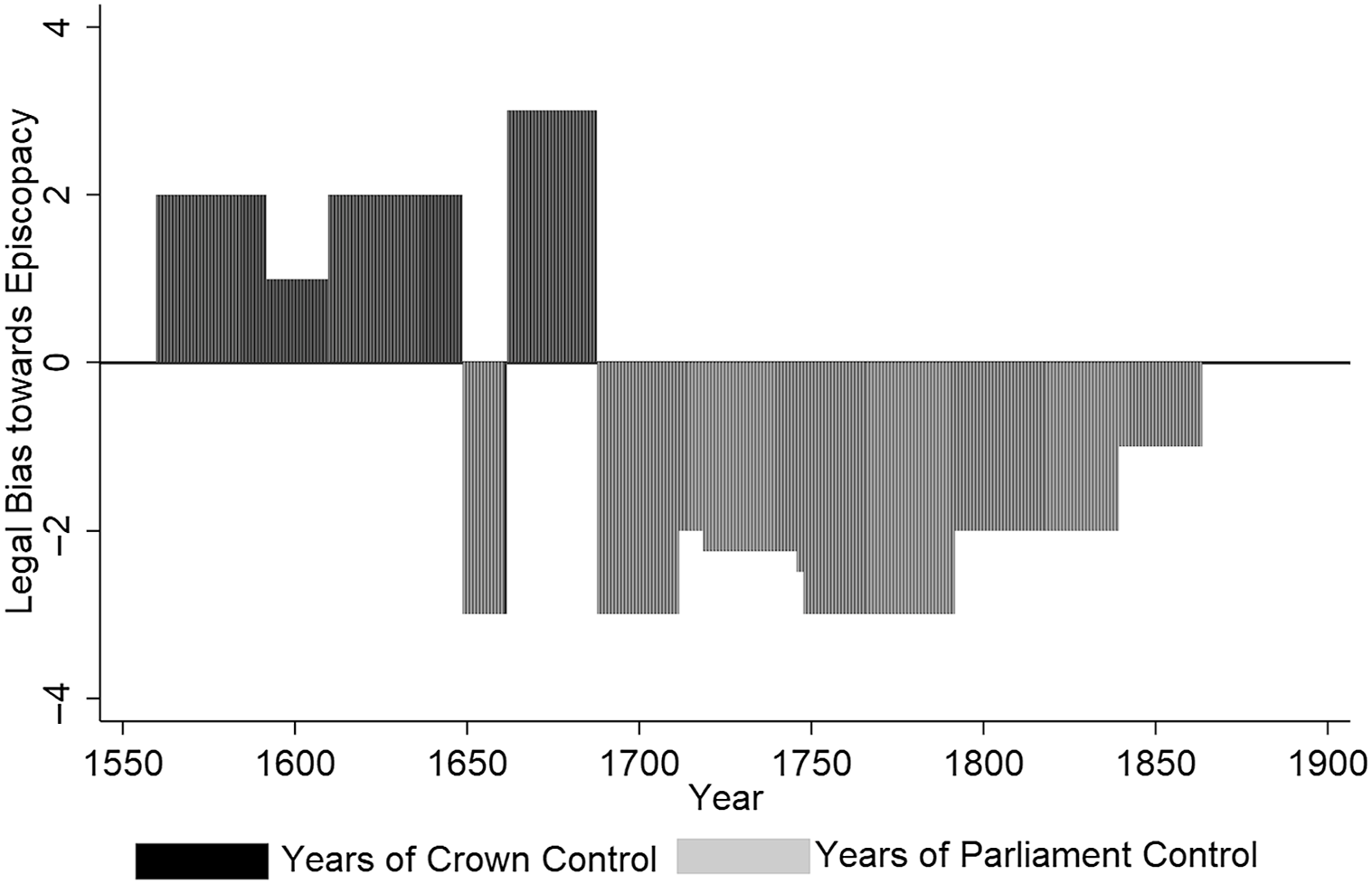
We used the following coding procedure. To code institutional bias toward episcopacy, equal treatment is coded as 0, negative bias with negative values and positive bias with positive values. The analysis begins with the year of equal treatment t (1864) and move backward. If the legislation at t-1 led to less equal treatment of episcopacy in relation to Presbyterianism than the legislation at t, we subtract one from the bias score of the period between t and t-1. If the legislation at t-1 led to more equal treatment than the legislation at t, we add one to the bias score of the period between t and t-1.
In 1840, the British Parliament repealed previous prohibitions on episcopacy, but the repeals did not bring about complete equality so the period from 1840 to 1863 is coded as –1. The legislation in 1792 repealed some prohibitions on episcopacy but did not bring about the level of equality of 1840, we code the period from 1792 to 1839 as –2. In 1748, the British Parliament imposed penal laws on the Episcopalians, which increased the level of repression after 1748. We code the period from 1748 to 1791 as –3. In 1746, penal laws were legislated but they were not as stringent as those in 1748. This is an improvement but not as positive as the state of affairs in 1792. Hence the value for years between 1746 and 1747 should be between 1792 and 1839(–3) and 1748–91(–2) which is averaged at –2.5. We proceed in a similar fashion until 1689, where the value is –3. If –3 represents abolishing episcopacy, 0 represents equal treatment, 3 has to represent the opposite of –3, that is exclusive monopoly. We code the years in which the Crown designated the episcopacy to be the exclusive Government of the Church as 3. However, during the Interregnum, when Charles I was deposed and the English Parliament controlled Scotland, episcopacy was abolished. Again, this period is coded as –3.
The legislation presented in figure 1 and table 1 makes clear that during the period when the Crown was politically dominant, Episcopalians received favorable treatment, whereas during periods when parliaments were dominant and until the beginning of the nineteenth century Episcopalians were worse off. It was only in 1864 that episcopacy and Presbyterianism received equal treatment de jure, though the beginnings of equitable treatment are observable in with the first efforts to secure protection for Scottish Episcopalians after 1707 and especially so after 1792 with the Scottish Episcopalian Relief Act.
Bias Towards toward Episcopacy episcopacy from 1560 to 1900.
In short, the conditions for Catholics and non-Trinitarians were poor in England and worse in the Britain’s other kingdoms. In Scotland, Presbyterian control over the Scottish Kirk was firm and Episcopalians and Catholics suffered discrimination and legal disadvantages. In Ireland, laws penalizing the local Catholic majority gained strength in the wake of the revolution while the Anglo Church of Ireland affirmed its privileged position. Throughout the Three Kingdoms, Parliaments denied Catholic civil rights entirely. The British Parliament did not grant Catholic emancipation until 1829 and Jewish emancipation until 1858. In spite of the revolution’s Act of Toleration, little was done to advance general religious freedom in Britain.
Religious Politics in Early Modern Scotland
The history of the Revolution of 1688 in Scotland is consistent with our argument that the logic of winning coalitions better explains its legislative and institutional outcomes than does the North and Weingast thesis and its extensions. This is because religious cleavages and confessional conflicts were major axes of British politics that did not fall in the wake of the revolution. But why was religious conflict so severe and enduring in Scotland?
In one configuration or another, the Stuart dynasty ruled Scotland from 1371 until the Hanoverian succession in 1714. The Stuarts were also the sovereigns of England from 1603. Following the Scottish Reformation in 1560 and the death of Elizabeth I, the Stuart King James VI gained the crown of England and conformed to the Church of England as James I. In Scotland, he asserted episcopacy, the royal appointment of higher church officials. Consequently, the power and influence of the Presbyterians on the established Kirk was continually frustrated in spite of the strong Calvinist leanings among many Scottish Protestants.
The influence of Calvinist reformers was strong in Scotland. They favored a Presbyterian structure for the reformed Church in which church courts and local presbyters would replace bishops. In the 1570s, Calvinists instituted Presbyteries throughout Scotland. This laid the roots of a divided Scottish Kirk; one side, Presbyterian and more congregational, and, the other, Episcopal, and more hierarchical in the mode of the English compromise between the Protestant faith and Catholic hierarchy. Besides their different understanding of ecclesiology, the conflict between the two fostered by the evolution of very different liturgical practices and confessional cultures that increasingly polarized Scottish society (Raffe Reference Raffe2010a).
Prior to the revolution, the Presbyterians periodically negotiated with the Crown for more favorable conditions in the established Scottish Kirk. For instance, following the War of the Three Kingdoms (the British Civil Wars, 1639–51), the Presbyterians had expected the reinstated king, Charles II (1660–85) to restore Presbyterianism, based on prior agreement. “All the Presbyterian clergy hoped that Charles would respect the Solemn League and Covenant of 1643 and the oaths he had taken to uphold it in 1650. They were to be disappointed” (Davies and Hardacre Reference Davies and Hardacre1962: 36). Indicating the Crown’s commitment problem in the religious sphere, Charles II reneged on his promise and decided to restore the episcopacy in 1661–62. Prior to this, all previous attempts to accommodate a Presbyterian Kirk had been contentious. Although the king persecuted many Presbyterians into returning to the established Scottish Church, a permanent political agreement governing the Kirk was impossible so long as the Stuarts were committed to securing their rule in Scotland through an episcopal religious policy.
The ecclesiastical history of Scotland is far too complicated to recount in full, but from the sixteenth century through the Revolution of 1688, sectarian conflict raged in Scotland. To simplify, on one side were the various Presbyterian sects (e.g., the “Covenanters”) who swore to uphold and protect strict Calvinism, and, on the other, the Episcopalians and moderates backed by the Crown. The conflict repeatedly erupted into conflict, mob violence, assassination, and rebellion. The sectarian conflict within Scottish Protestantism was so intense, in part, because the preferences of the Crown mattered in the theological, financial, and political activities of the Kirk. Unrestrained Crown preferences led to liturgical impositions that offended Calvinists. For instance, during the “Eleven Year Tyranny” Charles I (King of Scotland from 1625 to 1649) sought stricter implementation of the Five Articles of Perth that tried to harmonize the Scottish and Anglican churches.Footnote 5 Crown preferences also influenced access to state resources and positions. Charles I appointed pro-Anglican bishops to key positions of power such as privy counselors and commissioners of the exchequer (Mullan Reference Mullan1986: 173).Footnote 6 In 1634, all bishops began receiving commissions as justices of peace.
Charles I’s intensive suppression of Presbyterianism resulted in the Bishop Wars of 1639 between him and the Scottish Covenanters. The English Parliament, suppressed under the personalist rule of Charles I (“Eleven-Year Tyranny”), joined hands with the Presbyterians. The result was the English Civil War in which the forces of the Crown battled the English and Scottish Parliaments. Scottish Parliamentary forces captured Charles I and began negotiating the establishment of Presbyterianism as the only government of the Kirk. A faction then attempted to restore Charles I. It was intercepted and Charles I was handed over to the English and executed for treason by the Rump Parliament.
During the Interregnum (1649–60), when England became a republic under Oliver Cromwell, the English Parliament did not establish Presbyterianism as the official body of the Kirk. The death of Cromwell in 1658 and a succession crisis led to the restoration of Charles II (1660–85). Charles II favored the Episcopal faction and attempted to introduce religious freedoms for Catholics. The increasing tolerance toward Catholics led to a divide in the Parliament (proexclusion Whigs and antiexclusion Tories). The Whigs and the Scottish Presbyterians, again, became natural allies against Charles II. Charles II sided with the Tories and suppressed the Whigs. After Charles II’s death in 1685, James II/VII acceded to the throne and continued granting religious liberties to the Catholics, for instance by the suspension of the Test Acts.
Whiggish accounts of the revolution tend to dismiss the toleration pursued by James II/VII in favor of the more limited toleration instituted after 1689.Footnote 7 In 1687, James introduced a policy of tolerating nearly all forms of Christian worship in Scotland through a series of Acts of Indulgence that suspended penal laws against Catholics and nonconforming Protestants, including Presbyterian sects. Historian Alasdair Raffe (Reference Raffe2015: 357–58) has hailed James’s short-lived reforms as initiating a “multiconfessional experiment” that expanded religious liberty, allowed real competition between Scottish religious groups, and legally recognized multiple churches in the same polity. Although intended principally to benefit his Catholic coreligionists, James’s policies benefitted several other groups. At the same time they also allowed for the substantial mobilization and reorganization of Presbyterian sects suppressed under Charles II. Ironically, this prepared them for the coming revolution and the leading role they would play in the Williamite coalition in revolutionary Scotland.
Thus, contra Whiggish generalizations, on the eve of the revolution the Crown was pressing for broad-ranging religious toleration through exercise of royal powers because parliaments would not agree to tolerate Catholics. When the English Parliament opposed James’s religious policy, he responded by dissolving it and appointed Catholics to high-ranking positions in the army and government. As we have seen, the birth of James Edward Stuart, a Catholic heir to the kingdom, precipitated a political crisis. In response, a Williamite coalition requested the Dutch William of Orange (later William III and II of Scotland), whose Stuart wife Mary, had been James’s heir, to invade England. When William arrived with a large army, many of James’s Protestant officers defected and the king fled to France, making the revolution largely bloodless (at least in England). The outcome united English Whigs and the Scottish Presbyterians in the winning coalition whose demand for limited monarchy and anti-Catholicism cemented an alliance against royalists and Jacobites.
After accepting the Crown along with Mary II as joint monarch, William III/II summoned a Convention of the Estates of Scotland comprised mainly of clergymen and nobles. Presbyterians and Whigs dominated the Convention and offered the Crown of Scotland to William and Mary in return for restoring Presbyterianism as the ruling doctrine of the Kirk (Harris Reference Harris1993; Raffe Reference Raffe2018; Stephen Reference Stephen2010). The Settlement was complete in 1690.
In the period after the revolution, the Presbyterians, as party to the new ruling coalition in the Scots Parliament, suppressed episcopacy vigorously, very much in a spirit of vengeance (Raffe Reference Raffe2010b, Reference Raffe2018). In the Claim of Right of 1689 (the Scottish equivalent of the Bill of Rights) the Scottish Parliament condemned episcopacy and in subsequent laws described the Presbyterian Church as the “True Church of Christ” (RPS 1700, 1702, 1703; Raffe Reference Raffe2010b). Apart from legal instruments, the early years of the revolution also saw mob violence against Episcopalians. Crowds, mostly led by radical Presbyterian factions (“rabblings”), attacked members of the Episcopal clergy, forcibly ejecting them and their supporters from their homes and places of worship (Harris Reference Harris1999; Stephen Reference Stephen2010).
The church-state reforms brought about by the Claim of Right substantially reduced the influence of the Crown. Soon after the 1690 Settlement, King William’s attempt to compel the Presbyterians to receive the Episcopalians into full ministerial membership of the Church failed. The Williamite coalition in alliance with the Scottish Presbyterians agreed on a limited Crown. However, Parliaments were not similarly limited. Acting through their influence on the Scottish Parliament, the Presbyterians rejected doctrines of limited government and limited political interference in the realm of religion. The Presbyterians enforced severe restrictions on groupings outside their established Kirk.
Predictably, punitive religious politics in Scotland (just as in England and Ireland) provided little incentive for Episcopalians and Catholics to accept the new Williamite regime after 1688 or the Hanoverian succession in 1714. Rather, a Jacobite coalition, largely comprising Catholics, Episcopalians, and English royalists, repeatedly attempted to restore the exiled Stuarts to the English and Scottish (and Irish) Crowns. After the Revolution of 1688, the Jacobites staged five armed uprisings—1689, 1708, 1715, 1719, and 1745, and were involved in five plots to change the government—1703, 1706, 1717, 1723, and 1753 (Macinnes Reference Macinnes1999; Pittcock Reference Pittcock1998; Szechi Reference Szechi1994). The Jacobite threat to the Parliamentary regime was substantial and ongoing until Hanoverian forces conclusively defeated the rebels at the Battle of Culloden in 1746.
Episcopal support for the Scottish Jacobites resulted partly from their ouster from positions of authority in favor of Presbyterians following the Settlement of 1689. A minority of the Episcopalians tried to secure religious tolerance through institutional means. Queen Anne supported a compromise that recognized Episcopal communion under the condition that the clergy would use the Book of Common Prayer and take the Oath of Abjuration of James VII (James II in England), thus proclaiming the legitimacy of the 1688 revolution. A large proportion of Episcopalians refused to renounce their allegiances in 1693 and remained unreconciled in 1712. They were the cement of Scottish Jacobitism; Macinnes (Reference Macinnes2007) estimates that 75 percent of Jacobites were unreconciled Episcopalians (see also Szechi Reference Szechi1994: 67).
The situation for the Scottish Episcopalians remained dire for the first two decades after the revolution but improved somewhat thereafter. The Acts of Union that brought the Scottish and English kingdoms together affirmed the Presbyterian’s legal monopoly over the Kirk. However, Episcopalians gained some protection for their form of worship thanks to the intervention of the House of Lords in cases concerning the prosecution of Episcopalian priests. In 1712 a unified Parliament, now with a Tory majority, recognized a separate Episcopal Church in Scotland, confirmed its use of the liturgy of the Church of England, and allowed its jurant (those swearing an oath of loyalty) clergy to perform baptisms and weddings (Raffe Reference Raffe2012; Rogers Reference Rogers2020). As a result, the Scottish episcopate survived and meeting houses could operate.
Whereas union afforded protection, it did not challenge the Presbyterians’ control over the Scottish Kirk. In addition, widespread Jacobite sympathies and the unwillingness of the majority of the Episcopal clergy to swear the oath of loyalty undermined progress toward legal toleration of Episcopalians (Strong Reference Strong2002: 11–12). The succession of a Hanoverian prince to the throne of the United Kingdom in 1714 again worsened the political climate for Episcopalians in Scotland. Many Episcopalian priests refused to swear allegiance to George I and Episcopalians were core supporters of the Jacobite uprisings against the Hanoverians (Szechi Reference Szechi1994: 67). In the wake of the failed uprising of 1715, there was substantial repression of the Episcopalians and the further splitting of clergymen between jurant and nonjurant factions (Strong Reference Strong2002: 15–16).
More damaging to the Presbyterian legal monopoly in the Kirk was the Patronage Act enacted in 1712 that restored the right of aristocratic lay patrons to nominate candidates for parish vacancies. This measure effectively split the Presbyterians between moderate and evangelical factions. The Presbyterian tendency toward factionalism and fissiparity that resulted from the restoration of patronage in the Kirk eventually gave rise to multiple successions from the Presbyterian establishment that later did much to advance religious freedom in Scotland in the nineteenth century (Bruce Reference Bruce1986; Strong Reference Strong2002).
Inevitably, Jacobite rebellions intensified the repression of Episcopalians. Following the 1715 uprising, the Penal Acts of 1719 forbade Episcopal clergy from officiating in the presence of more than nine persons beyond their households and imposed six-month prison terms on those who would not take an Oath of Allegiance to George I. The Penal Acts of 1746, following the uprising of 1745, forbade Episcopal clergy to officiate without an Oath of Allegiance to George and Oath of Abjuration to the Stuarts. Further acts in 1748 forbade Episcopal clergy from officiating in the presence of more than four persons. Parliament repeatedly suspended the Habeas Corpus Act in Scotland: in 1715 (six months), 1716 (six months), 1722 (one year), 1744 (six months), and 1745 (one year), each time because of the Jacobite uprisings.
The death of Charles Stuart, the last serious Jacobite pretender, in 1788 finally prompted even the most recalcitrant Scottish Episcopalians to acknowledge the Hanoverian Crown. Parliament repealed some penal measures in 1792, though the Episcopalians could not minister in the established Churches of Scotland and England. The decades of repression had taken their toll. Over the course of the eighteenth century, the Episcopalian clergy declined from around 1,000 to less than 50 members, with just four bishops (Webley-Parry Reference Webley-Parry1879: 470). The suppression and near disappearance of Episcopal clergy led Walter Scott in 1815 to refer to “The Episcopal Church of Scotland—the shadow of a shade”’ (Scott Reference Scott2003 [1815]: 418). It was not until 1864—nearly two centuries after the revolution—that the Parliament abolished the remaining disabilities imposed upon Scottish Episcopalians and the Church of England allowed full communion and interchangeability of clergy with the Scottish Episcopalians.
North and Weingast cite the independent judiciary as an example of constraint on post-1688 government but it too failed to prevent the Presbyterian suppression of Episcopalians. The dominant groups in parliaments secured their interests through legislation, less through arbitrary appointments, royal prerogatives, or extralegal mandates, as had the Stuart Crown. As we have seen, the new Williamite coalition had little interest in preventing Episcopal suppression through new legislation. The Whigs and the Presbyterians were committed allies against the Jacobite coalition of Episcopalians and the Royalists (Whatley Reference Whatley2006, Reference Whatley2013). William’s difficulties in securing support for his governments in the Scottish Parliament led him to favor its elimination through a formal union of England and Scotland, a policy achieved by his successor, Queen Anne in 1707 (Riley Reference Riley1979). A united Parliament that included forty-five Scottish members but an Anglican majority showed more interest in restraining Presbyterian abuses than had the Scottish Parliament, but, as we have seen, it did not act decisively to protect the rights of Episcopalians, particularly once the goals of toleration vied with the imperative of suppressing Jacobitism.
In sum, when it came to religious policy, both the Scottish and united Parliaments had tendencies to be “irresponsibly” biased toward the Presbyterians after 1688. The union in 1707 offered only limited relief because Parliament remained dependent on Presbyterians and because the Jacobites represented the alternative power in Scotland. The effect of the revolution on religion was a component of the equilibrium balance on power on other dimensions. Institutional trade-offs across issue areas led to institutional variation, in this case, stricter discipline on debt and taxes but weaker discipline on religion. These trade-offs were determined by the interests of the coalition empowered by the revolution and the resulting allocation of public and private goods. It is likely that in another environment, perhaps led by religious leaders, the equilibrium could have been the opposite, resulting in stricter discipline in religious affairs and weaker discipline on debt and taxes (Rubin Reference Rubin2017).
What Explains Expanding Religious Liberty in the Nineteenth Century?
Although the revolution had different implications for political and religious liberties in England than in Scotland, this was for reasons having little to do with the revolution. The English Parliament was limited in its ability to introduce radical measures due to its bicameral structure. Moderates in the Upper House could also frustrate proposals of the Lower House dominated by the Whigs. However, until 1707 Scotland’s Parliament had a unicameral structure, largely controlled by the Whigs and the Presbyterians, with no restraint on their actions.
Like the Scottish Episcopalians, British Catholics and the Jews faced repression through legislative and informal means for a century or more after the revolution. Liberalization and political secularization came about very slowly (Clark Reference Clark2012). The Test Act of 1678 excluded Catholics from both houses of the English Parliament and from holding government offices and military commissions. James II/VII refused to enforce it. The revolutionary settlement retained these restrictions in spite of a largely Catholic population in Ireland and Catholic minorities in the other two kingdoms. The Papists Act of 1778 provided partial relief, allowing Catholics to maintain schools, inherit land and purchase property. In 1791, The Roman Catholic Relief Act extended franchise to Catholics who were large landholders. Together, these acts, through property and franchise, institutionalized the conditions for the increasing political power of Catholic constituencies. In 1823, Daniel O’Connell established the Catholic Association to campaign for complete emancipation. He contested in the 1828 elections, won, but was not allowed to take his seat in the House of Commons. In 1829, the movement allowing Catholics to become Members of the British Parliament was successful when O’Connell won the second time and Parliament passed the Roman Catholic Relief Act.
The representation of the Jews in the House of Commons follows a similar trajectory. Jewish merchants enjoyed toleration in London in the seventeenth century, for the most part, because of their trade and finance networks. The accession of William to the English throne was instrumental in creating a more tolerant regime. By 1753, the Jewish population gained enough political clout to present the Jewish Naturalization Bill in the House of Lords.Footnote 8 Benjamin Disraeli, Jewish by birth but baptized into the Church of England, became a Member of Parliament in 1837, and went on to become the Prime Minister of the United Kingdom in 1868 and 1874. Disraeli took the Christian oath but another Jewish candidate, Lionel de Rothschild, elected as one of the four Jewish members of Parliament from the City of London in 1849, refused to take the Christian oath. The two houses of Parliament reached a compromise whereby Rothschild took the oath without committing to the Christian faith. The Jews Relief Act passed in 1858, and two years later, there was a more general form of oath for all members of Parliament.
Although the political representation of religious groups outside the established Protestant churches gradually increased in England and Ireland, this development was somewhat retarded in Scotland. Rather than growing tolerance of religious pluralism driving an expansion of religious liberty in Scotland, the situation improved because of the increasing disunity of the Presbyterian camp in the wake of the Patronage Act. As Bruce (Reference Bruce1986) has forcefully argued, it was unceasing factionalism and bitter denominational rivalries among Scotch Presbyterians that undermined the authority of the established Kirk and hobbled its efforts to persecute minorities, including an influx of Irish Catholic immigrants. At the time of the 1707 Act of Union, the Presbyterians were a single, united denomination established in the Scottish Kirk. However, by the 1750s, Presbyterians had split into five groupings. Finally, the “Great Disruption” of 1843 led to the breakup of the mainstream Presbyterians into two groups, the evangelical Free Church that gave up all state privileges and the established Church of Scotland.
In the political arena, the Great Reform Act of 1832 substantially lowered the property restrictions on voting and expanded regional representation in the Parliament. “The Act represented a shift in favor of cities and the middle classes, and it almost doubled the size of the voting population to 800,000 people.” A month after the Great Reform Act, the Parliament passed the Scottish Reform Act 1832 that also significantly increased the county (rural) franchise in Scotland from 3,200 to 31,000. The franchise in the burghs (urban areas) rose from what was effectively a self-electing closed electoral system of 1,300 council members to a far more representative 32,000 (Johnston Reference Johnston2013); these reforms severely constrained special interest legislating (including in religion) and ushered in a period of expansion in public welfare spending (Lizzeri and Persico Reference Lizzeri and Persico2004).
In short, liberalization happened because of an increase in the number of religious groups and an increase in political representation of members of these groups. The “diversity of views” North and Weingast hail as a feature of the parliamentary regime introduced in 1688 came about because of growing religious diversity born of factionalism, on the one hand, coupled with the expansion of the franchise (and thus the widening of the selectorate) that allowed disadvantaged groups greater representation, on the other. After a period of multiple rounds of secession within the Presbyterian camp and the increase in Parliamentary representation of the Catholics, Jews, and other Protestants, Parliament reduced the monopoly privileges of the Presbyterians and moved in the direction of denominational equality. Similarly, franchise extension diluted confessional and conservative interests, a factor having little to do with the Whigs or the institutions established by the revolution. Simply put, increasing political representation in the context of religious pluralism forced the prevailing institutions to allow a wider set of beneficiaries (Lizzeri and Persico Reference Lizzeri and Persico2004).
Conclusion and Implications
The Revolution of 1688 did not lead Britain toward a general commitment to religious liberty or political secularization. To be clear, we are not attempting to impose an ahistorical standard of religious toleration on Britain after 1688. All early modern states, to varying extents, imposed religious monopolies and restricted minorities (see Johnson and Koyama Reference Johnson and Koyama2019). Rather, we are arguing against the North and Weingast thesis that makes England exceptional. One might further object that Britain’s “Celtic periphery” cannot falsify North and Weingast’s general argument because the conditions prevailing outside of England were different. However, the artificial separation of Scotland and Ireland from Britain has permitted scholars focusing on England to ignore the Scottish and Irish experiences as if they were under different rulers and, after 1707 and 1800, different Parliaments. Good political institutions are credible and consequential precisely because they secure general advantages across the groups comprising the polity, not merely for the politically advantaged at the core of the polity.
Focusing on the crucial case of Scotland, we used historical process tracing and a systematic coding of ecclesiastical legislation to show that rather than establishing conditions for religious liberty, the period after the revolution continued to be dominated by special interest legislating in the religious sphere, similar to the prerevolutionary period. James II/VII introduced substantial religious toleration through royal fiat that the partisans of the Williamite coalition decried as tyranny and quickly reversed—we have here a tolerant Crown and intolerant parliaments. Worse still, the institutional structure that evolved after 1688 provided incentives for parliaments to engage in the kind of “irresponsible” behavior attributed to the prerevolutionary Crown. Doing so both suppressed religious liberties and undermined political reconciliation after 1688. The record in Scotland is more dismal than glorious: The Crown and the Episcopalians repressed the Presbyterians before 1688; the Scottish Parliament and the Presbyterians repressed the Episcopalians after 1688. Conditions for religious liberty appeared first in the wake of the Act of Union, and much later, in the nineteenth century as the Presbyterians faced secession and non-Presbyterian denominations and religions gained a foothold in Parliament.
In effect, the revolution transferred power from one coalition to the other, continuing the “arbitrary” religious repression North and Weingast treat as symptomatic of the prerevolutionary Crown. Although the revolution did force the Crown to commit to religious tolerance, it did not compel parliaments to do so. As Clark (Reference Clark2012: 178) has put it, “The religiously neutral state, formerly dated to the late seventeenth century, can no longer be located in that age: In Britain, hegemonic official ideology pictured the state as built on religious premises throughout the long eighteenth century and residually into the twentieth.”
The benevolent view of the revolution’s legacy for civil rights also seems also to be overstated. The nature of post-1688 religious politics mattered not only in normative terms of injustice toward religious groups in the losing coalition and civil liberties long denied them but also in terms of the social and political stability of Britain. The ongoing repression of Scottish Episcopalians and Catholics, alongside and favoritism toward the established Presbyterian Kirk, helped to inspire decades of Jacobite agitation and rebellion. This repression complicated efforts by the British government to achieve social reconciliation and political stabilization.
In general, our findings are in accordance with selectorate theories (Bueno de Mesquita et al. Reference Bueno de Mesquita, Smith, Siverson and Morrow2003; Gallagher and Hanson Reference Gallagher and Hanson2015). Seen in this light, James II/VII’s multiconfessional experiment was a dangerous gamble that narrowed his winning coalition and empowered challengers. The revolution points to the limits of top-down efforts to impose toleration through executive powers in a society riven by fervent religious beliefs. As Raffe (Reference Raffe2015: 372) notes of James’s short-lived experiment imposing toleration, “[M]ulticonfessionalism from above could hold religious hatreds in check, but could not introduce a long-lasting harmony.” “Good” policy may be bad politics from the perspective of regime survival. Successful political leaders are compelled to promote policies that advantage the supporters comprising their winning coalition. The welfare effects of institutions are likely to expand (change) with the size and nature of the coalition in power. In the case of Britain, franchise extension played much larger role in achieving religious liberties than did parliamentary commitments. Although politically influential and commercially valuable religious minorities are more likely to be part of a selectorate and thus enjoy toleration (Gill Reference Gill2008), particularized institutions need not yield general benefits. Parliamentary rule does not ensure that general identity rules will prevail and even as democracy widens, parliaments are often captive to clientelism and special interest legislation (Fukuyama Reference Fukuyama2015; Piatonni Reference Piatonni2012). Future research should examine the relationship between franchise extension and the decline in private/special interest legislating, including in the sphere of religious regulation.
Our argument travels across time and places. Privileges for established religions and discrimination toward religious minorities are strongly associated with authoritarianism and violence (Grim and Finke Reference Grim and Finke2011), as well as with rebellion and state failure (Fox Reference Fox2004). The situation tends to worsen, as was the case in Scotland, where religious minorities are unprotected by the judiciary (Finke et al. Reference Finke, Martin and Fox2017). Our findings are also in accordance with Brathwaite and Bramsen (Reference Brathwaite and Bramsen2011), who argue that a structural lack of religion-state separation, as was the case in postrevolutionary Scotland, can retard democratization in general and religious liberties in particular because state-supported religions can introduce partisan legislation in the religious sphere. In contrast to Driessen’s view (Reference Driessen2010), we think that a hand-in-glove church and state might be harmful to democratic consolidation and the legitimacy provided by religion could be a double-edged sword. In fact, we suspect our argument regarding the limited religious commitment of the postrevolutionary state is understated—we examine de jure commitment, it is possible for de facto commitment to be even worse (Fox and Flores Reference Fox and Flores2009; Grim and Finke Reference Grim and Finke2011).
It is ironic that the search for the origins of modern economic growth unintentionally revived a Whiggish interpretation of history. More broadly, the claim that the Revolution of 1688 secularized British politics and advanced religious freedom seems to belong to the persistent myth that liberty and progress advanced because of the triumph of Protestantism over “popery” (Gregory Reference Gregory2012; Stark Reference Stark2017) and democracy over other forms of government (Fukuyama Reference Fukuyama2015). To be clear, we do not claim that Britain was especially egregious in terms of religious freedom, the politicization of religion, or the imposition of partial institutions that favored established religions over others. State involvement in the religious economy was ubiquitous in seventeenth- and eighteenth-century Europe, and indeed in many times and places (Iannaccone Reference Iannaccone1998). British rulers did gradually shift from relying on religion to propagate their rule to bargaining with commercial interests in Parliament (Rubin Reference Rubin2017) but they did not disestablish state churches or deregulate the religious sphere in the process. Finally, we are not attempting to impose an ahistorical standard of tolerance.Footnote 9 Rather, we are arguing against the tendency in comparative social science to regard the British case as exceptional in the state’s capacity to restrain abuse of power, protect individual rights, and create the conditions for growth that naturally spilled over into freedom of religion.
Acknowledgments
We would like to thank Jeremy Black, Edgar Kiser, Jared Rubin, Matthew Toro, and three outstanding anonymous reviewers at Social Science History for helpful comments on drafts of this paper.