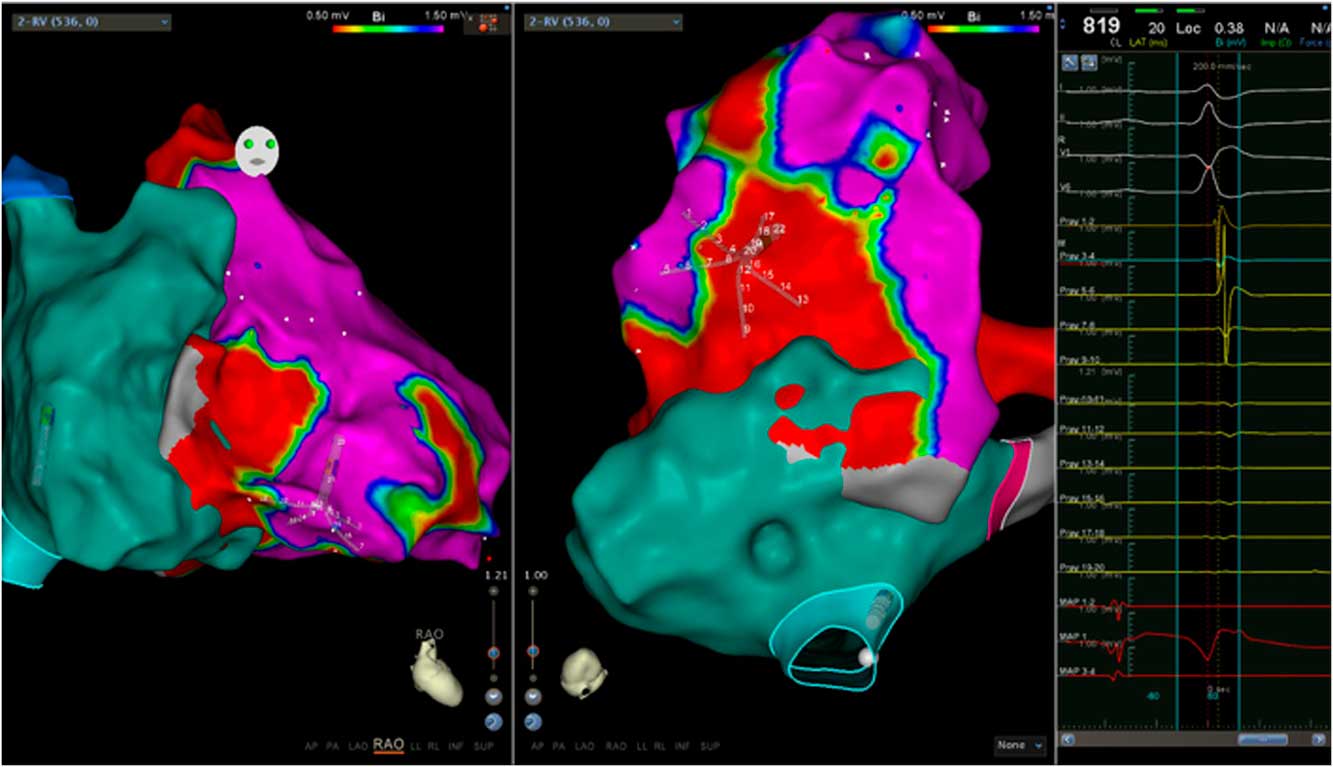
A 24-year-old young woman noted subacute onset of shortness of breath and was diagnosed with Ebstein’s anomaly. She was referred for surgical correction with the cone procedure.Reference da Silva, Baumgratz and da Fonseca 1 Given concerns for perioperative arrhythmias,Reference Shivapour, Sherwin and Alexander 2 a preoperative electrophysiology study was performed showing no accessory pathway conduction and no inducible ventricular tachycardia. In addition, a detailed greater than 2000-point voltage map of the right ventricle was created using the CARTO 3 mapping system and PentaRay catheter (Biosense Webster Inc. Diamond Bar, California, United States of America). This voltage map assigned scar as voltage of <0.5 mV in red and showed significant scarring in the inferior right ventricle from base to apex (Supplementary Fig 1), involving a significant portion of the atrialised ventricular myocardium. Contact was confirmed using PentaRay catheter’s deformation showing the splines in contact with the ventricular myocardium, which helped in defining the scar border (Fig 1). Ebstein’s anomaly itself seems to predispose patients to the development of macroreentrant circuits even before the induction of surgical scarring.Reference Sherwin, Triedman and Walsh 3 Although the body of information on ventricular tachycardia in Ebstein’s anomaly is limited, the amount of ventricular scar seems to be a risk factor for ventricular arrhythmias in other forms of congenital heart disease.Reference Tsai, Chan and Ro 4 In Ebstein’s anomaly patients with significant preoperative ventricular scarring, more information is needed to help appropriately manage the risk of ventricular arrhythmias and sudden death.
The PentaRay catheter was used to create a detailed voltage map. This representative image shows the PentaRay in the inferior scar. The 20-pole catheter has normal voltage on PentaRay 1–2 and 5–6. The other poles, such as PentaRay 13–14 show significant low voltage (<0.5 mV), suggestive of scar.

Acknowledgements
None.
Conflicts of Interest
None.
Supplementary materials
To view supplementary material for this article, please visit https://doi.org/10.1017/S1047951116001918