Antibiotics are widely used in very low-birth-weight infants (VLBW, <1500 g), and excess exposure, particularly to broad-spectrum antibiotics, is associated with significant morbidity. Reference Ting, Synnes and Roberts1–Reference Fajardo, Alshaikh and Harabor4 Neonatal intensive care units (NICUs) commonly quantify antibiotic utilization by tracking days of therapy (DOT). Although this method quantifies the duration of treatment, it treats all antibiotic exposure equally, regardless of the spectrum of antimicrobial activity, and it fails to fully capture important differences in NICU prescribing patterns. An antibiotic spectrum index (ASI) was developed to compare antibiotic selection patterns by the spectrum of antimicrobial action in addition to DOT. Reference Gerber, Hersh, Kronman, Newland, Ross and Metjian5 This index is calculated by multiplying the DOT of a drug by points assigned based on how many organisms are susceptible to that drug. For example, a relatively narrow-spectrum agent, such as nafcillin, is assigned 1 point for each DOT whereas gentamicin and vancomycin, both active against multiple organisms, are assigned 5 points for each DOT. The ASI does not assign points for some common NICU pathogens, including coagulase-negative staphylococci (CONS) and group B Streptococcus. However, a recent study used the ASI to identify changes in NICU antibiotic selection after the implementation of an antibiotic stewardship project. Reference Lahart, McPherson, Gerber, Warner, Lee and Newland6 No studies have compared ASIs across multiple NICUs or have used it to study drivers of differences in antibiotic use patterns, including the unit-specific burdens of morbidities and drug-resistant organisms.
Very low-birth-weight infants (VLBW, <1,500 grams) are at especially high risk of exposure to broad-spectrum antibiotics because they require prolonged hospitalization and are at high risk of infection due to immature immune systems and the need for invasive interventions. The signs and symptoms of infection in preterm infants have significant overlap with symptoms of immature organ systems and brain development associated with preterm birth. Therefore, empiric antibiotics are frequently prescribed for nonspecific clinical events for which infection is ultimately ruled out. More than half of all VLBW infants receive antibiotics during their NICU course, Reference Flannery, Ross, Mukhopadhyay, Tribble, Puopolo and Gerber7 and antibiotic overuse in NICUs has been associated with the emergence of antibiotic-resistant organisms (AROs). Reference Patel and Saiman8 In addition to promoting drug resistance, the overuse of antibiotics contributes to morbidity and mortality and alters the developing microbiome. Reference Gomez-Arango, Barrett, McIntyre, Callaway, Morrison and Dekker Nitert9,Reference Dardas, Gill and Grier10 Although overall reduction in the days of prescribed antibiotics is an important and achievable goal, Reference Cantey, Wozniak, Pruszynski and Sánchez11,Reference Fleiss, Hooven and Polin12 antibiotics with a broader spectrum likely do more damage to the microbiome than narrow-spectrum drugs, thus necessitating additional stewardship efforts to limit the duration and spectrum of empiric treatments. Furthermore, broad-spectrum antibiotic exposures increase the risk of invasive fungal infections, which can be deadly for premature infants. Reference Kaufman, Gurka, Hazen, Boyle, Robinson and Grossman13,Reference Swanson, Gurka and Kaufman14 The first choice of agent for empiric treatment varies by unit according to the local frequency of identified organisms and observed patterns of resistance as well as unit guidelines and other practices. Reference Rubin, Sánchez and Siegel15 Identifying differences in practices and outcomes could suggest targets for local improvement and provide a basis for standardization across NICUs. We aimed to compare antibiotic use among 3 NICUs using the ASI and to identify potential drivers of high ASI per antibiotic day in VLBW infants.
Methods
Antibiotic data were extracted from the pharmacy systems of 3 academic level 4 NICUs: the University of Virginia (UVA, NICU 1), St Louis Children’s Hospital/Washington University Medical Center (WU, NICU 2), and Columbia University Irving Medical Center (CU, NICU 3) for all VLBW infants <32 weeks gestational age (GA) during 2017–2018 for UVA and WU and during 2017 for CU. We searched for all intravenous and oral antibiotics prescribed to included infants during the study period. For the analysis, we included all drugs listed in the source ASI publication. Reference Gerber, Hersh, Kronman, Newland, Ross and Metjian5 This list overlaps with the list of neonatal antibacterial agents for tracking using the CDC National Healthcare Safety Network (NHSN) Antibiotic Use and Resistance Module but excludes antifungals and antivirals.
Patient days were calculated as the number of calendar days the infant was in the NICU during the years of the study at each site. If an infant was born in 2016, only the patient days from January 1, 2017, and beyond were included in the analysis. Days of therapy (DOT) were calculated for each drug as the number of calendar days on which the patient received at least 1 dose of the drug. Antibiotic days were assigned for each calendar day a patient received 1 or more antibiotics for prophylaxis or treatment (empiric or culture driven). When calculating the ASI, points are assigned per DOT for activity against 13 clinically relevant bacterial pathogens with an additional point for activity against multidrug-resistant organisms. Reference Gerber, Hersh, Kronman, Newland, Ross and Metjian5
We calculated the DOT per 1,000 patient days and ASI per antibiotic days for each site. We used the methods described by Gerber et al Reference Gerber, Hersh, Kronman, Newland, Ross and Metjian5 to calculate ASI. For example, an infant treated with ampicillin and gentamycin for 2 days, followed by vancomycin for 5 days would be calculated as follows: ampicillin gets 2 points × 2 DOT for an ASI of 4. Gentamycin gets 5 points × 2 DOT for an ASI of 10. Vancomycin gets 5 points × 5 DOT for an ASI of 25. The total ASI for these 7 antibiotic days equals 4 + 10 + 25, or 49, and the ASI per antibiotic days would be 49 ÷ 7, or 7.
We also calculated the ASI per antibiotic days while excluding days where only antibiotics for urinary tract infection (UTI) prophylaxis were administered to determine whether this difference was influenced by the high usage of UTI prophylaxis at one site compared to the others. Prophylactic daily doses of narrow-spectrum drugs, usually amoxicillin, are often prescribed in this population when urinary tract anomalies are suspected or cannot be ruled out because they can increase the risk of UTI. Evidence on this practice is mixed, but some recommend daily antibiotics for prophylaxis after every UTI until imaging can be performed to rule out urinary tract anomalies.
Additionally, we evaluated potential drivers of differences in antibiotic utilization including patient-level clinical variables and unit-level epidemiologic factors. We collected data on central-line days, ventilator days, clinical risk index for babies (CRIB-II) scores, Reference International Neonatal16 blood and urine culture results, methicillin-resistant Staphylococcus aureus (MRSA) screening results, and cases of necrotizing enterocolitis (Bell’s stages 2 and 3).
If a blood culture was positive, then we recorded the event as a bloodstream infection and not a contaminant if the positive culture was treated for ≥5 days with antibiotics. All 3 NICUs used a similar guideline for blood-culture evaluation of suspected sepsis, which recommended sending at least 1 mL of blood for aerobic culture, obtained using peripheral venipuncture under sterile procedure. If a urine culture was positive and the patient was treated for at least 5 days, we included it as a UTI. The standard for urine cultures is to obtain at least 1 mL of urine using sterile catheterization. We did not review cultures to confirm that these recommended procedures were used. Rates of bloodstream infections and UTIs were determined using these definitions for all sites. We reviewed the unit guidelines for choosing empiric antibiotics for suspected sepsis or necrotizing enterocolitis and summarized these in Supplementary Table 1 (online).
The unit protocols for MRSA screening differed for all 3 sites during the study period. NICU 1 screened only outborn infants at the time of admission; NICU 2 screened all infants at the time of admission and weekly; and NICU 3 screened all infants at the time of admission and every 2 weeks until discharge. Across all 3 sites, screening was performed by nasal swab.
Statistical analysis
We used Kruskal-Wallis tests to compare patient characteristics and antibiotic measures among the 3 sites. Variables were summarized using mean and standard deviation for continuous variables and number and percentage for categorical variables. Variables counted by day were summarized as days per 1,000 patient days to normalize for cohort size at each site.
Results
Patient characteristics
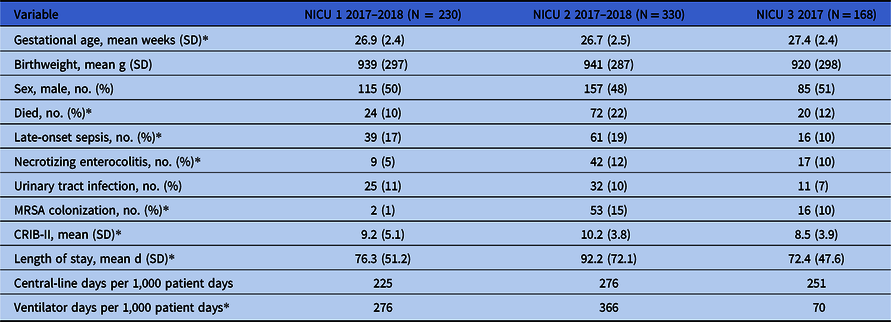
We analyzed antibiotic exposure for 728 VLBW infants <32 weeks GA. Table 1 compares patient characteristics across the 3 NICUs. Birth weight, GA, and sex were similar among the 3 sites. Mortality, CRIB-II scores, length of stay, and infection rates were highest at NICU 2, indicating an overall sicker cohort of VLBW infants. Central-line days per patient day were similar at the 3 units. Days on invasive mechanical ventilation per patient day were lower at NICU 3, reflecting preferential use of noninvasive respiratory support at NICU 3. Reference Polin and Sahni17 MRSA colonization was lowest at NICU 1, but this likely reflects the low frequency of screening compared with the other 2 units rather than a real difference in the prevalence of MRSA colonization.
Patient Characteristics Grouped by Sitea

*P < .05 by Kruskal-Wallis one-way analysis of variance.
Antibiotic metrics
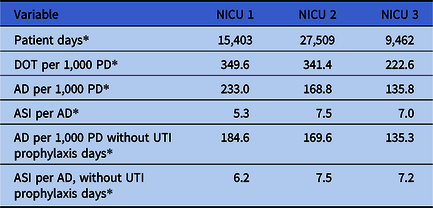
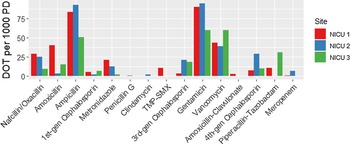
Several antibiotic-use variables were notably different among sites (Table 2). DOT and antibiotic days per 1,000 patient days were highest at NICU 1, while ASI per antibiotic days was lowest. We hypothesized that UTI prophylaxis was a driver of the lower ASI per antibiotic days at NICU 1 because this results in many antibiotic days with low ASI. Although the ASI per antibiotic days increased after excluding UTI prophylaxis, the ASI per antibiotic day remained lower at NICU 1. Antibiotic utilization varied by the center, particularly for drugs used for broad-spectrum coverage (Fig. 1). Vancomycin usage was highest at NICU 3, the site with the highest known MRSA colonization rates. Because the screening rate was much lower at NICU 1, we were unable to accurately compare MRSA colonization rates.
Antibiotic Exposure Measures by Site

Note. NICU, neonatal intensive care unit; DOT, days of therapy; AD, antibiotic days; PD, patient day; ASI, antibiotic spectrum index; UTI, urinary tract infection.
*P < .05 by Kruskal-Wallis one-way analysis of variance.
Relative frequency of antibiotic drug exposures among 3 neonatal intensive care units (NICUs). Bars represent the days of therapy (DOT) per 1,000 patient days (PD) for antibiotics used during the study period at each of the 3 sites.

During the years of the study, specific unit guidelines on the choice of empiric antibiotics differed (Supplementary Table 1 online). Most notably, the guidelines from NICU 3 recommended vancomycin as the first choice for gram-positive coverage in infants aged >1 week and piperacillin-tazobactam as first-line treatment for necrotizing enterocolitis. The guidelines from NICUs 1 and 2 recommended nafcillin–oxacillin as first choice for gram-positive coverage after the first week and ampicillin plus gentamycin with or without metronidazole for necrotizing enterocolitis.
Culture results
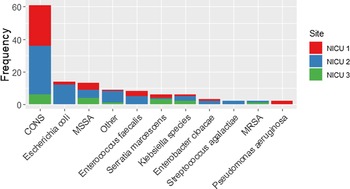
Of 122 positive blood cultures, the most common organisms were CONS (61, 50%), Escherichia coli (15, 12%), and methicillin-sensitive Staphylococcus aureus (MSSA, 8, 7%) (Fig. 2). The rates of MRSA sepsis at all 3 sites were very low during the period analyzed, with 1 case at NICU 2, 1 case at NICU 3, and no cases at NICU 1. NICU 2 had the highest incidence of bacteremia with sepsis and NICU 3 had the lowest. UTI rates were lowest at NICU 3. Among 66 positive urine cultures, Enterobacter cloacae (n = 8) and Escherichia coli (n = 5) were the most common organisms. One infant at NICU 3 had a recurrent E. coli UTI and 11 infants had 2 positive urine cultures with different organisms: 4 at NICU 1; 5 at NICU 2; and 2 at NICU 3.
Frequency of organisms causing sepsis with bacteremia during the study period at each neonatal intensive care unit (NICU 1 and 2 during 2017–2018 and NICU 3 during 2017). The category labelled “other” includes the following organisms: Citrobacter koseri, Bacteroides fragilis group spp, Clostridium spp, Haemophilus influenzae, Actinomyces oris, Prevotella bivia, Proteus, mirabilis, Streptococcus viridans group spp, and Streptococcus bovis group spp. Note. CONS, coagulase negative staphylococci.

Discussion
In this study comparing an objective measure of antibiotic spectrum exposure and clinical variables, we found differences among academic, level-4 NICUs in antibiotic utilization for VLBW infants. The differences identified by comparing the ASIs suggest that preferences in prophylaxis strategy and choices for empiric treatment drive intercenter variation in the spectrum of antibiotic exposure. These findings support the use of the ASI as an objective antimicrobial utilization measure for prospective surveillance to evaluate the spectrum of antibiotic exposure locally before implementing a stewardship program. Successful antibiotic stewardship programs have used prospective surveillance to safely reduce the duration of antibiotic therapy Reference Cantey, Wozniak, Pruszynski and Sánchez11 and the spectrum, as measured using the ASI. Reference Lahart, McPherson, Gerber, Warner, Lee and Newland6
Our data suggest that patterns of antibiotic usage are driven largely by local empiric antibiotic prescribing practices rather than identified organisms. This finding will not surprise most neonatologists, but they provide an easy tool to compare their practices with those of other units. Another tool for tracking antibiotic use in NICUs, the CDC NHSN Antibiotic Use and Resistance Module, 18 allows for benchmarking using standardized antimicrobial administration ratios (SAAR) developed by a national collaborative. Reference van Santen, Edwards and Webb19 The SAAR assumes that all antibiotics categorized as “broad spectrum” have equal impact, while the ASI gives specific weight to each drug. The ASI has the advantage of being accessible to all, without need for the specific training and hospital participation typically needed to use the CDC NHSN modules.
Multidrug-resistant bacteremia is rare in this population, and broad-spectrum antibiotics were presumably used in these patients to empirically treat cases of severe illness caused by necrotizing enterocolitis or other infections without bacteremia, such as pneumonia or tracheitis. NICU 2 used more cefepime (ASI = 6) and NICU 3 used more piperacillin-tazobactam (ASI = 8). The higher CRIB-II scores, mortality, and infection rates at NICU 2 suggest higher illness severity that might account for the higher DOT per patient days and ASI per antibiotic day. Other multicenter studies analyzing antibiotic exposures adjusted for disease and illness severity have found variability that can only be attributed to differences in institutional guidelines or preferences rather than patient or organism-specific factors. Reference Gerber, Hersh, Kronman, Newland, Ross and Metjian5,Reference Lahart, McPherson, Gerber, Warner, Lee and Newland6
NICU 3 used the most vancomycin despite a low incidence of CONS or MRSA bacteremia during the 1-year study period. The year studied came at a time just following an initiative to reduce MRSA colonization prompted by a surge in MRSA infections. This analysis may be limited by the shorter period with data available for the study at this center. The study period also followed a stewardship initiative at NICU 2 that implemented a change in guideline to recommend nafcillin or oxacillin instead of vancomycin as the first choice for empiric gram-positive coverage. This intervention resulted in safe reduction in ASI per antibiotic day Reference Lahart, McPherson, Gerber, Warner, Lee and Newland6 without an increase in balancing measures. In many cases in which the blood culture yielded CONS, repeat blood cultures prior to switching from empiric coverage with nafcillin or ampicillin and gentamicin to vancomycin are negative, suggesting either that the CONS was a contaminant, that the empiric antibiotics eliminated it, or that the initial positive culture represented transient bacteremia.
NICU 1 used more amoxicillin and other narrow-spectrum antibiotics for UTI prophylaxis than the other centers. This reflects differences in unit guidelines related to UTI prophylaxis as a result of variable interpretation of limited evidence-based guidelines on the matter. Reference Flannery, Brandsma, Saslow, Mackley, Paul and Aghai20,21 We recently published a 2-NICU study of UTI in VLBW infants in which we found no difference in recurrent UTIs among infants with or without antibiotic prophylaxis following a first UTI, Reference Aviles-Otero, Ransom and Weitkamp22 and we have modified unit guidelines at NICU 1 to restrict prophylaxis to infants with known urinary tract malformation or multiple UTIs. We did not have data on whether any included antibiotics were prescribed for perioperative prophylaxis. However, most surgeries in these infants would have been for necrotizing enterocolitis or intestinal perforation and the antibiotics prescribed would have been for treatment and not prophylaxis. Other surgeries are uncommon in this population, and typically only 1 or 2 doses of antibiotics are given, depending on the surgeon’s practice and the procedure performed.
This study provides evidence for the utility of the ASI in comparisons of similar NICUs with different practices and can guide stewardship initiatives to reduce the use of broad-spectrum antibiotics. A limitation of the ASI is that it was developed for pediatric patients and does not assign points for common pathogens affecting premature infants, including group B Streptococcus and CONS species. Reference Stoll, Hansen and Fanaroff23,Reference Mukhopadhyay and Puopolo24 Future work could develop and validate a modified ASI for premature infants.
We analyzed 2 years of antibiotic data from 2 NICUs and 1 year of data from a third unit to capture static differences in antibiotic utilization and infection rates among cohorts. A longer study period or prospective data collection may have identified changes over time. Using retrospective data, we did not know the indication for every antibiotic exposure or whether antibiotic days could be categorized as targeted therapy versus empiric treatment of a presumed infection. This approach precluded a more detailed analysis at the patient level and limited our ability to make conclusions about driving factors for the differing antibiotic use patterns. Also, we did not collect data on positive cultures from other sources, such as tracheal, skin, or spinal fluid cultures, which likely influenced the choice of antibiotics for some infants. Despite these limitations, the results of our analysis uncovered several specific targets for prospective surveillance and stewardship interventions.
In conclusion, an ASI was used to identify differences in antibiotic prescribing patterns among 3 NICUs unique from those identified by standard antibiotic use metrics, and despite similar organisms causing infections. Potential drivers of ASI differences included patient characteristics, infection rates, and unit guidelines for choosing prophylactic and empiric antibiotics. This comparison of multiple academic NICUs enabled us to identify opportunities for changes to unit guidelines and practices that would improve antibiotic stewardship.
Supplementary material
To view supplementary material for this article, please visit https://doi.org/10.1017/ice.2021.467
Acknowledgments
Financial support
This study was supported by the National Institutes of Health (grant nos. NIH/NICHD K23 HD097254 to Sullivan and NIH/NINDS K23 NS111086 to Vesoulis) and by the Agency for Healthcare Research and Quality (grant no. AHRQ R01HS026742 to Newland).
Conflicts of interest
All authors report no conflicts of interest relevant to this article.