

Internationally, there has been an increasing emphasis on inclusive practice and the provision of supports needed to enable students with special educational needs to participate and achieve in the context of mainstream curriculum and classes (Anderson & Boyle, Reference Anderson and Boyle2015; Chowdhury, Reference Chowdhury2011; United Nations Educational, Scientific and Cultural Organization, 2005). In Australia, the Disability Standards for Education 2005 (Commonwealth of Australia, 2006), made under the Disability Discrimination Act 1992 (Australian Government, 1992), states that an education provider is required to make any decisions about admission, enrolment, or participation such that reasonable adjustments will be made, where necessary, so that the student with disability is treated on the same basis as a student without disability. Although this legislation sets out requirements for making a reasonable adjustment according to individual need and determining such adjustments in consultation with the student and/or their parents, it does not specify the form that adjustments should take.
There is inconsistency in terminology around changes made within schools to meet the needs of students with special educational needs (Harrison et al., Reference Harrison, Bunford, Evans and Owens2013), with terms such as differentiation, adjustments, adaptations, accommodations, and modifications being variously employed. To reflect Australian terminology in the current study, the term adjustments will be used generically to refer to changes to curriculum (what is taught), instruction (how it is taught), and general support strategies (e.g., behaviour management, environmental changes) used to facilitate the learning of students with special educational needs in mainstream classrooms.
In New South Wales (NSW), all mainstream government schools receive funding allocated through a needs-based methodology that reflects the student profile, as well as targeted funds to support eligible students with identified disability (NSW Department of Education and Communities, 2012). Approved uses of funding may include additional teacher time; teacher release for coordination, mentoring, training, or development; classroom observation; team teaching; as well as teaching assistant time (NSW Department of Education and Training, n.d., 2018). This places the onus on school teams, and principals in particular, to engage in decision-making processes that will enable them to utilise the school’s allocated resources to meet the needs of all their students, including students with disability.
The Nationally Consistent Collection of Data on School Students With Disability (NCCD; https://www.nccd.edu.au) program has operationalised the reporting requirements and obligations of schools under the Disability Standards for Education 2005 (Commonwealth of Australia, 2006). As part of the NCCD, schools identify evidence of the adjustments that teachers have implemented to address the functional impact of a student’s disability. These obligations entail providing evidence of consultation and collaboration with the student and/or their parent, the assessed needs of the student, the provision of adjustments to meet these assessed needs, and monitoring and review of the impact of the adjustments provided (Australian Government, 2020a, 2020b). As previous research has demonstrated that formative monitoring of student performance improves outcomes for students with disabilities (Carter, Stephenson, & Carlon, Reference Carter, Stephenson and Carlon2020; Fuchs & Fuchs, Reference Fuchs and Fuchs1986; McLeskey et al., Reference McLeskey, Waldron and Redd2014), it is essential that school teams incorporate regular and systematic data collection and evaluation into their decision-making processes.
A number of researchers have attempted to characterise adjustments implemented by educators within mainstream classrooms. In some cases, schools were carefully selected as exemplary (e.g., Morningstar et al., Reference Morningstar, Shogren, Lee and Born2015), so findings may not be applicable to a broader range of school contexts. Other researchers have focused on very specific populations and types of adjustments, such as communication adjustments for students with autism spectrum disorder (ASD; e.g., Harper-Hill et al., Reference Harper-Hill, Trembath, Clark, Bruck and Saggers2021).
Kurth and Keegan (Reference Kurth and Keegan2014) investigated curricular adjustments through an examination of adapted and unadapted materials utilised by 31 educators (general education teachers, special education teachers, and teaching assistants) for students with severe disabilities in the United States of America (USA). They reported that the most frequent adjustments included changes to instructional stimuli, simplification of materials, or alternatives for student response. Finnerty et al. (Reference Finnerty, Jackson and Ostergren2019) also described adjustments to materials and curriculum employed by six teachers to facilitate access to grade-level content for students with severe disabilities in specific lessons in three general education classrooms in the USA. Although data sources included classroom observations, as well as interviews and artefacts, and some adjustments to instructional procedures were described, the focus of the study was on adjustments to materials and curriculum.
Strogilos et al. (Reference Strogilos, Avramidis, Voulagka and Tragoulia2020) examined instructional adjustments in 34 classrooms in Greece with students aged 4–8 years who were co-taught by general and special education teachers. Based on lesson plans, the most common adjustments were instructional, relating to how content was taught (around 75%), followed by curricular, relating to what is taught (around 25%). These findings contrasted with those of Kurth and Keegan (Reference Kurth and Keegan2014), who found greater curricular adjustments. Part of this difference could be that Strogilos et al. (Reference Strogilos, Avramidis, Voulagka and Tragoulia2020) examined co-taught classrooms. Researcher evaluation of the adjustments indicated they considered them poorly matched to the needs of students and generally similar to the original activities.
Wehmeyer et al. (Reference Wehmeyer, Lattin, Lapp-Rincker and Agran2003) conducted an observational study of 33 middle school students with intellectual disabilities in the USA in both mainstream and segregated classrooms. A key finding was that, across both groups, students were observed to receive an adjustment in content or representation in only 2.8% of intervals. Wehmeyer et al. (Reference Wehmeyer, Lattin, Lapp-Rincker and Agran2003) did not provide detailed analysis of the nature of adjustments made for students.
Lee et al. (Reference Lee, Wehmeyer, Soukup and Palmer2010) observed 45 high school students, primarily with learning disabilities, in the USA who were accessing the general education curriculum in mainstream classrooms. Lee et al. (Reference Lee, Wehmeyer, Soukup and Palmer2010) found provision of adult (teaching assistant) support was by far the most frequently observed adjustment (62.2% of observed intervals). A range of other adjustments were coded, including time adjustments, assistive technology, and adjustment of materials, but no other single adjustment was present in more than 20% of observations. Despite their extensive use, teaching assistants were observed to engage in behaviour classified as ‘instructional’ in only 0.6% of observed intervals. Support by adults, almost always teaching assistants, was also by far the most common support observed by Ware et al. (Reference Ware, Butler, Robertson, O’Donnell and Gould2011) in multiple case studies that involved 46 students conducted across 11 schools in Ireland. Although a range of adjustments were observed, most of these were used infrequently. Adult support was used almost 5 times as frequently as all other forms of support combined, and students were supported by adults about half the time. Furthermore, very few examples of specialist pedagogy were observed.
Thus, some existing research has focused, in part or whole, on examining specific adjustments nominated by teachers (Finnerty et al., Reference Finnerty, Jackson and Ostergren2019; Kurth & Keegan, Reference Kurth and Keegan2014; Strogilos et al., Reference Strogilos, Avramidis, Voulagka and Tragoulia2020) or broad classification of adjustments (Wehmeyer et al., Reference Wehmeyer, Lattin, Lapp-Rincker and Agran2003). Where assistance from educational staff has been examined as a form of adjustment, there is evidence that it is commonly employed (Lee et al., Reference Lee, Wehmeyer, Soukup and Palmer2010; Strogilos et al., Reference Strogilos, Avramidis, Voulagka and Tragoulia2020; Ware et al., Reference Ware, Butler, Robertson, O’Donnell and Gould2011), in particular the use of teaching assistants (Lee et al., Reference Lee, Wehmeyer, Soukup and Palmer2010; Ware et al., Reference Ware, Butler, Robertson, O’Donnell and Gould2011). In summary, limited research has been conducted on the range and focus of adjustments that are employed in schools or how the impact of these adjustments on student outcomes is monitored.
The data reported here are based on a larger study, which examined the way in which schools in NSW engaged in decision-making processes to select, monitor, and evaluate the effectiveness of adjustments for students with special educational needs. Results relating to decision-making processes are reported elsewhere (Carter, Webster, et al., Reference Carter, Webster, Stephenson, Waddy, Stevens, Clements and Morris2020). The present paper focuses on the specific types of adjustments that were provided and the means that were used to monitor their effectiveness for students. Given the relatively limited research in this area (Strogilos et al., Reference Strogilos, Avramidis, Voulagka and Tragoulia2020), the study was fundamentally exploratory in nature. The research questions for this study were as follows:
-
1. What adjustments do schools employ and how are they used to support students with special educational needs in mainstream classrooms?
-
2. How do schools evaluate the effectiveness of the adjustments and resources they use?
Method
Ethics
The research received ethics approval from both the Macquarie University Human Research Ethics Committee (ethics approval number: 5201600837) and the NSW Department of Education (SERAP: 2016531). All participants gave informed consent for the research.
Research Design
A primarily qualitative approach was taken with data collected using semistructured interviews. Multiple stakeholders in each school were interviewed, which provided a multi-perspective understanding of adjustment decisions made. The general methodological approach taken was most consistent with qualitative description (see Bradshaw et al., Reference Bradshaw, Atkinson and Doody2017; Sandelowski, Reference Sandelowski2010). Within the qualitative description approach, the researcher initially focuses on the literal description provided by participants and then on interpretation and understanding phenomena (Bradshaw et al., Reference Bradshaw, Atkinson and Doody2017; Sandelowski, Reference Sandelowski2010). Qualitative description maintains proximity to the data under examination (Sandelowski, Reference Sandelowski2010) rather than the highly abstract rendering that is characteristic of some other approaches (Bradshaw et al., Reference Bradshaw, Atkinson and Doody2017).
Recruitment
Principals from 800 schools across NSW were selected from a random sample of schools who met the participation criteria. Participation criteria specified that schools did not have a specifically designated special education class and had students enrolled full-time in a mainstream class who were identified through the NCCD framework as requiring extensive or substantial adjustments. The NCCD classifies children across four levels of support. Substantial adjustments represent the second highest level of support under the NCCD, with support occurring on most days and at most times (Australian Government Department of Education, 2019). These adjustments may involve extra specialist advice and additional support across multiple curriculum areas (Australian Government Department of Education, 2019). Extensive adjustments involve the highest level of support under the NCCD, which typically include the provision of targeted support at all times and extensive involvement of specialist staff (Australian Government Department of Education, 2019). The decision to limit sampling to schools that did not have a special education class was taken because members of the research team from the Department of Education indicated the need to avoid confusion that might arise regarding the target group. There was concern that students who spent all or the majority of time in a special class might be nominated for the research. The schools were initially approached by the NSW Department of Education to participate in the study. A total of 22 schools agreed to participate.
Participants
The schools were approximately representative of those in the complete sample, including 18 primary (82% of the study sample compared to 76% for the state) and four high schools. Fifteen were located in a metropolitan area (68% of the study sample compared to 61% for the state), three were in inner regional areas, and four were identified as outer regional schools (32% of the sample were regional schools in comparison to 38% of those in the state). Three schools had fewer than 50 students, five schools had 51–200 students, eight schools had 201–500 students, four schools had 501–1,000 students, and two schools had 1,001+ students.
Principals were asked to identify a focus student who required extensive or substantial adjustments under the NCCD and to nominate key stakeholders who were involved in decisions about that student to participate in interviews. Individuals recruited included 22 parents or guardians, 20 mainstream teachers, 18 principals (including two teaching principals), 15 learning support teachers, 14 school counsellors, eight teaching assistants, eight other executive staff members, one itinerant teacher vision, and a single student. All names reported in the manuscript are pseudonyms.
Of the focus students identified by each school, 13 were reported as requiring substantial adjustments under the NCCD, eight were reported as receiving extensive adjustments, and the classification of one student was unclear due to contradictory information from participants. It should be noted that due to confidentiality issues when working with the NSW Department of Education, the researchers relied on information from participants with regard to the level of adjustment. Data were obtained from parents on student diagnoses including ASD (n = 11, 50%), attention-deficit/hyperactivity disorder (n = 6, 27%), visual impairment (n = 5, 23%), Down syndrome (n = 3, 14%), learning difficulties (n = 2, 9%), and other diagnoses (n = 7, 32%). In addition, several students had multiple diagnoses (range: 1–3). The proportion of diagnoses across the broad NCCD categories in the sample was comparative for cognitive (44% of the study sample compared to 57% for the state), physical (9% for the study sample compared to 13% for the state), and social/emotive (31% for the study sample compared to 28% for the state; Australian Curriculum, Assessment and Reporting Authority, 2018). However, the proportion of sensory disability diagnoses was higher in the study sample, with 16% of total diagnoses being sensory compared to 3% as the main diagnosis for the state (Australian Curriculum, Assessment and Reporting Authority, 2018).
Interview Procedures
An interview schedule was developed and piloted with three volunteer participants, one teacher, one parent, and one principal. Following the coding of the pilot interviews and feedback from these participants, the interview questions were further refined.
Initially, stakeholders were informed that the researchers were interested in how decisions were made with regard to adjustments/supports for the student this year, as well as the specific adjustments and supports that were provided this year. Relevant demographic information was also collected from each participant, including qualifications and current position for school staff and relationship with the student for parents/caregivers.
In order to minimise the risk of leading, participants were asked broad questions about the focus student around general themes, followed by specific probe questions to elicit more detailed information. Participants were first asked if they remembered whether any specific goals or objectives were considered during the planning process. Depending on their response, they were then asked to outline these goals or objectives, indicate whether they were consistent with their expectations and their satisfaction with these goals. If they did not remember any goals, or stated they were not aware of any, stakeholders were asked what goals they personally had for the student and whether they were aware of a documented individual learning plan, IEP, personalised learning plan, or similar. Similarly, a general question about supports was followed by probes about potential supports in various areas and about the use of teaching assistants, if relevant. Broad questions about monitoring and evaluation were also then followed by probes about specific aspects of data collection and use. Finally, participants were asked to comment whether the current adjustments were meeting student needs and to explain their view. In addition, issues around the process of decision-making were explored, but these data are not reported in this paper. Full copies of the interview schedules can be obtained from the first author on request.
Each participant was interviewed individually by a trained research assistant, either at the participant’s school or over the phone. Interviews varied in length and were approximately 41 min on average (range: 13–75 min). Interviews were audiotaped and later transcribed for coding purposes. A copy of their interview transcript was sent to each participant to confirm accuracy of data and determine whether participants wished to clarify information. Participants were asked to specify any needed changes or additions and return the transcript to the research team.
Data Analysis
Given the quantity of data being examined and the complexity of the analysis, coding was conducted in three stages. The latter two stages of coding focused on synthesis and further development of interpretative themes.
Stage 1: Preliminary coding
A semantic coding approach using NVivo 11 (QSR International, 2015) was taken in the first round of coding, with a focus on explicit or surface meaning (Braun & Clarke, Reference Braun and Clarke2006). A preliminary framework was developed based around the research questions (e.g., types of adjustments, monitoring). Initial coding was trialled for transcripts from three schools. Codes were assigned at the sentence level. A research assistant completed initial coding for each of the three schools; these codes were then double coded by one of the first three investigators. Agreement calculated between the first coder and second coder was 91% across all three schools. Adjustments and refinements were made to the coding structure based on this initial examination. The research assistant then completed the preliminary coding for all 22 schools.
Stage 2: General themes and codebook development
Schools were allocated to each of the first three investigators to examine individually, one per week. The investigators met weekly to discuss general themes emerging from the data and develop the codebook. The codebook was progressively refined until all schools had been reviewed and final themes identified.
Stage 3: Final coding
Three schools (separate from those used in Stage 1) were coded by all three investigators to refine and clarify codes. Supporting evidence was reviewed and a summary position for each school was provided against the key themes considering all of the evidence provided by participants. Subsequently, these researchers independently coded themes for the 19 remaining schools and met approximately weekly to discuss the coding and, where relevant, review supporting evidence.
Credibility
To enhance the credibility of data, a number of strategies were employed, as well as asking general questions before probing, and having participants review their transcripts:
-
1. Information was crosschecked between participants within each school (Robinson & Donald, Reference Robinson, Donald, Chitpin and Evers2015) where relevant in order to verify accuracy of factual information and evaluate consistency of perceptions.
-
2. Researchers actively sought disconfirming evidence by looking for counterexamples and alternative explanations to minimise the risk of confirmation bias (Robinson & Donald, Reference Robinson, Donald, Chitpin and Evers2015).
-
3. In all stages of coding there was extensive discussion and triangulation between the authors involved in coding.
Consistency of Factual Information
One area of interest in the research was the consistency of participant views across each school. The matrix function in NVivo allowed for cross-referencing of information provided by participants (i.e., adjustments used). For evaluation of consistency, percentage agreement was preferred to Cohen’s kappa, as it is a descriptive and directly interpretable measure (McHugh, Reference McHugh2012). Percentage agreement was calculated by looking at the actual agreements across participants divided by the total possible agreements.
Results
Types of Adjustments
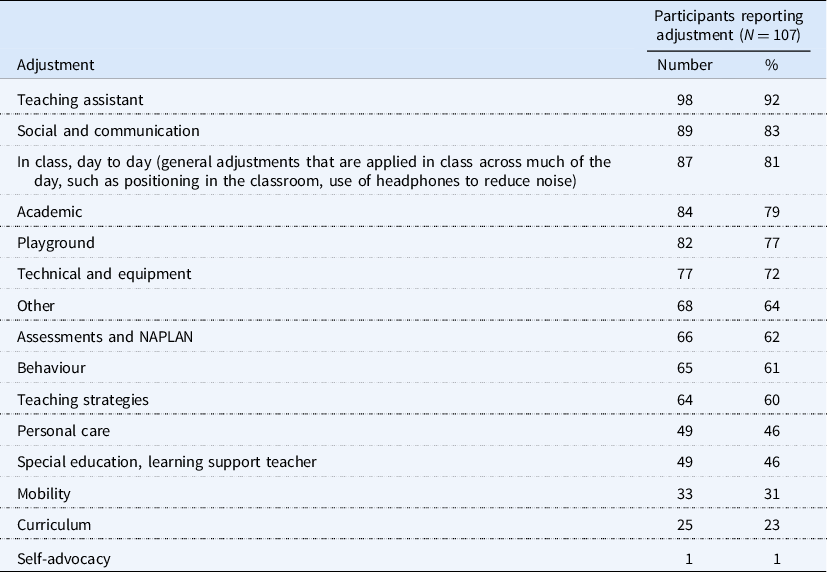
In the first stage of data analysis, explicit semantic information was coded, including the types of adjustments provided to students. In addition, the degree of agreement between participants was estimated. Reported adjustments implemented and the number of participants reporting each type of adjustment are summarised in Table 1. The mean number of adjustments reported by participants was nine (range: 0–13), with the most common being the provision of teaching assistant time, which was reported by more than 90% of respondents. The two least commonly reported adjustments were for curriculum (23%) and self-advocacy, which was reported by only one participant. The mean level of agreement across participants in a school on types of adjustments was 76% (range: 56%–91%).
Implemented Adjustments

Note. NAPLAN = National Assessment Program – Literacy and Numeracy.
Thematic Analysis
In addition to determining frequency and type of adjustments, a more detailed analysis of the transcript data revealed several key themes relevant to understanding the nature of adjustments provided by schools. These are described in more detail in the sections that follow in relation to adjustments and monitoring.
Adjustments
Management/care versus broad educational focus
The first theme related to the degree to which a participant’s responses described a focus of adjustment on teaching skills to the student rather than a focus on general care and management. Analysis of responses indicated that the primary focus in the education program of approximately one third of the schools was on management/care of the student with special educational needs. That is, they focused exclusively, or had a near exclusive focus, on care, safety, participation in school life, behaviour and risk management, task-related behaviour, or happiness. For example, when referring to the student goals, the learning and support teacher from School 17 noted,
Yeah, keep him safe number one. I think the main one and that I like a lot is that inclusive and stand back and just let him be in the world with the other kids, but just be the one to create the boundaries I guess, just constant reminders about what the boundaries are.
The remaining schools were considered to have a broad educational focus on teaching of academic, social, and other skills. For example, a teacher from School 22 described the main goal for the student as ‘improving her reading and maths ability really’, but stressed happiness. The principal from the school also noted that
… her goal was always to just be like everybody else. Just come in and get a good education and play and have friends and happiness and all of those sorts of things that every other child wants and that she has every right to have.
At School 2, the principal described multiple goals for their student:
The biggest goal that we have now is around his social interaction … So there is goals on multiple levels. Behaviourally, academically, socially, sporting.
Narrow versus broad focus of adjustments
Approximately two thirds of schools evidenced a narrow focus for the adjustments implemented, concentrating on only a small range of needs. In some cases, this appeared well matched to the reported student needs. For example, a number of the schools who reported on adjustments for students with visual impairments (Schools 16, 18, and 21) focused mainly on providing access to curriculum, such as enlargement of material and use of technology (e.g., visualisers, iPad) as well as mobility training. However, in other cases, it appeared that this narrow focus may not have comprehensively addressed reported needs. For example, School 15 focused on the safety and behavioural needs of a student with ASD, as evident in the learning and support teacher’s comment:
Predominately, the options were changing the environment … We were able to talk about the options in terms of academic work and where we needed to place him. For example, we did talk about do we engage in a minimal intensive program with an SLSO [teaching assistant] but the decision was made that until the environment was right he was unable to engage.
Participants from the remaining one third of schools described implementing a more broadly based educational program and adjustments addressing a wide range of needs. For example, participants in School 22 described implementing additional playground monitoring for health reasons, a small-group mathematics program with the support teacher and teaching assistant, individualised reading instruction, adjustments to a spelling program, testing adjustments (extra time, having questions read to her), and teaching assistant support in social groups to improve social interaction.
Pedagogical and curricular characteristics of adjustments
Although there was often expected variation across the perspectives of individual participants, the adjustments provided in most schools were clearly described and broadly agreed upon. In describing adjustments, the majority of the schools’ participants described what could be characterised as ‘light-touch’ approaches that required minimum changes to existing practices or curriculum (i.e., content that is taught). For example, academic adjustments were often described in terms of providing simplified work or assigning a teaching assistant to work with the student, as opposed to making significant adjustments to teaching strategies such as differentiating the curriculum or assessment. When asked to describe academic adjustments that were made for a student, the principal from School 15 only commented that ‘His work has been simplified’, while the classroom teacher did not describe implementing any academic adjustments in class, but did note
We have a school learning support officer [teaching assistant] who comes in to help Lachlan and other children. She comes in after recess…. So, she tries to work as much as she can one on one with Lachlan. Yeah … that’s the significant one I guess.
Participants at a few schools did provide a small number of examples of more significant adjustments to pedagogy. For example, the principal from School 2 described a visual timetable, social stories, and a behaviour support plan, and a teacher at the same school commented,
I make sure that when I’m working with him, that I get him to sit opposite me so that we’ve got, you know, I’m right in front of him so I can stop him from being distracted by stuff happening behind us. We’ve got eye contact, make sure he’s listening to me, and we just do lots of reminding, we do lots of retelling, showing, helping, so you support him a lot in getting stuff started. And when he does something, we’re really making a big deal, ‘Wow, look at that! You’ve really done that well. And that’s fantastic writing’.
Participants reported that a primary focus for many students was task completion (on-task behaviour), while the primary support implemented was the use of a teaching assistant. For example, in School 22 the parent commented,
Claire found it very, very hard to work independently by herself and will just say I can’t do it. Having someone, especially when you have a class of 30 kids, at least that she had someone there to help her at all times.
When the learning support teacher at School 15 was asked to discuss goals established for the use of the teaching assistant, she commented, ‘The second one was to engage him with his academic work and assist him in learning new concepts’. Systematic attempts to teach task completion strategies to students were described in only a minority of schools (e.g., Schools 2, 6, and 13), with the majority relying primarily on use of prompts provided by teaching assistants to support students to complete tasks. Although adjustments related to social outcomes were reported for some students, the nature of these adjustments usually involved providing experiences, such as buddies, clubs, or groups, rather than targeted instruction.
Thirteen schools reported extensive use of teaching assistants (e.g., several hours a day, typically one to one), identifying them as an adjustment. For example, the principal of School 17 stated,
There’s a school learning support officer [teaching assistant] which is allocated to him almost full-time. I think there’s probably an hour or two a week that he doesn’t get support … He’s supported in the playground as well as the classroom.
Similarly, at School 5, the principal noted that ‘… the main adjustment for Gary is to have his individual learning programs supported by an individual student learning support officer [teaching assistant] who works with Gary specifically’.
In cases where the teaching assistant was not employed full-time, interviewees often indicated that additional teaching assistant time was needed to support the student. For example, the learning support teacher from School 8 noted,
I’d like to see funding increased, because of an afternoon she [teaching assistant] leaves at recess time, so that’s around 2.30 she finishes her day. So we have an extra hour with John and at that time it can be quite difficult …
A notable feature of the interviews was the very infrequent mention of any attempts to withdraw or fade teaching assistant support over time.
In six schools, teaching assistants were judged to be used selectively in providing adjustments (e.g., during key periods of the day, general classroom support, etc.). For example, in School 16, a parent stated,
Well, he has the teacher’s aide that comes in, he has twice a week for a few hours. That’s all. That’s all in there and funded. But it’s not just for him. The teacher’s aide is there for other kids if required. It’s not just specifically for Blake.
The teacher also described how the teaching assistant supported both Blake and other students in the class.
Only three schools reported not using teaching assistant support at all, which was linked to funding issues in two schools. The principal of School 2 noted, ‘We would have loved to have been able to have employed a school learning support officer … to give Fred that additional one-on-one support, but funding has restricted that’. In the third school (School 3), the student had rejected teaching assistant support.
Role of teaching assistants
Participants indicated that teaching assistants were used almost exclusively in supplementary roles in the sense that they supported students under the direction of a teacher and were not reported to independently plan or adapt instruction. For example, the principal from School 22 commented, ‘… the SLSOs [teaching assistants] work under the learning and support teacher to put programs in place for Claire’. The support teacher from this school also noted that the class teacher’s role involved ‘training and working alongside the teacher’s aides to make sure that they’re implementing the programs that we’ve set up for her correctly’. Although most participants indicated that the teaching assistant worked under the direction of teachers, it is worth noting that participants generally offered limited detail on exactly how much teacher direction was provided.
A few participants did describe teaching assistants as having more extensive responsibility for student management, planning, adjusting, or delivering instruction. For example, the classroom teacher in School 8 noted that ‘her [teaching assistant] main role is to work with me with his learning program, and to be there, support him, encourage him, maybe adjust the lesson if it’s too difficult, or try and talk about it in a different way’. At School 6, the teaching assistant described her role: ‘… [class teacher] basically delivers the curriculum and then I modify it to whatever Ben’s needs are, and then I assist to deliver it in a different means so Ben can grasp it’. At this school, the principal specifically noted that special effort was required to secure the services of this particular teaching assistant.
Outcomes related to provision of teaching assistant support
Participants were asked whether they had identified any specific outcomes they expected to achieve through the use of teaching assistant support. In almost all cases, respondents stated either that there were no outcomes or goals related to the provision of the teaching assistant or they described the teaching assistant’s responsibilities. For example, the teacher from School 19 stated, ‘so her role is there to assist me, or whoever the classroom teacher might be, in making sure he has what he needs’.
Meeting needs
Most of the participants indicated that they viewed the student’s needs as being met by the adjustments in place. For example, the parent from School 21 commented, ‘Yes, definitely … Because she’s on track. Her grades are doing really well. She’s, I think, where she should be. She’s happy and that’s all that matters’. The class teacher from School 22 noted that
I think they are meeting her needs. I think she feels safe, she feels happy and I think we’re inclusive of her. The kids are definitely inclusive of her. They know she’s a bit different but they’re not unkind to her. They just treat her like one of the other kids basically so that’s quite good.
Nevertheless, in more than half of schools, at least one participant indicated that the student had needs that were not currently being met. In many cases, these needs were in non-academic areas such as communication and social skills. For example, both the head teacher of learning and support and the parent in School 20 identified communication as an area of unmet need. The head teacher noted,
The area that we haven’t really made the steps that her parents and the school would like is in the communication, the eye gaze in particular. We keep meeting problems with that in terms of sourcing personnel and equipment. So I would have liked to have seen that gone further than it has.
Monitoring
Student goal clarity
Respondents were asked about specific goals or objectives for each student. In contrast to participants’ description of adjustments, which were often clearly outlined, descriptions of educational goals tended to be broad, non-specific, or unclear. For example, the principal from School 22 noted,
I suppose if you’re looking at specific goals, it was mainly that she would adapt and be part of a mainstream school. That she would have access to opportunities just like any other child … So in terms of goals, her goal was always just to be like everybody else. Just come in and get a good education and play and have friends and happiness and all of those sorts of things that every other child wants and that she has every right to have.
Other participants gave similarly vague descriptions stating,
In year seven it was inclusivity and for him to transition well and make friends … In the older years now it’s about content. He’s got to get his head around content. (Learning support teacher, School 18)
When participants did identify academic goals, they generally described these in terms of broad outcomes such as ‘improving her reading and maths ability’ (Classroom teacher, School 22). When asked if her son had specific goals, a parent from School 4 commented,
No not really, it’s fairly grey I suppose, it was sort of to just try and help him, you know, do this reading and do that. But nothing like, okay, if you’re reading on level 18 now we’re going try, let’s aim by the end of the term to get to 20. Nothing like that, no.
In addition, a number of respondents, including classroom teachers, support teachers, principals, and parents, either stated that they did not know whether there were specific goals or that they were not aware of the goals for the student.
In contrast, a limited number of respondents did outline clear, specific, and measurable goals for the student. For example, the class teacher from School 1 stated, ‘Yep, so getting him completing his writing task on time, at least five sentences….’ And ‘my goal for him, at this point in time, is that he will be reading level 16 by the end of the year’. The executive staff member from School 9 stated,
Basic goals, when she first started kindergarten, was to write her name, count to 10, read a level 2 text, I think I had a goal of write five simple sight words. We started off with a goal of I think it was going two days without having a toileting accident, and then we expanded that to going a week without having a toileting accident.
Monitoring
Participants in all schools reported using informal monitoring to evaluate the adjustments that they used, indicating that often this was the only form of monitoring used. Informal monitoring included informal observation, informal discussion between stakeholders, and informal discussion at meetings. For example, the teacher from School 6 commented, ‘Yeah, we do informal evaluations. So as I said, we’re constantly talking about what we’re doing, what we could do better? What worked, what hasn’t worked?’ Other statements about informal monitoring included, ‘Not formally, mostly just informally in terms of anecdotal notes, day-to-day communication with the teachers and talking about what was working and whether or not the time that she was having was being used well’ (Teacher, School 22).
Some participants did discuss using more formal monitoring processes. However, these examples almost always involved the use of generic assessments such as regularly scheduled class assessments, semi-annual class assessments, and standardised tests such as the National Assessment Program – Literacy and Numeracy (NAPLAN) assessment given each year.
Very few participants described ways in which they collected data, such as weekly reading assessments and measures of playground behaviour, to monitor students’ skills or behaviours. For example, the principal from School 17 noted,
So Mrs Hayes asked for some additional support during the year and she’d graphed some data about the amount of times that he was absconding from the classroom, the amount of times that he was dropping to the ground, and so we used that data to go, ‘Okay, this is the picture that we’ve got now, there’s a whole person that’s actually required to stay with James so that the other children’s learning isn’t interrupted’, and so we allocated some additional SLSO [teaching assistant] time.
When asked about changes they had made in response to monitoring of students, participants often indicated that either no changes were made or they offered non-specific and general descriptions of change. For example, the counsellor from School 2 noted, ‘It’s forever changing, we’re constantly trying to develop ideas that work’. Likewise, the teacher from the same school commented, ‘Oh yeah, all the time, we’re always revising and making changes whether they’re subtle or big changes, yeah that happens constantly’. In a few cases, participants offered clear and specific details about changes they had made. For example, the learning and support teacher from School 15 noted that ‘Changes were made to how he used the calm corner’.
Discussion
Adjustments
The current study was conducted to address a gap in the research regarding how schools use adjustments to support students with special educational needs and the means they use to monitor and determine effectiveness. Between participants in each school, a reasonably high level of agreement was established with regard to the type of adjustments they employed. Moreover, analysis of data revealed a number of distinctive features regarding the types and patterns of adjustments used by schools. The first of these was how adjustments were used by schools. A notable feature in around 30% of schools was a substantial emphasis on management and care, which was illustrated by the use of adjustments to address students’ issues related to safety, behaviour management, and staying on task. Previous researchers have also found that some educators place a strong emphasis on caregiving, behaviour management, and safety, especially for students with high support needs (Roberts et al., Reference Roberts, Ruppar and Olson2018; Ruppar et al., Reference Ruppar, Roberts and Olson2018).
Findings in the current study also revealed that many schools did not clearly indicate they utilised adjustments extensively to support students to access curriculum content. Adjustments were particularly limited for supporting students to access curriculum content in non-academic skill areas, such as communication or social skills. This finding is especially concerning given that many of the focus students in the current study were identified with disabilities (e.g., ASD, Down syndrome) that are typically characterised by deficits in these areas. More importantly, researchers have emphasised that failure to address such skills may prevent these students from fully accessing the academic curriculum (Ostmeyer & Scarpa, Reference Ostmeyer and Scarpa2012). Previous researchers have also noted the limited address of other generic capacities that would enable access to the general curriculum, such as self-directed learning (Lee et al., Reference Lee, Wehmeyer, Soukup and Palmer2010; Wehmeyer et al., Reference Wehmeyer, Lattin, Lapp-Rincker and Agran2003).
Another feature of adjustments was the types of adjustments used by schools. Participants described adjustments that typically involved the addition of human resources in the form of teaching assistants or work simplification. The adjustments could be described as a ‘light touch’ in that they aimed to support students to complete tasks, but involved limited changes to teacher behaviour. These findings are somewhat consistent with the conclusions of Strogilos et al. (Reference Strogilos, Avramidis, Voulagka and Tragoulia2020), who noted that adjustments in classrooms in Greece were limited in variety and often provided a shallow level of support. Adjustments of teaching that could benefit learners with special educational needs, including universal design for learning (Rao et al., Reference Rao, Ok and Bryant2014) and explicit instructional strategies (Archer & Hughes, Reference Archer and Hughes2011; Rosenshine, Reference Rosenshine2012), were much less frequently and clearly evident. It is possible that participants, and teachers in particular, may have seen adjustments of this nature to be too ‘routine’ to mention, but this would seem unlikely given the degree of detail provided on other adjustments. These findings are consistent with Australian evidence that the adjustments teachers most often employ tend to be those that do not involve major change. For example, Shaddock et al. (Reference Shaddock, Smyth King and Giorcelli2007) have noted that the traditional use of funding to provide teaching assistant hours may discourage schools from using alternative adjustments. One important direction for future research would be to examine strategies that facilitate school use of more substantive adjustments to teaching practice.
In the present study, it was evident that the vast majority of schools utilised teaching assistants as the most commonly used resource, with much of this support provided on a one-to-one basis. This finding is not surprising given that both Australian (Graham & Spandagou, Reference Graham and Spandagou2011; Shaddock et al., Reference Shaddock, Smyth King and Giorcelli2007; Stephenson & Carter, Reference Stephenson and Carter2014) and international research (Blatchford et al., Reference Blatchford, Bassett, Brown, Martin, Russell and Webster2009; Giangreco, Reference Giangreco2013; Rubie-Davies et al., Reference Rubie-Davies, Blatchford, Webster, Koutsoubou and Bassett2010) indicates that schools rely extensively on teaching assistants to support students with special educational needs.
A common role for teaching assistants in the present research was to assist students to remain on task and complete their work. Ware et al. (Reference Ware, Butler, Robertson, O’Donnell and Gould2011) also reported non-academic prompting by teaching assistants to help some children to say on task and Morningstar et al. (Reference Morningstar, Shogren, Lee and Born2015) noted that teaching assistants were observed to use prompts that were ineffective in keeping students on task. In a recent survey of teaching assistants in NSW, Carter et al. (Reference Carter, Stephenson and Webster2019) found that the most frequently performed responsibility reported by teaching assistants was to help students to stay on task. More significantly, in the current study, there was limited evidence that schools utilised any systematic programs to facilitate student development of task-related behaviour or to fade teaching assistant support. This is despite research supporting a range of strategies and options to address on-task behaviour (e.g., Bruhn et al., Reference Bruhn, McDaniel and Kreigh2015; Gaastra et al., Reference Gaastra, Groen, Tucha and Tucha2016; Wood et al., Reference Wood, Murdock and Cronin2002). A reasonable interpretation would be that the teaching assistant was often viewed as the ‘adjustment’ rather than a way of delivering an adjustment. This interpretation is supported by the finding that participants were generally either unable to identify any goals related to teaching assistant use or described goals in terms of assistant responsibilities rather than outcomes for students.
Although there is little doubt that the provision of teaching assistants can be a valuable support (Mason et al., Reference Mason, Gunersel, Irvin, Wills, Gregori, An and Ingram2021; Webster et al., Reference Webster, Blatchford and Russell2013) for students with special educational needs given appropriate training and supervision (e.g., Brock & Carter, Reference Brock and Carter2016; Fried et al., Reference Fried, Konza and Mulcahy2012; Kim et al., Reference Kim, Koegel and Koegel2017), there is limited evidence that the use of teaching assistants as a primary support results in improved outcomes (Giangreco et al., Reference Giangreco, Suter and Doyle2010). In fact, overuse of teaching assistants may increase student dependence, and may inhibit teachers from making the changes necessary to facilitate students’ skill development (Butt, Reference Butt2016; Giangreco, Reference Giangreco2013; Sharma & Salend, Reference Sharma and Salend2016). Giangreco et al. (Reference Giangreco, Suter and Doyle2010) have suggested a range of alternative ways in which teaching assistants can be effectively employed to free up teachers to support students with special educational needs. These include clerical work, preparing materials, assisting with personal care, and providing group supervision. Mueller and Murphy (Reference Mueller and Murphy2001) have suggested a decision-making framework for determining when a student needs teaching assistant support, including fine-grained analysis of exactly when and what support is needed, how independence can be facilitated, what natural supports are available, and how the student’s social acceptance can be increased. Such a framework may be of assistance to schools in NSW in making the most effective use of teaching assistants.
An encouraging finding was that, with some notable exceptions, respondents in the current study indicated that teaching assistants were generally operating under the supervision of teachers. This finding is to some degree inconsistent with prior research, where assistants have been reported as taking on inappropriate degrees of responsibility. For example, Carter et al. (Reference Carter, Stephenson and Webster2019) found that over 30% of teaching assistants they surveyed reported providing adjustments for students without direction from teachers at least once a day. Similarly, Ware et al. (Reference Ware, Butler, Robertson, O’Donnell and Gould2011) noted assistants were observed to go beyond their defined role and in some instances ‘appeared to be making teaching decisions without referring to a teacher’ (p. 71). In the current study, participants often provided limited description of specific pedological and curriculum adjustments, suggesting that teaching assistants may have been working under broad teacher direction, but with limited specific guidance.
Harrison et al. (Reference Harrison, Bunford, Evans and Owens2013) have suggested a conceptual framework as a means of clarifying terminology around adjustments for students with special educational needs. They refer to modification as ‘changes to practices in schools that alter, lower, or reduce expectations to compensate for a disability’ (p. 556). Harrison et al. define accommodations as ‘changes to practices in schools that hold a student to the same standard as students without disabilities … but provide a differential boost … to mediate the impact of the disability on access to the general education curriculum’ (p. 556). The final type of adjustments are interventions, which are defined as ‘changes made through a systematic process to develop or improve knowledge, skills, behaviors, cognitions, or emotions’ (p. 556). This framework has the potential to help understand the type of adjustments employed for students with special educational needs in schools and evaluate the match between student need and adjustments provided.
With reference to the Harrison et al. (Reference Harrison, Bunford, Evans and Owens2013) framework, in the current study, the provision of teaching assistants to keep children on task, or assist them with work, could be considered examples of modifications (i.e., adjustments that lower or reduce expectations to compensate for special educational needs). In the case of students with very high support needs, such as severe and multiple disability, these types of adjustments might appropriately include curriculum modifications to include areas such as basic communication or functional life skills. In the current research, adjustments for students with visual problems, including making materials available in braille format and the use of assistive devices, could be considered accommodations (i.e., adjustments that hold a student to the same standard but assist in ameliorating the impact of the disability). Such adjustments often addressed fixed characteristics of the disability and, therefore, are likely to be permanent. Intensive reading programs or the use of a teaching assistant to provide an explicit and systematic program to teach a student to work independently would be examples of interventions (adjustments that systematically develop student capacities).
Harrison et al. (Reference Harrison, Bunford, Evans and Owens2013) argue that, without a clear understanding of the types of adjustments, there is a risk of mismatch between student need and adjustment. For example, a student might need an intervention (e.g., systematic program to teach independent task completion) but is provided with a modification (e.g., teaching assistant to help them complete tasks). Based on the present research, schools could consider carefully examining their current adjustments and, in particular, appraise the extent to which modifications are appropriate or whether they might be transformed into interventions. Although substantial consideration of management and care may be important for students with greater levels of disability, schools might consider the balance of adjustments aimed at student management and care versus the accommodations and interventions defined by Harrison et al.
Evaluation of Effectiveness
Goal setting is associated with positive educational outcomes (Hattie, Reference Hattie2009), and establishing clear and specific goals for students forms a basis for monitoring student progress. In previous research, Kurth and Keegan (Reference Kurth and Keegan2014) reported that teachers were unable to identify IEP goals that were related to student adjustments about 90% of the time. In the current research, goals set for students tended to be broad, non-specific, or unclear. Given this lack of clarity, it was perhaps unsurprising that monitoring was also typically very general in nature and conducted informally. When formal monitoring was described, it typically took the form of generic routine assessments that were conducted with all students and were not linked to monitoring specific outcomes for students with special educational needs. Systematic formal data collection was rarely described.
Research indicates that systematic monitoring is an important component of effective education programs for students with special educational needs (Carter, Stephenson, & Carlon, Reference Carter, Stephenson and Carlon2020; Fuchs & Fuchs, Reference Fuchs and Fuchs1986; McLeskey et al., Reference McLeskey, Waldron and Redd2014). This relies, however, on the collection of formative data, something that was reported by only a few schools in the current study. More broadly, when significant cost is involved in providing a support, such as significant teaching assistant time, evaluating the effects of that support on outcomes for students would seem critical to confirm that resources are well invested. Given that previous research has provided little evidence linking teaching assistant support with student outcomes (Giangreco et al., Reference Giangreco, Suter and Doyle2010), the limited use of formal monitoring in the current study is concerning. A specific challenge for schools in implementing systematic monitoring may be related to the lack of time for teachers to collect data. Teaching assistants may play an important role in filling this gap, particularly if they are given the appropriate training. For example, teaching assistants could take on the role of systematically monitoring the on-task behaviour of students to determine whether progress was being achieved. This information would provide valuable feedback and could be used to guide program changes. In addition, this would aid schools in considering whether outcomes for students were appropriate and to determine when they could fade teaching assistant support.
Limitations
A number of limitations need to be acknowledged in the current research. First, the schools volunteered to participate in the research and therefore are not necessarily representative of all schools in NSW. Nevertheless, a wide variety of different practices were evident, the sample was far from homogenous, and it appeared broadly representative of the geographical distribution of schools in NSW. It should also be noted that, although the number of secondary schools was proportionate, only four secondary schools participated in the research. Second, we specifically selected students who were classified as having extensive or substantial adjustments under the NCCD system in order to exclude students who required only minor levels of support. Thus, the findings of the present research cannot automatically be generalised to students requiring lower levels of support. In addition, while schools selected students with a range of needs as the focal point for their discussions, there was overrepresentation of students with visual disability (23%). Moreover, despite offering schools an opportunity to include student participants in the interviews where appropriate, only a single student was nominated and interviewed. Although our sample was not large enough to allow substantive comparison of adjustments across schools (primary, secondary, etc.) or disability type, this may be an area of exploration in future studies. Finally, the current study relied exclusively on information gained from interviews. Multiple informants were interviewed for each student, but direct observation of practices within schools was not undertaken.
Conclusion
Determining the types of adjustments that will best meet the needs of students with special educational needs is of critical importance, particularly given the limit of resources and range of issues faced by schools. Filling a gap in the extant research, the current study reveals that although schools may employ a range of strategies, they often rely heavily on teaching assistant use and focus on a narrow set of skills that may not fully address student needs. Moreover, these strategies are not often guided by specific goals for students or the collection and formal monitoring of data. These findings suggest that school resources are not always being used strategically or for optimum impact for students with a range of needs and that schools require additional knowledge or support to select and determine the appropriateness of adjustments for students with special educational needs.
Conflicts of interest
Authors Neale Waddy, Robert Stevens, and Melissa Clements were employed by the NSW Department of Education at the time of this research. The remaining authors declare that they have no conflicts of interest.
Funding
This research was supported by Australian Research Council Linkage Project LP160100191.