Introduction
The N.I. Vavilov Institute of Plant Industry (VIR), established in 1894, is the lead institution in the Russian Federation with the overall mandate for the conservation of plant genetic resources for agriculture and forestry. At present, VIR holds one of the world's oldest and largest collection of crop plants and their wild relatives that consists of 320,000 accessions belonging to 2532 species (http://www.vir.nw.ru). Berries are, of course, represented in this article. The VIR Rubus collection is rich with about 250 accessions. VIR started to gather Lonicera accessions in the middle of the 20th century. The collection now includes 420 accessions and it is the most comprehensive Lonicera collection in the world, especially when it comes to wild species.
The red raspberry (Rubus idaeus L.) is a well-known fruit tree from the Rosaceae family. It is widely cultured and almost 460,000 tons of raspberries were produced in 2008 (source: The Food and Agricultural Organization Statistical Database). Although raspberry has been bred for decades, it is only recently that new molecular tools were applied to this species (Graham et al., Reference Graham, Smith, MacKenzie, Jorgenson, Hackett and Powell2004).
The genus Lonicera L. belongs to the Caprifoliaceae family, and comprises about 200 different species. Among them, only a few species, usually named blue honeysuckle, have edible berries. All of them belong to subsection Caerulea Rehd., but their taxonomy is difficult because of different interpretations of species, subspecies and varieties (Naugžemys et al., Reference Naugžemys, Žilinskaitė, Denkovskij, Patamsytė, Literskis and Žvingila2007). Blue honeysuckle (Lonicera caerulea L.) originated from the Baltic region to China, Japan and Russian Far East. Plants present exceptional cold hardiness; they frequently can tolerate − 40°C, while flowers can stand spring frost as low as − 8°C (Plekhanova, Reference Plekhanova2000). Depending on the variety, ovoid to cylindrical berries may reach 1.5 g, and are dark blue to purple with a blue wax coating (Plekhanova, Reference Plekhanova2000). The taste may vary from sweet to sour or bitter. Blue honeysuckle is known as edible berry in Russia, China, Japan, and has recently been introduced in North America (Chaovanalikit et al., Reference Chaovanalikit, Thompson and Wrolstad2004).
The goal of this study was to investigate the genetic diversity available in the VIR collections of raspberry and blue honeysuckle through molecular analysis of nuclear DNA. This work, by improving the global level of characterization of the collections, was expected to help (1) in the management of the collections and (2) in promoting the use of these valuable resources for human nutrition and health purposes.
Material and methods
Dried young leaves of 95 Rubus accessions and 194 Lonicera accessions were submitted to standard DNA isolation procedure with cetyl trimethylammonium bromide. Similar quantities of DNA were PCR-amplified with published Rubus microsatellite-flanking primers or anonymous microsatellite primers for Lonicera (Supplementary Table S1, available online only at http://journals.cambridge.org). Fluorescent-tagged amplified fragments were separated on a capillary electrophoresis 3130 Genetic Analyzer (Applied Biosystems Inc., Foster City, CA, USA). Resulting peaks were calculated using the GeneMapper® v4.0 software (Applied Biosystems). Genotyping results were analyzed using Structure software (Falush et al., Reference Falush, Stephens and Pritchard2007) and DARwin5 software (Perrier and Jacquemoud-Collet, Reference Perrier and Jacquemoud-Collet2006).
Results and discussion
Raspberry
The eight chosen simple-sequence repeat markers were used for genotyping on the 95 accessions set, which included two accessions of wild species (R. odoratus and R. nutcanus) in addition to the 93 R. idaeus accessions. It is noticeable that 28 accessions could not be unambiguously distinguished from the others. The polymorphic information content (PIC) was calculated for each marker as PIC = 1 − Σ(p i2), where p i is the frequency of the ith allele from the sampled accessions. The mean PIC value for the eight markers was 0.626, indicating a fair level of genetic diversity in the sampled collection subset.
The structure of the collection subset was investigated using Structure2.2 software (Falush et al., Reference Falush, Stephens and Pritchard2007). Computations did not point at a clear number of subpopulations: the probabilities for a number K of subpopulations were not statistically different from K = 2 to 4, although the highest probability was obtained for K = 3 (data not shown).
Based on the same dataset, a Neighbour-Joining tree was calculated to represent diversity (Fig. 1; detailed results are available on request to the corresponding author and will be available soon on VIR website). The tree was coloured for each accession, according to the main contribution of the hypothetical subpopulations above for K = 3. In that case, three relatively homogenous clusters (top left, top right and bottom, Fig. 1) can be distinguished. However, a fourth group (top middle) appears as a mix of the three other groups. The wild species accessions, although included in one group, are obviously quite distant from the other accessions.
Neighbour-Joining tree of raspberry accessions, indicated by main contribution from three hypothetical ancestral populations. Stars indicate wild species.

These results highlight the complex structure of the collection, reflecting the multiple possibilities of cross-hybridization of raspberry with related species. With the help of more molecular markers, it would probably be possible to distinguish between all the investigated accessions. However, additional data such as passport data, morphological data or biochemical data are obviously required to address the issue of the structure of the collection.
Blue honeysuckle
The five used intersimple-sequence repeat markers yielded several thousands of scorable fragments with our 194 accessions subset. In order to ensure accuracy and reproducibility, we restricted to the top 10% of most-intense fragments; that resulted in 1158 scored fragments. Every accession was unambiguously distinguished from the others.
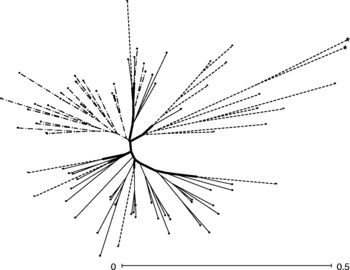
A Neighbour-Joining tree was calculated from the genotyping data. The analysis of the tree reveals that Lonicera accessions are mainly grouped by subspecies (Fig. 2). The cluster with a majority of accessions of the diploid species L. boczkarnikovae and L. edulis is quite specific The remaining of the tree is made of accessions of L. caerulea subspecies, all of them being reputed tetraploids.
Neighbour-Joining tree of blue honeysuckle accessions indicated by subspecies, with delimitations of clusters as dashed lines.

These tetraploid accessions can be divided into distinct clusters. The first group harbours only accessions of L. caerulea subsp. emphyllocalyx originating from Japan. This relatively isolated geographical origin may explain this grouping. A second cluster is mostly constituted with accessions of L. caerulea spp. altaica, pallasii and stenantha. This finding confirms other results suggesting that altaica and pallasii subspecies could be identical (Avena, Reference Avena1971; Kuklina, Reference Kuklina1985). In our study, this could even concern stenantha.
Most of our accessions were L. caerulea subsp. kamtschatica, but interestingly, these accessions do not cluster together on the Neighbour-Joining tree. Instead, they split up into two clearly different groups (Fig. 2). This phenomenon, similarly observed in a previous report (Naugžemys et al., Reference Naugžemys, Žilinskaitė, Denkovskij, Patamsytė, Literskis and Žvingila2007), may have implications in Lonicera taxonomy (Lamoureux et al., in preparation). Finally, the L. caerulea subsp. venulosa accessions raise some questions. Although the main part of them is grouped into one cluster, a few accessions are spread throughout the entire tree in various clusters, thus questioning the homogeneity of this subspecies.
The six clusters described above may provide a basis in defining the heterotic groups, useful for the breeding of new elite cultivars.
As shown above, the VIR collection of raspberry contains a significant amount of genetic diversity, but the elucidation of the fine structure of the collection obviously requires more data. As an uncommon fruit crop, the blue honeysuckle collection represents a resource of tremendous importance. Subspecies proved to be a key level for diversity in edible Lonicera, with possible implications on taxonomy and breeding.
Acknowledgements
The authors are grateful to Nadezhda Tikhonova and Laurent Solinhac for excellent technical assistance. This work was financially supported by the Ministry of Finance, Luxembourg.