1 Introduction
Regional Economic Courts (RECs) have become involved with politically loaded legal disputes,Footnote 1 which touch upon central aspects of social co-existence and political governance in times of crisis and polarise the public discourse.Footnote 2 Recent examples of judicial involvement in these disputes include the Court of Justice of the EU (CJEU) ruling over issues of systematic erosion of the liberal state in Poland and Hungary, the Andean Tribunal of Justice (ATJ) facing systemic non-compliance triggered by the ideological schism between its neoliberal and leftist Member States, the Central American Court of Justice (CACJ) intervening in the struggles of transition to democracy experienced by many of its Member States and, finally, the East African Court of Justice (EACJ) expanding its jurisdiction to human rights through teleological interpretation. The increased involvement of RECs in these controversial matters has triggered forms and patterns of resistance to them in their contexts of operation, ranging from threats of withdrawal from a court to non-implementation of individual judgments (Madsen et al., Reference Madsen, Cebulak and Wiebusch2018).
This paper aims to understand what happens to RECs when they rule over these divisive issues, which we label ‘legal disputes mirroring constitutional, political and social crises’.Footnote 3 Specifically, we unveil the factors affecting the authority of and triggering resistance to RECs on this specific subject matter.
To evaluate the authority of RECs, we rely on the literature on de facto authority, according to which international courts become authoritative when their rulings are endorsed by various actors in their practices (Alter et al., Reference Alter, Helfer and Madsen2016b). We also rely on the resistance framework to distinguish between ordinary pushback and backlash challenging the functional set-up of the courts (Madsen et al., Reference Madsen, Cebulak and Wiebusch2018).
We focus on the CJEU, the ATJ, the CACJ and the EACJ, which have all ruled upon legal disputes polarising their regional organisations and/or the constitutional organs of their Member States. We acknowledge that resistance to RECs is not new and that, for instance, the CJEU has already faced pushback and backlash during its existence (Davies, Reference Davies2014). We, however, explore the resistance triggered by the recent wave of populist politics across the globe.Footnote 4 We seek to understand whether and under which circumstances RECs can play a role in preserving democratic values in different socio-political contexts. We have chosen the four above-mentioned RECs also because they have adopted different strategies when addressing crises. The CJEU has faced the Polish and Hungarian illiberal turn without addressing them as systemic rule of law (RoL) violations. The Court has only applied secondary EU law in domains such as age discrimination among judges, the independence of a data protection commissioner and the enforcement of interim measures (Closa and Kochenov, Reference Closa and Kochenov2016). The ATJ has confronted the ideological schism within the Andean Community (AC) between the neoliberal Colombia and Peru and the leftist-populist Bolivia and Ecuador in non-compliance cases that are threatening the survival of the AC. Here, the Court has limited itself to ensure formal adherence to Andean law while allowing governments to revise the treaties following their preferences (Alter and Helfer, Reference Alter and Helfer2017). The CACJ has boldly intervened in a separation of powers dispute in Nicaragua between the parliament, the leftist Sandinista Party and the then Liberal and pro-US President Enrique Bolaños Geyer.Footnote 5 Finally, the EACJ has ruled upon disputes concerning electoral matters, public policy issues and human rights. The Court even condemned Kenya for violating the procedures for the election of its members of the regional legislative assembly based on a broad understanding of the RoL.Footnote 6
The four Courts are also interesting for a discussion on the RECs’ variable authority and uneven resistance over legal disputes mirroring constitutional, political and social crises because their rulings triggered different responses among their ‘compliance constituencies’.Footnote 7 The CJEU and the ATJ have thus far avoided significant political pushbacks, while the CACJ and the EACJ have faced extraordinary critique and political backlash. The CACJ has been targeted by blistering remarks from the Central American legal profession and some of its Member States aimed to curtail the Court's competences.Footnote 8 Similarly, the EACJ has faced extraordinary critique by its Member States, especially by Kenya, which pushed for reforms limiting the independence of the Court (Alter et al., Reference Alter, Gathii and Helfer2016a).
Finally, we do not focus on dedicated human rights courts because RECs allow study of the conditions allowing regional judicial institutions to achieve authority beyond their formally delegated powers.Footnote 9 Although human rights courts have also encountered various patterns of resistance when getting involved with highly political matters (Soley and Steininger, Reference Soley and Steininger2018), they are more likely to get involved with sensitive issues. RECs, instead, are more exposed to resistance when they are perceived as expansionist in their practices. Simultaneously, RECs can rely on stronger enforcement mechanisms and have been perceived as particularly effective institutions (Shany, Reference Shany2014).
We find that RECs trigger backlash when they rule directly upon divisive issues, while only pushback when they limit their practices to particular legal aspects, somehow ignoring the bigger crisis reflected in the specific legal dispute. This latter alternative, however, limits the RECs’ de facto authority over the broader values underpinning the regional system. This is the dilemma that RECs face in times of crisis, namely to find a balance between a meaningful involvement in the issues stemming from such crises and avoid resistance that would compromise their fragile authority.
We conclude by claiming that the authority of and resistance to RECs in times of crisis are linked to their capacity to harness compliance constituencies (i.e. national governments, regional commissions/secretariats, national judges and other substate actors) in their operational contexts. This is most likely to happen when there is a transnational consensus in favour of adjudication on such topics among the various actors of the systems in which these Courts operate. Conversely, when this support is missing, one may expect a limited authority and backlash. This provides empirically grounded evidence on the inherent limitations that RECs face when called to address attacks to democratic governance by national and regional actors.
The remainder of the paper proceeds as follows. Section 2 presents the responses of the four Courts to constitutional, political and social crises. Section 3 analyses the variable authority of and resistance to RECs in these crises by looking at the different reactions to the rulings by regional and national actors. This part also identifies several contextual factors (institutional, actor-based and socio-political) that have influenced the Courts’ de facto authority and resistance to them. Section 4 concludes by discussing the theoretical implications of our findings.
2 RECs adjudicating upon legal disputes mirroring constitutional, political and social crises
In what follows, we present some of the most representative examples of the CJEU, the ATJ, the CACJ and the EACJ's involvement in legal issues mirroring constitutional, political and social crises. When addressing the erosion of democratic values and RoL in Poland and Hungary, the CJEU did so from a mere common-market perspective without discussing whether these constituted a violation of the fundamental values of the EU entrenched in the Article 2 of the Treaty on European Union (TEU).Footnote 10 The ATJ intervened into the political turmoil of the Andean region by eschewing expansive rulings while condemning Member States for violating Andean law. Finally, the CACJ and the EACJ have intervened in separation of powers disputes, in electoral matters and alleged human rights violations by their Member States.
2.1 A (thus far) silent court: the CJEU's limited involvement with systemic RoL violations by EU Member States
Despite it being labelled as expansionist (Blauberger and Schmidt, Reference Blauberger and Schmidt2017), the CJEU has thus far been reluctant in addressing systemic RoL violations and enforcing democratic principles in the EU Member States. Instead, the Court has focused on proceedings against Member States for violations of internal market freedoms.
Even though the possibility of applying sanctions for violation of EU values has been often discussed,Footnote 11 we only discuss alleged violations of Article 2 TEU in Hungary and Poland (Bermeo, Reference Bermeo2016), which constitute violations of basic constitutional rules such as the separation of powers and judicial independence.
The ‘Hungarian crisis’ concerns the capturing of the democratic system by the ruling Fidesz Party led by Viktor Orbán. Since 2010, the Hungarian government has introduced reforms to limit the independence of the Constitutional Court. While increasing the number of judges at the Constitutional Court, the reforms forced out of office certain undesired judges. This created vacancies on the constitutional bench, which were then filled with individuals close to the Fidesz Party. Moreover, the Constitutional Court was stripped of its actio popularis jurisdiction, limiting its capacity to address separation of powers issues in Hungary.Footnote 12
The European Commission has brought several infringement actions against Hungary before the CJEU.Footnote 13 One of these was centred on the principle of non-discrimination based on age of judges. The technical nature of the proceedings – instigated on Directive 2000/78 establishing a general framework for equal treatment in employment and occupation – framed the legal reasoning of the Court. Illustrative is the Hungarian argument, according to which the retirement age for constitutional judges was lowered not to fire judges, but to create ‘a large number of senior positions … accessible to the “middle-aged” generation’ (CJEU, C-286/12, paragraph 35). While condemning Hungary for violating EU law, the Court did not mention the threat to democracy and judicial independence resulting from these legislative changes. Instead, the Court checked whether the age discrimination was justified by pursuing a legitimate aim. In short, the CJEU – supported by the narrow framing of the Commission – did not address the political context behind the dispute (CJEU, C-286/12, paragraph 79).
The CJEU also did not mention the report of the European Commission for Democracy through Law (the Venice Commission) published just a month beforehand and scrutinising the packing of the Constitutional Court in Budapest.Footnote 14 While the Venice Commission has asked Hungary to introduce measures reinstating the independence of the Constitutional Court, the CJEU's pronouncement was limited to scrutinising the change of the retirement age of its judges.
The CJEU was similarly vague concerning the situation of the Hungarian supervisory authority for the protection of personal data – another independent institution targeted by the Hungarian government. While the CJEU concluded that Hungary had violated the independence of this authority, it did not refer to any constitutional or RoL principles. Rather, the CJEU referred to Article 28(1) of Directive 95/46/EC on the processing and free movement of personal data.Footnote 15
Relevant for understanding the role and authority of the CJEU on legal issues mirroring crises is also the situation in Poland. Even though the reforms resemble the Hungarian ones, the response of the EU authorities in this case differs. Since the electoral victory of the Law and Justice (PiS) Party of Jarosław Kaczyński, the Polish government has paralysed the Constitutional Court, curtailed the freedom of press and removed the qualification requirements from the law about public service. Several violations of formal constitutional rules have occurred such as midnight votes in the parliament, refusal to publish judgments of the Constitutional Court in the Official Journal and the president's refusal to swear in judges legally appointed to the Constitutional Court.Footnote 16
In January 2016, the European Commission activated the dialogue of the RoL Framework against Poland.Footnote 17 This, however, is not a binding act, but a document released by the Commission via a press release emphasising a diplomatic dialogue rather than judicial solutions. Before taking further steps, the Commission awaited the Opinion of the Venice Commission published in March 2016.Footnote 18 Within the RoL Framework, the Commission issued three recommendations to the Polish authorities,Footnote 19 which, in turn, answered that these recommendations resulted from an incomplete knowledge of the Polish legal system.Footnote 20 On 20 December 2017, this was followed by a fourth recommendation and a Reasoned Proposal to the Council to trigger the Article 7 TEU procedure.Footnote 21
The Commission has also started two infringement proceedings against Poland. The CJEU has still to rule upon them. However, the framing of the Commission demonstrates its reluctance in getting the CJEU directly involved with this situation too. In the first case, the Commission claimed that its ‘key legal concern … relates to the discrimination on the basis of gender due to the introduction of a different retirement age for female judges (60 years) and male judges (65 years)’.Footnote 22 In the second case, the Commission challenged Poland for the activity of logging trees in the area of the Białowieża Forest, which allegedly violates Polish obligations under the Habitats DirectiveFootnote 23 and the Birds Directive.Footnote 24 The CJEU released an interim measure ordering Poland to stop any activity in that area until the judgment on the merits unless the ceasing of the logging would pose a danger to public security.Footnote 25 The Polish minister of environment has invoked this public security exception to continue the logging.Footnote 26 The CJEU has intervened with another order requiring Poland to cease its active forest management operations in the Białowieża Forest and threatening it with a penalty of at least €100,000 per day (CJEU, Commission v. Poland, C-441/17 R). If it comes to that, it would be the first time the CJEU has ordered financial penalties for non-compliance with interim measures.
Finally, the Polish and Hungarian cases might entail a breakthrough in the protection of the Article 2 values in the EU. The RoL Framework provides a more structured way of scrutinising the backsliding of democracy in the Member States. The existence of this framework combined with the blunt lack of co-operation from the Polish authorities has led to the activation of Article 7 TEU. This, however, does not foresee a judicial intervention. For now, the CJEU has been presented by the European Commission with technical cases of violation of particular norms of EU secondary law. This has led the CJEU to adjudicate on the technical violations relating to age discrimination or rare birds rather than addressing the underlying issues of independence of judiciary compliance with EU law and, more generally, the erosion of democratic values in EU Member States.
2.2 A legal referee: the legalistic approach of the ATJ to economic and political crises
Although mostly specialised in intellectual property (IP) issues,Footnote 27 the ATJ has been called upon to rule over political questions of national and Andean policy.Footnote 28 The cases concerning the extent to which Ecuador was allowed to depart from regional policies while dealing with internal economic crises are perhaps the most relevant for discussing patterns of resistance to the ATJ.Footnote 29 While not directly dealing with the Ecuadorean crisis, the cases presented before the ATJ had implications for the future of the AC. These cases implicitly asked the Court to address Ecuador's repeated non-compliance with regional policies due to an ideological disagreement over the overall purpose of the AC. From 2007, the leftist Ecuadorean President Rafael Correa had enacted reforms, known as the Committee on Foreign Trade (COMEX) regulations, to protect national producers vis-à-vis Peruvian and Colombian ones. These reforms triggered complaints to the Andean General Secretariat from Peruvian and Colombian substate actors. The Secretariat issued decisions scrutinising certain aspects of the COMEX regulations, which were then challenged by Ecuador before the ATJ. Presently, the ATJ has ruled upon two of these cases.
The first case was decided by the Court in 2016. This concerns the validity of two COMEX resolutions establishing restrictions on the import of cars and parts of cars from other members of the AC.Footnote 30 In 2013, the Secretariat deemed these measures in violation of Andean law, disposing their nullification.Footnote 31 Ecuador then filed a case before the ATJ asking the Court to invalidate the Secretariat's resolutions. Ecuador maintained that the COMEX regulations were pursuant to the system of exceptions to the free movement of goods in the Community established by the Article 73 of the Cartagena Agreement. In particular, Ecuador considered such regulations justified, as they were seeking to protect the life and health of people, animals and plants.
In September 2016, the ATJ declared the partial nullification of the resolutions of the Secretariat, as these restricted regional commerce.Footnote 32
In the second case,Footnote 33 the ATJ was called to annul the Resolutions 1695 and 1716 of the Secretariat, which had declared the COMEX Resolution 106 – through which Ecuador had created onerous certification processes to ensure the quality of imports and protect the health of consumers – against Andean law.Footnote 34 In February 2017, the ATJ declared Ecuador's claim unfounded because the COMEX Resolution 106 constituted an illegal restriction of the free movement of goods within the Community.Footnote 35 The ATJ also exhorted the Secretariat to enforce to the rulings. It remains to be seen how Ecuador will react to the ATJ's jurisprudence on such matters.
Parallel to these facts, Ecuador attempted to soften its economic crisis by imposing import sub-charges on capitals and consumer goods – a policy in contrast with the aims of the AC. While initially approved by the Secretariat, such measures were opposed by Peru and Colombia, which asked the ATJ to annul the Secretariat's approval.Footnote 36 This case is still awaiting a decision.
Meanwhile, other events increased the salience of the Ecuadorean situation. Ecuador, in fact, started advocating for absorbing the AC into the Union of South American Nations (UNASUR) – a regional organisation inspired by a counter-liberal narrative, which, among other things, seeks to merge MERCOSUR and the AC (Sanahuja, Reference Sanahuja2011). Bolivia took similar actions and, under its President Evo Morales, joined the MERCOSUR in 2015.Footnote 37 Finally, as Venezuela left the AC in 2006, the Community is now constituted by four countries with opposed views on regional integration: Peru and Colombia, which follow a neoliberal agenda, and Ecuador and Bolivia, inclined to a left-wing populist and inter-governmental version of regional integration. This situation has led the AC into a political stalemate. In this framework, the Andean regional integration project largely depends on the rulings of the ATJ on the matters currently under its scrutiny.
Although often presented as the less expansive counterpart of the Luxembourg Court (Alter and Helfer, Reference Alter and Helfer2010), the ATJ has shown a higher degree of involvement, with more legal issues mirroring constitutional, political and social crises than the CJEU. Counter to the CJEU – which has not gone beyond the framing of the European Commission – the ATJ addressed the core issues at play in the AC, notably the extent to which market integration has to be prioritised over economic, social and political development during crises. While this constitutes a higher degree of involvement in disputes mirroring national crises, the ATJ has also navigated safely the political turmoil in its operational context. In its decisions, the ATJ has repeatedly struck a balance between the interest of developing Andean law into a tool for economic and legal integration and the interests of the Member States to remain the ultimate arbiters of the system.
2.3 The lonely screamers: the CACJ and EACJ's attempts to enforce RoL and democratic values
Contrary to the CJEU and the ATJ, the CACJ and the EACJ have been rather bold when ruling upon legal issues mirroring constitutional, political and social crises.
The most relevant ruling of the CACJ is the Bolaños case (CACJ, no. 69–01–03–01–2005) – a dispute concerning a constitutional crisis in Nicaragua triggered by a political conflict between two former presidents of the republic, Enrique Bolaños Geyer and his predecessor Arnoldo Alemán. In 2002, Bolaños launched an anti-corruption campaign, which resulted in Alemán's imprisonment. To fight back, Alemán filed a case before the CACJ claiming that he was not subject to the jurisdiction of national courts because of his regional immunity as a member of the Central American Regional Parliament (PARLACEN). The CACJ rejected these arguments, ruling that Alemán's regional immunity had been automatically suspended after that the Nicaraguan Parliament had voted to suspend his national immunity (CACJ, no. 59–01–08–01–2003).
Alemán then attempted to politically isolate Bolaños by forging an alliance between the Liberal Party (of which both Bolaños and Alemán were members) and the leftist Sandinista Party, which at that point constituted one of the three main Nicaraguan political parties. This alliance became known as El Pacto and was aimed to pass reforms that would disempower and eventually impeach Bolaños. Afterwards, the Nicaraguan Parliament revoked the president's power to appoint key governmental figures.Footnote 38 President Bolaños then filed a case before the Nicaraguan Supreme Court, which was rejected. Finally, Bolaños instituted a separation of powers dispute before the CACJ, asking the Court to declare the constitutional reforms invalid (CACJ, no. 69–01–03–01–2005).
In the ruling, the CACJ overruled the Nicaraguan Supreme Court, releasing a precautionary measure aimed to block the reforms (CACJ, no. 69–01–03–01–2005, at results I, II and V). Finally, the Court declared the reforms initiated by the Legislative Assembly of Nicaragua in violation of the Nicaraguan Constitution and of several regional treaties. (CACJ, no. 69–01–03–01–2005).
Similarly to the CACJ, the EACJ has also boldly ruled upon legal disputes mirroring crises. Illustrative is the case Anyang’ Nyong'o et al. v. Attorney General of Kenya et al. (2007).Footnote 39 In 2006, Kenya elected nine members of the East African Legislative Assembly (EALA), the regional parliament of the East African Community (EAC), without deliberations on all of the submitted lists. Consequently, twenty-three members of the opposition parties argued that this particular procedure and the Kenyan legislation regulating the election process for the EALA violated the EAC Treaty (EACJ, Anyang’ Nyong'o, p. 8). The alleged violations were confined to Article 50 of the EAC Treaty, which prescribes that the ‘National Assembly of each Partner State shall elect … nine members of the Assembly … in accordance with such procedure as the National Assembly of each Partner State may determine’.Footnote 40 Apparently, the Kenyan law prescribing specific rules for the selection of the EALA members seems to fit into the margin provided for national discretion by the EAC Treaty. However, the EACJ infused some constitutional meaning into the word ‘elect’ used in Article 50 EAC Treaty. So, the Court ruled that: ‘[o]rdinarly a reference to a democratic election of persons to political office is understood to mean election by voting’ (EACJ, Anyang’ Nyong'o, p. 33, emphasis added). By adding the adjective ‘democratic’, the Court adopted an expansive understanding of the EAC Treaty. While the treaty left it to Member States to establish the procedures for electing their representatives at the EALA, the EACJ established a harmonised threshold for these elections. The Court thereby intervened directly in the abuse of power by the governing party in Kenya. This, as we will explore in the following section, triggered attempts at limiting the authority of the EACJ by the Kenyan government (Alter et al., Reference Alter, Gathii and Helfer2016a).
3 Authority of and resistance to RECs in times of crisis
In assessing the authority of the four Courts, we rely on the theoretical framework distinguishing between de jure and de facto authority (Alter et al., Reference Alter, Helfer and Madsen2016b). In this view, de jure authority is a position of normative power granted or constituted by norms and characterised by a content-independent response to a command (Alter et al., Reference Alter, Helfer and Madsen2016b). A REC has legal authority when it has the ‘right to rule’ over specific domains (Buchanan and Keohane, Reference Buchanan and Keohane2006).Footnote 41 Yet, because of the peculiar socio-political and institutional contexts in which RECs are entrenched, formal delegation of powers alone is insufficient to make them authoritative. Hence, RECs must transform legal authority into de facto authority (Alter et al., Reference Alter, Helfer and Madsen2016b). This chiefly occurs when RECs manage to avoid resistance. We operationalise resistance by disentangling its various aspects. Resistance comes in different forms – depending on whether it is directed against the international court as a whole (backlash) or against particular judgments and remains within the boundaries of ordinary critique (pushback) – and in different patterns – depending on the type of national actors involved (political, judicial, non-governmental) and its spread in the region (one Member State or a regional majority) (Madsen et al., Reference Madsen, Cebulak and Wiebusch2018). Hence, we reconstruct the forms and patterns of resistance to RECs’ involvement in legal disputes mirroring constitutional, political and social crises with the goal of grasping their de facto authority (or lack of thereof). The CJEU, the ATJ, the CACJ and the EACJ have responded quite differently when faced with issues mirroring crises. In what follows, we discuss the factors that triggered such divergent behaviours and the responses of the various stakeholders of the system in the Courts’ contexts of operation. In so doing, we assess the four Courts’ variable authority as well as forms and patterns of resistance to them in times of crisis. Initially, we discuss the extent to which the de jure features (i.e. rules of jurisdiction and standing) influence the Courts’ authority and resistance. We then discuss several institutional, actor-based and socio-political factors that hold important explanatory value for understanding the present limited de facto authority and the instance of pushback or backlash against the CJEU, the ATJ, the CACJ and the EACJ over legal issues mirroring constitutional, political and social crises.Footnote 42
3.1 The (limited) explanatory value of rules on jurisdiction and standing for the authority and resistance of RECs
Much of the scholarship has focused on how the formal features of RECs – compulsory jurisdiction and private access – influence the authority of these institutions (Helfer and Slaughter, Reference Helfer and Slaughter1997). Similarly, EU lawyers have explained the thus far limited response of the CJEU to the authoritarian turn in Poland and Hungary via an analysis of the shortcomings of the formal rules regarding the Court's jurisdiction (Closa and Kochenov, Reference Closa and Kochenov2016). We find, however, that formal rules of jurisdiction and standing play only a limited role in influencing the capacity of RECs to be more or less active (and activated) on legal issues that mirror constitutional, political and social crises.
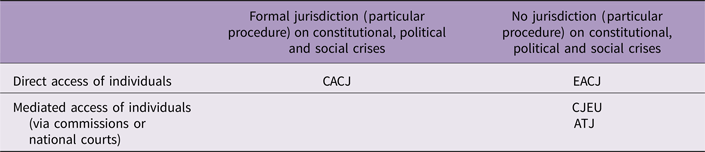
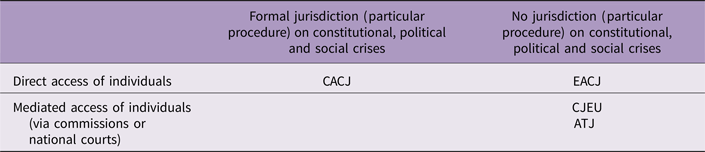
Our findings are corroborated by the fact that the four RECs analysed have different formal arrangements. The CJEU misses a specific procedure allowing it to intervene in constitutional and political crises. The possibilities of direct access of individuals to the CJEU are also limited. They mostly have to rely on cases being brought by the European Commission or referred by national courts. Similar considerations arise regarding the ATJ, whose formally delegated jurisdiction encompasses neither constitutional issues nor systemic RoL violations at the national level and, in addition to allowing preliminary references from national judges,Footnote 43 it empowers private parties to directly seize the Andean Secretariat to trigger the non-compliance procedure (Article 25 Protocol of Cochabamba).
The CACJ has the power to rule over separation of powers disputes between the constitutional organs of its Member States. Simultaneously, the CACJ allows individuals and national judges to directly bring cases without having to first exhaust local remedies.Footnote 44
The EACJ has another institutional arrangement. Formally, the Court has jurisdiction only on trade-related matters. Yet, through case-law, the judges expanded the Court's competences to encompass human rights and other politically sensitive disputes, which undoubtedly increased the Court's capacity to get involved with crises (Gathii, Reference Gathii2012). Moreover, even in the trade-related competences, the Court can rule upon politically loaded cases, it being empowered to receive complaints directly from private parties without the exhaustion of local remedies. In Table 1, we schematically represent these differences.
Jurisdiction and standing before the RECs
In the EU, the thus far limited involvement of the CJEU with RoL and constitutional crises is influenced by the legislative framework of the Union. The EU Treaties foresee a three-step procedure for dealing with systemic RoL violations enshrined in Article 7 TEU. This procedure, however, does not involve the CJEU, but rather the Council – a body composed of national ministers of EU Member States. According to Article 7(1), the Council decides whether there is a ‘clear risk of a serious breach by a Member State of the values referred to in Article 2’.Footnote 45 Higher inter-governmental hurdles are envisaged by Article 7(2) as to the determination of the existence of an actual violation. Here, the Council decides by unanimity (with the exclusion of the Member State concerned). Only after having determined the existence of either a risk of a violation and/or its actual occurrence and after having issued recommendations, the Council can suspend certain rights of a Member State by a qualified majority of votes.
Scholars have debated this particular procedure; Article 7 TEU precludes the CJEU from adjudicating upon RoL violations and other national crises.Footnote 46 On the one hand, the long procedure of diplomatic exchanges sketched out in Article 7 TEU illustrates the intention of the drafters to deal with these topics in an inter-governmental manner. On the other hand, some have argued in favour of a bolder role for the CJEU on such issues on the grounds that the jurisdiction of the Luxembourg Court covers all domains of EU law, unless they are expressly excluded by the EU Treaties.Footnote 47 Ultimately, both the text of the treaties and the interpretation of Article 7 given by many scholars – most notably that it is a ‘nuclear option’ – have significantly influenced the rather limited involvement of the CJEU in constitutional, political and social crises.
Especially in relation to the challenges to the independence of the judiciary at the national level, it is important to note that the preliminary ruling procedure, whereby questions are referred to the CJEU by national judges, represents the most common way to access the CJEU.Footnote 48 This is largely due to the restrictive approach of the Court in relation to direct access to individuals. In principle, the EU Treaties allow annulment applications from non-privileged applicants (natural and legal persons). However, since 1963, the CJEU has set a high threshold for fulfilling the admissibility requirements so that basically only actors individually mentioned by EU legislation can access the Court (Lenaerts, Reference Lenaerts2009). The fact that individual applicants have to rely on the intermediary stage of submitting their complaints to the European Commission (that might institute infringement proceedings) or national courts (that might refer a preliminary ruling question) has definitely affected the way in which the cases arising before the CJEU were framed.
With regard to the three remaining Courts, formal legal arrangements have also influenced their capacity to rule upon national crises. From 1984 to 1996, the ATJ heard very few politically sensitive cases and the Court's docket was mainly – and largely still is – dominated by preliminary references on IP issues triggered by administrative national agencies (Alter and Helfer, Reference Alter and Helfer2017). However, when in 1996 the Cochabamba Protocol amended the Original ATJ Treaty and allowed private litigants to bring cases before the Secretariat, the number of non-compliance cases increased significantly (Alter and Helfer, Reference Alter and Helfer2017). This confirms that formal rules of jurisdiction and standing affect the capacity of RECs to be activated. Simultaneously, however, this leaves unanswered issues such as the degree of compliance with these judgments, the ATJ's capacity to alter the behaviour of Member States and to trigger compliance constituencies in their contexts of operation and the Court's capacity to prevent political pushback and backlash. Hence, we conclude that formal rules of jurisdiction are a necessary but not sufficient condition for understanding the ATJ's de facto authority and resistance over legal disputes that mirror constitutional, political and social crises.
The limited role played by rules of jurisdiction and standing is also supported by our two remaining case-studies: the CACJ and the EACJ. Regarding the CACJ, it is worth mentioning that the Court was established for facilitating not only economic, but also political and legal integration during the Central American peace process of the 1980s and 1990s (Caserta, Reference Caserta2016). According to its statute, the Court aims ‘to bring about integration of Central America as a region of peace, freedom, democracy and development’.Footnote 49 The main treaty of the Central American System of Regional Integration (SICA) – the Protocol of Tegucigalpa – also defines a number of goals that go well beyond mere economic integration, such as consolidation of democracy, reinforcement of elected and democratic institutions, respect of human rights and so on. Accordingly, Article 22 of the CACJ's statute bestowed the Court with competencies aimed to make it a key institution for building peace and democracy in the region. Formally, the CACJ acts as a classic interstate court, as a CJEU-like regional economic court, as a supranational Constitutional Court and as an arbitral tribunal. Of particular relevance in this discussion is Article 22(f) of the protocol, which empowers the Court to rule upon separation of powers disputes between the constitutional organs of the SICA Member States. The CACJ also allows private parties to directly bring cases before the Court without preliminary filters such as national judges or regional secretariats.Footnote 50 In our view, this legal framework has allowed the CACJ to rule on situations of crisis more easily than the CJEU and the ATJ. Similarly to the ATJ, however, the CACJ's rules of jurisdiction and standing can only explain the rather active role played by the Court on this specific subject matter, while leaving unanswered important questions related to the actual impact of the Court's rulings on the behaviour of the actors of the systems.
As for the EACJ, the EAC Treaty provides direct access for individuals but no express jurisdiction on national crises. Article 30 of the EAC Treaty provides that any legal or natural person residing in the territory of the Member States can file a claim to the EACJ challenging a measure that ‘is unlawful or is an infringement of the provisions of this Treaty’. In spite of this prima facie broad jurisdiction, the Court's competence over national crises has been disputed. Article 27(2) EAC Treaty provides that the Member States acting as counsel shall determine the human rights jurisdiction of the EACJ in a separate protocol. The fact that this protocol has not yet been ratified suggests that the Court does not have formal jurisdiction over human rights. This would limit the chances of the EACJ adjudicating on cases reflecting social and political crises, as they are often litigated as human rights cases. Nonetheless, in Katabazi et al. v. Uganda (2007), the Court opened the door to de facto adjudicating on human rights issues in a way that allows it to include also national crises and RoL violations.Footnote 51 In this case, the EACJ ruled that, even though it cannot adjudicate ‘on disputes concerning violation of human rights per se’ (EACJ, Katabazi, p. 15), it would not ‘abdicate’ its jurisdiction over RoL violations (EACJ, Katabazi, p. 16). The Court derives this jurisdiction from the objectives and the fundamental principles of the EAC Treaty and adopts a broad understanding of the RoL principle (EACJ, Katabazi, pp. 15–16). This jurisprudential development, which was also confirmed in subsequent case-law, appears to open the possibility for the EACJ to adjudicate on issues related to national crises and is illustrative of its tendency to promote and protect its institutional power (Gathii, Reference Gathii2012). These developments also illustrate the limited explanatory value of the rules on jurisdiction and standing for understanding the de facto authority of the Court, as well as forms and patterns of resistance to it. While direct access to the Court has created the conditions for legal mobilisation that can contribute to the judicial expansion of jurisdiction of the Court (Gathii, Reference Gathii2012), the EACJ received severe criticism from its Member States and other non-state actors precisely on its judicial activism.
In conclusion, the difference in the formal rules concerning jurisdiction between the CJEU, the ATJ, the CACJ and the EACJ may explain the relatively higher level of activity of some of these Courts regarding legal disputes that mirror constitutional, political and social crises. This analysis, however, leaves unanswered questions of the Courts’ de facto authority and resistance to them. For this reason, we now analyse the role of the various compliance constituencies in triggering the variable involvement of the four RECs in these politically loaded disputes. Furthermore, we analyse the contextual responses generated by the four Courts’ involvement with such issues.
3.2 Assessing the de facto authority of and resistance to the CJEU, ATJ, CACJ and EACJ in times of crisis
This section assesses the variable (and rather limited) authority and resistance to the four Courts in times of crisis. Although the CJEU is generally recognised as one of the most authoritative RECs in the world (Kelemen, Reference Kelemen2016), its authority in this particular domain is rather narrow presently. This limited de facto authority is linked to the traditionally close co-operation between the Court and the other EU institutions such as the Commission and the EU Parliament. The Commission has so far been reluctant to involve the Court in constitutional crises within the EU Member States, preferring to adopt a rather technocratic approach to such matters. This narrow framing of the Commission can explain the Court's limited involvement with RoL violations in the EU. The case against Hungary, in which the Commission has addressed the capturing of the Constitutional Court by Orbán's government as an issue of age discrimination, is illustrative of the Commission's confined approach. This has contributed to the extraordinary critique expressed by the political institutions in Hungary and Poland. This critique, however, has been mostly addressed to the EU as a whole and contained to the Member States concerned.Footnote 52
Recently, the Commission has adopted a more proactive role by establishing the ‘RoL Framework’ – an institutional mechanism preceding the activation of Article 7 TEU. Through this informal procedure, the Commission empowered itself to scrutinise national RoL violations within the EU. The framework includes several stages (the Commission's Assessment, Opinion and Recommendation) that essentially constitute an exchange of letters between the Commission and the Member State concerned. This framework has been deployed for the first time with regard to judicial reforms in Poland. The blanket rejection of the Commission's recommendation by the Polish authorities has led to a deadlock.Footnote 53 After issuing three recommendations, the Commission has now exhausted the steps of the framework and, in December 2017, proposed to the Council to adopt a decision under Article 7(1) TEU.Footnote 54 Triggering of Article 7 TEU against Poland indicates the Commission's preference for a political rather than judicial mode of addressing the RoL crisis. The infringement proceedings brought before the Court continue in fact to be limited to technical violations of secondary norms of EU law such as the one claiming that the judiciary reform in Poland amounts to discrimination on the basis of gender in employment.Footnote 55
Both the Commission and the CJEU's preference for an indirect approach to the RoL crises in the Member States might be explained by the broader political situation in the European Parliament and Council. For instance, Fidesz, the Hungarian ruling party responsible for the constitutional reforms discussed in Subsection 2.1, is part of the European Peoples’ Party (EPP) in the European Parliament. As a member of this parliamentary group, Fidesz has contributed to electing the current Commission's president. This has allowed Fidesz to use EPP support as a shield from certain criticism (Gostyńska-Jakubowska, Reference Gostyńska-Jakubowska2016; Koncewicz, Reference Koncewicz2017). Despite this, in May 2017, the European Parliament adopted a resolution condemning ‘a serious deterioration of the rule of law, democracy and fundamental rights’ in Hungary.Footnote 56 The majority of the EPP voted against it (Gotev, Reference Gotev2017a).
The European Council and the Council of Ministers have been experiencing similar blockages, which suggests the lack of political support for such scrutinising measures and a likely resistance if they were judicially implemented. Affirming a serious breach of Article 7(2) TEU requires a unanimous vote. This has led many observers to anticipate reciprocal veto-readiness from either Hungary or Poland in case any of these states would be subject to this procedure (Gotev, Reference Gotev2017b). This inter-governmental stalemate does not create a supportive environment for either activating the CJEU or enforcing potentially audacious rulings. A potentially supportive environment could be created by the adjudication of the European Court of Human Rights on human rights violations in Hungary and Poland (Kosař and Šipulová, Reference Kosař and Šipulová2017). However, the CJEU's lack of interaction with these judgments further emphasises the importance of the distinction between RECs and regional human rights regimes, as pointed out in the introduction of this paper.
The limited authority of the CJEU on national constitutional and RoL crises can also be explained by the limited interaction of the Luxembourg Court with national judges on such topics. Concerns about judicial independence in Hungary and Poland have been voiced by the Network of the Presidents of the Supreme Judicial Courts through an official statement. This, however, has only declaratory value.Footnote 57 In addition, the strategic reforms of the highest courts as well as ordinary judiciary in Hungary and Poland have effectively subordinated the judicial branch to the oversight of the ruling party. In Poland, the envisaged reforms of the National Council for Judiciary combined with the support of the Constitutional Court might practically ensure the packing of ordinary courts with judges sympathetic to the political agenda implemented by the PiS party (Matczak, Reference Matczak2017). This yields little promise in terms of national courts playing an important role in the decentralised enforcement of EU law over constitutional and RoL crises.
The ATJ has struggled to impose its de facto authority on legal disputes mirroring constitutional, political and social crises. The ATJ has even triggered both pushback and backlash in its context of operation. One reason for this is the lack of constituencies willing to support the ATJ in this role. As explained by Karen J. Alter and Laurence Helfer, much of the ATJ's success was a direct consequence of both national administrative agencies and national judges referring IP cases to the regional court seeking the tribunal's guidance (Alter et al., Reference Alter, Helfer and Guerzovitch2009). This co-operative attitude between the ATJ and other national actors, however, did not spill over into other issue areas, such as non-compliance cases and other politically loaded issues. As posited by Alter and Helfer:
‘national judges have hesitated to expand their involvement with the ATJ beyond areas exclusively governed by Andean law. In interviews, judges emphasized that the Member States and the General Secretariat were responsible for ensuring compliance with Community law. They further claimed that they need not refer cases that concern only domestic legal issues.’ (Alter and Helfer, Reference Alter and Helfer2017, pp. 141–142)
This disinterest of national actors amounts to a wholesale lack of demand for enforcing Andean law outside the island of intellectual property adjudication.
Another factor affecting the ATJ's authority on national and regional crises is related to the political environment of the AC Member States, which are increasingly dominated by populist and authoritarian governments. These have repeatedly challenged the Andean integration project in national political arenas. Some of them even exited both the AC and the ATJ. This began in 1999, when Hugo Chavez was elected president of Venezuela. Chavez's political agenda was chiefly aimed to foster state-led development and diminish the influence of the US in the region. Chavez was also a strong advocate of both an AC-MERCOSUR Trade Agreement and of the substitution of the Organization of American States in Washington with an alternative organisation. These positions were not shared by Peru and Colombia, which in response ratified bilateral free trade agreements with the US. For this reason, in 2006, Venezuela withdrew from the AC to join the MERCOSUR (Malamud, Reference Malamud2006). Meanwhile, two leftist leaders – Evo Morales and Rafael Correa – were also elected as presidents of Bolivia and Ecuador, respectively. After Venezuela's withdrawal, this resulted in a two-two split between the remaining countries of the AC (Peru and Colombia), which continued to follow neoliberal political agendas. This situation created a stalemate in the AC, which was temporarily suspended in 2015, and subsequently resumed only when the four countries agreed in abrogating the Common External Tariff (CET).
This tense political situation did not favour the ATJ's intervention in the Ecuadorean crisis, generating significant political pushback against the Court. When faced with litigation by the Andean Secretariat, the Ecuadorean government threatened to leave the AC and to join either the MERCOSUR and/or the Union of South American Nations (UNASUR) (Alter and Helfer, Reference Alter and Helfer2017). While this weakened the Court's authority, Ecuador decided to play its legal battle within the framework of the ATJ, as demonstrated by the cases analysed above. This latest twist suggests that the Court has managed to avoid the same backlash experienced in the Venezuelan case by limiting the criticism to ordinary pushback within the system. While this suggests a relatively increased authority of the Court over crises, the future of the Court is still under threat. Ecuador accepted to litigate cases before the ATJ but it triggered an even more profound regional crisis, which may have consequences for the ATJ. In 2013, the AC ministers of foreign affairs discussed a protocol to eliminate the Andean Parliament and to reduce the AC's competences on the CET. This document even suggested modifying the ATJ Treaty.Footnote 58 The crisis is still ongoing and the ATJ may be soon called to take a stance, with possible consequences for its authority and even survival. According to a recent report of the ATJ, ten non-compliance cases and five nullification suits were filed in 2015.Footnote 59 The cases on the ATJ's docket confirm that several actors of the system perceive the Court as the venue where such issues should be discussed. While many of these cases are still pending, the Court has thus far ruled upon two of them without triggering further pushback or backlash from Ecuador. In this regard, the mediating role of the Secretariat, which has targeted the Ecuadorean systematic non-compliance with Andean law, has been of particular importance in support of a relatively active (and safe) role of the Court. It is, however, too early to assess whether the tribunal will be able to effectively make a difference in solving the Ecuadorean situation or whether future rulings will exacerbate the tension in the AC.
The authority of the CACJ over legal disputes that mirror constitutional, political and social crises is also limited, despite the Court's bold intervention in the Bolaños case. This ruling has in fact triggered ordinary and extraordinary critique. The main factor explaining the backlash against the CACJ is that the Court is the only organ of the SICA entitled to pursue this kind of violation. The two regional Secretariats – the SICA Secretariat and the Secretariat of the Central American Economic Integration (SIECA) – together with the regional parliament (PARLACEN) and the national courts are highly reluctant to engage with the CACJ on such topics. This lack of co-operation between the CACJ and these actors is due to both institutional and socio-political factors.
Regarding the Central American Secretariats, both the SICA and the SIECA Secretariats are in principle empowered to file infringement cases before the CACJ. Moreover, as the SICA Treaty and secondary legislation repeatedly refer to RoL, democracy, security and other constitutional values, one may expect a bold(er) role of the regional Secretariats on such topics. Yet, in practice, the SICA and the SIECA Secretariats are rarely in the position to do so and matters of non-compliance with SICA law are preferably solved via political channels by being submitted to the heads of government after mediation of the ministers of foreign affairs (Caserta, Reference Caserta2017a). In addition, the two Secretariats are financially dependent on the Member States, which perceive them more as ‘servants’ of their interests rather than independent organs with powers to implement regional policies and laws against them. Equally importantly, the two Secretariats have developed a conflictual relationship with the CACJ as a result of the Court's involvement over SICA inter-institutional conflicts. In these rulings, the CACJ attempted to limit the role of the Secretariats by repeatedly claiming its exclusive competence over all disputes arising in the SICA. The CACJ even attempted to establish a hierarchical relationship between the two Secretariats, which was not very well received by them and made them turn a deaf ear to the Court (Caserta, Reference Caserta2017a).
The limited authority of the CACJ on national and regional crises is also a consequence of the limited co-operation with national judges in this domain. Even though the CACJ is formally empowered to receive preliminary references from national judges when these are faced with issues of application and interpretation of the protocol of Tegucigalpa and of its complimentary instruments, national judges have been highly reluctant to use this avenue.Footnote 60 Since the Court's inauguration in 1994, only a few preliminary rulings have reached the CACJ and none of these concerned the rather widespread violations of RoL and democratic principles occurring in the CACJ's Member States.Footnote 61
Similarly, the Court's authority has been severely constrained by a stunning level of inactivity of the PARLACEN on such issues. This inactivity is due both to the PARLACEN's limited powers – it being vested only with advisory functions, despite the intentions of its founders (Nyman-Metcalf and Papageorgiou, Reference Nyman-Metcalf and Papageorgiou2005) – and to the fact that, instead being of an organ concerned with enforcement of democratic and constitutional values, it has become what many considers ‘a retirement house for corrupted politicians’.Footnote 62
The missing co-operation between the CACJ and the above-mentioned national and regional actors has played a central role in limiting the Court's potential to construct de facto authority and, hence, avoid resistance. It is difficult to speculate whether more co-operation between these actors would have resulted in increased litigation over critical situations in Central America. Yet, this missing co-operation has not only prevented the CACJ from having significant influence over the national disputes, but also triggered strong criticism of the Court. After the Bolaños case, allegation ensued that the CACJ was a politicised court more willing to deal with high-level political cases rather than legal issues related to the implementation of the policies of the SICA. This, in turn, pushed the reluctant states (i.e. Guatemala, Costa Rica and Panama) even further away from fully joining the Court and convinced the Central American commercial and corporate lawyers that the CACJ is not a suitable institution for the protection of their professional, economic and legal interests (Caserta, Reference Caserta2017b). In addition, in more than an instance, the SICA heads of government attempted to curtail the Court's competences precisely to avoid the CACJ's future involvement in these politically loaded cases. This occurred in 1997, with the Declaration of Panama II; again, in 1998, with the Declaration of Managua; and, finally, in 2003–2004, during two Presidential Meetings held in Belize and Guatemala (Nyman-Metcalf and Papageorgiou, Reference Nyman-Metcalf and Papageorgiou2005). In these circumstances, the Central American presidents attempted to limit the financial resources of the Court, to revise the method of appointment of the judges and to redefine the competences of the Court, especially in relation to its arbitral and constitutional jurisdictions (Nyman-Metcalf and Papageorgiou, Reference Nyman-Metcalf and Papageorgiou2005). These attempts, however, remained unexecuted nationally for lack of political will (Caserta, Reference Caserta2016).
The picture of the EACJ is also one of a limited de facto authority on legal disputes mirroring crises. In this regard, a central role was played by the Kenyan government, which, in the aftermath of Nyong'o, has successfully led an inter-governmental backlash campaign against the Court in Arusha. The campaign led to the introduction of several institutional changes limiting both the de jure and de facto authority of the Court. Initially, the EACJ was successful in guaranteeing the implementation of its Nyong'o judgment, as its interim ruling effectively barred the clerk of the EALA and the Secretary-General of the EAC from recognising the Kenyan representatives elected in the first round (EACJ, Nyong'o, 2006). Later, Kenya was even forced to enact new legislation on the selection of its EALA members and to hold a new election for the second legislative assembly (Alter et al., Reference Alter, Gathii and Helfer2016a, pp. 305–306). This partial and narrow success has been hindered by the Kenyan attempts at an institutional backlash against the Court. The story of the attempts to silence the EACJ suggests a crucial role of the inter-governmental consensus in relation to the Court. The attempts to ‘kill the court’ were curbed by Uganda and Tanzania, which supported the East African regional project and considered the Kenyan position as jeopardising the whole EAC (Alter et al., Reference Alter, Gathii and Helfer2016a, pp. 303–305). As the attempt to shut down the Court failed, Kenya pursued the strategy of amending the Court to curtail its power (Alter et al., Reference Alter, Gathii and Helfer2016a, p. 304). This approach was more successful. The amendments were proposed and drafted outside the ordinary procedure set up by the EAC Treaty at a Summit of Heads of State only three days after the Court's interim injunction in Nyong'o (Onoria, Reference Onoria2010, p. 80). Less than two months later, the EAC Summit formally adopted the amendments creating an appellate chamber at the EACJ, extending the grounds for removing or suspending the regional judges and adding a subsidiarity clause to the article about the Court's jurisdiction as well as a two-month time limit for introducing direct actions (Onoria, Reference Onoria2010, p. 83). In this attempt, the EAC Secretariat – perhaps because it faced strong pressure from Kenya – did not support the Court and tacitly accepted the reform enacted by the Member States (Alter et al., Reference Alter, Gathii and Helfer2016a, p. 320). These developments paint a picture of the EAC as a state-centric and inter-governmental organisation (Gastorn, Reference Gastorn2015, p. 29).
While strongly opposed by the Member States, the EACJ has continuously enjoyed the support of national and transnational advocacy communities, which welcome the Court's involvement in such issues. Particularly active in this regard was the East African Law Society (EALS), which has repeatedly contested the amendments to the Court's rules on access and jurisdiction (Alter et al., Reference Alter, Gathii and Helfer2016a, pp. 304–305). This support from non-state actors – such as human rights non-governmental organisations (NGOs), pro-democracy activists and government officials – has allowed the Court to withstand the backlash from the Member States and to develop a significant level of expertise in human rights and public interest cases (Gathii, Reference Gathii2016). In this regard, it is worth noting that both the Court and its registrar have cultivated a relationship with these ‘independent actors not subject to the political control’ through regular contacts with both the national and international judiciary (Gathii, Reference Gathii2012, pp. 272ff.). This strategy also included a ‘generous’ approach to the rules of access to the Court (Gathii, Reference Gathii2012, pp. 274–275). The alliance between the EACJ and the human rights advocates created a certain level of autonomy of the Court from the political institutions at the regional and national levels (Gathii, Reference Gathii2012, p. 295). While this alliance did not shield the EACJ from restrictive reforms, it has proven crucial for its survival.
4 Conclusions: the authority of and resistance to RECs in times of crisis
The paper has analysed the role, authority of and resistance to the CJEU, the ATJ, the CACJ and the EACJ in legal disputes that mirror constitutional, political and social crises at national and regional levels. As to the role of the four RECs in this domain, we have shown diverging judicial strategies. The CJEU has refrained from getting involved with them and, when seized by the Commission, it has avoided RoL and democratic values discourse, choosing instead the market-related treaty provisions or specific secondary legislation as the legal basis for its decisions. The ATJ has only indirectly addressed the systematic Ecuadorian disregard of Andean policies by refusing to interpret expansively Andean law and by leaving to the Member States the power to reform the treaties to adapt them to the changing political agendas. In contrast, the CACJ and the EACJ have boldly intervened on systemic RoL violations and constitutional issues by explicitly condemning their Member States for violations of East African and SICA laws.
The paper has also explained the variable authority of these Courts and the uneven resistance they provoke when adjudicating over these politically loaded legal disputes. We have done so by looking at the different responses among their ‘compliance constituencies’ triggered by the Courts’ rulings and/or reluctance to get involved with such issues. The CJEU and the ATJ have thus far avoided significant political backlash (yet). The CJEU has been criticised by outspoken Eurosceptic parties from certain Member States and by some academics. However, it has retained the support of the collegial institutions. In fact, the growing political support for sanctioning democratic backsliding in Poland is reflected in the triggering of the Article 7 TEU procedure by the European Commission. The ATJ was subject to strong criticism from Ecuador, which has thus far remained within the framework of ordinary critique (pushback) of individual rulings of the Court. The CACJ and the EACJ were subject to severe criticism and backlash. Since Bolaños, the CACJ has been targeted by blistering remarks from large sectors of the Central American legal profession and some SICA Member States, which in more than one instance have attempted to curtail the Court's competences. Similarly, the EACJ has been severely criticised by Kenya, which pushed for institutional reforms aimed at limiting the power and independence of the Court.
The paper has also identified several factors that help to explain the limited authority of these Courts, as well as forms and patterns of resistance to them regarding legal disputes that mirror constitutional, political and social crises. As to institutional factors, the paper has argued that, when legislative frameworks provide specific judicial procedures concerning these crises, it is more likely that a REC would be called upon to pronounce itself on such topics. Similarly, when the regional treaties allow private parties and national judges to directly and/or indirectly file cases before a REC, it is more likely that the latter will be called upon to adjudicate on such divisive issues.
The paper has also underscored the relatively limited importance of procedural arrangements for evaluating the RECs’ de facto authority and the avoidance of backlash when scrutinising crises. Our comparative study has shown that RECs can play a meaningful role in addressing such issues only to the extent that they find allies among the various actors of the systems in which these Courts operate, such as regional Secretariats/Commissions, national judges and other state and substate actors. Conversely, when support from these actors is missing – as in the cases of the CACJ and, partially, of the CJEU and the EACJ – one may expect a rather limited authority and the emergence of pushback or even backlash against RECs. The specific judgments of an REC on a technical legal violation can trigger a ‘spiral effect’ and be subsequently used to address the political, social and constitutional crises in the region. This, however, appears also to depend on the position of the political regional institutions and not the RECs.
In conclusion, our findings raise the compelling question of whether international courts are in the best position for dealing with the enforcement of democratic and RoL values vis-à-vis political actors that appear to shy away from them. In other words, while the counter-majoritarian function of courts does not raise systematic criticism during times of ordinary politics, it is more likely to generate resistance –in terms of both ordinary (pushback) and extraordinary (backlash) critiques – in times of crisis. We have shown that it becomes increasingly challenging for international judicial institutions to authoritatively address issues directly linked to crises at the regional and national levels. We focus on the particularly fragile authority of RECs during times of crisis when political issues are framed as matters that divide whole polities (Mudde, Reference Mudde2016, pp. 57–58). Moreover, these crises are the breeding ground for populist leaders and movements, whose agenda is often directed against technocratic elites that are identified as particularly strong beyond the nation state (Mudde, Reference Mudde2016, pp. 72–73). This makes RECs – and more generally regional and international organisations – a particularly likely object of resistance. In such a political environment, RECs are likely to reach the limits of their de facto authority more and more often. Therefore, studying empirically the processes of RECs gaining and losing authority in times of crises is particularly relevant for understanding which role – if any – international laws and institutions might be likely to play vis-à-vis forces that attempt to undermine the present liberal and democratic order.
Acknowledgements
This research is funded by the Denmark-Brazil Network on Regional and Constitutional Structures in Tension (RCST) (no. 6144–00110) and the Danish National Research Foundation Grant no. DNRF105 and conducted under the auspices of iCourts.