INTRODUCTION
The most common cause of death in Europe and Sweden is cardiovascular disease, followed by tumors. Death caused by dementia has increased over the last 20 years in Sweden. Some 90.000–95,000 now die every year, and almost 75% of all deaths occur at age 75 or above. In acute care settings, the provided care must be cost effective. The care of seriously ill and dying patients has gradually moved to home care or nursing homes. A peak in the number of elderly people is predicted for 2020, and by 2050 more than 25% of the population in the European region is expected to be 65 years or older. The complex palliative care needs will increase in a growing and aging population and will require high-quality services. The need for palliative care will also increase for mentally disabled persons living in group residential settings (NBHW, 2005; 2009; WHO, 2102).
The healthcare system in Scandinavia is decentralized, and in Sweden it includes a public sector, a growing private sector, and a universal welfare system. The public sector includes the national, regional, and local levels. The government is responsible for the overall health and medical care policy on a national level. On the regional level, 20 county councils are responsible for the healthcare services at hospitals, local healthcare centers, public dental services, and psychiatric care centers. On the local level, 290 communities through county councils are responsible for the social welfare and care of older persons in nursing homes, home care, and group residential settings. Primary care includes healthcare centers, district nurses, and mother and childcare. Under the terms of the Health and Medical Act, the health and medical services aim at assuring good health and care on equal terms for the entire population (Ministry of Health and Social Affairs, 2011).
In 1977, a palliative home care program was established in Sweden to provide a high level of medical care on a 24-hour basis and offer an alternative to hospital care. Palliative care is holistic care built on the hospice philosophy, which aims to create conditions of positive life qualities when a cure is no longer possible (Beck-Friis & Strang, Reference Beck-Friis and Strang1993). Palliative care prevents and alleviates suffering through early discovery and analysis as well as treatment for pain and other physical symptoms. The concept of palliative care now transcends pain and pain relief and includes psychological, social, and spiritual/existential issues. Care for persons with advanced illness in the palliative phase is complex and demanding and may be emotional—that is, palliative caregiving affects healthcare staff personally and professionally (WHO, 2011).
In Europe, competence in geriatrics and gerontology is frequently inadequate among healthcare professionals, and WHO recommends that healthcare staff be adequately trained with regard to the issues associated with aging (WHO, 2012). The end-of-life research in Sweden has shown that there is a gap between the existing standards of good palliative care and the possibilities for healthcare staff to have the experience necessary to provide good palliative care (Berterö, Reference Berterö2002; Blomberg & Sahlberg-Blom, Reference Blomberg and Sahlberg-Blom2007). This finding may result from the fact that palliative care is not always included in medical and nursing education, with some institutions offering only several hours of lecture time per semester on the subject. A third of the institutions do not provide any education in palliative care, while any educational content that may be provided is focused predominantly on cancer patients, death, dying, and ethics (Dickinson & Field, Reference Dickinson and Field2002; Lloyd-Williams & Field, Reference Lloyd-Williams and Field2002; White et al., Reference White, Coyne and Patel2001).
In complex healthcare situations such as end-of-life care, it is important that healthcare staff have the time for reflection and to obtain guidance. The purposes of this type of support are to reduce the risk of professional burnout and to develop the role of nursing. Through conversation and reflection, the healthcare staff develops knowledge, experience, and relationships (Holland & Neimeyer, Reference Holland and Neimeyer2005; Bégat & Severinsson, Reference Bégat and Severinsson2006). Most healthcare organizations are not prepared to support patients in providing a peaceful death. Education and support should be offered to all staff members in community care who encounter patients in need of palliative care (Ersek et al., Reference Ersek, Kraybill and Hansberry1999; NBHW, 2001; Kelly et al., Reference Kelly, Gould and White2006; Wowchuk et al., Reference Wowchuk, McClement and Bond2007; Shipman et al., Reference Shipman, Burt and Ream2008). In group residential settings, the need for palliative care will increase, and it is essential to define the education and support needed by staff members in this context. There are few studies concerning rural community care in Sweden that describe staff competencies in palliative care and the need for support and reflection in relation to different care contexts and professions. The objective of our study was to describe the total staff working in different care organizations in a rural community in Sweden and to explore palliative care competence. The specific objectives were to describe the educational gaps, the need for support and reflection, and whether there were differences in care organizations, professions, age, and gender.
METHOD
A quantitative study was performed during April–June 2010 in a rural community in central Sweden. A questionnaire was distributed to all the healthcare staff and managers in six geographical sections of the community. A descriptive design was employed, and the data were subjected to statistical analysis. The Care and Welfare board in the community initiated this study in May 2008, and operational permission was provided from the managers at the nursing homes. The ethical research committee at Mid Sweden University approved the study on June 10, 2011. Information about the study was provided to all organizations, managers, and healthcare staff, and informed consent was obtained.
Setting
There are approximately 60,000 inhabitants in the community: 1400 die every year, and, of these, approximately 1000 die of severe illness. The community is divided into 11 home care areas led by managers and vice managers (MAs), and care is provided by a community nursing system. The vision is that inhabitants live at home as long as possible and receive support and assistance in a safe and secure way. In 2010, 1980 older people received home care (HC), 779 lived in nursing homes (NHs), and 310 in group residential (GR) settings. In the HC model, the healthcare staff delivers care on a frequent or infrequent basis. Registered nurses (RNs) or district nurses (DNs) have the overall responsibility and follow the orders of general practitioners (GPs). Medical and nursing care are provided to inhabitants for a fee and/or rehabilitation care for illness, injury, chronic disease, or other disabilities. Twenty-five percent of HC services are provided by private providers. If HC is not appropriate, the person receives care on a 24-hour basis from an RN and assistant nurses (ANs) in a nursing home. A total of 25 NHs with 12–65 rooms provide care to multi-diseased persons (mean age 84). Paramedics (PMs), including physiotherapists and occupational therapists, provide free home rehabilitation and offer advice, support, and education to unhealthy persons for better daily life management. In approximately 48 group residential settings (GRs), care is provided to mentally disabled persons who need personal assistance, care, and supervision in daily life. Staff members work 24-hour shifts, and GRs are integrated in home care services, with the community DN having medical responsibility. ANs and uneducated staff work in GRs. Specialized end-of-life care is provided at home by a palliative home care team. The physicians and RNs provide care to dying patients and their family in cooperation with professionals, including paramedics, social workers, and priests. The team members act as consultants to the county healthcare staff.
Sample
The total number of staff in 2010 was 1686, and they were all included in our study. Of them, 16% (n = 256) were employed in private regimes. All the healthcare staff members and managers employed in HC, NHs, and GRs were invited to participate.
Questionnaire
A questionnaire in Swedish was designed for our study. All the authors are experts in the subject matter. The questionnaire was continually discussed with experts, and the aim of the study guided its development. The areas in which the questions should be proposed were developed, discussed, and operationalized. The relevant items were formulated as clear and simply as possible with flow and variety and were discussed and modified several times; the questionnaire pilot program included 13 healthcare staff. There were further modifications—for example, some questions were reformulated for clarity, the order of some questions was changed, and the questionnaire was reduced from 28 to 20 questions. It was tested on 61 healthcare staff representatives of the larger sample to test the items, the practical effect of the study, and the recruitment and data collection procedures. A mixture of closed and open questions was used including several response options—for example: “Yes” or “No” or “Do not know” or a Likert-type scale (1 = strongly disagree to 5 = strongly agree). The questionnaire consisted of the following four sections: demographics (6 items—e.g., professional data, age, and gender); knowledge about a community palliative care program (4 items); palliative care competences (3 items—e.g., level of competence, lack of competencies in specific areas, and need for further education in palliative care); and the need for support and reflection (6 items—e.g., need to consult palliative care experts and need to reflect with colleagues).
The final version of the questionnaire was distributed to MAs in the community one geographical area at a time in six areas. The MA distributed questionnaires to all the staff members in their unit. A letter was attached describing its purpose, the details about voluntary participation, and the suggested return date. Responses were anonymous, and the completed questionnaires were returned by post or collected by the authors.
Statistics
All the analyses used the Statistical Package for the Social Sciences (SPSS, version 17.0). Descriptive statistics were utilized for single variables in the questionnaire. Correlations concerning age, gender, palliative care competence, care organizations, and professions were calculated with the Pearson correlation coefficient. We presumed that there was no differences between groups concerning palliative care competence, which was calculated with a chi-square test. The level of significance was decided as p = 0.05.
RESULTS
Of 1686 staff members, 1098 (65%) completed the questionnaire. The results from the section concerning evaluation of the community palliative care program are not described in this paper. The answers from the open-ended questions are provided as quotations.
Dropouts
A total of 572 staff members (34%) did not participate because of parental leave, sick-leave holiday, or absence for other reasons, and 16 questionnaires were returned uncompleted. Of the 1098 staff members, 82 (7%) RNs, PMs, and MAs worked in more than one care organization, and the social workers and psychologists were a delimitated group (n = 6, 0.5%). These staff members were excluded when the data were analyzed. An internal dropout was found among the care organizations and professions concerning solitary questions. The largest loss of demographical data was found among staff members in NHs. In GRs many did not respond to the questions concerning their palliative care competence, and in HC and GRs many did not respond to the assertion about needs for support and reflection.
Demographics
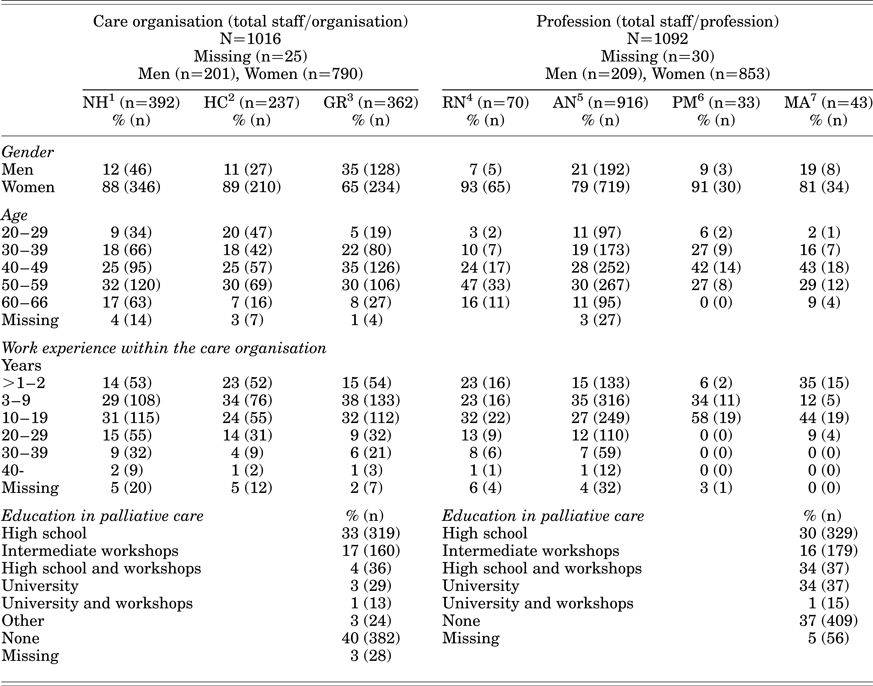
A majority worked as ANs and had two years of high school education. The RNs had three to four years of medical and nursing education, and a minority worked as PMs with three years of education at the university level. The MAs who worked in NHs and HC were usually RNs; 78% were women and ANs, with a mean age of 46 (range 20–66). A total of 21% were men and ANs working in GRs. A majority of all the staff was 40–59 years. A number of staff members in HC and ANs were between 20 and 29 years of age, and several of the PMs working in GRs were younger than 39 years. Some of the RNs working in nursing homes were older than 60. The total mean length of work experience in the organization was 15 years (range 1–45). All the staff members in NHs, HC, and GRs, and the PMs had 10–19 years of work experience, and the ANs had >1–9 years. A majority in NHs had worked 3–9 years. Several in HC and the MAs had worked >1–2 years. No PM or MA had worked more than 30 years (see Table 1).
Percentage (%) and distribution (n=) of healthcare staff and managers (N=1098) in the different care organisations (staff working in more than one care organisation were excluded n=82) and professions (social workers and psychologist excluded n=6), demographical data, work experience and palliative care education

1 NH= Nursing home, 2HC=Home care, 3GD= Group dwelling, 4 RN= Registered nurses, 5 AN=Assistant nurses, 6 PM= Paramedics, 7 MA= Managers.
Lack of Palliative Care Education
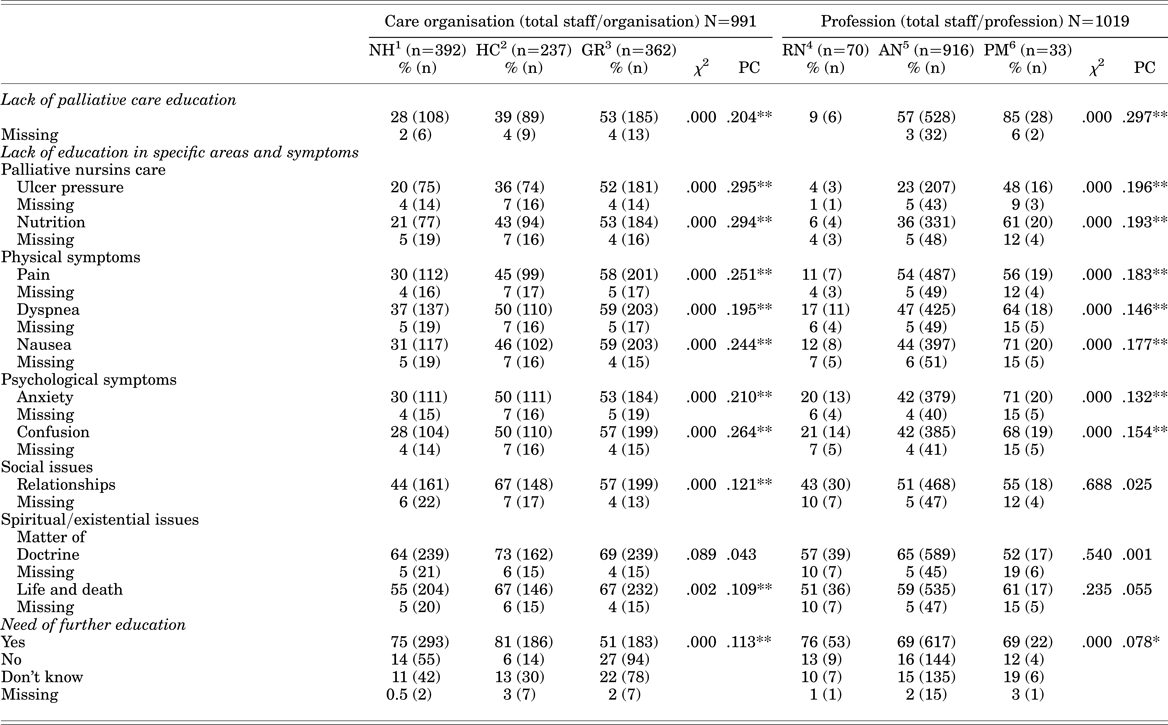
Of the staff working at care organizations (n = 991), 40% (n = 382) lacked palliative care education, and among the professions (n = 1019) this number was 37% (n = 409). The proportion was significantly higher (p = 0.000) in HC and GRs compared to NH staffs. There was a large difference between the professions in terms of education level (p = 0.000) because 85% of the PMs lacked education compared to RNs and ANs. Several more ANs than RNs lacked education, and 53% (n = 119) of the men had lower education levels. Of the 1019 staff members, a minority (16%, n = 179) had attended intermediate workshops, and of those who participated a majority were RNs. Of the MAs, 50% (n = 22) attended, and 33% (n = 14) of them lacked education (Table 2).
One MA in a NH reported that lacking education in palliative care as a manager is a shortage as this makes it difficult to support staff members in the care of dying patients. This was described as: As regards the lack of competence in palliative care, you know (. . .) I mean from my position as manager, to be able to engage in conversations with my staff in these matters.
Differences between lack of palliative care education, lack of education in specific areas (n=5) and symptoms (n=10) and care organisations and professions (managers, social workers and psychologists excluded n=49), response options Yes or No, need of further education response options Yes or No or Do Not Know, percentage (%), distribution (n=), chi2 p-values (= 0.5) and Pearson Correlation (PC) are calculated of care organisation and profession
NH1= Nursing home, HC2=Home care, GD3= Group dwelling, RN4= registered nurses, AN5=assistant nurses, PM6= paramedics. *Correlation is significant at the 0.05 level; **Correlation is significant at the 0.01 level.
Lack of Competence in Specific Areas
There was a significant difference in competence even though the relationships were weak between care organizations and healthcare staff members (ANs, RNs, PMs) in the five areas, including 10 specific palliative care symptoms (Table 2).
More than 50% of the staff members in GRs and the PMs lacked competence in palliative nursing care and the physical and psychological areas; half of the staff in HC lacked competence in one or more variables in the physical and psychological areas. A minority of the RNs lacked competence in palliative nursing care and the physical areas. Less than 50% of ANs lacked competence in palliative care nursing and in the physical and psychological areas. One AN working in HC remarked,
I have experienced several occasions when patients had a several-week struggle with anxiety, physical concerns, and, especially, mental pain. Our staff has time after time pointed out that patients need more pain relief, which should not depend on how persistent relatives are about what pain relief the patient receives.
All the staff members in all the care organizations and professions lacked competence in the social and spiritual/existential areas.
Need for Further Education
Of the staff members in care organizations (n = 991), more than 50% required further education, and among the professions (n = 1019) this number was above 69% (Table 2). Homecare staff members (81%, n = 186) had the greater need compared to NHs and GDs. Registered nurses (76%, n = 53) had a greater need compared to ANs and PMs. A total of 50% of MAs (n = 17) needed further education. There was a significant difference (p = 0.000) between the women and men concerning age and the need for further education (p = 0.026). Among the youngest (aged 20–39) and oldest (50–66), 75% estimated a need for further education, compared to 62% among the other age groups. One AN in HC addressed this issue as follows:
I think that the staff members who lack formal education should receive an education. This is to increase the staff's competence but also to give the staff member greater self-confidence and contentment.
Of the staff members, 38% (n = 387) worked nightshifts, and, of these, 58% (n = 224) did not require further education. In this group, 64% (n = 243) were 40–59 years old.
Need for Support and Reflection
The need for consulting specialists in palliative care for support outside the care setting differed between care organizations (p = 0.000) and professions (p = 0.012). In healthcare, 27% (n = 65) had a greater need for support than in NHs and GRs. Of the RNs, 31% (n = 22) needed support; 18% of the ANs needed support (n = 162), and 14% of the MAs were in need of support (n = 6). One RN in HC had this to say:
Sometimes I miss professional tutorial/supervision. In emotionally difficult cases, for example, with regard to younger patients, or in people who are angry and bitter and will never be satisfied with whatever one is doing
Significantly more women than men needed to reflect with colleagues after the death of a patient (p = 0.007), and staff members in the age group 50–59 had an increased need for reflection.
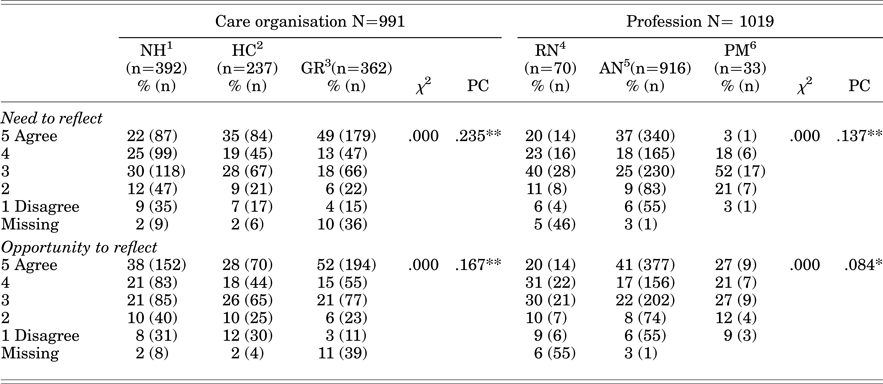
Of the staff members in GRs, 62% (n = 226) needed to reflect with colleagues, and 67% (n = 249) reported that they had the opportunity to reflect (Table 3). In HC, more than 50% of staff members needed to reflect, and 59% (n = 235) in nuring homes reported having an opportunity to reflect. The staff members in NHs had a significantly lower need to reflect compared to those in HC and GRs. The ANs had a significantly higher need and opportunity to reflect than those in other professions. The PMs reported a decreased need for reflection, but they reported an increased opportunity for reflection with colleagues.
Differences concerning the need and opportunity to reflect with colleagues after a patient's death between care organisations and professions described with percentage (%) and distribution (n=), calculated with chi2 p-values (=.05) and Pearson correlation (PC), estimated with a Lickert-scale 1= disagree to 5= strongly agree, managers excluded
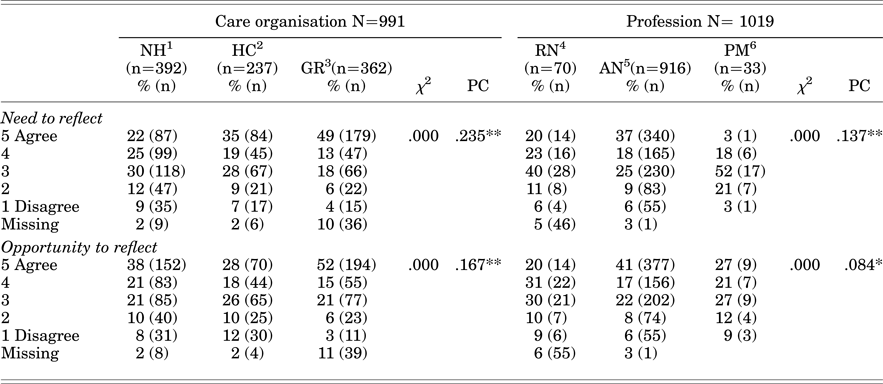
NH1= Nursing home, HC2=Home care, GD3= Group dwelling, RN4= Registered nurses, AN5=Assistant nurses, PM6= Paramedics. ** Correlation is significant at the 0.01 level.
DISCUSSION
This study identified the significant differences in competencies between care organizations and professions, gender, and age in a rural community in central Sweden. Many staff members lacked palliative care education on a basic or higher level, and there were educational gaps in specific palliative care areas. This finding was described by the National Board of Health and Welfare (NBHW, 2001). Palliative care must be prioritized, and continuous education and guidance should be given to all staff members who care for dying patients, a finding supported by Ferrell et al. (Reference Ferrell, Grant. and Viriani1999) and Brazil et al. (Reference Brazil, Bédard and Krueger2006). Staff members have also been found to lack knowledge of how to meet the needs of dying persons with different cultural backgrounds (Kayser-Jones, Reference Kayser-Jones2002).
The ANs in our study were younger, had shorter work experience, and lacked education and competence in specific symptoms. A majority of the staffs in home help services is composed of ANs. They often work alone and need education to manage care for palliative patients; they play an important role in identifying and reporting patients' symptoms and pain. According to Ersek et al. (Reference Ersek, Kraybill and Hansberry1999), ANs require competence concerning the side effects of drugs. In general, healthcare staffs need more education about symptom control, that is, to ameliorate difficult symptoms in consideration of patient dignity and autonomy.
Only a minority of all the staff members attended intermediate workshops in palliative care, a finding similar to that reported by Goddard and coworkers (Reference Goddard, Stewart and Thompson2011). Intermediate workshops are usually based on willingness and are limited to groups of staff (e.g., physicians and RNs). The importance of adapting education to staff needs and workplace was found by Ferrell and Borneman (Reference Ferrell and Borneman2002) and Shipman et al. (Reference Shipman, Burt and Ream2008). The staff who worked nights did not need further education, even if the staff in general expressed this need; however, when further education was offered, attendance was difficult because healthcare staff often prioritized daily work in the unit, and often there was a shortage of staff (Whittaker et al., Reference Whittaker, George and Hasson2006; Reference Whittaker, Kernohan and Hasson2007; Ferrell & Borneman, Reference Ferrell and Borneman2002). Schlairet (Reference Schlairet2009) argued that there is a gap in the quality of end-of-life care that nurses would wish to provide and their available skills, and that they often request additional education.
Staff in HC lack competence in several areas of palliative care, a situation described by Hasson and Arnetz (Reference Hasson and Arnetz2008); HC staff need to consult palliative care specialists, which was described by Brazil et al. (Reference Brazil, Bédard and Krueger2006) and Slåtten et al. (Reference Slåtten, Fagerström and Haltevik2010) among long-term care staff. A majority of RNs do not lack competence concerning pain, which is surprising because education concerning pain management is often requested by nurses (Ersek et al., Reference Ersek, Kraybill and Hansberry1999; Shipman et al., Reference Shipman, Burt and Ream2008), and the patients' symptoms are sometimes underestimated, resulting in undertreatment (Laugsand et al., Reference Laugsand, Sprangers and Bjordal2010). Registered nurses frequently care for dying patients, and the possibilities for further education concerning life and death issues are scarce (Bégat et al., Reference Bégat, Ellefsen and Severinsson2005). To confront these questions may create feelings of emptiness (Jones, Reference Jones2003), anxiety, and lack of control, as well as stress (Bégat et al., Reference Bégat, Ellefsen and Severinsson2005, Severinsson & Kamaker, Reference Severinsson and Kamaker1999).
The staffs at GRs and the PMs were found to lack education and competence in specific symptoms to a higher degree than other staffs. This was not surprising because PMs as physiotherapists traditionally rehabilitate patients physically with the aim of getting the patient back to work. Patients in the palliative phase need rehabilitation aimed at optimal quality of life. In GRs, the staff care for persons with intellectual disabilities and usually do not encounter dying and death. This competence should be strengthened, since the staff at GRs in the future will probably encounter dying patients and their families to a greater extent. Access to palliative care education is limited, and information and training materials must be developed (Tuffrey-Wijne, Reference Tuffrey-Wijne2003); GR staff members lack experience and confidence in their ability to provide palliative care (Ryan et al., Reference Ryan, McEvoy and Guerin2010) and require the knowledge to identify the signs and symptoms of terminal illness (Ersek et al., Reference Ersek, Kraybill and Hansberry1999; Goddard et al., Reference Goddard, Stewart and Thompson2011).
Staff members in leading positions had worked for a shorter time and needed palliative care education because they wanted to understand and support their staff, despite not working with dying patients themselves. All staff needed to have knowledge about palliative care philosophies and its principles to increase their awareness of the multiple needs of dying people and to implement the provision of the individual patient's physical, psychological, social, and spiritual/existential needs (Dwyer et al., Reference Dwyer, Hansebo and Andershed2011). Educational and staff shortages are significant barriers when providing palliative care, and continual educational efforts and enhanced staffing could improve end-of-life care (Dwyer et al., Reference Dwyer, Hansebo and Andershed2011; Rice et al., Reference Rice, Coleman and Fish2004). Lo et al., (Reference Lo, Kwan and Lau2010) found that staff members require moral support and consultation on the implementation of palliative care from the care organization in which they work. Another way to support staff is to create opportunities for reflection in a group context. There were differences among care organizations and age groups concerning the need and opportunity for reflection after a patient's death. Although a majority estimated a need to reflect, they did not always have the opportunity. This finding indicates the importance of having natural meeting places where staff can debrief after difficult care situations. Support in the workplace when staff members are caring for dying patients is certainly crucial (Ersek et al., Reference Ersek, Kraybill and Hansberry1999; Whittaker et al., Reference Whittaker, George and Hasson2006).
It is essential that patients at the end of life be relieved from physical, psychological, social, and existential symptoms so that they can obtain a positive quality of life. In our study, a majority of staff members lacked competence in the social and spiritual/existential areas. Social isolation is a risk factor among sick older people, particularly when family support is inadequate (WHO, 2012). White et al. (Reference White, Coyne and Patel2001) described the situation as staff members lacking the competence to discuss the dying process and pain control techniques with patients and their relatives. Certainly discussing life-and-death issues without diminishing hope and communicating the goals and quality of care with the patients and relatives is perceived as difficult (Ersek et al., Reference Ersek, Kraybill and Hansberry1999; Whittaker et al., Reference Whittaker, George and Hasson2006). However, the quality of care provided may be enhanced by increasing the competence and confidence of staff members delivering palliative care in a rural community.
There are limitations to the present study. Using a questionnaire in diverse care organizations where the healthcare staff and managers answer the same questions may imply that some questions are irrelevant to some participants. The participants had the opportunity with the open-ended questions to add their own comments. Because of the anonymous nature of the study, no data were collected with regard to age, gender, professional data, or competence in palliative care from the 588 staff members (35%) who could not participate. Incomplete questionnaires concerning single questions are common when collecting data from a long questionnaire and in a large sample. This internal dropout rate was relatively low, and we attempted to influence this rate by including a cover letter introducing the study and the questionnaire, by forming comprehensible and logical questions, and by using the managers as contacts to remind the staff of the importance of completing the questionnaires.
The strengths of our study included the facts that it was piloted and that self-addressed envelopes were enclosed with questionnaires, which may have decreased the proportion of external dropouts. The generalizability of our results is significant for other rural communities in Europe, but the questionnaire should be further analyzed to establish validity and reliability.
CONCLUSION
To summarize, we found that staff members in different care organizations in the studied community lacked basic education in palliative care as well as in specific areas related to palliative care. A majority of staff members lacked education in the social and spiritual/existential areas related to palliative care. Professionals such as assistant nurses and paramedics require education concerning the relief of physical and psychological symptoms. Based on the results obtained, an educational program should be developed that focuses on the different needs in care organizations and professions. This study could serve as guidance for managers in community enterprises when planning palliative care education for healthcare staff so as to address educational interventions for specific groups of professions according to their special needs, instead of providing the same education for all staff regardless of care organization or profession.