Introduction
In palliative care, family caregivers are included in the unit of care and the assessment of their bereavement risk could improve the provision of support. The loss of a close family member is known to be one of the most stressful events in a person's life (Haley et al., Reference Haley, LaMonde and Han2001). Although most bereaved individuals overcome their grief over time without any intervention, a minority of individuals experience severe and long-term consequences (Schut & Stroebe, Reference Schut and Stroebe2005). Previous studies indicated that this minority of individuals are more likely to be at risk of negative bereavement-related outcomes such as poorer mental health, diminished quality of life, and risk of suicide (Ajdacic-Gross et al., Reference Ajdacic-Gross, Ring and Gadola2008; Boelen, Reference Boelen2013; Ghesquiere et al., Reference Ghesquiere, Haidar and Shear2011). This is referred to as complicated or prolonged grief (Prigerson et al., Reference Prigerson, Horowitz and Jacobs2009). Unfortunately, research indicates that those experiencing negative bereavement do not seek help (Currow et al., Reference Currow, Alien and Plummer2008); therefore, to provide psychological help to those who need it, it is necessary to identify those likely to suffer from the more severe consequences of bereavement.
The Bereavement Risk Assessment Tool (BRAT) was developed by the health professionals of Victoria Hospice Society in Canada (Rose et al., Reference Rose, Wainwright and Downing2011). Because the BRAT is based on observation, it requires staff to be trained in its use and has several complex factors that are rated subjectively. The BRAT can be used before the patient's death for recording and analyzing the bereavement needs of caregivers and staff in a timely manner. This strategy avoids duplication of assessment and reduces the likelihood of missing caregivers for the assessment. This tool includes risk and protective factors based on previously published reports and clinical evidence.
As the study by Bonanno et al. (Reference Bonanno, Wortman and Lehman2002) suggested, individual resilience is a common reaction to bereavement that protects against prolonged grief. Stroebe et al. (Reference Stroebe, Folkman and Hansson2006) argued against examining any specific factor in isolation and suggested that the assessment of risk should include factors that mitigate future potential harm in the adjustment to loss. From this point of view, the BRAT is somewhat effective because it considers both risk and relevant resiliencies. To date, however, only a few studies have examined bereavement risk using the BRAT. Rose et al. (Reference Rose, Wainwright and Downing2011) estimated the inter-rater reliability of the BRAT using case studies, with 36 psychosocial professionals completing the BRAT on 10 caregivers of hospice palliative care patients. In that study, four of the 10 caregivers were considered to be at a high risk for bereavement (level 4 or 5). In addition, Hirooka et al. (Reference Hirooka, Sakaguchi and Iwamoto2016) developed a preliminary Japanese version of the BRAT (BRAT-J) and assessed 25 family caregivers of patients with cancer. They reported that nine participants (36%) were at moderate risk and one (4%) was at a high risk for bereavement.
There are no conclusions regarding the degree of bereavement risk of family caregivers of patients with cancer, which suggests that research is required to clarify this issue. The relationship of bereavement risk with psychological distress and resilience among caregivers also needs to be examined to determine the validity of the BRAT-J. In this study, we investigated the following: (1) the degree of bereavement risk of family caregivers of patients with cancer and (2) the relationship of bereavement risk with psychological distress and resilience among caregivers.
Method
Participants
In the palliative care unit of Tohoku University Hospital, between September 2013 and December 2016, the average number of patients per year was 199.3 and their average stay 43.2 days. Family psychoeducation was provided to family caregivers of patients (Saito et al., Reference Saito, Tominaga and Takamatsu2012). Individuals who met the following inclusion criteria were invited to family psychoeducation by the medical staff: (1) aged >20 years, (2) family caregivers of patients with cancer who were hospitalized in the palliative care unit of Tohoku University Hospital, and (3) judged upon observation of the medical staff to be seeking psychological help.
A total of 70 family caregivers (from 57 families) participated to family psychoeducation. Among them, 50 family caregivers provided their written informed consent and were thus included in this study. Twenty excluded caregivers were omitted for varied reasons (e.g., no time to reply after the session, declining to participate in this study, participants were ≥90 years of age).
The research design was approved by the Ethics Committee of Tohoku University Graduate School of Medicine and Tohoku University Hospital. This study complies with the principles laid down in the Declaration of Helsinki for experiments involving human participants.
Measures
With permission from Caelin Rose, Hirooka et al. (Reference Hirooka, Sakaguchi and Iwamoto2016) first translated the BRAT into Japanese. Then, the BRAT-J was back-translated into English and the results of the back-translation were examined and judged satisfactory by Rose. We used BRAT-J to assess the degree of bereavement risk of the family caregivers of patients with cancer; it is a 40-item, staff-administered observational checklist. Items are based on 36 risk factors and four protective factors. This checklist was designed to predict bereavement and generates a risk rating, where level 1 represents no known risk and level 5 indicates high risk. (A manual is available from Victoria Hospice at http://www.victoriahospice.org). The assessments were undertaken by the psychiatrist and psychologist based on the information from the informal discussions in the family psychoeducation session about caregivers’ needs.
We also used the Kessler Psychological Distress Scale (K6) and the Tachikawa Resilience Scale (TRS) to investigate the relationship between bereavement risk and psychological characteristics (i.e., psychological distress and resilience). The K6 consists of six items measured on a 5-point scale (0–4). High scores indicate more severe psychological distress (Kessler et al., Reference Kessler, Barker and Colpe2003). The Japanese version of the K6 has been previously validated (Furukawa et al., Reference Furukawa, Kawakami and Saitoh2008). A cutoff point of 9/10 has been used to screen for mood or anxiety disorder (Sone et al., Reference Sone, Nakaya and Sugawara2016; Suzuki et al., Reference Suzuki, Fukasawa and Obara2014), which we adopted in this study. The TRS is a 10-item self-report measure of resilience for Japanese populations. All items are scored on a 7-point scale from 1 (strongly disagree) to 7 (strongly agree), with a total score ranging from 10 to 70. Higher scores reflect higher resilience. The reliability and validity of the TRS have been established (Nishi et al., Reference Nishi, Uehara and Yoshikawa2013).
Analysis
To assess the degree of bereavement risk of the family caregivers of patients with cancer, the proportion of individuals at high risk as defined by the BRAT-J was calculated. In addition, to investigate the relationship between bereavement risk and psychological characteristics among caregivers, Spearman's correlations of BRAT-J risk levels with K6 and TRS scores were calculated. Statistical analyses were conducted with IBM SPSS statistical software, version 20.0 (IBM Japan, Tokyo, Japan). All testing was two-tailed, and the significance level was set at 5%.
Results
Demographic characteristics
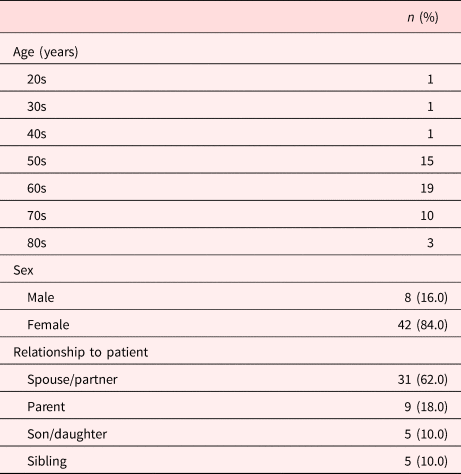
Demographic characteristic of participants are shown in Table 1. The majority (84%) of the participants were female, nearly two-thirds (62%) were spouses or partners of the patient/deceased, and the mean age was 62.98 years (SD = 11.10).
Demographic characteristics of participants (N = 50)
Profile of bereavement risk
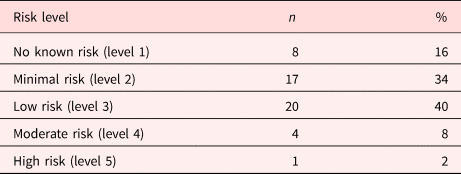
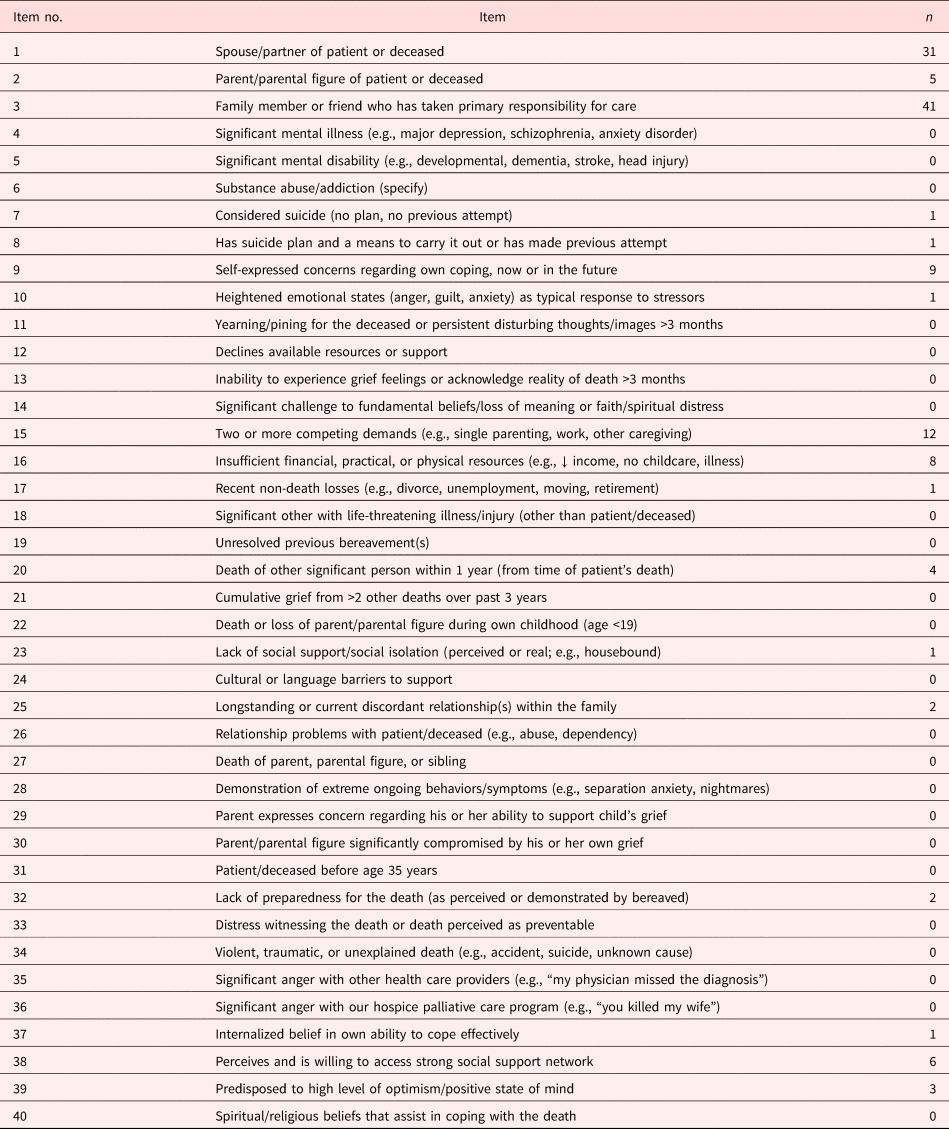
According to the BRAT-J risk levels (Table 2), five (10.0%) of the 50 participants were in the category of high bereavement risk (level 4 or 5). Frequency counts for each item of the BRAT-J are presented in Table 3. The majority (82%) of the participants had primary responsibility for care, and one-quarter (24%) had two or more competing demands.
Frequency of BRAT-J risk levels (N = 50)
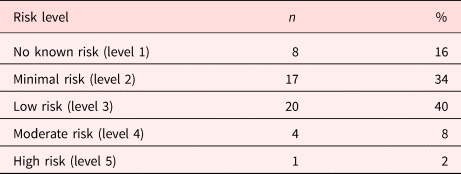
BRAT-J, Japanese version of the Bereavement Risk Assessment Tool.
Frequency of BRAT-J items

Correlation of bereavement risk with psychological distress and resilience
The mean K6 score was 7.58 (SD = 4.37), and 12 participants (24.0%) had scores higher than the cutoff point (>9) for the detection of depressive disorder. K6 scores were significantly correlated with the BRAT-J risk level (ρ = 0.30, p = 0.032). The mean score of resilience as measured by the TRS was 45.9 (SD = 8.9), and TRS scores were significantly negatively correlated with the BRAT-J risk level (ρ = –0.44, p = 0.001).
Discussion
This study investigated bereavement risk among family caregivers of patients with cancer using the BRAT-J. Five individuals (10%) were in a high category of risk (level 4 or 5). This prevalence is lower than that reported in previous studies (Hirooka et al. Reference Hirooka, Sakaguchi and Iwamoto2016; Rose et al., Reference Rose, Wainwright and Downing2011). Participants were recruited from family psychoeducation; that is, they were already seeking psychological support, which could act as a protective factor. Additionally, our results are consistent with previous studies showing that approximately 10–20% of caregivers suffer from complicated grief (Prigerson, Reference Prigerson, Frank and Kasl1995). Family members of palliative care patients are usually tasked with responsibilities that include maintenance of personal hygiene, medical care, consultations with health professionals, emotional support, and patient advocacy (Thomas et al., Reference Thomas, Hudson and Trauer2014). Participants in this study also experienced many different pressures, such as facing the unknown, their own work, and insufficient financial, practical, or physical resources; these issues are associated with various mental problems.
According to the cutoff point of the Japanese version of the K6, 12 (24%) of the 50 participants were suspected of having depression. In a previous study with family caregivers, depression rates between 12% and 59% and anxiety rates between 30% and 50% were reported (Hudson et al., Reference Hudson, Thomas and Trauer2011). Additionally, a positive correlation between BRAT-J risk level and the total K6 score was observed. This positive correlation suggests that family caregivers of patients with cancer with higher bereavement risk exhibited higher rates of psychological distress. Moreover, the present study also found that the mean TRS scores were very close to those reported in previous studies assessing the resilience of healthy populations using the TRS (Nishi et al., Reference Nishi, Uehara and Yoshikawa2013).
Further, resilience was negatively correlated with BRAT-J risk level, which supports previous findings that resilience is associated with adjusting better to bereavement (Bonanno et al., Reference Bonanno, Wortman and Lehman2002). Family caregivers’ resilience may therefore protect against prolonged grief, which requires further experimental analyses.
A limitation of the present study was the small sample size; as noted previously, the sample may have been biased because caregivers were already seeking psychological support. A larger sample size would provide more precise information about the prevalence of bereavement risk. Second, this study was cross-sectional, and future longitudinal studies would make it possible to examine the predictability of the bereavement risk of family caregivers using the BRAT-J.
In conclusion, we demonstrated that the BRAT-J can be an efficient screening tool for the bereavement risk of family caregivers of patients with cancer. The systematic assessment of bereavement risk would make it possible to promote empirical study and evidence-based clinical practice in palliative care. It appears that the BRAT-J is useful in predicting the likelihood of difficulties or complications in bereavement for family caregivers and could help to provide support with these issues when needed.
Acknowledgments
This research was partly supported by a Grant-in-Aid for Scientific Research (C) 15A04108 from the Japan Society for the Promotion of Science.
Conflict of interest
The authors declare no conflict of interest.