FOCUS POINTS
• Desvenlafaxine is the active metabolite of venlafaxine; both are SNRI antidepressants, but desvenlafaxine does not undergo extensive CYP450 mediated metabolism.
• Desvenlafaxine has not been directly compared with venlafaxine in its approved dosage range (50 to 200 mg/day).
• Based on indirect meta-analysis, desvenlafaxine has comparable efficacy to venlafaxine, and may have a tolerability advantage.
Background
Unipolar major depression remains a major cause of morbidity in Australia, with the 2007 National Survey of Mental Health and Wellbeing reporting a 12 month prevalence rate of 4.1% for a depressive episode in adults 18 to 65 years of age.1 However, while the rate of prescribing antidepressants has increased since the introduction of selective serotonin reuptake inhibitors,Reference Mant, Rendle and Hall2 there is evidence that major depression remains underdiagnosed and undertreated.Reference Hickie, Davenport and Scott3
Desvenlafaxine, as the major active metabolite of venlafaxine hydrochloride (HCl), offers an additional treatment option to the serotonin noradrenaline reuptake inhibitor (SNRI) class of agents for major depression.Reference Deecher, Beyer and Johnston4 Desvenlafaxine and venlafaxine each have different chemical structures, and in vitro studies have shown differing affinities for serotonin (5-HT) and noradrenaline (NA) receptors. Desvenlafaxine has a smaller 5-HT/NA selectivity ratio compared with venlafaxine. At equi-effective concentrations for inhibiting serotonin uptake, one would expect to see more NA inhibition with desvenlafaxine than with venlafaxine.
Venlafaxine, like most antidepressants, is metabolized via the cytochrome P450 enzymatic pathway. In particular, venlafaxine undergoes CYP2D6 metabolism. This enzyme shows a high degree of genetic polymorphism and variability in activity. Based on the degree of CYP2D6 activity, patients can be classed as 1 of 4 phenotypes: poor, intermediate, extensive, or ultra-rapid metabolizers. Poor metabolizers will have high plasma concentrations secondary to slow elimination, whereas those who are ultra-rapid metabolizers will rapidly eliminate the drug leading to potentially sub-therapeutic plasma concentrations of the drug.
Unlike the parent molecule, desvenlafaxine is not significantly metabolized by the hepatic cytochrome P450 (CYP450) isoenzyme system, and in particular its metabolism is independent of the CYP2D6 pathway. Therefore desvenlafaxine demonstrates similar plasma levels in extensive and poor CYP2D6 metabolisers.Reference Preskorn, Patroneva and Silman5 Poor CYP2D6 metabolizer status is being increasingly recognized as a risk factor for a negative outcome with venlafaxine treatment, manifested as either lack of efficacy or unacceptable tolerability.Reference Shams, Arneth and Hiemke6–Reference McAlpine, O'Kane, Black and Mrazek8
As a result of these differences in pharmacodynamic and pharmacokinetic properties, dose equivalence between venlafaxine and desvenlafaxine that can accurately account for all variabilities has not been determined.
Early clinical trials conducted with desvenlafaxine, which included two studies that incorporated venlafaxine as an active comparator arm, utilized doses of 200 or 400 mg daily. A clear dose–response relationship in efficacy with higher doses was not demonstrated, and tolerability at 400 mg was less favorable with higher attrition rates.Reference Septien-Velez, Pitrosky, Padmanabhan, Germain and Tourian9–Reference Lieberman, Montgomery and Tourian11 Subsequent studies have demonstrated the efficacy and tolerability of desvenlafaxine at a dose of 50 mg/day.Reference Liebowitz, Manley and Padmanabhan12, Reference Boyer, Montgomery and Lepola13 As such, desvenlafaxine is registered in Australia with a recommended daily dose of 50 mg and a maximum recommended dose of 200 mg per day.14 The aim of the present analysis is to compare the efficacy and tolerability of desvenlafaxine and venlafaxine at Australian approved doses via an indirect comparison using placebo as the common comparator.
Methods
A systematic literature search was conducted to identify all relevant randomized controlled trials using the Medline and Embase databases, the Cochrane Library, and Wyeth in-house files. In addition, searches were undertaken of the Australian New Zealand Clinical Trials Register (ANZCTR) and the U.S. National Institutes of Health Clinical Trials Register (via http://www.clinicaltrials.gov). An initial literature search was conducted on October 25, 2007, and an update was performed on May 12, 2008.
Only data from randomized, placebo-controlled clinical trials that included either desvenlafaxine (50 to 200 mg/day) or venlafaxine (75 to 225 mg/day) in one of the active treatment arms were included in the analysis. All analyses were based on 8-week data only.
Twenty-seven trials were identified for inclusion in the analysis. The majority of included trials used either computer-generated randomization schedules or block randomization, although 7 studies included in the analysis (2 for desvenlafaxine, 5 for venlafaxine) did not specify the exact method of randomization in their respective publications or study reports. All studies included adult patients (≥18 years of age) with a diagnosis of major depressive disorder, usually according to the Diagnostic and Statistical Manual of Mental Disorders (DSM), 3rd (text revision) or 4th edition criteria.15, 16
For all included studies, study participants were required to have a minimum baseline score of 20 on either the 17- or 21-item versions of the Hamilton Depression Rating scale (HAM-D17 or HAM-D21).Reference Hamilton17
The primary measure used to assess the comparative efficacy of desvenlafaxine relative to venlafaxine was mean change from baseline in the HAM-D17 score. All studies were required to include an efficacy assessment based on mean change in HAM-D score from baseline. To ensure comparability, for studies in which the 21 item version of the HAM-D scale was applied, original patient data were used to calculate HAM-D17 scores.
For the purposes of this analysis, a minimum clinically important difference (MCID) of 1.5 points on the HAM-D17 scale was the threshold applied to assess non-inferiority. Study and indirect analyses were carried out on the intention to treat population (ITT). The ITT population included all subjects who received treatment and who had at least one post-baseline efficacy assessment.
Secondary efficacy measures assessed were remission and response to treatment. Remission was defined as a final HAM-D17 score of ≤7. This was the definition used for all of the desvenlafaxine trials and the majority of the venlafaxine trials. Two venlafaxine trials used alternate definitions: Ven 209 defined remission as a HAM-D21 score of ≤8, while Ven 211 defined remission as a HAM-D21 score of ≤7.
Response was defined as (i) a decrease of at least 50% from baseline in HAM-D17 total score for all desvenlafaxine studies; and (ii) a decrease of at least 50% from baseline in HAM-D21 total score for all venlafaxine studies. The only exception to this was Ven 317 where response was analyzed using the HAM-D17 scale. To ensure comparability, for studies in which the 21-item version of the HAM-D scale was applied, original patient data were used to estimate the numbers of remitters and responders based on HAM-D17 scores.
Indirect analyses were carried out on the full ITT population. Randomized subjects who had been excluded from the study analysis due to having no post-baseline measure were included in the indirect analyses as nonresponders/nonremitters. In all included studies, an adverse event (AE) was defined as any untoward, undesired, or unplanned clinical event in the form of signs, symptoms, disease, or laboratory or physiologic observations occurring in a person participating in a clinical study, regardless of causal relationship. This definition included a recurrence or any clinically important worsening in frequency or intensity of a pre-existing condition, an AE associated with any study procedure, or an AE associated with the discontinuation of test article. The safety population included in the study and indirect analyses included all subjects who received at least one dose of study therapy.
A standard head-to-head meta-analysis was conducted for each outcome using the software package Review Manager 4.2 (Cochrane Collaboration). Results were generated using the random effects method (REM), with analysis of continuous data using the weighted mean difference (WMD). Analysis of dichotomous data was generated using both the relative risk (RR) and risk difference (RD). Head-to-head data versus placebo was used to perform the indirect meta-analysis. The standard indirect analysis was conducted using the method proposed by Bucher etal.Reference Bucher, Guyatt, Griffith and Walter18 using MS Excel.
A regression analysis was also conducted to evaluate the impact of potential differences in study conduct and patient characteristics within each group of trials and across the two groups of trials on the primary efficacy outcome, which was mean change from baseline HAM-D17. The following potential predictors of mean HAM-D17 change from baseline were examined: study duration, year of publication of study report, baseline HAM-D score, patient age, actual/mean dose, and fixed versus flexible dosing regimen. The regression analysis identified the following three variables as significant predictors of mean change from baseline HAM-D17: baseline HAM-D score, study duration, and age. A Bayesian model, adjusted for the three identified predictors and using data from a mixed-effect model repeated measure (MMRM) analysis was used to conduct an indirect comparison of desvenlafaxine versus venlafaxine based on the primary efficacy outcome. Only baseline HAM-D score remained a significant predictor in the analysis; therefore, the final analysis of change in HAM-D from baseline was adjusted for baseline HAM-D only. The Bayesian indirect analysis was conducted using OpenBUGS v. 2.2.0, as described by Spiegelhalter etal.19
Findings
Demographics
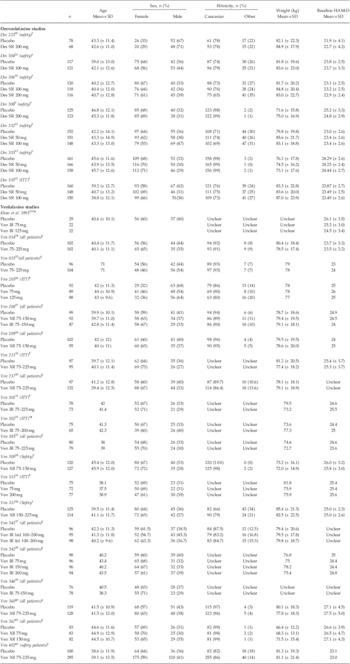
The main demographic and disease characteristics of participants in the trials included in this analysis are summarized in Table 1. According to these metrics, study participants were generally quite similar across trials. The majority of trials were conducted in the U.S. or in Europe, and as such, most participants were Caucasian (ranging from 66% in the placebo arm of Ven 317 to 99% in Des 308). The mean age of participants was also generally consistent, ranging from 37.5 in the 75 mg arm of Ven 313 to 46.8 in the placebo arm of Des 308. With a mean age of 71, Ven 015 was the only study where the participants were markedly older than the participants in other studies. This difference is accounted for by the fact that the study was designed to only include patients over the age of 65. The mean weight across studies varied from 66.4 kg in the placebo arm of Ven 367 to 85.6 kg in the 50 mg arm of Des 332. The mean total HAM-D score at baseline was very similar across studies, ranging from 21.9 in the placebo arm of Des 223 to 27.5 in the venlafaxine arm of Ven 360. As mentioned earlier, some studies applied the 17-item scale (HAM-D17) (all Des studies and Ven 309 and Ven 317), while others used the 21-item version (HAM-D21).
Characteristics of participants in the included studies

Abbreviations: Des, Desvenlafaxine; HAM-D, The Hamilton Rating Scale for Depression; IR, immediate-release; ITT, intention-to-treat; SD, standard deviation; SR, sustained release; Ven, Venlafaxine; XR, extended release.
† Baseline data available for all patients who received at least one dose of the test article.
‡ Unclear if data pertain to ITT population, safety population, or all patients.
§ Baseline data available for all randomized patients (including those who did not take the test article).
¶ Baseline data available for ITT population (including all randomized participants who underwent at least one post-baseline primary efficacy evaluation after receiving the first test article).
Efficacy
Based on a MMRM analysis of desvenlafaxine and placebo, and venlafaxine and placebo, the mean change in HAM-D17 from baseline ranged from −11.5 to −7.6 in the placebo arms of the desvenlafaxine studies and −13.8 to −7.2 in the placebo arms of the venlafaxine studies. The average mean change in HAM-D17 in the placebo arms across all studies was approximately −9.7 for the desvenlafaxine studies and −10.2 for the venlafaxine studies. The average mean change in the active treatment arms was −12.5 for desvenlafaxine and −12.8 for venlafaxine. The WMD for desvenlafaxine versus placebo (−2.8) was similar to that seen for venlafaxine versus placebo (−2.6). As per Figure 1, a standard indirect comparison demonstrated no significant difference in mean change in HAM-D17 between the two treatments (WMD −0.20; −1.27, 0.87; p = 0.71).
Standard indirect comparison of desvenlafaxine with venlafaxine (HAM-D17 reanalysis): mean change in HAM-D17 (MMRM data). Abbreviations: Des, desvenlafaxine; plac, placebo; Ven, venlafaxine.

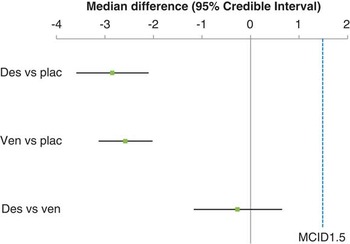
The Bayesian indirect comparison of desvenlafaxine and venlafaxine (adjusted for baseline HAM-D) resulted in a WMD of −0.27 (−1.17, 0.65). As can be seen in Figure 2, the result is not statistically significant, as the 95% CI crosses zero and the upper CI does not cross 1.5 (defined as the MCID).
Bayesian indirect comparison of desvenlafaxine with venlafaxine (HAM-D17 reanalysis): mean change in HAM-D17 (MMRM data). Abbreviations: Des, desvenlafaxine; plac, placebo; Ven, venlafaxine.

With regard to response (≥50% decrease in HAM-D17 score from baseline), placebo response rates ranged from 32–50% in the desvenlafaxine studies and from 28–50% in the venlafaxine studies. The mean response rate in the placebo arms across all studies was approximately 39% for desvenlafaxine and 40% for venlafaxine. The mean response rate in the active arms across all studies was approximately 50% for desvenlafaxine and 52% for venlafaxine. The indirect comparison shows no significant difference in response rates between the two treatments (RR 0.97; 0.85, 1.10; p = 0.63 and RD −0.02; −0.07, 0.03; p = 0.43).
With regard to remission (HAM-D17 ≤ 7), placebo remission rates ranged from 19–29% in the desvenlafaxine studies and from 17–41% in the venlafaxine studies. The mean remission rate in the placebo arms across all studies was approximately 23% for desvenlafaxine and 24% for venlafaxine. The mean remission rate in the active arms across all studies was approximately 30% for desvenlafaxine and 35% for venlafaxine. Again, the treatment effect for desvenlafaxine versus placebo was similar to that observed for venlafaxine versus placebo, and therefore the indirect comparison including all venlafaxine studies showed no significant difference in remission rates between the two treatments (RR 0.94; 0.78, 1.12; p = 0.48 and RD –0.04; –0.09, 0.01; p = 0.12).
Tolerability
Adverse event rates for subjects receiving placebo ranged from 63–89% in the desvenlafaxine studies and 60–96% in the venlafaxine studies. The mean adverse event rate in the placebo arms across all studies was approximately 75% for desvenlafaxine and 82% for venlafaxine. The mean adverse event rate in the active arms was approximately 85% for desvenlafaxine and 91% for venlafaxine. The RRs and RDs for the desvenlafaxine versus placebo and venlafaxine versus placebo comparisons were almost identical. The indirect comparison showed no significant difference in adverse event rates between the two treatments (RR 1.01; 0.96, 1.06; p = 0.70 and RD –0.01; –0.05, 0.03; p = 0.59). An indirect analysis of serious adverse events was not conducted due to the low number of events. Data on deaths during the clinical trials was not pooled for the same reason.
Nausea is generally the most common adverse event associated with SNRI therapy, and as such, nausea rates were specifically evaluated. Nausea rates reported by subjects receiving placebo ranged from 9–12% in the desvenlafaxine studies and 5–28% in the venlafaxine studies. The mean nausea rate in the placebo arms across all studies was approximately 10% for desvenlafaxine and 14% for venlafaxine. The nausea rate in the desvenlafaxine arm was 27%, while the nausea rate in the venlafaxine arm was 38%. While there was no significant difference in nausea between desvenlafaxine and venlafaxine using RR (RR 0.97; 0.77, 1.22; p = 0.80), the RD between desvenlafaxine and venlafaxine was significantly different (RD –0.07; –0.12, –0.01; p = 0.02).
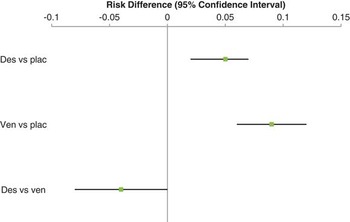
With regard to discontinuation due to adverse events, placebo rates ranged from 3–6% in the desvenlafaxine studies and 1–16% in the venlafaxine studies. The mean rate of discontinuations due to adverse events in the placebo arms across all studies was approximately 4% for desvenlafaxine and 6% for venlafaxine. The rate of discontinuation due to adverse events was approximately 9% in the desvenlafaxine arm and 16% in the venlafaxine arm. The point estimates of the RR and RD were similar but slightly lower for the desvenlafaxine analysis compared with the venlafaxine analysis. The indirect comparison did not reach statistical significance (RR 0.86; 0.58, 1.29; p = 0.48 and RD –0.04; –0.08, 0.00; p = 0.06) but suggested a trend in favor of desvenlafaxine (see Figure 3).
Indirect comparison of desvenlafaxine and venlafaxine: discontinuations due to adverse events. Abbreviations: Des, desvenlafaxine; plac, placebo; Ven, venlafaxine.

Discussion
The results of this indirect meta-analysis indicate that at Australian approved doses, desvenlafaxine is not inferior to venlafaxine in the short-term treatment of major depression. This result was anticipated based on the pharmacokinetic and pharmacodynamic properties of venlafaxine. With regard to the pharmacokinetics of venlafaxine, the in vivo exposure to desvenlafaxine is on average more than double the exposure to the parent compound following administration of venlafaxine extended release capsules.Reference Troy, Dilea and Martin43 From a pharmacodynamic perspective, both venlafaxine and desvenlafaxine demonstrate potent inhibition of serotonin and noradrenaline reuptake in preclinical models.Reference Deecher, Beyer and Johnston44 Hence, desvenlafaxine is likely to be a major contributor to the efficacy of venlafaxine preparations with the exception being poor CYP2D6 metabolizers, who do not convert significant amounts of venlafaxine to desvenlafaxine.Reference Shams, Arneth and Hiemke6 Poor CYP2D6 metabolizers comprise around 5–10% of the Caucasian population.Reference Caraco45
The analysis generated some evidence that desvenlafaxine may be better tolerated than venlafaxine at the doses examined, as demonstrated by the significantly lower nausea rate observed in subjects treated with desvenlafaxine (RD –0.07; –0.12, –0.01; p = 0.02). Furthermore, the indirect analysis of dropout rates due to adverse events, while failing to reach statistical significance, demonstrated a trend in favor of desvenlafaxine (RD –0.04; –0.08, 0.00; p = 0.06). One possible explanation for this finding is that poor CYP2D6 metabolizers have been reported to experience more side effects than extensive metabolizers.Reference Shams, Arneth and Hiemke6 In the case of desvenlafaxine, plasma levels are consistent for poor and extensive CYP2D6 metabolizers, although this has not been correlated with clinical outcomes at present.Reference Preskorn, Patroneva and Silman5
This analysis used MMRM methodology rather than the last observation carried forward (LOCF) technique usually used for regulatory evaluations to account for missing data. It has been shown that MMRM methodology minimizes Type I error in cases of missing data, such as early study drop-outs, relative to the LOCF method.Reference Siddiqui, Hung and O'Neill46 Nevertheless, an analysis using LOCF analysis of covariance methodology was also conducted and demonstrated non-inferiority for desvenlafaxine versus venlafaxine, consistent with the MMRM results.
The primary limitation of this meta-analysis is that it relies on an indirect comparison with placebo, rather than head-to-head trial data. It would clearly be preferable to make comparisons between treatments based on specific randomized controlled trial results. However, in the absence of such data, indirect comparisons can provide useful information, and the results obtained from such analyses have generally been shown to agree with the results obtained from direct comparisons.Reference Song, Altman, Glenny and Deeks47 The study population for the trials included in this indirect meta-analysis consisted entirely of outpatients with major depression. Thus the results obtained from the analysis may not be generalizable to other populations, such as patients with melancholic depression or treatment-resistant depression.
A further limitation is the lack of consensus in the literature on what constitutes an MCID as measured by the HAM-D or any other rating scale used to assess the efficacy of antidepressants in the treatment of major depression. Published comparisons of treatments for depression have proposed a number of values for the MCID as measured by the HAM-D scale, including 1.15 points,Reference Perahia, Pritchett and Kajdasz48 2.2 points,Reference Lee, Shu and Xu49 and 2.5 points.Reference Szegedi, Kohnen, Dienel and Kieser50 An MCID of 1.5 points on the HAM-D scale was chosen for this analysis because it is comparable to the mean drug–placebo difference of 1.80 HAM-D points reported in a recent meta-analysis of registration studies for four antidepressants,Reference Kirsch, Deacon and Huedo-Medina51 and is also within the range of values reported in the literature.
Conclusion
The results of this indirect Bayesian analysis, adjusted for baseline HAM-D score, indicate that desvenlafaxine is non-inferior to venlafaxine in terms of efficacy at Australian approved doses for the treatment of major depression. The results of the analysis also suggest that desvenlafaxine has a tolerability advantage over venlafaxine in terms of less nausea; however, both the safety and efficacy results require confirmation via adequately powered head-to-head studies.
Disclosures
Kristina Coleman is a current employee and Libby Radalj is a former employee of Health Technology Analysts Pty Ltd., which is the consultant that provided a paid service to Wyeth Australia. At the time this work was conducted, Vanessa Xavier, Trish Palmer, and James Meaney were all employees of Wyeth Australia Pty Ltd.