The physical and mental health of adolescents is a crucial cornerstone of social development, and its influencing factors are multidimensional and interactive. In recent years, the association between modifiable lifestyle factors such as sleep, diet and physical activity and psychological symptoms has increasingly become a focal point of academic attention(Reference Wu and Yin1). According to data from the WHO (2021), approximately one in seven adolescents aged 10–19 years worldwide experience varying degrees of physical and psychological symptoms. These issues account for 13 % of the total disease burden in this age group(Reference Xie, Xiang and Shen2). In China, approximately 18 % of adolescents aged 6–16 years exhibit psychological symptoms. Moreover, the overall prevalence of the condition is higher among boys than among girls; girls are more commonly affected by depression and anxiety issues, while boys, on the other hand, tend to exhibit more behavioural problems(Reference Li, Cui and Li3). Therefore, mental health issues among Chinese youth pose a significant public health challenge. Emerging evidence from the field of nutritional psychiatry suggests that dietary behaviours across the life course are transdiagnostically relevant to mental health, providing a framework for investigating how specific eating habits, such as breakfast frequency, may be associated with psychological symptoms in adolescents(Reference Marx, Mueller-Stierlin and Wallace4). Further research is needed to investigate potential influencing factors in the future, thereby providing a scientific basis for developing precise and effective intervention strategies to comprehensively promote adolescent mental health.
Unhealthy eating patterns and disrupted eating rhythms, such as high-energy dietary intake and long-term skipping of breakfast, have been confirmed to be significantly associated with psychological subhealth risks among secondary school students(Reference Pengpid and Peltzer5–Reference Zhang, Xie and Liu7). Based on data from the US Youth Survey, it was found that there is a chain-mediated effect between skipping breakfast and suicide risk. The less frequently adolescents eat breakfast, the higher the risk of suicidal ideation and suicide attempts(Reference Liu, Fang and Jia8). Additionally, research on students in eastern China indicates that breakfast frequency is significantly negatively correlated with symptoms of depression and anxiety. There exists a dose–response relationship(Reference Wang, Guan and Du9). Longitudinal studies further indicate that persistent unhealthy dietary patterns are positively associated with the risk of anxiety and depressive symptoms(Reference Tong, Liu and Zhang10), and psychosocial factors, such as stress levels, have also been found to be associated with unhealthy eating behaviours. Psychological resilience can mitigate these negative effects to a certain extent, which serves a regulatory and protective function(Reference Yu, Gu and Chen11). In the multi-ethnic border regions, unhealthy eating habits and psychological issues are both particularly prominent among adolescents, requiring special attention(Reference Xu and Tao12). Together, these pieces of evidence suggest that regular breakfast serves as a key component of healthy eating habits. It may maintain neurotransmitter balance and safeguard brain function, thereby protecting the mental health of adolescents(Reference Huo, Gao and Zhou13).
Meanwhile, as a core static indicator for assessing cardiopulmonary function and baseline physical fitness, the association between forced vital capacity (FVC) and mental health has garnered increasing attention in recent years. Unlike dynamic physical activity behaviours, FVC reflects an individual’s level of cardiopulmonary development and physiological reserve capacity over extended time scales, exhibiting relative stability and individual variability. From a physiological perspective, robust cardiopulmonary function may provide a more stable physiological foundation for emotional regulation and cognitive performance by optimising cerebral oxygenation, modulating stress hormone levels and improving autonomic nervous system balance(Reference De Nys, Anderson and Ofosu14). Some studies support this inference, finding significant associations between regular physical exercise and lower risks of depression and anxiety(Reference Du, Jiang and Yuan15). Furthermore, adolescents with better cardiopulmonary endurance often exhibit superior sleep quality and lower levels of psychological distress(Reference Zeng, Cao and Yin16). Collectively, this evidence suggests that cardiopulmonary function, as represented by FVC, may serve as a crucial physiological mediating variable linking physical health and psychological adaptation.
However, despite theoretical mechanisms suggesting a link, empirical evidence examining the association between FVC as an independent indicator and psychological symptoms remains insufficient and inconclusive(Reference Liu, Fang and Jia8). Most studies incorporate FVC into composite physical fitness indicators for analysis, rarely focusing on its combined effects and lacking exploration of its interaction with dietary behaviours such as breakfast frequency. Preliminary analysis in this study indicates no significant association between spirometric capacity levels and the prevalence of psychological symptoms among adolescents (prevalence rates in low, medium and high capacity groups were 14 %, 14 % and 14 %, respectively; χ2 = 0·14, P = 0·932). Adjusted binary logistic regression analysis also failed to reveal statistical significance (OR = 1·21, 95 % CI 0·87, 1·70, P = 0·263). However, further stratified analysis revealed that adolescents with both low breakfast frequency and low FVC had a 4·10-fold higher risk of psychological symptoms compared with those with high breakfast frequency and high FVC (95 % CI 1·83, 9·21, P < 0·001), suggesting potential risk clustering between these factors. This means that although FVC did not demonstrate an independent protective effect, it may indirectly contribute to the development of psychological symptoms by amplifying the impact of unhealthy eating behaviours. Thus, the independent role of FVC in adolescent mental health and its combined mechanism with lifestyle factors require further clarification.
Therefore, this study examines vital capacity as a key indicator of basic physical fitness in isolation, not only analysing its independent association with psychological symptoms but also placing greater emphasis on exploring the risk clustering associated with breakfast frequency. For this reason, a cross-sectional assessment of breakfast frequency, FVC and psychological symptoms was conducted among 2776 adolescents aged 12–17 years across three regions in Anhui Province. The present study therefore investigated the independent and combined associations of breakfast frequency and FVC with psychological symptoms among 2776 Chinese adolescents aged 12–17 years, aiming to provide evidence to inform comprehensive mental health promotion strategies.
Experimental methods
Research subjects and operation procedures
This study used a stratified cluster random sampling method to select participants in 2024. Participants were recruited from three cities in Anhui Province, specifically Suzhou City, Chizhou City and Shitai County. Then, two secondary schools were selected in each city to serve as pilot schools for this study. In every secondary school, classes from seventh to eleventh grade serve as sampling units, three teaching classes were randomly selected and a total of fifteen teaching classes were randomly selected from each school.
Inclusion criteria for this study were middle school students currently enrolled in school, aged 12–17 years, and parents and students voluntarily participated in this research survey. The participant screening process is detailed in Figure 1.
Flow chart of the participant screening and inclusion process.

Forced vital capacity
Assessment of FVC, the method and equipment for measuring vital capacity are those specified in the Chinese National Student Physical Fitness Survey (CNSSCH)(Reference Wu, Zhang and Zheng17). Measurements were taken using the Zhongti Tongfang Electronic Spirometer (model: CSTF-FH). The CSTF-FH spirometer meets the CNSSCH accuracy standards and was calibrated daily. Test–retest reliability of this FVC protocol has been shown to be high in adolescents (intraclass correlation coefficient > 0·85). The same protocol has been widely used in national physical fitness surveys among Chinese adolescents(Reference Song, Song and Chen18,Reference Dong, Jan and Zou19) . Subjects were instructed to stand upright, take a deep breath and then exhale as forcefully as possible until maximum exhalation was achieved. After taking two consecutive measurements, the maximum value was recorded as the final result. The unit of measurement is milliliters (ml). This study is based on the distribution of the sample, dividing the three-digit values of FVC into three levels: low (< 2539·7 ml), medium (2539·8–3402·2 ml) and high (> 3402·3 ml), which facilitated subsequent classification, comparison and analysis.
Breakfast frequency
The assessment of breakfast frequency was conducted using a self-administered breakfast frequency questionnaire. The exact question asked was: ‘During the past month, how many days per week did you usually eat breakfast? Please circle one number: 0, 1, 2, 3, 4, 5, 6, 7?’ This self-report item has shown good test–retest reliability in a pilot sample of fifty adolescents and has been used in previous studies of adolescent dietary behaviour. The content validity of this question was supported by literature review and expert consultation(Reference Wang, Guan and Du9). This questionnaire aims to systematically document participants’ regular breakfast habits each week over the past month. All data were distributed and collected centrally by the school, and trained investigators uniformly explained the requirements for completing the forms to ensure data comparability and consistency. Based on the actual research findings, breakfast frequency was categorised into three groups: low: 1–2 d/week; moderate: 3–4 d/week; and high: 5–7 d/week.
Psychological symptoms
This study employed the Multidimensional Subhealth Assessment Questionnaire for Adolescents (MSQA) to conduct a psychological subhealth survey among middle school students and has been applied in multiple studies(Reference Wu and Yin20). The validity and reliability of this MSQA have been confirmed. The Cronbach’s α coefficient (α) is 0·96. This MSQA demonstrates excellent validity and reliability, and its applicability has been validated in large-scale testing. The questionnaire covers three dimensions: emotional problems (18 items), conduct problems (8 items) and social adjustment difficulties (13 items), a total of thirty-nine entries. Example items include ‘I felt sad or depressed most of the time’, ‘I often lost my temper or argued with others’ and ‘I felt uncomfortable making new friends’. Each entry uses a six-point rating scale (1 = symptoms lasting > 3 months, 6 = no symptoms or ≤ 1 week). The lower the score, the longer the duration of symptoms. Based on previous research recommendations, individuals scoring ≤ 3 points on ≥ 8 items (i.e. symptoms persisting for > 1 month) are classified as having psychological symptoms. The criteria for determining suboptimal health status across each dimension are as follows: emotional dimension: ≥ 3 items scoring ≤ 3 points; behavioural dimension: ≥ 1 item scoring ≤ 3 points; and social adaptation dimension: ≥ 4 items scoring ≤ 3 points.
Covariates
The assessment of covariates in this study included participants’ physical measurements and lifestyle indicators. Physical measurement indicators include height, weight, grip strength and standing long jump. Lifestyle indicators include sleep duration and the educational attainment of both parents. The testing methods and tools are those specified in the Chinese National Survey on Students’ Physical Health (CN-SSCH). Researchers assessed participants’ lifestyles based on their fathers’ and mothers’ educational attainment across seven levels, which were then grouped into three categories: low, medium and high. Sleep duration was calculated based on participants’ bedtime and wake-up times(Reference Li, Liu and Cao21).
Statistical analysis
This study categorises variables into two types. Psychological symptoms were treated as a dichotomous outcome variable present/absent based on the MSQA cut-off of ≥ 8 items with score ≤ 3. Using binary logistic regression analysis, we evaluated the impact of FVC and breakfast frequency on the prevalence of psychological symptoms and their dimensions (emotional problems, conduct problems and social adjustment difficulties). Both breakfast frequency and FVC were entered as categorical predictors low, medium and high in the same binary logistic regression model. Based on previous data and in conjunction with this study, adjusted analysis controlled for several factors influencing participants’ psychological symptoms as covariates. Model 1 did not adjust for covariates. Model 2 adjusted for age, father’s educational attainment and mother’s educational attainment. Model 3 further adjusted for height, weight, grip strength, standing long jump performance and sleep duration. To further investigate the association between the clustering of risks related to FVC and breakfast frequency and psychological symptoms among Chinese adolescents, this study employed ordered logistic regression analysis within generalised linear models. After performing logistic regression analysis, the OR and 95 % CI were reported. Statistical analysis was performed using SPSS 25.0 software, with P < 0·05 as the significance level.
Incomplete questionnaires were removed before analysis: fifteen invalid questionnaires, 0·54 %. No missing data remained for the main variables. Outliers in continuous covariates were checked using boxplots; none were removed. Multicollinearity was assessed using variance inflation factors, all below 2·0. The Hosmer–Lemeshow test indicated acceptable model fit (P > 0·05).
Results
This study conducted a cross-sectional survey and analysis of 2776 Chinese adolescents aged 12–17 years (1404 males, 51 %). The average age of participants was 14·56 years (sd 1·46). The research findings indicate that the overall prevalence rate of psychological symptoms among Chinese adolescents aged 12–17 years is 14 %. The prevalence rates of emotional problems, conduct problems and social adjustment difficulties among adolescents were 62 %, 77 % and 69 %, respectively. The prevalence of emotional problems among female students (20 %) was significantly higher than that among male students (17 %), and this difference was statistically significant (χ² = 4·646, P = 0·031). However, there was no significant difference in the reported rates of conduct problems and social adjustment difficulties between males and females. Notably, only 3 % of participants reported low breakfast frequency, while the majority (83 %) reported high breakfast frequency. Given this imbalance, the precision of the risk estimates for this subgroup may be limited, and the findings should be viewed as preliminary. The basic characteristics of subjects of different sexes are detailed in Table 1.
Basic characteristics of Chinese adolescent subjects (n 2776)

Table 1. Long description
The table compares various characteristics of Chinese adolescent boys and girls. It has 27 rows and 10 columns. The columns are labeled: Boys Mean, Boys SD, Girls Mean, Girls SD, Chi-Square/ t value, P, and Total Mean, Total SD. The rows are labeled: Total, Age, Height, Weight, Grip strength, Standing long jump, Sleep duration, Father’s educational attainment, Mother’s educational attainment, Grip strength, Standing long jump, Sleep duration, Forced vital capacity, Breakfast frequency, Emotional problems, Conduct issues, Social adaptation difficulty, and Psychological symptoms. Each row provides mean and standard deviation values for boys and girls, along with total mean and standard deviation values. The table also includes chi-square or t values and P values for statistical comparisons.
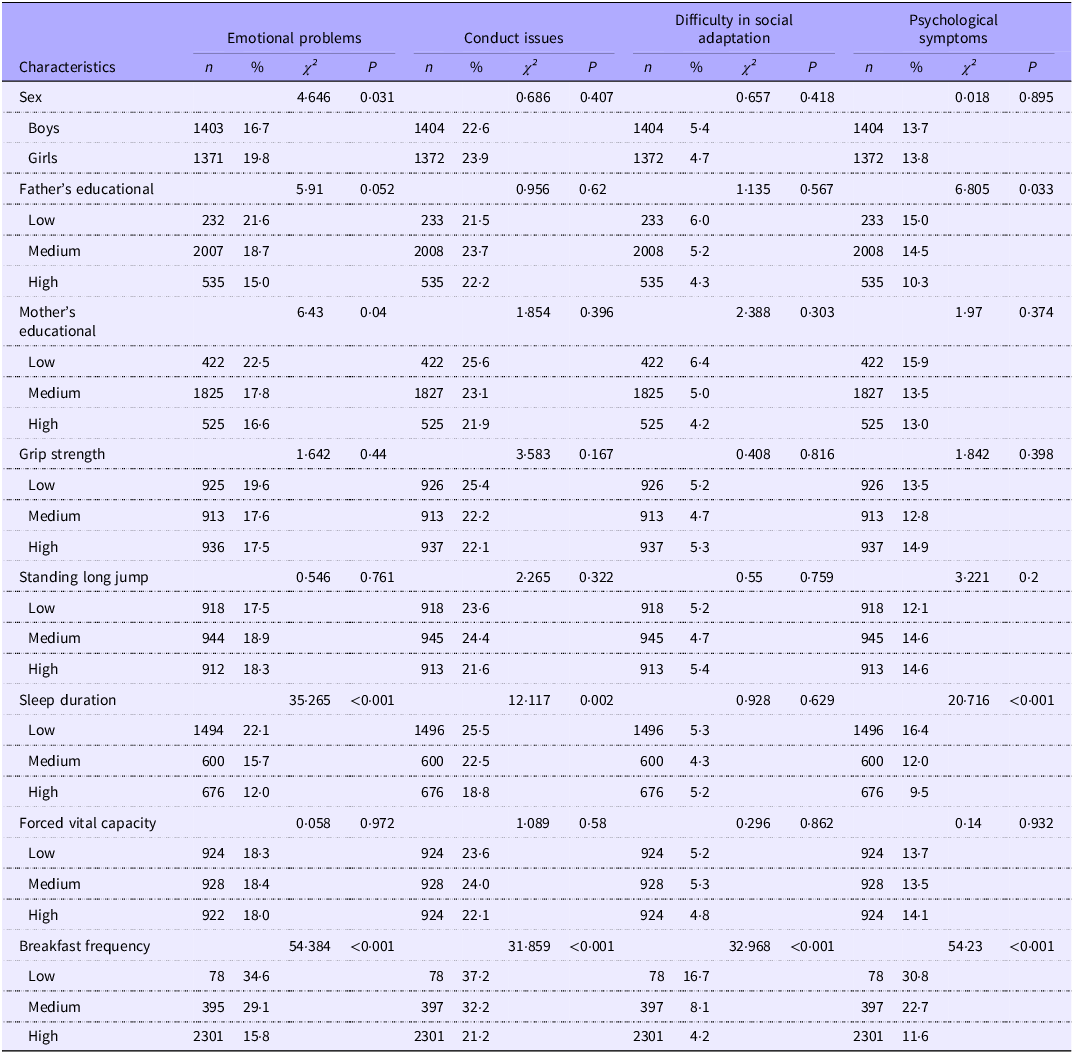
According to the results in Table 2, psychological symptoms and their respective dimensions exhibit variations in distribution across different adolescent populations. Father’s educational attainment, sleep duration and breakfast frequency were significantly associated with the reported prevalence of psychological symptoms (χ² = 6·805, 20·716, 54·23, P < 0·05). Among these, the lowest rate of psychological symptom reporting among adolescents was observed in those with fathers who had higher levels of education (10 %); those with sufficient sleep duration came next (10 %); the proportion of individuals who regularly eat breakfast was also relatively low (12 %).
Psychological symptoms among Chinese adolescents

Table 2. Long description
The table presents data on psychological symptoms among Chinese adolescents, categorized by sex, father’s educational level, mother’s educational level, grip strength, standing long jump, sleep duration, forced vital capacity, and breakfast frequency. The table has 10 columns and 24 rows, including headers and characteristics. Column headers include Emotional problems, Conduct issues, Difficulty in social adaptation, and Psychological symptoms, each with sub-columns for n, %, χ2, and P values. Row labels include characteristics such as Sex (Boys, Girls), Father’s educational level (Low, Medium, High), Mother’s educational level (Low, Medium, High), Grip strength (Low, Medium, High), Standing long jump (Low, Medium, High), Sleep duration (Low, Medium, High), Forced vital capacity (Low, Medium, High), and Breakfast frequency (Low, Medium, High). Notable trends include significant associations of father’s educational attainment, sleep duration, and breakfast frequency with psychological symptoms, with lower rates observed in adolescents with higher father’s education, sufficient sleep duration, and regular breakfast consumption.
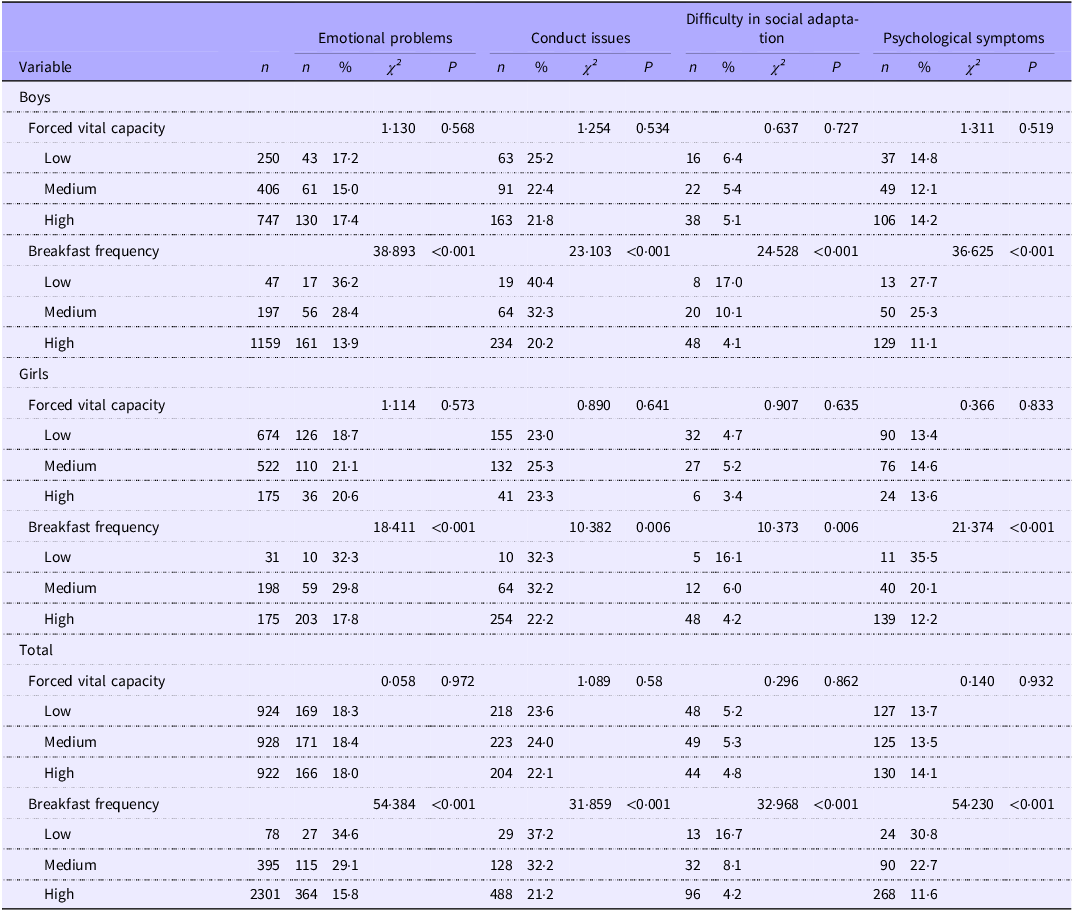
Table 3 presents the univariate analysis of FVC, breakfast frequency and psychological symptoms among adolescents. The overall results indicate that the rates of psychological symptom reporting among adolescents with low, moderate and high breakfast frequency were 31 %, 23 % and 12 %, respectively. The trend showed a significant decrease with increasing frequency (χ² = 54·23, P < 0·001). Trend tests further confirmed that there is a significant dose–response relationship between breakfast frequency and psychological symptoms (trend test P < 0·001). The dimensions of emotional problems, conduct problems and social adjustment difficulties also showed the same trend. However, the prevalence rates of psychological symptoms among individuals with low, medium and high FVC levels were all 14 %, and no statistically significant difference was observed (χ² = 0·14, P = 0·932). When the analysis was stratified by sex, the negative correlation between breakfast frequency and various psychological symptom dimensions was consistently observed in both males and females (P < 0·01), and the association with FVC was not significant in either group.
Univariate analysis of forced vital capacity, breakfast frequency and psychological symptoms among Chinese adolescents

Table 3. Long description
The table presents a univariate analysis of forced vital capacity, breakfast frequency, and psychological symptoms among adolescents. It includes data for boys and girls separately and combined. The table has 18 rows and 13 columns. Column headers are Variable, Emotional problems (n, %, χ2, P), Conduct issues (n, %, χ2, P), Difficulty in social adaptation (n, %, χ2, P), and Psychological symptoms (n, %, χ2, P). Row labels include Forced vital capacity (Low, Medium, High) and Breakfast frequency (Low, Medium, High). The table shows the number of adolescents (n), percentage (%), chi-square (χ2), and P-value (P) for each category. For boys, the data shows varying percentages of emotional problems, conduct issues, difficulty in social adaptation, and psychological symptoms across different levels of forced vital capacity and breakfast frequency. For girls, similar data is presented with varying percentages. The total row combines data for boys and girls. Notable trends include a significant decrease in psychological symptom reporting with increasing breakfast frequency and no significant difference in psychological symptoms based on forced vital capacity.
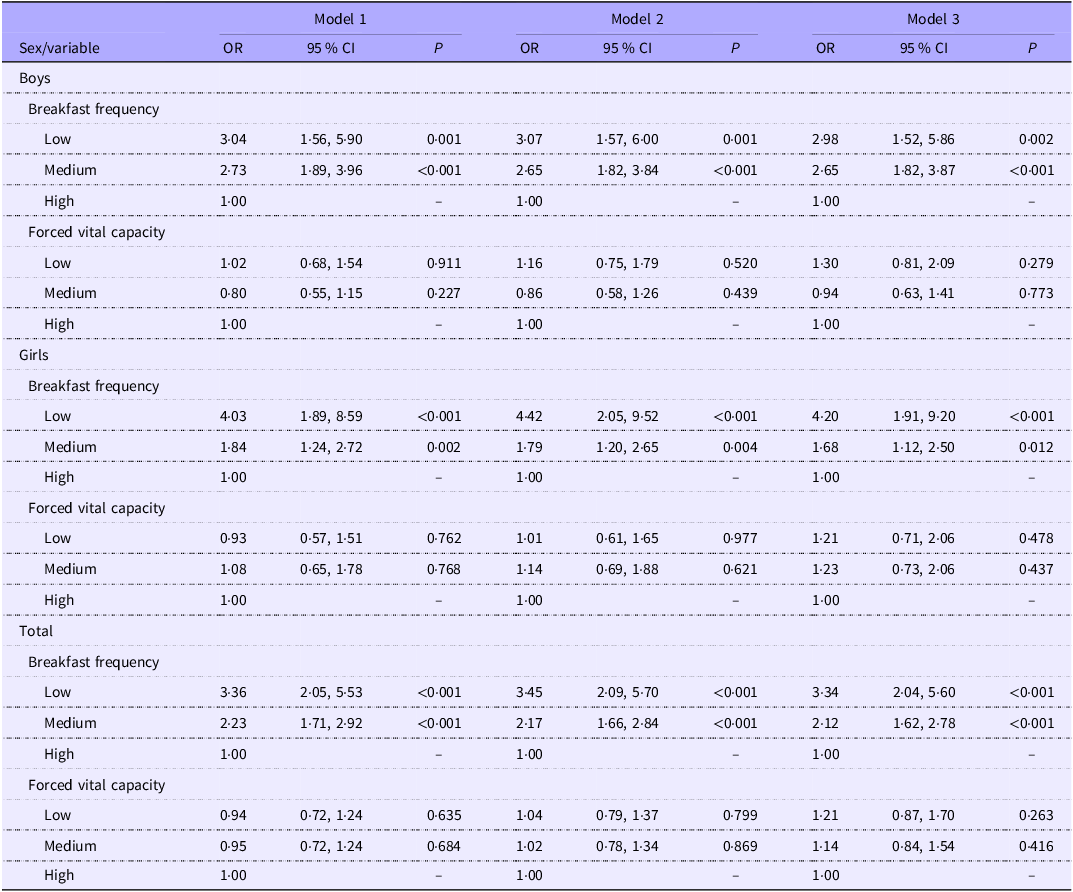
Table 4 presents the results of the binary logistic regression analysis examining the relationship between adolescents’ breakfast frequency, FVC and psychological symptoms. After adjusting for covariates including age, parental education level, sleep duration, grip strength and standing long jump performance (model 3), the results show that compared with the group with a ‘high’ breakfast frequency, adolescents with ‘moderate’ (OR = 2·12, 95 % CI 1·62, 2·78) and ‘low’ (OR = 3·34, 95 % CI 2·04, 5·60) frequencies exhibited a significantly higher risk of developing psychological symptoms. The OR value increases as breakfast frequency decreases. Further analysis confirmed a dose–response relationship trend between the two variables (P < 0·001). Stratified by sex, the protective association trend of breakfast frequency remained consistent in both males and females (P < 0·01). The association with FVC remains statistically insignificant.
Binary logistic regression analysis of forced vital capacity, breakfast frequency and psychological symptoms among Chinese adolescents

Table 4. Long description
The table presents the results of a binary logistic regression analysis examining the relationship between breakfast frequency, forced vital capacity (FVC), and psychological symptoms among adolescents. The table is divided into three models, each adjusting for different covariates. It includes data for boys, girls, and the total population, with rows labeled for different levels of breakfast frequency and FVC. Each cell contains the odds ratio (OR), 95% confidence interval (CI), and p-value. For boys, the OR for low breakfast frequency ranges from 3.04 to 2.98 across models, with p-values indicating statistical significance. For girls, the OR for low breakfast frequency ranges from 4.03 to 4.20, also showing statistical significance. The total population shows similar trends with OR values ranging from 3.36 to 3.34 for low breakfast frequency. The FVC data shows no significant association with psychological symptoms across all models and groups.
Model 1 was unadjusted for covariates. Model 2 adjusted for age, paternal education and maternal education. Model 3 further adjusted for sleep duration, height, weight, grip strength and standing long jump based on model 2.
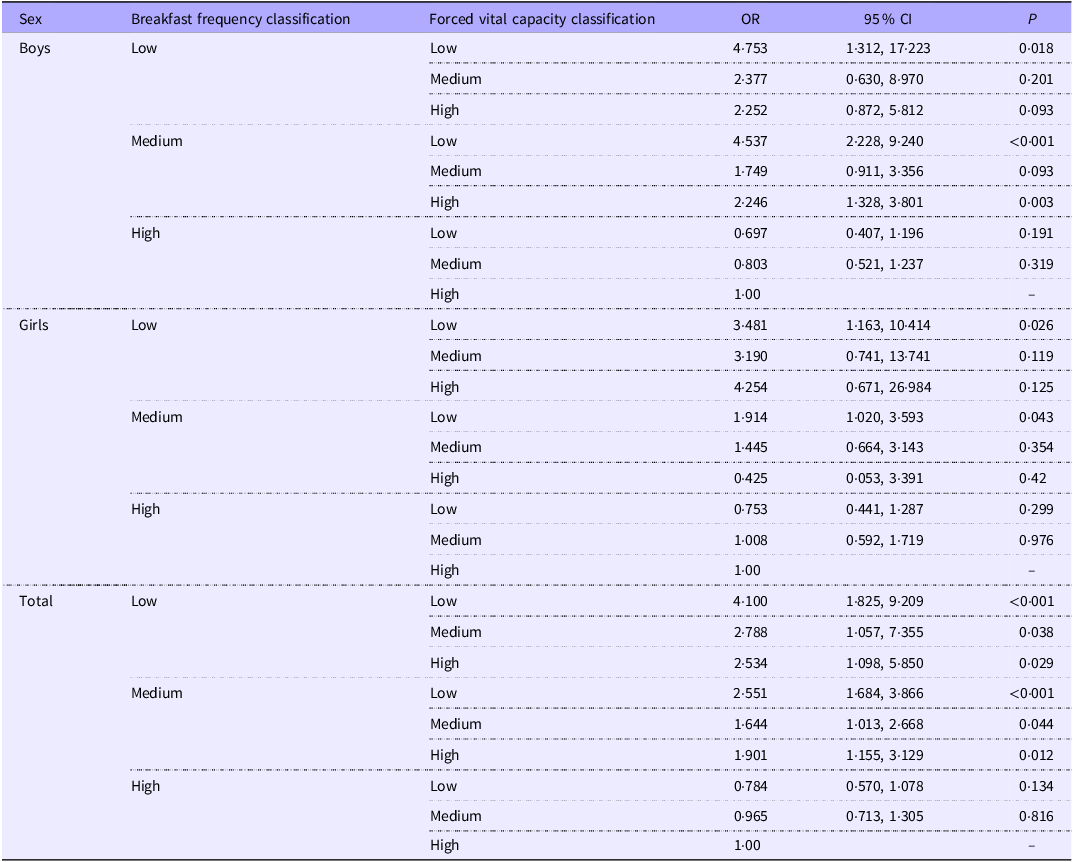
Table 5 further presents the ordered logistic regression analysis examining the relationship between breakfast frequency and FVC with psychological symptoms. The model adjusted for the same covariates. Compared with the group with ‘high breakfast frequency and high forced vital capacity’, a combination of low or moderate breakfast frequency with any level of FVC, psychological symptoms show significant risks or an upward trend. The analysis results indicate that breakfast frequency is a more stable and significant factor associated with psychological symptoms. However, FVC did not show a significant association with breakfast frequency in this study, either independently or in interaction with it.
Ordered logistic regression analysis of forced vital capacity, breakfast frequency and psychological symptoms among Chinese adolescents

Table 5. Long description
The table presents the results of an ordered logistic regression analysis examining the relationship between breakfast frequency, forced vital capacity (FVC), and psychological symptoms. The table has 18 rows and 6 columns. The columns are labeled as Sex, Breakfast frequency classification, Forced vital capacity classification, OR, 95 percent CI, and P. The rows are categorized by sex (Boys, Girls, Total) and further divided by breakfast frequency classification (Low, Medium, High) and forced vital capacity classification (Low, Medium, High). Each cell contains specific values for OR, 95 percent CI, and P. Notable trends include significant risks or upward trends in psychological symptoms for groups with low or moderate breakfast frequency combined with any level of FVC compared to the group with high breakfast frequency and high FVC.
Discussion
Based on a regional adolescent sample, this study was the first to systematically examine the association between breakfast frequency, physical fitness indicators such as FVC and psychological symptoms. Research has found that breakfast frequency is a stable and significant protective factor for psychological symptoms: the lower the frequency, the higher the proportion of adolescents experiencing emotional, behavioural and social adjustment difficulties. This relationship exhibited a significant dose–response pattern (trend test < 0·001). On the contrary, FVC, as a static physical fitness indicator, showed no independent significant association with psychological symptoms in this study. Additionally, there was also no significant difference in the risk clustering of psychological symptoms based on breakfast frequency and FVC. The impact of both factors on psychological symptoms is primarily characterised by the additive nature of independent risks, rather than synergistic enhancement.
Research indicates that breakfast frequency showed a significant negative correlation with various psychological symptoms. In the overall sample, the prevalence of psychological symptoms among adolescents who ate breakfast only 1–2 times per week is 31 % and those who ate 5–7 times per week dropped to 12 %. This trend was consistent across both male and female groups. This finding aligns with domestic research indicating an upward trend in the prevalence of psychological distress among children and adolescents(Reference Wang, Shen and Zhu22,Reference Xu, Zhang and Liu23) . Breakfast, as the first meal of the day, helps maintain stable blood sugar levels and provides sustained energy and may affect neurotransmitter secretion and daytime cognitive function, indirectly promoting emotional and behavioural regulation(Reference Hoyland, Dye and Lawton24). This finding is consistent with the results of multiple studies in adult populations: for example, adherence to healthy dietary patterns such as the Mediterranean diet is significantly associated with a reduced risk of depression, suggesting that the protective role of positive dietary behaviours for mental health may be universally applicable across age groups(Reference Sánchez-Villegas, Henríquez-Sánchez and Ruiz-Canela25). In addition, evidence links ultra-processed food intake to multiple adverse health outcomes, including psychological problems, which serves as counterevidence confirming the fundamental impact of overall dietary quality on mental health(Reference Barbaresko, Bröder and Conrad26). Similarly, high added sugar intake increases the risk of depression; high-quality carbohydrates (such as whole grains) have been shown to have a protective effect(Reference Sanchez-Villegas, Zazpe and Santiago27). Other studies suggest that breakfast frequency interacts with the dietary inflammation index, and individuals with a high-inflammation diet and low breakfast frequency face the highest risk of psychological issues(Reference Haghighatdoost, Feizi and Esmaillzadeh28). Skipping breakfast is commonly associated with reduced sleep quality, increased risk of depression and heightened psychological distress(Reference Jung and Lee29,Reference Zahedi, Djalalinia and Sadeghi30) . The quality of breakfast and overall dietary patterns are not only associated with psychological symptoms but also associated with multidimensional mental health indicators such as self-rated health and life satisfaction(Reference Liu, Guo and Lang31). Therefore, breakfast is not only an important part of nutritional intake, but it may also be an important behavioural habit for maintaining emotional stability and psychological adaptation in adolescents. At the same time, only 3 % of the sample belonged to the low breakfast frequency group. This imbalance reduces the precision of the risk estimate for this subgroup. While the observed association is statistically significant, it should be interpreted as preliminary, and confirmation in larger, more balanced samples is needed.
In terms of physical fitness metrics, this study found no independent significant association between FVC and psychological symptoms. This contrasts with the findings of studies focusing on physical activity behaviours. The latter consistently indicates that regular physical activity has a protective effect on adolescents’ mental health(Reference Rodriguez-Ayllon, Cadenas-Sánchez and Estévez-López32). Although good cardiopulmonary function can theoretically support mood and cognition by optimising cerebral oxygenation, regulating cortisol levels and improving autonomic nervous system balance(Reference De Nys, Anderson and Ofosu14,Reference Murrell, Cotter and Thomas33) . Moreover, some studies have found that adolescents with better cardiorespiratory fitness often exhibit superior sleep quality and psychological well-being, and the empirical data from this study did not support this association. This may be related to the following reasons: vital capacity is a single static measurement indicator, not a dynamic cardiopulmonary fitness indicator. It may not fully reflect the dynamic physiological adaptation processes and cardiopulmonary functional reserves that are more important for mental health(Reference Ross, Blair and Arena34,Reference Haapala, Leppänen and Skog35) . The impact of physical fitness on mental health may exhibit a ‘dose–response’ effect, with varying effects observed across different intensities, frequencies and types of exercise(Reference Gronwald, Velasques and Ribeiro36). Significant sex differences were observed in the distribution of vital capacity among the study sample (with males demonstrating overall superior performance compared with females). This may introduce confounding factors into the analysis. Although physical fitness indicators showed a non-significant trend in association with psychological symptoms among male students, their independent protective effect could not be established overall. This result suggests that among adolescents, the association between static physical fitness indicators and mental health may not be as pronounced as that observed in dynamic, sustained physical activity or cardiorespiratory endurance testing.
Although the association between FVC and psychological symptoms alone did not reach statistical significance, the stratified analysis continues to reveal noteworthy trends. As shown in Table 5, for adolescents who ate breakfast infrequently and had low FVC, the risk of psychological symptoms was 4·10 times higher among those with high breakfast frequency and high FVC (95 % CI 1·83, 9·21, P < 0·001). It should be noted that this study incorporated an interaction term between breakfast frequency and FVC in the binary logistic regression model. The results were not statistically significant (P > 0·05). The effects of both factors on psychological symptoms may primarily involve the accumulation of independent risks, rather than collaborative interaction. This is consistent with the trend observed in similar studies(Reference Zheng, Xiong and Huang37). This finding has significant public health implications: although FVC was not an independent predictor of psychological symptoms, when it is at a lower level, it can still amplify the negative impact of unhealthy eating habits on mental health. Therefore, in future intervention practices targeting adolescents, the lack of independent association with FVC should not overshadow its auxiliary value as a risk stratification indicator. Combining regular breakfast with moderate aerobic exercise may achieve this through synchronised optimisation of energy metabolism and cardiopulmonary functional reserves, thereby promoting mental health more comprehensively(Reference Kandola, Lewis and Osborn38).
The strength of this study lies in its use of a regional sample. This study provides the first analysis of the association between breakfast frequency, FVC indicators and various psychological symptoms and conducted a sex-stratified analysis, thereby enhancing the group-specific relevance of the results. At the same time, the study included covariates such as sleep duration, parental education level and multiple physical fitness indicators, thereby enhancing the comprehensiveness and credibility of the analysis. However, this study still has several limitations. First, cross-sectional designs cannot establish causal relationships; therefore, future longitudinal studies are needed to further validate the long-term effects of breakfast habits and physical fitness on mental health. Second, data on psychological symptoms, breakfast frequency and other factors were collected through self-reported questionnaires; therefore, recall bias and social desirability bias may be present. Additionally, the study did not account for potential moderating variables such as family functioning, peer support and campus atmosphere. Furthermore, the breakfast frequency only examined weekly frequency, without distinguishing between breakfast quality, meal timing and specific food composition, limiting a comprehensive explanation of the factors that may have influenced the results. In the future, the questionnaire should be refined. Finally, the proportion of adolescents with low breakfast frequency was very small, which limits the precision of the estimates for this group and reduces the generalisability of our findings. Future studies with larger and more balanced samples are needed to confirm the observed associations.
In this context, regular breakfast and adequate sleep are viable entry points for promoting mental health among adolescents. The role of physical fitness enhancement in mental health interventions requires detailed design that accounts for sex differences. Future research should incorporate objective measurement tools, explore the underlying mechanisms linking different dietary patterns, exercise types and mental health, and provide more targeted evidence for early prevention and comprehensive intervention in adolescent mental health.
Conclusion
There was a significant negative correlation between breakfast frequency among Chinese adolescents and their psychological symptoms. The lower the breakfast frequency, the higher the risk of developing psychological symptoms. Adolescents with low breakfast frequency and low FVC exhibited the highest prevalence of psychological symptoms, exhibiting characteristics of risk accumulation. However, the study did not find a statistically significant interaction, suggesting that breakfast frequency and FVC may influence mental health through independent pathways. Therefore, to promote adolescent mental health, efforts should focus on cultivating regular breakfast habits and incorporating moderate physical activity. Developing comprehensive intervention pathways that integrate nutrition and physical fitness may help reduce the risk of psychological symptoms.
Acknowledgements
The authors would like to thank all participants for their support and assistance with their research.
This study was supported by the National Social Science Fund of China (25BTY107), the General Project of Cultivating Excellent Young Teachers in Anhui Universities (YQYB2023058), the Scientific Research Startup Fund Project for High-level Talents of Chizhou University (CZ2024YJRC47) and the Anhui Province Philosophy and Social Sciences Planning Youth Project (AHSKQ2024D087). The funders had no role in the design, conduct, analysis or writing of this article.
The authors declare no conflict of interest.
J. D.: Conceptualisation-Equal, Data curation-Equal, Formal analysis-Equal, Investigation-Equal, Methodology-Equal, Project administration-Equal, Resources-Equal, Software-Equal, Supervision-Equal, Validation-Equal, Visualisation-Equal, Writing – original draft-Equal, Writing – review and editing-Equal; C. B.: Funding acquisition-Equal, Resources-Equal, Software-Equal, Supervision-Equal, Validation-Equal, Visualisation-Equal, Writing – original draft-Equal, Writing – review and editing-Equal; M. Z.: Conceptualisation-Equal, Data curation-Equal, Investigation-Equal, Methodology-Equal, Project administration-Equal, Resources-Equal, Software-Equal, Supervision-Equal, Validation-Equal, Visualisation-Equal, Writing – original draft-Equal, Writing – review and editing-Equal; T. Z.: Project administration-Equal, Resources-Equal, Software-Equal, Writing – original draft-Equal, Writing – review and editing-Equal; M. Z.: Conceptualisation-Equal, Data curation-Equal, Writing – original draft-Equal, Writing – review and editing-Equal.
This study was conducted according to the guidelines laid down in the Declaration of Helsinki, and all procedures involving human participants were approved by the Human Ethics Committee of Chizhou University (approval number: CZU-2025-LL091). Written informed consent was obtained from all participants and their parents/guardians prior to study enrolment.
To protect the privacy of participants, the questionnaire data will not be disclosed to the public. If necessary, you can contact the corresponding author.