INTRODUCTION
Individuals who speak Spanish at home represent 13% of the population in the US (US Census Bureau, 2012). This population is often referred to as language minority (e.g. August & Hakuta, Reference August and Hakuta1997) because their home language differs from the language spoken by the majority of the population of the country in which they live. As a group, language minority children are at a high risk for academic difficulties, including problems in reading. Spanish-speaking language minority children in the US have significantly lower reading skills than their monolingual English-speaking peers in the fourth and eighth grades (Hemphill, Vanneman & Rahman, Reference Hemphill, Vanneman and Rahman2011). It is possible that this risk for developing reading problems stems from weaknesses in oral language skills, as evidence indicates that oral language skills are significantly predictive of children's later reading abilities (Miller, Heilmann, Nockerts, Iglesias, Fabiano & Francis, Reference Miller, Heilmann, Nockerts, Iglesias, Fabiano and Francis2006; Storch & Whitehurst, Reference Storch and Whitehurst2002). Preschool children's developing oral language skills are commonly measured by assessing vocabulary knowledge. An understanding of the early development of vocabulary knowledge may help identify children at risk for developing later reading difficulties and prevent them from falling further behind their typically developing peers. However, there is disagreement in the literature about which vocabulary scoring techniques (e.g. total scores, conceptual scores, single-language scores) are most appropriate for use with language minority children. It is possible that different scoring techniques may be most appropriate when examining a particular outcome of interest (e.g. diagnosis of language impairment, prediction of future vocabulary development). Therefore, the purpose of this study was twofold. First, we evaluated the validity of one scoring technique commonly used to quantify vocabulary knowledge among language minority children. Additionally, we evaluated whether language minority children can transfer information about vocabulary across languages.
Evidence indicates that the vocabulary knowledge of language minority children is distributed across the languages they are learning (Bedore, Peña, García & Cortez, Reference Bedore, Peña, García and Cortez2005; Oller, Pearson & Cobo-Lewis, Reference Oller, Pearson and Cobo-Lewis2007; Peña, Bedore & Zlatic-Giunta, Reference Peña, Bedore and Zlatic-Giunta2002). That is, there are words in children's vocabularies that are uniquely known in one language or the other, as well as words that children know in both languages. Data suggest that language minority children's vocabularies contain more words known uniquely in one language than they do words known in both languages (Pena et al., Reference Peña, Bedore and Zlatic-Giunta2002). Therefore, although children learning more than one language may know approximately the same total number of words as do monolingual children at any given age (e.g. Pearson, Fernández & Oller, Reference Pearson, Fernández and Oller1993), their single-language vocabulary knowledge is often substantially lower than the vocabulary knowledge of monolingual children (Core, Hoff, Rumiche & Señor, Reference Core, Hoff, Rumiche and Señor2013; Mancilla-Martinez & Vagh, Reference Mancilla-Martinez and Vagh2013; Pearson et al., Reference Pearson, Fernández and Oller1993; Umbel, Pearson, Fernández & Oller, Reference Umbel, Pearson, Fernández and Oller1992). Researchers argue in favor of alternative methods of vocabulary assessment for language minority children, as opposed to single-language vocabulary assessment, because the use of single-language vocabulary assessment may lead to the overidentification of language impairment in language minority children (e.g. Bedore & Peña, Reference Bedore and Peña2008).
In recent years, several scoring techniques have emerged as potential alternatives to single-language vocabulary assessment. One simple alternative is to assess children's vocabulary knowledge in both languages, and add children's first (L1) and second (L2) language vocabulary scores together to come up with a score that represents the child's total vocabulary knowledge. When total scores are used, language minority children's vocabulary knowledge more closely approximates monolingual norms than when single-language vocabulary scores are used (Core et al., Reference Core, Hoff, Rumiche and Señor2013; Hoff, Core, Place, Rumiche, Señor & Parra, Reference Hoff, Core, Place, Rumiche, Señor and Parra2012; Pearson et al., Reference Pearson, Fernández and Oller1993). Another alternative is the use of conceptual scoring. Similar to computing a total score, conceptual scoring assesses children's vocabulary knowledge in L1 and L2 and computes an overall ‘total conceptual vocabulary’ score that gives children credit for each individual concept that is known. A conceptual score consists of words known uniquely in L1, words known uniquely in L2, and words known in both L1 and L2. However, in contrast to the total-score approach, words known in both L1 and L2 are only counted once (e.g. if the child knows both dog and perro, she or he is given credit once for knowing the general concept). When conceptual scoring is used, the gap in vocabulary knowledge between monolingual children and language minority children is not as pronounced as it is when single-language scores are used (e.g. Mancilla-Martinez & Vagh, Reference Mancilla-Martinez and Vagh2013).
In his developmental interdependence hypothesis, Cummins (Reference Cummins1979, Reference Cummins1981, Reference Cummins, Cummins and Hornberger2008) claimed that children can directly transfer knowledge across languages. Specifically, Cummins argued that skills in each language are supported by a common underlying proficiency about those skills that is independent of language. Once this proficiency is obtained, children should be able to apply it to any subsequently learned language. It is often presumed that assessing language minority children's unique L1 vocabulary knowledge will provide information relevant to subsequent L2 development because children can transfer L1 vocabulary knowledge to their L2; however, whether children take advantage of vocabulary knowledge in one language and utilize it when learning a second language is an open empirical question. For example, if children's language-learning environments are isolated from one another, words known in L1 may not be particularly relevant to the contexts in which children are learning their L2, limiting the opportunities for transfer of vocabulary knowledge to occur. Cummins (Reference Cummins, Cummins and Hornberger2008) proposed that five different types of transfer can occur, but these five types represent two more broad types of transfer: language-specific and language-independent transfer. Language-independent transfer represents the transfer of knowledge that is applicable to more than one language (e.g. phonological awareness – the knowledge that words are made up of smaller sound units), whereas language-specific transfer represents transfer of information that is dependent on the transferred-to and transferred-from languages (e.g. cognate knowledge).
To the extent that L1 and L2 vocabularies are interdependent and can transfer across languages (e.g. Cummins, Reference Cummins, Cummins and Hornberger2008), it may be expected that unique Spanish vocabulary knowledge would provide information relevant to later English vocabulary knowledge; however, the likelihood of cross-language transfer depends on the type of information that is common across the languages. In general, skills that are primarily language-independent (e.g. phonological awareness) are significantly related across languages; however, vocabulary knowledge is primarily language-specific. Although studies of some measures of oral language skills (e.g. narrative production skills) report evidence of cross-language transfer between English and Spanish (e.g. Miller et al., Reference Miller, Heilmann, Nockerts, Iglesias, Fabiano and Francis2006), prior research indicates that English and Spanish vocabulary knowledge are either not correlated across languages or are only weakly to moderately correlated across languages (Dickinson, McCabe, Clark-Chiarelli & Wolf, Reference Dickinson, McCabe, Clark-Chiarelli and Wolf2004; Goodrich, Lonigan & Farver, Reference Goodrich, Lonigan and Farver2013, Reference Goodrich, Lonigan and Farver2014; Gottardo & Muller, Reference Gottardo and Mueller2009, Kan & Kohnert, Reference Kan and Kohnert2008). Narrative production may be less specific to a particular language than is vocabulary knowledge because it involves the combination of multiple oral language skills that together represent a more general communicative competence. In contrast, words in a given language are arbitrarily tied to the underlying concepts that they represent and are unique to that language. Therefore, it seems unlikely that children would transfer a large amount of vocabulary knowledge across languages. Consequently, the utility of conceptual scoring may be limited with regard to providing information about language minority children's later L1 and L2 vocabulary knowledge.
Although unique vocabulary in L1 may not longitudinally predict L2 vocabulary knowledge, Mancilla-Martinez and Vagh (Reference Mancilla-Martinez and Vagh2013) argued that children will readily acquire the L2 translational equivalents of words they already know in their L1. For example, children may actively seek to acquire the L2 word for a concept for which the word in L1 is known, and vice versa. Although the L2 word learned may have a form that is completely different than the L1 word already known, all of the information about the underlying concept to which the word is tied is already known and may be transferred across languages (assuming the vocabulary needed to describe the concept in L2 is known). For example, a child that knows the word saltamontes in Spanish may seek to acquire the word grasshopper in English. All of the conceptual information about this concept can be transferred across languages (e.g. it is an insect, it is green, it can jump far). Because the underlying concepts related to words known in L1 are already known, learning their L2 translation equivalents may be easier than is learning words not known in either language, for which the underlying concepts must also be learned. Therefore, language-independent information about vocabulary knowledge that comes from the underlying concepts to which words are tied may facilitate the acquisition of translational equivalents and the transfer of specific linguistic information (e.g. individual words).
Both conceptual scoring and total vocabulary are ways of addressing the fact that language minority children are learning vocabulary in two languages. Both approaches are useful for preventing the overidentification of language impairment in language minority children that may result from single-language vocabulary assessment. A second question concerning conceptual or total scoring is what information these methods provide about children's future development of language skills (i.e. What is the validity of conceptual or total scoring?). This is related to Cummins’ (Reference Cummins, Cummins and Hornberger2008) conceptualization of transfer. In one sense, Cummins proposes a broad notion of transfer in which the absolute level of skill acquired in L1 should be informative concerning the degree to which skill in L2 is acquired, and vice versa. In another sense, Cummins proposes a narrow notion of transfer in which specific information acquired in L1 can be transferred to L2 and vice versa. From a future expectations standpoint, both conceptual and total scoring assume that the broader notion is correct. Prior research has shown that level of proficiency in certain reading-related skills (e.g. phonological awareness) in L1 is significantly related to level of proficiency in those skills in L2; however, this may not be the case for all academic skills. Extant evidence indicates that L1 and L2 oral language skills are separate constructs (e.g. Gottardo & Mueller, Reference Gottardo and Mueller2009), suggesting that the broad notion of transfer may not apply to these skills. Nevertheless, the narrow notion of transfer could still apply to children's developing vocabulary knowledge. Therefore, this study sought to evaluate transfer in the context of the validity of conceptual scores and the acquisition of translational equivalents.
CURRENT STUDY
The first purpose of this study was to examine the utility of conceptual scoring in predicting children's later single-language vocabulary knowledge. A second purpose of this study was to examine whether children readily acquire translational equivalents for words they know in one language but not the other. Several research questions were evaluated to examine the extent to which vocabulary knowledge and individual words known in one language predicted vocabulary knowledge and individual words known in another language, respectively. The first research question was whether L1 and L2 vocabulary knowledge are significantly related across languages. Based on prior evidence, we expected that L1 and L2 vocabulary knowledge would not be significantly correlated or would only be weakly correlated across languages. The second research question focused on the predictive validity of conceptual scoring. Specifically, we examined whether unique L1 vocabulary knowledge (i.e. words known in L1 but not L2) predicted subsequent L2 vocabulary knowledge after accounting for the effects of initial L2 vocabulary knowledge. Based on findings that the vocabulary knowledge of language minority children is typically not related across languages or only moderately related across languages (e.g. Gottardo & Mueller, Reference Gottardo and Mueller2009; Kan & Kohnert, Reference Kan and Kohnert2008), we expected that unique L1 vocabulary knowledge would not predict later L2 vocabulary knowledge after accounting for initial L2 vocabulary knowledge. The third research question was whether children readily acquired translational equivalents of words known in L1 but not L2. Although we did not predict that children's unique L1 vocabulary knowledge would contribute to their total L2 vocabulary knowledge, theory and evidence suggest that children may be able to transfer some information about vocabulary knowledge across languages (e.g. Cummins, Reference Cummins, Cummins and Hornberger2008; Goodrich et al., Reference Goodrich, Lonigan and Farver2013). Therefore, we predicted that children who initially knew a word in L1 but not L2 would be significantly more likely to acquire that word in L2 at a later time. The fourth research question was whether the effects of cross-language transfer replicated across two independent samples of children who came from different cultural backgrounds. It was expected that results would replicate across samples. Because there is no reason to expect that backward (L2 to L1) transfer cannot occur, parallel research questions and hypotheses were proposed for L1 vocabulary outcomes.
METHOD
Participants
Participants in this study came from two independent samples of Spanish-speaking language minority children. Sample 1 consisted of ninety-six children enrolled in a Head Start center in Los Angeles, California. All children were Latino and, based on parent report, Spanish was the dominant home language for all children. All children were born in the US. Twenty-six percent of the parents were US born of Mexican or Central American ancestry, and 74% were immigrants from Mexico (67%) or Central America (33%). The average age of children in this sample was 54·51 months (SD = 4·72 months). Approximately half of the sample was male (54·3%). Sample 2 consisted of 116 children enrolled in various preschool programs in Miami, Florida. All children were Latino and came from home environments in which parents reported that Spanish was spoken to some degree. Country of origin data were available for ninety-six out of the 116 participants. Eighteen percent of mothers were born in the US. Twenty-nine percent of mothers were immigrants from Cuba, 19% were immigrants from Mexico or Central America, 25% were immigrants from South America, 6% were immigrants from Puerto Rico or the Dominican Republic, and 2% were immigrants from other countries. The average age of children in this sample was 60·70 months (SD = 5·72 months), and there were slightly more males (56%) than females.
Measures
Both samples of children completed the Receptive and Definitional Vocabulary subtests of the Preschool Comprehensive Test of Phonological and Print Processing in English (P-CTOPPP; Lonigan, Wagner, Torgesen & Rashotte, Reference Lonigan, Wagner, Torgesen and Rashotte2002) and Spanish (P-CTOPPP-Spanish; Lonigan, Farver & Eppe, Reference Lonigan, Farver and Eppe2002). The Receptive and Definitional Vocabulary subtests of the P-CTOPPP-Spanish are direct Spanish-language translations of the corresponding subtests on the P-CTOPPP. The Receptive Vocabulary subtest contained forty items. For each item, children were shown four pictures and asked to point to the picture of a particular thing named by the examiner. For example, one item asked children to “point to the door”. Internal consistency reliability for the Receptive Vocabulary subtest in English and Spanish ranged from acceptable to good in these samples of children (Sample 1: English α = ·84, Spanish α = ·78; Sample 2: English α = ·88, Spanish α = ·79). The Definitional Vocabulary subtest contained forty items, each of which had two components, an expressive component and a definitional component. For the expressive component of the items, children were shown a picture and asked to name the thing pictured. For example, children were shown a picture of a lock and asked “What is this?” Internal consistency reliability for the forty expressive items in English and Spanish was excellent in these samples of children (Sample 1: English α = ·93, Spanish α = ·93; Sample 2: English α = ·94, Spanish α = ·95). For the definitional component of the items, children were asked to describe one of the important features of the object pictured in the expressive component of the items. For example, as a follow up to labeling lock, children were asked “What is it for?” Internal consistency reliability for the forty definitional items in English and Spanish was excellent in these samples of children (Sample 1: English α = ·93, Spanish α = ·94; Sample 2: English α = ·96, Spanish α = ·96). Responses to all types of vocabulary items administered were coded as correct or incorrect (i.e. 1 or 0). Responses were only coded as correct if they were given in the language being assessed. Raw scores were used for data analysis, as standard scores for the P-CTOPPP and P-CTOPPP-Spanish are not available.
Procedure
In both samples, informed consent was obtained from parents of children prior to inclusion in the study. Additionally, assent was obtained from each child prior to testing. Assessments were administered by trained bilingual individuals and administration of assessments was counterbalanced by language. In Sample 1, children completed the two vocabulary subtests of the P-CTOPPP and P-CTOPPP Spanish at the beginning and end of the preschool year. Assessment took place over two days for each child, with assessment of English language skills taking place on one day and assessment of Spanish language skills taking place on the other day. Each session lasted approximately 20–30 minutes. In Sample 2, children completed the two vocabulary subtests of the P-CTOPPP and P-CTOPPP-Spanish at an initial time-point. These children completed the P-CTOPPP English at a second time-point approximately one year after the initial assessment. Because of the age range of the children in this sample, some children were still in preschool at the time of the second assessment whereas others were already in kindergarten.
Data analysis
To evaluate the first research question – whether Spanish and English vocabulary knowledge were significantly related across languages – zero-order correlations between Spanish and English receptive, expressive, and definitional vocabulary knowledge were computed. To evaluate the second research question – whether unique Spanish vocabulary knowledge predicted later English vocabulary knowledge after accounting for initial English vocabulary knowledge – linear regression analyses were conducted. At time 1, unique Spanish (i.e. words known in Spanish but not English), unique English (i.e. words known in English but not Spanish), and combined Spanish–English vocabulary (i.e. words known in both Spanish and English) variables were computed (the three components of the conceptual score). We then examined the conditional effect of each predictor on time 2 English vocabulary knowledge. Corresponding models were constructed for Spanish language outcomes for the children in Sample 1.
To evaluate the third research question – whether knowledge of a word in Spanish but not English at time 1 predicted likelihood of knowledge of that word in English at time 2 – a series of hierarchical generalized linear models (HGLMs) were built using HLM 6 (Raudenbush, Bryk & Congdon, Reference Raudenbush, Bryk and Congdon2004). In these models, items were nested within children. Therefore, level-one data consisted of children's responses to vocabulary items (i.e. correct or incorrect) in English and Spanish at time 1 and time 2. Level-two data consisted of children's total scores (out of 40) for each outcome in English and Spanish at time 1 and time 2. Because the dependent variables in the models were binary (i.e. whether the word was known in English at time 2), results are presented in terms of odds ratios (OR). Significance tests for odds ratios determine if an odds ratio is significantly different than 1. An odds ratio between 0 and 1 is indicative of a negative effect, and an odds ratio greater than one is indicative of a positive effect. For descriptive simplicity, models with English vocabulary outcomes are described below.
The main effects of whether the word was known in English and Spanish at time 1 and the interaction between these two variables predicted whether the word was known in English at time 2. These models also controlled for the child-level total scores for English and Spanish vocabulary knowledge at time 1. If the interaction term was significant, this effect was followed up to determine the nature of the interaction. Because the interaction consisted of the product of two dichotomous variables, the main effect of one dichotomous variable represented its effect at the zero point of the other variable. In this case, the main effect of Spanish represented the effect of knowing a word in Spanish at time 1 on knowing it in English at time 2 when it was not known in English at time 1. Therefore, to follow up any significant interactions, the zero-point of the time 1 English variable was changed so that the main effect of knowing a word in Spanish at time 1 represented that effect when the word was also known in English at time 1. To evaluate the fourth research question – whether effects replicated across samples – all analyses were conducted separately for Samples 1 and 2.
RESULTS
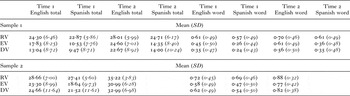
Descriptive statistics for both samples are shown in Table 1. In both samples, children's English language skills were slightly stronger than their Spanish language skills. In Sample 1, children's receptive vocabulary skills were stronger than their expressive vocabulary skills, which were stronger than their definitional vocabulary skills. However, in Sample 2, children's definitional vocabulary skills were stronger than their expressive vocabulary skills. In Sample 1, children's expressive and definitional vocabulary skills increased from time 1 to time 2 to a greater extent than did their receptive vocabulary knowledge; however, this was not the case in Sample 2. This was likely due to the fact that children in Sample 1 had lower overall vocabulary knowledge than children in Sample 2, leaving more room for improvement on the task. Furthermore, the discrepancy in time 1 receptive vocabulary scores and time 1 expressive and definitional vocabulary scores was larger in Sample 1 than it was in Sample 2.
Descriptive statistics for child- and item-level variables in both samples

note: RV = receptive vocabulary; EV = expressive vocabulary; DV = definitional vocabulary; word = whether word was known in a given language at a given time-point.
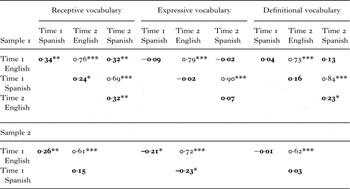
To evaluate the first research question, within- and cross-language correlations of vocabulary knowledge were computed. Within-skill zero-order correlations are shown in Table 2. For Samples 1 and 2, when correlations were compared using Steiger's test for correlated correlations (Steiger, 1980), within-language correlations were always greater in magnitude than cross-language correlations (for all rs, p < ·001). All within-language correlations were positive and statistically significant. Children's receptive vocabulary skills were significantly and positively correlated across languages for both samples; however, the pattern of relations was not as strong or consistent for expressive and definitional vocabulary skills. In Sample 1, other than the cross-language correlations between children's receptive vocabulary skills, the correlation between time 2 English and time 2 Spanish definitional vocabulary skills was the only other significant cross-language correlation. In Sample 2, cross-language correlations of expressive vocabulary skills were negative and statistically significant.
Within-skill correlations for Samples 1 and 2

note: Cross-language correlations are shown in boldface; *** p < ·001; ** p < ·01; * p < ·05.
Cross-time prediction: Sample 1
Linear regression analyses
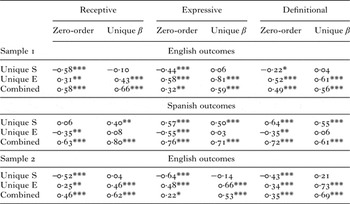
To evaluate the second research question, linear multiple regression analyses and zero-order correlations were computed to determine the effects of unique Spanish vocabulary, unique English vocabulary, and combined Spanish–English vocabulary at time 1 on English and Spanish vocabulary outcomes at time 2. Results for English language outcomes in Sample 1 are shown in the top panel of Table 3. For all subtests (i.e. Receptive, Expressive, and Definitional Vocabulary), unique Spanish vocabulary at time 1 was negatively correlated with total English vocabulary at time 2. Unique Spanish vocabulary at time 1 did not predict total English vocabulary at time 2 after accounting for the effects of unique English vocabulary at time 1 and combined English–Spanish vocabulary at time 1. Results for Spanish language outcomes in Sample 1 are shown in the middle panel of Table 3. For all subtests, unique English vocabulary at time 1 was negatively correlated with total Spanish vocabulary at time 2. Unique English vocabulary at time 1 did not predict total Spanish vocabulary at time 2 after accounting for the effects of unique Spanish vocabulary at time 1 and combined English–Spanish vocabulary at time 1.
Results of linear regression analyses examining effects of unique and combined vocabulary knowledge at time 1 on total vocabulary knowledge at time 2

note: S = Spanish; E = English; Zero-order = zero-order correlations; *** p < ·001; ** p < ·01; * p < ·05.
Hierarchical Generalized Linear Models
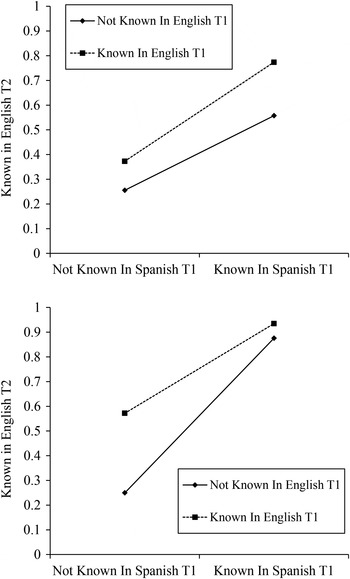
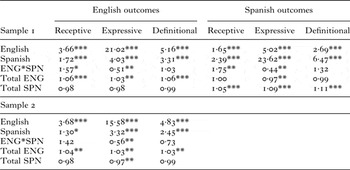
To evaluate the third research question, knowledge of individual words in English and Spanish at time 1 and the interaction between knowing a word in English and Spanish at time 1 were included as predictors of knowing the words at time 2. Results for English language outcomes for Sample 1 are shown in the top panel of Table 4. For receptive and expressive vocabulary, knowing individual words in English at time 1 and knowing individual words in Spanish at time 1 were significant and unique predictors of knowing those words in English at time 2. There also were significant interactions between knowing words in English at time 1 and knowing words in Spanish at time 1. These effects held when controlling for total English and Spanish receptive vocabulary knowledge at time 1. Results of the interaction probes for receptive and expressive vocabulary are shown in the upper and lower panels, respectively, of Figure 1. The simple effect of knowing a word in Spanish was significant when that word was not known in English at time 1 (for receptive vocabulary: OR = 1·72, p < ·001; for expressive vocabulary: OR = 4·03, p < ·001) and when that word was known in English at time 1 (for receptive vocabulary: OR = 2·71, p < ·001; for expressive vocabulary: OR = 2·04, p < ·01). For definitional vocabulary, the ability to define individual words in English at time 1 and the ability to define individual words in Spanish at time 1 significantly predicted the ability to define those same words in English at time 2, but there was not a significant interaction. These effects held when controlling for total English and Spanish definitional vocabulary knowledge at time 1.
Probability of knowing a word in English at time 2 (T1) when it was either known or not known in Spanish and English at time 1 (T1) for receptive vocabulary (upper panel) and expressive vocabulary (lower panel) in Sample 1.

Odds ratios for the effects of English and Spanish vocabulary knowledge at time 1 on English and Spanish vocabulary outcomes at time 2 in Samples 1 and 2

note: English = whether the word was known in English at time 1; Spanish = whether the word was known in Spanish at time 1; ENG*SPN = interaction between whether the word was known in English and whether it was known in Spanish; Total ENG = total score on English vocabulary subtest; Total SPN = total score on Spanish vocabulary subtest; *** p < ·001; ** p < ·01; * p < ·05.
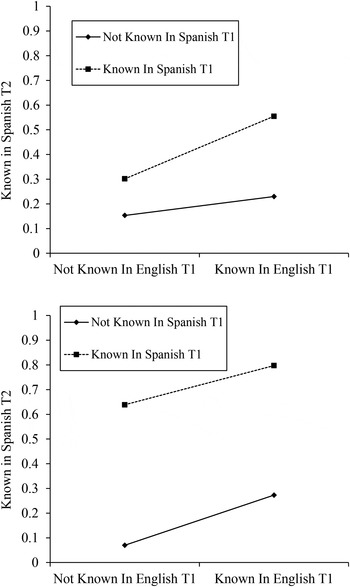
Results for Spanish language outcomes in Sample 1 are also shown in the top panel of Table 4. For receptive and expressive vocabulary, knowing individual words in English at time 1 and knowing individual words in Spanish at time 1 were significant and unique predictors of knowing those words in Spanish at time 2. There were significant interactions between knowing words in English at time 1 and knowing words in Spanish at time 1. These effects held when controlling for total English and Spanish receptive vocabulary knowledge at time 1. Results of the interaction probes for receptive and expressive vocabulary are shown in the upper and lower panels, respectively, of Figure 2. The simple effect of knowing a word in English at time 1 was significant when that word was not known in Spanish at time 1 (for receptive vocabulary: OR = 1·65, p < ·001; for expressive vocabulary: OR = 5·02, p < ·001) and when that word was known in Spanish at time 1 (for receptive vocabulary: OR = 2·90, p < ·001; for expressive vocabulary: OR = 2·23, p < ·001). For definitional vocabulary, the ability to define individual words in English at time 1 and the ability to define individual words in Spanish at time 1 significantly predicted the ability to define those same words in Spanish at time 2, but there was not a significant interaction. These effects held when controlling for total English and Spanish definitional vocabulary knowledge at time 1.
Probability of knowing a word in Spanish at time 2 (T2) when it was either known or not known in English and Spanish at time 1 (T1) for receptive vocabulary (upper panel) and expressive vocabulary (lower panel) in Sample 1.

Cross-time predictions: Sample 2
Linear regression analyses
To evaluate the fourth research question, parallel analyses were conducted on data from children in Sample 2. Results of linear regression analyses for English language outcomes in Sample 2 are shown in the bottom panel of Table 3. For all subtests, unique Spanish vocabulary at time 1 was negatively correlated with total English vocabulary at time 2. Unique Spanish vocabulary at time 1 did not predict total English vocabulary at time 2 after accounting for the effects of unique English vocabulary at time 1 and combined English–Spanish vocabulary at time 1.
Hierarchical Generalized Linear Models
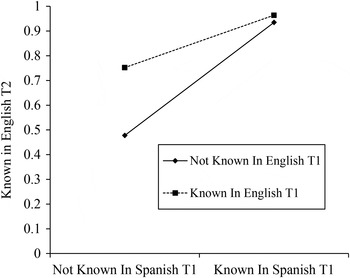
Results for Sample 2 are shown in the bottom panel of Table 4. For receptive vocabulary knowledge, knowing individual words in English at time 1 and knowing individual words in Spanish at time 1 were significant, unique predictors of knowing those words in English at time 2, but there was not a significant interaction. These effects held when controlling for total English and Spanish receptive vocabulary knowledge at time 1. For expressive vocabulary knowledge, knowing individual words in English at time 1 and knowing individual words in Spanish at time 1 were significant, unique predictors of knowing those words in English at time 2. There was a significant interaction between knowing individual words in English at time 1 and knowing individual words in Spanish at time 1. These effects held when controlling for total English and Spanish expressive vocabulary knowledge at time 1. Results of the interaction probe are shown in Figure 3. The simple effect of knowing a word in Spanish at time 1 was significant when that word was not known in English at time 1 (OR = 3·32, p < ·001) and when that word was known in English at time 1 (OR = 1·87, p < ·01). For definitional vocabulary knowledge, the ability to define individual words in English at time 1 and the ability to define individual words in Spanish at time 1 were significant, unique predictors of the ability to define those words in English at time 2, but there was not a significant interaction. These effects held when controlling for total English and Spanish definitional vocabulary knowledge at time 1.
Probability of knowing a word in English at time 2 (T2) when it was either known or not known in Spanish and English at time 1 (T1) for expressive vocabulary in Sample 2.

DISCUSSION
This study evaluated the cross-language relations of vocabulary knowledge for Spanish-speaking language minority children. Specifically, we asked whether L1 and L2 vocabulary knowledge was related across languages, whether initial unique L1 vocabulary knowledge predicted later L2 vocabulary knowledge after accounting for initial L2 vocabulary knowledge, and whether knowledge of a word in L1 but not L2 at time 1 predicted knowledge of that word in L2 at time 2. Corresponding models were evaluated for L1 vocabulary outcomes. Consistent with findings from prior research (e.g. Gottardo & Mueller, Reference Gottardo and Mueller2009, Kan & Kohnert, Reference Kan and Kohnert2008), vocabulary knowledge was not consistently correlated across languages. Results indicated that unique L1 and unique L2 vocabulary knowledge did not predict later L2 and L1 vocabulary outcomes, respectively. Thus, it appears that conceptual scoring provides little information relevant to the later single-language vocabulary development of language minority children that is not already provided by single-language vocabulary assessment in the same language. However, results indicated that children were more likely to acquire a word in their L2 if they already knew it in their L1 than they were if they did not know it in their L1, and vice versa. This finding provides partial support for the idea that children can transfer word-level information about vocabulary across languages (i.e. the narrow conceptualization of transfer). Results generally replicated across two independent samples of children who came from differing cultural backgrounds, extending the external validity of the study. These findings have important implications for the assessment and instruction of vocabulary knowledge for Spanish-speaking language minority children.
Cross-language relations of vocabulary knowledge
The first research question was broadly concerned with whether children's vocabulary knowledge was related across languages. In general, children's overall vocabulary knowledge was not positively correlated across languages in these samples of children, consistent with predictions and findings of prior research (e.g. Carlisle, Beeman, Davis & Spharim, Reference Carlisle, Beeman, Davis and Spharim1999; Gottardo & Mueller, Reference Gottardo and Mueller2009); however, children's receptive vocabulary knowledge was positively correlated across languages and time-points in Sample 1 and positively correlated across languages, within time-points in Sample 2. This finding may reflect the fact that receptive vocabulary knowledge develops earlier than does expressive or definitional vocabulary knowledge, as demonstrated by the overall mean scores across components of vocabulary knowledge in these samples. Receptive vocabulary tasks only require recognition of the word, whereas expressive and definitional vocabulary tasks require production of a word. It is well established that, for many aspects of language development in children, comprehension precedes production (e.g. Benedict, Reference Benedict1979). Children in these samples may have already transferred information relevant to receptive vocabulary knowledge from one language to the other.
In contrast to results for receptive vocabulary knowledge, the lack of a cross-language correlation between expressive and definitional vocabulary knowledge could be due to several factors. First, evidence indicates that at any given age young children's productive vocabulary is limited to some degree. For example, children learning English, on average, can produce approximately fifty words around 18 months of age (Menyuk, Liebergott & Schultz, Reference Menyuk, Liebergott and Schultz1995). Therefore, it seems likely that 18-month-old children learning more than one language would not be able to produce fifty words in each language but would have a combined productive vocabulary of fifty total words across their two languages. Consequently, as the number of words known in one language increases, the number of words known in the other language is likely to decrease. Evidence for this idea is seen in studies of conceptual vocabulary that have shown that the vocabulary knowledge of young language minority children is distributed across their two languages. One study reported that language minority children know approximately 70% of words in only one language or the other and know 30% of words in both languages (e.g. Peña et al., Reference Peña, Bedore and Zlatic-Giunta2002). Second, children's language environments may be largely isolated from each other (e.g. input in L1 occurs primarily at home and input in L2 occurs primarily at school). For example, the set of words needed to converse with others at home may be different from the set of words needed to communicate and succeed in a school environment. In this situation, there would be little overlap between words known in L1 and L2, leading to a lack of a relation between L1 and L2 vocabulary when formally assessed.
Utility of conceptual scoring
The second research question concerned whether the individual components of conceptual scores at time 1 uniquely predicted variance in L1 and L2 vocabulary knowledge at time 2. Consistent with our predictions, results indicated that conceptual scoring did not provide additional information about a child's later single-language skills that was not provided by monolingual assessment. This suggests that the broad notion of transfer does not apply to vocabulary knowledge. Vocabulary knowledge is a construct that is largely language-specific. That is, words are arbitrarily connected to an underlying concept, and therefore are unlikely to be similar across languages. For example, there is little to no information that is specific to the word casa that a child could transfer to English to help acquire the word house. Therefore, it is unsurprising that the results of this study and other studies often show only modest or no relations between vocabulary knowledge in L1 and L2. Conceptual scoring may be a better method of diagnosing language impairment in language minority children than is single-language vocabulary assessment; however, it does not appear that general levels of L1 and L2 proficiency predict future development in L2 and L1 proficiency, respectively.
Acquisition of translational equivalents
In contrast to the results of the conceptual scoring analyses, results of this study indicated that for receptive and expressive vocabulary knowledge children do readily acquire translational equivalents of words known in one language but not the other. This finding provided support for the narrow notion of transfer, in which specific information can be transferred from L1 to L2 and vice versa. For example, children who knew the word perro in Spanish were more likely to acquire the word dog in English than were children who did not know perro in Spanish. This is consistent with prior findings that children can transfer some aspects of vocabulary knowledge across languages, including cognate knowledge (e.g. August, Carlo, Dressler & Snow, Reference August, Carlo, Dressler and Snow2005). However, it is important to note that the within-language effect was always larger than the cross-language effect, and at times it was substantially larger (i.e. up to nine times the magnitude of the cross-language effect). Therefore, although children may be able to transfer some knowledge across languages, this does not appear to be the primary means through which children learn a second language, and it is still important to attend to children's vocabulary knowledge in the language of interest.
No evidence of transfer emerged for definitional vocabulary items. This lack of transfer could be due to a number of factors. First, rather than knowing individual words, definitional vocabulary items required children to describe a feature of the word or object named. Detailed knowledge of the concepts to which words are tied may develop somewhat later than does simple receptive or expressive vocabulary knowledge. A central idea in the developmental interdependence hypothesis and the broad notion of transfer is that there must be adequate L1 proficiency for the transfer of skills and/or knowledge to L2 to occur (Cummins, Reference Cummins1979). Because definitional vocabulary may be a later developing skill than is receptive or expressive vocabulary, it is possible that preschool children do not have adequate definitional representations of words in L1 to utilize when learning L2. Older children with more detailed definitional vocabulary knowledge may more readily transfer that knowledge from L1 to L2. Additionally, the language-specific transfer effect seen for expressive and receptive vocabulary outcomes may not carry over to the language-independent transfer of conceptual knowledge about objects, as this knowledge is somewhat more complex than simply linking an object with its label. Potential cross-language transfer of conceptual knowledge may occur through different mechanisms (e.g. common underlying proficiency; Cummins, Reference Cummins1981) than does cross-language transfer of language-specific information.
Implications
Conceptual scoring is often advocated as an assessment technique to prevent the overidentification of language impairment among language minority children (e.g. Bedore & Peña, Reference Bedore and Peña2008). If diagnosis of language impairment is the desired outcome, conceptual scoring may prove useful. However, conceptual scoring may not be useful when single-language vocabulary outcomes are of interest, as the inclusion of words uniquely known in Spanish does not provide additional information about children's English language development (and inclusion of words uniquely known in English does not provide additional information about children's Spanish language development). Furthermore, although language minority children may not be language impaired, they are at risk for difficulties in other skills that are dependent on better-developed vocabulary skills (e.g. reading comprehension; Nakamoto, Lindsey & Manis, Reference Nakamoto, Lindsey and Manis2008). Because prior research indicates that children's language skills are significantly related to their later reading abilities (e.g. Lonigan, Schatschneider & Westberg, Reference Lonigan, Schatschneider and Westberg2008; Storch & Whitehurst, Reference Storch and Whitehurst2002), the results of this and other studies highlight the importance of attending to children's current English language skills when predicting later development of those skills and attempting to close the achievement gap between language minority and monolingual children (Gottardo & Mueller, Reference Gottardo and Mueller2009; Mancilla-Martinez & Lesaux, Reference Mancilla-Martinez and Lesaux2010; Nakamoto et al., Reference Nakamoto, Lindsey and Manis2008).
Nevertheless, there may be circumstances under which L1 vocabulary knowledge can be used to leverage the further development of L2 vocabulary knowledge. For example, Goodrich et al. (Reference Goodrich, Lonigan and Farver2013) reported that children with greater initial L1 vocabulary knowledge benefitted more from an intervention designed to improve vocabulary knowledge in L2 than did children with weaker initial L1 vocabulary knowledge. L2 vocabulary instruction could specifically target words for which children already have detailed knowledge of the underlying concept because they know the word in L1. These L2 words may be easier for young children to acquire because they only need to map the word to the concept rather than learn the word and acquire a detailed understanding of the concept to which the word is attached.
The results of this study also indicated that knowing a word in both languages acted as a protective factor for the memory of the word, reducing the likelihood that it would be forgotten (i.e. the effect of knowing a word in both languages at Time 1 on knowing that word in either language at Time 2). This finding was unexpected, but it is nevertheless interesting and potentially relevant to the language of instruction for language minority children. Perhaps if knowing a word in both languages increases the likelihood that knowledge of the word is retained over time, bilingual vocabulary instruction (rather than English-only instruction) would increase language minority children's memory for words.
Limitations and future directions
Despite the strengths of this study (e.g. cross-sample replication, longitudinal data), it had several limitations. First, the use of conceptual scoring is often advocated to prevent the overidentification of children at risk for language impairment (e.g. Bedore & Peña, Reference Bedore and Peña2008). However, this study was designed to test the utility of the conceptual vocabulary score in predicting single-language outcomes. Although conceptual scoring may not be relevant to children's later single-language vocabulary knowledge, a study that tests the predictive accuracy of conceptual scoring and single-language assessment in diagnosing language impairment may provide evidence that conceptual scoring is needed in that context. Conceptual scoring may be of use when other outcomes are of interest as well (e.g. maintenance of skills in multiple languages). Additionally, a broader age range of children may reveal different patterns of transfer of receptive and definitional vocabulary knowledge. A sample of children younger than preschool-age may be more appropriate to test whether transfer of receptive vocabulary knowledge occurs, and a sample of children in elementary school may be more appropriate to test whether transfer of definitional vocabulary knowledge occurs. A broader age range of participants with more time-points of data may reveal further information about if and how children acquire translational equivalents and transfer vocabulary knowledge across languages. Finally, transfer of vocabulary knowledge and the utility of conceptual vocabulary scores may differ for children from different language backgrounds.
CONCLUSIONS
Overall, it appears that when the primary outcome of interest is single-language vocabulary knowledge, conceptual scoring is no more useful than single-language assessment of the to-be-predicted language. Specifically, results of this study indicated that children's unique L1 vocabulary knowledge did not predict their later L2 language skills after accounting for their prior L2 vocabulary knowledge, indicating that the broad notion of transfer proposed by Cummins (Reference Cummins, Cummins and Hornberger2008) may not apply to vocabulary knowledge. In other words, children's overall level of vocabulary knowledge in L1 is not predictive of subsequent vocabulary development in L2, and vice versa. However, it appears that bilingual vocabulary instruction may help children take advantage of existing vocabulary knowledge in L1 and facilitate the acquisition of vocabulary knowledge in L2, as children were able to transfer language-specific information about vocabulary across languages, providing support for the narrow notion of transfer. Finally, it appears that knowing a word in both languages acts as a protective factor against forgetting that word in either language. These findings have implications for the assessment and instruction of Spanish-speaking language minority children. However, future research is needed to determine the extent to which children transfer knowledge of words across languages and how to diagnose children accurately as at risk or not at risk for developing later language difficulties through the use of conceptual scoring.