INTRODUCTION
This article is a critical review of published data from the earliest evidence of pressure knapped microblade technology in each region, including discussions not only on published dates, but also on published artifacts (drawings and photos) relating to microblade technology. In this review, sites from Siberia, Russian Far East, Mongolia, China, Korea, and Japan are discussed (Figure 1). The analysis of published data, detailed in the following pages, has led me to conclude that based on the present available data, pressure knapping microblade technology probably emerged in the Far East (Korea, Japan or China) around 30,000–25,000 cal BP, rather than in southern Siberia over 35,000 years ago. An earlier version of this review was published in 2011 in the framework of a PhD thesis (Gómez Coutouly Reference Gómez Coutouly2011a), but has since been updated with the new available research of the last years, especially from China. This article deals with the emergence of the pressure knapping technique (for producing microblades), not pressure flaking (for retouching tools). Some of the assemblages under discussion might have tools such as bifaces retouched through pressure, but the review of this aspect is beyond the scope of this publication.
Map of Northeast Asia with the main microblade sites discussed in the article.

A CLOSER LOOK AT MICROBLADE DEFINITIONS
The issue concerning the geographical and chronological origin of microblade technology in Northeast Asia remains a widely debated concern, not only as new data emerge, but also due to researchers having different definitions of the term “microblade” and “microblade core”. Nowadays, most researchers (Derevianko et al. Reference Derevianko, Agadjanyan, Baryshnikov, Dergacheva, Dupal, Malaeva, Markin, Molodin, Nikolaev and Orlova1998; Keates Reference Keates2007; Kuzmin Reference Kuzmin2007; Bae Reference Bae2010; Seong Reference Seong2011; Yi et al. Reference Yi, Gao, Li and Chen2016) consider that the origin of microblade technology is to be found in southern Siberia some 35,000–40,000 years ago. Other researchers disagree, including Graf (Reference Graf2009a) who considered that the earliest reliably dated microblade sites are to be found in Hokkaido, around 25,000 years ago. The reasons behind such different hypotheses reside not only in the different critical approaches to the available archaeological data and published 14C dates, but also in the very different definitions of the term “microblade”.
Indeed, in all these cases, researchers discuss the emergence of “microblade technology”, but without systematically specifying the knapping techniques and methodsFootnote 1 employed for the production of such microblades. For the advocates of a Siberian origin, the assemblages under consideration are usually bladelet cores not necessarily pressure knapped, while for the defenders of a more recent origin in Japan (even if they do not always write it explicitly) refer to microblade cores with evidence of pressure knapping. In the literature, a “microblade” will have different definitions depending on authors. The following is a selection of the variability concerning the definition of a microblade:
∙ Seong (Reference Seong1998: 245) considers microblades as “small and ‘thin strips’ of rock detached from specially prepared cores by indirect or pressure flaking. They are about 2 mm thick with parallel sides of about 4–7 mm width and 15–50 mm length”.
∙ Kuzmin (Reference Kuzmin2007: 115) respectively uses definitions from Bahn (Reference Bahn2001: 292) and Darvill (Reference Darvill2002: 259) to characterize a microblade as a “small stone blade, typically several centimeters in length, often produced from a conical or wedge-shaped microcore” and a “very small, narrow blade”.
∙ Keates (Reference Keates2007) uses Akazawa et al. (Reference Akazawa, Oda, Yamanaka and Nakatsu1980: 74) to define a microblade as a “type of flake whose length is greater than twice its width and whose width is less than 1.2 cm”.
∙ Graf (Reference Graf2010: 211) defines “true microblades as exceedingly standardized, measuring roughly 2 mm thick, 15–50 mm long, and 2–7 mm wide with consistently parallel lateral margins and systematically removed from expressly prepared wedge-shaped or tortsovyi microblade cores”.
∙ For Terry et al. (Reference Terry, Buvit and Konstantinov2016: 90), artifacts will be considered microblades “if they exhibit parallel sides, are <7 mm wide, are <2 mm thick, and are associated with specialized cores exhibiting wedge-shaped cross-sections and blade scars <7 mm wide”.
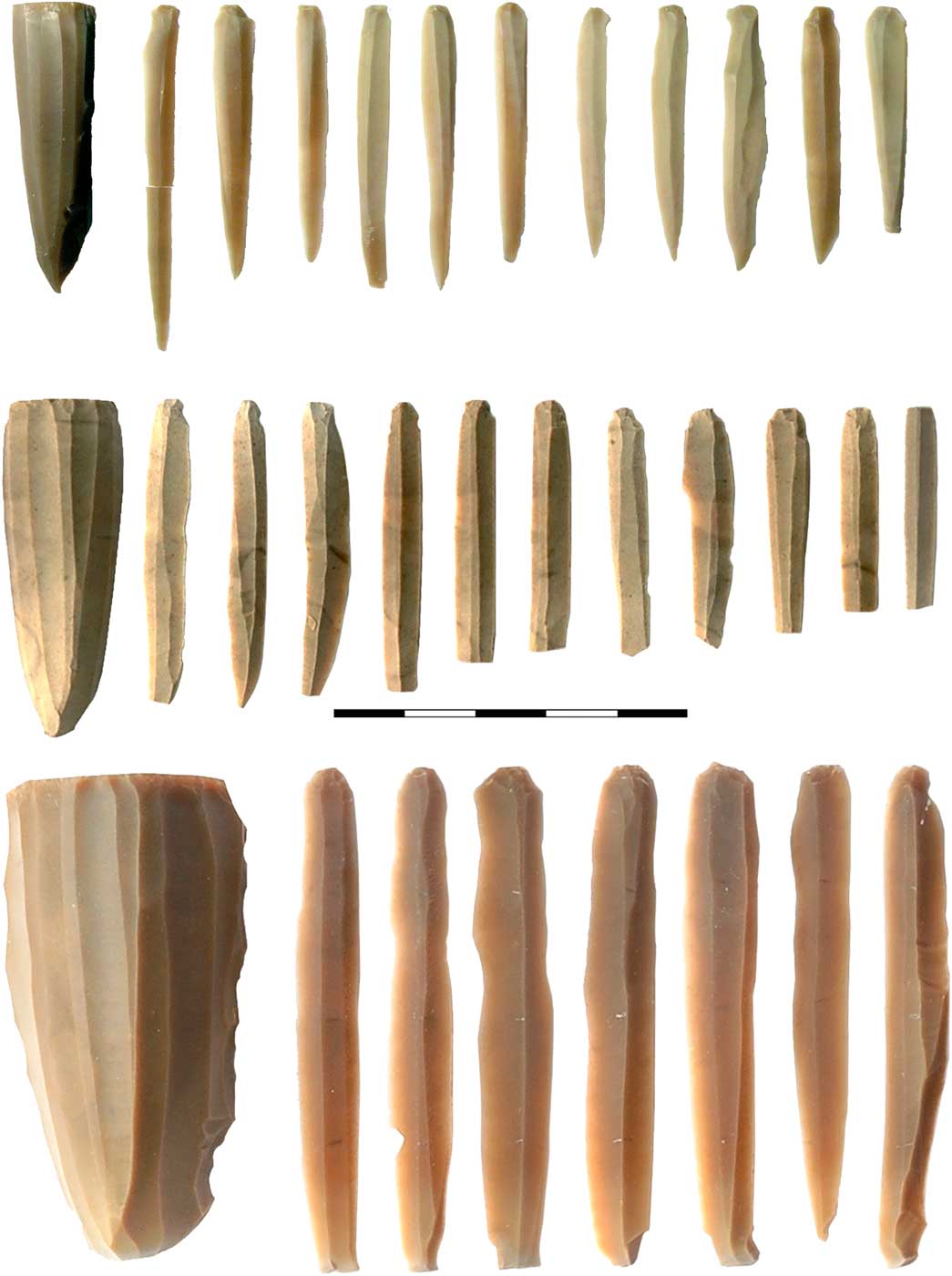
In this case, by microblade technology, I refer to the systematic production of microblades using the pressure knapping technique (Figure 2). By definition, these will fall in the range of 3–12 mm in width and will be highly regular, as indicated in most definitions above. But if a pressure microblade is a standardized small blade less than 12 mm wide, a standardized small blade less than 12 mm wide is not necessarily a pressure microblade. Our objective is not to determine where and when bladelet productions first appeared, but where and when pressure knapped microblade technology first emerged. The pressure knapped nature of microblades should by no means be considered as secondary or unimportant, but rather the opposite: it is the crucial defining nature of microblade technology in Northeast Asia. Once pressure knapping is invented, this technique used for the removal of microblades spread to most of Northeast Asia (Siberia, Russian Far East, Mongolia, China, Korea, Japan) up to North America (Alaska, the Yukon, and British Columbia), but also towards other regions such as Central Asia and ultimately Europe. Hence, focusing on the emergence of “pressure knapping” is not a detail: it is the start of a widespread technique that lasted over 20,000 years in various areas of the North Pacific region and beyond. Inizan was among the first to focus on tracking the appearance and spread of this particular technique in Northeast Asia, and designated the Siberian-Chinese-Mongolian area as the probable initial area of emergence for pressure knapping of microblades some 20,000 years ago (Inizan Reference Inizan1991, Reference Inizan2012; Inizan et al. Reference Inizan, Lechevallier and Plumet1992).
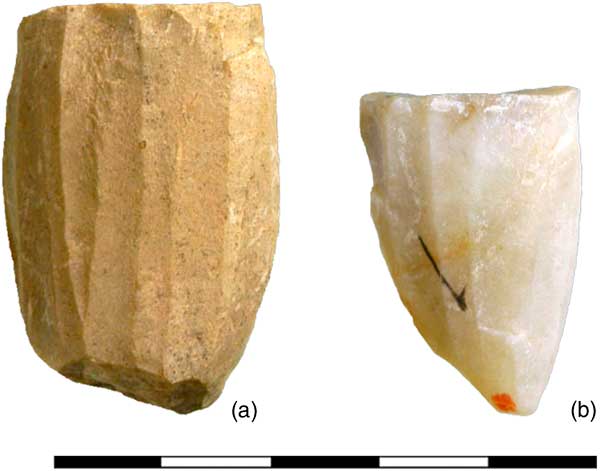
Examples of various experimental pressure knapped microblade cores and associated microblades (experimental flintknapping made by J. Pelegrin).
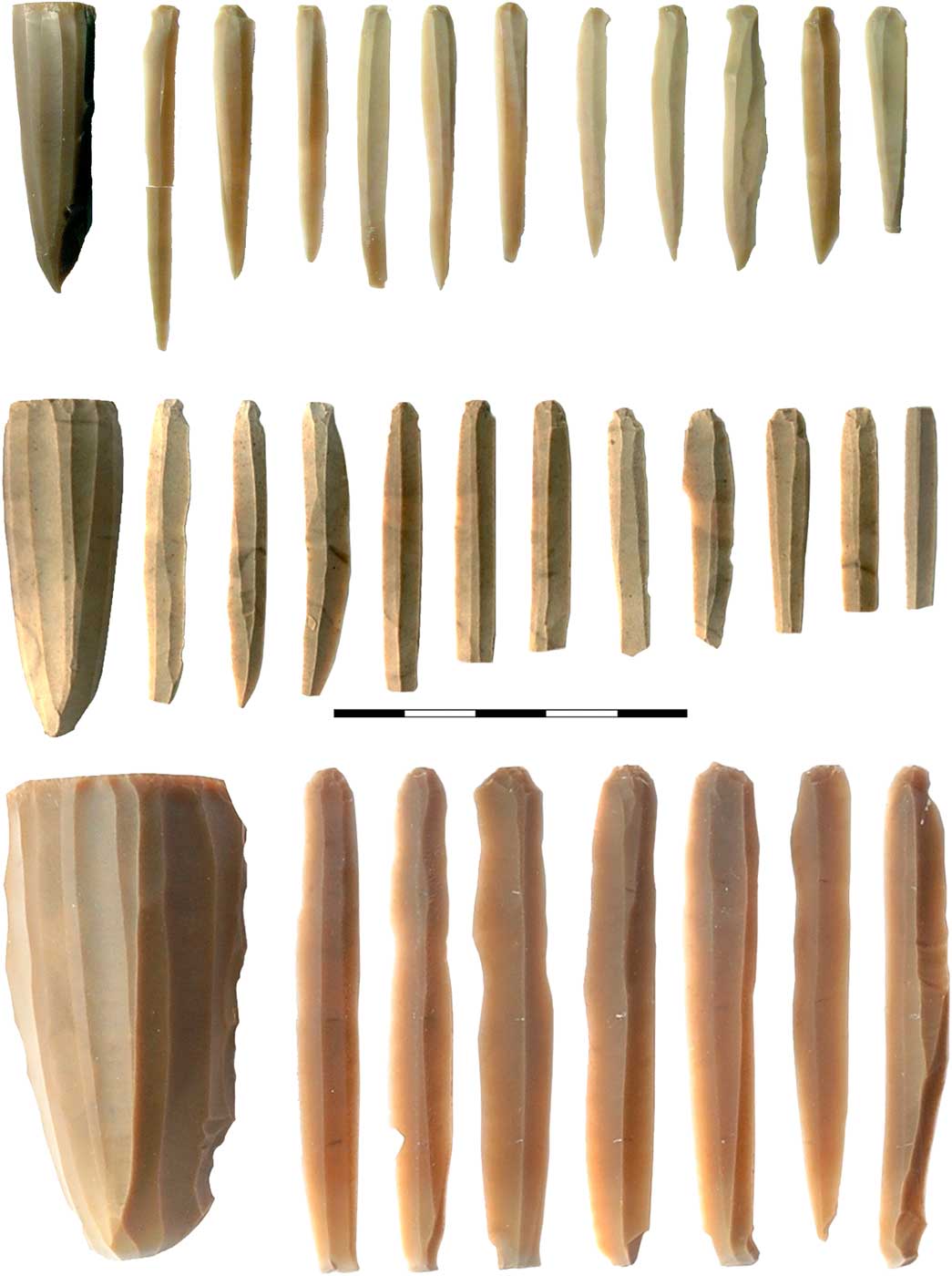
Some authors have pointed to the possible presence of indirect percussion for the removal of microblades in some cases (Zhao Reference Zhao2011; Takakura Reference Takakura2012), which is not surprising given the huge area and chronology we are dealing with. And finding out whether there are indeed indirect percussion microblades being produced at the same time as pressure microblades is an important question that needs further investigation. However, the evidence as of now, is that pressure knapping was overwhelmingly used for the production of microblades, and this technique was the one to diffuse over vast areas, hence it is the reason why I seek for the specific emergence of pressure knapped microblade technology.
A second issue concerns the method for producing microblades. Pressure knapped microblades can come from conical cores, Yubetsu cores, cores on flakes, wedge-shaped cores, etc. Some authors (see definitions above) consider that the presence of wedge-shaped core is an important characteristic when dealing with the emergence of microblade technology. Given that the hallmark of Northeast Asian microblade cores is that they are wedge-shaped in nature (as opposed to conical), looking for the emergence of microblades on wedge-shaped cores (including the Yubetsu method) is indeed essential. However, it is necessary to keep in mind that the appearance of pressure knapped microblades and the appearance of pressure knapped microblades on wedge-shaped cores may not be synchronous.
PRESSURE KNAPPING OF MICROBLADES
Pressure as a method for producing blade tools was first discovered by Crabtree (Reference Crabtree1968) when reproducing Mesoamerican polyhedral and prismatic obsidian blade cores. After his demonstration of pressure knapping to some of his French colleagues in 1964 (Pelegrin Reference Pelegrin2003), this technique was soon identified in new archaeological contexts such as the Epipaleolithic industries from Maghreb (Tixier Reference Tixier1976). Since then, the production of microblades and blades has been attributed to pressure knapping in diverse geographic and chronological contexts worldwide, such as France (Binder Reference Binder1984), Greece (Perlès Reference Perlès1984), Denmark (Callahan Reference Callahan1985), Turkey (Binder and Balkan-Atlı Reference Binder and Balkan-Atlı2001), the Canadian Arctic (Desrosiers and Sørensen Reference Desrosiers and Sørensen2012) and central Asia (Brunet Reference Brunet2002). Pressure knapping to produce microblades was first identified in Siberia by Flenniken (Reference Flenniken1987) and has since been suggested for most of the Paleolithic microblade assemblages from Northeast Asia and North America (Kobayashi Reference Kobayashi1970; Morlan Reference Morlan1976; Inizan et al. Reference Inizan, Lechevallier and Plumet1992; Tabarev Reference Tabarev1997, Reference Tabarev2012; Inizan et al. Reference Inizan, Reduron-Ballinger and Roche1999; Derevianko and Kononenko Reference Derevianko and Kononenko2003; Gryba Reference Gryba2006; Gómez Coutouly Reference Gómez Coutouly2007, Reference Gómez Coutouly2011a, Reference Gómez Coutouly2011b, Reference Gómez Coutouly2012, Reference Gómez Coutouly2015, Reference Gómez Coutouly2016; Takakura Reference Takakura2012; Gómez Coutouly and Ponkratova Reference Gómez Coutouly and Ponkratova2016).
Different techniques (called “modes”) for the removal of blades and microblades by pressure knapping have been proposed by authors such as Pelegrin (Pelegrin Reference Pelegrin1988, Reference Pelegrin2003, Reference Pelegrin2012; Gómez Coutouly Reference Gómez Coutouly2011a) to reproduce various archaeological cases, which vary widely in size, from small microblades to very large blades. But in the chrono-cultural context under discussion, only pressure microblades have been recognized, blade pressure knapping being a Holocene phenomenon (Gómez Coutouly Reference Gómez Coutouly2011b, Reference Gómez Coutouly2016).
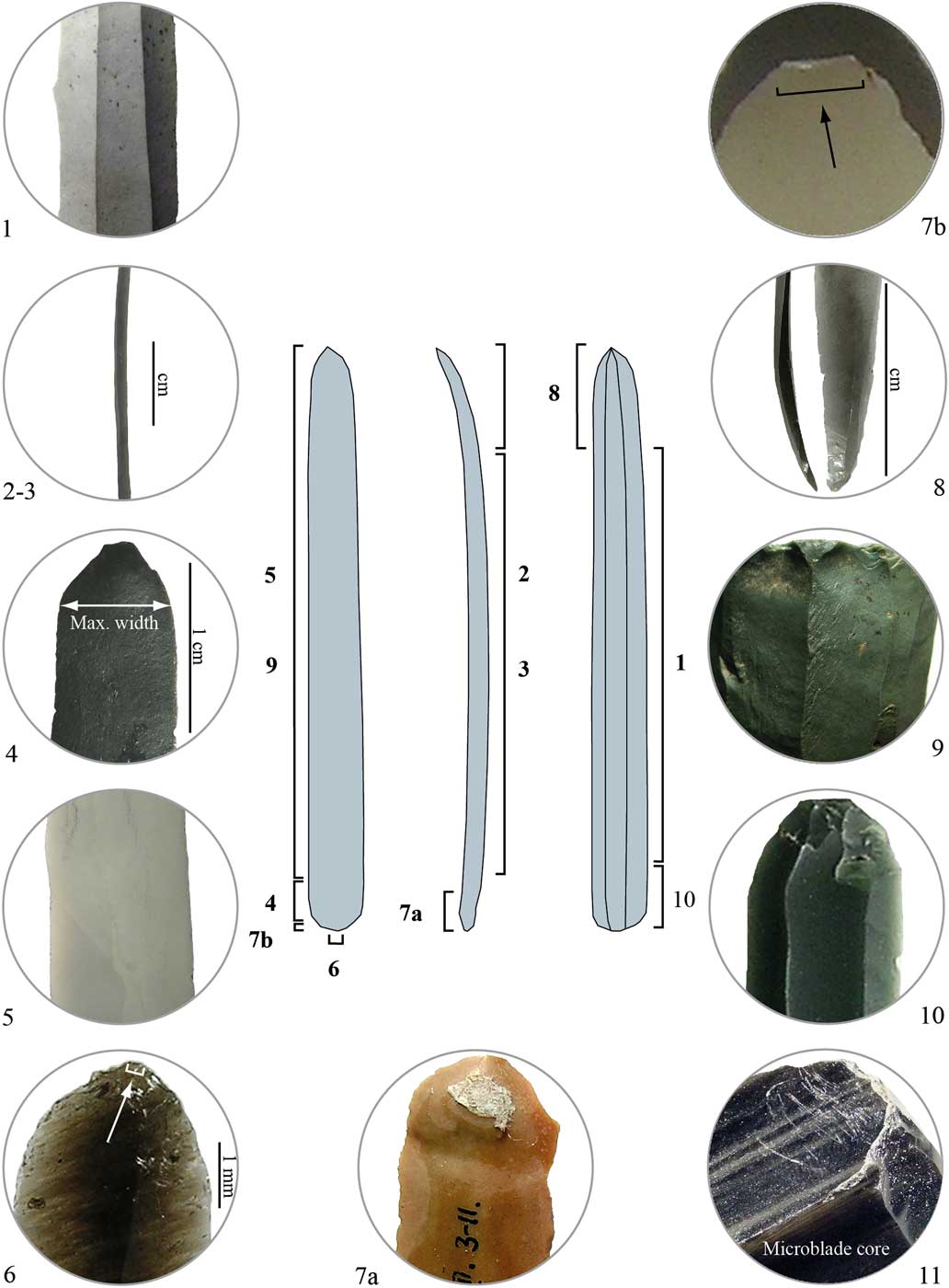
The main technical characteristics and criteria to recognize pressure knapping of microblades and blades have been extensively described elsewhere (Crabtree Reference Crabtree1968; Perlès Reference Perlès1984; Inizan et al. Reference Inizan, Lechevallier and Plumet1992; Inizan et al. Reference Inizan, Reduron-Ballinger and Roche1999; Pelegrin and Riche Reference Pelegrin and Riche1999). Of key note, the main attributes of pressure knapping include the edge regularity and parallelism, a straight profile (instead of a curved profile), a maximum width at the shoulder (i.e., right below the bulb), and the presence of a very small point-like pressure bulb on microblades. However, other criteria allow to identify pressure knapping as the technique of producing microblades, as summarized in Figure 3 (Gómez Coutouly Reference Gómez Coutouly2011a). It goes without saying that not all these features will be present at once on each microblade or microblade core.
Main criteria to recognize pressure knapping of microblades: 1. Perfect regularity and parallelism of edges and arises; 2. very thin profile; 3. straightness of profile; 4. butt is narrower than maximum width of microblade; maximum width is reached rapidly (right below the bulb); 5. lower face of microblade has no marked ripples; 6. pressure butt is usually punctiform; 7a. bulb is short and pronounced; 7b. discreet lip under butt; 8. distal section is curved and ends in “feathering”; 9. hackles are well pronounced; 10. abrasion of overhang can extend to the débitage surface; 11. pressure platforms can be scratched (only visible on cores).
CRITICAL REVIEW OF THE EARLIEST MICROBLADE ASSEMBLAGES BY REGION
The following review is based on published data mostly, which makes it quite difficult sometimes to determine whether the pressure technique was used. Not all the criteria for identifying pressure knapped microblades can be seen on illustrations, and one can only generally assume, with more or less certainty, whether the illustrated cores were pressure knapped. In some cases, the illustrations allow to positively confirm the pressure knapping nature of microblades or, on the contrary, to seriously doubt that this technique was employed. Also, this article reviews the archaeological data from various countries, and although I have tried to be thorough, there is no doubt that many publications and reports in Russian, Japanese, Chinese, Mongolian, and Korean containing pertinent information on the issues discussed here exist that I am not aware of. However, I hope that this review will stimulate the debate on the importance of focusing on the pressure technique when dealing with the emergence of microblade technology, and on the relevance of providing high quality illustrations (drawings and photographs) in order for readers to evaluate the assemblages.
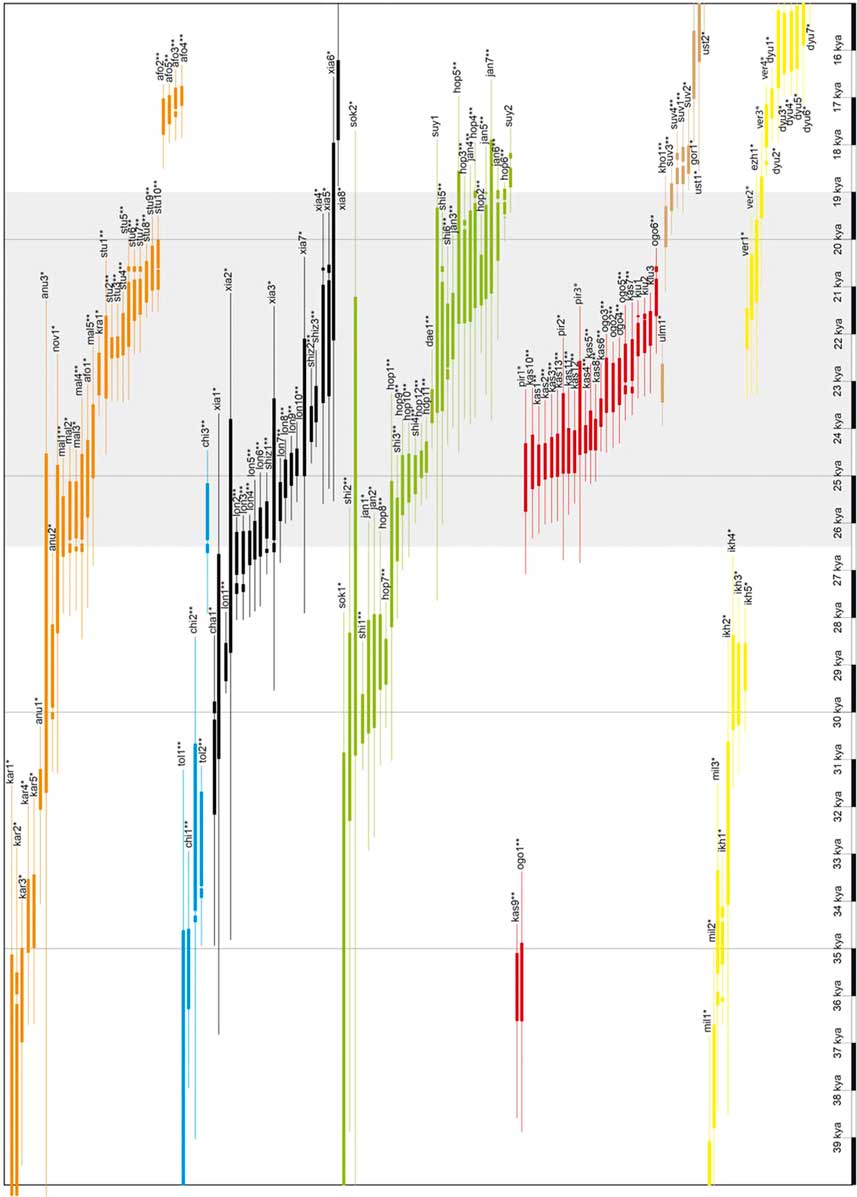
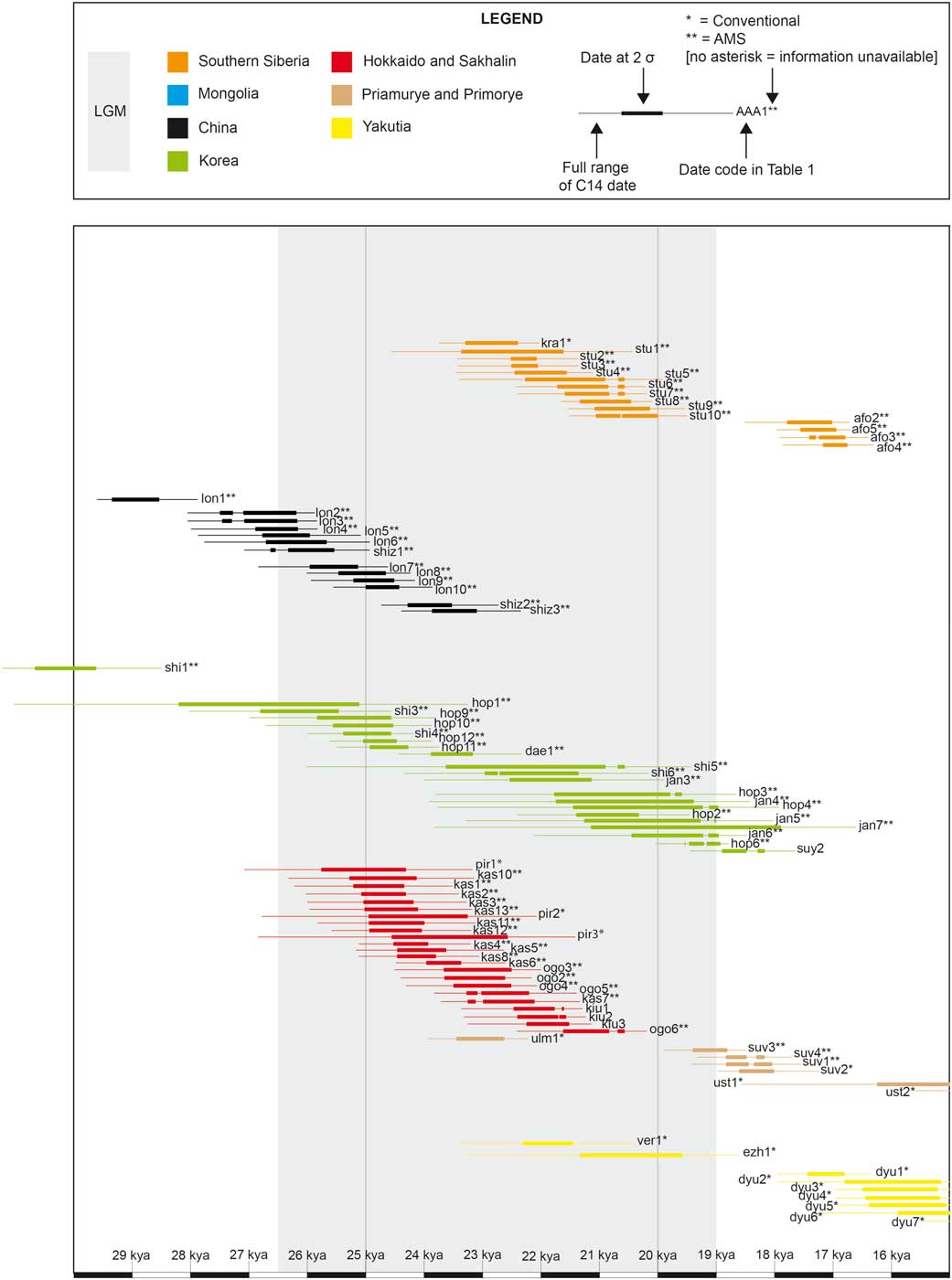
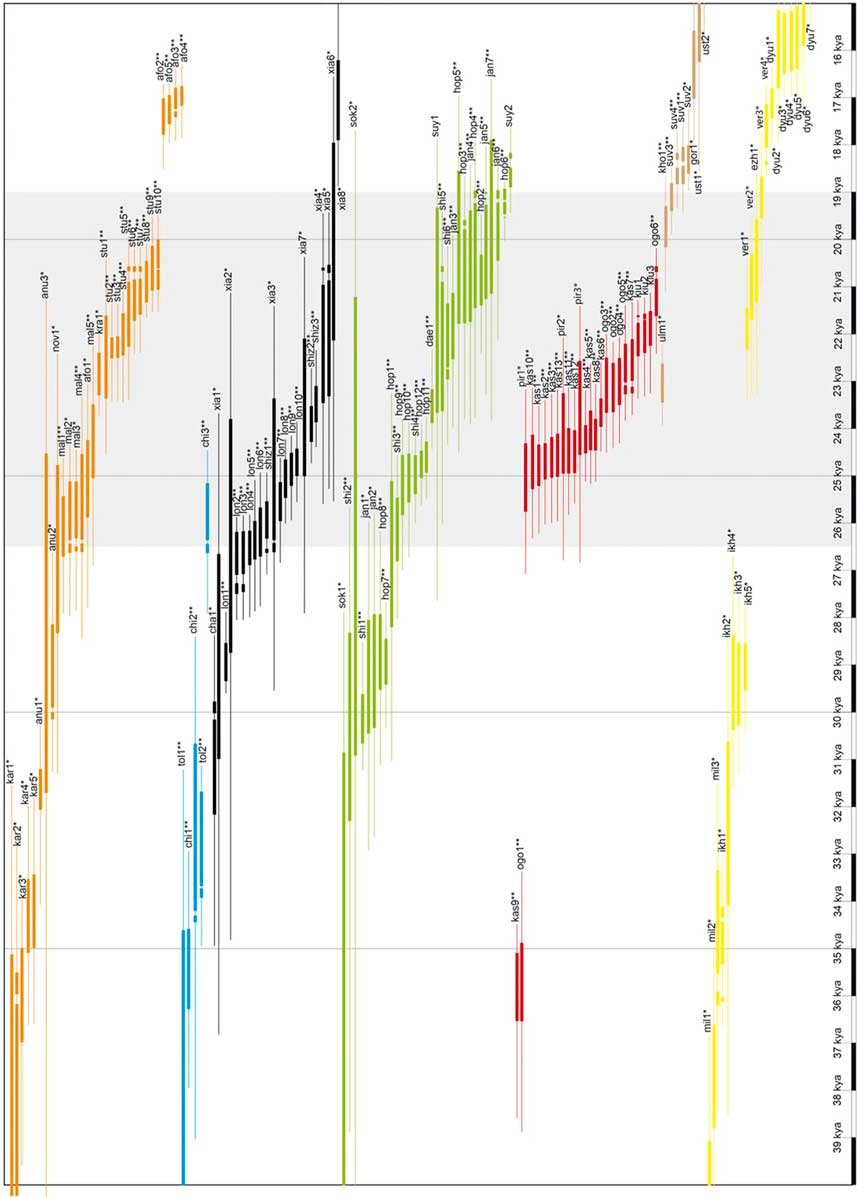
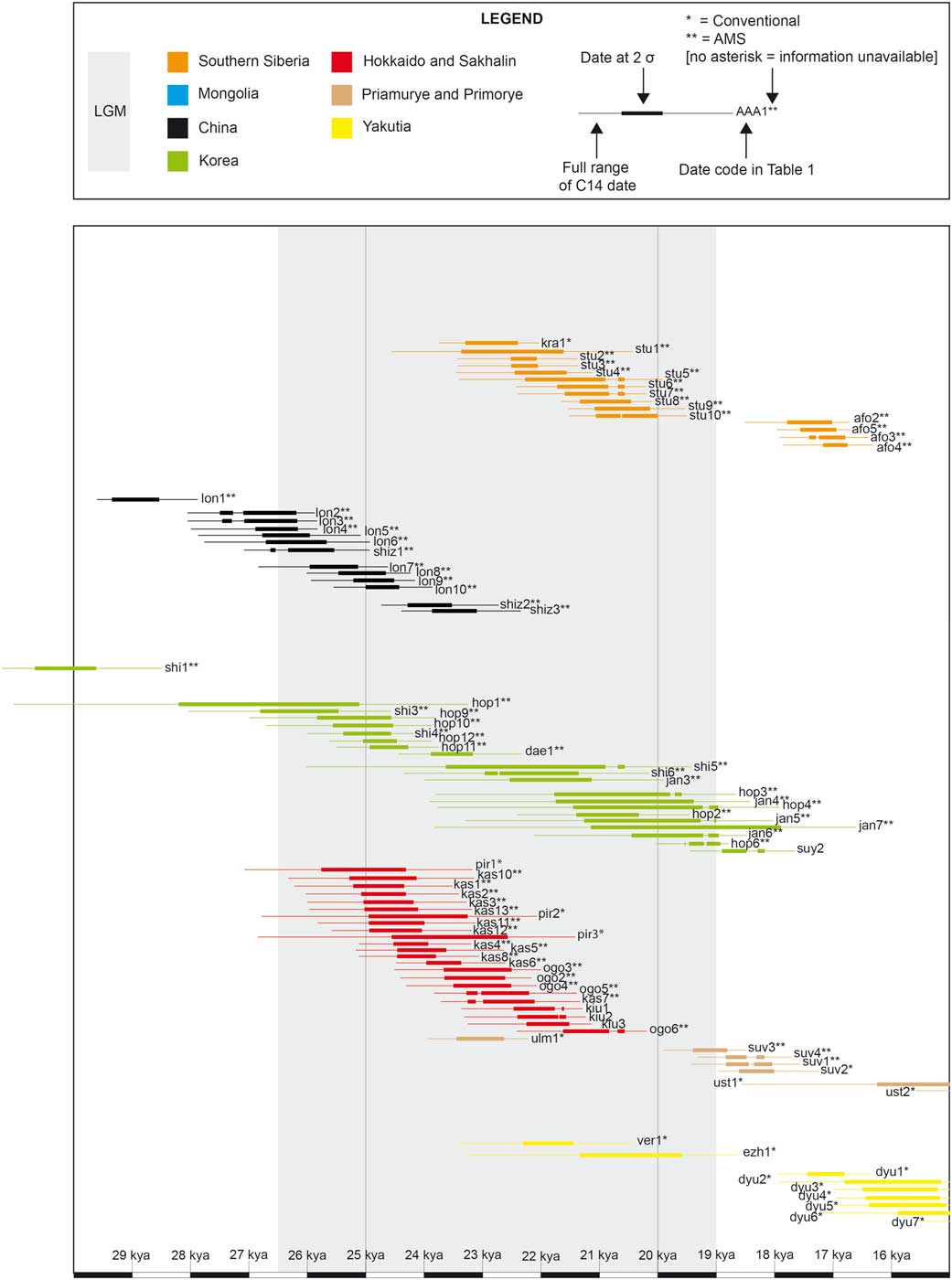
Figure 4 (also available as Figure S1 in better quality as supplementary online material) illustrates the 14C dates calibrated at 2σ of assemblages that are discussed hereafter, corresponding to the earliest microblade assemblage (or supposed microblade assemblage) reported for each region. Figure 5 is based on the previous figure, but with all the dates that I do not consider valid removed, either because of issues with the date itself or with the dated assemblage. The reasons leading me to exclude some of the dates/assemblages, are detailed hereafter. Table 1 (see appendix) provides all the information on the 14C dates from Figure 4.
Calibrated dates of early microblade sites from each region. Notes: A larger version including the full range of 14C dates not visible on this figure is availbale as a supplementary file online (Figure S1). More information on each individual date can be found in Table 1. Only the older dates from each region are shown (younger microblade sites from within each region are not represented). The LGM (Late Glacial Maximum) dates are based on (Clark et al. Reference Clark, Dyke, Shakun, Carlson, Clark, Wohlfarth, Mitrovica, Hostetler and McCabe2009). Abbreviation of sites: afo: Afontova Gora-2; anu: Anui-2; cha: Chaisi; chi: Chikhen Agui; dae: Daejeong-dong; dyu: Diuktai Cave; ezh: Ezhantsy; gor: Gorbatka-3; hop: Hopyeong-dong; ikh: Ikhine-2; jan: Jangheungni; kar: Ust-Karakol-1; kas: Kashiwadai-1; kho: Khodulikha; kiu: Kiusu-5; kra: Krasnyi Iar; lon: Longwangchan Loc. 1; mil: Ust’-Mil-2; nov: Novoselovo-13; ogo: Ogonki; pir: Pririka; shi: Shinbuk; shiz: Shizitan 29; sok: Sokchangni; stu: Studenoe-2; suv: Suvorovo-4; suy: Suyanggae; tol: Tolbor-15; ulm: Ust-Ulma 1; ust: Ustinovka-6; ver: Verkhne-Troitskaia; xia: Xiachuan, Shanziyan, Shunwangping.
Accepted dates of early microblade sites from each region, after excluding problematic dates and/or assemblages (based on Figure 4).
Southern Siberia
I include in this section sites from several regions located in southern Siberia, from the Altai to the Transbaikal regions. In these areas, many radiocarbon dates have been obtained from sites with bladelet and microblade assemblages, and for many researchers it is potentially the geographical region where microblade industries first emerged before diffusing to neighboring areas. I exclude from this discussion some sites from the region that have been considered by some to represent early microblade assemblages or precursors to microblade assemblages, given that there is no evidence to support the presence of a microblade assemblage based on published materials. These sites are Kara-Bom (Derevianko et al. Reference Derevianko, Grichan, Dergacheva, Zenin, Lauhin, Levkovskaya, Maloletko, Markin, Molodin and Ovodov1990), Kurtak-4 (Lisitsyn Reference Lisitsyn2000), Kamenka complex B (Lbova Reference Lbova2002), Ui-1 (Vasil’ev Reference Vasil’ev1996), Buret (Sitlivy et al. Reference Sitlivy, Medvedev and Lipnina1997) and Denisova Cave (Derev’anko and Markin Reference Derev’anko and Markin1998; Derevianko Reference Derevianko2001; Derevianko and Volkov Reference Derevianko and Volkov2004). In all these cases, either there is a lack of published drawings confirming the presence of microblade cores and/or microblades, or some of the illustrated artifacts are not microblade cores (sometimes called “proto-microblade cores” or “proto-wedge-shaped cores”).
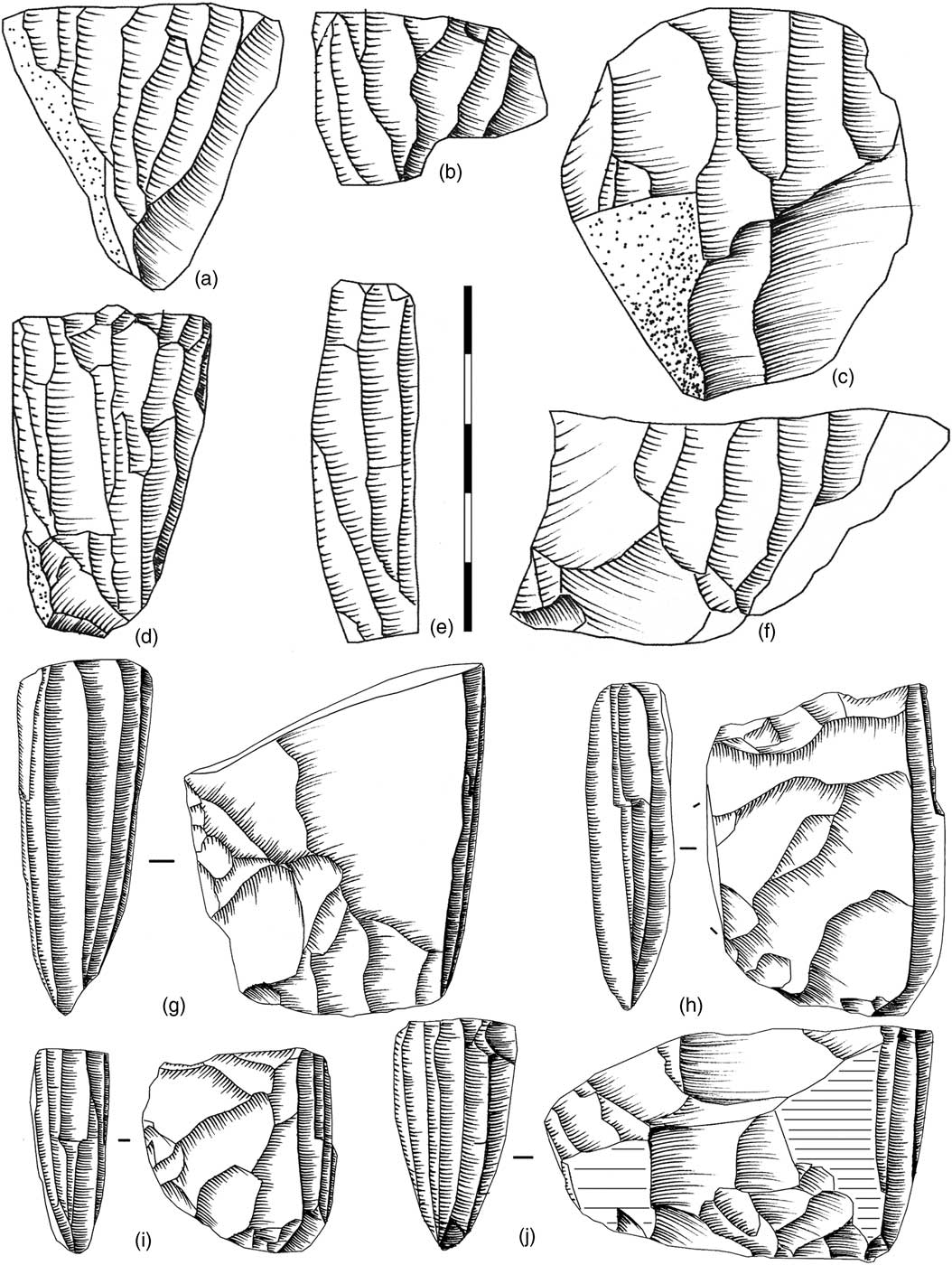
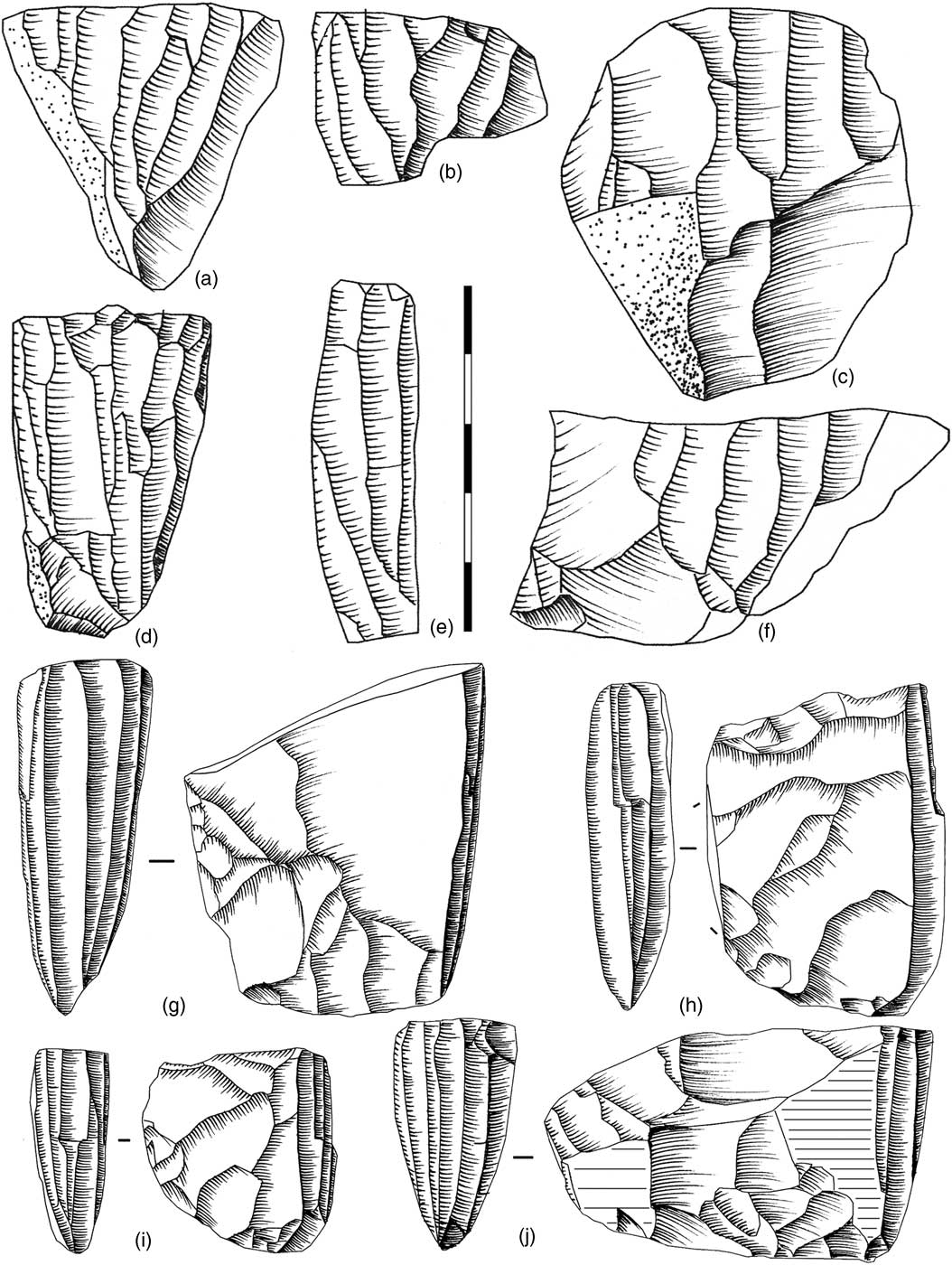
In the Altai region, the two oldest candidates are Ust-Karakol-1 (layers 9a and 11a) and Anui-2. These sites have been detailed and discussed in previous publications (Derevianko and Zenin Reference Derevianko and Zenin1990; Derevianko et al. Reference Derevianko, Agadjanyan, Baryshnikov, Dergacheva, Dupal, Malaeva, Markin, Molodin, Nikolaev and Orlova1998; Derevianko Reference Derevianko2001). Their conventional radiocarbon dates range respectively from ca. 47,750 to 33,400 cal BP at 2σ (Table 1 and Figure 4, kar1 to kar5) and from ca. 31,650 to 28,150 cal BP at 2σ (Table 1 and Figure 4, anu1 to anu3). The first issue with these dates is of course that they are conventional dates made several decades ago and some have very high standard deviations (±2850, ±1547 and ±1285). However, the other more important issue with these assemblages relates to the cores themselves. Although they are indeed bladelet cores, the illustrated examples (Derevianko and Zenin Reference Derevianko and Zenin1990; Derev’anko and Markin Reference Derev’anko and Markin1998; Derevianko et al. Reference Derevianko, Shunkov, Agadjanian, Baryshnikov, Malaeva, Ulianov, Kulik, Postnov and Anoikin2003; Derevianko and Shunkov Reference Derevianko and Shunkov2004) do not correspond to our definition of microblade cores. Indeed, due to the lack of regularity of the “microblade” negatives, these cores do not provide evidence of being pressure knapped. This issue has already been addressed before by other researchers such as Graf (Reference Graf2008a). These sites are often mentioned in the discussions as representing evidence for the birthplace of microblade technology, but so far the published data do not allow to consider these assemblages as serious candidates for the emergence of pressure knapped microblade industries, as illustrated in Figure 6 when comparing these cores and pressure knapped microblade cores.
Siberian and Mongolian bladelet cores (a–f) vs. Siberian and Russian Far East pressure knapped microblade cores (g–j): (a–b) Bladelet cores from Ust’Karakol-1 (Altai), redrawn from Derevianko and Shunkov (Reference Derevianko and Shunkov2004); (c and f) bladelet cores from Anui-2 (Altai), redrawn from Derevianko et al. (Reference Derevianko, Agadjanyan, Baryshnikov, Dergacheva, Dupal, Malaeva, Markin, Molodin, Nikolaev and Orlova1998); (d) bladelet core from Tolbor-15 (Mongolia) redrawn from Gladyshev et al. (Reference Gladyshev, Olsen, Tabarev and Kuzmin2010); (e) bladelet/microblade core from Mal’ta (Angara), redrawn from Sitlivy et al. (Reference Sitlivy, Medvedev and Lipnina1997); (g) microblade core from Druchak-Vetrenny (Kolyma); (h) microblade core from Tytylvaam-4 (Chukotka); (i) microblade core from Ushki Lake-1 (Kamchatka); (j) microblade core from Verkhne-Troitskaia (Yakutia).
In the Yenisei region, the Novoselovo-13 site level 3 is dated to ca. 28,300–24,800 cal BP at 2σ (Table 1 and Figure 4, nov1) based on one single conventional date, the reason why this date is rejected. Multiple microblade cores have been reported from this cultural layer, although only three have been illustrated (Abramova et al. Reference Abramova, Astakhov, Vasil’ev, Lisitsyn and Ermolova1991; Lisitsyn Reference Lisitsyn2000). Out of the three illustrated microblade cores, one is a very convincing pressure knapped microblade core on a bifacial preform. The other two illustrated artifacts cannot be considered as microblade cores. Another site in the area, Afontova Gora-2, has a reported old microblade assemblage. The site was first dated in the 1970s by one single conventional date placing the site ca. 25,900–24,250 cal BP at 2σ (Table 1 and Figure 4, afo1) (Tseitlin Reference Tseitlin1979; Drozdov and Artem’ev Reference Drozdov and Artem’ev1997; Graf Reference Graf2008b). However, this date is rejected (Graf Reference Graf2009b), since about 15 new AMS dates reassign the site to ca. 18,000–14,000 cal BP. Only the four oldest dates have been illustrated here (Table 1 and Figure 4, afo2 to afo5).
In the Angara region, based on the assertion of some researchers (Sitlivy et al. Reference Sitlivy, Medvedev and Lipnina1997), the lithic industry from Mal’ta includes a microblade assemblage with pressure knapped microblades. Fourteen dates (AMS and conventional) have been published from stratum 8 or from the main cultural stratum (ca. 26,700–23,500 cal BP to 2 σ, Table 1 and Figure 4, mal1 to mal5), all on bone. Based on the published drawings (Boriskovskii Reference Boriskovskii1984; Sitlivy et al. Reference Sitlivy, Medvedev and Lipnina1997; Medvedev Reference Medvedev1998), most of the cores look like bladelet cores with no pressure knapping. Out of the two illustrated cores (Sitlivy et al. Reference Sitlivy, Medvedev and Lipnina1997: 49 n°13–14) that present the most regular microblade scars, one is redrawn here (Figure 6, e). These cores are not wedge-shaped, and are expedient cores on flakes. But most importantly, they do not seem to be regular enough to be considered pressure knapped, especially since the illustrated core is the closest example of a microblade core based on published drawings. A study by Kimura (Reference Kimura2003) on the blade and bladelet production at Mal’ta considered that the assemblage did not provide evidence of microblade technology, although some bladelet cores could be considered “precursors” due, among others issues, to the presence of cores with a wedge-shaped morphology.
The Krasnyi Iar-1 assemblage is slightly younger, with just one reported conventional date spanning ca. 23,300–22,400 cal BP to 2 σ (Table 1 and Figure 4, kra1). To be accepted, this date should be replicated to confirm the age of the microblade assemblage. Based on published data (Boriskovskii Reference Boriskovskii1984; Medvedev Reference Medvedev1998), the assemblage is characterized by pressure knapped Yubetsu microblade cores.
There has been at least two other sites (Igeteiskii Log 1 and Ust-Kova) from the Angara region with reported early dates associated with a microblade assemblage, but these are not discussed in detail here. At Igeteiskii Log 1 (Abramova et al. Reference Abramova, Astakhov, Vasil’ev, Lisitsyn and Ermolova1991), dates in excess of 20,000 years ago have been reported for an assemblage where only one core was reported at first, although other researchers working at the site did not mention the presence of microcores and indicated that all the material was redeposited (Kuzmin and Orlova Reference Kuzmin and Orlova1998). At the Ust-Kova site, a date of 19,540 ± 90 uncal BP was obtained in contradiction with a much younger date from the same assemblage (Kuzmin and Orlova Reference Kuzmin and Orlova1998; Goebel Reference Goebel2002).
In the southwest Transbaikal region, the earliest dated site with a pressure knapped microblade component is Studenoe-2. The oldest 10 radiocarbon AMS dates span from ca. 23,350–20,000 cal BP at 2σ (Table 1 and Figure 4, stu1 to stu10), although the oldest date was rejected by Goebel et al. (Reference Goebel, Waters, Buvit, Konstantinov and Konstantinov2000) as discordantly older, which would then place the start of the occupation ca. 22,500 cal BP at the earliest. This site was considered at one point as representing the start of microblade technology in Northeast Asia (Goebel et al. Reference Goebel, Waters, Buvit, Konstantinov and Konstantinov2000). Terry et al. (Reference Terry, Buvit and Konstantinov2016: 97) indicate that “pressure-knapping (…) may have been sporadic during the MUP [middle Upper Paleolithic]” in the region, and indicate that some of the attributes of pressure knapping “are clearly illustrated in all of the microblades from the Transbaikal assemblages”. However, the illustrations of cores and tools from the middle Upper Paleolithic sites do not convincingly demonstrate the presence of pressure knapping (Terry et al. Reference Terry, Buvit and Konstantinov2016: 8). Instead, the microblade cores from the late Upper Paleolithic sites like Studenoe-2 provide the most obvious indication for the use of this technique.
In the Transbaikal and Baikal regions, other sites have been considered as early microblade assemblages, although they are very problematic. For example, the Sokhatino-4 site (Okladnikov and Kirillov Reference Okladnikov and Kirillov1980; Orlova Reference Orlova1995) has only two reported dates (26,110 ± 200 uncal BP and 11,900 ± 130 uncal BP), but the oldest date is rejected here, as have done previous researchers (Kuzmin and Orlova Reference Kuzmin and Orlova1998; Goebel Reference Goebel2002), given that it is a single date made from samples from several excavation pits and that the same site has provided much younger dates. In a similar way, the Kurla-3 site (layer 2) in the Baikal area (Orlova Reference Orlova1995) is not discussed here given that the single date has an extreme margin of error (24,060 ± 5,700 uncal BP).
Mongolia
Mongolia is probably one of the most problematic areas, as most assemblages come from surface sites, are not stratified and are therefore difficult to date (Derevianko et al. Reference Derevianko, Gladyshev, Olsen, Petrin and Tserendagva2001). As a result, there is not only a lack of solid evidence in Mongolia demonstrating the presence of old assemblages containing microblade productions, but also a lack of solid evidence demonstrating the absence of them, too.
The oldest candidate for an early microblade industry in Mongolia is Tolbor-15 horizon 5 (Gladyshev et al. Reference Gladyshev, Olsen, Tabarev and Kuzmin2010 Reference Gladyshev, Olsen, Tabarev and Jull2012). This site has provided two dates stretching from ca. 41,000–32,000 cal BP at 2σ (Table 1 and Figure 4, tol1 and tol2). Although the authors specifically mention that these were pressure knapped microblade cores, it is far from evident based on the only two illustrated microblade cores (Gladyshev et al. Reference Gladyshev, Olsen, Tabarev and Kuzmin2010: 2 n°15–16), one of which is redrawn here (Figure 6, d). Other researchers (Rybin et al. Reference Rybin, Khatsenovich, Gunchinsuren, Olsen and Zwyns2016) have also expressed their skepticism due to the lack of clear stratigraphic evidence, and the lack of a more developed microblade industry in the layer where these cores were found. Moreover, they consider that a contamination from the overlying Late Upper Paleolithic layer cannot be ruled out, and conclude that “the assumption that Mongolia contains the earliest evidence for the emergence of typical microblade technology and the use of pressure flaking techniques in Asia is not yet supported by sufficient stratigraphic evidence” (Rybin et al. Reference Rybin, Khatsenovich, Gunchinsuren, Olsen and Zwyns2016: 40–42).
Another prehistoric site in Mongolia, Chikhen Agui, has been considered as another potential candidate (Brantingham et al. Reference Brantingham, Krivoshapkin, Jinzeng and Tserendagva2001; Derevianko et al. Reference Derevianko, Gladyshev, Olsen, Petrin and Tserendagva2001, Reference Derevianko, Brantingham, Olsen and Tseveendorj2004, Reference Derevianko, Olsen, Tseveendorj, Gladyshev, Nokhrina and Tabarev2008; Keates Reference Keates2007). Chikhen Agui locus 2 (layer 3) has been dated to ca. 36,300–34,500 cal BP at 2σ (Table 1 and Figure 4, chi1 to chi3) (Derevianko et al. Reference Derevianko, Brantingham, Olsen and Tseveendorj2004), but for the moment the description of the lithic industry associated with layer 3 presents no evidence of a microblade component. A so-called microblade core associated with this layer has been considered to represent an old microblade core at the site (Derevianko et al. Reference Derevianko, Gladyshev, Olsen, Petrin and Tserendagva2001; Keates Reference Keates2007), although the drawing of the artifact resembles a flake core (Derevianko et al. Reference Derevianko, Gladyshev, Olsen, Petrin and Tserendagva2001: 7 n°7) and is in no way representative of a microblade core, let alone a pressure knapped microblade core. In a recent article, Derevianko et al. (Reference Derevianko, Markin, Gladyshev and Olsen2015: 8 n°4, 12 n°5) illustrate microblade cores that may have been pressure knapped from layers 2.5 and 2.6 of the same site. But in this new article, the previous reported date from layer 3 (a non-microblade component) is now associated with layer 2.5 (a possible microblade component), therefore shedding some confusion.
China
Most scholars do not consider China as a possible birthplace for microblade industries, with the exception of some researchers (Gai Reference Gai1985; Seong Reference Seong1998; Yi et al. Reference Yi, Gao, Li and Chen2016).
The Chaisi site, located in the Shanxi Province and excavated in 1978 (Huang and Hou Reference Huang and Hou1998; Yi et al. Reference Yi, Gao, Li and Chen2016) has provided the oldest (ca. 32,200–29,800 cal BP at 2σ, Table 1 and Figure 4, cha1) but not the most reliable date for a microblade assemblage in China. Indeed, the assemblage is dated through a single conventional 14C date from the 1990s made on shell, therefore quite inaccurate as pointed out by other researchers (Chen Reference Chen1992). Moreover, there also seems to be questions raised on the stratigraphic integrity of the site (Yi et al. Reference Yi, Gao, Li and Chen2016). The assemblage includes six microblade cores and 86 microblades (Chen Reference Chen2007), and based on published drawings they are pressure knapped cores, including the Yubetsu method. However, given the issues on the date and the stratigraphy, this site has to be dismissed from this discussion.
Also in the Shanxi Province, Xiachuan has long been the main candidate for an early microblade presence in China. The dates, made in the 1980s (Chen and Wang Reference Chen and Wang1989), range from ca. 31,000 to 16,000 cal BP at 2 σ (Table 1 and Figure 4, xia1 to xia8). First of all, some of these dates have large standard deviations (±1000, ±900, etc.) or are made on peat or mud. But there is also another problem that does not allow me to take into account these dates. When the authors mention the Xiachuan site, they are not only referring to a stratified site, but also to 16 test-pits distributed over an area of 20 km x 30 km (Chen and Wang Reference Chen and Wang1989). When discussing the chronology of the site, the authors are very clear:
“There are a total of 11 radiocarbon dates from Xiachuan and related sites. Eight of these, ranging between 13,900±300 and 23,900±1000, might represent the chronology of the Xiachuan industry. Because the samples dates were collected from different localities rather than from a sequential profile of cultural deposits, it is impossible to trace cultural or technological change or development at Xiachuan” (Chen and Wang Reference Chen and Wang1989: 135).
In addition, the illustrated artifacts come from the 16 test-pits, not just the main excavation (Chen Reference Chen2007), meaning that we do not know which dates are associated with which artifacts. The Xiachuan assemblage includes 219 microblade cores (Chen Reference Chen2007) and based on the drawings, some of these are indisputably pressure knapped microblade cores, including conical and wedge-shaped types. But given the context, these dates cannot here be accepted.
These last few years, new research has provided evidence of old microblade sites in China (Zhang et al. Reference Zhang, Wang, Qiu, Shelach, Hu, Fu, Zhuang and Zhou2011; Nian et al. Reference Nian, Gao, Xie, Mei and Zhou2014; Kato Reference Kato2017; Song et al. Reference Song, Cohen, Shi, Wu, Kvavadze, Goldberg, Zhang, Zhang and Bar-Yosef2017). These publications included some sites that I have decided not to discuss here, either for lack of contextual information or dated only through OSL, such as Xishi, Youfang, Dadong, and Mengjiaquan. However, two other sites provided good evidence of pressure knapped microblade assemblages in association with well-dated occupation layers: Longwangchan Loc. 1 and Shizitan Loc. 29. The Longwangchan Loc. 1 site is located in the Shanxi Province and has been excavated from 2005 to 2008; it represents so far the oldest reliably dated microblade assemblage in China (Zhang et al. Reference Zhang, Wang, Qiu, Shelach, Hu, Fu, Zhuang and Zhou2011), ranging from ca. 29,350 to 24,400 cal BP at 2σ (Table 1 and Figure 4, lon1 to lon10). This site has also provided some older dates (not included in Figure 4) using the OSL technique (Zhang et al. Reference Zhang, Wang, Qiu, Shelach, Hu, Fu, Zhuang and Zhou2011), from ca. 21,000–26,000 years ago. The microblade cores from the site shown in their article (Figure 7) suggest the presence of pressure knapped microblade cores in the assemblage. These were not wedge-shaped, but rather conical or tabular in shape, and were likely pressure knapped.
Microblade cores from Longwangchan Loc. 1 (China, Shanxi Province). (Adapted from Zhang et al. Reference Zhang, Wang, Qiu, Shelach, Hu, Fu, Zhuang and Zhou2011, with permission from the author.)

Shizitan Loc. 29 is another well-dated microblade assemblage, located in the same region (Song et al. Reference Song, Cohen, Shi, Wu, Kvavadze, Goldberg, Zhang, Zhang and Bar-Yosef2017). The site contains microblade technology throughout the whole sequence, including in layer 7 dated to 26,650 to 23,100 cal BP (Table 1 and Figure 4, shiz1 to shiz3). I have only included the dates from the oldest layer, but younger layers with microblade industry have also been reported at the site, including layer 6 with very similar dates than layer 7 although slightly younger but with some overlap (Song et al. Reference Song, Cohen, Shi, Wu, Kvavadze, Goldberg, Zhang, Zhang and Bar-Yosef2017). The drawings of some of the microblade cores from layer 7 (Song et al. Reference Song, Cohen, Shi, Wu, Kvavadze, Goldberg, Zhang, Zhang and Bar-Yosef2017: 6 e–f) clearly show pressure knapped microblade cores; these are not wedge-shaped, but semi-conical in shape.
Korea
Most researchers do not generally considered Korea as the area where microblade technology first emerged and instead consider that Korean microblade industries originally came from China or southern Siberia (Seong Reference Seong1998; Norton et al. Reference Norton, Bae, Lee and Harris2007).
The Sokchangni (or Sokchang) site was excavated and dated in the 1970s, and potentially represents the oldest microblade site in Korea. The microblade cores are made with the Yubetsu method, the Horoka method, as well as microblade cores on flakes, and seem to be pressure knapped based on the drawings made by our colleague I.-S. Seo (Gómez Coutouly Reference Gómez Coutouly2011a: 4.8 a–g). However, the dating of this site cannot be accepted for now since the only two 14C dates, from the 1970s, have very large standard deviations and span almost 25,000 years at 2σ, from ca. 46,000 to 21,200 BP cal BP (Table 1 and Figure 4, sok1 and sok2). Moreover, the stratigraphical position of the microblade industry is not yet clear, and some researchers do not completely dismiss the hypothesis that this assemblage dates from the Mesolithic (Seong Reference Seong1998; Norton et al. Reference Norton, Bae, Lee and Harris2007). These dates are therefore rejected from our discussion.
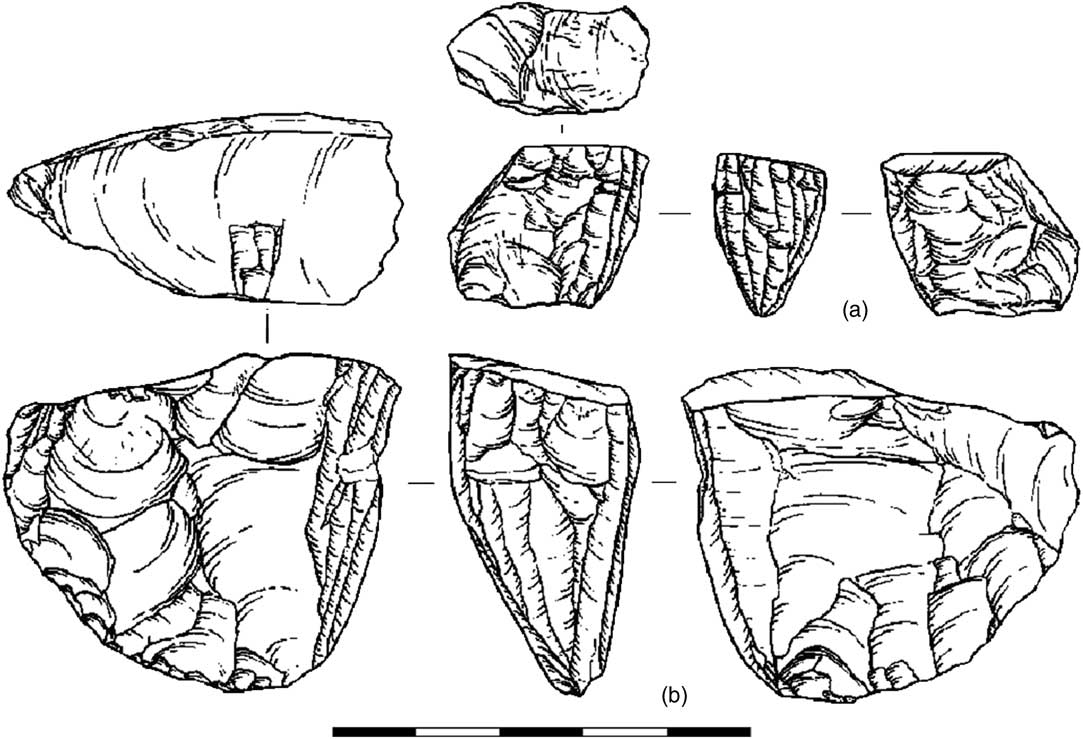
The site of Shinbuk (or Sinbuk) thus becomes the site with the oldest microblade component in Korea. The site was excavated in 2003 and 2004 (Kim et al. Reference Kim, Kim, Youn, Yun, Park, Woo, Hong and Lee2007), and the six AMS radiocarbon dates range from ca. 30,700 to 20,500 cal BP at 2 σ, when not taking into account the date with 1000 years standard deviation (Table 1 and Figure 4, shi1 to shi6). Let it be noted that these dates span more than 10,000 years (between 32,300 and 20,500 cal BP) for one single cultural layer. Only the older date is rejected here due to its high standard deviation. Since the Shinbuk site has been excavated recently, there is so far little bibliographic data at the moment. To the best of our knowledge, only three microblade cores have been published so far (Lee Reference Lee2006, Reference Lee2012), two of them are reproduced here (Figure 8). One of these cores is likely shaped according to the Yubetsu method, and pressure knapping is present, based on these drawings, but also based on photographs of the microblade cores and microblades taken by our colleague I.-S. Seo.
Microblade cores from Shinbuk (Korea). (Adapted from Lee Reference Lee2006, with permission from the author.)
The site of Jangheungni (or Jangheung-ri) was considered, until the discovery of Shinbuk, as the oldest Korean site with a microblade component with reliable dating. The first two dates places the occupation of the site around 30,500–28,000 cal BP at 2σ (Table 1 and Figure 4, jan1 and jan2). Although other authors (Seong Reference Seong2011) have accepted these dates, I will not take them into account since a more recent study (Kim et al. Reference Kim, Youn, Kim, Park, Song, Kang, Choi, Yum and Liu2004) dated the sediments of the same cultural layer using AMS radiocarbon dating and obtained a much more recent dating, between ca. 22,500 to 18,000 cal BP at 2σ (Table 1 and Figure 4, jan3 to jan7). In spite of the coherence of these dates, the authors consider that they do not represent the real age and that soil contamination resulted in much younger dates. The various publications on the site only show a handful of microblade cores of wedge-shaped morphology (YUM 2001), and pressure knapping cannot be confirmed.
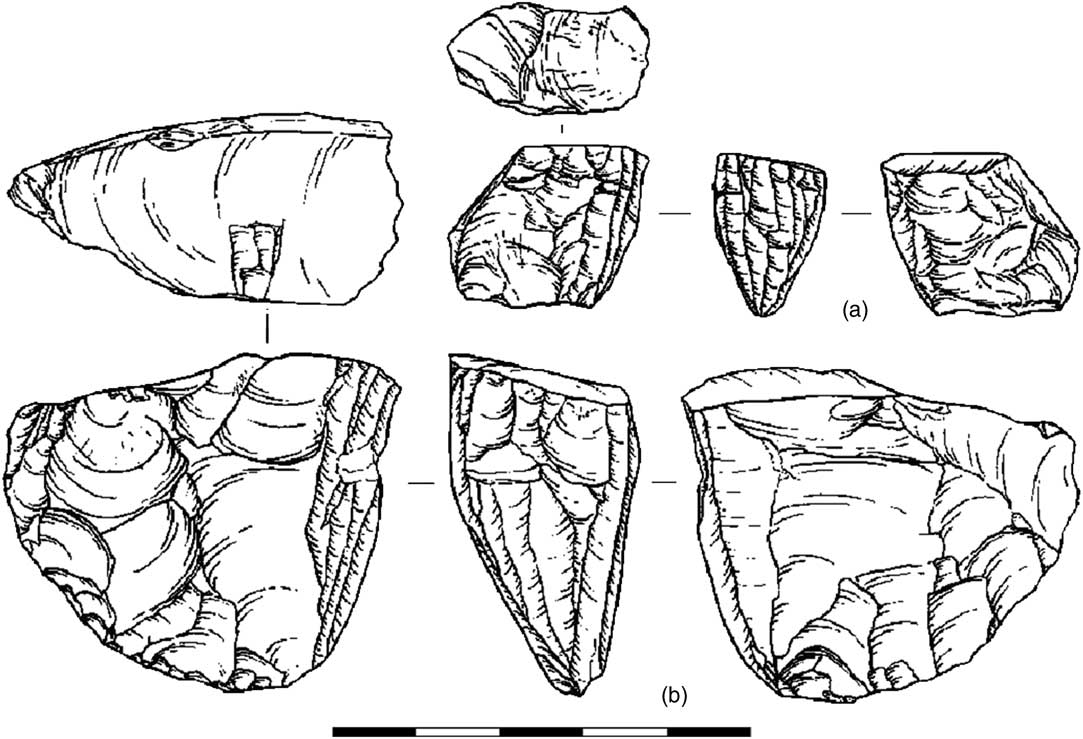
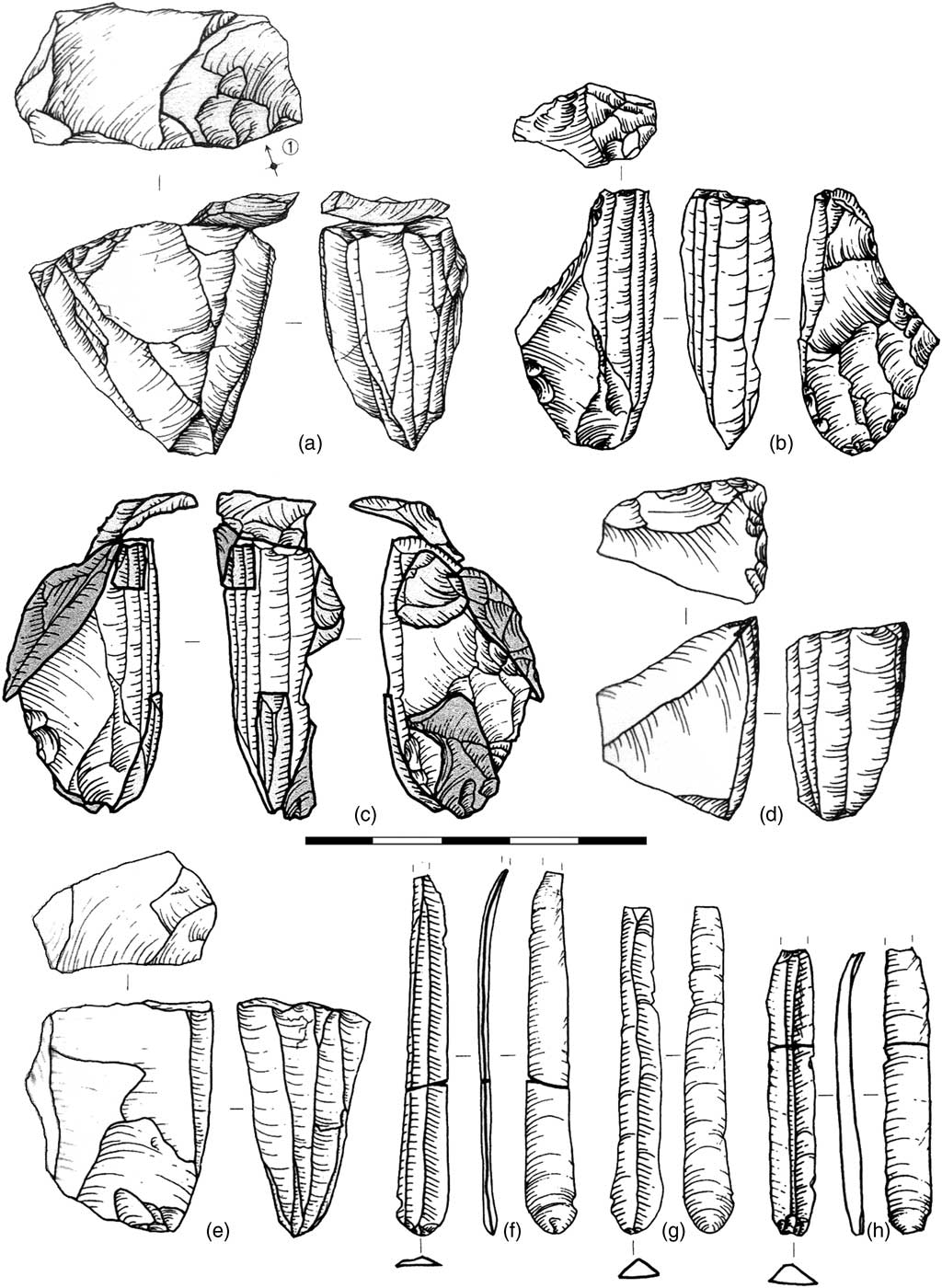
Hopyeong-dong (cultural layer 2) is one of the oldest sites in the region for which there is a very good documentation (Figure 9) allowing to firmly guarantee the presence of a pressure knapping microblade assemblage, including cores on bifacial preforms (Hong and Kim Reference Hong and Kim2008). The dates for cultural layer 2 range from ca. 29,500 to 18,500 cal BP at 2 σ (Table 1 and Figure 4, hop1 to hop12). The figures from the original report (Hong and Kim Reference Hong and Kim2008) seem to indicate that all of these dates are associated with the microblade component, as indicated by other authors as well (Bae Reference Bae2010). However, a critical review of the 14C dates from the site by Seong (Reference Seong2011) considers the two older dates from cultural layer 2 (Table 1 and Figure 4, hop7 and hop8) to be associated with an older blade industry including blade cores, blades and tanged points. He also rejects one date (Table 1 and Figure 4, hop5) that is too young for the discovery context and therefore consider that only two dates are really associated with the start of the microblade industry at the site. In this article, this analysis is accepted therefore placing the start of the microblade industry at the site at ca. 28,200–24,550 cal BP at 2 σ (Table 1 and Figure 4, hop1 and hop9).
Microblade cores (a–e) and microblades (f–h) from Hopyeong-dong, stratum 2 (Korea). (Adapted from Hong and Kim Reference Hong and Kim2008, with permission from the author.)
For the Daejeong-dong site, dating ca. 23,900–23,200 cal BP at 2 σ (Table 1 and Figure 4, dae1) I had only access to three published cores (Seong Reference Seong2007: 7.4 c–e), one of which is a Yubetsu core. In all three cases the pressure knapping is very likely the technique for removing microblades.
Finally, the Suyanggae site (Lee and Kong Reference Lee and Kong2006), a major site in Korea, has a well-defined pressure knapped microblade component, including various Yubetsu cores. Of the two available 14C dates, only one is considered here as valid, since the second one has a standard deviations of 900 years. Therefore, I consider the site dates ca. 18,900–18,200 cal BP at 2σ (Table 1 and Figure 4, suy2).
Hokkaido and Sakhalin
I study Hokkaido and the island of Sakhalin as a unique geographical group, given that at the time under discussion, it constituted a single peninsula attached to the continent. Around 40,000 years ago, Sakhalin is connected to the Asian continent (but not Hokkaido), and from ca. 25,000 to 10,000 years ago, Hokkaido and Sakhalin are both connected to the mainland (Kuzmin Reference Kuzmin1996, Reference Kuzmin2006). This is sometimes referred to as the PSHK Peninsula (Paleo-Sakhalin/Hokkaido/Kurile Peninsula) (Buvit et al. Reference Buvit, Izuho, Terry, Konstantinov and Konstantinov2016). Only the island of Hokkaido is discussed here for Japan, given that microblade technology in Honshu (which was not connected by land to Hokkaido or the Asian continent) appeared around 17,000 years ago (Sato et al. Reference Sato, Izuho and Morisaki2011).
Although most archaeologists consider that microblade industries first appeared on the Asian continent and then spread to Sakhalin and Japan, Graf (Reference Graf2009a) considered that the oldest reliably dated microblade sites were to be found in Hokkaido. The oldest known sites from the PSHK Peninsula are located on the island of Hokkaido in Japan (Kashiwadai-1 and Pirika-1) and on the Sakhalin Island of Russia (Ogonki-5). The two oldest dates from Kashiwadai-1 and Ogonki-5 (Table 1 and Figure 4, kas9 and ogo1) are excluded since they are clearly deviating dates, and various publications do not even mention them when discussing these components (Nakazawa et al. Reference Nakazawa, Izuho, Takakura and Yamada2005; Kuzmin Reference Kuzmin2007; Sato and Tsutsumi Reference Sato and Tsutsumi2007).
The Pirika-1 site is potentially the oldest site with a pressure knapped microblade component in the PSHK Peninsula, with conventional 14C dates ranging from ca. 25,700 to 22,500 cal BP at 2σ (Table 1 and Figure 4, pir1 to pir3). Based on published drawings (Imakane Chômin Sentâ 1991; Kuwafuji Reference Kuwafuji1991), the Pirika-1 microblade assemblage is composed of Yubetsu cores (or other variants on bifacial preforms), Togeshita cores and other wedge-shaped cores. There is no evidence of conical, cylindrical, or tabular microblade cores. Pressure knapping is most likely used for the production of microblades.
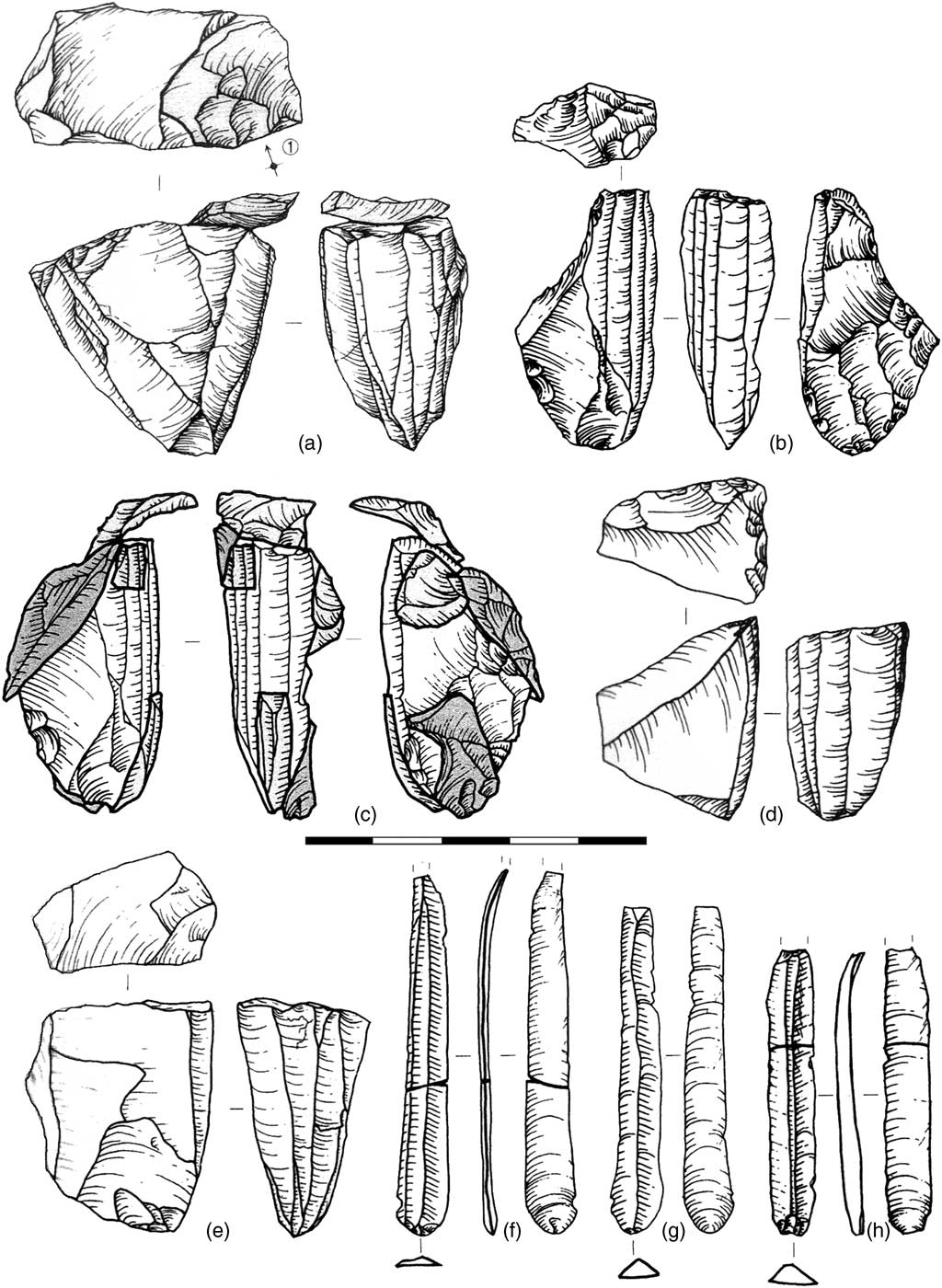
Kashiwadai-1 (Hokkaido Center for Buried Cultural Property 1999; Nakazawa et al. Reference Nakazawa, Izuho, Takakura and Yamada2005; Iwase Reference Iwase2016) is a site of major importance for the region given that twelve different AMS dates firmly place the microblade component ca. 25,300–22,000 cal BP at 2σ (Table 1 and Figure 4, kas1 to kas13). Out of these 12 dates, seven of them span ca. 25,300–23,600 cal BP; we can therefore establish with a high degree of confidence that a pressure knapped microblade component was present in Hokkaido as soon as ca. 25,000–24,000 cal BP. Indeed, the drawings and photographs from the microblade component of Kashiwadai-1 (Figure 10) leave no doubt concerning the use of pressure knapping for the removal of microblade cores, which are mainly Yubetsu cores or other variants on bifacial preforms such as Rankoshi.
Microblade cores (a–d) and microblades (e–i) from Kashiwadai-1 (Japan, Hokkaido). (Adapted from Hokkaido Center for Buried Cultural Property 1999.)

Recently, other early microblade-bearing sites have been reported from Hokkaido, such as the Kiusu-5 site, dating from ca. 22,500 to 21,500 cal BP (Table 1 and Figure 4, kiu1 to kiu3) (Nakazawa and Akai Reference Nakazawa and Akai2017). Although not as old as Kashiwadai-1 or Pirika-1, it provides evidence of a well-dated microblade assemblage prior to 20,000 cal BP, although I was not able to have access to published illustrations from this material in order to make a critical evaluation of the assemblage.
Ogonki-5 is the oldest site on the island of Sakhalin, but it has been the subject of few publications with illustrations, even though it is often discussed in articles given its chronology (Vasil’ev et al. Reference Vasil’ev, Kuzmin, Orlova and Dementiev2002; Kuzmin et al. Reference Kuzmin, Vasilevski, Gorbunov, Burr, Jull, Orlova and Shubina2004; Graf Reference Graf2008a). The oldest dates for the site are from layer 3/2B; once the oldest date rejected (see above), there are 5 remaining AMS spanning dating from ca. 23,650 to 20,550 cal BP (Table 1 and Figure 4, ogo2 to ogo6). Layer 3 contains 66 wedge-shaped microblade cores, although only four are illustrated (Vasilevski Reference Vasilevski2006: 5.9 n°1–4; Vasilevski Reference Vasilevski2008). These four cores are Horoka wedge-shaped cores and they were likely pressure knapped, although it can hardly be confirmed due to the lack of detail of these figures.
The Amur Valley (Priamurye) and Primorye
These regions are not suitable for the preservation of organic material and therefore to radiocarbon dating, which may explain the low number of dated sites and the existing gap between sites. Ust’-Ulma (cultural layer 2b) is the oldest known site in the Amur region (Derevianko Reference Derevianko1996), based on one single conventional date ranging from ca. 23,500 to 22,500 cal BP at 2σ (Table 1 and Figure 4, ulm1). To confirm with certainty the presence of microblade technology in this region as early as ca. 23,000 cal BP (or earlier), new AMS dates will be required either at this site or at other sites from the region. The microblade component at Ust’-Ulma (cultural layer 2b) is well-documented through numerous drawings (Derevianko and Zenin Reference Derevianko and Zenin1995); microblade cores include the Yubetsu method, and most are clearly pressure knapped microblades. It should also be noted that layer 3 from the same site (stratigraphically lower than level 2b, therefore older but undated) also contains some microblade cores (Derevianko and Zenin Reference Derevianko and Zenin1995). The date of this site is left on Figure 5, but is considered temporary pending new dates. The next dated microblade assemblage in the region comes from Khodulikha-2, with a single date ca. 20,200–19,300 cal BP to 2σ (Table 1 and Figure 4, kho1). Unfortunately, the only information I have concerning the microblade assemblage from this site is that it contains “49 cores, 7 end (tortsovyi) microcores, and 55 microblades” and that “microcores are boat shaped with a wide striking platform” (Kuzmin et al. Reference Kuzmin, Petrov and Kim2005: 7). Until more information is available, the date from this site will not be taken into account.
In the Primorye region, 14C dating of sites is also scant. The three oldest dated microblade assemblages in this area are Suvorovo-4, Gorbatka-3, and Ustinovka-6. Several publications (Vasil’evskii et al. Reference Vasil’evskii, Krupianko and Tabarev1997; Vasil’evskii Reference Vasil’evskii1998; Derevianko and Kononenko Reference Derevianko and Kononenko2003; Derevianko and Tabarev Reference Derevianko and Tabarev2006; Garkovik and Korotkii Reference Garkovik and Korotkii2007) discuss the presence of a microblade industry at Suvorovo-4 (ca. 19,400–18,000 cal BP, Table 1 and Figure 4, suv1 to suv4), but unfortunately most published figures focus on the blade industry and I have only been able to find one drawing of a microblade core from the site (Vasil’evskii Reference Vasil’evskii1998: 5 n°1). Nevertheless, microblade components from nearby sites are well known and well documented such as the Suvorovo-3 site (Tabarev Reference Tabarev1994), Ustinovka-4 (Kuznetsov Reference Kuznetsov1995), and Ustinovka-6 (Derevianko and Kononenko Reference Derevianko and Kononenko2003; Gómez Coutouly Reference Gómez Coutouly2007, Reference Gómez Coutouly2011a). The dating of Gorbatka-3, ca. 17,000–15,500 cal BP at 2σ (Table 1 and Figure 4, gor3), is more problematic given that there is a single conventional date made on humates (less reliable) and also because it dates the layer stratigraphically below the microblade component (Kuznetsov Reference Kuznetsov1996; Vasil’ev et al. Reference Vasil’ev, Kuzmin, Orlova and Dementiev2002); therefore the microblade assemblage can only be younger in age and the date is rejected. That being said, the microblade assemblage is pressure knapped as shown in various studies (Gómez Coutouly Reference Gómez Coutouly2007, Reference Gómez Coutouly2011a). Finally, Ustinovka-6, located near the Suvorovo sites, has two dates spanning ca. 16,000–12,500 cal BP to 2σ (Table 1 and Figure 4, ust1 and ust2) with a microblade assemblage using the Yubetsu and Horoka methods. Other sites in the region may also be older, such as Ustinovka-7 which has a reported OSL date of 18,600 years ago (Derevianko and Kononenko Reference Derevianko and Kononenko2003).
Yakutia
The oldest reported dates from microblade assemblages in Yakutia are from two sites (Ust’-Mil and Ikhine-2) that have been assigned to the Diuktai Complex (Mochanov and Fedoseeva Reference Mochanov and Fedoseeva1996a, Reference Mochanov and Fedoseeva1996b). Given their age, they could theoretically be among the oldest evidence of microblade technology in Siberia. However, the dates and contexts are very problematic and are therefore refuted by most researchers. All the dates from Ust’-Mil and Ikhine (ca. 42,000–28,000 cal BP at 2σ, Table 1 and Figure 4, mil1 to mil3 and ikh1 to ikh5) are conventional and made on wood not found in hearths; their validity is therefore questioned by several researchers (Yi and Clark Reference Yi and Clark1985; Kuzmin and Orlova Reference Kuzmin and Orlova1998; Goebel Reference Goebel2004). Moreover, the five dates of Ikhine-2 have been made from the same wood sample (Mochanov and Fedoseeva Reference Mochanov and Fedoseeva1996b), hence the apparent consistency among these dates. This site has also provided more recent dates on bone (20,080±150 and 19,695±100) (Kuzmin and Orlova Reference Kuzmin and Orlova1998), but I exclude them since there is no known stratigraphic provenience for the samples. The dates from Ust’-Mil-2 would also be in contradiction with the pollen record of the site, which corresponds to a more recent period (Kuzmin and Orlova Reference Kuzmin and Orlova1998). Finally, these cultural layers have only produced a single microblade core preform at Ikhine-2 (Mochanov and Fedoseeva Reference Mochanov and Fedoseeva1996b), and one single microblade core at Ust’-Mil’ (Mochanov and Fedoseeva Reference Mochanov and Fedoseeva1996a). Once these dates are excluded, Verkhne-Troitskaia would then represent the earliest reliably dated microblade site from Yakutia, ca. 22,300 to 17,000 cal BP at 2 σ (Table 1 and Figure 4, ver1 to ver4), although the researchers at the site believe that the microblade component could be older given that the artifacts are stratigraphically below the dated samples (Mochanov and Fedoseeva Reference Mochanov and Fedoseeva1996c). Based on the stratigraphic position of the artifacts and the dated samples (Mochanov and Fedoseeva Reference Mochanov and Fedoseeva1996c: 3–11), I believe that only the oldest date (ca. 22,300–21,450 cal BP at 2σ, Table 1 and Figure 4, ver1) is closely associated with the microblade component. The following dated microblade sites in the region is Ezhantsy (layer 3) with one single date (ca. 21,350–19,550 cal BP at 2σ, Table 1 and Figure 4, ezh1); although there is only one reported date from layer 3 (the cultural layer), some have interpreted the assemblage as being much older based on geological determinations (Mochanov and Fedoseeva Reference Mochanov and Fedoseeva1996d). The following site is Diuktai Cave, which is clearly the most reliable first evidence of a pressure knapped microblade assemblage in Yakutia (ca. 17,450–13,650 cal BP at 2σ, Table 1 and Figure 4, dyu1 to dyu7).
THE FAR EAST (JAPAN, KOREA AND CHINA), BIRTHPLACE OF PRESSURE KNAPPED MICROBLADE TECHNOLOGY?
In conclusion, even if many researchers argue that the birthplace of microblade technology occurred in southern Siberia at around 40,000–35,000 cal BP, the critical review presented here (focusing on pressure knapped microblade assemblages) reveals a younger emergence located in the Far East. It seems clear to me that the oldest “microblade” cores from southern Siberia (Ust-Karakol-1 and Anui-2) cannot be considered as the birthplace of microblade technology, since the presence of pressure knapping of microblades has not been demonstrated and is hardly evident from published figures, as can be easily perceived when comparing some of the published cores with various pressure knapped microblade cores from younger sites in Siberia (Figure 6). These latter microblades cores are not simply more “formal”, they are pressure knapped, hence the regularity of microblade removals. When putting aside the oldest deviant date of Afontova Gora-2 and the single conventional radiocarbon date from Novoselovo-13, Mal’ta is the next candidate in line. But although researchers have considered some of these cores as pressure knapped, the illustrated cores are not self-evident. Moreover, other researchers (Kimura Reference Kimura2003; Graf Reference Graf2008a) disagree with the presence of microblade technology at the site, or its association with the early dates. The current available data from Mongolia, Yakutia, Primorye, and Priamurye do not support the emergence of microblade technology, either due to very questionable early dates, lack of early dates or lack of evidence of pressure knapped microblade cores in early sites.
Once all the questionable sites (having either problematic dating or non-demonstrated pressure knapped microblade assemblages) have been removed (Figure 5), it shows that the Far East region has good candidates for the first emergence of pressure knapped microblades in Northeast Asia. In this vast area, there are several sites that offer the association of various early dates associated with clearly pressure knapped microblade cores (including the Yubetsu method). Such sites include newly discovered sites in China like Longwangchan Loc. 1, the evidence at early Korean sites such as Hopyeong-dong, and the assemblages in the Paleo-Sakhalin/Hokkaido/Kurile Peninsula such as Kashiwadai-1, Pirika-1, and Ogonki-5.
Therefore, based on the current state of research and the critical review presented here, our hypothesis is that the initial emergence of pressure knapped microblade cores, that will later spread to much of northeast Asia, is to be found in the Far East (Korea, Hokkaido, Sakhalin and China) between 30,000 and 25,000 cal BP. The new published data from China and Korea these last few years is promising, and there is no doubt that new research in the future will permit to clarify even more the geographical and chronological origin of pressure knapped microblade technology in Northeast Asia. Based on the current state of research and the overlap of 14C dates at 2σ, I believe there is yet not enough precision to suggest a specific birthplace or to suggest specific diffusion patterns.
Finding the birthplace of pressure knapping is a worldwide relevant issue. Based on our current knowledge, once this technique emerged in Northeast Asia, it then diffused towards the Americas, but also towards Central Asia and ultimately towards Europe and Africa. This scenario is based on the fact that after its invention, its progression through continents can be tracked, the general pattern being that the further we move away from Northeast Asia, the later pressure knapping appears in the archaeological record (Inizan Reference Inizan2012). But was there one single birthplace for this technique in the whole world? There is some evidence of possible independent inventions such as in the French Upper Paleolithic during the Aurignacian (Bordes and Lenoble Reference Bordes and Lenoble2002), where this technique appeared for a while but quickly died out. As we have seen throughout this article, the early record of microblade technology in Northeast Asia is still too incomplete to pinpoint the exact birthplace of this technique, let alone establish whether only one single core area developed this technique or if they might be independent inventions within Northeast Asia. Given the relative chronological and geographical proximity of all of these sites under discussion, I believe it is unlikely that pressure knapping was independently invented in various areas of Northeast Asia. As other major inventions, once invented, it spread like wildfire.
EMERGENCE OF PRESSURE KNAPPED MICROBLADE TECHNOLOGY AND THE ROLE OF OBSIDIAN
If our hypothesis concerning the emergence of pressure knapped technology in the Far East region proves to be correct as new research is made available, it will also be necessary to reflect on the role that obsidian and other high quality raw materials may have had in the invention of pressure microblades. Indeed, the abundant and high quality obsidian in areas such as Korea and Hokkaido may have played a major role in the first emergence of this new technique. This theory is based on the following information:
1. Obsidian is one of the best-suited raw materials for making pressure knapped microblades (Whittaker Reference Whittaker1994; Inizan et al. Reference Inizan, Reduron-Ballinger and Roche1999; Pelegrin and Yamanaka Reference Pelegrin and Yamanaka2007).
2. Obsidian allows production of longer and wider microblades than on other raw materials such as chert (Pelegrin and Yamanaka Reference Pelegrin and Yamanaka2007).
3. When using handheld pressure knapping without any kind of core holding device, obsidian facilitates the production of microblades of relatively decent size up to 7 or 8 mm wide and up to 7 or 8 cm long (Flenniken and Hirth Reference Flenniken and Hirth2003; Pelegrin and Yamanaka Reference Pelegrin and Yamanaka2007), while on chert only tiny microblades are produced with the same mode, up to 5 or 6 mm wide and only about 3 cm long maximum (Callahan Reference Callahan1985; Pelegrin Reference Pelegrin2012).
Therefore, if we assume that pressure knapping of microblades was first invented as a handheld pressure mode, then microblades would immediately appear as an economically interesting technique producing sizeable microblades with relatively little effort when made on obsidian. On chert or other raw materials of less quality, microblades would be smaller and tougher to produce. However, once this technique is discovered, it can easily be applied to flint and other raw materials with great results with the addition of a simple core holding device (Pelegrin Reference Pelegrin2012).
Moreover, in the Far East, the use of obsidian seems to be closely correlated with the appearance of pressure knapped microblade technology. In Korea, one of the earliest evidence of pressure knapped microblade comes from the site Hopyeong-dong, where most of the microblade component is made on obsidian (Hong and Kim Reference Hong and Kim2008), a raw material mainly used for this type of production at the site. What is interesting, is that this site is also the oldest occurrence of obsidian in a Paleolithic site on the Korean Peninsula (Seong Reference Seong2011). Indeed, in this region the emergence and spread of microblade technology is closely correlated with the widespread use of obsidian (Lee Reference Lee2006; Seong Reference Seong2008). Likewise, this pattern is not only observable in Korea, given that it is also observed in other areas such as in China where the use of obsidian is also related to the appearance of microblade assemblages (Chang Reference Chang2013; Yi et al. Reference Yi, Gao, Li and Chen2016). In Hokkaido, obsidian was already in use before the appearance of microblade technology (Izuho and Sato Reference Izuho and Sato2007; Yakushige and Sato Reference Yakushige and Sato2014). For Yakushige and Sato (Reference Yakushige and Sato2014: 335), “the drastic expansion of the Shirataki obsidian distribution area did not coincide with the introduction of microblade technology” (25,000–21,000 cal BP), but rather “with the the adoption of real Yubetsu industry” (19,000–16,000 cal BP). However, there are also some instances where the use of obsidian in Hokkaido seems closely linked to microblade technology. For instance, summarizing H. Kimura’s research, Izuho and Sato (Reference Izuho and Sato2007: 117) state that “before the appearance of microblades, only rounded material from secondary sources was exploited (…). Exploitation of the outcrop near the top of Shirataki-Akaishiyamna began after the period of microblade industries”. This analysis was mainly based on the Shirataki source, but an increase of the use of obsidian by microblade-bearing populations is also visible at other obsidian sources such as at the Kozushima obsidian source (Tsutsumi Reference Tsutsumi2007).
A lot of research has been done on long-distance circulation of obsidian in the Far East, from China to Japan (Kuzmin et al. Reference Kuzmin, Popov, Glascock and Shackley2002; Kim et al. Reference Kim, Kim, Youn, Yun, Park, Woo, Hong and Lee2007; Kuzmin and Glascock Reference Kuzmin and Glascock2007; Jia et al. Reference Jia, Doelman, Chen, Zhao, Lin, Torrence and Glascock2010; Doelman et al. Reference Doelman, Jia, Torrence and Popov2014), providing evidence of obsidian circulation over long distances, often associated with microblade technology. Therefore we have an economic aspect (diffusion of obsidian raw material) and an intellectual one (diffusion of microblade pressure knapped technology). Whether microblade technology and obsidian source exploitation were closely related is a working hypothesis that will need to be validated as new sites, new dates and new assemblages are discovered. Future research will have to determine how these two complimentary aspects coexisted, coevolved and nurtured each other in order to answer the question: were raw materials and ideas spreading at the same time?
CONCLUSION: THE EMERGENCE OF WHAT?
When discussing the emergence of microblade technology, what are we discussing exactly? The emergence of pressure knapped microblades? Small bladelets? Wedge-shaped cores? Wedge-shaped cores with small bladelets? Wedge-shaped cores with pressure knapped microblades? Slotted inset tools? In order to deepen this debate on the origin of microblade technology, our discussions have to be more specific about what is under scrutiny. Failure to do so will result in researchers having simultaneous conversations about different concepts. It is of major importance to stress the relevance of illustrating cores and microblades when discussing candidates for the first emergence of microblade technology, so other researchers can agree or disagree with as much information at hand as possible. In the same way that when dates are presented they are systematically detailed (laboratory number, 14C vs. OSL, context of discovery, type of material dated, conventional vs. AMS method, etc.) so other researchers can use that information, lithic assemblages that are potentially considered as early candidates for the emergence of microblade technology should also be well documented through drawings and photographs, so other researchers can critically evaluate these assemblages. In conclusion, when discussing the emergence of microblade technology, let us just bear in mind this one question: the emergence of what, exactly?
ACKNOWLEDGMENTS
I would like to thank the researchers that gave me permission to reproduce artifacts from their publications: Mi-Young Hong for the Hopyeong-dong site, Gi-Kil Lee for the Shinbuk site, and Jia-Fu Zhang for the Longwangchan site.
SUPPLEMENTARY MATERIAL
To view supplementary material for this article, please visit https://doi.org/10.1017/RDC.2018.30
APPENDIX
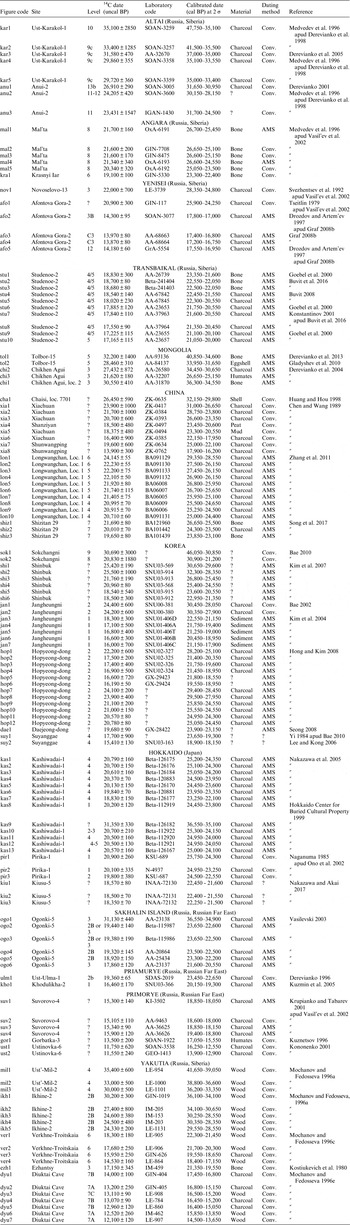
Radiocarbon dates from microblade assemblages discussed in the article. All dates have been calibrated with Oxcal 4.1 (Bronk Ramsey Reference Bronk Ramsey2009) using the calibration curve IntCal09 (Reimer et al. Reference Reimer, Baillie, Bard, Bayliss, Beck, Blackwell, Ramsey, Buck, Burr and Edwards2009). Most of the dates had already been calibrated earlier (Gómez Coutouly Reference Gómez Coutouly2011a) and have not been updated here with IntCal13, given that it does not affect the large-scale chronological discussion from the article.