The road is a cemetery … For some, it is civilization and progress, but for me it is the sepulcher where the ravenous hunger of wildlife who descend from the mountains to confront modern civilization dies forever. Footnote 1
~ Joaquín C. Beleño, Gamboa Road Gang (1960)
Taking stock of the roads the US government forced prisoners to build in the Panamá Canal Zone, journalist Joaquín Beleño likened them to a death-dealing graveyard. His extended critique of convict road building as a symbol of civilization and progress provides a thorough indictment of US modes of imprisonment and forced labor. Those modes were authorized by the “convict clause” in the Thirteenth Amendment to the US Constitution, the exception made for slavery and involuntary servitude to continue as punishment for crime. In designing and rolling out the prison system in the Zone, US officials relied on forms of anti-black racialization, targeted criminalization, and carceral modes of exclusion. Afro-Panamanians and Caribbean migrants, who were the majority of those forced into Canal Zone chain gangs, protested the prison system's racism by organizing politically, writing poignant critiques, and rebelling with courage, humor, and sacrifice. In combining anti-colonialism and anti-racism, these protests responded directly to the ways that imperialism and anti-blackness were intertwined in the Panamá Canal Zone.
The American-style chain gang was brought to the Panamá Canal in the aftermath of racial slavery. W.E.B. DuBois famously condemned the convict labor system that took hold in the American South following formal emancipation, referring to it as the “spawn of slavery.”Footnote 2 Historians of the convict leasing and chain gang era have since characterized it as “worse than slavery” and “slavery by another name.”Footnote 3 The persistence of racial domination in the US prison system today continues to be likened to slavery and a new Jim Crow system of racial caste.Footnote 4 While most studies have focused on the American South, the convict clause itself applied not only within the United States, but to “any place subject to their jurisdiction.”Footnote 5 Following the Civil War, those places came to include territories across western North America, Alaska, Hawaii, Guam, the Philippines, Puerto Rico, and the Panamá Canal Zone. By establishing slavery and involuntary servitude as punishment for crimes committed any place under US jurisdiction, federal penal policy became used as a tool of white settler-colonialism, imperial expansion, and infrastructure building for global capitalism. As the convict clause has come to symbolize systems of racial domination within the United States over time, its imperial career reveals its expansiveness across space.
The Canal Zone convict road-building program created the cornerstone from which the “Good Roads Movement” boosters pushed for a Pan-American Highway stretching from Alaska to Argentina. Movement champions within the United Staes lobbied for massively increased federal support for public transportation infrastructure and extolled the benefits of using convict labor. Proclaiming that “the convict on the road is a slave of the state,” they joined prison reformers in calling for an end to the privately controlled convict lease system.Footnote 6 Public control of convict labor became a convenient way to appease urban progressives and agrarian populists by aligning the interests of cities, towns, and rural areas. The demise of the private convict lease system and rise of public road gangs in places like Georgia, historian Alex Lichtenstein suggests, was used to redistribute the spoils of black convict labor more widely beyond the wealthy few who controlled monopolies on the lease.Footnote 7 Replacing private with public control, as Angela Y. Davis has shown, tended to reinforce notions of black criminality even as it shed light on the brutality of privatized convict leasing.Footnote 8
This sea change in the use of convict labor took place throughout the American empire over the first two decades of the twentieth century. The convict road-building scheme in Panamá began the same time that chain gangs were deployed on public roads in southern states like Georgia, western states like New Mexico, and island colonies like Puerto Rico and the Philippines. Imperial personnel and practices moved between these sites, the second section of this article illustrates, as military men became police and prison guards. As a group they brought personal experiences of slavery, the Civil War, and colonial expeditions from “Indian Country” to places like Alaska, Cuba, Puerto Rico, the Philippines, and Panamá. Their lived experience with colonial violence shaped how they thought about mastery, adventure, and the course of their own lives. Colonial officials, meanwhile, used expanded legal power and discourses about racially differentiated labor capacity and fitness for freedom to design and justify new convict labor regimes. In places like the Canal Zone, the federal government took an active role in promoting white uplift through black immiseration by promising to turn convicts’ alleged debt to society into a “public good,” literally paving the way for capitalist development, tourism, and other forms of profit and pleasure-seeking.
The imagined relation between slavery, blackness, and criminality became a linchpin of the prison labor program in the Panamá Canal Zone, as it did in the United States. Highly visible and degrading forms of hard physical toil were used to fortify the equation of blackness and criminality.Footnote 9 The “condemnation of blackness,” portraying formerly enslaved people as innately criminal, was evident in crime statistics and social scientific discourse and can likewise be found throughout the Isthmian Canal Commission's (ICC) records.Footnote 10 The chattel principle of incarceration forged an association between slavery, blackness, and criminality that extended far beyond US borders. Modeled on a “global formation of racial chattel slavery,” as Ethnic Studies scholar Dylan Rodríguez puts it, the US prison regime's logic of power was racial and gendered domination, not merely the exploitation of a reserve pool of unfree labor.Footnote 11 Immobilization and forced transportation were equally rooted in racial slavery. These forms of imprisonment, transport, and forced labor also drastically differentiated in racial terms what counted as “womanhood” and structured gendered ideas about respectability around work and patriarchal authority.Footnote 12 Through targeted arrests, caging, degradation, and deportation, the canal convict system produced racist notions of black criminality, even as racial disparities in arrests and convictions were thought to confirm them.
Efforts to bind black labor to the political project of white supremacy have been normalized through the race-neutral language of political economy.Footnote 13 In the Canal Zone prison road-building program, the process of targeted criminalization turned a supposed “debt to society” to a “public good,” even a “surplus.” The costs and benefits were neatly tabulated and celebrated as economic progress. Yet, there was profound violence involved in transfiguring alleged black indebtedness into whites-only welfare benefits through legalized racial domination.Footnote 14 That violence helped constitute racial hierarchy, along with white supremacist claims to sovereignty. Prison imperialism was not just an economic response to the demand for unfree labor driven by an invisible and all-mighty profit motive, it transported US-style structural racism around the globe. In sites of the American empire like the Canal Zone, criminalization, chattel incarceration, and forced labor were inseparably linked to anti-black racialization and carceral forms of disposability. Drawing on dramatically expanded deportation powers, the prison regime became a testing-ground for intensified modes of marginalization and exclusion. Obsessed with racial explanations for criminality, deviance, and differential labor capacity mapped onto the physical body, administrators, engineers, and guards sought to produce a day-laboring subject that could be flexibly deployed and ultimately disappeared.Footnote 15
African descended peoples living and working in the Panamá Canal Zone were, of course, acutely aware of the way the penal system was used to criminalize blackness and support the ICC's efforts to establish and maintain racial segregation and hierarchy. As the final section of the article shows, black people from Panamá and the Caribbean vigorously protested US prison imperialism, constructing positive visions of blackness as self-determination and race pride to shield themselves from white supremacist practices of racial domination in the Zone. Drawing on anti-colonial and Pan-Africanist thought and organizing, they creatively deployed notions of blackness-as-solidarity in cultural formations, political organizing, and protests against the very same racialized systems of exploitation disguised in putatively race-neutral terms of criminal law and political economy and the lofty language of justice, civilization, and progress.
The Highway to Empire
After the US military occupied the Isthmus of Panamá and the Hay-Bunau-Varilla Treaty was signed, President Theodore Roosevelt issued a series of executive orders to establish US law in the Canal Zone. The 1904 treaty provided the US government with “all rights, power, and authority which it would possess and exercise if it was the sovereign of the territory,” and Roosevelt's orders created an outline for the criminal legal system. He gave the governor and the ICC sweeping exclusion and deportation power, and initially chose not to extend the right to jury trial. The Thirteenth Amendment's “convict clause” was central among the constitutional guarantees that were selectively extended: “Neither slavery nor involuntary servitude shall exist except as punishment for crime,” the order proclaimed.Footnote 16 As Canal Zone District Attorney William Jackson described it, the sources of law included a mix of executive orders, congressional acts, Columbian civil law, local ordinances, criminal codes of procedure, and military doctrine, all of which were designed to ensure labor productivity.Footnote 17
The Canal Zone's legal architecture was created with black labor migration in mind, as well as an eye toward those who were already there. Tens of thousands had migrated from Jamaica, Antigua, Barbados, St. Lucia, Haiti, Martinique, and elsewhere to work on the French Canal and Panama Railroad between 1850 and 1904.Footnote 18 Hundreds of thousands more migrated from the Caribbean, Latin America, Europe, Asia, and the United States during the period of US canal construction. The so-called “problem of freedom,” or how to compel formerly enslaved people and their descendants to work certain hard labor jobs, still dominated policy discussions in the United States and other empires.Footnote 19 In the years since the Civil War, thousands of former Confederate soldiers and other white Southerners had become managers, foremen, and overseers on plantations and infrastructure projects in the American South, the American West, and across Latin America, the Caribbean, and the Pacific Ocean.Footnote 20 In the Panamá Canal Zone, white officials and engineers from northern US states were also eager to establish a racialized division of labor. As the scholarship on race and labor by Michael Conniff, Julie Greene, and Michael Donoghue has shown, the Canal Zone's legal system was not only designed to maximize labor productivity, but also to police morality and enforce racial segregation.Footnote 21 Canal officials set up “Gold Roll” and “Silver Roll” employee designations to structure racial hierarchy in the Zone. Gold Roll employees received untaxed income, free housing, utilities, health care, schooling, sick leave, and paid vacations. Silver Roll employees, on the other hand, received no such government benefits and paid taxes, which supported public services.Footnote 22 Beneath gold and silver status, however, lay an ever present third metallic metaphor: the convict's iron ball and chain.
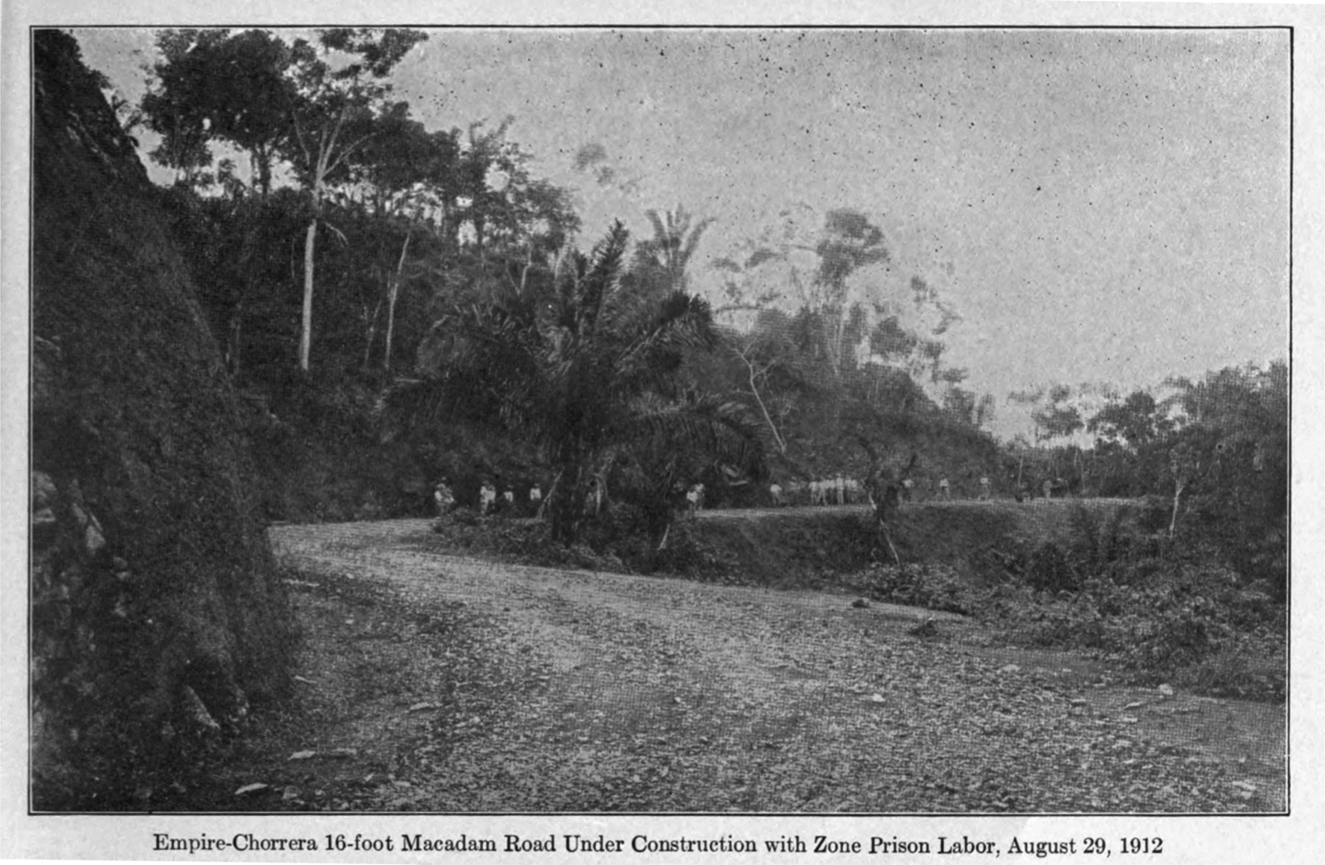
Empire-Chorrera Road under construction with Zone Prison Labor, 1912.

The ICC convened a “Special Committee on the Employment of Prisoners” in the Panamá Canal Zone in 1908. Proposing that convicts be forced to build roads, their stated aims were threefold: to reimburse the Government for the expense of maintaining its penal system, to open the fertile valleys of the Canal Zone to development, and to improve the condition of the prisoner. Footnote 23 The convict road-building program began in March of 1908, when Governor Joseph Blackburn authorized the transport and housing of prisoners outside the Culebra penitentiary.Footnote 24 As a Kentucky plantation owner and former Confederate officer in charge of an independent command in Mississippi, he was familiar with regimes of forced labor as well as military-style work camps. On his order, Canal Zone police established a portable camp at Brazos Brook and moved half of the penitentiary population there to be near the work at all times.Footnote 25
Clearing, cutting, grading, leveling, draining, filling—each stage of the road-building process presented its own arduous challenges. Work must have been especially grueling that first summer, as those who were imprisoned were forced to grade a sixty-foot slope leading to a bridge they would have to build over the Miraflores dump. But perhaps even that gang, averaging one hundred prisoners daily, did not envy their fellow prisoners who were sent to fill swamps at West Culebra in May, or those who spent over twenty-five thousand total hours filling the Lirio swamp in August and September.Footnote 26 By fall, work had begun on the Empire-Paraíso section of road and seventy prisoners were transferred to a new convict labor camp on the side of Gold Hill. They had already put in over 140,000 total hours on the highway between the towns of Empire and Bas Obispo. When Chief Engineer George Goethals announced the opening of the highway to Empire in his “Notes on Progress” in September of 1910, it had taken over a year for prisoners to build the 18,392-foot long, 18-foot wide stretch of roadway. They excavated some 17,457 cubic yards of material for the subgrade, laid 2,563 cubic yards of gravel, and another 2,860 cubic yards of stone in the process.Footnote 27
Reimbursing the government for the expense of maintaining the penal system was one of the three central aims of the ICC Special Committee on the Employment of Prisoners. Monthly police reports made the financial record of prisoners’ labor publicly available.Footnote 28 The system of accounting for the value of prison labor used a fixed hourly wage rate and then subtracted the cost of their subsistence, clothing, and guarding. At the program's inception, the chief of police reported that the division of municipal engineering credited the department of civil engineering eighty cents per day for each convict employed on the roads. He was proud to report that the experiment was proving profitable: “The Department of Civil Administration finds that the revenue from its prisoners is greater than the expense of keeping them.”Footnote 29 Yet that was not the total cost of maintaining the penal system; the payroll for 150 members of the police force was still listed at ten times the value of road work performed by about the same number of prisoners.Footnote 30 One year later, the monthly value of prisoner roadwork was reported as $1,821.55, while the cost of subsistence was $857.75, clothing was another $378.80, and guard payroll was an additional $1,473.76.Footnote 31 By 1914, the value of work surpassed the cost of “prisoner maintenance.”Footnote 32 The costs involved in road building, meanwhile, were reported in local newspapers in a such a way as to reinforce the idea that their work was already a naturally unpaid, and presumably unobjectionable, part of the equation. It was estimated, for example, that the Empire-Gamboa Road would cost $17,952.98, “exclusive of convict labor.”Footnote 33
Once incarcerated and designated for road work, Canal Zone prisoners were made to clear the ground, build portable camps, haul water, prepare food, and clean. The force “does its own cooking and takes care of the sanitation of the camp,” claimed one monthly police report.Footnote 34 By making them responsible for their own social reproduction, such as it was, colonial officials and prison guards sought to turn prisoners into pure surplus. In 1913, a photographer from the Keystone View Company captured one of these “convict corrals” in the background of a photograph of a “Thatched Roof Native Home.” Of course, the caption read, “this corral is a temporary structure because these convicts are transported from point to point, according to where their labor is needed.”Footnote 35 Intrigued, the photographer captured the camp itself. “We have a closer view of the corral partially seen in view 21740,” they wrote. “The corral is the temporary quarters for the prison convicts, who are here employed in building a macadam road.” The image depicts the barbed-wire enclosure and an officer “brandishing a revolver,” described as “necessary assistants in such camps,” as well as the prisoners’ mess table shown in the foreground.Footnote 36
Thatched Roof Native Home – Temporary Convict Corral in the Background Near Old Panama, Canal Zone.

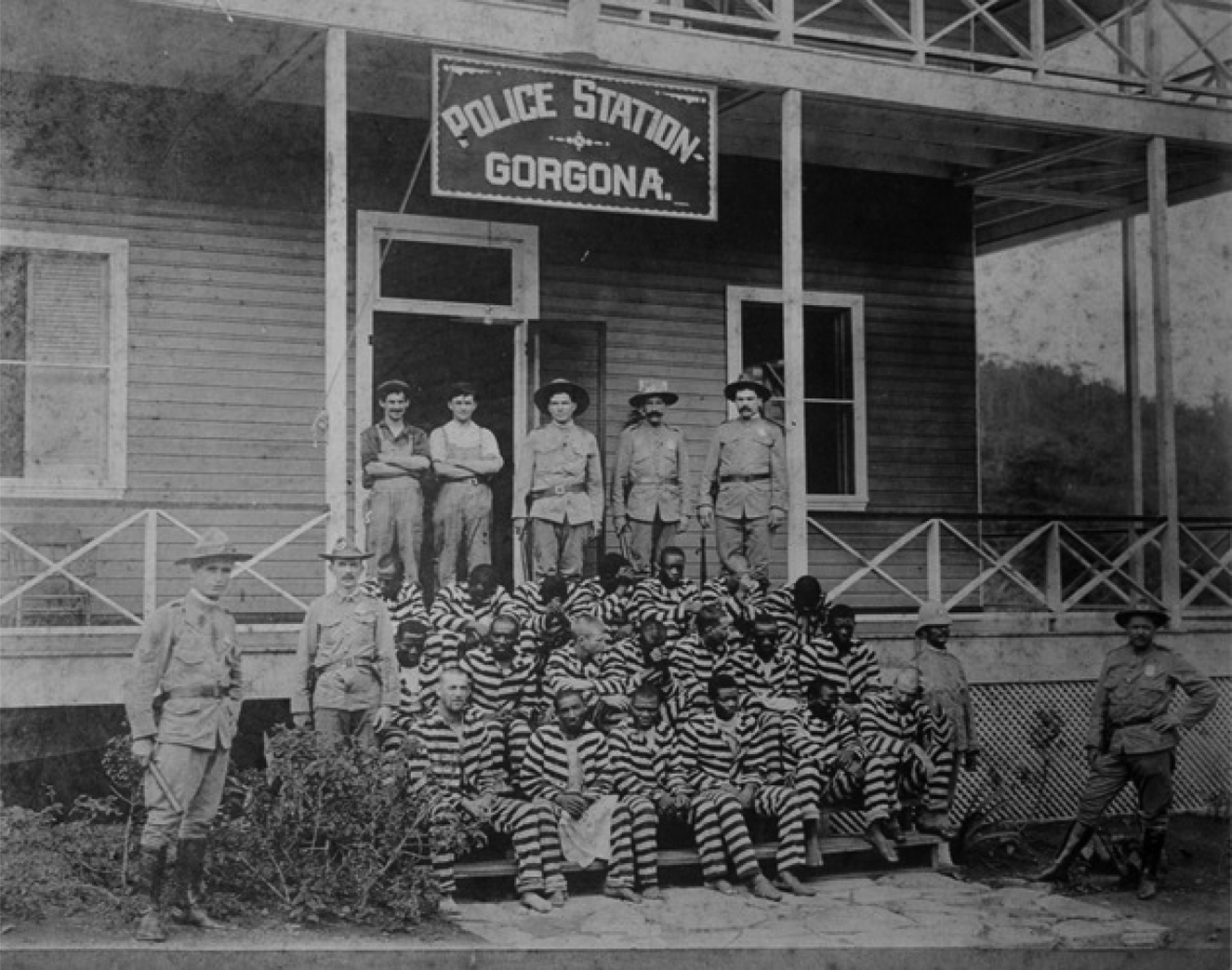
The stereograph's caption explained how “the roads are being built by the United States Government and the convicts here located are prisoners sentenced for misdemeanors done in the Canal Zone.”Footnote 37 Perhaps in an attempt to portray the prison system as racially unbiased, the Keystone View Company's writer added, “Naturally these prisoners are of all races and colors.” But in fact, the prison population and road gangs they were looking at were disproportionately black.Footnote 38 “In the Canal Zone is to be found, doubtless, the only place where the National Government uses convicts for road construction,” they noted, while in some southern states “convict labor is the usual one employed in building roads,” the practice had not yet been taken up in the nation's federal penitentiaries. Stereographs like these, together with photographs in news reports and exhibitions like the 1915 World's Fair, were instrumental in constructing the visual representation of the Canal Zone's prison labor program to the US public in ways that obscured the racial violence of Uncle Sam's chain gangs.
Temporary Corral of Prisoners Employed in Road Work, Showing Mess Table, Near Old Panama, Canal Zone.

Another goal of the Special Committee on the Employment of Prisoners was to open the fertile valleys to cultivation and development, by which they meant to white settlement. When Governor Blackburn first authorized the prison road gangs, ICC officials explained it this way: “the intention is to locate these roads away from the railroad so as to develop the agricultural recourses of the country to as great an extent as possible.”Footnote 39 The roads were designed to facilitate settlement and plantation-style agriculture both within the Zone and in the neighboring Republic of Panamá. Zone administrators pressured their government counterparts in Panamá, urging them also to employ convicts to build connector roads outside the Zone. As civil engineer J.G. Holcombe told The Daily Star and Herald, he intended to get to work at building roads throughout Panamá and would use prison laborers wherever possible so they would cost a minimum outlay.Footnote 40 The Star and Herald reported that a highway would be built from the town of Empire in the Canal Zone through to Chorrera, in the Republic of Panamá: “From Empire to Arraijan the trail traverses one of the best agricultural sections of the Zone and a large amount of fruit and produce is brought over it by pack horse and marketed in Empire.” It was nine more miles, however, from the edge of the Zone boundary to the “native village” of Chorrera, a town of about thirty-five hundred people with “many farms of considerable extent” growing corn and other produce and raising cattle. The Government of Panamá has given assurance, a reporter assured readers, that it will continue the highway built to the Zone line into Chorrera, “thereby making the entire section of country accessible to Empire.”Footnote 41
The Canal Zone prison road-building scheme was situated squarely in an ongoing debate over settlement versus depopulation. Those who favored settler-colonialism in the Zone, advocated roads be built in order to connect agricultural plantations to markets. As the Canal Zone Governor George Goethals told it a few years later, the group in favor of establishing a white settler colony “asserted that Americans should be permitted to take up land, provision being made for homesteading it as an inducement … the assumption being that they would have farms or plantations worked by West Indian negroes; the general idea amounted to opening up the land to ‘gentlemen farmers.’ ”Footnote 42 Goethals himself, however, opposed settlement in favor of depopulation after work on the canal was complete in 1914. “I did not care to see a population of Panamanian or West Indian negroes occupying the land, for these are non-productive, thriftless, and indolent,” he wrote. According to his racial nightmare, they would not only act as unproductive squatters, but drain government resources by congregating in small settlements and costing the government money for sanitation and police.Footnote 43 As his theory about the increased cost of policing suggests, he speculatively criminalized those he lumped into the category “negro” and deemed as an unwanted surplus population once their labor was no longer needed on the canal.Footnote 44 The irony was that throughout the canal construction period, only black Silver Roll employees paid income tax, which supported such public services, while white Gold Roll employees paid no income tax and received a range of free and subsidized government benefits.
Through these type of discussions over depopulation, criminality, and prison labor, Canal officials actively inverted the meaning of who was generating value and who was supposedly a burden on the government. In a declassified record from the ICC's executive office at the end of canal construction, officials noted that in addition to those they had deported and those “removed in the course of depopulation,” the ICC planned to begin transporting people who were now out of work “as a police measure.”Footnote 45 Their justification for mass deportations revealed the logic at work in speculatively criminalizing unemployment and poverty: “[A]ny increase in crime always occurs where conditions cause a large number of men to be without employment,” wrote Police Chief Mitchell, expressing what seemed like a timeless, race-neutral, truism. Yet he and Mr. Copeland knew exactly what group they were targeting: “Nearly all police cases in Panama for wounding, sneak thieving, robbery and fraud,” he speculated, “are those of Jamaicans who are out of work on account of termination of canal work.”Footnote 46 They were also clearly ambivalent about those they deemed as surplus, whose lives they evidently did not consider very valuable. While Mitchell proposed removing all “unemployed aliens” from the Isthmus if the US government “had to take care of them,” for example, he added that they actually might need all available labor for defense measures, adding that “such labor could be forced.”Footnote 47
Imperial Practices and Personnel
Combining a racial discourse of debt with the legal mechanism of deportation, Canal officials fashioned a form of criminal transportation that could only work in a world of empires. Allegations of black people's supposed indebtedness began well before they were actively criminalized by the police and in the legal system, or even arrived in the Canal Zone. For many former slave-owners and their offspring, the debt they owed white society stemmed from the “crime” of freeing themselves through the greatest general strike turned slave revolt in modern history during the Civil War.Footnote 48 Former slaveholders jealously recounted the twenty million pounds the British government had paid their counterparts for the loss of wealth in the form of enslaved humanity in the West Indian colonies of Jamaica, Barbados, and Antigua. It was no secret that the legal system in the American South was being used to try and extract value from the formerly enslaved. In a sentiment echoed by black-owned newspapers across the South, the attempt to revive slavery using local jails was nothing more than “a shrewd device of the ex-slaveholders to get compensation for the loss of their slaves.”Footnote 49
The foothold created by prisoner-built roads in the Canal Zone enabled colonial officials, army engineers, and politicians in the United States to train their sights on a Pan-American Highway, which would run north-south from Alaska to Argentina. Convict road building in Panamá became part of the massively increased federal support for convict road building projects across states, territories, and colonies under US jurisdiction. Federal officials, meanwhile, pushed their modernizing agenda for prisons and roads at the convenings of international organizations like the Pan American Union (PAU) and the Pan American Prison Congress. The Pan-American Highway was shrouded in the rhetoric of hemispheric harmony, and PAU Director General L.S. Row described the “Good Roads Movement” as encapsulating “the very essence of true Pan-Americanism.”Footnote 50
E.W. James, chief of the inter-American regional office of the Public Roads Administration, promised the highway would open up great tracts of land and offer US motorists scenes of “exotic interest,” discovery, and adventure.Footnote 51 Probably “no white man” has ever traveled between Central and South America overland, he wrote referring to the Darién Gap between Panamá and Columbia.Footnote 52 He provided a list of voyages along portions of the highway, including that of Zone policeman 88, Harry A. Franck.Footnote 53 At the 1915 Panama-Pacific World's Fair in San Francisco, the US Office of Public Roads staged the most comprehensive road exhibit to date.Footnote 54 By the end of World War II, the inter-American portion between the United States and Panamá included 1,557 miles of paved roadway, 930 miles of all-weather, 280 miles of dry-weather, and 567 miles of trails.Footnote 55 “The last quarter century in the Western Hemisphere has been preeminently an era of road building,” James proudly concluded.Footnote 56
Businessmen and local officials looked to the example the federal government set overseas as more federal funding was becoming available in the form road subsidies and police, jail, and prison funding. When the Commercial Club of Mobile, Alabama, wrote to ask Panamá Canal Warden and Police Chief George Shanton about the convict road building program, for instance, he proudly informed them it was the “most practicable and humane” method of handling prison labor.Footnote 57 Reporters and globe-trotting penologists remarked on the growing US role compared to other preeminent empires. Missouri journalist Samuel Fox, for instance, invoked the example of the British empire in Australia when advocating that the federal government import convicts from the United States for canal construction in Panamá. Apparently the US Department of Labor and Commerce, historian Julie Greene notes, found the proposal convincing enough to instruct him to forward it to the ICC for consideration.Footnote 58
The expansion of federally funded convict road building was worked out in explicitly racial and imperial terms. As Blake McKelvey put it, prison expansion in the “Great West” was essential to the “institutional conquest of the last frontier.”Footnote 59 Up to that point the federal government had “scarcely shown sturdy leadership in territorial penology,” he wrote, “the same government that was so soon to take up proudly the ‘White Man's Burden’ across the seas, and there, incidentally, to learn some progressive penology.”Footnote 60 According to McKelvey, the Good Roads Movement had found the perfect solution: It drew on funds from the East, the demise of the private convict leasing system in the South, and experiments with convict labor on public roads in the Western territories.Footnote 61 McKelvey was careful to distinguish convict road building from older modes of racial domination, as to him “penal slavery” stopped at the “borders of the black race” in the South.Footnote 62 Road camps, as Colorado Warden Thomas Tynan put it, were not to be confused with Southern contract camps “where men are sold at auction to the highest bidder.”Footnote 63 Yet, despite these statements to the contrary, the chattel principle embedded in the convict clause ensured that “slaves of the state” would continue to be imagined as black well beyond the American South.
Forced transportation was central to the chattel mode of incarceration, along with degrading hard labor.Footnote 64 Throughout the period of US canal construction, 1904–1914, police and prison officials routinely deported people from the Zone. Indeed, when he was appointed police chief, George Shanton saw it as his first order of business. Before he was even expressly granted expanded deportation powers, he gathered members of Teddy Roosevelt's “Rough Riders” and other “American gunmen” to round up any “bad men” in the newly occupied territory.Footnote 65 “We went after them and some we found necessary to kill off but the great majority were gradually rounded up and placed in the stocks, later being put into bull-pens which we constructed,” he told the Boston Globe years later. “The next thing to do was to get them out of the country altogether, but we were in a position where we could not legally deport them. So we rounded up some old three masters […] and, bundling the birds all aboard, shot them off to the Islands thereabout.” His nonchalance masked a more systematic process of targeted depopulation that combined Spanish-speaking Afro-Panamanians, French-speaking Martinicans, and English-speaking Jamaicans and Barbadians under the general category of “negro criminal,” who were then indiscriminately sent off to neighboring Caribbean islands. “With them out of the Zone,” Shanton wrote, “we were then in a position of refusing them entrance should they attempt to return.”Footnote 66
Canal Zone District Attorney William Jackson argued that the “great expense” the government had incurred by paying to transport some twenty thousand workers from Barbados and elsewhere in the West Indies “abundantly justified” expanded powers of deportation and judicial cost savings measures.Footnote 67 The Canal Zone government paid the cost of deportation, he added, and rightly recouped the “enormous expense incident to jury trials.”Footnote 68 As with other labor recruitment contracts, some officials worried they were skirting a line too near slavery. Responding to John Steven's request to import more Chinese laborers, for instance, Secretary of War William Taft wrote, “peonage or coolieism, which shortly stated is slavery by debt, is as much in conflict with the Thirteenth Amendment of the Constitution as the usual form of slavery.”Footnote 69 Others were less concerned. Despite apparent ambiguities in charting these degrees of unfreedom, they knew for certain that the Thirteenth Amendment's convict clause provided that those convicted of a crime would become slaves of the state. Following a paradigm of patriarchal governance, Canal officials also assumed that other forms of dependent or coerced labor—of women, children, and colonial subjects—were part of the natural order of things. Evidently paying the passage of a small fraction of the total Canal Zone workforce had metaphorically, if not contractually, already indentured much wider segments of the population in the eyes of certain administrators.
Caribbean women shouldered both the unpaid labor of cooking, cleaning, and caring for male partners and family members working on the canal, as well as underpaid work as domestic servants, washerwomen, seamstresses, waitresses, and vendors in the Canal Zone and in border towns of Panama City and Colón.Footnote 70 Although black women were arrested and imprisoned far less frequently than men, their daily lives in the Canal Zone were constantly circumscribed by forms of gendered surveillance and carceral control. A scandal over the importation of 280 women from Martinique revealed several of these intersecting relations of race, gender, debt, and dependent labor. About a year into canal construction, Governor Charles Magoon urged his labor agent to “supply” black laborers with women, noting that if they failed to do so it would surely affect the labor migration from the West Indies.Footnote 71 Chief Engineer John Stevens promptly ordered that women be recruited and brought from Martinique and paid for their passage. When the American journalist Poultney Bigelow broke the story in the New York Herald, it blew up into accusations of state-sponsored prostitution, leading to a full Senate investigation.
Prosecutors and police inspectors interrogated the women, collecting some 167 affidavits from them in which they had to testify to their migration story, marital status, intentions, and current employment. The investigators were especially concerned about common-law marriages as officials viewed unmarried cohabitation as both illegal and a sin. Single women were forced to live in dormitories watched by police and locked at night after curfew.Footnote 72 In reporting on this for a US audience, Bigelow used a set of racial and gendered code words to provoke outrage that the US government had imported these black women for immoral purposes at considerable “expense to taxpayers.” Prostitutes, Bigelow jabbed, could be trusted to come without any “special assistance” whenever the town of Colón “clamored” for them. Colón, he explained, is a dump where the “negro population” is compelled to dwell in their own “human excrement.”Footnote 73 At issue was not only the embarrassing accusation that the federal government was involved in sex-trafficking, but also taxpayers’ dollars and what sorts of people were predicted to drain resources, a clear dog-whistle for those who opposed black settlement in the Zone in the first place.
The police and prison guards charged with implementing the forced labor program brought their own ideas about dependency, deviance, punishment, and work. Racialized labor control schemes had been vitally important to their jobs throughout the American empire. Zone policemen like Harry Franck and Robert Lamastus remarked that their fellow officers were mostly Southerners and almost all military men.Footnote 74 Police Chief George Shanton, for instance, had served in the Rough Riders during the US wars in Puerto Rico and the Philippines. His successor had been a Confederate blockade runner, and the police chief after him was a former US Marshal in Indian Territory.Footnote 75 When a police chase was on, wrote Harry Franck, everyone from the lieutenant down to the newest rookie would swarm out of the police station: “[T]he most apathetic of the force were girding up their loins with the adventurous fire of the old Moro-hunting days in their eyes, and all, some ahorse, more afoot, were dashing one by one out into the night and the jungle.”Footnote 76 With this turn of phrase, Franck evoked the experience of colonial violence from fighting in the predominantly Muslim region of the Philippine archipelago to characterize the rush of tracking alleged outlaws in the Panamanian jungles as a kind of manly “adventure.”
Robert Lamastus, who was put in charge of working prisoners outside the penitentiary, exemplified many of these elements guards brought to the road gangs. With his family back in Kentucky, heavily indebted after the Civil War, he had gone fortune-seeking in the far reaches of the Northwest, joining the army in Alaska. He dreamed of striking it rich prospecting for gold or purchasing land to clear and cultivate. Yet his letters home made clear that he envisioned himself directing rather than performing hard physical labor; referring to farm work, for example, he exclaimed that there were “plenty of easier ways of making a living besides working like a slave for it.”Footnote 77 Lamastus joined the police force in 1907 and was rapidly promoted. Within two years he was making $107.50 per month, five times what he earned when he first enlisted in the army, and the following year he received an additional $10 a month to serve as labor foreman over prisoners at Culebra. “We are building roads with them,” he wrote home, “I start work at 7 in the morning and I am through 5:30 in the evening.”Footnote 78 After successfully completing his road building assignments in the town of Empire, he was made Assistant Deputy Warden in charge of all outside work. “I was promoted on the 19th of Dec. my pay is $125 per mo.” he proudly wrote home.Footnote 79 In addition to his salary, as Gold Roll employees, white police and prison officers like Robert Lamastus also received the full range of government benefits including paid housing, health care, and vacations. The racially segregated social and economic hierarchies he and his colleagues helped establish in the Canal Zone therefore ensured that white American men, as a group, would stand to gain the most from the incarceration and forced labor of Zone inhabitants deemed criminals.
The Canal Zone governors, wardens, police, and prison guards who implemented the prison labor program drew on techniques of labor extraction and domination that had characterized the American expansion under slavery, settler colonialism, and war-making. While they were not all members of the ex-Confederate diaspora who sought to spread white supremacy across the Caribbean to Brazil, or across the Pacific to Hawaii, Fiji, and Australia, most shared lived experiences of slavery and colonial violence.Footnote 80 They also shared a vision of patriarchal mastery and racial hierarchy in which white men assumed themselves to be the head, performing mental and skilled labor, and racialized others to be the body, performing unskilled, physically demanding, menial labor. Their vision of white settler-colonial agricultural development depended on roads being built throughout the Zone and across Panamá. It also provided prison administrators and guards a unique avenue of upward social mobility. After a career commanding prison labor in the Canal Zone and directing the Panamanian island prison colony at Coiba, for example, Robert Lamastus went on to set up coffee plantations in Boquete, Chiriqui, that have remained in his family to this day.Footnote 81
Canal Convicts at Gorgona Police Station.

Protesting Prison Imperialism
Black people in and around the Panamá Canal Zone protested the penal system in ways that revealed the entwined workings of racism and imperialism. Along with forging a greater sense of race pride through Afro-Caribbean and Pan-African solidarities, the collective lived experience of unjust, racially-targeted persecution by police, judges, and prison guards was instrumental to the politicization of the labor movement. Having lived in Panamá himself, Marcus Garvey summed up the conditions he saw in the Zone: they were dominated by prejudice, discrimination, and the oppression of black people by the white race. “Most of the American foremen, superintendents, and officials were rabid Negro-hating Southerners,” he wrote, who were busy segregating employment and “Jim-Crowing” on work trains and public institutions.Footnote 82 Indeed, Amy Ashwood's parents had left Panamá and returned to Jamaica because of the substandard education she was receiving there ten years before she cofounded the Universal Negro Improvement Association (UNIA) with Marcus Garvey in 1914.Footnote 83 Garveyite organizers were intimately familiar with the tools the imperial penal state used to try and control black labor and suppress protest movements—namely surveillance, espionage, jailing, and deportation. Thus, for many black people in the Canal Zone, the arrival of UNIA's International Organizer Henrietta Vinton Davis aboard the Black Star Line's steamship the S.S. Frederick Douglass likely provided a triumphant counterpoint to the specter of the British convict ship Success, which was paraded through the Canal by white officials en route to the Panama-Pacific Exhibition.Footnote 84
The process of contesting the Canal Zone's condemnation of blackness helped solidify a feeling of blackness as race pride that strengthened political and labor protests. Existing and manufactured linguistic and cultural differences and inter-island rivalries had created initial divisions between “West Indian” workers in the Canal Zone.Footnote 85 However, efforts to organize around a positive program of “Race Success,” as historian Carla Burnett illustrates, was essential to the great West Indian Silver workers strike of some twelve thousand to sixteen thousand people in 1920.Footnote 86 Barbadian William Stoute and Afro-Panamanian Eduardo Morales emerged as local labor leaders, she argues, because of their ability to articulate a version of black self-determination in opposition to the structural racism of the US state policies of economic slavery and unequal exposure to danger and death.Footnote 87 When Stoute wrote to Garvey, he thanked him for his leadership in opposing the “unspeakable oppression of our race by the whites.”Footnote 88
Individual and collective direct action protesting imperial penal state racism also worked to create racial solidarities. In recounting the legend of John Peter Williams, the Canal Zone's black Robin Hood, both Afro-Antilleans and Afro-Panamanians adopted “Old Pete” as their own hero-outlaw, historian Michael Donoghue points out.Footnote 89 Born to Jamaican parents in Panama City, Peter Williams had faced white racism first-hand when seeking employment as a taxi driver in the Zone. Over the course of his storied career as a bandit, he targeted symbols of US power. By robbing the homes of police chiefs and judges, evading capture, and leaving behind a trail of humorous notes, he was clearly concentrating his protest on the penal system in particular. The ICC even brought Pinkerton agent Ronald George from the United States to try to track and arrest him.Footnote 90 When Williams eventually turned himself in, he was sentenced to fifty years hard labor on the Gamboa road gang, and his sister was sentenced to five years for allegedly aiding and harboring him. But, the chain gang was not for Old Pete. After escaping quarry detail beside the Gillard Highway two years later, he decided to prove his point once more by robbing the home of Police Captain E. P. Jessops. When the alarm was sounded by a barking dog, he hid and then ran to Fourth of July Avenue at the boundary of the Zone. Police Sergeant Carl Wanke, chasing hard in pursuit, ordered him to “Halt!” “Damn you!” Peter Williams shouted back. Carl Wanke shot a .45 caliber bullet through head.
The road gang serves as the main motif of Joaquín Beleño's novel los forzados de Gamboa / Gamboa Road Gang. Beleño based his protagonist Atá on the actual case of Lester Greaves, whom Michael Donoghue describes as the “symbol of apartheid justice” in the Zone.Footnote 91 He too was sentenced to fifty years hard labor on the road gang after his arrest and incarceration for allegedly raping a white woman he maintained was his lover. Beleño ends his narrative with a powerful scene of Atá, after suffering a kind of nervous breakdown from being forced to work on the roads, walks off in protest. “‘Son of a bitch… HALT!’ yelled the gringos as they raised their rifles, aiming,” writes Beleño. “Still, Atá is slowly heading down the Golden Highway […] No one can stop him. Nothing can stop him. The rifles are still fixed upon him. ‘HALTTT…!!!’ came the voice of the guard again,” Beleño continues. “The guards fire three shots, mount new rifles and open fire again. Atá’s legs tremble, he shakes all over. The blood saturates his shirt, but still he does not fall to the ground.” Finally, “he stumbles, stretches out his arms and staggers slowly down the road, dying.”Footnote 92 Beleño writes, “So long Atá! At last you are free! You are safe!”Footnote 93 This final protest feels like a gesture toward what one contemporary black political theorist calls “planetary violence.” Invoking the term población chatarra (disposable people) from Latin American social movements, theorist Ronald Judy applies it to conditions of violence, which tend toward annihilation rather than redress.Footnote 94 That is to say, forms of violence that are produced by conditions of utter disposability.
“The road is a cemetery,” Joaquín Beleño concluded. “For some, it is civilization and progress, but for me it is the grave,” he wrote, that swallows all natural life who dare confront it.Footnote 95 In juxtaposing claims of civilization and progress with the violent reality of colonial domination, he amplified a central theme of Aimé Césaire's Discourse on Colonialism, published five years earlier. Born in Martinique at the apex of canal construction, Césaire described a geography of exploitation stretching from Africa to the Caribbean, where he saw the United States aggressively asserting control. He warned against being duped by these very claims of progress and civilization. Colonists talk of achievements, he explained, throwing “facts at my head, statistics, mileages of roads, canals, and railroad tracks.” “‘But American racism!’” Césaire wrote emphatically. By the time canal construction was complete, the United States was gearing up to “raid every colony in the world,” he predicted. And “American domination” is the only domination “from which one never recovers.”Footnote 96 For both Beleño and Césaire, anti-black racism and this so-called progress were inseparably bound together.
As with Joaquín Beleño's critique of convict road-building as a symbol of civilization, carceral state violence was central to Aimé Césaire's indictment of colonialism. Colonists kill, torture, and imprison, Césaire wrote. From the vantage of the colonized, there exists only “relations of domination,” which turn the colonizer into “an army sergeant, a prison guard, a slave driver.”Footnote 97 Césaire's theory of the “boomerang effect” of colonialism was also about policing, prisons, and torture. Colonization works to decivilize and brutalize the colonizer by stoking violence, race hatred, and moral relativism: “The gestapos are busy, the prisons fill up, and the torturers standing around the racks invent, refine, discuss.”Footnote 98 The flight of the boomerang is that by treating the colonized like a beast, the colonizers themselves become the animal. The civilization that justifies colonialism is morally diseased, Césaire proclaimed, and will progress, one denial after another, to fascism. This is what he meant when he wrote that a society that chooses to close its eyes to the most crucial problems of the day is a sick one. And a society who plays fast and loose with its principles is a dying one. For William Stoute, Peter Williams, Joaquín Beleño, and others, what Aimé Césaire said of colonialism, in general, could likewise be said of US prison imperialism, in particular.
The story of convict road-building in the Panamá Canal Zone over the first half of the twentieth century is just one chapter in the strange career of the convict clause. Federal penal policy was, and is, a strategy of empire-building. The chain gang was, and is, an imperial institution. It has long been used to produce and maintain racial hierarchy in order to “govern difference, differently.”Footnote 99 When the federal government massively increased its support for prison labor on public works, whites clamored to distribute the benefits of black convict labor beyond those who controlled the private lease system in the American South and in places like the Panamá Canal Zone. If the Good Roads Movement can be said to be a county, state, and federal partnership to appease agrarian populists and urban progressives by imprisoning formerly enslaved people and forcing them to build the New South's transportation infrastructure, it becomes clear that this was a regional, national, and imperial process.
Attending to the conjunctions of the penal state and racial state in sites of the American empire like the Panamá Canal Zone shows how the dialectic of blackness and labor in the aftermath of slavery shaped the growth of the contemporary carceral state, as well as forms of protest, resistance, and survival beyond US borders. The dialectic of racialization and labor in the case of prison imperialism in the Panamá Canal Zone evokes dual meanings of blackness. That is to say, it helps illuminate the relationship between carceral violence directed at the category of blackness, and the poetic forms of subjectivity, which coalesced around blackness as race pride and solidarity.Footnote 100 This history suggests that anti-imperial along with antiracist movement building strategies are necessary to reckon with the living legacies and ongoing forms of racial domination in the modern-day prison system. Indeed, right now, organizations like The Alliance for Global Justice are calling for an end to all US international prison programs and the release of all “prisoners of empire.”Footnote 101 Ultimately, a more complex framework for understanding the roots of anti-black carceral violence within and beyond borders might open a wider range of alternate solutions. This could begin, returning to Joaquín Beleño's epigraph, with the choice of how to see the highway itself: as a symbol of civilization and progress, or a death-dealing graveyard.