From 1956 to 1964, the U.S. government funded a program run by the Economics Department at the University of Chicago, famous for its advocacy of free markets and monetarism, to train Chilean graduate students. The Ford Foundation and other organizations continued this program after 1964.Footnote 1 Latin American scholars, such as Chilean critic Alejandro Foxley, disparaged the central role of “the Chicago School” in the successful transfer of neoliberalism to the region.Footnote 2 David Harvey, Wendy Brown, and many other scholars have placed the “Chicago Boys” at the center of their global histories of neoliberalism.Footnote 3 According to these studies, these Chilean students returned to their home country and spread free market ideas as professors at the Catholic University in Santiago, through their own think tank and through their networks with conservative business elites. Many of the Chicago Boys and like-minded economists implemented these ideas when they took leadership positions in the military government of Augusto Pinochet after it seized power in 1973, creating one of the early test sites of neoliberalism. Peruvian, Mexican, and other Latin American economics students also studied at the University of Chicago and at Catholic University in Santiago and were also called “Chicago Boys” for advocating the turn to neoliberal policies in their own countries.Footnote 4 A transnational network of right-wing think tanks, publishers, foundations, associations like the Mont Pelerin Society, and university economics departments spread neoliberal ideas and transformed economic policy worldwide.Footnote 5 The Chicago Boys in Chile represents a widely discussed case of neoliberal conversion and ideological transfer.
Scholars have criticized this narrative. Carlos Huneeus has argued that the Chilean students were unified not by rigid neoliberal policies but rather by their long-standing political commitments to authoritarianism. Patricio Meller has called the Chicago Boys a “scapegoat” obscuring broad active and passive support for the Pinochet regime in Chile. Veronica Montecinos and Patricio Silva point to Chile's long-standing tradition of technocracy, which resonates with neoliberal ideas. These scholars agree that Chilean society had earlier, domestic sources of neoliberalism.Footnote 6 Furthermore, the ideological transfer from Chicago to Chile required specific political conditions that made Chile, in contrast to other countries, receptive to extreme neoliberal policies.Footnote 7 According to these critiques, local conditions and contradictions may interrupt or intensify ideological transfer.Footnote 8 It is also true that the U.S. government, through both overt academic programs and covert military and intelligence support, emboldened and supported already authoritarian right-wing groups in Chilean society and connected them with their counterparts abroad.
Focusing on the Chicago Boys, however, obscures a wide range of socialisms that were active transnationally, which the Pinochet regime and the U.S. government worked to destroy. Chileans, Peruvians, and other Latin Americans took part in long-term, worldwide discussions of socialism. While the Soviet Union and official communist parties supported centralized states and central planning, socialists around the world criticized Stalinism and state-centered, authoritarian socialism from the beginning.Footnote 9 Observers have conflated these socialist discussions—which often advocated markets, radical democracy, and workers’ power—with neoliberalism, thus rendering them invisible.Footnote 10 This conflation also obscures what was at stake in the period from 1988–1994 worldwide and restricts our understanding of neoliberalism. J. K. Gibson-Graham has criticized “capitalocentrism,” a tendency to condense economic difference and fuse “the variety of noncapitalist economic activities into a unity in which meaning is anchored to capitalist identity.”Footnote 11 Recognizing socialist alternatives to neoliberalism is necessary in a world in which social movements and political leaders who have rejected neoliberalism have today taken on “the difficult task of building an alternative economic model.”Footnote 12 This paper explores one of many socialist alternatives and contributes to the study of actually existing alternatives to capitalism, such as “real utopias,” “diverse economies,” participatory democracy, and solidarity economies.Footnote 13
In what follows, I examine Chilean and Peruvian engagements with Yugoslavia's unique form of socialism—its worker self-management socialism. I draw from the archives of the former Yugoslavia in Belgrade and of the Ford Foundation in New York, as well as Chilean and Peruvian economic publications, memoirs, and secondary literature.Footnote 14 To understand the history of neoliberalism, we need to understand the varieties of East European socialism with which Latin Americans were very much in dialogue. Both Chilean and Peruvian socialists took part in long-term international discussions about a variety of socialisms, including Yugoslav socialism. Both Chile and Peru implemented socialist policies in the late 1960s and early 1970s, and both Chilean socialists and the Peruvian government asked Yugoslavia for assistance. The two countries differed in that Peru continued socialist practices and actively participated in the non-aligned movement with Yugoslavia through the 1980s, while the post-1973 Pinochet regime dismantled socialist institutions and sought to destroy socialist movements even as external and internal discussions of socialism continued.
Yugoslav socialism did not infiltrate Chile and Peru as a foreign model. Socialism controlled and organized by workers themselves, rather than by the state, had long been a goal of socialists worldwide. In Chile and Peru, as in many countries, Yugoslavia was particularly popular as a model because, after 1948, the Yugoslav government began to implement anti-authoritarian socialist institutions on a national level. Rejecting the Soviet model, Yugoslavs attempted to further the withering away of the state and approach communism through worker self-management and participation, non-state social property, markets, and, perhaps surprisingly, neoclassical economic models.Footnote 15 Socialists around the world found the Yugoslav model fascinating. Socialist rejection of central planning and nationalization, as well as an openness to markets within socialism and neoclassical economics, has confused observers who argue that in the 1990s left-wing leaders embraced neoliberalism.Footnote 16 Latin American political leaders could take advantage of this confusion, coopt the radical language of socialists, and create new kinds of neoliberalism with narrow, liberal democracy.Footnote 17
I will first introduce the Yugoslav socialist model that inspired those in Chile and Peru. I then examine socialist discussions in Chile and Peru, which called for decentralized, democratic socialism and looked to Yugoslavia for advice. I conclude by turning to the 1990s postponement of socialism in the name of a very narrow democracy and realization of new forms of neoliberalism.
YUGOSLAV SOCIALISM
Postwar Yugoslavia created a unique form of socialism. In 1948, the leadership of the Soviet Union expelled Yugoslavia from the Cominform, the Soviet-dominated organization uniting the Communist Parties of Eastern and Western Europe.Footnote 18 In response, Yugoslav leaders developed a new kind of socialism as an attempt to survive without those former allies. They condemned the Soviet Union for its etatism—its reliance on an authoritarian state—which, they claimed, it shared with the United States. Both state socialism and state capitalism, according to these leaders, shared a bureaucratism and thus could not approach stateless communism.
In place of state intervention in enterprises, workers’ councils took control of workplaces, creating “worker self-management.” According to Communist Party leaders, such as Boris Kidrič, worker self-management would introduce “socialist democracy” and make the state unnecessary.Footnote 19 Furthermore, as envisioned in 1954 by Communist Party leader Edvard Kardelj, one of the main designers of this new form of socialism, enterprises would, “through free competition with other enterprises on the market,” become interested in achieving “the best results as regards quality and quantity of goods, lower costs of production and good marketing.”Footnote 20 Economist Branko Horvat described Yugoslavia as having a system of “‘free market’ and workers’ management,” and U.S. observer Dennison Rusinow called it “laissez-faire socialism.”Footnote 21 Yugoslav leaders did not view this as capitalism because, in addition to worker self-management, they had transformed both private and state ownership of the means of production into “general people's ownership,” later called “social property.”Footnote 22 They did not consider the Yugoslav model a third way between capitalism and socialism, but rather a form of socialism most closely approaching communism. Many scholars have demonstrated that Yugoslavia did not realize these goals,Footnote 23 but its worker self-management with social property and markets offered an important model for economists and political leaders in Peru, Chile, and the non-aligned movement more broadly.
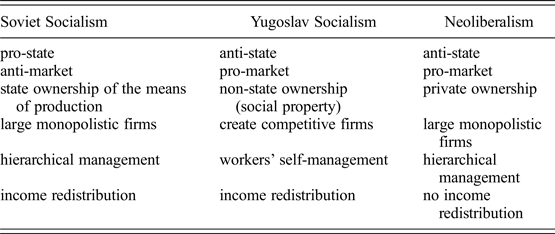
With its anti-state, pro-market approach, the Yugoslav model could appear neoliberal, especially if one assumed that the Soviet Union represented the only possible form of socialism. Anti-state forms of socialism, such as Yugoslavia's, do exhibit certain superficial, but misleading, similarities with neoliberalism. In Table 1, we can see that Yugoslav socialism and neoliberalism share a critique of the state and often an advocacy of markets, but they differ greatly in the institutions they require for a functioning market. In their embrace of large monopolistic firms and hierarchal management, neoliberalism and Soviet socialism share far more with each other than they do with Yugoslav socialism.
Comparison of Socialisms and Neoliberalism
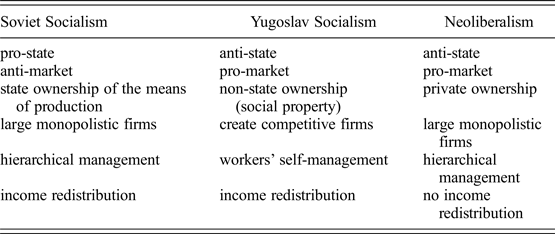
If one reduced economic debates to market versus planning or market versus the state, then one might easily conflate neoliberalism and anti-state socialisms. The key elements of neoliberalism, however, are not markets or anti-statism, but rather private property, the alienation of workers, and hierarchical management.Footnote 24 Yugoslav economists rejected the authoritarianism characteristic of both capitalism and state socialism and argued that socialism needed markets and markets needed decentralizing, democratic, socialist institutions. In contrast, although Chicago School economists publicly presented markets as best freed, or dis-embedded, from institutions, they in fact supported hierarchical, authoritarian institutions such the military, the anti-democratic state, and corporations. Yugoslavia, in contrast, represented one of many varieties of anti-authoritarian socialisms.Footnote 25
While Moscow-connected communist parties condemned Yugoslav socialism, it expressed a critical socialist vision that was spreading worldwide.Footnote 26 Yugoslavia's 1948 expulsion from the Warsaw Pact forced it to develop an active and independent foreign policy to find allies and trading partners. It also gave the country an ideological interest in extending socialist cooperation beyond the Pact. Josip Broz Tito symbolized the potential of the non-aligned movement to create a global alternative to both Soviet socialism and Western capitalism. The first official Non-Aligned Conference, in fact, took place in Belgrade in 1961. Within international forums, Yugoslavs stressed the differences between Soviet socialism and their own, which they presented as a potentially helpful model for other developing countries.Footnote 27 By 1953, Yugoslavia was sending advisors and consultants around the world,Footnote 28 and Yugoslav enterprises sent several thousand experts abroad.Footnote 29 These enterprises, advisors, and consultants all built infrastructure, factories, and mines worldwide. The Yugoslav government also provided military assistance to anti-colonial movements. Yugoslavia sought to play a global role in economic development and anti-colonial movements and sought allies for mutual protection from the whims of the Cold War superpowers.
Yugoslav involvement in Latin America was not as extensive as that in North Africa and other places, but official delegations visited there in 1949, 1954, 1958, and 1959,Footnote 30 and in the 1960s the Yugoslavs increased their involvement in the region.Footnote 31 Yugoslavia evoked great interest among socialists around the world because it had begun to realize an anti-authoritarian socialism on a national level, different from that in the Soviet Union and in line with the socialist projects of many. To understand Chile and Peru in the 1980s and 1990s, we need to talk about not only the role of the Chicago Boys but also the two countries’ relationships with the unique socialism developed by Yugoslavia and the Non-Aligned Movement.
CHILE AND YUGOSLAVIA
In contrast to members of the Chilean Communist Party, who supported the Soviet Union, Chilean socialists showed a deep commitment to decentralized socialism and the Yugoslav model. In 1947, the anti-capitalist Socialist Party (Partido Socialista Popular, henceforth PS) publicly condemned Stalinism and Soviet central planning and suggested instead a form of worker self-management socialism.Footnote 32 Leaders of the PS—Raúl Ampuero, Aniceto Rodríguez, and Oscar Waiss—were known as Titoists and maintained strong ties with Yugoslavia.Footnote 33 As Pollack has argued, “The Chilean Socialists … viewed the Soviet claim to be the main center of world socialism as completely unacceptable” and supported “the Yugoslav system as desirable, as it represented a form of proletarian control of power, as opposed to the bureaucratic, extremely centralized Soviet system.”Footnote 34 The Socialist Party rejected etatism. For example, PS leader Eugenio Gonzalez in 1953 told the Chilean Senate:
We must not nationalize [estatizar] the economy but socialize it, that is, humanize it…. Socialism does not aspire to reinforce the political power of the state with the management of economic power. Socialism does not try to be a state which plans, regulates, and manages complex process of production and distribution of goods and services…. On the contrary, socialism wants that workers and technicians themselves, through their organizations, plan, regulate, and manage, directly and democratically, economic processes in the interests of themselves, their security, and real and living society.Footnote 35
Gonzalez thus rejected Soviet state socialism and called for a broad economic democracy with extensive workers’ power. This stance brought the socialists into conflict with not only conservatives but also the Chilean Communist Party. In 1954, during the visit of a Yugoslav commercial mission, young Chilean socialists defended the Yugoslavs from harsh attacks by both communists and Catholics.Footnote 36 In 1955, Waiss and Rodríguez traveled to Belgrade, after which Waiss published a book on the Yugoslav system, Amanecer en Belgrado [Dawn in Belgrade], and Rodríguez delivered a speech explaining Yugoslav ideas to the Chilean senate.Footnote 37 In 1957, Raúl Ampuero, too, visited Yugoslavia, and in 1962, as head of the PS, he initiated a discussion of the direction of the party and encouraged it to advocate self-management according to Yugoslavia's example.Footnote 38
The Yugoslav model, then, was on the minds of Chilean socialists.Footnote 39 They had increased their contacts with Yugoslav worker self-management socialism through programs supported by the Ford Foundation. While funding part of the free-market-oriented University of Chicago program at Catholic University in Chile, the Foundation gave priority to building “national planning expertise” in Latin America, which spread knowledge about Yugoslav and broader Eastern European socialisms.Footnote 40 The Chilean government had developed its first national economic plans in 1958.Footnote 41 In 1964, President Eduardo Frei organized a new Office of National Planning (ODEPLAN). Three years later, the Ford Foundation paid MIT's Center for International Studies to build research capacity in planning within ODEPLAN. MIT faculty worked with ODEPLAN staff to develop short-term and long-term planning methods. With the election of Salvador Allende in 1970, one of the staff members, Alejandro Foxley, left ODEPLAN and brought this project to his newly formed Center for National Planning Studies (Centro de Estudios de Planificacion Nacional, or CEPLAN) at Catholic University.Footnote 42 CEPLAN's mission was “to conduct research on major socioeconomic issues related to Chile's national planning process,”Footnote 43 and CEPLAN had itself emerged out of economists’ experiences with planning in the 1960s.
As part of its mission, CEPLAN staff studied planning in socialist countries. In 1969, those who would soon form CEPLAN held a conference on comparative socialisms, which was repeated in 1970 as “Centralization and Decentralization: Alternative Roads to Socialism in Chile” and resulted in the best-selling book Chile: The Search for a New Socialism.Footnote 44 According to the Ford Foundation, “The ‘Socialism and Decentralization’ topic,” one of CEPLAN's main projects, “is clearly the ‘hottest’ in Chile today, and much of CEPLAN's energies will be absorbed in this project and seminar during 1971.”Footnote 45 The fact that Chilean Titoists, the radical wing of the Christian Democratic Party, some faculty in both the Catholic University of Chile and the Catholic University of Peru, and others became committed to worker self-management socialism reflects the heterogeneous nature of the opposition to central planning and foreshadows the similar nature of the later opposition to the Chicago Boys.Footnote 46
The members of CEPLAN discussed actually-existing socialisms with East European economists and Sovietologists. Late 1960s Eastern Europe offered an exciting place to explore various forms of socialism. Yugoslavia had already developed its worker self-management socialist system, Czechoslovakia's Prague Spring set off exhilarating political debates, and in 1968 Hungary implemented its new market socialist system. During a trip to England, Alejandro Foxley met a wide range of academics, including many East European experts such as Alec Nove, Michael Ellman, Włodzimierz Brus, Tomas Bacskai, Basile H. Kerblay, Erich Klinkmuller, Archie Brown, Michael Kaser, Ghita Ionescu, and Robert Davies.Footnote 47 With Ford Foundation funding, Yugoslav economist Branko Horvat and Hungarian economist Béla Kádár, as well as British scholar of the Soviet economy Alec Nove, visited CEPLAN. In 1972, CEPLAN published the following texts on Soviet and East European socialisms: Branko Horvat's “Institutional Model of the Socialist Self-Managed Economy”; Béla Kádár's “Direction and Regulation of Foreign Trade in Hungary” and “Planning Systems in Socialist Countries: The Case of Hungary”; Ernesto Tironi's “Economic Debates during the Soviet Transition to Socialism”; and Alec Nove's “Economic Reforms in Socialist Countries of Eastern Europe” and “Income Distribution in the Soviet Union and Eastern Europe” (1972 and 1973, respectively). CEPLAN staff wrote about socialist experiments in Eastern Europe, invited scholars from there to visit Chile, and read their works.
The staff particularly admired Yugoslav worker self-management socialism. In 1962, Yugoslavia and Chile signed a technical cooperation agreement, but it led to little immediate action. Between 1962 and 1970, eleven Chilean students studied in Yugoslav institutions of higher education. For the 1970 academic year, Yugoslavia offered the Chilean government two fellowships for postdoctoral study and three for specialized training.Footnote 48 That same year, a group of five Catholic University professors, including CEPLAN employees Crisóstomo Pizarro and Alejandro Foxley, made a month-long study trip to Yugoslavia.Footnote 49 There they participated in a course, met with other professors and government officials, and visited enterprises. Pizarro soon published his findings in “Participation and Economic Development in a Socialist Society,” republished in Chile: The Search for a New Socialism. It judged Yugoslavia's “nearly direct socialist democracy” very positively.Footnote 50 Foxley was well known for his long-standing interest in Yugoslavia and worker self-management. By 1971, he had visited Yugoslavia at least twice to explore how the country organized of its macroeconomy and systems of self-management, planning and distribution, finance for trade, and banking.Footnote 51 In 1972–1973, Yugoslav economist Branko Horvat visited CEPLAN for six weeks, where he gave a seminar titled “The Self-Managed Economy.”Footnote 52 Ramon Downey, too, traveled to Yugoslavia, in 1972, to attend the World Congress on Participation.Footnote 53 CEPLAN became the main advocate in Chile for decentralized socialism and self-management.Footnote 54
Allende's ruling Popular Unity Party discussed self-management, but it became primarily the policy of the socialist and democratic oppositions.Footnote 55 As the Allende government began, CEPLAN staff were members of the Christian Democratic Party and dissenters who criticized government economic policies and called for decentralized, democratic, self-management socialism. Then, in 1971, nearly half of CEPLAN's staff joined the Christian Left and the United Party, bringing their anti-authoritarian, socialist ideas with them.Footnote 56 Meanwhile, workers seized their workplaces on their own and without the full support of the Allende government, which planned for workers to participate in companies and at the national level, but never realized those plans.Footnote 57 Worker self-management remained part of the socialist and democratic opposition.
In 1973, Augusto Pinochet seized the Chilean state in a coup d’état. His regime sought to destroy the left and dismantle the emerging socialist economy and forced at least two hundred thousand people into exile.Footnote 58 Thousands of others were executed, disappeared, imprisoned in camps, or internally exiled. It was unclear what would happen to CEPLAN. CEPLAN researcher and MIT Ph.D. candidate Ernesto Tironi was arrested with his wife while on vacation:
The military encountered an article in Tironi's car which he was writing on labor participation in management in Chile. The paper contained phrases such as “transition to socialism,” “self-management,” and “participation,” which greatly perturbed the military. Tironi was taken to a military camp, interrogated, beaten, and several times was subjected to a simulated execution in which blanks were used by the firing squad. He was ultimately questioned in detail by a ranking officer who became convinced of Tironi's innocence of extremist acts, and he was released.Footnote 59
Because of Pinochet's repressive regime, Chile's connection with Yugoslavia was shorter and less intense than Peru's. Yet we will see that these socialist ideas remained significant for the ongoing Chilean socialist movement.
PERU AND YUGOSLAVIA
Peruvians were also active interlocutors in transnational socialist discussions. Like their Chilean counterparts, Peruvian politicians had early contact with Yugoslavs. As Peter T. Knight has discussed, until sometime in the 1950s the Peruvian Aprista Party (APRA) had declared socialism to be its goal.Footnote 60 In 1957 its head, Victor Raul Haya de la Torre, visited Yugoslavia for ten days.Footnote 61 A representative of the Peruvian parliament, Antonio Rodriguez Del Valle, visited Yugoslavia for four days in 1959, during which he declared that he felt like a “Communist Marxist” and showed great interest in the Yugoslav social system, economic policy, agricultural machines, ship building, and workers’ self-management.Footnote 62 From the 1950s, groups formed in Peru that criticized Moscow-controlled communism and advocated alternative socialisms.Footnote 63
On 3 October 1968, General Juan Velasco Alvarado led a military coup that overthrew Peru's democratically elected government and installed the Revolutionary Government of the Armed Forces (GRFA). The Velasco “revolutionary government” fascinated observers around the world because this military regime sought to “modernize” Peru through seemingly radical left-wing reforms.Footnote 64 Scholars have noted the clear influence of Yugoslavia in Velasco's Peru,Footnote 65 and Peru and Yugoslavia were the only countries to realize some form of worker self-management and social property at the national level.Footnote 66
The Velasco regime declared itself socialist rather than capitalist or communist, but scholars have disregarded this claim, for several reasons. First, the regime does not fit with the usual view of socialism as state-dominated, and worker self-management is often dismissed as merely a conservative tactic of cooptation. Second, scholars have labeled economists “technocrats,” thus relegating them to a single category without recognizing their political differences and often heterogeneous socialist ideas.Footnote 67 Finally, scholars from both the right and the left, with the significant exceptions of dependency theorists and structuralist economists, have presented Latin America as the passive recipient of ideas. They have called the Velasco regime “populist,” “corporatist,” or “state capitalist,” labels that describe the actual results of the regime rather than its intentions.Footnote 68 As a result, the profound influence of Yugoslav worker self-management socialism has been missed.
By 1970, General Velasco maintained that Peru's “revolution” was “independent” and “autonomous” and followed “neither capitalism nor communism.”Footnote 69 Later that year, he clarified his criticism of communism: “The concrete reality of communism as a political, economic, and social system in other countries has made them into totalitarian and bureaucratic societies, incapable of guaranteeing free development of man in all his dimensions.”Footnote 70 While he then argued that socialism did not define Peru as a whole,Footnote 71 Velasco did in 1971 describe the revolution as “socialist” to a degree: “This revolution is inscribed, with all its proven conceptual autonomy, in the tradition more illustrated as socialist libertarian and humanist thinking.”Footnote 72 At a banquet honoring Salvador Allende, Velasco proclaimed, “We strive to create a social democracy of full participation in which all institutions respond to the mandate and control of those who make them up.”Footnote 73 He continued, “Our revolution is situated at the convergence of humanist, libertarian, socialist, and Christian values.”Footnote 74 To the Group of 77, Velasco further explained that this “social democracy of full participation” was based on a “self-managed economy” in which the means of production would be predominantly social property, under the direct control of those whose work generated the wealth, and with a political order in which decision-making power was defused without intermediation.Footnote 75
The Velasco regime implemented several significant reforms. Most importantly, it created four economic sectors: cooperative, industrial community, social property, and private. In 1969, the Agrarian Reform Laws created rural cooperatives. The General Law of Industries of 1970 formed industrial communities in which employees participated in the management of their industrial firms and gained shares of the profits. The Social Property Law of 1974 established a social property sector in which employees across an industry owned the firms in that industry. This law eliminated the holding of private equity and placed control and ownership of firms in the hands of their employees. Workers could also take over a bankrupt or abandoned firm and turn it into a social property firm.Footnote 76 The Velasco regime wanted the social property sector to dominate the Peruvian economy.Footnote 77
The leadership turned to Yugoslavia for advice. While developing the Social Property Law, the government carried out an “analysis of the theoretical and practical contributions of self-management in Yugoslavia, Algeria, and other countries.”Footnote 78 In 1970, Jaroslav Vanek, economist and Yugoslav expert at Cornell University, visited Peru at the invitation of one of the generals.Footnote 79 He conducted a seminar at the Institute for National Planning, met with those preparing the Social Property Law, and spoke to the Council of Presidential Advisors (COAP). He made two more visits in 1971. Yugoslav economist Branko Horvat also visited and advised the government.Footnote 80 In April of 1974, the government asked Yugoslavia to send three more experts on finance and planning,Footnote 81 at least one of whom would advise Velasco directly. The Yugoslav ambassador to Peru remarked that this request was of a very sensitive nature and suggested that they should choose experts outside the government “to give less of an argument to speculation that we are intervening in the very processes of transformation of Peru.”Footnote 82
As in Chile, the Ford Foundation, which had been active in Peru since the early 1960s, supported programs to develop national economic planning and statistical data collection and others to disseminate knowledge about Yugoslav worker self-management socialism.Footnote 83 In 1967, it began funding the Peruvian Central Reserve Bank to provide economics coursesFootnote 84 and it also supported the Institute for National Planning (INP) when it started a similar program in 1971. As part of these programs, between 1967 and 1972 the Foundation sent eighteen Peruvian economists abroad for graduate training—six to Mexico and Chile and twelve to the United States.
As in Chile, the Ford Foundation supported the development of a permanent university base for Peruvian economics training, and it chose the Catholic University of Peru, which in 1969 created a new department of economics.Footnote 85 It had difficulty retaining professors, however, since they could often find better-paying positions elsewhere. The Foundation sought to create a stable group of professors who would provide undergraduate, MA, and eventually Ph.D. training. The faculty looked to Chile as a model, but their heterogeneous training, in contrast to that of the Chicago Boys, meant that they shared no single policy perspective.Footnote 86 Before long, professors in the department were earning additional degrees from the University of Chicago, Cornell, Harvard, the New School, and Vanderbilt, and also from the University of Essex in England.Footnote 87 In 1975, the Catholic University started its own MA Program in economics, which saw a rapid rise in student enrollment throughout the 1970s.Footnote 88
The university's Economics Department and the ESAN business school (Escuela de Administración de Negocios para Graduados) developed a keen interest in social property and helped to shape the Velasco reforms. The Economics Department's series Documentos de Trabajo included: Roberto Abusada-Salah's Social Property: Some Economic Considerations (October 1973); Luis Pasara's “Social Property: The Utopia and the Project (October 1973); and César Peñaranda's Blueprint of Law of Social Property: Commentary and Proposed Alternatives (January 1971).”Footnote 89
In 1971, César Peñaranda, in collaboration with Jaroslav Vanek, prepared an extensive report that described how to create and develop a self-managed sector in Peru.Footnote 90 ESAN also had faculty interested in worker self-management and worker participation. For example, Luis G. Flores, ESAN's Director of Executive Development Programs and Instructor of Management, studied at Texas Tech University from 1972 to 1976 with USAID and Ford Foundation fellowships, and with a Ford Foundation fellowship he traveled to Yugoslavia. Upon his return to Texas Tech he wrote his 1976 dissertation, “Organizational Goals, Growth, and Growth Strategy in the Peruvian Co-Determination and the Yugoslav Self-Determination Systems.”Footnote 91 The Foundation also sent students to Cornell University to study with Vanek, including Robert Abusada of Catholic University and Santiago Roca of ESAN. Roca later became a leader in the Latin American and Caribbean Council for Self-Management. The Foundation also gave the ESAN business school $70,000 to fund research on worker participation. Economists at Catholic University and ESAN took part in a broad discussion about social property and self-management.
Ford Foundation officials, especially Peter T. Knight, soon became fascinated by the reforms going on in Peru and helped promote the Yugoslav model there.Footnote 92 He organized fellowships for Peruvians to travel to Yugoslavia, including employees in the Institute for National Planning (INP)—Luis Guiulfo, Fernando Murguia Pinillos, and Alejandro Vera—and René Rodríguez, head of the Unit of Social Property and Participation at the Sectoral Planning Office of the Ministry of Industry and Commerce. In 1971, the Ford Foundation hired Vanek and Juan Guillermo Espinoza (a graduate student of Vanek and then a professor of economics at the University of Chile) as consultants to the Development Finance Corporation (COFIDE) and “high officials of the Peruvian government.”Footnote 93 They prepared the “General Report on Peru as a Participatory Economy.”Footnote 94 In 1973, Knight acknowledged the excitement in the local Ford Foundation office:
The evolving Lima office program interest in research and training related to new forms of economic organization designed to increase worker participation … starts from the premise that better understanding of the Peruvian experience with new organizational forms is important not only for Peru but also for other countries seeking to develop along lines different from traditional private or state capitalism. The obverse of this premise—that the experience of other countries undertaking experiments in worker participation contain lessons for the Peruvians—also guides supporting program development work accomplished up to now through travel and study and discretionary award.Footnote 95
Knight and the Ford Foundation, at least in Peru, thought the worker self-management experiments there had global significance and the potential to create a system beyond “traditional private or state capitalism.”
The Peruvian leadership sought further assistance from Yugoslavia. A Yugoslav delegation visiting in June 1975 met with Peruvian Minister of Foreign Affairs Alan Wagner and other officials, most significantly officials connected with the National Commission of Social Property (CONAPS). CONAPS asked Yugoslavia for several forms of help: (1) four professors of administrative and methodological instruction for the 1975–1976 year; (2) ten experts, including economists and engineers, to help analyze and evaluate projects; (3) three planning experts (one economic engineer to organize the planning of self-management and two experts to organize a research institute to study the social sector of the economy); (4) study trips to Yugoslavia for CONAPS functionaries; (5) twenty fellowships for training workers in production; (6) two-month trips to Yugoslavia for four groups of Peruvians to visit factories and study the self-managed system in practice; and (7) materials about Yugoslav experiences in managing enterprises and self-management, written in either Spanish or Serbo-Croatian.Footnote 96 It is unknown to what extent Yugoslavia fulfilled these requests, but that they were made is significant.
In August 1975, General Francisco Morales Bermúdez usurped power from Velasco. Morales dismantled many of the reforms of the Velasco period and, in hopes of stabilizing the economy, soon adopted the standard package of reforms advocated by the International Monetary Fund.Footnote 97 Popular mobilizations and a general strike in 1977 forced the military government to speed up the timetable for elections and a transition to civilian, democratic rule. While both the Velasco and Morales regimes grew intolerant of criticism and sought to retain hierarchical control over society, the Velasco reforms had restructured political space and encouraged local political mobilization and movements.Footnote 98
SOCIALISM IN PERU IN THE 1980S AND 1990S
Unlike Chile, Peru maintained some connections with Yugoslavia and continued aspects of its socialist experiment into the 1980s. Yugoslavia itself had entered a long period of crisis and would lose its position as a global socialist model. Tito died in 1980 and by the early 1980s Yugoslavia, as well as Peru and Chile, had fallen into deep economic crises. Nonetheless, Peru and Yugoslavia continued working together in the non-aligned movement. In the 1980s and 1990s, Yugoslav firms provided development assistance, such as in the Chira Piura I and II dam and irrigation projects. Such non-aligned linkages were reflected in debts owed to Yugoslavia. By the end of 1984, Yugoslav banks and enterprises were owed nearly $2.4 billion by foreign countries, including $116.7 million by Peru.Footnote 99 Even after Yugoslavia lost its leading global role the socialist ideals it represented remained popular among socialists around the world.
Peru's situation also changed. Morales took power from Velasco in 1975, and then in 1980 the military handed control over to a newly elected government led by Fernando Belaúnde Terry. Belaúnde invited Yugoslav diplomats to meet with him during the first months of his leadership. In these meetings he confirmed Peru's commitment to the non-aligned movement and to bilateral relations between the two countries, as well as to new relations with the United States and the Reagan administration. His government also brought in a team of Chicago Boys.Footnote 100
Such neoliberal governments made it difficult for social property to thrive because they discontinued state support of social property enterprises, forcing them to compete directly with more exploitative and therefore more profitable enterprises.Footnote 101 The social property sector nonetheless continued to exist through the 1970s and 1980s.Footnote 102 In 1981, the head of the Peru's Institute for Research and Development of Self-Management (Instituto de investicacion y desarollo de la autogestion, INDA), Rene Rodríguez Heredia, made a study trip to Yugoslavia.Footnote 103 According to Rodríguez, self-management had a strong basis in Peru and still functioned in about five thousand firms employing about three million workers. INDA itself represented about 1,300 industrial firms. He told his Yugoslav hosts that “self-management is exactly identical with communism.” According to Rodríguez, despite the economic difficulties INDA still worked to strengthen and expand self-management with the goal that it would become the system for all of Peru.
Worker self-management remained popular among Peruvian leftists. The United Left (Izquierda Unida, IU), an alliance of left-wing parties and movements, adopted self-management as one of its ideological banners.Footnote 104 Self-management remained significant in Peruvian shantytowns as well, and the famous Lima shantytown of Villa El Salvador served as a model for the IU. The Velasco regime encouraged self-management there and residents participated in neighborhood decision-making committees and even began a worker-controlled industrial park. By the late 1980s, Villa El Salvador was being internationally recognized with visits from socialist leaders such as Willy Brandt, Julius Nyerere, and Carlos Andrés Pérez. Velasco government officials who had joined the Partido Socialista Revolucionario—General Leonidas Rodríguez Figueroa, General Jorge Fernandez Maldonado, Enrique Bernales, and Alfredo Filomeno—brought their support of self-management to the IU. In 1988, the IU's main document on political principles (Tesis politicas) declared that capitalism could not solve Peru's problems and called for the “democratizing” of society rather than the nationalization of industry.Footnote 105 The IU policies reflected the transnational socialist discussion that rejected state socialism and advocated political democracy, economic democracy, self-management, and socialism.
Worker self-management socialism continued in paradoxical ways, at least initially, in the new government of President Alberto Fujimori. In his 1990 campaign, Fujimori named as one of his economic advisors Santiago Roca. As discussed earlier, Roca had studied in the Catholic University's newly formed economics department, and a Ford Foundation grant allowed him to complete graduate school with Jaroslav Vanek at Cornell.Footnote 106 Upon his return Roca became a professor at ESAN. He was well acquainted with the Yugoslav model and remained a leader in the field of self-management and cooperatives, including as president of the Latin American and Caribbean Council for Self-Management. According to political scientist Susan Carol Stokes, in 1990 Roca opposed neoliberal economic shock therapy and blanket privatization, calling instead for a “debureaucratized state.”Footnote 107 Within ten days of taking office, Fujimori nonetheless began neoliberal shock therapy; he had coopted socialist ideas to win the election, but abandoned them once he took office, and in 1991 Roca resigned from his administration.Footnote 108
SOCIALISM IN CHILE IN THE 1980S AND 1990S
Almost immediately after the coup, CEPLAN staff became vocal critics of the Chicago Boys. In 1974, the UN financed Foxley to travel around Latin America developing contacts for regional collaborative research on poverty, distribution issues, and alternative development models. According to the Ford Foundation, Foxley sought to “promote a serious and significant body of research on a regional scale that will challenge the development theses of the so-called ‘Chicago boys’ in Chile and their colleagues of similar grain elsewhere in the hemisphere.”Footnote 109 Foxley also sought to create an international web of relationships to protect CEPLAN from attack by the Chilean regime. In mid-1976, CEPLAN closed, left the university, and reopened as the Corporación de Investigaciones Económicas para América Latin (CIEPLAN). CIEPLAN published some of the most important critical analyses of the Chicago Boys, monetarism, and what by then had been named “neoliberalism.”Footnote 110
In contrast to Peru, the Chilean government banned the Socialist Party and other leftist parties and dismantled socialist economic institutions. As a result, CEPLAN staff no longer advocated socialism. In the months after the coup, they chose a technocratic path and set aside certain discussions: “CEPLAN will place more emphasis on technical issues, such as the policies needed to increase output in the agricultural and copper sectors, and less emphasis on issues like labor participation.”Footnote 111 The new CIEPLAN instead set forth on a long research agenda on economic integration and the Andean Pact, as well as on poverty. In their 1983 book, Economic Reconstruction for Democracy, CIEPLAN staff used the word “socialism” only twice, both in referring to Allende-era debates, and did not mention “Yugoslavia” or “communism” at all. Foxley shifted rightward with the others. He now advocated “companies of workers,” participation, and economic and political democracy, but he argued that workers did not seem to want to take over the firms; rather, he asserted, they only wanted stable work.Footnote 112 He ignored or rejected the mass mobilizations of working-class and poor Chileans, hinting at the later attempts by elites to demobilize these groups.Footnote 113 The economic reconstruction for democracy primarily involved industrialization and the expansion of exports, with economic participation as a vague side-issue and democracy as an undefined but supposedly all-important goal.
In exile and within Chile, socialist discussions continued, specifically in support of socialism and democracy. Scholars have extensively explored this “socialist renewal” or “socialist renovation” in which Chilean socialists like Ricardo Lagos and Jorge Arrate turned away from Marxism-Leninism and revolution and developed new democratic socialist thinking.Footnote 114 In exile, the Chilean left became even more directly involved in new developments in socialism worldwide. Wright and Oñate described these new developments: “The exiles were influenced by Gramsci, the debates over Eurocommunism and perestroika, and developments such as the Polish workers’ movement Solidarity and its suppression and the Soviet invasion of Afghanistan. Some who settled in Eastern Europe became disillusioned with ‘real socialism.’”Footnote 115 Chilean socialists distanced themselves from East European socialist countries, including Yugoslavia, while deepening their connections with Western European Eurocommunism. Western European social democratic parties funded a shift away from radical socialism. Others expected, with Perestroika in the Soviet Union, a turn, finally, to radical socialism with a broad economic and political democracy.Footnote 116 When exiles returned to Chile in the mid-1980s, they brought with them this variety of new socialist thinking.Footnote 117 They came into dialogue with, in the words of political scientist Sara C. Motta, “the continued commitment to social democracy and socialism in the forces of popular mobilization throughout the 1980s, and in the continued mobilization of the poblador (shanty-town movement until the early 1990s).”Footnote 118 This hope for broad, radically democratic socialism also appeared worldwide in the 1988–1994 period in battle with elites and conservative masses who sought to limit democracy.Footnote 119 At stake was the realization of broad, radically democratic socialism on a global scale.
Chilean political elites in the anti-Pinochet Concertación de Partidos por la Democracia (Concertación) sacrificed this broad democracy and socialisms and forged a new kind of neoliberalism. Technocratic economists like those at CEPLAN, who had criticized the Chicago Boys and neoliberalism while admiring Yugoslav worker self-management socialism, now focused on elite negotiations to end the dictatorship and on this narrow democracy. They accepted neoliberal economic policies, now altered to include “growth with equity” and anti-poverty programs. CIEPLAN staff developed alliances with certain socialist factions, which encouraged this narrowing to formal, representative democracy.Footnote 120 In his 1987 book, Toward Democracy: Socialists in Chile Today, Ricardo Lagos, a trained economist and future President of Chile, argued that socialism required democracy to avoid authoritarianism. He embraced the ideas of PS leader Eugenio Gonzalez, who had argued in 1947 that democracy and socialism could not be separated, and that “real” economic and social democracy was required. Yet, Lagos called for a democracy that aimed toward socialism. With the prioritizing of democracy, and narrowing of that to representative democracy, socialist economic transformation was postponed indefinitely.Footnote 121
As in Peru, Chilean political elites used the language of socialism to win elections and created a new neoliberalism. During the reunification of the Chilean Socialist Party (PSCh) in 1990, factions allied with the Christian Democrats (PDC) took over the PSCh leadership and marginalized such groups as the Nueva Izquierda (NI), which worked with mass social movements and “was publicly committed to both the symbols and ideas of socialism.”Footnote 122 In the name of “democracy,” the PSCh leaders marginalized these factions and sought to demobilize social movements. The Concertación used the PSCh to coopt, delegitimize, and silence those on the left who they deemed Stalinist, terrorists, unpragmatic, and/or lacking common sense. Thus, Concertación with the active participation of PSCh created a new kind of neoliberalism by bringing together a narrow democracy limited to political elections and political rights, earlier neoliberal economic policies, and anti-poverty and pro-equity programs. This allowed neoliberalism a much more stable existence in Chile.
CONCLUSIONS
The Chicago Boys narrative has obscured anti-authoritarian transnational socialisms like Yugoslav worker self-management socialism. The twentieth century witnessed a proliferation of socialist projects and imaginings, many of which sought to avoid authoritarianism and bureaucracy. Yugoslavia, Chile, and Peru participated in this long and critical transnational discussion about socialism. Yugoslavia with its worker self-management socialism represented one particularly influential model because it sought to realize a socialist society based on workers’ power, which was the goal of socialists worldwide.
Observers of Latin America in the 1980s and 1990s often found it difficult to differentiate between neoliberals and anti-authoritarian socialists because they distinguished them by whether they advocated markets or state planning. Neoliberals and socialists alike have advocated both markets and state planning, though of very different natures. Neoliberals, with their authoritarian political commitments, called for markets and, ironically, like authoritarian Soviet central planners, for hierarchical institutions such as an anti-democratic state, large-scale corporations or enterprises, and military control. Anti-authoritarian socialists understood socialism as needing markets and markets as needing socialist institutions such as worker self-management, economic democracy, social property, and political democracy.Footnote 123 Thus, they supported decentralized democracy in a broad sense, including economic democracy. Neoliberals used socialist language to legitimate their policies, worked to demobilize social movements for socialism and democracy, and supported a narrowly representative, political democracy.
Recognizing these transnational movements helps us to understand what was really at stake during the 1988–1994 period: radically democratic socialism on a global scale. Transnational movements—of neoliberalism, democratic socialism, Marxism, liberal democracy, and beyond—battled in this period about the very nature of economies and their relationships to politics and social life. Many people worldwide ask, out of the mass protests and calls for true democracy and real socialism, who decided that we would instead get capitalism, and specifically neoliberal capitalism? Today, contemporary social movements in Latin America, Eastern Europe, and elsewhere ask similar questions and discuss actually-existing alternatives to capitalism. We should not allow either neoliberals or their overly focused critics to obscure a more complicated and hopeful history.