Introduction
Obsessive-compulsive disorder (OCD) is a psychiatric disorder characterized by persistent thoughts (obsessions) and repetitive behaviors (compulsions) with a lifetime prevalence of 2% (Stein et al., Reference Stein, Costa, Lochner, Miguel, Reddy, Shavitt and Simpson2019). Both pharmacotherapy and cognitive behavioral therapy (CBT) are evidenced-based treatments for OCD, but approximately 10% of patients remain refractory to treatment (Denys, Reference Denys2006). For refractory patients, deep brain stimulation (DBS) is a treatment option (Denys et al., Reference Denys, Graat, Mocking, de Koning, Vulink, Figee and Schuurman2020).
DBS is a neuropsychiatric treatment involving the implantation of electrodes that send electric pulses to specific brain areas including the ventral anterior limb of the internal capsule (vALIC), bed nucleus of the stria terminalis (BNST) and subthalamic nucleus (STN), thereby reducing symptoms in patients with refractory OCD by 40–50% (Bergfeld et al., Reference Bergfeld, Dijkstra, Graat, de Koning, van den Boom, Arbab and Mocking2021). Despite clinically relevant results patients often experience residual symptoms following DBS, even with optimal stimulation settings. While DBS improves anxiety and obsessions, compulsions are more likely to endure due to their habitual nature (Mantione, Nieman, Figee, & Denys, Reference Mantione, Nieman, Figee and Denys2014). Although literature on DBS in psychiatry is expanding, studies addressing post-operative management to improve the effects of DBS are sparse (Davidson, Li, Meng, Hamani, & Lipsman, Reference Davidson, Li, Meng, Hamani and Lipsman2021).
Previously, our group explored the effects of CBT in a group of 16 patients with vALIC DBS for OCD (Mantione et al., Reference Mantione, Nieman, Figee and Denys2014). The aim of CBT was to reduce habitual compulsions and avoidance, improve insight and social reintegration. Following 24 weekly CBT sessions, OCD symptoms further reduced with 22%, without any effect on depressive and anxiety symptoms. A more recent study including nine patients with DBS of the BNST for OCD found a Yale–Brown Obsessive Compulsive Scale (Y-BOCS) reduction of 4.8 points following CBT (Mosley et al., Reference Mosley, Windels, Morris, Coyne, Marsh, Giorni and Silburn2021). By contrast, Tyagi et al. reported no beneficial effects of post-operative CBT in six OCD patients with DBS of the STN or ventral striatum (Tyagi et al., Reference Tyagi, Apergis-Schoute, Akram, Foltynie, Limousin, Drummond and Joyce2019). Four out of six patients experienced only mild OCD symptoms at start of CBT, so the authors suggested a floor effect of DBS. A recent systematic review stated that due to differences in designs, small sample sizes and different ways of administering CBT, no firm conclusions can be drawn from these studies (Görmezoğlu et al., Reference Görmezoğlu, Bouwens van der Vlis, Schruers, Ackermans, Polosan and Leentjens2020). In addition, there are no controlled studies on CBT following DBS; the question remains whether improvements following additional CBT are due to CBT or merely an effect of time or late effects of DBS itself.
In order to guide clinicians involved in DBS care, we used the largest single-center cohort of patients with treatment-refractory OCD treated with DBS to perform the first controlled study investigating the augmentative effects of post-operative CBT (Denys et al., Reference Denys, Graat, Mocking, de Koning, Vulink, Figee and Schuurman2020). First, we described the course of symptoms during and following additional CBT in a naturalistic, open cohort of patients with DBS and additional CBT. We tested potential moderators of response to CBT (Abramowitz, Reference Abramowitz2006; Gordon, Salkovskis, & Bream, Reference Gordon, Salkovskis and Bream2016). Second, we performed a direct comparison between patients that received CBT and matched patients that did not. In this way, we created the possibility to study the effects of CBT, while controlling for the effects of other factors including time and DBS itself. We hypothesized that following post-operative CBT, OCD symptoms decrease further. In addition, we hypothesized that OCD symptoms decrease more in patients with post-operative CBT than in patients without post-operative CBT.
Methods
Study design and treatment protocol
In the present longitudinal study, we included all treatment-refractory OCD patients that underwent DBS surgery between October 2008 and November 2017 at the Amsterdam University Medical Centres (Amsterdam UMC). For detailed information on inclusion and exclusion criteria for DBS, see Denys et al. (Reference Denys, Graat, Mocking, de Koning, Vulink, Figee and Schuurman2020). In summary, patients were eligible to receive DBS when they suffered from primary severe OCD (>28 on Y-BOCS) with at least a 5-year history, severe functional impairment and no or insufficient response to the following treatments: two selective serotonin reuptake inhibitors (SSRIs) at maximum dosage for at least 12 weeks; clomipramine at maximum dosage for at least 12 weeks; an augmentation trial with an antipsychotic and an SSRI for 8 weeks and minimal 16 sessions of CBT at an OCD expert center (individual or group treatment). Participants were excluded to receive DBS when they suffered from a psychotic disorder, substance abuse disorder within the last 3 months or unstable neurological or coagulation disorders.
Patients underwent stereotactic bilateral implantation of quadripolar DBS electrodes (model 3389 Medtronic, Minneapolis, contact points being 1.5 mm long and separated from adjacent contacts by 0.5 mm) implanted in the vALIC. Two weeks following surgery, the stimulation was turned on and patients entered the optimization phase in which stimulation settings were adjusted according to protocol (Denys et al., Reference Denys, Graat, Mocking, de Koning, Vulink, Figee and Schuurman2020). In brief, we started at 3 volts and increased to a maximum of 5.5 volts, with optimization of frequency, pulse width and the combination of active electrodes if needed. After the optimization phase, the CBT phase followed. During this phase, we ideally kept the stimulation settings stable, but 15 patients received minor stimulation (M = 0.76, s.d. = 0.68) adjustments when deemed necessary (e.g. when experiencing severe side effects).
Clinical outcome scales were completed on sequential visits prior to DBS and before, during and after CBT until last follow-up and data were collected from clinical records. The ethical committee of the Amsterdam UMC concluded that ethical approval was not needed for this study. We obtained written informed consent for the usage of data.
Cognitive behavioral therapy
The decision to undergo additional CBT was made in a naturalistic shared decision-making process between the patient and clinicians. In general, patients were deemed eligible for CBT if they had experienced enough reduction of obsessions and anxiety following DBS to be able to resist compulsions and stop avoiding anxiety-provoking exposure situations. Patients with such a good response to DBS that they had no need for CBT were not deemed eligible for CBT, as well as patients with a lack of motivation. All patients had no (lasting) response to CBT before they received DBS. So, patients with no or little response to DBS would likely still not benefit from additional CBT, and did therefore also not receive CBT. Also patients with alcohol abuse during DBS were excluded. Individual preferences and motivation of patients and clinical experience incorporating these considerations finally resulted in a group of patients that underwent additional CBT and a group that did not.
CBT consisted of exposure and response prevention for OCD and was provided by a psychological wellbeing practitioner or psychologists (Verbraak et al., Reference Verbraak, Hoogduin, Methorst, Arts, Hansen, Keijsers, Keijsers, van Minnen and Hoogduin2004). CBT was offered besides regular DBS visits. Prior to the treatment, patients formulated goals for CBT. The length of CBT depended on the individual needs of the patient and varied within the sample, based on shared decision making between patient and clinicians. Both individual CBT and cognitive behavioral group therapy (CBGT) were administered following the procedure adapted from Verbraak et al. (Reference Verbraak, Hoogduin, Methorst, Arts, Hansen, Keijsers, Keijsers, van Minnen and Hoogduin2004). The goal of CBT was to decrease habitual compulsions and avoidance, improve insight and encourage societal reintegration.
Measures
The primary outcome measures were scores on the Y-BOCS ranging from 0 to 40 and the secondary outcome measures were scores on the Hamilton Depression Rating Scale (HAM-D) ranging from 0 to 54 (Goodman et al., Reference Goodman, Price, Rasmussen, Mazure, Fleischmann, Hill and Charney1989; Hamilton, Reference Hamilton1960). Several additional measures were used to match patients that received CBT to patients that did not receive CBT. Anxiety was assessed using the Hamilton Anxiety Scale (HAM-A) ranging from 0 to 30 (Hamilton, Reference Hamilton1959). Insight in illness was assessed using the Brown Assessment of Believes Scale (BABS), ranging from 0 to 24 (Eisen et al., Reference Eisen, Phillips, Baer, Beer, Atala and Rasmussen1998). Higher scores on all questionnaires reflect a greater severity of symptoms.
Statistical analysis
In the first part of the analyses, we examined the course of Y-BOCS and HAM-D scores in all patients that received CBT. In addition, we tested clinical variables that might interact with CBT. In the second part, we compared the course of Y-BOCS and HAM-D scores of patients that received CBT to a carefully matched group of patients that did not receive CBT.
First, we used a linear mixed model (LMM) to examine the course of the Y-BOCS and HAM-D in all patients that received CBT. We conducted an LMM with Y-BOCS scores as the criterion and fixed effects of time from the start of CBT (in days) until last follow-up on subject-specific slopes. Since we also wanted to examine the long-term effects of post-operative CBT, we included all measurements after CBT. We included a dichotomous variable for stimulation (whether the stimulation was on or off) and for optimization of stimulation parameters (optimization and stable phase) in the model as time-dependent fixed effects. During the optimization phase voltage, frequency and pulse width were being adjusted, and during the stable phase no big adjustments were made anymore. We included a categorical time-dependent phase variable indicating whether a measurement was before, during or after CBT in the model as fixed effect. We conducted a similar model for HAM-D scores.
In addition we looked at response at start and end of CBT. Response was defined by percentage Y-BOCS decrease compared to start of DBS. Patients with >35% Y-BOCS decrease were responder, patients with 25–35% Y-BOCS decrease partial responder and patients with >35% Y-BOCS decrease non-responder. Furthermore, we included ‘presence of a personality disorder’, ‘disease insight’ as measured by the BABS, and the ‘number of CBT sessions attended’ to investigate whether they interacted with the effect of CBT on course of Y-BOCS scores over time.
For the second analysis, we carefully matched patients that received additional CBT to patients that did not receive CBT. First, we matched patients with a similar course of Y-BOCS scores following DBS. Second, we compared the groups based on the following variables: sex; age; age of OCD onset; duration of OCD in years; course of HAM-D scores until start of CBT (or in the case of patients without CBT: the same time period until start of CBT in the matched patient); pre-DBS Y-BOCS, HAM-D, HAM-A, BABS and global assessment of functioning (GAF) scores and the presence of a personality disorder. To check matching outcomes, we compared the course of the Y-BOCS and HAM-D from baseline until start of CBT to the course of the Y-BOCS during the same timeframe in matched patients that did not receive CBT. We used an LMM with Y-BOCS or HAM-D scores as the criterion and fixed effects of time (in days), a dichotomous group variable (CBT v. no-CBT) and their interaction. For the other variables, we performed t tests and chi-squared (χ2) tests to compare matched groups to test matching success. After obtaining two matched groups, we analyzed Y-BOCS scores from start of CBT until last follow-up (or similar timeframe in the matched patients without CBT) using an LMM with Y-BOCS scores as the criterion and fixed effects of time (in days), a dichotomous group variable (CBT v. no-CBT) and their interaction. We used a similar LMM with HAM-D scores as the criterion. As a sensitivity analysis, we compared the Y-BOCS scores of the full sample of patients with and without CBT.
We organized demographic and clinical characteristics of the study sample using means and standard deviations for continuous variables and frequency distributions for categorical variables. We presented data as mean values and standard deviations at a 5% level of significance. We conduced all statistical analyses with the SPSS statistical package version 26 (IBM, USA). Because of the explorative nature of the present study, we did not correct for multiple testing.
Results
Sample characteristics
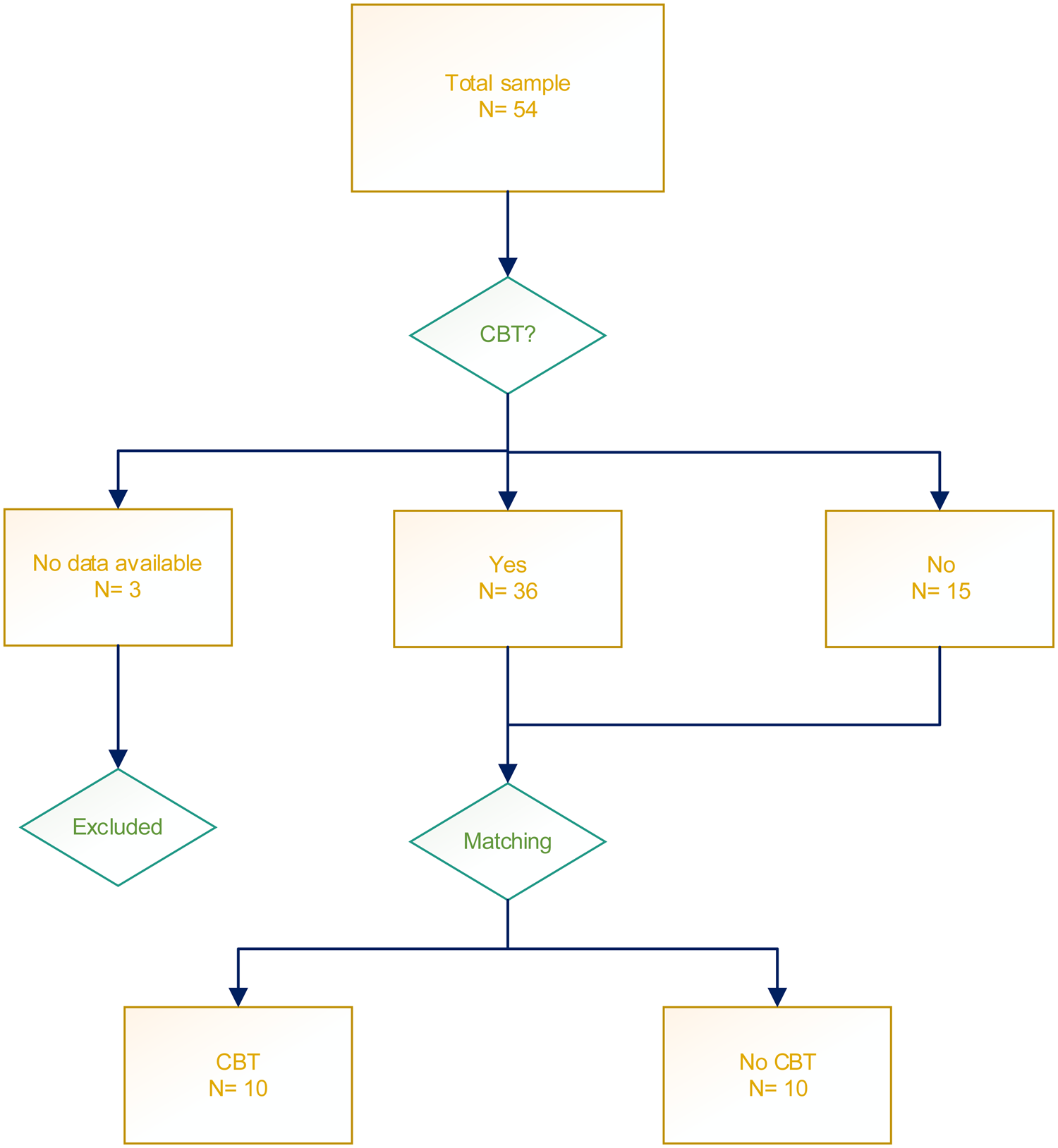
In the present study, 54 patients were included; 38 patients received addition of CBT and 16 patients did not (Fig. 1). Two patients with CBT were excluded from analysis because data were missing. Patients did not receive CBT because of the following reasons: lack of motivation (N = 4); alcohol abuses (N = 2); insufficient response to DBS (N = 5) or remission of OCD symptoms (N = 4). Of one patient the reason for not receiving CBT was unknown (N = 1). Four patients in the CBT group received CBGT.
Flowchart of the selection of patients with DBS for OCD with and without additional CBT.

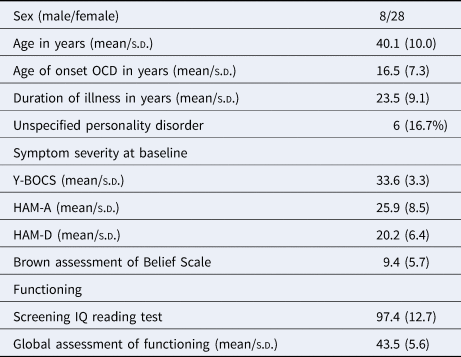
Demographic and clinical characteristics of the 36 patients that were included in the first analysis are presented in Table 1. CBT was commenced after optimization of DBS settings, which took on average 16.8 weeks (s.d. = 11.4). On average, participants received 11.4 (s.d. = 6.6) sessions and duration of CBT was 10.4 (s.d. = 6.4) months. Patients with individual CBT received 10.3 (s.d. = 6.8) sessions in 11.0 (s.d. = 6.6) months and patients with CBGT received 12.0 (s.d. = 7.1) sessions in 6.4 (s.d. = 3.1) months. The duration between sessions varied. The total follow-up period from start of CBT until last follow-up measurements varied between 1 and 9.8 years.
Baseline demographic and clinical characteristics of patients that received CBT following DBS for treatment-refractory OCD (N = 36)

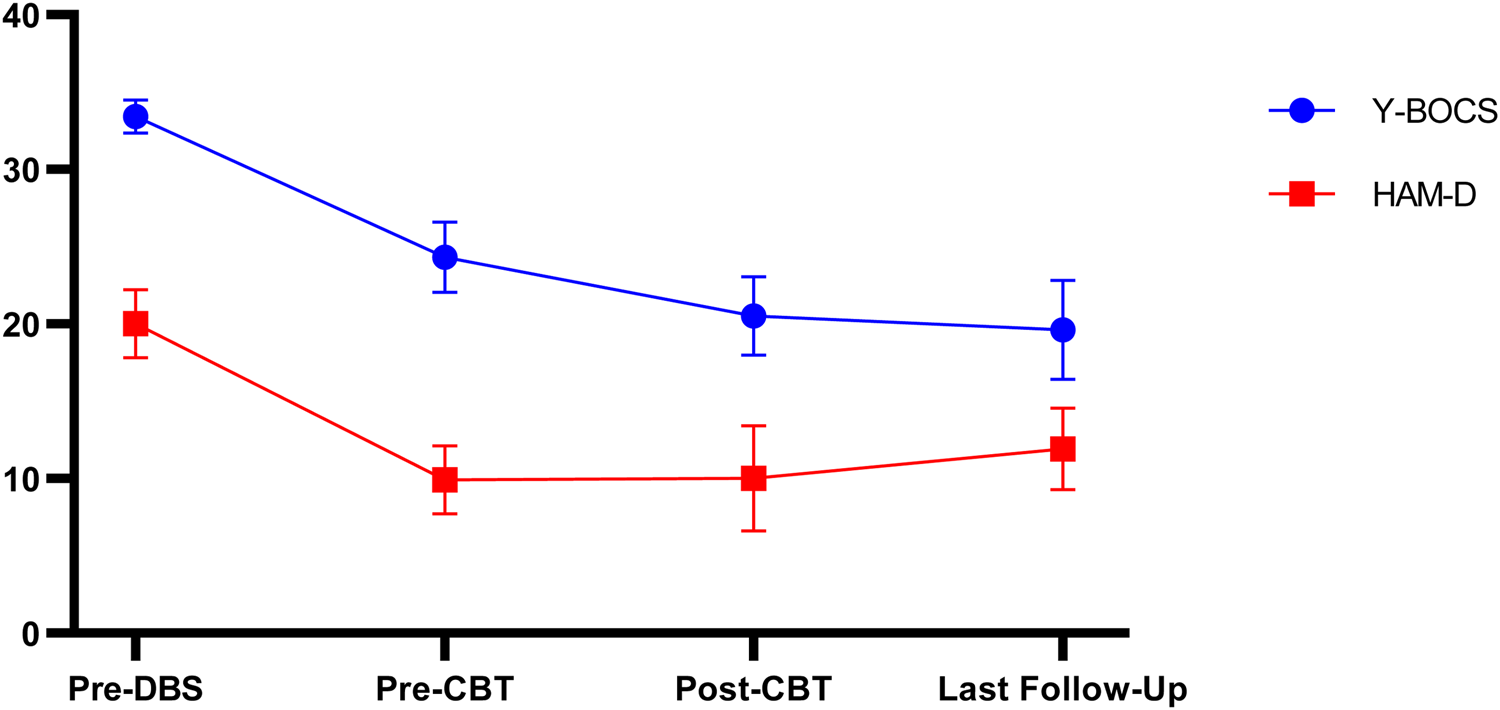
Course of symptoms in all patients with post-operative CBT (N = 36)
In the total group of patients with post-operative CBT, Y-BOCS scores between start of CBT and last CBT session decreased with 3.8 points (14.8%) on average (Fig. 2). Prior to CBT, 13 patients were responder, 3 partial responder and 20 non-responder. At end of CBT the number of responders and partial responders increased significantly to, 15 and 10 respectively (χ2 = 9.56, p = 0.048) and 11 patients were still non-responders. HAM-D scores did not change (0.1 point; 0.003% increase). An LMM was estimated to examine the course of the Y-BOCS before, during and after CBT. According to the model, there was a non-significant difference between Y-BOCS score before and during CBT (B = −1.59; s.d. = 0.8; p = 0.06) and before and after CBT (B = −2.28; s.d. = 1.1; p = 0.043). Y-BOCS scores decreased by 1.59 points during CBT and 2.28 points after CBT compared to start of CBT. There were also significant effects of stimulation (B = −2.10; s.d. = 1.0; p = 0.034) and optimization of stimulation parameters (B = 1.94; s.d. = 0.7; p = 0.007). A similar model was estimated with HAM-D scores but there was no significant effect of CBT on HAM-D scores.
Mean scores [95% confidence interval (CI)] on the Y-BOCS and HAM-D before deep brain stimulation (pre-DBS), at the start of cognitive behavioral therapy (pre-CBT) and at the end of CBT (post-CBT) (N = 36).

Factors associated with response to CBT were examined in all patients with post-operative CBT (N = 36). Results showed no significant interaction effect on Y-BOCS scores of CBT and ‘insight in illness’ (B = −0.23; s.d. = 0.2; p = 0.412), ‘number of CBT sessions’ (B = −2.28; s.d. = 1.1; p = 0.165) and ‘presence of a personality disorder’ (p = 0.120).
CBT v. no-CBT
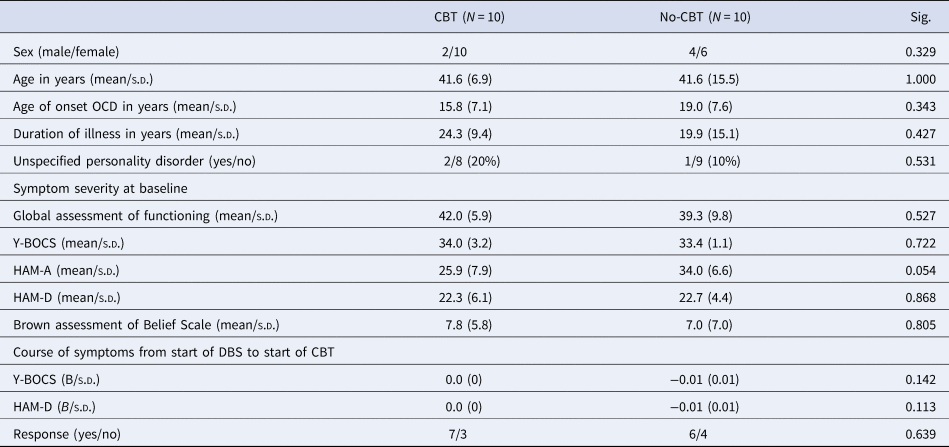
Of the 54 patients, 10 patients that underwent CBT were well matched to 10 patients without additional CBT (Fig. 1). There were no significant differences between the course of Y-BOCS and HAM-D scores prior to CBT and between demographic and baseline characteristics, so matching was considered successful (Table 2).
Baseline demographic and clinical characteristics of two matched groups of patients with OCD treated with DBS: with additional CBT (N = 10) v. patients without CBT (N = 10)

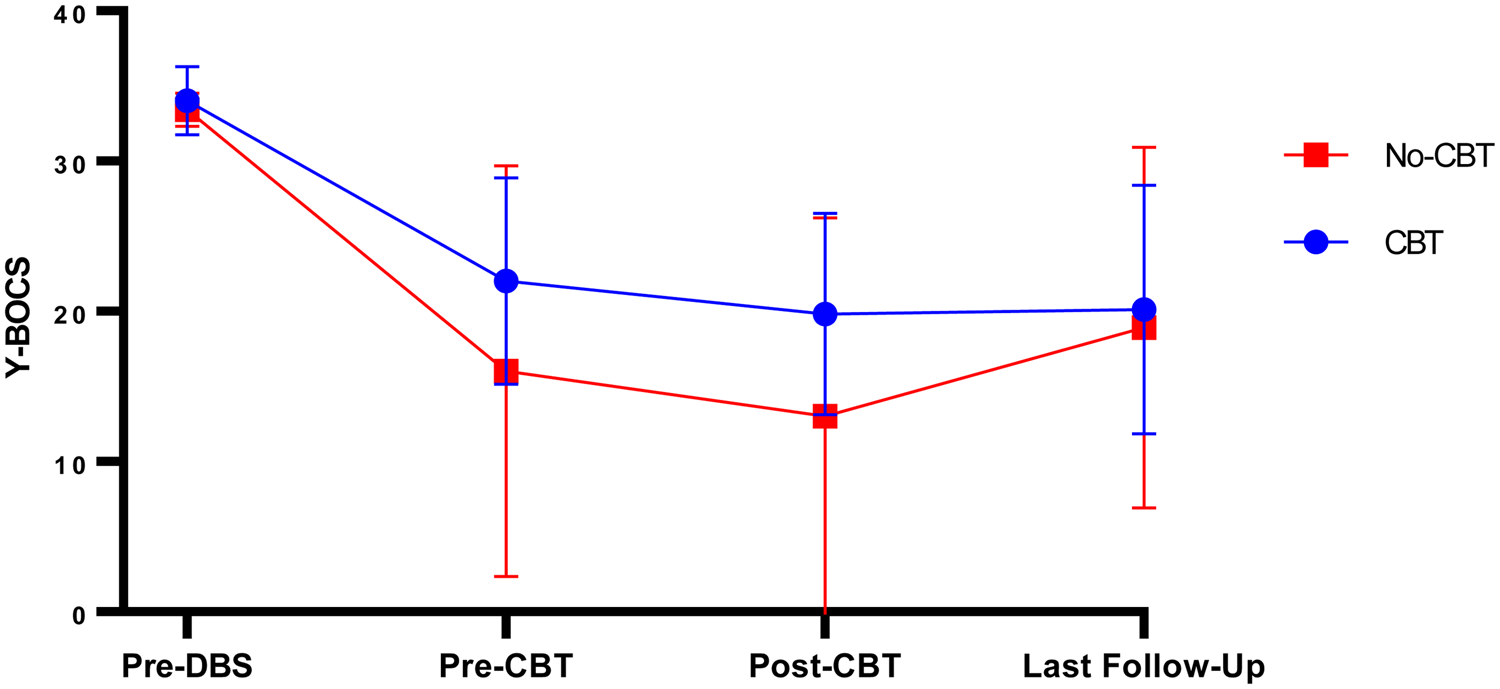
An LMM was used to examine the course of Y-BOCS scores between start of CBT until last follow-up (1–9.8 years) in patients that received post-operative CBT (N = 10) and a matched group of patients that did not (N = 10). From start until end of CBT, Y-BOCS scores decreased with 10% in the CBT group and with 13.1% in the group without CBT (over the same timeframe). Results showed no significant interaction effect between CBT and time (B = 0.001; s.d. = 0.0; p = 0.741), so there was no differences in the course of OCD symptoms over time between the CBT and the no-CBT groups (Fig. 3). In addition, we found no significant interaction effect of CBT when comparing all patients from our sample with (N = 36) and without CBT (N = 16) as a sensitivity analysis (B = 0.002; s.d. = 0.0; p = 0.838).
Mean scores (95% CI) on the Y-BOCS and HAM-D before deep brain stimulation (pre-DBS), at the start of cognitive behavioral therapy (pre-CBT) and at the end of CBT (post-CBT) in the CBT (N = 10) and no-CBT groups (N = 10).

A similar mixed model was estimated with HAM-D scores as the criterion. Results also showed no significant interaction effect between CBT and time (B = −4.52 × 10⁻⁵; s.d. = 0.0; p = 0.983), with a very small parameter estimate for the interaction effect. This means that the course of HAM-D scores over time did not differ significantly between the CBT and the no-CBT groups.
Discussion
To our knowledge, this is the first controlled study on the effects of post-operative CBT in patients with DBS for OCD. In line with our hypotheses, OCD symptoms improved significantly following post-operative CBT. However, when directly comparing patients with and without post-operative CBT, OCD symptoms did not decrease more in patients with CBT.
The finding that OCD but not depressive symptoms decrease following CBT is in line with a previous study by Mantione et al. (Reference Mantione, Nieman, Figee and Denys2014), although OCD symptoms in the present study decreased slightly less on average (14.8% v. 22%). The decrease in Y-BOCS scores in this study was on average approximately 4 points, but considering the refractory nature of OCD in patients with DBS, this can be considered clinically significant. A possible explanation for the difference with previous results is that Mantione et al. performed a controlled study in which all patients received 24 weeks of CBT and in the present study the average amount of sessions was 11.4. Also, patients in our cohort started on average 17 weeks after implantation with CBT, compared to 8 weeks in the study by Mantione et al. Hence, improvement of OCD symptoms between weeks 8 and 27 due to the DBS itself, may have been (potentially incorrectly) attributed to CBT in the study by Mantione et al. (Reference Mantione, Nieman, Figee and Denys2014). Potentially, the additional decrease of OCD symptoms during the longer post-operative follow-up may have caused a floor effect in our study.
Previously, it was hypothesized that anxiety and depression were rapidly weakened by DBS, and CBT affects habitual compulsive behavior (Mantione et al., Reference Mantione, Nieman, Figee and Denys2014). Nevertheless, we found that symptoms of OCD decline further after optimizing DBS parameters in both patients with and without additional CBT. This indicates that the improvement of OCD symptoms during post-operative CBT should not (only) be attributed to the CBT itself, but may be explained by other factors, e.g. late effect of DBS and/or effects of time. For example, patients have to adapt to a new situation in which they experience less anxiety and obsessions, and spend less time on compulsions. Most patients with DBS have been ill for decades and their social and work life is severely affected; it takes time to get back into society (Graat et al., Reference Graat, Mocking, Figee, Vulink, de Koning, Ooms and Denys2020). The lack of beneficial effects of CBT is in line with the study by Tyagi et al., in which no favorable effects of CBT in patients with DBS for OCD were found (Tyagi et al., Reference Tyagi, Apergis-Schoute, Akram, Foltynie, Limousin, Drummond and Joyce2019). Tyagi et al. suggested a floor effect of DBS to explain the lack of symptom decrease following CBT. However, in our sample we found that OCD symptoms did decrease further, but since this also applied for patients without CBT this reduction is likely due to late effects of DBS itself.
An important limitation of the present study is that it is not a randomized controlled trial, possibly leading to selection biases. However, because this is the first controlled and largest study on the effects of post-DBS CBT, it provides the best estimate available thus far. Other nonspecific study effects may account for the variability in response rates, although we controlled for the effect of adjustments in stimulation settings. Another limitation is that the clinicians administering the questionnaires were not blinded. However, this would have potentially increased the effects of CBT compared to the no-CBT group, for which we found no evidence. Since four patients received CBT in the form of group therapy and the CBT was not completely standardized, differences in setting and instrumentation may have influenced the internal validity of findings. In addition, a proportion of the included patients also received adjustments in stimulation settings during CBT which made it difficult to distinguish the pure effects of CBT and DBS itself. Nonetheless, our study also has multiple strengths. First, our study had a naturalistic setting and is therefore representative of daily clinical practice, enhancing generalizability. In addition, the present study is the largest clinical study examining the effectiveness of CBT in patients with DBS for OCD and is the first to examine the effects of CBT by comparing an intervention and control group.
CBT is an intervention that costs resources from the community and time from both patients and clinicians. The present study raises the question whether CBT in patients with DBS for OCD is (cost-)effective. Our results suggest that it is not since OCD symptoms did not decrease more in patients with CBT following DBS. However, since the present study was retrospective in nature and lacked a randomized control group, no definite conclusions can be drawn. Also, it did not include other potential benefits of CBT in patients with DBS for OCD. Other favorable effects of CBT following DBS might be improvements in quality of life (QoL), functioning and re-integration (Graat et al., Reference Graat, Mocking, Figee, Vulink, de Koning, Ooms and Denys2020). Our findings could inspire a future (non-inferiority) randomized controlled trial examining the effects of CBT in patients with DBS for OCD, also taking effects of CBT on QoL and functioning into account.
In conclusion, this largest and first controlled study on the effect of post-DBS CBT in OCD showed that although OCD symptoms improve following post-operative CBT, there was a comparable decrease of symptoms over the same timeframe in patients without CBT. Therefore, improvements in OCD symptoms may be better explained by late effects of DBS stimulation, instead of CBT. These findings emphasize the need for a randomized controlled study, examining the effects of post-operative CBT on symptoms, QoL and global functioning in patients with DBS for OCD.
Acknowledgements
R.T. Mocking is funded by unrestricted ABC Talent Grants. D. Denys has received funding from ZonMw (no. 636310016) and Boston Scientific (in kind) for a trial on deep brain stimulation for depression. No funding was received for the present trial.
Conflict of interest
All authors have no disclosures to report.