INTRODUCTION
Recent fishing and resource exploration in the Arctic Ocean has increased the need for a better understanding of the polar ecosystem and the interactions amongst the resident species. Cephalopods play an important role both as predator and prey to a variety of species including those of commercial importance to the Arctic region (Gardiner & Dick, in press). As part of an ongoing study examining the biology and distribution of Canadian Arctic cephalopods (Gardiner & Dick, in press), three species of Bathypolypus Grimpe (B. arcticus Prosch, B. bairdii Verrill, and B. pugniger) and one Cirroteuthis muelleri Eschricht were found with individuals exceeding the normal size-range. Six large specimens of Gonatus fabricii Lichtenstein were also collected from Davis Strait. Fast growing, semelparous cephalopods are easily impacted by major marine ecological perturbations, i.e. increasing water temperatures and commercial fishing (Boyle & Boletzky, Reference Boyle and Boletzky1996), and as a result, could conceivably collapse within a single year (Rodhouse & White, Reference Rodhouse and White1995). Such impacts would also affect both their predators and prey (Boyle & Boletzky, Reference Boyle and Boletzky1996) and may alter the exponential growth rates of their larval and juvenile stages (Wood & O'Dor, Reference Wood and O'Dor2000). This would then impact their size-at-maturity and thus their reproductive success (Wood & O'Dor, Reference Wood and O'Dor2000).
This note augments the current knowledge of the size and distribution of these Arctic cephalopods as well as speculates on the reasons why they are found in the same region.
MATERIALS AND METHODS
Samples were obtained from by-catch of the NAFO Groundfish Surveys of the Hudson Strait and Davis Strait in 2007 and 2008 respectively. All cephalopods captured in Hudson Strait were brought back to the laboratory for morphometric analysis while only specimens from the southern extent of the 2008 Davis Strait–Baffin Bay survey were collected. Individuals collected from Davis Strait–Baffin Bay represented the size spectrum of the various species observed during the survey (M.A. Treble, personal communication, 2008).
In total, 101 stratified 25 minute bottom otter trawls produced 330 cephalopods in Hudson Strait from 14 October to 28 October 2007 (NAFO, unpublished 2007). These 330 individuals represented three species (Gonatus fabricii, Rossia palpebrosa Owen and Bathypolypus arcticus), and were dominated by juvenile G. fabricii. The mean depth of the samples was 313.40 m with a range of 108 to 968 m and the average temperature was 1.26°C with a range of –0.89 to 3.79°C (NAFO, 2007).
One hundred and eighty-three bottom otter trawls were conducted between 8 October and 4 November 2008 in Davis Strait–Baffin Bay and recovered 603 cephalopods, although not all individuals were collected for further study. The cephalopods sampled represented six species common to Canadian waters (G. fabricii, B. bairdii, B. pugniger, R. moelleri Steenstrup, R. palpebrosa and Cirroteuthis muelleri), with G. fabricii, again, the dominant species (Mercer, Reference Mercer1968). The average bottom temperature was 0.86°C with a range of –1.64 to 4.16°C and a mean depth of 694.75 m with a range of 11 to 1474 m (NAFO, unpublished 2008).
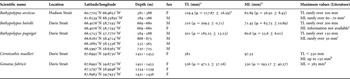
Maximum sizes were determined based on measurements from the most recent sources for the particular species. Historical metrics of Bathypolypus were based on the accounts of Muus (Reference Muus2002) while Cirroteuthis was based on descriptions by Nesis (Reference Nesis2001). All species measures for octopods (both cirrate and incirrate) are listed and include total length (TL) and mantle length (ML) as mantles can be distorted, while those of the decapods (i.e. G. fabricii) are listed as dorsal mantle length (ML) as per standard measures (Table 1).
Location, depth, sex, total length (TL) and mantle length (ML) of three Bathypolypus species, Cirroteuthis muelleri and Gonatus fabricii from Hudson Strait and Davis Strait, Canada.

1Largest individual total length (TL) for each species. 2Largest individual mantle length (ML) for each species. 3A single tentatively identified B. arcticus was recorded from Hudson Strait with a TL of 252.2 mm (59.56267°N 66.98367°W; 270–274 m depth).
aSennikov et al. (Reference Sennikov, Mukhin and Bliznichenko1989); bNesis (Reference Nesis2001); cMuus (Reference Muus2002).
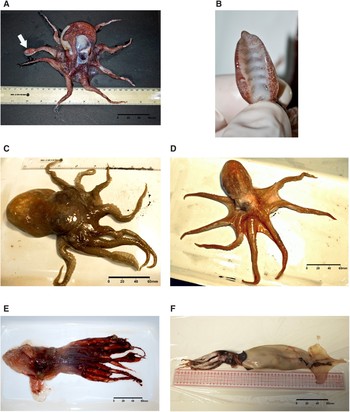
Photographs and morphometric measurements were taken of the largest specimens (Figure 1). The specimens were preserved as museum vouchers, but were destroyed in a laboratory fire. However, smaller representative samples are preserved and will be placed in the Atlantic Reference Centre (ARC), St Andrew's, New Brunswick, Canada (accession numbers pending).
The largest specimens of Bathypolypus spp. (A–D) collected in the eastern Canadian Arctic. (A) B. pugniger, arrow points to the ligula (enlanged in B); (C) B. bairdii; (D) B. arcticus; (E) Cirroteuthis muelleri; and (F) Gonatus fabricii. All specimens were collected during the NAFO fishery surveys in 2007 (Hudson Strait) and 2008 (Davis Strait).

RESULTS
Four large male Bathypolypus pugniger specimens were recorded from Davis Strait with the largest reaching 201 mm TL (Figure 1A; Table 1). All were collected between depths of 532 to 875 m at bottom temperatures ranging from 1.16°C to 1.82°C (Table 2).
Temperature and depth-ranges for five Arctic cephalopod species comparing observed depth and temperatures to literature values.

1Combined depth-range from Table 1 values. 2Both B. bairdii were caught in the same location. 3Both C. muelleri were caught at the same depth.
4Surface temperatures warmer than at the depths they were caught.
aKristensen (Reference Kristensen and Boyle1983); bPiatkowski & Wieland (Reference Piatkowski and Wieland1993); cTomczak & Godfrey (Reference Tomczak and Godfrey2003); dBaum (Reference Baum2001); eCollins et al. (Reference Collins, Yau, Allcock and Thurston2001); fNesis (Reference Nesis2001); gMuus (Reference Muus2002); hCollins & Villanueva (Reference Collins and Villanueva2006).
The largest B. bairdii specimen from Davis Strait was a male with a TL of 210 mm and weighted 128.7 g (Figure 1C; Table 1). The female, although shorter (TL= 209 mm) was heavier, weighing 196 g (Table 1). Both B. bairdii specimens were collected at the same location from depths of 669 to 680 m and a bottom temperature of 1.4°C (Table 2).
Two large specimens of B. arcticus (one male and one female) were collected from Hudson Strait (Figure 1D; Table 1). The largest (the female) had a TL of 229.4 mm (Table 1). The two individuals were collected at depths of 284 to 388 m  and at a mean bottom temperature of 1.36°C (range 1.08°C to 1.64°C; Table 2). An additional female specimen, tentatively identified as B. arcticus based on external characteristics (Gardiner, unpublished) had a TL of 252.2 mm. This individual was collected between 270 and 274 m and at a temperature of –0.23°C.
A single Cirroteuthis muelleri was collected in Davis Strait at ~1450 m depth (Table 2). It had a TL of 381 mm (Figure 1E; Table 1).
Six large Gonatus fabricii (Figure 1F) were collected from Davis Strait and had an average ML of 267.71 mm. The largest had a ML of 330 mm and was not sexually mature (Table 1).
Four specimens of Bathypolypus pugniger surpassed its known size-range of 150 mm TL by 51 mm (Table 1). Two B. bairdii specimens were collected nearby with the largest recorded at 210 mm TL, 10 mm greater than Muus (Reference Muus2002) described (Table 1). The largest B. arcticus specimen was 229.4 mm TL and exceeded the literature value of 200 mm TL (Table 1). One Cirroteuthis muelleri specimen from Baffin Bay was 381 mm and exceeded the literature value of 350 mm TL (Table 1).
Gonatus fabricii specimens were not larger than the maximum ML of 385 mm (Table 1) but were larger than those reported from a known breeding population in Disko Bay, Greenland (Zumholz & Frandsen, Reference Zumholz and Frandsen2006). The largest record from Disko Bay was a sexually mature male (257 mm pen length; Zumholz & Frandsen, Reference Zumholz and Frandsen2006); while the largest, reported from the Norwegian Sea, was a mature female (385 mm ML; Table 1). The specimen in our study from Davis Strait, was 55 mm ML smaller than reported from the Norwegian Sea (Table 1) but 73 mm greater than described from Disko Bay (Zumholz & Frandsen, Reference Zumholz and Frandsen2006).
DISCUSSION
The size of four cephalopod species across two genera exceeded the maximum size reported and the ubiquitous G. fabricii was near the maximum size. We speculate that further surveys in the high Arctic will produce even larger specimens of Bathypolypus spp., C. muelleri and especially G. fabricii since our samples did not have mature gonads. Perhaps G. fabricii exhibit similar maturation to Moroteuthis ingens from New Zealand waters that were reported to reach a certain mantle length before rapid gonadal development (Jackson, Reference Jackson1997).
Since little information is available for B. pugniger and C. muelleri it was not surprising that larger specimens would eventually be collected. Gonatus fabricii exceeded the largest size reported for breeding individuals from the adjacent, well-studied Disko Bay population (Kristensen, Reference Kristensen1982; Zumholz & Frandsen, Reference Zumholz and Frandsen2006). The addition of six large G. fabricii adds to the interest of the area. Previous work has identified two separate populations of this species; one in Amerdloq Fjord and the other in Disko Bay (Kristensen, Reference Kristensen1982). Although it is unclear why there are morphological differences (Kristensen, Reference Kristensen1982) it is possible, that the individuals caught in Davis Strait may also be a separate population as they were caught at >1000 m (Table 1) compared to a depth of <541 m from Disko Bay (Zumholz & Frandsen, Reference Zumholz and Frandsen2006) and in water temperatures colder than 1 to 3°C in Amerdloq Fjord (Kristensen, Reference Kristensen1982).
It is generally accepted that ectotherms become larger in cold conditions (Atkinson & Sibly, Reference Atkinson and Sibly1997) but to find the largest specimens of four species, reported to date, from a relatively localized area of the Canadian Arctic is unexpected. Various factors may contribute to the large sizes, such as temperature, depth, cyclonic upwellings (food availability and productivity), latitude/longitude, response to predators and delayed sexual maturation and reproduction.
Bathypolypus bairdii and B. pugniger were found at similar depths and temperatures but B. pugniger was collected over a broader environmental range than B. bairdii (Table 2). Bathypolypus pugniger has been collected from Arctic overflow water (approximately −0.9°C; Table 2) and may be able to tolerate colder temperatures than B. bairdii. By contrast, B. bairdii are usually recovered from waters with temperatures of 2°C to 8°C (Table 2). However, B. bairdii specimens recovered in Davis Strait were at temperatures of 1.4°C (Table 2). Clearly B. bairdii has a wider thermal tolerance than previously thought and its range may extend further into the Arctic Ocean.
Bathypolypus arcticus specimens were found in relatively shallow, but colder waters than the other species (Table 2). These values agree with Muus (Reference Muus2002) who reported samples collected at −1.7°C to 3°C at 37 to 1210 m. This species, as with the other Bathypolypus species, is only found in shallow water at high latitudes where the temperature remains cold (Muus, Reference Muus2002). O'Dor & Macalaster (Reference O'Dor, Macalaster and Boyle1983) established a maximum temperature of 12°C for B. arcticus but also stated that it is rarely found above 6°C. However, they were likely studying the more southern ranging B. bairdii as the study was done prior to the description by Muus (Reference Muus2002) of the Bathypolypus complex. If this genus behaves similarly to the southern ocean octopods examined by Strugnell et al. (Reference Strugnell, Rogers, Prodohl, Collins and Allcock2008), Bathypolypus spp. may move to deeper water if Arctic waters become warmer, altering its present distribution. The depth and temperatures at which C. muelleri specimens were collected are within the reported range (Table 2). Cirroteuthis muelleri has been reported from depths of 4846 m (Table 2) but Davis Strait does not exceed 1500 m in the more southern portion of the Strait (Jørgensen et al., Reference Jørgensen, Hvingel, Møller and Treble2005). It has been reported at temperatures of 0.04°C (Table 2).
The G. fabricii specimens from Davis Strait were found at deeper depths  than those reported from West Greenland (200–400 m) but not as deep as <2700 m in the Norwegian Sea (Table 2). No references were found describing the preferred temperature range for C. muelleri and adult G. fabricii (Table 2).
Discovering large cephalopods specimens from the Canadian Arctic requires comment, albeit cautiously. Temperature, depth, hatch time, and high productivity (food) have been proposed to contribute to large size. Temperature is considered to be more important for distribution (Stewart et al., Reference Stewart, Pocklington and Cunjak1985; Strugnell et al., Reference Strugnell, Rogers, Prodohl, Collins and Allcock2008), and size, than depth (Boyle & Boletzky, Reference Boyle and Boletzky1996). For example squid adjust their depth to remain in their preferred temperature-range, as temperature decreases with depth and latitude. The Norwegian Sea is warmer and squid move deeper to find cooler water but the shallow water off West Greenland meets their temperature requirements (Kristensen, Reference Kristensen and Boyle1983; Gyory et al., Reference Gyory, Mariano and Ryan2008). Similarly, Bathypolypus species occupy shallow waters at high latitudes (Nesis, Reference Nesis2001).
Typically, warmer water promotes fast growth and maturation (Wood & O'Dor, Reference Wood and O'Dor2000). Perhaps cold Arctic waters slow maturation causing individuals to be older when they reach sexual maturity than those in warmer water. This allows more time to attain greater size before switching their energy to the production of gametes (Moltzchaniwskyi, Reference Moltzchaniwskyi2004). In laboratory rearing experiments, Bathypolypus arcticus (likely B. bairdii) was shown to speed up its maturation with increasing temperatures, producing a decrease in size and lifespan (Wood & O'Dor, Reference Wood and O'Dor2000). Our samples were recovered from cold deep water which is affected by the cold West Greenland Current and Baffin Island Current (Gyory et al., Reference Gyory, Mariano and Ryan2008). We speculate that sexual maturation takes several years rather than the typical 1–2 years expected for most cephalopods (Wood & O'Dor, Reference Wood and O'Dor2000), resulting in larger, older individuals. Large size could also be influenced by hatch time with late hatched individuals growing at a more rapid rate than those hatched earlier (Wood & O'Dor, Reference Wood and O'Dor2000). Perhaps these large specimens represent individuals that hatched later in the season when temperatures and food availability were optimal for growth.
Productivity is a factor of upwelling or water mixing from currents and eddies which provides greater nutrient flux and thereby greater quantities of food (Zuev & Nesis, Reference Zuev and Nesis2003). The sample locations are influenced by the West Greenland Current, some of which is deflected westward and mixes with the south flowing cold Baffin Current (Jørgensen et al., Reference Jørgensen, Hvingel, Møller and Treble2005). This area of mixing and upwellings with increased productivity would be ideal for cephalopod feeding and dispersal (Zuev & Nesis, Reference Zuev and Nesis2003), especially for G. fabricii.
Clearly we are in the very early stages of understanding cephalopod biology and distribution in the Canadian and western Arctic Ocean, and it is likely that larger specimens of these and other cephalopod species will be discovered in the future.
ACKNOWLEDGEMENTS
The authors would like to thank Ms Margaret Treble and Mr Tim Siford (DFO—Winnipeg) for their help in the collection of samples on the North Atlantic Fisheries Organization (NAFO) surveys. T.A. Dick acknowledges financial support from a NSERC Northern Research Chair. We thank the referees for their constructive comments.