Trophic plasticity of food webs is an important topic in ecology that is receiving increasing attention. In particular, comparisons across ecosystems await research in order to highlight structural and functional degrees of similarity. Among the different network systems in nature, it seems to be difficult to establish clear universal patterns governing the global structural and functional properties of food webs (Garlashelli, Reference Garlashelli2004). In addition to structural and functional differences that occur among ecosystem types, important deviations between food chain models and the observed dynamics of natural ecosystems have been hypothesized (Chase, Reference Chase2000; Polis, Reference Polis, Sears, Huxel, Strong and Maron2000).
Nevertheless, one would have expected quite predictable patterns when regarding energy pathways of a single species, especially a key one, whose populations occur in a specific ecosystem type. Measuring the major trophic pathways within a food web allows us to appreciate the potential role of autochthonous or imported food sources in structuring food webs. In fact, the extent to which the major trophic links towards key consumers involve a single or several food sources, strongly influences the energy pathways, structure and stability of food webs. Consequently, a fundamental question of food web ecology is which organic matter sources preferentially sustain energetic flows within an ecosystem? Since the 1970s, studies claiming questionable food preference and trophic pathways are increasingly based on measurements of 13C/12C, 15N/14N and 34S/32S ratios. Interestingly, the stable isotope approach can be applied to comparisons among similar ecosystems where a species occupies a key position as consumer. Within these systems, the trophic transfers towards the consumer may be hypothesized to converge towards a quite similar pattern, becoming predictable among similar ecosystem types.
Stable isotopes providing evidence of trophic plasticity: the case of Crassostrea gigas
During the last few years, I was involved in several δ13C versus δ15N studies in similar intertidal ecosystems located along the French Atlantic, the Channel coast and the North Sea. A demonstrative case of trophic plasticity can be evidenced when comparing the results related to a single tropic interaction. In the considered areas, the Japanese oyster Crassostrea gigas occurs among the most representative benthic filter feeding species. The major diet components for this oyster have been determined through stable isotope analyses. These areas were characterized by extensive intertidal flats where epipelic benthic diatoms constitute visible brown mats at the sediment surface. The so called microphytobenthos was reported as a predominant highly nutritive food source for several primary consumer communities inhabiting those ecosystems (Currin et al., Reference Currin, Newell and Paerl1995). In systems where tidal flats are adjacent to oyster reefs, benthic diatoms become directly available to filter feeders through sediment re-suspension.
Direct comparisons of the results obtained in different areas imply the use of similar protocols from the field sampling to the estimation of diet contribution. At each sampling area, the major organic matter sources available for oysters were sampled and prepared according to the same procedure, in order to be analysed for natural stable isotopes composition. In particular, benthic diatoms were sampled at low tide and microalgae were extracted from the sediment, using the method of Couch (Reference Couch1989), slightly modified by Riera & Richard (Reference Riera and Richard1996). Specimens of Crassostrea gigas were also collected and prepared according to the same procedure. Oysters were taken by hand, cleaned of epibionts and kept alive overnight at the laboratory in filtered water from the sampling site to allow evacuation of gut contents. They were then frozen, dissected and the flesh treated with 10% HCl to remove any carbonate debris from the shell, rinsed with distilled water, freeze dried, ground to a powder using a mortar and pestle and kept frozen until analysis. Carbon and nitrogen isotope ratios were determined using a mass-spectrometer. Data are expressed in the standard δ unit notation where δ X = [(Rsample/Rreference) − 1] × 103, with R = 13C/12C for carbon and 15N/14N for nitrogen, and reported relative to the Vienna Pee Dee Belemnite standard (PDB) for carbon and to air N2 for nitrogen.
In situations where more than two food items are used by a consumer, which is the case in coastal ecosystems, mathematical mixing models are available to calculate their individual contributions to the observed animal's signature. A mixing model was applied using the Isosource routine developed by Phillips & Gregg (Reference Phillips and Gregg2003). This method examines all possible combinations of each source contribution (0–100%) in 1% increments. Combinations that delivered the observed consumers' isotopic signature within a small tolerance range are considered to be feasible solutions, from which the mean contribution and its range are given for each food source. Consequently, due to the methodological similarity, the variation in the importance of microphytobenthos in oysters' diet can be directly compared among sites at a geographical scale.
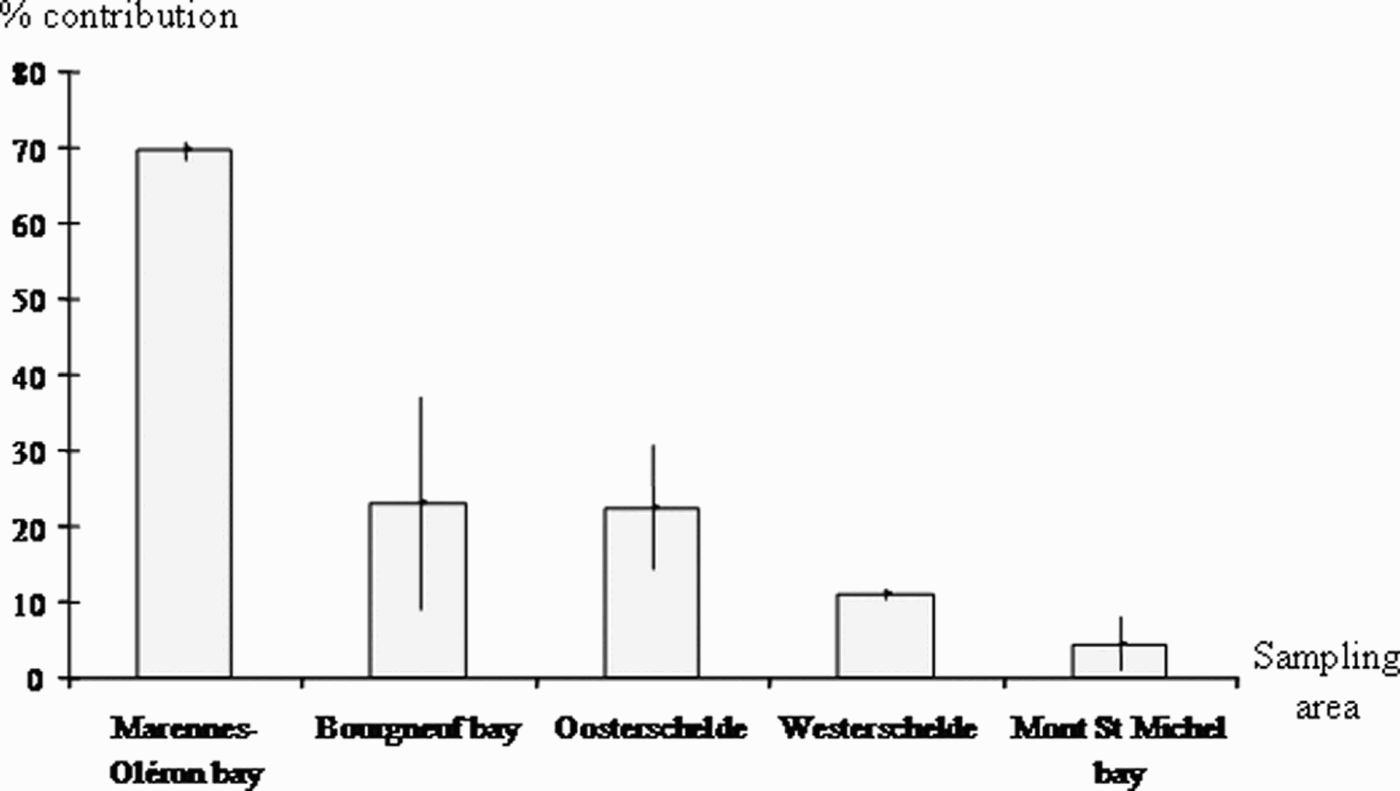
In fact, the contribution of this food source to oyster diets varies greatly according to geographical locations (Figure 1). The major role of microphytobenthos for oysters' diet inhabiting coastal areas characterized by extensive intertidal mudflats cannot be extrapolated to other similar ecosystems as could have been firstly supposed according to results obtained in the Marennes-Oléron bay (France) (Riera & Richard, Reference Riera and Richard1996). In contrast, in the Mont St Michel bay, although benthic diatoms abundantly cover intertidal sediments, they contribute a minor part of oysters' feeding requirements. The major trophic pathway of Crassostrea gigas inhabiting this bay involves predominantly the marine plankton entering the bay which was observed to constitute from 80% to 95% of oyster diet (Riera, Reference Riera2007). Between these contrasted patterns, intermediate feeding contributions of benthic diatoms were measured in other similar habitats for oysters. In the bay of Bourgneuf, oysters were reported to feed preferentially on a mixture including benthic diatoms (mean contribution around 23%) and marine plankton. However, detritus originating from macroalgae and marine plants which offer substantial trophic subsidies to these oysters vary according to season (mean contributions from 16% to 30%) (Decottignies et al., Reference Decottignies, Beninger, Rincé, Robins and Riera2007). Along the mid-Oosterschelde and mid-Westerschelde (Netherlands) the diet of Crassostrea gigas living near intertidal mudflats was measured to consist mostly of a mixture of benthic diatoms and marine plankton (Riera et al., Reference Riera, Stal and Nieuwenhuize2002, Reference Riera, Stal and Nieuwenhuize2004). Here, measurements of the trophic interactions, as provided by the field application of stable isotopes revealed strong differences.
Mean contributions (% together with ranges) of epipelic benthic diatoms in the diet of Crassostrea gigas from different intertidal areas. The contributions have been estimated through a mixing model run (Phillips & Gregg, Reference Phillips and Gregg2003) using an increment of 1% and a tolerance of 0.05 per mil. Except for the Mont St Michel bay and the Bourgneuf bay retrospective calculation have been done from stable isotopes data of previous studies.

Consequences on extrapolation among similar habitat types
From these results, the major trophic pathways of a single species which occupy similar ecosystems are clearly not a priori predictable out of site-specific investigations. Consequently: (1) a major trophic link evidenced within an ecosystem must be considered only as a potential process when regarding other similar ecosystems where identical trophic compartments also occur; and (2) extrapolation of major trophic links between identical food source and consumer is not possible among similar ecosystems. Hence, the differences revealed by comparative measurements of an identical trophic link between dominant species whose populations occur in similar ecosystems from different areas sustain the idea that no clear universal pattern governs functional properties of their associated food webs.
To explain such a trophic plasticity in similar ecosystems clearly remains a challenge. Although including most of identical populations, similar ecosystem types in coastal areas can differ by ecological, hydrodynamic characteristics or anthropogenic pressure. For example, variation in the availability of a food source for a consumer due to productivity or physical processes may explain the plasticity of the resulting trophic link. Finally, such plasticity observed for a single consumer–source interaction at the base of a trophic cascade severely limits the generalization of simple consumer–resource models in order to predict the consequences of future anthropogenic changes on several ecosystems.