Introduction:
The different traditions in different countries and the different judgements about the relevance of CSF analysis in the context of other clinical or imaging methods led to a wide spectrum of acknowledgement for CSF analysis. In case of infectious, acute neurological diseases Reference Reiber and Peter(1,Reference Reiber2) or in case of multiple sclerosis Reference Reiber and Ungefehr(3,Reference Rostasy and Reiber4) with a chronic inflammatory process there is no controversy about the relevance of CSF analysis in Neurology (including analysis of CSF/serum quotients QAlb, QIgG, QIgA, QIgM, cell count, oligoclonal IgG and specific antibodies). But what about psychiatric diseases or dementive processes in brain, brain trauma, autoimmune diseases with involvement of the brain? The chance for rehabilitation after neurodegenerative processes is primarily based on an early and correct diagnosis. A recent investigation Reference Bechter, Reiber, Herzog, Fuchs, Tumani and Maxeiner(5)) shows that in psychiatric diseases it has to be regarded as a serious deficit not to make at least once a CSF analysis in the patients: In 15% of psychiatric patients with schizophrenic or affective disorders an inflammatory process could be detected and in 30% an increased albumin quotient (i.e. a blood-CSF barrier dysfunction) which points to a brain-organic involvement and could modify the possibly wrong diagnosis in 6% of the patients. So CSF analysis must be the base for diagnostic approaches in all neurological and psychiatric diseases as CSF data pattern Reference Reiber and Peter(1,Reference Reiber2) can contribute to differential diagnosis of brain diseases by
1) Supporting suggested diagnosis by disease-related typical data patterns
2) Pointing to unexpected diagnosis by disease-related typical data patterns
3) Exclusion of inflammatory processes
4) Discrimination of chronic from acute diseases
5) Leading to further more specific analytical efforts.
The relevance of cerebrospinal fluid and blood analysis offers a most specific and sensitive approach, but needs for reliability sophisticated, knowledge-based data interpretation. In general CSF analysis takes advantage of the intrathecal synthesis of immunoglobulins, increased release or production of marker proteins for tumor metastasis (CEA) or increased release of neuronal or glial proteins in degenerative diseases (Tau, beta amyloid, NSE, S100). In some rare cases the increased release of brain proteins (NSE) can be detected in blood.
The basic issue is the difference for a source related interpretation of the proteins in CSF.
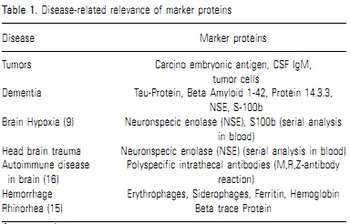
After an earlier report in this journal Reference Reiber(2)) on basics in CSF analysis, focusing on blood derived proteins in CSF we focus now on the different approach for the brain-derived proteins Reference Reiber(6,Reference Reiber7), serving as surrogate markers for differential diagnosis of noninflammatory processes in the brain (Table 1). After reviewing the knowledge base for interpretation of brain-derived proteins we focus on two examples, the dementive and psychiatric diseases. Interpretation of blood- vs. brain-derived proteins in CSF: The understanding of the source-related dynamics of molecules in CSF with their subsequently different variability allows the rational choice between the different evaluation concepts for blood- and brain-derived proteins.
Blood-derived proteins:
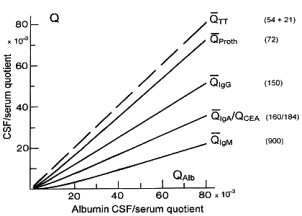
For the primarily blood-derived proteins the discrimination of a brain-derived fraction from a blood-derived fraction in CSF is done with highest sensitivity and specificity by evaluation of CSF/serum quotients with reference to the albumin quotient in a nonlinear hyperbolic function (Fig. 1). This allows to take into account the positive rostro-caudal concentration gradients in CSF and the decreasing CSF flow rate in case of a blood CSF barrier dysfunction Reference Reiber(8)). The graphical interpretation is done with nonlinear reference ranges in quotient diagrams (Fig. 3) or by the numerical interpretation which also refers to the hyperbolic relation of proteins in CSF Reference Reiber and Peter(1)).
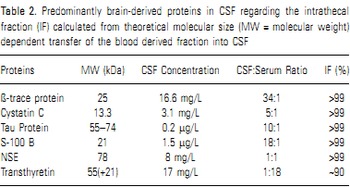
Brain-derived proteins: A brain-derived protein in CSF is recognized by one of the following properties (Table 2) including the different source related biological coefficient of variation (CV):
1) CSF concentration > Blood concentration
2) Blood derived fraction << Brain-derived fraction
3) CV in CSF < CV in Blood (CV of Q > CV in CSF)
Physiology of brain-derived proteins:
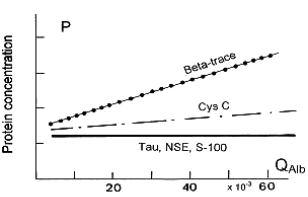
Proteins from neurons or glial cells like tau protein, neuron-specific enolase, S-100 protein, all enter CSF primarily in the ventricular and cisternal space. Their concentration between normal ventricular and lumbar CSF is decreasing (in contrast to blood-derived proteins), and in the case of pathologically decreasing CSF flow rate, the concentration in lumbar CSF remains invariantly constant (Fig. 2).
Concentrations of the primarily leptomeningeal proteins, β-trace protein and cystatin C, increase between normal ventricular and lumbar CSF. In the case of pathologically decreased CSF flow rate they increase linearly(Fig. 2) in lumbar CSF (concentrations of blood-derived proteins increase nonlinearly, Fig. 1).
The predominantly brain-derived proteins in CSF of neuronal or glial origin are evaluated using their absolute concentrations in CSF for maximal sensitivity without reference to QAlb. The leptomeningeal proteins like beta trace or cystatin C are evaluated as absolute concentrations with reference to QAlb.
Interpretation of Brain-derived proteins in blood
In case of brain hypoxia with a very strong release of Neuron-specific enolase (NSE) into brain tissue the protein reaches high concentrations in blood by direct diffusion from brain tissue into blood capillaries. In contrast Beta trace protein reaches the blood by CSF bulk flow into venous blood.
So the pathological increase of NSE and S100 is detectable in blood, e.g. in cases of brain hypoxia or infarction. In particular NSE has a high predictive value for clinical outcome of the patient after brain trauma or hypoxia Reference Schaarschmidt, Prange and Reiber(9)).
Relevance of CSF analysis for diagnosis of dementive processes:
Alzheimer's disease (AD), Parkinson's disease dementia (PDD)/Lewy-body disease (DLB) and frontotemporal dementia (FTD) are the major causes of neurodegenerative memory impairment and dementia. As new therapeutic agents are visible for the different diseases there is an ultimate need for an early differential diagnosis. Until recently the diagnosis of AD was made according to the McKhann criteria Reference McKhann, Drachman and Folstein(10)) in which cerebrospinal fluid findings were used to exclude other diseases. A recent update of the criteria originates from an international consensus group Reference Dubois, Feldman and Jacova(11)). In the last 10 years it was shown that a combined determination of just these few markers (tau-proteins, and abeta-peptides) is already sufficient to achieve a high degree of diagnostic certainty in the diagnosis of AD Reference Otto, Lewczuk and Wiltfang(12,Reference Jesse, Steinacker, Lehnert, Gillardon, Hengerer and Otto13). According to the new research criteria low abeta 1-42 and high total-tau protein in CSF are suggested as additional criteria for the diagnosis for AD. As result of this there is a rising need for quality control of CSF samples and determination methods and on the knowledge of typical CSF findings in the various neurodegenerative diseases. Depending on the differential diagnostic question e.g. MCI vs. AD, depressive syndrome vs. AD or AD vs. FTD or AD vs. PDD, the used cut-off values will vary. The typical low abeta 1-42 and high tau-protein finding is especially helpful in the differential diagnosis of a depressive syndrome vs. AD, however for other differential diagnostic questions e.g. AD vs. PDD this profile will not be sufficient to differentiate between the two diseases especially not in the single patient approach Reference Otto, Lewczuk and Wiltfang(12,Reference Jesse, Steinacker, Lehnert, Gillardon, Hengerer and Otto13).
Fig. 1. CSF/serum quotients as a function of QA1b, a measure of CSF flow rate (7,8).
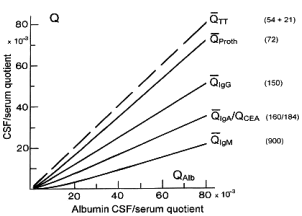
Fig. 2. CSF protein concentration as a function of QA1b.
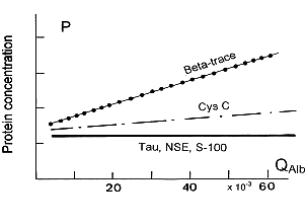
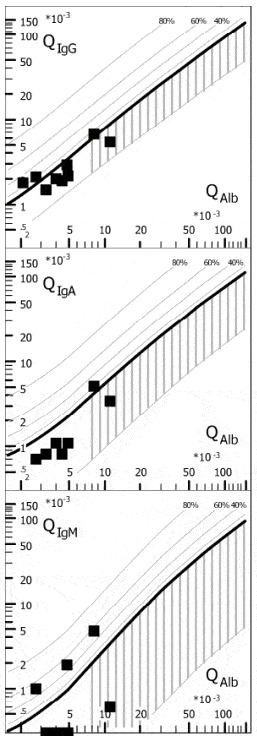
Fig. 3. CSF data of patients with schizophrenic or affective spectrum disorders in Reibergrams (1). These patients represent a subgroup with inflammatory signs in CSF (9/63) involving 3 cases with intrathecal IgG, 1 case with intrathecal IgA and 3 cases with intrathecal IgM synthesis or other signs of inflammation, like intrathecal antibodies or increased cell count in CSF (5). The graph is created with the CSF statistics tool of COMED (14).

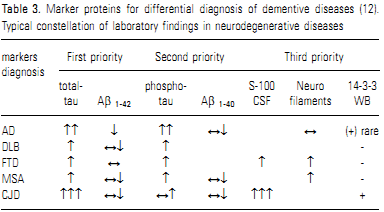
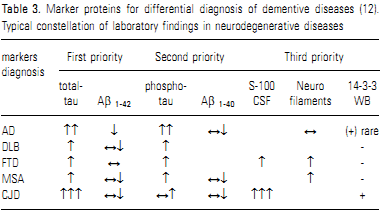
Typical findings of markers in neurodegenerative diseases are shown in Table 3. New research approaches from direct measurement of oligomers in specific diseases to proteomic expression profiles might come into clinical use Reference Otto, Lewczuk and Wiltfang(12,Reference Jesse, Steinacker, Lehnert, Gillardon, Hengerer and Otto13).
CSF analysis in psychiatric patients:
In a recent study(5) the authors analysed albumin, IgG, IgA, IgM, oligoclonal IgG and specific antibodies in CSF and serum from hospitalised affective and schizophrenic spectrum disorder patients. Numerical and graphical interpretation of CSF protein data was performed in Reibergrams Reference Reiber and Peter(1)) with a new CSF statistics tool for nonlinear group analysis with reference to a large control group Reference Reiber and Albaum(14)). As much as 41% of the psychiatric patients investigated (n=63) had pathological parameters in CSF: 14% intrathecal humoral immune responses, 10% slightly increased CSF cell counts. 24% had moderate increase of the Albuminquotient QAlb (blood-CSF barrier dysfunction) as the only pathological sign with normal IgG, IgA and IgM concentrations in CSF. CSF analysis and interdisciplinary clinical approach helped to rediagnose 6% of psychiatric patients as likely representing a specific virus, streptococcus or autoimmune associated disorder with CNS involvement.
Conclusions:
CSF analysis is an underestimated diagnostic tool for differential diagnosis in psychiatric and noninflammatory diseases.
Disease-related relevance of marker proteins

↑ increase; ↓, decrease; ↔, not changed; −, negative immunoblot;+, positive immunoblot; AD, Alzheimer's disease, DLB, Lewy-bo dy disease; FTD, fronto-temporal demen tia; MSA, multiple system atrophy; CJD, Cre utzfeldt-Jakob disease.
†95% conf idence interval.
‡Mann–Whitney U test with Exact statistical significance (P).
Predominantly brain-derived proteins in CSF regarding the intrathecal fraction (IF) calculated from theoretical molecular size (MW = molecular weight) dependent transfer of the blood derived fraction into CSF

Marker proteins for differential diagnosis of dementive diseases (12). Typical constellation of lab oratory findings in neurodegenerative diseases