Introduction
Worry, the cardinal symptom of Generalized Anxiety Disorder (GAD), initiates a cascade of internal events (Newman et al., Reference Newman, Llera, Erickson, Przeworski and Castonguay2013). Based on evidence gathered from experimental studies of worry (e.g. Andrews and Borkovec, Reference Andrews and Borkovec1988; McLaughlin et al., Reference McLaughlin, Borkovec and Sibrava2007a; Llera and Newman, Reference Llera and Newman2010), worry generates and sustains negative affect (Newman and Llera, Reference Newman and Llera2011). Worrying also leads to negative health outcomes, such as cardiac events (Kubzansky et al., Reference Kubzansky1997). Brosschot et al. (Reference Brosschot, Gerin and Thayer2006) describe the possible etiology of the association between worry and negative health outcomes in their Perseverative Cognition Hypothesis. The authors postulate that engaging in prolonged thinking, as in worry or rumination, lengthens the duration of a stress response even after the repetitive thinking ceases (Brosschot et al., Reference Brosschot, Van Dijk and Thayer2007). These prolonged cardiovascular stress responses, such as chronically elevated heart rate and blood pressure, and diminished cardiovascular flexibility, are risk factors for cardiovascular disease (Thayer et al., Reference Thayer, Yamamoto and Brosschot2010) and mortality (Tsuji et al., Reference Tsuji1994). In light of the association between worry and cardiovascular disease, as well as increased rates of cardiovascular disease in older adulthood, understanding worry among older adults is important.
Many studies (e.g. Basevitz et al., Reference Basevitz, Pushkar, Chaikelson, Conway and Dalton2008; Gould and Edelstein, Reference Gould and Edelstein2010) have found that older adults worry less than young adults. Although older adults worry less than young adults, late-life worry is associated with substantial distress, particularly greater disability and greater healthcare utilization (de beurs et al., Reference de Beurs1999) and diminished quality of life in the context of GAD (Wetherell et al., Reference Wetherell2004). Nonetheless, the etiology of fewer worry symptoms in late life is unknown. Further, inconsistent findings of age differences in emotional reactivity and physiological arousal complicate the interpretation of age differences in worry. One explanation for diminished worry in late life is that older adults worry less often or not as intensely due to experiencing fewer daily stressors than young adults (Brose et al., Reference Brose, Scheibe and Schmiedek2013). In addition to experiencing fewer stressors, older adults may have less fluctuation than young adults in their affective states (e.g. Brose et al., Reference Brose, Scheibe and Schmiedek2013), which could lead older adults to experience less intense negative emotions that accompany worry. Brose et al. (Reference Brose, Schmiedek, Lövdén and Lindenberger2011) also found that older adults experienced both lower levels of intrusive thoughts and less negative affect compared with young adults, which supports evidence of diminished intrusive thoughts and dampened negative affect in older adults compared with young adults.
Experimental inductions of anxiety and panic symptoms in older and young adults provide some evidence of the role of anxiety-evoking stimuli in detecting age differences in the experience of anxiety. For instance, Fox and Knight (Reference Fox and Knight2005) had older and younger participants read an article about bioterrorism with the instruction that afterwards participants would present a summary of the article to a panel of judges. The induction induced anxiety in older adults, but not in young adults. In another study, Teachman and Gordon (Reference Teachman and Gordon2009) examined age differences in older and young adults’ responses to three anxiety-inducing tasks. No age differences in response to two tasks that simulated anxiety symptoms were found. However, in response to the third anxiety-provoking task, a brief, impromptu speech about what participants liked about their hometown, older adults had less anxiety, less fear, and lower heart rates compared with young adults. Age differences in experimentally induced anxiety were evident, but the different stimuli yielded contradictory findings regarding age differences in anxiety symptoms. Findings from an experimental mood induction study (e.g. Kunzmann and Grühn, Reference Kunzmann and Grühn2005) provide support for the importance of selecting age-relevant stimuli (e.g. new diagnosis of Alzheimer's disease, death of a family member). Using age-relevant imagery in a mood induction yielded equivalent or sometimes more intense self-reported emotions for older adults than young adults, but no age differences on autonomic reactivity (i.e. interbeat intervals, finger-pulse amplitude, pulse transmission time, respiration, finger temperature) to the imagery (Kunzmann and Grühn, Reference Kunzmann and Grühn2005). Inconsistent findings of experimental studies on age differences in anxiety combined with the findings of Kunzmann and Grühn (Reference Kunzmann and Grühn2005) points to the importance of using age-relevant stimuli to induce worry in a future study.
Age-related changes in psychophysiological arousal could affect the extent to which older adults worry and experience the negative effects of worrying. Findings from a meta-analysis and review (Uchino et al., Reference Uchino, Birmingham and Berg2010) suggest that in contrast to young adults, older adults are less reactive to experimental emotion-based tasks when heart rate is measured, but this finding does not hold for blood pressure or skin conductance reactivity. For instance, in response to an emotion manipulation in one study, (Seider et al., Reference Seider, Shiota, Whalen and Levenson2011) older adults had increased negative affect and blood pressure reactivity in older adults. In a naturalistic study that used daily diaries and ambulatory heart rate monitoring, older adults experienced more negative affect and greater cardiovascular reactivity than young adults if the stressor was complex compared with less complex stressors (see Wrzus et al., Reference Wrzus, Müller, Wagner, Lindenberger and Riediger2013 for details). Age differences in psychophysiological arousal may exist, but evidence from experimental and naturalistic studies suggests that inconsistent findings may be due to type of stimuli or physiological measures used. Age differences in emotional reactivity and intensity in previous studies also may be a function of stimulus relevance for older individuals (Kunzmann and Grühn, Reference Kunzmann and Grühn2005).
Later adulthood appears to be a time of fewer worry symptoms and the factors contributing to this apparent age difference are likely a combination of some or all of the contributing factors discussed above. Further, extrapolating older adults’ experience of worry based only on findings from experimental studies with young adults would be inaccurate based on evidence of age differences in anxious responding and the importance of selecting age-relevant stimuli. To this end, our aim was to characterize worry in a community-dwelling sample of older adults and to examine whether age differences in worry exist in a non-clinical sample. In the present study, experimental manipulations of worry were used with older and young adults to examine causal relations among worry, emotion, self-reported (i.e. subjective) arousal, and psychophysiological measures. Psychophysiological measures were interbeat intervals (IBI), the time interval between heart beats in a single cardiac cycle, and respiratory sinus arrhythmia (RSA), an estimate of the variability in beat to beat interval and measure that approximates parasympathetic activity. Instructions for the two experimental conditions, worry and recall of recent pleasant or neutral events, were ideographic. An individualized worry induction in older adults was used with older adults with and without GAD in a previous study (Andreescu et al., Reference Andreescu2011), which provides initial validation for the successful induction of worry in older adults, but does not address whether age differences in worry exist.
Five hypotheses were generated based on our expectations of the presence and absence of age differences on worry intensity, emotional experience, self-reported arousal, and objective physiological arousal, specifically IBI and RSA. In light of previous findings, (e.g. Basevitz et al., Reference Basevitz, Pushkar, Chaikelson, Conway and Dalton2008), we expected to find baseline age differences such that older adults would experience fewer negative emotions and lower objective and self-reported arousal compared with young adults. Consequently, our hypotheses adjust for baseline values of each measure in the corresponding analysis because we expected systematic age differences therein. In hypothesis one, we predicted that older and young adults would have similar increases in worry intensity for the worry induction, which is based on findings that older and young adults experience anxiety symptoms similarly when stimuli are age-relevant (Kunzmann and Grühn, Reference Kunzmann and Grühn2005). In hypothesis two, we predicted that compared with young adults, older adults would experience smaller increases in negative emotions, specifically, anxiety, depressed affect, and hostility, and a smaller decrease in positive affect in response to the worry induction. This hypothesis is grounded in previous evidence of reduced affect variability among older adults (e.g. Brose et al., Reference Brose, Schmiedek, Lövdén and Lindenberger2011; Brose et al., Reference Brose, Scheibe and Schmiedek2013). In hypothesis three, we predicted that older adults would have smaller increases in self-reported arousal than young adults following the worry inductions, which is consistent with Teachman and Gordon's (Reference Teachman and Gordon2009) finding of lower perceived heart rate change in older adults. In hypothesis four, we predicted that older adults would have smaller decreases in IBIs, an index of cardiovascular reactivity, than young adults for the worry induction. In hypothesis five, we predicted that older adults would have smaller reductions in RSA than young adults during the worry induction. Hypotheses four and five are based on evidence of older adults’ reduced heart rate reactivity in response to experimental tasks relative to young adults (Uchino et al., Reference Uchino, Birmingham and Berg2010).
Methods
Participants
One hundred nine participants (56 older and 53 young adults) consented and participated in the present study. One older participant randomized to the pleasant/neutral recall induction experienced a recent stressor that influenced responses during the experiment and was excluded from the study. The findings reported here are based on 108 participants (55 older and 53 young adults). Two age groups were eligible for the present study: older adults (aged ≥ 60 years) and young adults (aged 18 to 30 years). Individuals were excluded if they: (1) were current smokers, (2) were taking beta-blockers, anxiolytics, psychostimulants, or diet pills, (3) had pacemakers, (4) had histories of arrhythmias, heart surgery, or heart attacks, or (5) scored 22 or below on the Montreal Cognitive Assessment (MoCA; Nasreddine et al., Reference Nasreddine2005). One participant failed to report an arrhythmia on the screening questionnaire, completed the study, and was excluded from psychophysiological analyses. Young adult graduate or undergraduate students were recruited from psychology classes, emails to listservs, flyers, and word-of-mouth. Older adult participants were recruited via listservs, news announcements on websites, television advertisements on the community bulletin, flyers, researcher visits to senior centers, word-of-mouth, and following participation in previous studies. Monetary compensation ($20) was provided to older adults, whereas young adults were provided with extra credit and monetary compensation ($5).
Pre-Experiment measures
Each participant completed a screening questionnaire that assessed exclusion criteria with questions about current smoking status, cardiovascular illness, medical and psychiatric problems, and current medications. A demographic and health questionnaire that assessed demographic and additional personal and family health history was also completed.
The Penn State Worry Questionnaire (PSWQ; Meyer et al., Reference Meyer, Miller, Metzger and Borkovec1990) was completed by participants to assess the excessiveness and uncontrollability of worry. PSWQ items are rated from 1 (not at all typical) to 5 (very typical); total scores range from 16 to 80 with higher scores indicating greater worry. Evidence for the convergent validity of the PSWQ has been found with older (Beck et al., Reference Beck, Stanley and Zebb1995) and young adults (e.g. Meyer et al., Reference Meyer, Miller, Metzger and Borkovec1990). In the present study, internal consistency was good for older adults (α = 0.84) and excellent for (α = 0.95) for young adults.
The MoCA (Nasreddine et al., Reference Nasreddine2005) is a clinician-administered cognitive screening instrument, was administered to detect possible mild cognitive impairment and possible dementia. MoCA scores range from 0 to 30. A cut-off of 22 or below yields excellent sensitivity (96%) and specificity (95%) for detecting mild cognitive impairment or dementia (Luis et al., Reference Luis, Keegan and Mullan2009). The MoCA has good reliability and convergent validity with brief cognitive assessments and a neuropsychological assessment battery (Nasreddine et al., Reference Nasreddine2005).
Dependent measures
self-report measures
Worry intensity was measured with a single item in which participants were asked to rate the intensity of their worry on a scale from 0 (not at all) to 100 (extremely worried). Worry intensity was included as an assessment of the extent to which the worry induction resulted in greater worry than the recall induction. A previous study (Andor et al., Reference Andor, Gerlach and Rist2008) also used worry intensity ratings.
Participant's self-reported emotional state was assessed by the state form of the Multiple Affect Adjective Checklist-Revised (MAACL-R; Zuckerman and Lubin, Reference Zuckerman and Lubin1985). The MAACL-R contains 132 emotion adjectives. Participants check which adjectives that describe the emotional state they are experiencing at the time of the assessment. Here we examine four subscales: anxiety (10 items), depression (12 items), hostility (15 items), and positive affect (21 items). Based on previous studies, the MAACL-R subscale scores demonstrate good convergent and discriminant validity with other self-report measures. The state MAACL-R anxiety subscale had a large association (r = 0.56) with an anxiety subscale on the State-Trait Personality Inventory and a lower association (r = 0.35) with the depression subscale (Lubin and Zuckerman, Reference Lubin and Zuckerman1999). Low variability for the subscales at baseline was found in older and young adults and was reflected in low internal consistency coefficients for the separate age groups. Consequently, we report Kuder Richardson-20 (KR-20) values at baseline for the entire sample: 0.64 for anxiety, 0.73 for depression, 0.77 for hostility, and 0.88 for positive affect.
Participants’ subjective sense of arousal was measured using the arousal item of the Self Assessment-Manikin (SAM; Bradley and Lang, Reference Bradley and Lang1994), a picture-oriented rating scale used to report one's response to a stimulus. Five pictures range from an excited wide-eyed figure to a relaxed sleepy figure for the arousal item. This non-verbal assessment correlates highly with verbal semantic differential scales and with behavioral and physiological assessments (Bradley and Lang, Reference Bradley and Lang1994).
psychophysiological measures
A Polar heart rate monitor model 810i (Lake Success, New York) was used to measure interbeat intervals (IBIs). The Polar monitor is frequently used in experimental research studies (e.g. Teachman and Gordon, Reference Teachman and Gordon2009). Heart rate assessed with the Polar monitor is very strongly correlated with heart rate measured with an echocardiogram (r = 0.98, Goodie et al., Reference Goodie, Larkin and Schauss2000). Three minute continuous segments of IBI data were not available for 23 baseline or induction periods due to temporary loss of connection between the heart rate monitor and the participant's chest. We excluded participants (n = 21) who were missing continuous segments of IBI data, resulting in an n of 86 for IBI and RSA analyses. The Polar Precision Performance SQ analysis software was set at a moderate filtering level; all corrections were reviewed by the first author before values were replaced. A mean of 1.4% and 0.9% of data points were replaced for young and older participants respectively. Kubios HRV v2.0 (Niskanen et al., Reference Niskanen, Tarvainen, Ranta-aho and Karjalainen2004) was used to calculate the root mean squared difference of successive intervals (RMSSD), a time-domain measure of RSA.
Post-Experiment measures
After the experiment participants completed two questions to examine the extent to which participants followed instructions and to examine whether the worry and pleasant/neutral recall inductions were similar to the participant's everyday thinking or worrying. The items, modeled after items used in previous studies (e.g. Andor et al., Reference Andor, Gerlach and Rist2008), were rated using a Likert-type scale ranging from 1 (very untrue) to 7 (very true) for the first item and 1 (not at all similar) to 7 (very similar) for the second item.
Procedure
Prior to the study visit, participants were asked not to consume caffeine, smokeless tobacco, or alcohol or engage in exercise for two hours prior to the study visit. After obtaining consent, the researcher demonstrated the proper placement of the Polar heart monitor and briefly explained how it worked. All participants were seated for the duration of the experiment. Participants placed the monitor on themselves, completed the questionnaires, and the researcher administered the MoCA to detect possible cognitive impairment. One individual was excluded from the study at this point, paid $5 per the consent form, and told that a cut-off was established on the measure for the study and lower scores may indicate cognitive problems and was advised to discuss cognitive difficulties with a phyician. Participants were randomly assigned via simple randomization to one of two conditions: worry induction or pleasant/neutral recall induction. If the Polar heart rate monitor signal was intermittent while the participant completed questionnaires, modifications such as asking the participant to sit up straight or tighten the monitor across their chest, were made during a planned stopping point in the experiment.
To establish a baseline, participants were instructed to sit quietly for three minutes with their eyes closed. After the baseline, the researcher read a definition of worry and provided the definition on paper for participants to refer to throughout the study. We used a previous study's definition of worry (McLaughlin et al., Reference McLaughlin, Borkovec and Sibrava2007a) that we modified by incorporating simpler words that may be more familiar to older adults. Our clarification of the definition was provided in brackets: “intrusive [distracting or bothersome] thoughts or images about potential future events or catastrophes [concerns] that produce negative feelings when they occur” (McLaughlin et al., Reference McLaughlin, Borkovec and Sibrava2007a, p. 27). Participants were then asked to complete the worry intensity item, SAM arousal item, and MAACL-R. Next, the researcher read either the worry or recall instructions depending on randomization. The duration of both induction periods was five minutes. The worry and recall inductions were completed silently by the participant.
The worry instructions have been used in previous studies with young adults (e.g. McLaughlin et al., Reference McLaughlin, Borkovec and Sibrava2007a; Reference McLaughlin, Mennin and Farach2007b). In the worry induction, participants were provided a piece of paper and asked to write three topics or concerns they worry about the most. After three concerns were recorded, the researcher asked participants to worry in a typical fashion, but as intensely as possible until asked to stop. At 2.5-min, the researcher interrupted the induction to instruct participants to complete the worry intensity item and the SAM arousal item. At the end of the induction, participants completed the worry intensity item, SAM arousal item, and MAACL-R. Intermittent ratings did not appear to alter the effect of inductions used in other investigations (e.g. McLaughlin et al., Reference McLaughlin, Borkovec and Sibrava2007a).
The recall instructions were slightly modified from instructions used in previous studies with young adults. McLaughlin and colleagues (Reference McLaughlin, Mennin and Farach2007b) asked participants to recall three tasks completed during the prior weekend. We changed recall instructions from recalling a neutral event (McLaughlin et al., Reference McLaughlin, Mennin and Farach2007b) to recalling either neutral or pleasant events. The goal of this change was to help patients not engage in worry or rumination during the comparison condition. After reading the instructions, the researcher gave participants a sheet of paper and asked them to write three pleasant or neutral activities or tasks completed last weekend. The researcher asked participants to think about the topics listed until asked to stop. Participants completed the worry intensity and SAM arousal items at 2.5-min and then again at the end of the induction along with the MAACL-R.
After the induction period and completion of post-induction questionnaires, a brief 1-min re-induction was conducted and followed by a focused breathing exercise. The aim of the re-induction and focused breathing period was to examine the return to baseline levels of anxiety and arousal. These data are not included in the present report. The researcher debriefed participants and inquired about concerns or residual symptoms.
Data analysis
A power analysis conducted using Sample Power 2 (Sample Power 2, SPSS Inc., an IBM Company, Chicago, IL) suggested that a sample of 104 participants was needed to obtain a power level of 0.71 to detect a medium-sized effect for a 2 × 2 factorial analysis of variance (ANOVA). Based on previous studies with similar sample sizes (e.g. Teachman and Gordon, Reference Teachman and Gordon2009) we expected to find a medium to large effect of worrying on measures of worry intensity and emotions. All statistical analyses were conducted with SPSS Statistics 20 (SPSS Inc., an IBM Company, Chicago, IL) and are reported using an alpha of 0.05. As part of preparation of the data for analysis, univariate and multivariate outliers were identified and examined. One participant had IBI and RMSSD scores that were univariate outliers (Z > 3) and the results affected the results and were excluded from corresponding analyses. Missing self-report data were found for worry intensity for one participant; no data were imputed. Because individuals with missing data on worry intensity and IBI or RMMSD were excluded from corresponding analyses, samples varied in size, but overall a sample of 54 older adults and 53 young adults was used for analyses. A positive skew (z < 2.6) was observed for self-report variables (except MAACL-R positive affect) during baseline and pleasant/neutral recall. A positive skew for MAACL-R depression and hostility was observed for the worry induction. Due to the skew, the assumption of normality was not achieved in the present sample using the raw data. Standardized residuals scores were calculated and used to address the skew and adjust for baseline differences in the analyses addressing the five hypotheses. To obtain the residual scores, we regressed experimental period on the baseline period for each variable. We used the standardized residual scores from the regression as the dependent variable for the corresponding analyses.
Age differences on pre-experiment questionnaires and baseline assessments were examined using student's t-tests and ANOVAs. Induction group differences at baseline following randomization were examined with student's t-tests. Adjusted t-test statistics are reported wherever variances were unequal as evidenced by a violation of Levene's test. Univariate and multivariate analyses were conducted with between-subjects variables of age (older and young) and induction type (worry and pleasant/neutral recall) to address the five hypotheses. Additional details on the data analysis are incorporated below.
Results
Participant characteristics
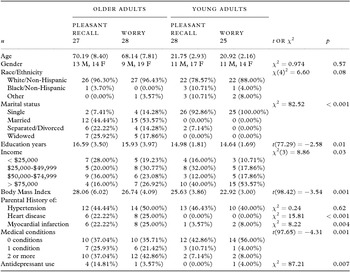
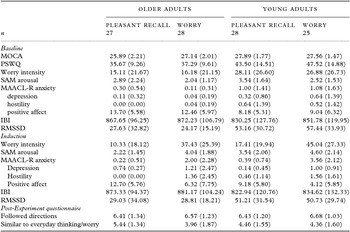
Older and young adults differed on several demographic characteristics (Table 1). More older adults were married, had more years of education, more medical problems, and higher BMIs compared with young adults. Older adults were more likely to be taking antidepressants or to have parental family history of myocardial infarction or coronary heart disease compared with young adults. As found in previous research (e.g. Gould and Edelstein, Reference Gould and Edelstein2010), age differences emerged on measures completed before the experiment began. Table 2 provides means and standard deviations by age and induction type. Older adults had lower MoCA scores, t(99.84) = 3.27, p = 0.001 and lower PSWQ scores, t(87.92) = 3.74, p < 0.001, compared with young adults. High worriers, defined as participants with PSWQ scores one SD above the normative mean (Llera and Newman, Reference Llera and Newman2010), were identified using norms published in Startup and Erickson (Reference Startup, Erickson, Davey and Wells2007). Five older adult and ten young adults were identified as high worriers because they had scores one standard deviation above the respective PSWQ means of 38.94 (SD = 10.98) for unselected older adults and 47.42 (SD = 13.40) for unselected college students. The proportion of high worriers did not differ significantly across age groups, χ2 = 2.16 p = 0.14.
Demographic Characteristics of Older and Young Adults (n (%) or M (SD)

Note. The t and χ2 tests compared older and young adults. Income refers to total family income. Four participants did not provide income data.
Self-report and psychophysiological variables means and standard deviations at baseline and induction periods

Note. N = 86 for IBI and RMSSD.
Age differences in several baseline measures (N = 108) were found. Older adults reported lower baseline worry intensity, t(99.66) = 2.57, p = 0.01, lower anxiety, t(60.79) = 3.89, p < 0.001, lower depression, t(65.20) = 2.009, p = 0.049, lower hostility, t(52.94) = 2.949, p = 0.005, and higher positive affect, t(106) = −4.04, p < 0.001 compared with young adults. Older adults (n = 51, M = 876.83, SD = 110.34) had greater baseline IBI, t(102) = −2.09, p = 0.04 than young adults (n = 53, M = 826.10, SD = 135.19). Older adults also had lower RMSSD, t(79.13) = 4.76, p < 0.001, compared with young adults (See Table 2).
Results of randomization
Fifty-five participants (27 older and 28 young adults) were randomized to the pleasant/neutral recall induction and 53 participants (28 older and 25 young adults) were randomized to the worry induction. Randomization resulted in an even distribution of high worriers in the recall (n = 7) and in the worry inductions (n = 8), χ2 = 0.13 p = 0.79. Randomization was successful for all baseline variables with the exception of self-reported arousal. Participants assigned to the recall induction had significantly higher arousal (M = 3.22, SD = 1.97) than those assigned to the worry induction (M = 2.26, SD = 1.36), t(96.24) = 2.94, p = 0.004.
Effects of experimental manipulation
The effects of the manipulation were examined using one self-report item completed after the experiment and an analysis of the worry intensity ratings. A 2 (Age) × 2 (Induction) ANOVA was conducted on the extent to which participants followed instructions. No effects of age, F(1,104) = 0.08, p = 0.78, induction, F(1,104) = 0.81, p = 0.37, or age by induction interaction, F(1,104) = 0.04, p = 0.85, were found. Both experimental groups reported that it was true that they attempted to follow the instructions (M worry = 6.62, M recall = 6.42).
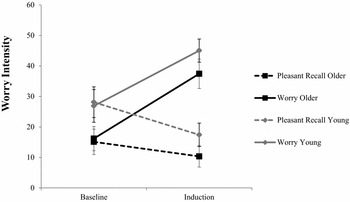
To determine the effectiveness of the manipulation and to address the first hypothesis, which stated that both older and young adults would report increases in worry intensity for the worry induction compared with the recall induction, a 2 (Age) × 2 (Induction) ANOVA was conducted on worry intensity residuals. A main effect of induction type emerged, F(1, 103) = 83.02, p < 0.001, partial η2 = 0.45. An inspection of the means revealed that the worry intensity increased from baseline for the worry induction (M = 0.67, SD = 0.84), whereas the worry intensity decreased for the recall induction (M = −0.66, SD = 0.63). No significant main effects of age, F(1,103) = 0.07, p = 0.80, or age by induction interaction was found, F(1,103) = 0.12, p = 0.73. Figure 1 displays the raw data for worry intensity.
Mean worry intensity ratings for pleasant recall and worry inductions. Note: Error bars represent standard error of the mean.

More information about the two age groups’ experience of the recall and worry inductions can be found in their perception of how similar or dissimilar these laboratory inductions were to everyday thinking or worrying. Older adults found that the recall induction was less similar to their everyday thinking compared with young adults, t(53) = −2.50, p = 0.02. No significant differences in how similar the worry induction was to worrying were found, t(51) = 0.82, p = 0.42 for older compared with young adults (See means in Table 2).
Effects of experimental induction on emotions
The second hypothesis, which stated that, relative to young adults, older adults would experience smaller increases in self-reported anxiety, depressed affect, and hostility, and smaller decreases in positive affect following the worry induction compared with recall, was addressed with a 2 (Age) × 2 (Induction) MANOVA conducted on the four MAACL-R subscales residuals. The assumption of equality of covariance matrices was violated, evidenced by a significant Box's test of equality of covariance matrices. The Pillai-Bartlett trace is reported because it is considered to be the most robust multivariate statistic when assumptions are violated (Bray and Maxwell, Reference Bray and Maxwell1985). A significant main effect of induction type emerged, Pillai's Trace V(4, 101) = 21.00, p < 0.001, partial η2 = 0.45, with increased anxiety, depression, hostility, and decreased positive affect from baseline for the worry induction. The age by induction interaction was significant, Pillai's Trace V(4, 101) = 2.68, p = 0.04, partial η2 = 0.10. No main effect of age was found, Pillai's Trace V(4, 101) = 1.08, p = 0.37.
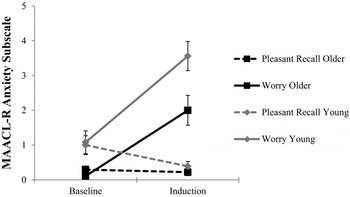
Follow-up ANOVAs were conducted to explore the significant age by induction interaction on emotions measured with the MAACL-R subscales. Figure 2 displays the raw means for the anxiety subscale. First, a 2 (Age) × 2 (Induction) ANOVA was conducted on MAACL-R anxiety subscale residuals. A significant main effect of induction type, F(1, 104) = 75.59, p < 0.001, partial η2 = 0.42, was found. A significant age by induction interaction, F(1, 104) = 4.59, p = 0.03, partial η2 = .04, emerged as well. The main effect of age on anxiety was not significant, F(1, 104) = 1.77, p = 0.19. Following the significant age by induction interaction, a comparison of the means was conducted using t-tests. An examination of differences in induction type yielded significant effects of induction type for both young adults, t(37.46) = −8.11, p < 0.001, and older adults, t(28.37) = −4.41, p < 0.001. An examination of age differences in the worry induction demonstrated that young adults reported greater increases in anxiety (M = 0.91, SD = 0.85) than older adults (M = 0.40, SD = 1.13), but these findings were not significantly different, t(51) = 1.82, p = 0.08. In the recall induction, no age differences in anxiety emerged for young (M = −0.68, SD = 0.49) and older adults (M = −0.56, SD = 0.18), t(34.06) = −1.20, p = 0.24.
Mean scores for MAACL-R anxiety subscale for pleasant recall and worry inductions. Note: Error bars represent standard error of the mean.

For the remaining MAACL-R subscales, only main effects of induction type were found in the follow-up ANOVA analyses. Main effects of induction type resulted in increases in depression, F(1, 104) = 14.70, p < 0.001, partial η2 = 0.12, and hostility, F(1, 104) = 17.51, p < 0.001, partial η2 = 0.14, in the worry induction. A main effect of induction type resulted in a decrease in positive affect, F(1, 104) = 35.30, p < 0.001, partial η2 = 0.25, for worry induction compared with recall. No main effect of age was found for depression, F(1, 104) = 0.101, p = .752, hostility, F(1, 104) = 0.20, p = 0.66, or positive affect, F(1, 104) = 0.07, p = 0.79. The age by induction interactions were not significant for depression, F(1, 104) = 0.29, p = 0.59, hostility, F(1, 104) = 0.12, p = 0.73, or positive affect, F(1, 104) = 0.006, p = 0.94.
Effects of experimental inductions on subjective and objective arousal
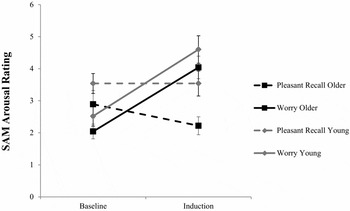
Mean SAM self-reported arousal ratings for the recall and worry inductions are displayed in Figure 3. To address the third hypothesis, that older adults would report smaller increases in self-reported arousal than young adults following both induction periods, a 2 (Age) × 2 (Induction) ANOVA was conducted with SAM arousal residuals. A significant main effect of age was found, F(1, 104) = 4.81, p = 0.03, partial η2 = 0.04, such that older adults had overall decreases in arousal (M = −0.17, SD = 0.95) and young adults had overall increases in arousal (M = 0.17, SD = 1.03). A significant main effect of induction type was found, F(1, 104) = 29.14, p < 0.001, partial η2 = 0.22, such that arousal increased in the worry induction (M = 0.46, SD = 0.89) and decreased in the recall induction (M = −0.44, SD = 0.89). No age by induction interaction was found for self-reported arousal, F(1,104) = 1.08, p = 0.30.
Mean SAM arousal ratings for pleasant recall and worry inductions. Note: Error bars represent standard error of the mean.

To address the fourth hypothesis that older adults would have smaller decreases in IBIs than young adults for the worry induction, a 2 (Age) × 2 (Induction) ANOVA on IBI residuals was conducted. A significant main effect of age emerged, F(1, 82) = 7.08, p = 0.009, partial η2 = 0.08, such that young adults had greater decreases in IBI from baseline (M = −0.27, SD = 1.16), whereas older adults had increases in IBI from baseline (M = 0.27, SD = 0.16). No significant main effect of condition, F(1,82) = 0.13, p = 0.73, or age by induction interaction was found, F(1,82) = 0.63 p = 0.43.
To address hypothesis five, that older adults would have smaller reductions in RSA than young adults during the worry induction, a 2 (Age) × 2 (Induction) ANOVA on RMSSD residuals was conducted. Main effects of age, F(1,82) = 2.439, p = 0.12, and induction type, F(1,82) = 0.08, p = 0.78, and age by induction interaction, F(1,82) = 2.05, p = 0.16, were not significant.
Discussion
Our principal aims were to characterize worry in a community-dwelling sample of older adults and to examine whether age differences in worry exist in a non-clinical sample. As expected, baseline age differences were found such that older adults had lower worry intensity, less anxiety, less hostility, higher positive affect, and lower psychophysiological arousal (greater IBI and lower RMSSD). These findings were consistent with previous studies comparing young and older adults (e.g. Basevitz et al., Reference Basevitz, Pushkar, Chaikelson, Conway and Dalton2008; Gould and Edelstein, Reference Gould and Edelstein2010). After adjusting for baseline differences in analyses, we found that one hypothesis was supported, three were partially supported, and one was not supported. The first hypothesis was supported in that the worry induction resulted in similar sized increases in worry intensity for older and young adults. This finding provides support of the effectiveness of the manipulation. The second hypothesis was partially supported in that age differences in emotions emerged such that worry resulted in smaller changes in self-reported emotions for older adults compared with young adults. Although this interaction was significant, follow up analyses indicated that the magnitude of the effect was small. The third and fourth hypotheses were partially supported; summarized across both inductions, older adults experienced less self-reported arousal and demonstrated increases in IBI from baseline compared with young adults, whereas young adults had a reduction in IBI from baseline. Hypothesis five was not supported in that we did not find any age effects for RSA reactivity. Although our worry induction increased self-reported arousal, there was no corresponding change in objectively measured arousal, specifically, IBI or RSA. A discussion of the study results and their implications follows.
Findings from our study generate preliminary evidence of how worry is experienced by older adults, which achieves our first study aim. We found that older adults experience worry as a mix of negative emotions and increased self-reported arousal, which is consistent with how worry is described in the literature (e.g. Newman et al., Reference Newman, Llera, Erickson, Przeworski and Castonguay2013). It is noteworthy that our worry induction had an effect on subjective measures of arousal (self-reported SAM arousal ratings), but not objective measures (IBI and RSA). Null results for IBI and RSA reactivity stand in contrast to the Perseverative Cognition Hypothesis (Brosschot et al., Reference Brosschot, Gerin and Thayer2006). Worrying was expected to be associated with shorter IBI and lower RSA as demonstrated in previous experimental studies (e.g. Thayer et al., Reference Thayer, Friedman and Borkovec1996). However, these null findings may be due to diminished sample power from missing data on RSA, the heterogeneity of the recall induction, or the strength of the worry induction.
Age variations in the experience of anxiety were found, which helps clarify age differences in worrying and thus addresses our second study aim. Previous research has demonstrated lower trait worry and anxiety among older than young adults using questionnaire studies with cross-sectional designs. Our findings suggest that older adults had reduced changes in emotions in response to the worry induction compared with young adults’ responses. The present study demonstrates that whereas older adults may report lower levels of trait worry, older and young adults have similar sized increases in worry intensity when worrying about personally relevant topics. In our post hoc analyses we found that older adults reported marginally less anxiety than young adults during the worry induction. The experimental inductions affected self-reported arousal. No effects were found for IBI and no age by induction interactions were found. Though older adults had lower magnitudes of subjective or self-reported arousal, the pattern of subjective reactivity to the experimental inductions was the same for both age groups. This explanation is consistent with Levenson's (Reference Levenson, Quails and Abeles2000) conclusion that older adults have similar emotional experiences to young adults, but exhibit a lower magnitude of objectively measured arousal associated with emotional experience. Contrary to expectations, the present study partially supports to the hypothesis that diminished affect variability accounts for lower worry in older adults. Here, we found that older adults experienced smaller increases in only one type of negative affect, anxiety, compared with young adults during the worry induction. More research is needed to determine whether age differences in anxiety and worry are due to lower rates of subjective or objective physiological arousal in older adults compared with young adults.
A second possible explanation of the finding of reduced levels of emotions among older adults in the worry induction compared to young adults is that older adults may engage in emotion regulation strategies (e.g. avoiding arousing worry content) to minimize arousal. For instance, older adults may monitor their emotion and arousal and maintain their emotion levels within a certain range of tolerability. Monitoring emotion and arousal levels are emotion regulation strategies that would result in age differences in arousal. More research is needed to directly test these hypotheses.
Our findings provide insight into the experience of late-life worry, which is beneficial to clinicians and researchers. The constellation of findings on level of affect and level of arousal demonstrates that compared with young adults, older adults have lower levels of negative affect and lower subjective arousal. Interestingly, both young and older adults experienced similar increases in worry intensity when asked to worry, which suggests that when older adults do worry, they experience dampened negative emotions (anxiety, sadness, and depression). This finding is consistent with previous research on intrusive thoughts in late life (Brose et al., Reference Brose, Schmiedek, Lövdén and Lindenberger2011). Despite the difference in intensity of emotions, the pattern of emotions experienced during worry is the same for young and older adults. Thus, the tripartite model (Clark and Watson, Reference Clark and Watson1991) fits older adults’ experience of worry and demonstrates that worry is closely tied to factors underlying both depression and anxiety.
Our findings have potential age-related clinical implications for the assessment of worry. Lower base rates of worry and the resulting anxiety and arousal among older adults may result in subthreshold symptoms of worry that are difficult to detect using norms on measures developed with mostly young adults. The finding of an absence of age differences in baseline-adjusted worry intensity has important implications for providers who may rely on questionnaire based assessments of worry. Using geriatric norms is essential to the assessment of late-life worry to avoid underestimating the severity of worry, as may occur when older adults’ questionnaire scores are compared with young or middle-aged adult norms. Furthermore, because older adults report lower overall arousal during worry, it is important to use measures that also assess the cognitive and affective symptoms.
Several limitations of the present study should be taken into consideration. The present findings may not be generalizable to all older Americans, as older participants were mostly Caucasian and highly educated. Diagnostic interviews were not used to identify or exclude individuals who met criteria for an anxiety disorder. Although individuals taking medications that influence cardiac reactivity (e.g. anxiolytics) were excluded, individuals taking antidepressants that may affect psychophysiological measures were allowed to participate. Due to low power, antidepressants were not included in analyses as a covariate. Other limitations to the study method and measurement include the absence of any measure of respiration to better estimate RSA and the use of the polar heart rate monitor system rather than a full electrocardiogram. A within-subjects design for the worry and recall manipulations may have increased power, but a between-subjects design was selected based on previous findings of a differential effect of presentation order for worry and rumination inductions on participant's emotional states (McLaughlin et al., Reference McLaughlin, Borkovec and Sibrava2007a).
Using self-report assessment instruments to measure most of the dependent variables is an additional limitation of the present study. The psychometric properties of the assessment measures varied by age group. Internal consistencies were in the questionable range or above (KR-20 > 0.60) for the MAACL-R for the combined total sample. Low internal consistencies were influenced by the lack of variability, in that our participants had low levels of negative affect at baseline. We did not request that participants rate the intensity or personal relevance of the worry or pleasant/neutral recall items, which did not allow us to test whether one age group may have selected less emotionally arousing topics for the worry induction. The conclusions that we can draw from the recall induction are limited by the absence of ratings of the pleasantness associated with the three pleasant or neutral events identified by participants.
Despite these limitations, a strength of the present study is the use of an idiographic manipulation, in which each individual identified his or her three main concerns for the worry manipulation or three pleasant/neutral activities in which one engaged during the past week. This design eliminates the need to provide stimuli that are content valid for both older and young adults. A second strength of the study was the use of multiple methods to assess emotions and objective and self-reported arousal. In creating a worrisome state for older and young adults in a controlled environment, we directly examined age differences in worry intensity, subjective (self-reported) arousal, anxiety, depression, hostility, positive affect, and psychophysiological measures (IBI and RSA). These findings are also consistent with previous studies that demonstrated that worry inductions (Andreescu et al., Reference Andreescu2011) and anxiety inductions (e.g. Fox and Knight, Reference Fox and Knight2005; Teachman and Gordon, Reference Teachman and Gordon2009) are effective for older adults.
The present study's findings suggest several possible directions for future research. The further exploration of psychophysiological arousal during worry in older adults is needed in light of previous research on age-related differences in arousal and the failure of the worry induction to generate differences in objective measures of arousal in the present study. Some authors (e.g. Uchino et al., Reference Uchino, Birmingham and Berg2010) suggest that heart rate and heart rate variability are not as sensitive to experimental inductions among older adults compared to young adults, which may account for the null findings. Older adults have lower maximal heart rates and their heart rate reactivity to experimental tasks was attenuated in the meta-analysis. In contrast, blood pressure, specifically systolic blood pressure is recommended as a more sensitive measure of older adults’ emotional reactivity (Uchino et al., Reference Uchino, Birmingham and Berg2010). Nevertheless, previous studies with young adults have found an effect of worrying on heart rate and RSA (for a review, see Brosschot et al., Reference Brosschot, Gerin and Thayer2006). Perhaps examination of a more robust manipulation of worry is needed. The sensitivity of other psychophysiological measures (e.g. skin conductance, blood pressure reactivity) might be explored in future studies of late-life worry as well. Findings from observational studies of worry and psychophysiological arousal (e.g. Brosschot et al., Reference Brosschot, Van Dijk and Thayer2007) provide support for the Perseverative Cognition Hypothesis in samples of young and middle aged adults. Prospective, observational studies with older adult samples may help clarify the effects of daily worry on cardiac responses through daily tracking of stressors and worry and physiological monitoring.
Here, we have demonstrated that there are age differences in the experience of worry and that worry assessment decisions should not be entirely based on research completed with younger adults. There are some significant differences in the experience of worry, such as the lower overall arousal, that should be taken into account during assessment of older clients. In sum, our findings represent an important step towards understanding the experience of late-life worry. Future research can further clarify the nature and dynamics of late-life worry.
Conflict of interest
None.
Description of authors’ roles
C. E. Gould designed the study, collected portions of the data, conducted statistical analyses, and wrote portions of the paper. L. A. Gerolimatos collected portions of the data and wrote portions of the paper. B. A. Edelstein helped design the study, supervised the data collection, and wrote portions of the paper.
Acknowledgments
This research study was supported by grants from WVU Department of Psychology Alumni Fund, WVU Eberly College of Arts and Science, and the Biological Behavioral Science Research Award. The first author is supported by the Special Fellowship Program in Advanced Geriatrics, Department of Veterans Affairs. This study was presented at the 64th annual Gerontological Society of America convention, Boston, MA. The first author is grateful to Michiko Iwasaki, Ph.D., Elizabeth Kyonka, Ph.D., Kevin Larkin, Ph.D., and Tracy Morris, Ph.D. for their contributions as dissertation committee members and Melissa Shreve, B.A. for assistance with data collection and data entry. Views expressed in this paper are those of the author and not necessarily those of the Department of Veterans Affairs.