Theories of child development underline the quality of mother–infant interaction as being at the heart of the postnatal experiences that shape early social, emotional, and cognitive development (Bronfenbrenner, Reference Bronfenbrenner1986; Hinde, Reference Hinde1987; Sroufe, Egeland, Carlson, & Collins, Reference Sroufe, Egeland, Carlson and Collins2005). Longitudinal research has established that these early experiences, composed of variably predictable, coherent, and synchronous maternal responses to infant signals, needs, and behaviors, are linked to different markers of attachment security and disorganization (DeWolff & van IJzendoorn, Reference DeWolff and van IJzendoorn1997; Sroufe et al., Reference Sroufe, Egeland, Carlson and Collins2005; van IJzendoorn & Bakermans-Krenenburg, Reference van IJzendoorn, Vereijken, Bakermans-Kranenburg and Marianne Riksen-Walraven2004), markers of early and later language and cognitive development (Lemelin, Tarabulsy, & Provost, Reference Lemelin, Tarabulsy and Provost2006; McLoyd, Reference McLoyd1998; NICHD Early Child Care Research Network, 2005; Raby, Roisman, Fraley, & Simpson, Reference Raby, Roisman, Fraley and Simpson2015), as well as different aspects of emotion regulation and expression in various contexts, across development (Bernier, Carlson, Deschênes, & Matte-Gagné, Reference Bernier, Carlson, Deschênes and Matte-Gagné2012; Pauli-Pott, Mertsacker, & Beckman, Reference Pauli-Pott, Mertesacker and Beckmann2004).
The centrality of maternal interactive behavior to infant development has led many scholars to devise intervention strategies that attempt to favorably modify them to improve the developmental prospects of children who are raised in high-risk environments. In recent years, attachment researchers have been among those who have most worked with this basic premise to elaborate strategies that target different aspects of mother–infant interaction to improve security and reduce disorganization within the mother–infant relationship. This has been an especially important undertaking in the context of very high-risk, neglecting families where parent–child interactions are notoriously problematic and associated with diverse developmental difficulties (Erickson & Egeland, Reference Erickson, Egeland and Myers2002; O'Hara et al., Reference O'Hara, Legano, Homel, Walker-Descartes, Rojas and Laraque2015; Perry, Reference Perry2002; Strathearn, Gray, O'Callaghan, & Wood, Reference Strathearn, Gray, O'Callaghan and Wood2001). Work with attachment-based strategies has shown that relatively short-term, highly focused, and manualized intervention has the potential to effect positive change in maternal interactive sensitivity and attachment security and disorganization, as well as other attachment-based mother and child behaviors (Bernard, Meade, & Dozier, Reference Bernard, Meade and Dozier2013; Moss et al., Reference Moss, Dubois-Comtois, Cyr, Tarabulsy, St.-Laurent and Bernier2011; Spieker, Oxford, Kelly, Nelson, & Fleming, Reference Spieker, Oxford, Kelly, Nelson and Fleming2012). Not only do these studies give hope that such intervention strategies can eventually be applied in different settings where practitioners work with high-risk families (Cicchetti & Toth, Reference Cicchetti and Toth2006), but the randomized control trials that have been used by researchers give greater confidence in the posited causal link between maternal interactive behavior and different aspects of child attachment, a point that has been made by several researchers (Bakermans-Kranenburg, van IJzendoorn, & Juffer, Reference Bakermans-Kranenburg, van IJzendoorn and Juffer2003; Cicchetti, Rogosch, & Toth, Reference Cicchetti, Rogosch and Toth2006; Tarabulsy et al., Reference Tarabulsy, Pascuzzo, Moss, St.-Laurent, Bernier, Cyr and Dubois-Comtois2008). In light of the complex developmental challenges that maltreated children are confronted with, the convergence of empirical validation of extant theory and social pertinence has been favorably viewed by many researchers (Cicchetti & Toth, Reference Cicchetti and Toth2006; Dozier et al., Reference Dozier, Peloso, Lindhiem, Gordon, Manni, Sepulveda and Levine2006; Tarabulsy et al., Reference Tarabulsy, Pascuzzo, Moss, St.-Laurent, Bernier, Cyr and Dubois-Comtois2008).
Further confirmation of developmental theory came when this research demonstrated that exposure to attachment-based intervention is linked to positive changes in other aspects of social and emotional development. Improving the quality of maternal interactive behavior has been linked to reductions in maltreated preschoolers’ levels of behavioral problems (Moss et al., Reference Moss, Dubois-Comtois, Cyr, Tarabulsy, St.-Laurent and Bernier2011), to more favorable diurnal cortisol secretion (Bernard, Hostinar, & Dozier, Reference Bernard, Hostinar and Dozier2015), to lower levels of expressed negative affect in different circumstances (Lind, Bernard, Ross, & Dozier, Reference Lind, Bernard, Ross and Dozier2014), and to improved sleep patterns (Oxford, Fleming, Nelson, Kelly, & Spieker, Reference Oxford, Fleming, Nelson, Kelly and Spieker2013). Such research suggests that improving mother–infant interaction, even in the highly maladaptive parenting contexts that characterize maltreatment samples, may set positive conditions for different aspects of future infant and child development.
In the current study, we wish to extend in two ways the validation of attachment-based intervention using a sample of infants and toddlers who were neglected or at serious risk of neglect. First, we examine how broad indices of cognitive and motor development vary based on exposure to this type of intervention. Second, we investigate whether attachment intervention may be linked to more subjective experiences of parenting stress.
Infant Development
Several groups have demonstrated the positive impact of improving mother–infant interaction on general markers of early infant development, such as those that are assessed by the Bayley Scales of Infant Development (Bayley, Reference Bayley1993). For example, in their work with depressed mothers, Field et al. (Reference Field, Pickens, Prodromidis, Malphurs, Fox, Bendell and Kuhn2000) have shown that early intervention involving interactive coaching can have an important, positive impact on Bayley scores at infant age 12 months. In this study differences between intervention and control groups ranged between a third and half of a standard deviation from standardized norms. Several other studies have shown that with high-risk parents, most effective strategies for improving infant and early childhood cognitive outcome involve some level of interactive coaching, supporting basic theoretical postulates on the factors that drive early development (Sroufe et al., Reference Sroufe, Egeland, Carlson and Collins2005). In a recent meta-analysis of 23 intervention studies concerned with the infant and early childhood cognitive outcome of the offspring of adolescent mothers, our group found effect sizes two to three times greater when specific interaction coaching strategies were part of intervention procedures than when intervention focused on other aspects of the developmental ecology (Baudry, Tarabulsy, Atkinson, Pearson, & St-Pierre, Reference Baudry, Tarabulsy, Atkinson, Pearson and St-Pierre2017). Moreover, interactive coaching has been successfully used with premature or otherwise biologically at-risk infants to improve the potential for child cognitive development (Field, Widmayer, Greenberg, & Stoller, Reference Field, Widmayer, Greenberg and Stoller1982; Wallace & Rogers, Reference Wallace and Rogers2010).
Only one study has specifically examined the cognitive outcome of infants who were maltreated or at high risk for abuse/neglect in the context of attachment-based intervention (Osofsky et al., Reference Osofsky, Kronenberg, Hammer, Lederman, Katz, Adams and Hogan2007); however, here, the research design did not involve either randomization or any kind of comparison group. In addition, outcome measures were based on parental reports, which involves a certain level of measurement error that can be alleviated by independent observation. In light of the interactive and relationship challenges faced by neglected children, as well as their well-documented cognitive deficits throughout development (Erickson & Egeland, Reference Erickson, Egeland and Myers2002), it appears important to address the potential impact of attachment-based intervention on this specific aspect of developmental outcome with this highly vulnerable population. Moreover, such a test of attachment-based intervention would also serve to confirm that even within the high-risk contexts of neglected children, improving interactions can also improve cognitive outcome.
Parental Stress
An important area that has been overlooked in relation to attachment-based intervention involves parental reports of stress and well-being. The literature testifying on such effects is currently inconsistent. Whereas few studies have showed a decrease in parenting stress and psychological distress from pre- to posttreatment (Thomas & Zimmer-Gembeck, Reference Thomas and Zimmer-Gembeck2011; Timmer, Urquiza, Zebell, & McGrath, Reference Timmer, Urquiza, Zebell and McGrath2005; Timmer, Ware, Urquiza, & Zebell Reference Timmer, Ware, Urquiza and Zebell2010), a recent meta-analysis of parenting programs implemented in maltreatment samples found a nonsignificant intervention effect on parenting stress (Chen & Chan, Reference Chen and Chan2016). More surprising, recent findings by Oxford, Marcenko, Fleming, Lohr, and Spieker (Reference Oxford, Marcenko, Fleming, Lohr and Spieker2016) documented increases in parental stress following exposure to an attachment-based intervention strategy. Empirical findings testing how subjective experiences of stress relate to intervention exposure are therefore unclear.
Measures of subjective experiences of stress and adaptation have consistently posed a problem to developmental researchers working in high-risk environments. Three issues are raised by this work. First, it is not altogether clear that very high-risk parents possess the cognitive and emotional resources to deal with the demands that intervention may place on them. It is possible that an intervention strategy that emphasizes parental monitoring of infant cues, behaviors, and emotions may place a burden on high-risk parents that they are not accustomed to carry and serve to increase parental personal difficulties by making them more aware of their personal involvement in the very processes that influence infant development (Spieker, Nelson, DeKlyen, & Staerkel, Reference Spieker, Nelson, DeKlyen, Staerkel, Berlin, Ziv, Amaya-Jackson and Greenberg2005). This may be an especially important issue with neglecting parents who, in a sense, are abdicating their parental role by failing to provide for their child's basic physical and psychological needs.
Second, the actual results linking subjective experiences of parental stress and independent observations of parental interactive behavior are mixed, suggesting that there are misunderstood processes involved in this association. Although there is ample demonstration that parents in high-risk homes experience objectively greater levels of stressful events and that these parents experience greater difficulty in their daily interactions with their infants (Lemelin et al., Reference Lemelin, Tarabulsy and Provost2006; NICHD Early Child Care Research Network, 2005), subjective measures of parenting stress have only sometimes been linked to the quality of mother–infant interaction in high-risk contexts (Tarabulsy et al., Reference Tarabulsy, Pascuzzo, Moss, St.-Laurent, Bernier, Cyr and Dubois-Comtois2008; Teti, Nakagawa, Das, & Wirth, Reference Teti, Nakagawa, Das and Wirth1991). Moreover, in the work conducted by Teti et al., who have reported links between maternal interactive behavior and stress, these links were moderated by parental knowledge of child development: parents who had low levels of knowledge but who reported low levels of parental stress were those who had the most interactive difficulties.
Third, several studies have indicated that some parents from high-risk environments may systematically underreport levels of adjustment difficulties, including measures of stress and depression, for reasons of social desirability or defensiveness (Abidin, Austin, & Flens, Reference Abidin, Austin, Flens, Archer and Wheeler2013; Joiner, Schmidt, & Metalsky, Reference Joiner, Schmidt and Metalsky1994; Lyons-Ruth, Zoll, Connell, & Grunebaum, Reference Lyons-Ruth, Zoll, Connell, Grunebaum, Tronick and Field1986). These factors may be particularly important in groups of neglecting parents, where participants may want to underplay their levels of discomfort in parenting and show themselves in a more positive light (Ethier, Couture, Lacharité, & Gagnier, Reference Ethier, Couture, Lacharité and Gagnier2000).
In the current study we explore, with a small sample of substantiated and highly suspected neglecting parents, how parental stress may be linked to exposure to an attachment-based intervention strategy in a randomized control trial involving pre- and postintervention measures. In addition, we will use Abidin et al.’s (Reference Abidin, Austin, Flens, Archer and Wheeler2013) suggestions for accounting for possible defensive profiles of some parents in the child welfare system.
The Current Study
This is the first study that assesses the efficacy of a short-term parent–child attachment-based intervention on the cognitive and motor outcomes of neglected or at high risk of neglect infants and toddlers using a randomized control trial design. Whereas child neglect is by far the most prevalent form of maltreatment that infants and young children are exposed to, the developmental processes that operate within the ecologies where it can be found have not received as much scholarly attention as those where children are exposed to other forms of maltreatment (McSherry, Reference McSherry2007). It appears important to provide neglected children with effective intervention to improve basic aspects of cognitive and motor outcome, prerequisites for the acquisition of more sophisticated abilities that will shape their developmental trajectory (Allen & Kelly, Reference Allen and Kelly2015).
In a previous study, we used the Attachment Video-Feedback Intervention (AVI; Moss et al., Reference Moss, Dubois-Comtois, Cyr, Tarabulsy, St.-Laurent and Bernier2011) with maltreated children aged between 12 and 71 months, and found positive intervention effects for maternal sensitivity and child attachment security, disorganization, and behavior problems. The present objectives are threefold. First, we attempt to replicate, with a subsample of the larger study, the findings for maternal sensitivity. Presently, we selected only neglected infant and toddlers or those at high risk of neglect, aged between 1 and 36 months. Second, we also tested the hypothesis that children in the intervention group will show greater levels of cognitive and motor development. Third, we explored variations in parental subjective reports of stress as a function of exposure to the intervention strategy. The overarching purpose of the present study was to address the possibility that attachment-based intervention could be helpful to infants on broader aspects of development, as well as to parents in terms of their subjective experiences of parenting, within a highly vulnerable and understudied population.
Method
Participants
Participants in this study were 41 children (51.2% boys) aged 1–30 months and their parents, who were recruited through Child Protection Services (CPS) or community agencies giving services to families at high risk of maltreatment. These children were drawn from a larger sample of children aged 1–71 months who took part in a randomized control trial of an attachment-based intervention on child and parent functioning. A previous paper focused on a subsample of children aged 12–71 months (Moss et al., Reference Moss, Dubois-Comtois, Cyr, Tarabulsy, St.-Laurent and Bernier2011). Presently, 26 participants of the original study were involved in the current analyses.
Referred children had to be living with their biological parent and were not participants in any other parent–child oriented treatment program. Children in CPS had substantiated experiences of neglect (n = 17) while those recruited from community services were at high risk of neglect (n = 24) and received voluntary clinical services from CPS. Four children who were neglected also experienced physical abuse (3 in the intervention group).
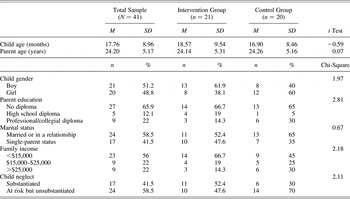
Child age ranged from 1 to 30 months (M = 17.76; SD = 8.96). All primary caregivers were mothers with the exception of one father. Parents ranged in age from 15 to 39 years (M = 24.20, SD = 5.17). A majority of parents had not completed high school (65.8%), while the rest had a high school diploma (12.2%) or a professional or initial college diploma (22%). More than half (56%) of participating families had an income under $15,000, 22% between $15,000 and $25,000, 12.1% between $25,000 and $40,000, and 9.8% above $40,000. In Canada, at the time of recruitment, the poverty threshold was between $25,000 and $30,000 (Statistics Canada, 2008). Our t-test and chi-square analyses did not show any significant differences between the intervention and control groups on child neglect status or any demographic variables (see Table 1). No differences in demographic variables were found as a function of child neglect status.
Comparison of intervention and control groups on sociodemographic variables and child neglect status at pretest

Measures
Maternal interactive sensitivity
The Maternal Behavior Q-Set (MBQS; Pederson & Moran, Reference Pederson and Moran1995) is a 90-item instrument for measuring the quality of caregiving behavior during parent–child interactions in the home. Each item describes potential maternal behaviors, and the measure is completed using Q-sorting procedures described elsewhere (Pederson & Moran, Reference Pederson and Moran1995). Correlations, corresponding to the score for parental behavior, are calculated between observer sorts and a criterion sort for the prototypically sensitive and responsive caregiver provided by the developers of the instrument. Thus, scores can vary from –1.0 (least sensitive/responsive) to 1.0 (prototypically sensitive/responsive). The MBQS has been shown to be among the more valid indicators of maternal sensitivity in relation to attachment process and constructs, including other measures of sensitivity, and assessments of infant attachment security and disorganization (Atkinson et al., Reference Atkinson, Chisholm, Scott, Goldberg, Vaughn, Blackwell and Tam1999; Pederson, Gleason, Moran, & Bento, Reference Pederson, Gleason, Moran and Bento1998; Tarabulsy et al., Reference Tarabulsy, Bernier, Provost, Maranda, Larose, Moss, Larose and Tessier2005; van IJzendoorn, Vereijken, Bakermans-Kranenburg, & Riksen-Walraven, Reference van IJzendoorn, Bakermans-Kranenburg, Bremner and Slater2004). Intraclass correlations between pairs of observers averaged 0.84 at pretest and 0.81 at posttest.
Parenting Stress Index (PSI—Short Form)
Parents completed the 36-item PSI—Short Form, a maternal self-report measure focusing on sources of perceived stress related to the parental role (Abidin, Reference Abidin1995). Items are rated on a 6-point Likert scale and are summed to generate a total stress score, which has a clinical cutoff of 90, as well as three subscales: parental distress, parent–child dysfunctional interaction, and difficult child. The PSI shows excellent psychometric properties (Abidin, Reference Abidin1995). Excellent internal consistency was found for the total stress score in the current study (Cronbach α = 0.93).
To control for the possibility that certain parents might be defensive in their reports of stress, a defensive score was calculated based on suggestions by Abidin et al. (Reference Abidin, Austin, Flens, Archer and Wheeler2013). The scale, which assesses the possibility that a participant is biased to presenting himself or herself in a most favorable light, is obtained by summing up a series of seven items that describe general feelings with respect to the parenting role (e.g., “I often have the feeling that I cannot handle things very well” and “I find myself giving up more of my life to meet my child's needs than I ever expected”). Abidin et al. stipulate that a score equal to, or lower than, 10 on this scale identifies individuals who are responding in a defensive manner. Analyses with the PSI will be conducted with and without the defensive participants (n = 11).
Bayley Scales of Infant Development—II (BSID-II)
Mental and motor development of children was assessed using the BSID-II (Bayley, Reference Bayley1993). The instrument is valid to age 42 months and generates three separate scales: the mental scale, the motor scale, and the behavior rating scale (not presently considered). Raw scores on each scale are converted into a mental developmental index (MDI) and a psychomotor developmental index. Both indices have a standardized mean of 100 and a standard deviation of 15. The BSID-II is among the most frequently used and psychometrically sound measures of infant development (Bayley, Reference Bayley1993).
Family background
A family background questionnaire was completed by the participating parent to obtain demographic information. Items regarding child characteristics at birth (e.g., weight and premature birth) or medical problems during pregnancy were also part of this questionnaire.
Procedure
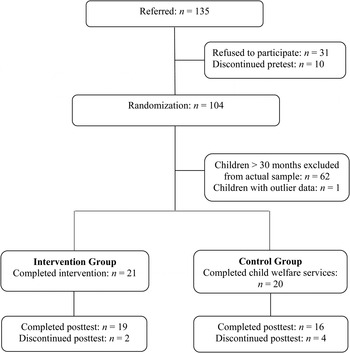
The study was approved by the ethics committee of the Research Institute of Child Protective Services. The flow chart in Figure 1 shows participants’ progress through the phases of the randomized trial, which lasted 2.5 years including the posttest assessment.
A flow chart of study participant numbers during recruitment, inclusion, randomization, and intervention processes.

Recruitment
A project coordinator, who worked independently of the research team, contacted each eligible family to explain the research procedure and to obtain written consent for the parent and child's participation. Parents who agreed to participate all signed an informed consent form, which explained randomization to the program and asked for participant consent to use data from all sessions for research purposes.
Preintervention and postintervention assessments
Participating families completed pretest measures during a 2-hr home and a 1-hr lab visits, scheduled approximately 1 week apart. During the home visit, the parent completed the family background questionnaire, and an infant developmental assessment was conducted by a research assistant. Immediately following the home visit, the caregiver's sensitivity was assessed using the MBQS, based on observations performed throughout the visit. Following pretest assessments, families were randomly assigned to the intervention or control group using a simple 1:1 block allocation sequence. During the laboratory visit, dyads completed the separation–reunion procedure (Moss et al., Reference Moss, Dubois-Comtois, Cyr, Tarabulsy, St.-Laurent and Bernier2011).
One week after completion of pretesting, the 8-week home visiting program began for the intervention group. Both the intervention and the control groups received standard agency services, consisting of a monthly visit by a child welfare caseworker. Agency standards for these meetings are not uniform and usually consist of general monitoring of family conditions with respect to neglect and abuse (e.g., adequacy of nutrition and hygiene, and use of noncoercive discipline). Caseworkers from the agency were also available to respond in crisis situations (e.g., separation or abandonment, or family violence).
Posttest assessments took place approximately 10 weeks after the second pretest evaluation. These assessments were identical to pretest visits. Different research assistants conducted the pre- and posttest assessments. All assistants were blind to study hypotheses, exposure to intervention, and to all test results.
Intervention
Similar to other video-feedback programs (e.g., Juffer, Bakermans-Kranenburg, & van IJzendoorn, Reference Juffer, Bakermans-Kranenburg and van IJzendoorn2008), the AVI is designed to enhance maternal sensitivity to child needs, as well as emotional and behavioral signals. Essentially, sensitivity involves (a) responding to child distress signals with comfort and appropriate structuring and (b) promoting and supporting active child exploration when the child is not distressed (Moss et al., Reference Moss, Dubois-Comtois, Cyr, Tarabulsy, St.-Laurent and Bernier2011). All intervention sessions were primarily focused on reinforcing parental sensitive behavior by means of personalized parent–child interaction, video feedback, and discussion of attachment/emotion regulation-related themes (e.g., child negative emotion, discipline, and separation anxiety). The program consisted of eight, 90-min home visits consisting of four segments:
-
1. A 20-min discussion on a theme chosen by the parent: these discussions focused on recent events, discussing child-related issues, and reflecting on different responses to problematic parent–child interactions.
-
2. A 15-min videotaped interactive session with toys provided by the intervener: the activity was individually chosen by the intervener as a function of child age and perceived dyadic needs (e.g., building reciprocity, synchrony, proximity, encouraging parent to follow child lead, and helping parent assume parenting role).
-
3. A 20-min feedback session during which the intervener reviewed the video segment and discussed parental perceptions and feelings of self and child during the interaction. Intervener probes provided support for parental sensitive behavior toward the child, often evidenced by positive infant response to parental behavior.
-
4. A 15-min wrap-up session during which progress was highlighted and the parent was encouraged to continue similar activities with the child during the coming week.
Training and other details of the intervention program are available elsewhere (Moss et al., Reference Moss, Dubois-Comtois, Cyr, Tarabulsy, St.-Laurent and Bernier2011, Reference Moss, Tarabulsy, St.-Georges, Dubois-Comtois, Cyr, Bernier and Lecompte2014).
Results
Missing data
Between the pre- and postintervention assessments, six participants (14.3%) were lost due to child placement (n = 3), untraceable parents (n = 2), or refusal to pursue participation in the research project (n = 1). To maximize sample size and take into account all participants who were initially included in the study, we used the intention to treat (ITT) method and replaced missing values by using the last observation carried forward, that is, pretest values. This method minimizes Type I error and provides a conservative estimate of individual functioning following treatment by considering the last available data (Gupta, Reference Gupta2011; Overall, Tonidandel, & Starbuck, Reference Overall, Tonidandel and Starbuck2009). Analyses conducted with and without the ITT method revealed similar results. The reported results are those from the ITT analyses.
Preliminary analyses
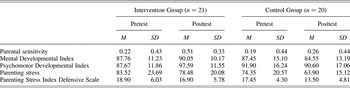
Table 2 presents descriptive statistics of the target variables as a function of group, at pretest and posttest. All measures were normally distributed at pre- and posttest. Simple t test comparisons conducted on target measures at pretest revealed no differences between the intervention and control groups (t = 0.08–1.32, ps = .25–.72).
Comparison of intervention and control groups on target variables at pretest and posttest

To identify other possible sociodemographic covariates, analyses were then undertaken to examine links between sociodemographic variables and posttest outcome measures. Correlation analyses revealed that child age, parent age, and education were not significantly associated with outcome measures at posttest (rs = .01–.20, ps = .21–.56), with the exception of MDI, which was greater for younger children (r = –.43, p = .005). Analyses of variance revealed no differences at posttest as a function of child gender (Fs = 0.02–2.90, ps = .10–.88). Family income did not differentiate outcome scores at posttest (Fs = 0.24–1.63, ps = .21–.79), with the exception of a significant result with parenting stress, F (2, 39) = 3.93, p = .028. Marital status differentiated scores on the MDI and parenting stress, F (1, 39) = 5.15, p = .029 and F (1, 39) = 18.67, p = .001, respectively, but not on psychomotor developmental index or sensitivity scores (Fs = 0.01 and 0.13, ps = .72 and .97). Mothers earning less than $15,000 and those living without a partner experienced more stress than other mothers, and children in single-parent families showed lower MDI scores than those living with two parents. We also examined whether child neglect status (neglected vs. at high risk of neglect) was related to posttest outcome measures. Child neglect status did not differentiate outcome scores at posttest (Fs = 0.03–2.27, ps = .14–.86), with the exception of a marginal result with the MDI, F (1, 39) = 3.39, p = .073, neglected children showing lower scores than children at high risk of neglect. Thus, child age and marital status were related to MDI at posttest, while family income and marital status were linked to parenting stress at posttest.
Intervention effects
In order to test the efficacy of the AVI on the four measures targeted by the intervention, four separate univariate analyses of covariance (ANCOVAs) were performed on posttest outcomes, with the intervention/control group distinction as the between-subject factor. These analyses were used to examine group differences at posttest, with pretest values of each posttest variable being entered as a covariate in order to account for baseline levels. When testing treatment efficacy, univariate ANCOVAs are the preferred method of analysis of pretest–posttest data because they reduce error variance and provide a more accurate estimate of treatment main effect than repeated measures analyses of variance (Dimitrov & Rumrill, Reference Dimitrov and Rumrill2003). Analyses were first run without the sociodemographic covariates and then executed including these covariates (as identified in the preliminary analyses, i.e., child age, marital status, and family income).
Maternal sensitivity
The ANCOVA revealed, after accounting for pretest levels, that parents in the intervention group exhibited higher sensitivity scores following the intervention than those in the control group, F (1, 38) = 5.70, p = .022, d = 0.77. A similar intervention group effect is found when sociodemographic covariates are entered in the model, F (1, 35) = 6.41, p = .016, d = 0.86.
Mental development
The ANCOVA revealed, after accounting for pretest levels, that children in the intervention group exhibited significantly higher mental development scores following the intervention than those in the control group, F (1, 38) = 5.11, p = .03, d = 0.74. Analyses including sociodemographic covariates yielded a similar intervention group effect, F (1, 35) = 8.26, p = .007, d = 0.97.
Psychomotor development
The ANCOVA revealed, after accounting for pretest levels, that children in the intervention group exhibited higher motor development scores following the intervention than those in the control group, F (1, 38) = 8.50, p = .006, d = 0.95. A similar intervention group effect is found when sociodemographic covariates are entered in the model, F (1, 35) = 10.46, p = .003, d = 1.09.
Parental stress
The ANCOVA revealed, after accounting for pretest levels, that parents in the intervention group reported higher parental stress scores following the intervention than those in the control group, F (1, 38) = 7.09, p = .011, d = –0.86. Analyses including sociodemographic covariates also yielded an intervention group effect, F (1, 35) = 5.21, p = .029, d = –0.77. Analyses also revealed a significant difference on the PSI defensive scale at posttest, with parents in the control group reporting significantly lower scores, t (38) = 2.11, p = .04. Seven parents in the control group have a defensive profile (scores of 10 or less on the defensive scale), compared with 4 parents in the intervention group. When the same analyses were conducted after removing the 11 participants who obtained markedly low scores on the PSI defensive scale, results no longer showed an intervention effect on parenting stress, F (1, 30) = 1.23, p = .278.
Discussion
Sensitivity and development
The results of this study suggest, as have other reports, that highly focused intervention targeting improvements in mothers’ ability to interact in a predictable, coherent, and warm manner with their infants, responding to infant needs, emotional cues, and behaviors, can be effective also in improving general aspects of infant development, even in a small very high-risk, neglected sample. This finding supports much of developmental theory that places an emphasis on the early parent–infant relationship as the premier postnatal environment that drives early development. The novelty of these results is not in the finding that improving early interaction affects early development, as that had been a part of much intervention research intended for high-risk populations (Field et al., Reference Field, Pickens, Prodromidis, Malphurs, Fox, Bendell and Kuhn2000), but rather that an attachment-based intervention that targets the elaboration of security and trust in the relationship also provides the setting for cognitive and psychomotor improvement. This is the first demonstration, in a randomized control trial, of an association between attachment processes and these other aspects of development. It is important to contrast this finding with meta-analytic results that underline the challenges of improving basic indices of cognitive outcome in high-risk infants exposed to broader, less focused prevention and intervention strategies. Sweet and Applebaum (Reference Sweet and Appelbaum2004) have shown that even with repeated home visits, the relation between exposure to intervention and improved cognitive development in high-risk infants was relatively small, although significant. The present results suggest that an 8-week intervention might be enough to improve this outcome in a particularly vulnerable group of infants. Moreover, the present findings contribute to the burgeoning literature that suggests that the early attachment relationship provides an important context that touches on developmental outcome in different spheres (Bernard et al., Reference Bernard, Hostinar and Dozier2015; Moss et al., Reference Moss, Dubois-Comtois, Cyr, Tarabulsy, St.-Laurent and Bernier2011; Spieker et al., Reference Spieker, Oxford, Kelly, Nelson and Fleming2012).
That these findings were obtained with a very high-risk group of neglecting parents, whose general parental capacities are lacking, has important clinical implications for professionals involved in CPS. We have argued elsewhere (Moss et al., Reference Moss, Dubois-Comtois, Cyr, Tarabulsy, St.-Laurent and Bernier2011, Reference Moss, Tarabulsy, St.-Georges, Dubois-Comtois, Cyr, Bernier and Lecompte2014; Tarabulsy et al., Reference Tarabulsy, Pascuzzo, Moss, St.-Laurent, Bernier, Cyr and Dubois-Comtois2008) that parents who are involved in CPS develop highly problematic relational dynamics with their infants that require specific attention within any intervention protocol. Our observations of neglecting and at high risk of neglect parents revealed that most mothers did not really know how to play in a reciprocal fashion with their child, showing a coercive, self-focused, or detached style of dyadic play. That a relatively short-term, structured, and intensive intervention procedure like the AVI and others (Bernard et al., Reference Bernard, Hostinar and Dozier2015; Spieker et al., Reference Spieker, Oxford, Kelly, Nelson and Fleming2012) serves to positively influence maternal sensitivity provides a degree of hope for both caseworkers and the families they work with. Mothers who were increasingly sensitive during the intervention process progressively involved their child in activities that implied predictability, shared affect, synchrony, planning, and child attention, different factors that have been linked to child cognitive and motor outcomes in high-risk groups (Baudry et al., Reference Baudry, Tarabulsy, Atkinson, Pearson and St-Pierre2017). Previously, we have shown the AVI to be linked to increasing attachment security, reducing levels and frequency of disorganization, as well as lowering levels of behavior problems in older maltreated preschoolers (Moss et al., Reference Moss, Dubois-Comtois, Cyr, Tarabulsy, St.-Laurent and Bernier2011). Although obtained with a very small sample of children exposed to a neglectful environment, the present results suggest that younger infants’ cognitive and motor development also benefit from early exposure to this type of intervention. Nevertheless, replication of our findings with larger samples are needed to confirm these results.
Parental stress
The results concerning parental stress suggest that, when parents who are suspected of responding defensively to the PSI are removed from analyses, the AVI appears to have no effect on self-reports of stress. However, when these parents are maintained in the analyses, the control group reports significantly lower levels of stress. Two points need to be made regarding this perplexing finding. It is unclear how valid it is to ask parents who are receiving social and judicial services for their parenting problems to complete a measure such as the PSI, where numerous questions are asked concerning parenting feelings and abilities. Abidin et al. (Reference Abidin, Austin, Flens, Archer and Wheeler2013) pondered this issue when devising the defensive scale, suspecting that some parents would want to use the measure as a means to underplay their difficulties. Moreover, several researchers have obtained data that questions the validity of self-reports of different forms of adjustment from research participants in very high-risk circumstances because of the possibility that a portion of these individuals may underestimate or underreport symptoms, such that scores are abnormally low (e.g., Lyons-Ruth et al., Reference Lyons-Ruth, Zoll, Connell, Grunebaum, Tronick and Field1986). Even in a low-risk, community sample, Bailey, Redden, Pederson, and Moran (Reference Bailey, Redden, Pederson and Moran2016) demonstrated that very low levels of parental reports of relationship problems with their child were linked to lower levels of observed interactive sensitivity and greater frequencies of insecure attachment. The present results add to the quandary of parental self-reports of adjustment, and take on added significance given the particular, sociojudiciary context of neglecting parents.
Conversely, there are good reasons to suspect that an intensive intervention that focuses on maternal sensitivity may not help lower parenting stress, especially with high-risk populations, and that to obtain this desired result, intervention that specifically targets this outcome would have to be devised. It is important to state that neither the intervention nor the control group reported increases in parenting stress. Both reported decreases, but the decrease in the control group was significantly greater from that in the intervention group prior to the removal of the defensive participants from analyses. If the basic PSI data can be considered to be valid and some confidence may be placed in these results, it becomes conceivable that participating in the AVI, or other attachment-based interventions, may place an additional burden on parents, which participants in the comparison group do not have, such as additional adaptational demands on them, in spite of the benefits for their infants. Parents learn to be attentive and interpret infant cues and behaviors and to be sensitive to, and reflective of, infant emotions. These potentially new tasks may make parenting more complex than for parents in the control group who have not had this exposure. It is beneficial for high-risk infants to be exposed to more sensitive interactions with parents. However, it may require greater efforts on the part of neglecting parents to become more sensitive during interactions with their infant than to respond to the more usual social services.
From both a conceptual and applied perspective, this finding raises important questions that further research should address. If it can be validated that parents who participate in attachment-based intervention experience greater demands for adaptation and report greater levels of distress than when they are not exposed to intervention, this suggests that what may be good for the child may actually be challenging in some way for the parent (Spieker et al., Reference Spieker, Nelson, DeKlyen, Staerkel, Berlin, Ziv, Amaya-Jackson and Greenberg2005; Tarabulsy et al., Reference Tarabulsy, Pascuzzo, Moss, St.-Laurent, Bernier, Cyr and Dubois-Comtois2008). Appropriate support to neglecting parents, before and after intervention, should therefore be implemented.
Moreover, conceptually, one questions whether simple assessments of stress are sufficient to address parental experience appropriately during an intervention process. The present results raise the possibility that parents receiving intervention obtain greater scores on the PSI than their counterparts but may nevertheless be pleased with their child's developmental gains. Perhaps the higher scores found in the intervention group may be related to a better understanding of the requirements needed to adequately fulfill the parental role and a greater awareness of the parent's own limitations and need for support. Thus, the greater parental stress in the intervention group may reflect enhanced awareness of the parenting task. These issues appear to be critical to the growing field of attachment-based intervention that has remained, for the most part, relatively focused on improving maternal sensitivity (Bakermans-Kranenburg et al., Reference Bakermans-Kranenburg, van IJzendoorn and Juffer2003). Considering the small nature of our sample, validation of the present findings is needed.
Limitations
As with many studies involving maltreatment samples, this study comprises certain important limitations that need to be mentioned. First, the sample is small, and replication regarding both child and parent outcomes are required. Moreover, larger samples would also allow testing for potential moderators, some of which have already been mentioned in the attachment intervention literature, most notably child age (Moss et al., Reference Moss, Dubois-Comtois, Cyr, Tarabulsy, St.-Laurent and Bernier2011), social services characteristics (Oxford et al., Reference Oxford, Marcenko, Fleming, Lohr and Spieker2016), and genetic polymorphisms that would allow for an examination of differential susceptibility to intervention. Such information is important for determining the suitability of the intervention program for different populations. Second, the research design did not include a follow-up assessment. The prevention and intervention research literature has regularly shown how different types of outcomes have emerged at follow-up that were not immediately observable during the posttest assessment (Campbell et al., Reference Campbell, Conti, Heckman, Moon, Pinto, Pungello and Pan2014; Oxford et al., Reference Oxford, Marcenko, Fleming, Lohr and Spieker2016). The opposite situation is also possible. Whatever gains were achieved also stand to diminish over time, given the continued exposure to difficult environments and the challenges they pose. It is important for follow-up work to identify if, when, and how further intervention may be required with these families. It is not presently possible to ascertain that intervention gains were maintained over time, and if so for how long.
Conclusion and clinical implications
The present findings are important considering the developmental vulnerability of children exposed to maltreatment. Studies on neglected infants and toddlers, especially published reports testing the efficacy of short-term intervention, are relatively scarce. Using a randomized control trial, the findings of this study highlight the importance of attachment-based short-term intervention in enhancing general aspects of development, like cognitive and psychomotor abilities, in infancy and toddlerhood. This change in child competence may set the necessary conditions for the acquisition of more sophisticated abilities, all of which shape long-term adjustment during childhood. Developing effective intervention strategies for neglecting parents is a challenge, given the numerous risk factors, including poverty and multiple psychiatric problems, that characterize these families. The efficacy of our 8-week intervention protocol in showing higher levels of maternal sensitivity and child cognitive and psychomotor development at posttest is notable in this regard.
The study also raises questions regarding the experience of parents exposed to such protocols and suggests that other, supportive strategies, specifically aimed at helping parents manage the demands of intervention, also be put in place. This work also underlines that more research is needed to more appropriately understand the meaning of low levels of parental stress and adaptation and the factors that may contribute to them within an intervention protocol. This work, accompanied by follow-up assessments that trace the duration of effects and presently unmeasured outcome, traces a path for a more structured application of developmental theory and research to the intervention strategies that professionals implement with our most vulnerable children.