Introduction
Kerimasi (2°51'S, 35°5'E) is a dormant stratovolcano located in the Gregory Rift Valley of northern Tanzania and in common with the adjacent active Oldoinyo Lengai volcano (2°75'S, 35°90'E), belongs to the series of younger volcanoes (<1.2 Ma) of the Neogene-to-Recent volcanic field of the North Tanzania Divergence of the East African Rift System (Dawson, Reference Dawson2008). Oldoinyo Lengai is the only known volcano to erupt natrocarbonatites. These consist principally of nyerereite, gregoryite, sylvite–halite solid solutions and fluorite. The paucity of fresh natrocarbonatites in the geological record has given rise to the hypothesis that other nephelinite–carbonatite volcanoes (e.g. Fort Portal, Uganda; Homa Mountain, Kenya; Tinderet, Kenya; Catanda, Angola) also erupted natrocarbonatites and that nyerereite in these lavas has been altered to flow-aligned calcite during subaerial weathering (Hay, Reference Hay1983; Deans and Roberts, Reference Deans and Roberts1984; Clarke and Roberts, Reference Clarke and Roberts1986; Zaitsev et al., Reference Zaitsev, Keller, Sprat, Perova and Kearsley2008; Zaitsev, Reference Zaitsev2010). The concept originated from a belief that calcite could not crystallise at atmospheric pressure from a carbonatitic magma; an idea which was shown subsequently to be incorrect by the experimental studies of haplocarbonatites by Gittins and Jago (Reference Gittins and Jago1991). The hypothesis has been questioned by: Le Bas (Reference Le Bas1984); Bailey (Reference Bailey1993); Gittins and Jago (Reference Gittins and Jago1991); Gittins and Harmer (Reference Gittins and Harmer1997); and Woolley and Church (Reference Woolley and Church2005).
The comprehensive investigations by Dawson et al. (Reference Dawson, Garson and Roberts1987), Keller and Zaitsev (Reference Keller and Zaitsev2006), Zaitsev and Keller (Reference Zaitsev and Keller2006) and Zaitsev et al. (Reference Zaitsev, Keller, Sprat, Perova and Kearsley2008, Reference Zaitsev, Keller and Billström2009) showed conclusively that natrocarbonatites alter initially to pirssonite plus gaylussite and ultimately to calcite with, in some instances, preservation of natrocarbonatite textural features. However, the applicability of these observations in general to eruptive calciocarbonatites with flow-aligned calcite remains debatable. The Oldoinyo Lengai calcite-rich altered natrocarbonatites were termed ‘calcite carbonatite’ by Zaitsev and Keller (Reference Zaitsev and Keller2006) and Zaitsev et al. (Reference Zaitsev, Keller, Sprat, Perova and Kearsley2008), albeit with proviso that the calcite in these rocks is not of primary magmatic origin. Unfortunately, this terminology is inappropriate and misleading, and it is suggested here that ‘calcareous carbonatite’ is perhaps a better description of these rocks which avoids any confusion with primary calcite carbonatites.
In the search for altered natrocarbonatites Kerimasi and Tinderet have played key roles. Kerimasi is a dormant nephelinite volcano which has preserved erupted calcite carbonatite tephra and lava at the crater rim and diverse calcite carbonatites within the pyroclastic sequence (Guest, Reference Guest1953; Mariano and Roeder, Reference Mariano and Roeder1983; Church, Reference Church1995). Many of these rocks have been interpreted to be altered natrocarbonatites and it was Hay's (Reference Hay1983) descriptions of flow-aligned calcite carbonatites from Trig Point Hill on the south-eastern flank of Kerimasi, which instigated the altered natrocarbonatite controversy.
The Kerimasi pyroclastics also contain many plutonic xenoliths ranging from afrikandite through ijolite series rocks to coarse-grained primary calcite carbonatites (Church, Reference Church1995; Dawson, Reference Dawson2008; Zaitsev Reference Zaitsev2010; Guzmics et al., Reference Guzmics, Mitchell, Szabo, Berkesi, Milke and Abart2011). There are major differences between Kerimasi and Oldoinyo Lengai in that the latter has erupted diverse peralkaline phonolites and lacks both primary plutonic or eruptive calcite carbonatites. Hence, direct comparisons between the two volcanoes might not be appropriate as, although in geographical proximity, their petrology is clearly different (Dawson, Reference Dawson2008). Kerimasi actually has greater petrological affinities with the melilitite/nephelinite magmatism of the Natron–Engaruka tuff cone area (Dawson, Reference Dawson2008; Mattsson, Reference Mattson2012) than with Oldoinyo Lengai.
With regard to Tinderet, the influential paper of Deans and Roberts (Reference Deans and Roberts1984), appears to have established the ‘altered nyerereite’ hypothesis as received wisdom, with this being perpetuated by: Clarke and Roberts (Reference Clarke and Roberts1986) for Homa Mountain (Kenya); Zaitsev et al. (Reference Zaitsev, Wenzl, Venneman and Markl2013) for Tinderet; and Campeny et al. (Reference Campeny, Kamenetsky, Melgarejo, Mangas, Manuel, Alfonso, Kamenetsky, Bambi and Gonçalves2015) for Catanda (Angola). Unfortunately, the Deans and Roberts (Reference Deans and Roberts1984) paper appears to contain a major error in that the caption for figure 3b (p. 568) refers to the rock illustrated (p. 569) as a natrocarbonatite from Oldoinyo Lengai. However, the text (p. 568, l.1-9) refers to this figure as illustrating textural features of a Tinderet sample. Figure 3b, actually shows none of the textural features of either fresh (Peterson, Reference Peterson1990; Keller and Krafft, Reference Keller and Krafft1990) or altered Oldoinyo Lengai natrocarbonatite (Zaitsev et al., Reference Zaitsev, Keller, Sprat, Perova and Kearsley2008), and in keeping with all other sub-figures in figure 3 of Deans and Roberts (Reference Deans and Roberts1984) must be a Tinderet sample. This observation is discussed further below.
This work presents data for carbonatite lavas preserved in a major debris flow originating from sector collapse of the southeast flank of Kerimasi volcano (Fig. 1). Samples were collected from Trig Point Hill, a region referred to as site 6 by Hay (Reference Hay1983). These data have a direct bearing on the problem of the absence of natrocarbonatites in general, as we show that these lavas cannot be altered natrocarbonatite as suggested by the previous studies of Hay (Reference Hay1983); a conclusion that is also applicable to similar rocks occurring at the Tinderet and Homa volcanoes (Deans and Roberts, Reference Deans and Roberts1984; Clarke and Roberts, Reference Clarke and Roberts1986; Zaitsev et al., Reference Zaitsev, Wenzl, Venneman and Markl2013) and Catanga (Campeny et al., Reference Campeny, Kamenetsky, Melgarejo, Mangas, Manuel, Alfonso, Kamenetsky, Bambi and Gonçalves2015). This contribution by addressing mineralogical and petrographic data, together with solution/deposition models of pseudomorphism, demonstrates that the hypothesis that flow-aligned calcite crystals in some calciocarbonatites are pseudomorphs after nyerereite is not correct.
Topographic map of Kerimasi volcano (after Kervyn et al., Reference Kervyn, Ernst, Klaudius, Keller, Mbedes and Jacobs2008) showing the location of the currently inactive crater and the debris flow formed by sector collapse. The termination of the debris flow at Trig Point Hill is the locality #6 originally investigated by Hay (Reference Hay1983).

Kerimasi debris flow
The major avalanche deposit formed by collapse of the south-eastern flank of Kerimasi (Fig. 1) has been described by Hay (Reference Hay1983), Kervyn et al. (Reference Kervyn, Ernst, Klaudius, Keller, Mbedes and Jacobs2008) and Delcamp et al. (Reference Delcamp, Delvaux, Kwela, Mocheyek and Kervyn2016). This deposit extends from a scarp at an elevation of ~2000 m approximately 8.9 km in a south-easterly direction to the surrounding Engaruku Basin plains (~800 m). The flow covers an area of ~33 km2 and has an average thickness of 30 m. The distal lobe is ~8 m in thickness at a location known locally as Trig Point Hill. The debris flow did not originate at the summit of Kerimasi and thus does not include any of the crater rim carbonatites. Although the debris flow has not been investigated in any detail it consists of a heterogeneous assemblage of a matrix of finely comminuted pyroclastic nephelinite and carbonatite with large blocks of carbonatite together with a wide assortment of coarse grained clasts (1–20 cm) of diverse ijolite series rocks and melilite-bearing rocks (afrikandite; uncomphagrite) plus xenocrysts of clinopyroxene, titanite and garnet. This plutonic suite is a microcosm of the petrology of the substructure of the volcano, which has not as yet been thoroughly investigated, although some mineralogical data for an afrikandite are given by Guzmics et al. (Reference Guzmics, Mitchell, Szabo, Berkesi, Milke and Ratter2012).
Trig Point Hill carbonatites
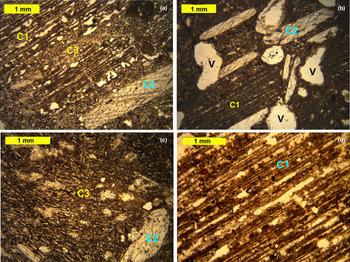
The debris flow at its distal lobe contains a distinctive assemblage of large blocks of carbonatite tephra (Fig. 2) including a distinct variety of clast (~3 cm × 1 cm) dominated by a macroscopic texture referred to as ‘corduroy’ calcite. This texture appears to result from the development of solution spaces (<0.2–0.35 mm) along the cleavage planes of closely-spaced (0.2–0.4 mm) parallel calcite lamellae. The voids created are, in part or in whole, filled with amorphous brown Fe–Mn hydroxide/oxides and microcrystalline calcite (Fig. 2a,d). Similar ‘corduroy’ calcite carbonatite has been recognised by Church (Reference Church1995) and Zaitsev (Reference Zaitsev2010) from the northeastern slopes of the volcano and, by the authors of this study, at the crater rim.
Transmitted light photomicrographs of Trig Point Hill carbonatites illustrating the heterogeneous texture and the three varieties of calcite. (a) corduroy calcite (C1) and prismatic calcite (C2) set in the very fine grained matrix of calcite laths (C3); (b) Corduroy calcite (C1) and flow-aligned, resorbed prismatic calcite (C2), V = voids; (c) the matrix of the breccia consisting of fine grained flow-aligned prismatic calcite (C3); and (d) texture of corduroy calcite (C1) illustrating parallel bands of replacement plus voids of colourless calcite and brown bands of amorphous Mn–Fe hydroxide/oxides plus calcite.

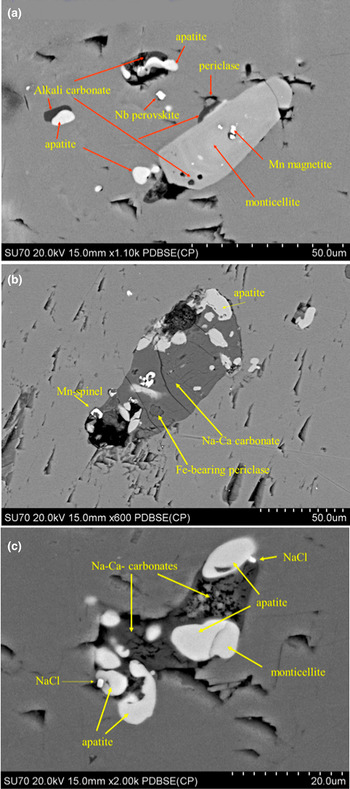
Three morphological types of calcite (Figs 2) are present in the carbonatite tephra: ‘corduroy’ calcite (C1); primary resorbed prismatic (0.5–2 mm) inclusion-bearing ‘phenocrystal’ calcite (C2); fine grained (<1 mm), flow-aligned prismatic calcite (C3). The ‘phenocrystal’ calcite (C2) in many instances contains inclusions of 1–100 μm multi-phase ovoid melt inclusions containing: Na–Ca carbonates; subhedral compositionally-zoned monticellite; periclase; Mn-Mg magnetite; Mn–Fe-sphalerite and Nb-perovskite.
The matrix in which the ‘corduroy’ calcite clasts (C1) and phenocrystal (C2) calcite are set consists of closely-packed, flow-aligned, small stubby prisms of calcite (C3) lacking melt inclusions together with interstitial fine-grained apatite, baryte, strontianite, trace fluorite and xenocrystal clinopyroxene, titanite and Ti andradite (Fig. 3). Pore spaces are filled with secondary Mn-oxides/hydroxides, anhydrite and gypsum.
Back-scattered electron images of the matrix of the Trig Point Hill breccia. (a) Calcite laths (cc) with interstitial anhedral apatite and voids (black); (b) interstitial gypsum and anhydrite; and (c) interstitial Mn–Fe hydroxide/oxides, celestite and voids.

Analytical methods
Polished thin sections, prepared in kerosene, were examined by standard petrographic methods and back-scattered electron petrography. Compositions of the phases present were determined by quantitative energy dispersive X-ray spectrometry using a Hitachi FE-SU70 scanning electron microscope equipped with the Oxford Instruments AZtec software package. The electron accelerating voltage was 20 kV and beam current 300 pA. Standards used were: synthetic pyroxene glass (Si, Ca); corundum (Al); jadeite (Na,Al); CaF2 (Ca, F) Mn-hortonolite (Mg, Fe, Si, Mn); ilmenite (Ti, Fe); synthetic rare element phosphates (Ca, La, Ce, Pr, Nd, Sm, P); SrTiO3 (Sr, Ti), BaSO4 (Ba, S); and ThNb2O12 (Nb).
The analysis of the Na–Ca carbonates present in the melt inclusions proved to be challenging as they have quenched to a porous aggregate of extremely fine-grained microcrystals rather than a glass. The use of rastered small areas (10 μm2) and the low beam currents (300 pA) employed for analysis permitted reproducible analyses of these carbonatites. During analysis the X-ray count-rate for Na did not decrease and there was no obvious decomposition of the samples. However, given the presence of the micro-voids in the quench aggregates, it is considered that the compositions determined represent those of carbonate plus micro-voids. Thus, the reported compositions (Table 4) include this contribution which, on the basis of secondary electron imagery and estimation of CO2 content, is estimated to be small but not constant. The Na, Ca and K contents are considered to be accurate and any calculated equivalent carbonate based on these data indicates the amount of void contribution and does not reflect analytical error. Hence, it is considered that the reported compositions are realistic for the purposes of this study
Mineral compositions
Calcite
All three textural varieties of calcite contain <0.2 wt.% FeO and MnO, and have very limited compositional variation with respect to Sr and Mg (Table 1). Only the ‘corduroy’ calcite (C1) contains minor amounts of MgO ranging from <0.2–0.6 wt.%. Their SrO contents are low (<0.2–0.5 wt.%) relative to prismatic (C2) and lath (C3) calcite, which are similar with SrO ranging from 0.5–0.9 wt.% (Table 1). Individual crystals of ‘corduroy’ calcite do not exhibit any significant compositional variation within and between parallel lamellae, and individual crystals of lath (C3) calcite are homogeneous. Prismatic (C2) calcite in some crystals exhibits weak heterogeneous irregular zoning with respect to SrO (0.5–0.9 wt.%), a range identical to that determined for this calcite paragenesis as a whole. The above SrO contents are similar to those reported by Zaitsev (Reference Zaitsev2010) for single crystals (0.73–0.78 wt.%; C2 in this work) and banded calcite (0.1–0.54 wt.%; C1 in this work).
Representative compositions of calcite.

Compositions: 1–3 courdoy calcite (C1); microphenocrystal calcite (C2); 6–9 fine grained prismatic calcite (C3). n.d. = not detected (<0.15% oxide).
Monticellite
Monticellite occurs as euhedral-to-subhedral microphenocrysts in calcite (C2) laths or less commonly in melt inclusions with apatite and Na–Ca carbonate (Fig. 4). It exhibits a very limited compositional range in MnO (2.3–4.1 wt.%) at near-constant FeO (1.3–1.8 wt.%) content. (Table 2). The principal substitution is within the monticellite–glaucochroite series (Mo87–93Glc3.8–9.3Kir2.8–4.9 mol.%); (Mo = CaMgSiO4; Glc = CaMnSiO4; Kir = CaFeSiO4). The monticellite is of identical composition to that in Kerimasi plutonic calcite carbonatite (Fig. 5) reported by Guzmics et al. (Reference Guzmics, Mitchell, Szabo, Berkesi, Milke and Abart2011), but differs substantially from the manganoan monticellite in Oldoinyo natrocarbonatites (Fig. 5) described by Mitchell and Belton (Reference Mitchell and Belton2004; Reference Mitchell and Belton2008). This difference in Mn content is significant with respect to the hypothesis that these tephra are altered natrocarbonatites (see below).
Back-scattered electron images of inclusions in Trig Point Hill prismatic calcite (C2). (a) Large monticellite inclusion with Na–Ca carbonate and Mn-magnetite inclusions associated with periclase. Also shown are round melt inclusions consisting principally of Na–Ca carbonate and resorbed apatite; (b) Na–Ca carbonate inclusion with resorbed apatite, periclase and Mn-magnetite; and (c) Na–Ca carbonate inclusion with resorbed apatite, monticellite and NaCl.

Compositions of monticellite plotted in the ternary system Fe2+–Mg–Mn (atoms per formula unit) from Trig Point Hill (TPH; black squares, this work) and Kerimasi (purple field from Mitchell and Belton, Reference Mitchell and Belton2008), compared with monticellite from Oldoinyo Lengai natrocarbonatites erupted in 2003 and 2008, Oka calcite carbonatite and kimberlite (K) (Mitchell and Belton, Reference Mitchell and Belton2008).

Representative compositions (wt.%) of monticellite.

Mon = monticellite CaMgSiO4; Kir = kirschsteinite CaFeSiO4; Glc = glaucochroite CaMnSiO4
Apatite
Apatite is scattered throughout the matrix of the prismatic lath calcite (C3) as rare anhedral small (<20 μm) crystals commonly in association with Mn–Fe hydroxide/oxides, baryte, celestite, anhydrite, gypsum and spinels (Fig. 3).The apatite is of near-stoichiometric composition, with REE and Mn not detectable by EDS methods (<0.2 wt.%), and containing 2.1–2.9 wt.% SiO2, 0.6–0.9 wt.% SrO, and 1.6–3 wt.% F.
Apatite is notably absent as single crystal inclusions in prismatic (C2) calcite and occurs only in melt inclusions as rounded-to-lobate resorbed small crystals (<20 μm) in association with Na–Ca carbonates, periclase and Nb-perovskites (Fig. 4). In common with apatite associated with calcite (C3) these apatites have low contents (wt.%) of SrO (0.42–0.55), SiO2 (2–3) and F (1.1–3.5). The paucity of primary phenocrystal apatite relative to its abundance in Kerimasi crater rim carbonatite (see below) is a significant difference to the Trig Point Hill carbonatites.
Spinels
Spinels occur principally as small (<25 μm) anhedral-to-subhedral crystals in the interstices between prismatic calcite (C3) in association with apatite, Mn–Fe hydroxides/oxides, celestite, anhydrite and gypsum. Spinels are rarely present as very small (<5 μm) anhedral crystals in Na–Ca carbonate-bearing melt inclusions in calcite (2), and are absent in corduroy calcite (C1).
Spinels exhibit a very wide range in composition (Table 3; Fig. 6) and are essentially members of the magnesioferrite–jacobsite–ulvöspinel–magnetite solid-solution series. The crystals are too small to establish any zonation trends, although increased Mn contents of individual crystals are correlated with decreasing Ti contents.
Compositions of spinels plotted in the ternary system jacobsite–magnesioferrite–magnetite (mol.%), showing the pronounced dichotomy in composition between spinels from Oldoinyo Lengai natrocarbonatites belonging to the magnetite–jacobsite series versus those from Kerimasi calciocarbonatites which belong to the magnetite–magnesioferrite series.

Representative compositions of spinels from Trig Point Hill and Kerimasi crater.

Compositions: 1–5 Trig Point Hill spinels in the matrix of calcite (C3) prisms; 6–8 spinels in Kerimasi crater apatite carbonatite.
FeOT = total Fe expressed as FeO; Fe2O3 and FeO calculated from total Fe on the basis of 24 cations and 32 atoms of oxygen by the method of Droop (Reference Droop1987).
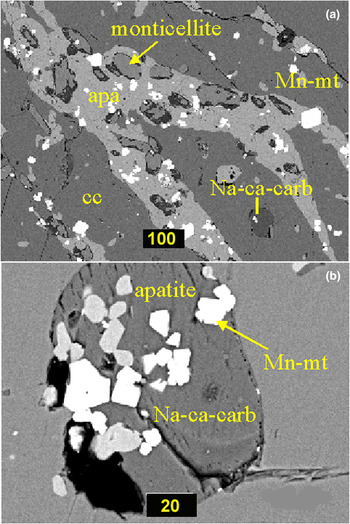
Apatite calcite carbonatite and tephra are exposed at the crater rim at Kerimasi (Mariano and Roeder, Reference Mariano and Roeder1983, this work). The tephra are similar in their petrography to the Trig Point Hill carbonatites in containing calcite similar to the corduroy (C1) and prismatic (C2) calcite. The coarse-grained apatite carbonatites contain subhedral-to-anhedral (20–100 μm) spinels in close association with apatite. The apatite is commonly rounded and contains melt inclusions dominated by Na–Ca-carbonate. The spinels, in common with Trig Point Hill spinels, are members of the magnesioferrite–jacobsite–ulvöspinel–magnetite solid solution and exhibit a limited range in composition (Table 3; Fig. 6). Some compositions are similar to spinel compositions reported by Reguir et al. (Reference Reguir, Chakhmouradian, Halden, Yang and Zaitsev2008) from a Kerimasi north slope calcite carbonatite, although the majority of these spinels are richer in magnetite (Fig. 6). In contrast to Trig Point Hill, spinels in other carbonatites from the north slopes of Kerimasi (this work; Guzmics et al., Reference Guzmics, Mitchell, Szabo, Berkesi, Milke and Abart2011), occur in abundance as large euhedral crystals within apatite veins (Fig. 7a) and Na–Ca-carbonate inclusions. (Fig. 7b).
Back-scattered electron images of calciocarbonatites from the north slope of Kerimasi. (a) Veins of apatite, monticellite and magnetite–magnesioferrite in calcite (cc) with inclusions of Na–Ca carbonate; and (b) Inclusion of Na–Ca carbonate in calcite with anhedral apatite and subhedral magnetite–magnesioferrite.

In summary, all spinel compositions from diverse Kerimasi calcite carbonatites are Mn-poor relative to Mn-rich spinels occurring in fresh and altered Oldoinyo Lengai natrocarbonatites (Mitchell and Belton, Reference Mitchell and Belton2004, Reference Mitchell and Belton2008; Keller and Zaitsev, Reference Keller and Zaitsev2006; Fig. 6); an observation indicating that the Trig Point Hill carbonatites are unlikely to be altered natrocarbonatite.
Periclase
Small crystals of periclase (<20 μm) occur as inclusions in, or at the margins, of monticellite inclusions in calcite (C2), and rarely as small crystals (<10 μm) in Na–Ca carbonate inclusions. (Fig. 4a,b). These relations indicate that periclase is a primary liquidus phase. There is no petrographic or mineralogical evidence to indicate its presence in this carbonatite results from decarbonation of dolomite as suggested by Treiman and Essene (Reference Treiman and Essene1984) for periclase occurring at the Oka complex or by decarbonation to produce calcite and periclase with further reaction to produce forsterite, monticellite, garnet and melilite as suggested by Stoppa et al. (Reference Stoppa, Schiazza, Rosatelli, Castorina, Sharygin, Ambrosioa and Vicentinia2019) for some Italian carbonatites.
The compositions (wt.%) of two crystals large enough for analysis without excitation of their host monticellite are: (1) 84.54 MgO; 13.33 FeOT; 2.62 MnO; and (2) 85.47 MgO; 13.30 FeOT; 2.48 MnO. These correspond respectively to (Mg0.90Fe0.08Mn0.02)O and (Mg0.906Fe0.079Mn0.015)O, indicating these are ferro-periclase with a significant Mn content. Similar, but more abundant, ferro-periclase (wt.%: 84.3 MgO; 12.6 FeOT; 1.8 MnO) coexisting with monticellite has been reported by Mariano and Roedder (Reference Mariano and Roeder1983) from an apatite–periclase calcite carbonatite occurring in the centre of the Kerimasi crater.
Na–Ca carbonate
Calcite (C2) contains numerous oval-to-lobate multi-phase melt inclusions ranging in size from <10–150 μm. They are characterised primarily by the presence of apatite set in a matrix of Na–Ca carbonate (Fig. 4). Inclusions containing approximately equal amounts of apatite and carbonate are common. Apatite in the inclusions always occurs as rounded crystals which in some instances exhibit resorbed embayed margins. Less common minerals, typically <5 vol.%, occurring as single crystals (<10 μm), included in the carbonates, in order of decreasing frequency of occurrence are: euhedral monticellite; latrappite; perovskite; magnesioferrite; periclase; Mn-sphalerite; and very rare halite. Representative compositions of the Na–Ca carbonates are given in Table 4. Individual inclusions contain carbonates of uniform composition, although the overall range of all inclusions analysed (wt.%) is from 28.7 to 35.9 CaO; 16.7–23.6 Na2O; 0.5–2.8 K2O, with minor SO3 (1.1–2.2) and SrO (0.34–1.0). The compositional variation is illustrated in Fig. 8 and shows a poor anti-correlation between CaO and (Na+K) contents. Compositions are closer to shortite [Na2Ca2(CO3)3] rather than nyerereite [Na2Ca(CO3)2].
Compositions (wt.%) of alkali carbonates occurring as inclusions in calcite from Trig Point Hill calcite (C2), Kerimasi calcite carbonatite, and afrikandite (this work), compared with the compositions of Oldoinyo Lengai nyerereite (Zaitsev et al., Reference Zaitsev, Keller and Billström2009) and Kerimasi nyerereite (Zaitsev, Reference Zaitsev2010) SH = shortite; NY = ideal K-free nyerereite.

Representative compositions of Na–Ca carbonates.

Compositions|:1–5 Trig Point Hill; 6–7 Kerimasi north slope calcite carbonatite; 8–10 Kerimasi afrikandite. Recalc = Totals of Na,K,Ca,Sr contents recalculated as carbonate plus SO3. Low totals reflect the presence of voids in the microcrystalline assemblage and not analytical errors.
The composition of Na–Ca-carbonates hosted by melt inclusions in Kerimasi calcite carbonate (this work) are also shown on Fig. 8. These carbonates are essentially identical to those from Trig Point Hill. The inclusions are also characterised by rounded resorbed apatite but differ in containing more spinel (Fig. 7). Na–Ca carbonates occurring in association with silicates are common in magnetite and perovskite in melt inclusions from Kerimasi afrikandite (this work; Guzmics et al., Reference Guzmics, Mitchell, Szabo, Berkesi, Milke and Ratter2012). These are, in contrast, relatively poor in Ca and show a limited range in CaO (26.1–27.90 wt.%), with a wide range in Na2O (17.8–22.5 wt.%) and (Na2O + K2O; 23.1–28.5 wt.%) together with significant K2O (5.2–6.5 wt.%) contents. The compositional variation in terms of CaO versus (Na2O + K2O) extends towards ideal K-free nyerereite (Fig. 8) because the high K content reflects their overall composition as (Na,K)2Ca(CO3)2. Similar Na–Ca carbonates occur as inclusions in magnetite from Kerimasi north slope calcite carbonatite (Fig. 8), which have been identified on the basis of Raman spectrometry by Zaitsev (Reference Zaitsev2010) as bona fide nyerereite, although these are relatively poor in K2O (1.6–1.9 wt.%) compared to the K-rich Na–Ca carbonates from Kerimasi afrikandite and nyerereite phenocrysts in Oldoinyo Lengai natrocarbonatites (Fig. 8). The Na–Ca carbonates from the Kerimasi afrikandite are thus the closest in composition to Oldoinyo Lengai nyerereite than any Na–Ca carbonate yet described from Kerimasi.
Secondary and supergene minerals
The interstitial and porous regions between calcite (C3) prisms, apart from apatite and spinel, are occupied principally by a wide variety of minerals which might have either secondary or supergene origins. The most abundant are gypsum and anhydrite occurring as veins and irregular patches which commonly include Ca–Mn–Fe oxide/hydroxides (Fig. 3). Gypsum, on the basis of textural relationships, appears to have been formed by hydration of anhydrite. Both anhydrite (58.4 SO3; 41.5 CaO wt.%) and gypsum (46.4 SO3; 33.4 CaO wt.%) have near-stoichiometric compositions.
An unidentified hydrous Ca–Si–Mn–FeO oxide/hydroxide is common as small (<20 μm) ovoid particles included in anhydrite and as very fine grained material in the interstices between calcite laths. In some instances the larger examples exhibit minor very fine scale concentric compositional zonation suggestive of a colloidal origin (Fig. 3c). Regardless, the composition variation (wt.%) of several rastered areas is relatively constant: 19.7–19.9 FeOT; 19.4–20.8 MnO; 9.24–10.5 CaO; 6.5–6.8 SiO2; 1.7–1.8 BaO. Other common interstitial minerals are: baryte (58.7–60.9 BaO; 3.2–4.1 SrO; 1.6–2.4 CaO; 35.0–35.1 SO3 wt.%); celestite (49.9 SrO; 6.2 CaO; 0.6; 0.6 BaO; 42.6 SO3 wt.%) and strontianite (53.5–56.9 SrO; 4.0–6.4 CaO; 1.14 BaO, wt.%).
Discussion
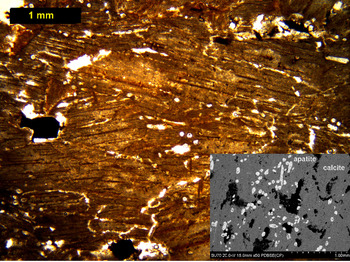
The Trig Point Hill debris flow contains blocks of heterolithic pyroclastic carbonatite. Typically, these consist of three distinctive textural and mineralogical varieties of calcite carbonatite with ‘corduroy’ calcite (C1) and the calcite (C2) clasts with Na–Ca-carbonate inclusions, incorporated into a matrix of volcaniclastic prismatic calcite (C3) carbonatite. Similar carbonatites Fig. 9) are exposed at the crater rim (this work; Mariano and Roeder, Reference Mariano and Roeder1983), within the pyroclastic deposits on the northern slopes of Kerimasi (Zaitsev, Reference Zaitsev2010), and at Tinderet volcano, Kenya (Zaitsev et al., Reference Zaitsev, Wenzl, Venneman and Markl2013). Hay (Reference Hay1983) proposed initially that the corduroy calcite (C1) clasts and the prismatic (C3) calcite laths are altered nyerereite. The only evidence for this supposition was that the textures of the rocks were similar to those of Oldoinyo Lengai natrocarbonatites, these being dominated by flow-aligned nyerereite prismatic crystals. The calcite (C2) clasts were considered as primary and to have crystallised before incorporation in ‘natrocarbonatite’, regardless that such calcite is not present at Oldoinyo Lengai. Hay (Reference Hay1983) did not recognise any Na–Ca-carbonates as inclusions in these calcites or that they are actually clasts in the calcite (C3) carbonatite matrix. The rocks described by Hay (Reference Hay1983) actually do not bear any textural resemblance to any fresh or altered Oldoinyo Lengai natrocarbonatite (Keller and Krafft, Reference Keller and Krafft1990; Peterson, Reference Peterson1990; Mitchell, Reference Mitchell2006; Zaitsev et al., Reference Zaitsev, Keller, Sprat, Perova and Kearsley2008).
Altered calciocarbonatite tephra from the rim of the current crater at Kerimasi consisting of flow-aligned calcite prisms and colourless subhedral-to-round microphenocrysts of apatite. The inset is a back-scattered electron image illustrating the abundance of apatite in this carbonatite.

Hay (Reference Hay1983) did not describe any material which might be considered as altered gregoryite, nor was any recognised by us in this investigation. In contrast, Zaitsev (Reference Zaitsev2010) has considered that ‘corduroy’ calcite (C1) clasts, referred to as ‘banded calcite’, from the north slope of Kerimasi are altered gregoryite. Zaitsev (Reference Zaitsev2010) suggested that these clasts were initially gregoryite containing exsolved lamellae of nyerereite and that complete dissolution of gregoryite by meteoric water coupled with replacement of the nyerereite by calcite leads to the formation of the banded calcite clasts. However, Zaitsev (Reference Zaitsev2010, p.638) also notes that “why and how banded crystalline segregations have formed remains unanswered”. There is no mineralogical evidence that dolomite was involved in the formation of these segregations as suggested by Church (Reference Church1995).
Zaitsev et al. (Reference Zaitsev, Wenzl, Venneman and Markl2013) have provided limited C and O isotopic data for Tinderet and Kerimasi clasts and shown that there are significant isotopic differences between primary prismatic C2 calcite and banded C1 calcite. What is apparent from these data is that there is a continuum between mantle-type compositions for C2 calcite and altered material (C1, C3) with high δ 18O(>+20‰). This is not surprising given that the C1 and C3 material is very porous and clearly has been subject to isotopic exchange with meteoric water. The formation of gypsum and other supergene minerals in these rocks attests to their extensive interaction with meteoric waters. In contrast, prismatic C2 is homogeneous and therefore less subject to such exchange. Regardless, isotopic equilibrium cannot be expected between any of these components and/or with meteoric water in their current environment. Consequently, stable isotopic studies are considered not to be informative regarding the genesis of these heterolithic pyroclastic rocks.
Other problems with this hypothesis are that none of the rocks actually have the textures of natrocarbonatites and the gregoryites at Oldoinyo Lengai are small (<1 mm), rounded-to-kidney shaped with common concentric zoning and mantling (Peterson, Reference Peterson1990; Keller and Krafft, Reference Keller and Krafft1990). These can in some instances contain 25–30 vol.% inclusions of nyerereite together with very fine grained exsolved nyerereite (Peterson, Reference Peterson1990). However, these modal volumetric relationships are the reverse of the corduroy clasts which are dominated by calcite. Thus, if a typical Lengai-type gregoryite were dissolved, a void would be created with concomitant collapse and aggregation of the unsupported nyerereite crystals, followed by their probable subsequent recrystallisation to anhedral aggregates of calcite without pseudomorphic replacement of any pre-existing textures. Zaitsev et al. (Reference Zaitsev, Keller, Sprat, Perova and Kearsley2008) have noted that alteration of natrocarbonatite at Oldoinyo Lengai leads to the complete elimination of gregoryite and only the rare formation of pirssonite pseudomorphs; observations not in accord with the gregoryite dissolution process described above as advocated by Zaitsev (Reference Zaitsev2010) for the formation of corduroy calcite. In addition, Oldoinyo Lengai gregoryite contains significant amounts of phosphorus (1.3–4.5 wt.% P2O5; Peterson, Reference Peterson1990; Zaitsev et al., Reference Zaitsev, Keller, Spratt, Jeffries and Sharykin2009), which should be retained after dissolution as insoluble phosphates. These are not observed, nor are any of the major secondary minerals, i.e. pirssonite, kogargoite, formed during alteration of natrocarbonatite (Zaitsev et al., Reference Zaitsev, Keller, Sprat, Perova and Kearsley2008; Mitchell, Reference Mitchell2006). Zaitsev (Reference Zaitsev2010) has reported the presence of nyerereite from a Kerimasi north slope carbonatite, to support the existence of former natrocarbonatite. However, this nyerereite only occurs as inclusions in magnetite and its relevance to Hay's (Reference Hay1983) hypothesis is doubtful. Moreover, the composition of this nyerereite is very different to that of Lengai phenocrystal nyerereite (6–9 wt.% K2O; Zaitsev et al., Reference Zaitsev, Keller, Spratt, Jeffries and Sharykin2009; Peterson, Reference Peterson1990) as it is poor in K2O (1.6–1.9 wt.%).
The Na–Ca carbonate problem and natrocarbonatite volcanism
The presence of Na–Ca carbonates as micro-inclusions in a variety of calcite carbonatites at Kerimasi and elsewhere has, particularly recently, been construed as indicating an alkali–rich parental carbonatite magma which might differentiate to natrocarbonatite and even to common calcite carbonatite. Such a deduction is mistaken. Its advocates attribute absence of natrocarbonatite anywhere but at Oldoinyo Lengai as due to it having been dissolved during sub-aerial weathering. However, postulating a former presence from an assumed absence is not sound petrology. Moreover, it is evident that Na–Ca-inclusions in calcite at Kerimasi contain none of the characteristic minerals of bona fide natrocarbonatite, such as Ba-nyerereite, fluorite, khanneshite, halite–sylvite and cuspidine (Keller and Krafft, Reference Keller and Krafft1990; Peterson, Reference Peterson1990, Mitchell, Reference Mitchell1997a, Reference Mitchell2006; Mitchell and Belton, Reference Mitchell and Belton2004). The parental melts to these inclusions crystallised calcite as a primary liquidus phase, and thus cannot differentiate to natrocarbonatite. Thus, the calcite has merely trapped deuteric Ca-Na-rich residual fluids/melts which have also crystallised apatite, monticellite, magnetite–jacobsite and perovskite – i.e. an undersaturated silico-carbothermal fluid/melt. Notably, monticellite and periclase are primary liquidus phases, and primary apatite is not stable in the Na–Ca–CO2 residual fluids and is resorbed.
The ‘altered nyerereite’ problem
Flow-aligned calcite prisms are common in many calcite kimberlites, melilitites and carbonatites. Typical examples are: the Jos, Nikos and International kimberlites, Canada (Mitchell, Reference Mitchell1997b); Kaiserstuhl lapilli tuffs, Germany (Keller, Reference Keller and Bell1989);calcite carbonatite dyke rocks in the Guli and Maimecha-Kotui complexes, Siberia (Zhabin and Cherepivskaya, Reference Zhabin and Cherepivskaya1965; Zhabin, Reference Zhabin1971); carbonatitic lavas at Catanda, Angola (Campeny et al., Reference Campeny, Kamenetsky, Melgarejo, Mangas, Manuel, Alfonso, Kamenetsky, Bambi and Gonçalves2015); Saltpetre Kop melilitites, South Africa (de Wit, Reference de Wit1975); and hypabyssal dykes at the Prairie Lake complex (this work). In all of these examples the textures are best considered as examples of rheological concentration of primary liquidus calcite as there are no petrographic indications that they might be pseudomorphs after some pre-existing phase. In particular, Campeny et al. (Reference Campeny, Kamenetsky, Melgarejo, Mangas, Manuel, Alfonso, Kamenetsky, Bambi and Gonçalves2015) have claimed, without any supporting evidence, that flow-aligned calcite found in clasts at Catanda are nyerereite pseudomorphs, regardless that the texture of these clasts is similar to that of primary calcite-bearing clasts occurring in Kaiserstuhl lapilli tuffs (Keller, Reference Keller and Bell1989) and that these calcites exhibit compositional zoning. From these occurrences, and the experimental studies of Gittins and Jago (Reference Gittins and Jago1991), demonstrating that calcite can crystallise at atmospheric pressure, there seems to be no a priori reason not to accept a primary origin for flow-aligned calcite-bearing carbonatites at Kerimasi, Homa, Tinderet, or Catanda (Deans and Roberts, Reference Deans and Roberts1984; Clarke and Roberts, Reference Clarke and Roberts1986; Zaitsev et al., Reference Zaitsev, Wenzl, Venneman and Markl2013; Campeny et al., Reference Campeny, Kamenetsky, Melgarejo, Mangas, Manuel, Alfonso, Kamenetsky, Bambi and Gonçalves2015).
With respect to Tinderet, Le Bas (Reference Le Bas1984), in a discussion of the Deans and Roberts (Reference Deans and Roberts1984) hypothesis, has noted that the flow-aligned calcite laths described are more probably altered melilite rather than nyerereite. This conclusion is supported by the brown alteration and texture as illustrated in fig. 3b of Deans and Roberts (Reference Deans and Roberts1984), which is typical of altered melilite in many hypabyssal alnöites, okaites and melilitites (Larsen and Goransen Reference Larsen and Goransen1932; Stansfield Reference Stansfield1923; de Wit Reference de Wit1975; Hay Reference Hay1978; Mitchell, Reference Mitchell1997b; Zaitsev et al., Reference Zaitsev, McHenry, Savchenok, Strekopytov, Spratt, Humphreys-Williams, Sharygin, Bogomolov, Chakhmouradian, Zaitseva, Arzamastsev, Reguir, Leach, Leach and Mwankunda2019). The alteration typically occurs under hydrothermal conditions and results in the formation of very fine grained cebollite, juanite and other hydrous Ca-silicates. Exact identification requires X-ray diffraction and/or Raman spectrometry.
Further evidence that flow-aligned calcite cannot be altered nyerereite is supported by preliminary analysis of length/breadth aspect ratios of prismatic melilite and calcite in melilitites and kimberlites as illustrated by: Mitchell (Reference Mitchell1997b); Keller and Zaitsev (Reference Keller and Zaitsev2006); Peterson (Reference Peterson1990); and Keller and Kraft (Reference Keller and Krafft1990). Although, these data are not claimed here to be statistically rigorous they do suggest that random sections of orthorhombic prismatic nyerereite have different aspect ratios to those of rhombohedral calcite. At Nyiragongo (Zaire) and Armykon Hill (Tanzania) typical melilites have aspect ratios of 3.8–6.0 (n = 15: av. = 5.14) and 4.3–8.6 (n = 10; av. 6.7) respectively, and those of altered melilitite in an alnöite from Alnö (Sweden) are from 10–15 (n = 5). Calcite in the Jos kimberlite has aspect ratios ranging from 3.5–7 (n = 8; av. 5.1). In contrast, aspect ratios of bona fide altered nyerereite from Oldoinyo Lengai (Keller and Zaitsev, Reference Keller and Zaitsev2006) range from 2.1–5.5 (n = 6 av. 3.4), with those of fresh nyerereite illustrated by Peterson (Reference Peterson1990) ranging from 2.3–5.2 (n = 15; av. 3.3). On the basis of these preliminary data it is considered as very unlikely that the Tinderet prismatic calcite illustrated in figs 3b–d of Deans and Roberts (Reference Deans and Roberts1984) are altered nyerereite as they have aspect ratios of 5.7–12 (n = 8; av. 8.7). Further investigation of this topic is under consideration.
Alteration of nyerereite to calcite has been shown by Zaitsev and Keller (Reference Zaitsev and Keller2006) to proceed in three stages: (1) hydration of nyerereite to form pirssonite [(Na2Ca(CO3)·2H2O]; (2) leaching of Na from pirssonite; (3) dehydration of pirssonite to calcite (± shortite).These process must involve both dissolution and precipitation reactions (Putnis and Austrheim, Reference Putnis and Austrheim2010) and involve very significant density and volume changes as reaction (1) requires a molar volume increase from 81.10 cm3 to 103.02 cm3 followed by Na and H2O loss, Ca ‘solution’ and redeposition as denser calcite with a lower molar volume (36.92 cm3). It seems extremely unlikely that such processes can produce isovolume pseudomorphic replacement of nyerereite as the volume increase incurred during pirssonite formation would, on decomposition of this phase, result in the formation of significant voids or porosity such as are evident in figure 2 of Zaitsev et al. (Reference Zaitsev, Keller, Sprat, Perova and Kearsley2008) and figures 5 and 6 of Keller and Zaitsev (Reference Keller and Zaitsev2006).
Although it is possible to devise theoretical isovolume replacement compositional reactions (Keller and Zaitsev, Reference Keller and Zaitsev2006) for the transformation of nyerereite via pirssonite and gaylussite to calcite there are no grounds for assuming that the transformations as proposed in these reactions is thermodynamically possible or is valid in the actual alteration environment. In particular, these isovolume replacement equations neglect the role of other elements (Ca, K, Na, S and Cl) being added to the pseudomorphing fluids by the simultaneous decomposition of associated minerals such as gregoryite and halite–sylvite solid solutions. The latter are highly soluble in meteoric water and although NaCl does not hydrolyse, further Na will be added to the pseudomorphing fluids. In contrast, the hydrolytic solution of KCl will result in an increase in acidity and further promote Na–Ca-carbonate dissolution. For example the pH of a 3 m\l KCl solution in H2O at 20°C is 6.2.
Keller and Zaitsev (Reference Keller and Zaitsev2006) suggest that nyerereite replacement does not require an external source of Ca and that sufficient Ca is liberated during the decomposition process to form the calcite pseudomorphs. However, it is not evident that any Ca liberated would be sufficient to fill the solution void. As noted above it is extremely unlikely that the fluids involved in any replacement are pure water but rather will be solutions which might be saturated with diverse salts. If this happened to be calcium carbonate then even a small amount of dissolution of nyerereite would supersaturate the interfacial fluids and calcite or amorphous CaCO3 or granular calcite might be expected to be precipitated, as shown in figure 7 of Zaitsev et al. (Reference Zaitsev, Keller, Sprat, Perova and Kearsley2008). However, if the dissolution rate was faster than the precipitation rate, the dissolution–precipitation reaction would become decoupled and no pseudomorphism would occur (Putnis and Austrheim Reference Putnis and Austrheim2010).
These observations are in accord with the conclusions of Putnis and Mezger (Reference Putnis and Mezger2004) and Putnis and Austrheim (Reference Putnis and Austrheim2010) that pseudomorphing by dissolution–precipitation reactions can be very complex but typically result in the development of porosity. It is considered here that complete pseudomorphing of nyerereite by calcite would require the addition of calcium from externally-derived acidic fluids, followed by recrystallisation as a single crystal with the original habit of the nyerereite and well-developed porosity. Such porosity is not evident in any of the calcite considered to be pseudomorphs. From the above discussion it is evident that replacing nyerereite with calcite as perfect pseudomorphs is not a viable hypothesis.
Natrocarbonatite
It is apparent that the formation of natrocarbonatite at Oldoinyo Lengai is associated with undersaturated silicate volcanic rocks such as combeite wollastonite nephelinite (Mitchell and Dawson, Reference Mitchell and Dawson2012); an observation supported by experimental studies of synthetic carbonate-bearing silicate systems (Kjarsgaard et al., Reference Kjarsgaard, Hamilton, Peterson, Bell and Keller1995). The presence of a K-rich nyerereite-like mineral in association with peralkaline silicate glass as inclusions in perovskite and magnetite in Kerimasi afrikandite (this work; Guzmics et al., Reference Guzmics, Mitchell, Szabo, Berkesi, Milke and Ratter2012), and Na–Ca-carbonates as inclusions in minerals of the Gardiner, Kovdor and Guli carbonatites (Veksler et al., Reference Veksler, Nielsen and Sokolov1998; Kogarko et al., Reference Kogarko, Plant, Henderson and Kjarsgaard1991) supports an association with melilite-crystallising magmas rather than nephelinite/phonolitic magmas. These observations suggest that peralkalinity in sodic magmas is a prerequisite for natrocarbonatite formation and that the process requires extreme differentiation together with immiscibility between sodic peralkaline and carbonate melts (Mitchell and Dawson, Reference Mitchell and Dawson2012; Kjarsgaard et al., Reference Kjarsgaard, Hamilton, Peterson, Bell and Keller1995; Guzmics et al., Reference Guzmics, Mitchell, Szabo, Berkesi, Milke and Ratter2012; Kaldos et al., Reference Guzmics T., Dawson J.B., Milke and Szabo2015).
Volcanoes such as Kerimasi, which are characterised by melilite-nephelinite magmatism might indeed have produced a variety of natrocarbonatite at some stage in their evolution during the formation of the melilite-pyroxenites (afrikandites) within the roots of the volcano. Unfortunately there is no actual evidence for their existence at the current level of erosion and extrapolation of small inclusions to significant volumes of ‘natrocarbonatite’ is neither desirable nor warranted. Regardless, is it considered that the magmas which give rise to calcite carbonatites either as effusive or intrusive rocks will not differentiate to natrocarbonatites nor are natrocarbonatites precursors to calcite carbonatites. Typically one can expect the latter to be formed from the differentiation of carbonated melilititic or nephelinitic magmas with the formation of calcite cumulates and alkali enriched carbohydrothermal residua (Mitchell, Reference Mitchell2005).
In summary, the Trig Point Hill and Kerimasi crater rim carbonatites cannot be an altered natrocarbonatite as: (1) the deposits are a heterolithic breccia; (2) there is no textural or compositional evidence to suggest that any of the prismatic calcite laths are altered nyerereite (see below); (3) spinels and monticellite are poor in Mn (Figs 5 and 6) relative to these minerals in Oldoinyo Lengai natrocarbonatites; (4) fluorite, which can be expected to be a stable relict phase in altered natrocarbonatite is a very rare mineral in the Trig Point Hills rocks; and when present does not exhibit the characteristic texture of groundmass fluorite in natrocarbonatite.
A further conclusion of the above discussion is that flow-aligned calcite in extrusive calcite carbonatites is either a primary liquidus mineral or altered melilite. To use the replacement concept to imply that natrocarbonatite might be relatively common is completely unwarranted and misleading.
Acknowledgements
This work is presented as a memorial to the late John Barry Dawson (1932–2013) who introduced me to the exotic rocks of Oldoinyo Lengai and Kerimasi. This investigation was initiated subsequent to our last visit to Trig Point Hill but was unfortunately interrupted by Barry's untimely passing. This study has been supported by the Natural Sciences and Engineering Council of Canada, Lakehead University and Almaz Petrology. Dorobo Safaris of Arusha (Tanzania) are thanked for logistical support at Kerimasi and Oldoinyo Lengai. Valerie Dennison is thanked for editorial assistance. Anatoly Zaitsev and two anonymous reviewers are thanked for editorial and scientific comments.