Introduction
Cowpea, Vigna unguiculata subsp. unguiculata (L.) Walp. (Fabaceae), is an essential component of cropping systems in sub-Saharan Africa. It is often intercropped with sorghum, millet, maize or cassava under various ecological conditions. The ability to tolerate dry conditions and poor soils makes cowpea cultivation possible throughout Burkina Faso in all three ecological zones. Burkina Faso is ranked third in cowpea production in Africa with an estimated 455,000 tons produced annually (FAOSTAT, 2007). However, the average yield is only 625 kg/ha (computed from FAOSTAT, 2007) compared with the estimated potential of 2500 kg/ha (Singh et al., Reference Singh, Chambliss, Sharma, Singh, Mohan-Raj, Dashiell and Jackai1997).
The lower yields are due to several constraints among which insect pests are the most important. The complex of pod-sucking bugs (PSB) including the predominant species Clavigralla tomentosicollis Stäl (Hemiptera: Coreidae) (Singh and Jackai, Reference Singh, Jackai, Singh and Rachie1985) is of significant importance contributing to yield losses. Clavigralla tomentosicollis nymphs and adults feed on developing pods inducing premature drying and abscission of pods (Suh et al., Reference Suh, Jackai and Hammond1986), and seeds abortion (Dabiré, Reference Dabiré2001). Grain yield losses may amount to 60–100% in the absence of a control measure (Singh and Jackai, Reference Singh, Jackai, Singh and Rachie1985). Effective control of C. tomentosicollis on cowpeas can be achieved through insecticide sprays (Singh and Van Emden, Reference Singh and Van Emden1979). However, synthetic insecticides are often too expensive for small-scale farmers, and misuse can occur among farmers who are often neither trained nor equipped for the application of pesticides. Thus host plant resistance is the most appropriate and sustainable strategy for insect pest control. Further, it is environmentally friendly and affordable to smallholder farmers. Efforts to identify sources of plant resistance to cowpea PSB are still underway. Genes conferring resistance to PSB were found to exist in some wild Vigna spp. (Chiang and Singh, Reference Chiang and Singh1988), but attempts made to transfer these genes to cultivated cowpea have so far been unsuccessful (Fatokun, Reference Fatokun, Fatokun, Tarawali, Singh, Kormawa and Tamò2002).
Proper host plant selection is vital for the insects' survival and reproduction. Host location in phytophagous insects is based on visual cues (Prokopy and Owens, Reference Prokopy and Owens1983) and volatile odours emitted by plants (Visser, Reference Visser1986). Other traits of the plant such as biophysical and biochemical compounds determine feeding preference (Thorsteinson, Reference Thorsteinson1960). Thus breeding for host plant resistance involves identification of genes conferring resistance and mechanisms involved in resistance.
In Burkina Faso, a local landrace of cowpea, Moussa local, is less attacked by PSB in the field. Since this variety has purple-coloured pods, this character was suspected to confer resistance to PSB (Dabiré, Reference Dabiré2001). Based on this criterion, another cultivar IT86D-716 was selected at the International Institute of Tropical Agriculture (IITA) in Ibadan, Nigeria, for resistance to PSB. Purple-coloured pods with anthocyanin pigments have been reported to confer resistance to insect pests (Hedin et al., Reference Hedin, Jenkins, Collum, White, Parrott and MacGown1983; Johnson and Patrick, Reference Johnson and Patrick2004). This study is aimed at testing the hypothesis, whether the purple colouration, i.e. the anthocyanins, confers resistance to PSB. For this purpose, we set up a trial to score PSB infestation in the field under natural infestation and bioassays to look at feeding preference of C. tomentosicollis when exposed to different cowpea varieties. In addition, a chemical analysis of the pods was performed to identify chemical compounds potentially involved in insect resistance.
Materials and methods
Study site
Field trials were conducted at the research station of the Institut de l'Environnement et de Recherches Agricoles (INERA) at Kamboinse in central Burkina Faso (latitude, 12° 27′ N, longitude 1° 33′ W, altitude 330 m) during two consecutives rainy seasons from July to October in 1997 and 1998. Total rainfall of 540 and 674 mm was recorded, respectively, in 1997 and 1998.
Laboratory bioassays were conducted in the prevailing ambient conditions of the INERA entomology laboratory at Kamboinse under fluctuating temperature of 28–35°C and 20–30% relative humidity.
Cowpea material
Three cowpea varieties, IT86D-716 from IITA, Moussa local and KVx396-4-5-2D from Burkina Faso, were used in bioassays. The first two varieties exhibited little damage by PSB in the field, while the third variety suffered heavy damage from PSB. Pods of IT86D-716 and Moussa local turned from green to purple at the time of maturity, while KVx396-4-5-2D pods turned to yellow.
Source of insects
The nymphs and adults of C. tomentosicollis used in the laboratory tests were obtained from a mass rearing facility at Kamboinse. Insects were reared in wooden cages and supplied with fresh pods of the susceptible cowpea variety KN1 according to Dabiré et al. (Reference Dabiré, Kini, Ba, Dabiré and Fouabi2005).
Field trial experimental design
A randomized complete block design with three treatments and four replications was used. The three treatments included plots of the three varieties, KVx396-4-5-2-D, IT86D-716 and Moussa local. Plot sizes were 96 m2 each and consisted of twelve 10 m rows. Plots were separated by a 2 m wide border margin. Cowpea plants were planted with an intra-row spacing of 0.40 m and inter-row spacing of 0.80 m. NPK (15–15–15) fertilizer was applied before planting at the dose of 100 kg/ha, and insecticide spraying (12.5 g deltamethrin/ha) was conducted when cowpea plants began flowering (35 days after planting) to prevent thrips and pod borer infestations and ensure a good pod production.
The occurrence of C. tomentosicollis was recorded twice a week from the beginning of the cowpea podding stage until maturity. A wire cage of 2 m height and 1 m2 base with muslin cloth on all the sides was randomly placed in two spots of the plot. Visual counts of PSB species and pod damaged were made by entering the cage through a zip present on one side of the muslin cloth. After observations, the cage was removed from the field. We computed the total number of C. tomentosicollis by adding both immature and adult insects. At pod maturity, 100 pods were randomly picked, and the total number of seeds and the proportion of damaged seeds were recorded. Germination tests were conducted on three sets of 100 grains randomly selected from each plot.
Laboratory bioassays on the feeding preference of C. tomentosicollis
This test was carried out under a choice situation using three cowpea pods. One pod of each of the three varieties was arranged at equal distance around the edge of a transparent rectangular plastic box of 2325 cm3 covered with muslin cloth. One adult C. tomentosicollis was released at the centre of the box equidistantly to the three pods. This test was carried out with two types of insects: (i) 12 h starved and (ii) actively feeding insects (feeding on pods of the susceptible variety KN1). For each of the two types of insects, we used 120 adults (60 male and 60 female) split into 120 boxes, and each batch of 30 boxes corresponded to one replication. The behavioural and orientational responses of the insects in the boxes were monitored to score the variety selected and the feeding duration.
Suitability of cowpea varieties for PSB development
Neonate nymphs of C. tomentosicollis were fed with pods of the three cultivars. They were supplied daily with fresh pods until they developed to adulthood. Nymphs were kept individually in Petri dishes. Four batches of 24 boxes were used per variety, each batch representing one replication. Nymphs were allowed to feed until adult metamorphosis. Dead insects were removed daily from the boxes. Pods were compared for their suitability to nymphal development. The parameters measured included the number of nymphs surviving to the adult stage and total developmental time of insects (egg hatch to metamorphosis into adult). An insect growth index (GI), which gives an indication of the suitability of pods for nymphal development, was calculated according to Howe's (Reference Howe1971) formula as log (% of adult emergence/total developmental time). Emerging adults were sexed, and single mate pairs were enclosed in oviposition cages (42 × 42 × 42 cm, wooden frame with mesh) on pods of the same cultivar initially used to feed the nymphs. The food was supplied to the insects as a bouquet composed of leaves of cowpea and pods cut at the base of the peduncle. The bouquets were immersed into a flask containing water to avoid desiccation. Leaves were used as an oviposition substrate. Eggs laid were collected and counted everyday. Hatching was checked on a daily basis. Adults' lifespan was also recorded.
Chemical analysis of the pods
Chemical qualitative analysis of cowpeas was made to identify the compound(s) conferring resistance to C. tomentosicollis according to the methods described by Ciulei (Reference Ciulei1982), Bruneton (Reference Bruneton1993) and Wagner and Bladt (Reference Wagner and Bladt1996). Seeds and pod walls were analysed separately to identify the part of the pods containing potential antifeedant/antibiosis factors. The analyses included the following compounds: (i) protein (Kjeldahl oxidation reaction with sulphuric acid); (ii) sterol–triterpene (Shibata purple colouration test with acetic anhydride and sulphuric acid); (iii) flavonoid (Shinoda's pink red or red colouration test when methanolic extract is mixed with a piece of magnesium ribbon and concentrated hydrochloric acid); (iv) tannin (dark blue or greenish grey colouration reaction with alcoholic ferric chloride and Stiasny's precipitate test); (v) saponosides (index of moss plant by vigorous shaking of the aqueous extract); (vi) trypsin inhibitor (Mayer white precipitate test); (vii) cyanogenic heteroside (fresh substrate mixed with picric acid and sodium carbonate reaction with hydrocyanic acid on paper impregnated with reagents); and (viii) essential oils (purple colour reaction with anisaldehyde sulphuric acid on thin layer chromatography analysed with toluene ethyl acetate).
The relative importance of each chemical compound was estimated by the intensity of the colour reaction or the number of coloured spots on the chromatography reaction. For precipitate reaction, the quantity of the precipitate determined the relative importance of the compound.
Data analysis
For each parameter, data were subjected to ANOVA using SAS Version 8 software (PROC GLM; SAS Institute, 2001). When ANOVAs were significant, means were separated by the Student–Newman–Keuls test at the 5% level. Data on occurrence of PSB in the field were analysed per day of observation for each season. Data on pod and seed damage, and seed germination rates from the two seasons were pooled to compute a mean value for each parameter.
Results
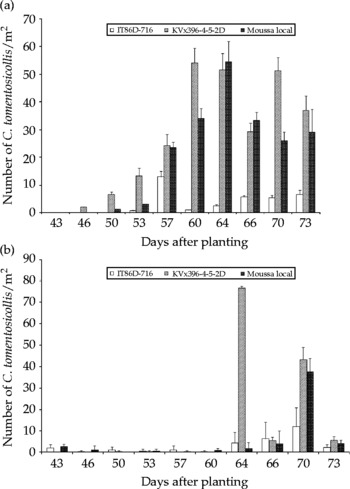
Clavigralla tomentosicollis adults and nymphs were observed feeding on pods of all three cowpea cultivars during 1997 and 1998 (Fig. 1). At five to eight times, significantly lower numbers of insects were recorded on the pods of IT86D-716 variety regardless of the year (F = 5.41, P < 0.05). As a consequence, pod and seed damage on IT86D-716 was significantly less severe (Table 1).
Abundance of Clavigralla tomentosicollis adults on three cowpea varieties during (a) the rainy season in 1997 and (b) the rainy season in 1998 in Kamboinsé, Burkina Faso.

Damaged pods and seeds, and viable seeds (means±SEM) on three cowpea varieties under natural infestation of Clavigralla tomentosicollis in Kamboinse, Burkina Faso, in 1997 and 1998

Means within a column followed by the same letter are not significantly different (P < 0.05; SNK test).
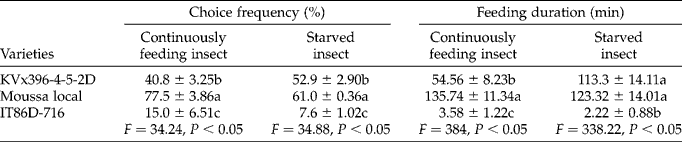
PSB adults showed greater preference to pods of the Moussa local variety followed by KVx396-4-5-2D and IT86D-716 cultivars regardless of the pre-existing condition of the insects (starved or actively feeding insects). As a result, feeding duration on IT86D-716 pods was significantly lower (Table 2).
Choice frequency and feeding duration (means±SEM) of continuously feeding and starved adults of Clavigralla tomentosicollis when reared on fresh pods of three cowpea varieties
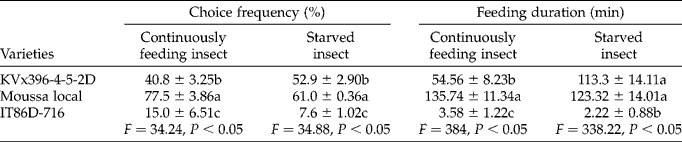
Means within a column followed by the same letter are not significantly different (P < 0.05; SNK test).
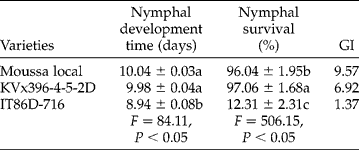
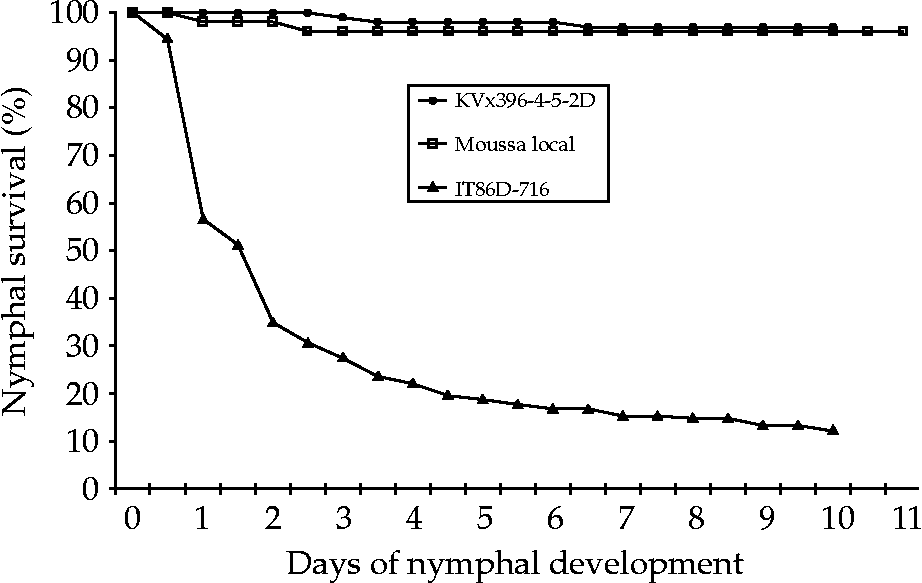
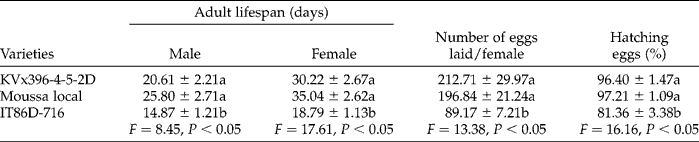
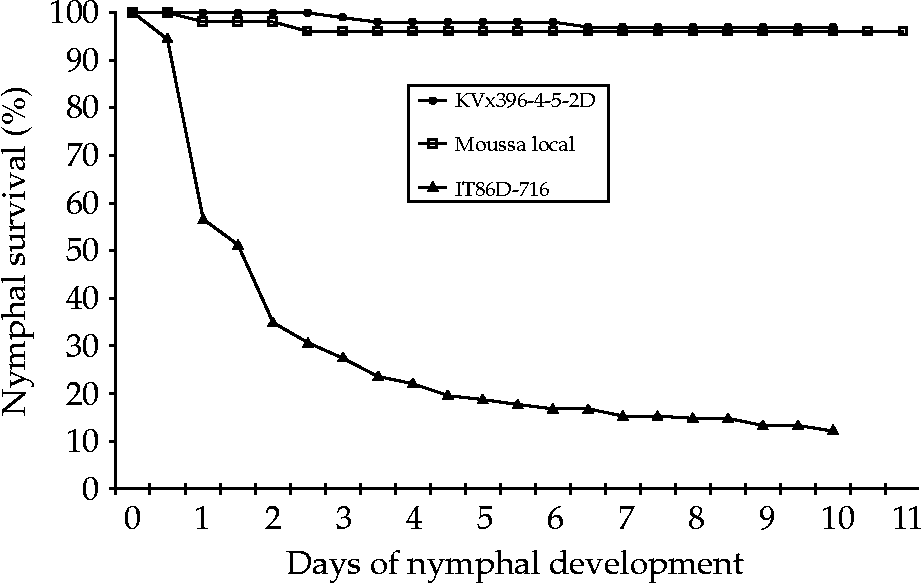
When the insects were fed with pods of IT86D-716, the nymphal development time was shorter and the nymphal survivorship was lower (Table 3). In that case, the daily nymphal survival dropped sharply within 3 days (Fig. 2). Insects feeding on the other two varieties, i.e. Moussa local and KVx396-4-5-2D, exhibited a higher GI (Table 3). Both female and male longevity were affected by the type of pods they were feeding on. The reproductive potential of the females was markedly reduced when insects were reared on pods of IT86D-716 with significantly lower number of eggs laid (Table 4). Consequently, the number of viable eggs was also lower (Table 4).
Clavigralla tomentosicollis nymphal developmental period and survival rate (means±SEM) and GI when reared on fresh pods of three cowpea varieties
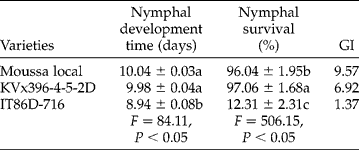
GI, growth index. Means within a column followed by the same letter are not significantly different (P < 0.05; SNK test).
Daily nymphal survival of Clavigralla tomentosicollis on fresh pods of three cowpea varieties.
Clavigralla tomentosicollis adult lifespan, number of eggs laid per female and percentage of hatching eggs (means±SEM) when reared on fresh pods of three cowpea varieties
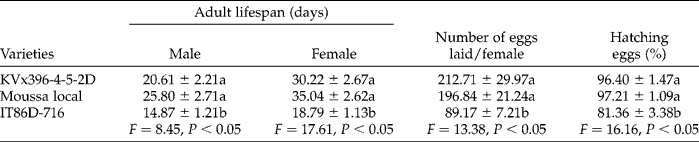
Means within a column followed by the same letter are not significantly different (P < 0.05; SNK test).
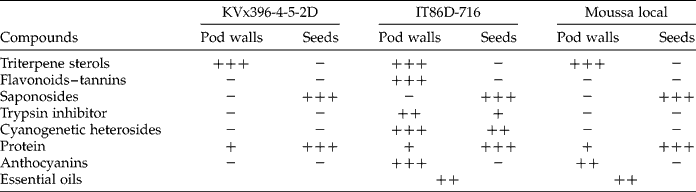
Chemical analysis revealed flavonoids, tannins, cyanogenic heterosides and trypsin inhibitors in pods of IT86D-716; these compounds were not detected in the two other varieties (Table 5).
Chemical composition of seeds and pod walls of three cowpea varieties
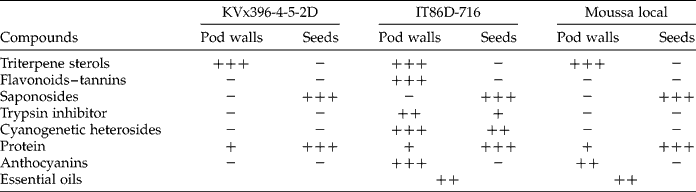
− , absence of the compound; +, low presence of the compound; ++, medium presence of the compound; +++, high concentration of the compound.
Discussion
The cowpea variety IT86D-716 exhibited two types of resistance to C. tomentosicollis. The damage on this variety was sporadic in the field, and when the insects were given a choice, they did not prefer the pods of IT86D-716 for feeding. This is a typical non-preference resistance mechanism as described by Painter (Reference Painter1951). The purple colour of IT86D-716 pods was suspected to be conferring resistance to PSB. However, the purple-coloured pods of Moussa local were heavily attacked and faced similar frequency of choice compared with the susceptible variety KVx396-4-5-2D. In addition, the chemical analysis revealed that both Moussa local and IT86-D-716 pods contain anthocyanins that confer the purple colour character. Therefore, these findings demonstrate that the purple colour character was not responsible for the non-preference mechanism. This led us to conclude that non-preference might be due to some other factors. Non-preference was reported on cowpea due to the presence of trichomes on the pod surface providing a physical barrier to the insects (Oghiakhe et al., Reference Oghiakhe, Jackai, Makanjuola and Hodgson1992; Jackai et al., Reference Jackai, Nokoe, Tayo and Koona2001; Koona et al., Reference Koona, Osisanya, Jackai, Tamo, Reeves and Hughes2002b). The IT86D-716 variety pods do not have trichomes. However, biochemical characters can also confer non-preference resistance to insect pest (Panda and Khush, Reference Panda and Khush1995). Non-preference has been hypothesized as related to volatile odours emitted by the pods in some cowpea genotypes (Koona et al., Reference Koona, Osisanya, Lajide, Jackai and Tamo2003). The chemical analysis revealed volatile essential oils in pods of IT86D-716 and Moussa local varieties.
In addition to non-preference, pods of IT86D-716 exhibited antibiosis to C. tomentosicollis. As defined by Painter (Reference Painter1951), impaired development of C. tomentosicollis resulted in high nymphal mortality, low GI and decreased fecundity. Similar observations were reported on cowpea genotypes resistant to C. tomentosicollis (Olatunde and Odebiyi, Reference Olatunde and Odebiyi1991; Koona et al., Reference Koona, Osisanya, Jackai, Tamo and Markham2002a; Koona et al., Reference Koona, Osisanya, Lajide, Jackai and Tamo2003; Olatunde et al., Reference Olatunde, Biobaku, Ojo, Pitan and Adegbite2007). Thus, variability in chemical content of seeds has been reported as a factor conferring resistance to cowpea insect pests (Egwuatu and Taylor, Reference Egwuatu and Taylor1977; Gatehouse et al., Reference Gatehouse, Gatehouse, Dobie, Kilminster and Boulter1979; Marconi et al., Reference Marconi, Ruggeri and Carnovale1997; Dabiré et al., Reference Dabiré, Kini, Ba, Dabiré and Fouabi2005). The chemical analysis of IT86D-716 pods revealed polyphenols (cyanogenic heterosides and flavonoids–tannins) that were not present in the two other varieties. These compounds might have induced antibiosis in IT86D-716 pods. Polyphenols comprise a large group of natural components almost ubiquitously present in plants and exhibiting a wide range of biological activities (Thorsteinson, Reference Thorsteinson1960; Simmonds, Reference Simmonds2003). High concentrations of cyanogenic glycosides have already been observed inhibiting feeding and causing toxicity of bean varieties to the Mexican bean beetle (Beck, Reference Beck1965). In addition, a positive relationship between resistance against insect pests and high flavonoid glycoside content in cowpea or pigeon pea was highlighted (Lattanzio et al., Reference Lattanzio, Arpaia, Cardinali, Di Venere and Linsalata2000; Green et al., Reference Green, Stevenson, Simmonds and Sharma2003). Antibiosis due to tannins has been reported for several insect species (Grayer et al., Reference Grayer, Kimmins, Padgham, Harborne and Rao1992; Reddy et al., Reference Reddy, Sharma, Stenhouse, Nwanze and Youm1995; Sharma and Nwanze, Reference Sharma and Nwanze1997). In addition to polyphenols, the pods of IT86D-716 contained trypsin inhibitor, a component that was not present in the other two varieties. Several studies mention the unsuitability of trypsin inhibitor for herbivores of legumes (Liener, Reference Liener1981; Gatehouse and Boulter, Reference Gatehouse and Boulter1983; Bressani, Reference Bressani, Singh and Rachie1985; Broadway and Duffey, Reference Broadway and Duffey1986; Chavan and Kadam, Reference Chavan, Kadam, Salunkhe and Kadam1987). In this study, some of the compounds responsible for antibiosis were found in the pod walls, similar to what was reported in pigeon pea (Green et al., Reference Green, Stevenson, Simmonds and Sharma2003).
Our study revealed that IT86D-716 exhibited a high level of resistance to C. tomentosicollis. The same cultivar was reported to be moderately resistant to lygus bug and bruchids (Lima et al., Reference Lima, De-Oliveira, Barros and Torres2001; Ehlers et al., Reference Ehlers, Fery, Hall, Fatokun, Tarawali, Singh, Kormawa and Tamò2002). A closely related variety, IT86D-721, was found to be moderately resistant to PSB in Nigeria (Yehouenou, Reference Yehouenou1994). Since climatic factors can affect the concentration of antibiosis compounds (Jackai and Inang, Reference Jackai and Inang1992), this might explain the moderate resistance of the cultivar in Nigeria. Accumulation of polyphenols such as flavonoids can be affected by solar radiation (Warren et al., Reference Warren, Bassman, Fellman, Mattinson and Eigenbrode2003; Rousseaux et al., Reference Rousseaux, Julkunen-Titto, Searles, Scopel, Aphalo and Ballare2004). We thus hypothesize that warm temperature and short rainfall conditions in the Kamboinse region of Burkina Faso may result in increased concentrations of the antibiosis compounds.
Conclusion
The current study has clearly demonstrated that IT86D-716 has a high level of resistance to C. tomentosicollis contributed by both non-preference and antibiosis mechanisms. This character can be incorporated into any of the already improved, well-adapted, popularly accepted and high-yielding cowpea varieties to create C. tomentosicollis-resistant varieties.