Introduction
In the United Kingdom (UK) at present, older people with disabilities may be entitled to one of two social security benefits which are intended to help with the extra costs of disability: Attendance Allowance (AA) and Disability Living Allowance (DLA). AA can be claimed only by people aged 65 and over; DLA must be claimed before reaching age 65, but if awarded, can continue past age 65. It is not possible to receive both benefits simultaneously. In Great Britain in November 2009, there were 0.81 million DLA recipients aged 65 and over, and 1.62 million AA recipients, comprising respectively 8.3 and 16.5 per cent of the over-65 population. From April 2013 DLA will start to be replaced by Person Independence Payment which will differ from DLA in certain details but like DLA will have to be claimed before age 65 and can continue in payment beyond 65 (Welfare Reform Act 2012, http://www.legislation.gov.uk/ukpga/2012/5/contents/enacted).
At times of tight fiscal constraints, governments tend to scrutinise welfare payments which may be being paid to people who could afford to manage without them. Non-means-tested payments are likely to be targets for reform. AA and DLA are not means-tested; entitlement to them depends only on meeting the disability criteria. Internationally, attention has been paid to the prospects for reducing state spending on disability benefits for working-age people (see e.g. McVicar Reference McVicar2008; Organisation for Economic Co-operation and Development 2010) but there has been less analysis of potential reforms to disability benefits for people beyond retirement age. However, the drive to more consumer-directed care services means that a growing proportion of publicly funded care for older people may in future be provided through ‘personal budgets’ (actual or virtual cash budgets) rather than in-kind services (Arntz and Thomsen Reference Arntz and Thomsen2010). The extent to which cash and in-kind care benefits should be means-tested is of widespread interest.
In the UK, disability benefits for older people have been identified as candidates for reform (Wanless Reference Wanless2006). In 2009, the then Government set out some options for reform of the system of social care in England, raising the possibility of some reallocation of public spending away from these non-means-tested cash benefit programmes (Her Majesty's Government 2009) into the social care system which is means-tested. Subsequently, it ruled out ‘any changes to AA or DLA in the next Parliament to fund the second stage of [social care] reform’ (Her Majesty's Government 2010a: 123). The change of government in May 2010 was followed by an announcement of a new Commission on the Funding of Adult Care and Support which was asked to ‘make recommendations on how to achieve an affordable and sustainable funding system for all adults in England … The approach recommended must be affordable and sustainable in the short and long term. It must be consistent with the Government's deficit reduction plan’ (Secretary of State for Health 2010). This commission concluded that universal disability benefits should remain but recommended that ‘the Government consider how better to align benefits with the reformed social care funding system and that Attendance Allowance should be re-branded to clarify its purpose’ (Commission on Funding Care and Support 2011: 6). In July 2012 the Government published a progress report on social care funding which has deferred any reform until the next public spending review (Her Majesty's Government 2012). Reform of AA and DLA continues to be the subject of debate.
It is not feasible to anticipate the possible changes to the pattern of provision of social care if a full reform of both cash benefits and social care were undertaken. Our more modest aim here is to analyse the consequences in terms of income losses (and a few gains) of potential reforms of AA and DLA, in the context of a general move towards retrenchment in benefit expenditures which might be a response to continuing public expenditure constraints. We identify some important methodological issues which apply more generally where reforms to welfare benefits result in large changes in incomes for some groups and/or involve benefits which, like AA and DLA, are intended to help recipients meet living costs that non-recipients do not face.
We begin in the next section by discussing two important conceptual issues that affect the presentation and interpretation of the potential impacts of reform. We follow this with an outline of the relevant features of the current benefits system and potential reforms to it. Our baseline is the 2007–08 system of disability and other relevant pensioner benefits. There have been no significant structural changes to these benefits since then. Data and methods are described next before we present analyses of a range of potential reforms.
Presentation matters! Describing the distribution of reform impacts
An official view
Following the May 2010 change of government in the UK, a new State of the Nation report was published, questioning the targeting of DLA and saying that:
over one in five of DLA claimants are in the top two income quintiles. (Her Majesty's Government 2010b: 38)
This phrasing could create a presumption in the reader's mind that DLA is poorly targeted and that, consequently, there exists a possible case for its curtailment. There are two obvious problems with this statement. The first concerns the concept of income: if the income definition used to construct quintiles includes receipts of DLA, then the statement may be factually correct but conceal the fact that curtailment of DLA would drive many DLA recipients into the lower income quintiles. Thus, the way we choose to define income for the purpose of describing the incidence of reform effects may prejudice the debate in one direction or another.
The second problem with the State of the Nation statement is that it involves an implicit comparison between the incomes of disabled and non-disabled people, since the income quintiles are based on the whole household income distribution, while the incomes of DLA recipients are incomes of people who have been assessed as being severely disabled. If disabled people require a higher level of income to achieve the same standard of living as an otherwise similar non-disabled person, a simple comparison of their income levels gives a misleading picture of their relative living standards. The stated objectives of the DLA system explicitly recognise this non-comparability, by emphasising the additional costs of living with disability. For example, guidance to potential claimants of the care and mobility components of DLA refers to needs for ‘help with things such as washing, dressing, eating, getting to and using the toilet, or communicating your needs’ and ‘guidance or supervision most of the time from another person when walking out of doors’. Such support is, in general, costly.
The authors of the State of the Nation report were aware of the problems of income definition and costs of disability, since the statement was followed immediately by a qualification:
…(when Disability Living Allowance is included in income and no account is taken of extra costs of disability).
We would argue that is inappropriate to relegate such important issues to a subsidiary qualification which might be interpreted as a minor definitional detail.
In the remainder of this section, we examine the conceptual issues of income definition and disability-related need in more detail.
Income definitions for distributional analysis
Our unit of analysis is the benefit unit, defined as a group of co-resident individuals treated as a unit by the benefit system. For the older population, this generally means a single person or a married or cohabiting couple (only a small proportion of people over 65 have dependent children who would be classified as part of the same benefit unit). For our purposes, the income of a benefit unit can be decomposed as follows:
 $$BI = DB + MTB + MTDB + OI.$$
For some purposes, we may wish to look at income available to the benefit unit after meeting housing costs, which gives a definition
 $$AI = DB + MTB + MTDB + OI - HC.$$
In these definitions, BI and AI represent income before and after housing costs, respectively; DB is basic disability benefit (AA or DLA); MTB is basic means-tested benefit (Pension Credit, Housing Benefit and Council Tax Benefit); MTDB is the disability-related component of means-tested benefit known as the Severe Disability Premium (SDPFootnote 1); OI is other income (including pensions, investment income, etc.); and HC is housing costs. We define housing costs as rent, mortgage payments and the local property tax known as Council Tax.Footnote 2 The policy reforms we consider here affect DB and MTDB but leave MTB, OI and HC unchanged.
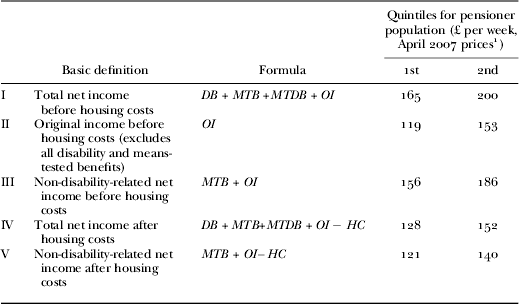
Used as a classificatory variable, income is intended to represent the standard of living of the benefit unit, so that we can say whether reforms tend to affect those who can ill-afford or well-afford to cope with the impact of reform. To reflect this aim, we adjust our measures of income for the number of members of the benefit unit, using the modified OECD equivalence scale, which is used in the UK's official Households Below Average Income (HBAI) analysis (see e.g. Department for Work and Pensions 2009).Footnote 3 In the fifth section, we estimate and plot the average income loss of people classified into groups according to their pre-reform income (defined in various ways). This is a very common method of presenting the results of policy simulations (see e.g. Brewer et al. Reference Brewer, Browne, Leicester, Miller, Chote, Emmerson and Shaw2010; Creedy, Hérault and Guyonne Reference Creedy, Hérault and Guyonne2009), and it focuses on the empirical association between two amounts for each benefit unit in the sample: their equivalised pre-reform income and the equivalised loss they are expected to experience. The drawback of this approach is that it treats pre-reform and post-reform income asymmetrically, and perhaps misleadingly – the fact that someone is not poor pre-reform does not mean that they could not become very poor post-reform.Footnote 4 Pre-reform income is not a good indicator of a benefit unit's ability to manage if a fairly large part of that income were to be withdrawn by the reform. More comprehensive descriptions involve symmetric comparisons of pre-reform and post-reform incomes, for example by estimating the numbers of moves into or out of poverty that would be induced by the new policy, an approach we pursue in the sixth section. For the present, we work with five alternative definitions of pre-reform income, which are set out in Table 1.
Income constructs

Notes: 1. Equivalised benefit unit income calculated from the Family Resources Survey (see text). DB: basic disability benefit [Attendance Allowance (AA) or Disability Living Allowance (DLA)]. MTB: basic means-tested benefit [Pension Credit (PC), Housing Benefit (HB) and Council Tax Benefit (CTB)]. MTDB: disability-related component of means-tested benefit known as the Severe Disability Premium (SDP). OI: other income (including pensions, investment income, etc.). HC: housing costs.
The first income definition is closest to the concept of total net income used in HBAI statistics and the concept of income underlying the statement from the State of the Nation report. It includes both disability benefits and means-tested benefits. The second income concept (original income) is intended to measure the benefit unit's underlying need for government support, and comprises income exclusive of all disability-related and means-tested benefit. The third income definition is intermediate between these two. It includes both original income and means-tested benefit, but excludes any disability benefit and disability-related additions to means-tested benefit (SDP). This definition avoids a problem inherent in the conventional net income concept – that, when the source of income (in our case disability benefit) which is the subject of a policy reform is included in the income used to determine a benefit unit's position in the income distribution, the reform may change that position, complicating interpretation of results. Income definitions IV and V are identical to definitions I and III, with housing costs subtracted, and equivalised using the OECD modified equivalence scale.
Comparing incomes of the disabled and non-disabled
If disability brings with it additional costs that are not experienced by non-disabled people, then comparisons of incomes across the disability spectrum are potentially misleading, since they are biased in the direction of making disabled people appear more well-off than they are in fact. This is analogous to the problem addressed by Radner (Reference Radner1997) and Klavus (Reference Klavus1999) when the value of in-kind benefits (such as public health care) is included in income without adjustment for the need that such benefits are intended to meet. There have been many attempts to estimate the costs associated with various forms and degrees of disability either through attempts to identify those costs explicitly (see e.g. Martin and White Reference Martin and White1988; Sainsbury, Hirst and Lawton Reference Sainsbury, Hirst and Lawton1995; Smith et al. Reference Smith, Middleton, Ashton-Brooks, Cox, Dobson and Reith2004; Thompson, Lavery and Curtice Reference Thompson, Lavery and Curtice1990; Tibble Reference Tibble2005) or implicitly by comparing the living standards of disabled and non-disabled people on similar incomes (Berthoud, Lakey and McKay Reference Berthoud, Lakey and McKay1993; Jones and O'Donnell Reference Jones and O'Donnell1995; Zaidi and Burchardt Reference Zaidi and Burchardt2005). There are two difficulties here: the conceptual problem of measuring costs and the sheer range of different disabilities and consequent needs. There is no consensus of opinion in the research literature on how best to measure these costs or their size. Policy makers have also not solved this problem and the UK benefit system delivers fixed sums to people within broad ranges of assessed care and, for DLA, mobility needs. Although estimates exist of the costs of various packages of formal social care services (see e.g. Curtis Reference Curtis2011), such costs are not the only costs of disability. Moreover, when AA and subsequently DLA were introduced they were not intended specifically to pay for care (Hansard, 10 July 1970, column 1013, cited in Berthoud and Hancock Reference Berthoud, Hancock and Churchill2008 and Department of Social Security 1990).
The use of any single estimate of the extra costs of disability would be open to justifiable criticisms. Our approach is thus to use sensitivity analysis to explore alternative assumptions about the average scale of these hidden disability-related costs. We tie these alternatives to the minimum income levels guaranteed under the pre-reform benefit system to older people who claim all their entitlements to means-tested and disability benefits. For people who are not eligible for the SDP, we use the Guarantee Credit (GC) component of the Pension Credit system, excluding the SDP, as a basic poverty line (£119.05 and £181.70 in 2007–08 for single-person and two-person benefit units, respectively). For those who qualify for the SDP, we add to this basic poverty line a proportion 0–100 per cent of the SDP (£48.45 for a single person, £96.90 for a couple where both qualify). We extend this set of poverty lines further by using GC + SDP plus a proportion of the AA or DLA amount that the benefit unit currently receives. This gives a range of alternative poverty lines for a benefit unit receiving AA or DLA of £119.05 to £232 for a single pensioner and £181.70 to £407.60Footnote 5 for a couple. These ranges allow for disability-related costs which vary from zero to a maximum of that built into the present structure of the benefit system. Each pensioner benefit unit's income under the present and reformed benefit system is then compared to each of these poverty lines. For this comparison we use net income after housing costs (definition IV) as it is this which is guaranteed through the benefits system. For example, £119.05 is the minimum that a non-disabled single pensioner would have to live on after meeting their housing costs. We then examine the impact that potential reforms have on the proportion of benefit units with incomes below these alternative thresholds and see the effect on these proportions of different assumptions on the scale of disability costs. The poverty rates generated in this way are not intended to be comparable with those based on widely-used definitions of poverty such as 60 per cent of median income. Our thresholds are not linked to the levels of income in the general population and even the highest threshold may not fully allow for the disability-related costs faced by the most severely disabled older people. Note also that we make no adjustment to the GC poverty line for people who may be disabled but who do not receive AA or DLA, so our analysis will understate poverty in that respect.
Reform
The pre-reform system
Our interest here is in two groups of welfare payments which can supplement the state pensions, private pensions and other incomes of people aged 65 and over. The first group consists of the non-means-tested and non-taxable AA (claimable from age 65) and the alternative DLA (which must be claimed before reaching age 65 but payment can continue beyond 65). AA can be awarded at one of two rates depending on the extent of care needs. In 2007–08 the lower rate was £43.15 and the higher rate was £64.50. DLA has a care component and a mobility component. Recipients can receive one or both of these components. The care component (DLAc) is payable at one of three rates depending on the claimant's care needs. The two highest rates are the same as the two AA rates. In 2007–08 the lowest rate was £17.10. The mobility component has two potential rates, £17.10 and £45.00 in 2007–08.
The second group of benefits consists of three means-tested benefits. Pension Credit (PC) is a general income supplement. Housing Benefit (HB) and Council Tax Benefit (CTB) provide help with the costs of rent and council tax. PC is made up of Guarantee Credit (GC) and Savings Credit (SC). Benefit units with assessable income below their GC level are entitled to a GC payment which brings their income up to that level. The applicable GC level depends on various characteristics of the claimant. The main ones are whether the benefit unit consists of a single pensioner or a couple, and whether one or both partners is eligible for the SDP. To be eligible for the SDP, a claimant must be receiving AA or the middle or higher rate of DLAc and meet other ‘living alone’ conditions which effectively restrict eligibility to those who do not have someone who does, or could, provide care for them (Age UK 2010). These conditions particularly affect couples.Footnote 6
The SC is an addition which is related to the amount of income that the claimant has above a certain threshold which in 2007–08 was equivalent to the value of the basic state pension, and subject to a weekly maximum of £19.05 for a single pensioner and £25.26 for a couple. The threshold is below the GC level so it is possible to be entitled to the GC or the SC or both. In calculating assessable income for both the GC and SC, actual income from capital or savings is ignored but capital above a lower threshold is assumed to generate a weekly income of £1 for every £500 of capital above that threshold. The means tests for HB and CTB are such that most older people entitled to GC are entitled to receive HB and CTB equivalent to 100 per cent of these costs.Footnote 7 People with higher incomes are entitled to lower amounts which decline as incomes rise. HB and CTB embody an SDP on the same basis as PC. There is no upper capital limit for PC but for anyone not receiving the GC, an upper capital limit applies such that, if capital exceeds this limit, entitlement to HB and CTB is zero. Thus there are very complicated interactions between PC and HB/ CTB.
Some reform options
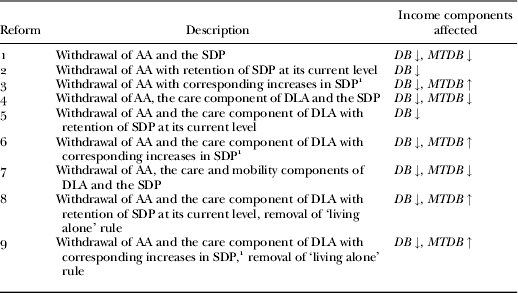
We are concerned here with reforms which would affect eligibility for AA and DLA among the older population. Reforms mooted by the previous Labour Government were directed mainly at AA but did not rule out the possibility of reforms to DLA for people aged 65 + . We therefore examine options which would affect only AA and some which would affect both AA and DLA for older people. The reforms we examine are set out in Table 2. All the reforms involve removing AA, meaning that there would be no non-means-tested benefit for people becoming disabled after the age of 65. In reforms 1–3 DLA is retained so those disabled before age 65 would continue to get non-means-tested support after 65 whereas reforms 4–6, 8 and 9 also remove the care component of DLA. Reform 7 removes both components of DLA. Reforms 1, 4 and 7 additionally abolish the means-tested SDP, while reforms 2 and 5 retain the SDP at its current level and reforms 3 and 6 not only retain but increase SDP to maintain the level of disability benefit for those who qualify.Footnote 8 In practice, the retained SDP would mainly go to single people without carers or couples where both are disabled, due to the ‘living alone’ rules. Reforms 8 and 9 are versions of reform 5 and 6 in which this rule is abolishedFootnote 9 so that everyone previously receiving AA or the middle/higher rate of the care component of DLA is automatically eligible for the SDP.
Simulated reforms of disability benefit
Notes: See Table 1 for abbreviations. 1. Note that reforms 3, 6 and 9 can in some circumstances result in gains rather than losses. The higher levels of SDP can result in people becoming entitled to the Guarantee Credit part of PC and so no longer being subject to the upper capital limit in HB and CTB. They then become entitled to 100 per cent HB and CTB which together with their higher PC, can exceed the loss of AA/DLAc (care component of DLA).
Reforms 3 and 6 would effectively constitute a comprehensive switch from ‘universal’ disability benefit (AA and DLAc) to means-tested disability benefit (enhanced SDP), retaining the existing AA/DLA mechanism for assessing disability and the existing means-testing apparatus used for PC, etc. Reforms 8 and 9 go a step further to provide protection for those who would otherwise be excluded from qualifying for SDP by the ‘living alone’ rule. At the other end of the spectrum, reform 7 would result in no disability benefits, means-tested or otherwise, for people aged 65 and over.
Data and simulation methods
Data
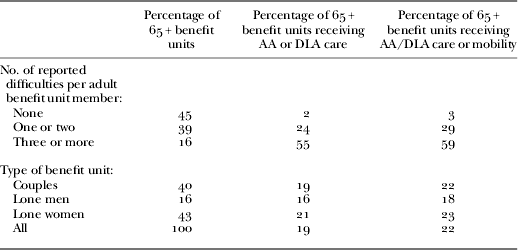
We use data from the UK Family Resources Survey (FRS) spanning the three financial years April 2002 to March 2005. The FRS is a continuous cross-sectional survey, designed to be representative of UK private households, with a sample size of around 25,000 households each year. It collects detailed information on the personal characteristics and incomes of all adults in the sampled households, enabling us to simulate the effects of relevant changes to the benefit system for a large sample of older people. Importantly for this paper, the FRS distinguishes the care and mobility components of DLA. We work at the benefit unit level and include all benefit units containing at least one person aged 65 and over but exclude those containing an adult under state pension age (65 for men, 60 for women at the time of the surveys). There are 21,850 such units in the sample we use. Table 3 summarises some relevant characteristics of the sample. Overall, a little over 20 per cent of this sample report receiving AA or DLA. The FRS asks respondents about difficulties in eight areas of daily lifeFootnote 10 and we use this to classify benefit units by the number of such difficulties (disabilities). Fifty-five per cent of the sample have at least one such disability. AA/DLA receipt reaches 59 per cent among those with three or more disabilities per person in the benefit unit. The large majority of benefit units consist of a couple (40%) or a lone woman (43%) with only a small minority consisting of lone men (16%). The proportion of those lone men who receive AA/DLA is a little below the average for the whole sample. A comparison of the third and fourth columns of Table 3 indicates that there are small but not negligible proportions of the sample reporting receipt of the mobility but not the care component of DLA.
Sample characteristics
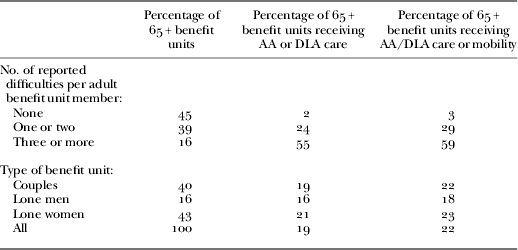
Notes: AA: Attendance Allowance. DLA: Disability Living Allowance.
The simulation method
The information in the FRS is used to simulate income tax liability, entitlement to means-tested benefits for the benefits units in our selected sample and reforms to AA and DLA together with any related reforms to means-tested benefits. We use a microsimulation model (CARESIM). This model is a dynamic microsimulation model whose primary aim is to examine the effect of alternative care charging policies, for a base year and for future years, for people aged 65 and over sampled in the UK FRS (Hancock et al. Reference Hancock, Wittenberg, Pickard, Comas-Herrera, Juarez-Garcia, King and Malley2007). For this paper we use the part of the model which simulates income tax and means-tested benefit entitlement of sample members. It does this using the very detailed information on incomes and other characteristics collected in the FRS that is needed to assess income tax liability and benefit entitlement. The model is used here as a static tax-benefit model since simulations are performed only for the base year. It has been enhanced to simulate reforms to AA and DLA for people aged 65+ who report receipt of one of these benefits in the FRS. The FRS excludes people living in care homes so our analysis is restricted to people living in private households. There is no source of information which provides the degree of detail on the incomes and other relevant characteristics of the care home population that is collected in the FRS and necessary for the analysis in this paper. However, approximately two-thirds of care home residents receive some support from a Local Authority with their care home fees. As a result they cease to receive AA, DLA and the SDP, and hence would be unaffected by their withdrawal. The exclusion of care home residents is therefore not as limiting as it might seem.
We allow for non take-up of means-tested benefits drawing on Department for Work and Pensions estimates of the pensioner caseload take-up rates for each benefit and evidence on the pattern of multiple benefit take-up (Hancock et al. Reference Hancock, Pudney, Barker, Hernandez and Sutherland2004). Our approach is similar to that used by Sutherland et al. (Reference Sutherland, Hancock, Hills and Zantomio2008). Take-up of each benefit is randomly assigned to an appropriate proportion of those entitled. Where a pensioner unit is assigned to take up their pre-reform benefit entitlement, they are assumed also to take up any post-reform entitlement. For PC, we assume that the take-up rate by those entitled to the GC is higher than for those entitled only to the SC rate and that take up of HB and CTB is 100 per cent for those taking up any entitlement to PC. Take up of CTB by those not receiving PC is assumed to be lower among owner-occupiers than among renters.Footnote 11 This method allows only indirectly for the known relationship between take up and size of entitlement and assumes that take-up probabilities are not changed by a policy reform. We do not allow directly for any change in take-up behaviour which could be induced by the reforms we consider. In practice take-up of entitlements may be lower under means-testing than under a system where entitlement depends only on disability and this is not fully reflected in our results. Allowance for this possibility would require statistical modelling of take-up behaviour and simulation of changes in take up induced by the reform, in the manner discussed by Pudney, Hancock and Sutherland (Reference Pudney, Hancock and Sutherland2006).
Note that the simulations refer only to the household-resident population, so we are not capturing the effects of the reforms on the institutional population, nor any effect they might have on the relative sizes of the household and institutional populations.
Income is expressed in 2007 prices. Income from those social security benefits not covered in the simulation process has been adjusted according to movements in the relevant rates of benefits between the survey year and the financial year. Other non-simulated types of pre-tax income have been adjusted by movements in the all-items Retail Price Index before applying the simulation model.
Aggregate budgetary cost savings generated by the reforms are constructed by grossing-up the FRS data to the level of the household population. No allowance is made for any under-reporting of AA/DLA receipt in the FRS. Thus, simulated aggregate costs of the AA/DLA system and the savings generated by reform are both likely to be understated to some degree. For example, the savings generated by reform 2 correspond to the annual cost of AA. Administrative statistics indicate that in 2007 this cost was some £4.4 billion for the UK compared to our estimate of savings of £2.7 billionFootnote 12 from abolishing AA while retaining the SDP at its current level. Administrative figures include AA paid to people in care homes and to people with partners below state pension age. Both these groups are excluded from our sample. Even so, the comparison suggests that our results probably underestimate public expenditure savings. However, we believe they provide a good indication of the relative savings from the different reforms.
The pattern of reform impacts by income
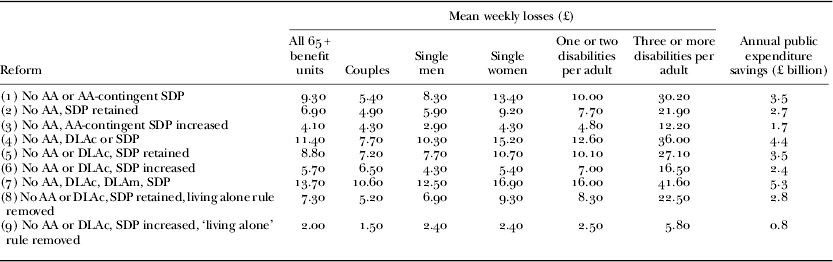
Table 4 presents the estimated total public expenditure savings from the reforms, together with average weekly equivalised losses for couples, lone men and lone women, and by number of reported disabilities per person (one or two disabilities and three or more disabilities per person).
Mean weekly equivalised losses by pensioner unit type and total annual public expenditure savings, 2007 prices
Notes: AA: Attendance Allowance. DLAc: Disability Living Allowance care component. DLAm: Disability Living Allowance mobility component. SDP: Severe Disability Premium.
The ranking of public expenditure savings is as would be expected. Abolishing AA, both components of DLA and the SDP saves about £5.3 billion a year. To put this in context, it exceeds the UK budget deficit of £4.7 billion for our reference year 2007–08, but is small relative to the £105.6 billion deficit for 2009–10.Footnote 13 Options which increase the SDP save the least: £1.7 billion if only AA is withdrawn and the AA-contingent SDP increased; £2.4 billion if AA and DLAc are withdrawn and SDP increased. The absence of large potential savings from this switch to means-testing is not surprising, given the significant degree of implicit income targeting that already exists in AA/DLA, as a result of the income-related incidence of disability and the negative relationship between the probability of disability benefit take-up and income (Pudney Reference Pudney2010; Pudney et al. Reference Pudney, Zantomio, Hancock and Morciano2010). The effect of removing the SDP ‘living alone’ rule can be seen by comparing reform 5 with reform 8 and reform 6 with reform 9. The average weekly loss from abolishing AA and DLAc is reduced from £8.80 to £7.30 if SDP is retained at its current level, and from £5.70 to £2.00 when SDP is increased. The savings in annual expenditure are correspondingly lower.
The impact varies considerably across population groups. Losses are particularly high for those with three or more disabilities per person, and are higher for single people (especially women) than for couples. Increasing the SDP substantially reduces losses for all pensioner unit types but has the least effect for couples – partly because they are less likely to fall within the scope of means-tested benefits and partly because it is harder for them to qualify for the SDP. As would be expected, removing the SDP ‘living alone’ rule reduces average losses for couples in particular but single pensioners also benefit.
In Figures 1–5, we plot the average equivalised gain or loss generated by these reforms against income for pensioner units, using the five alternative income concepts for classification purposes. We use smoothed income profiles so as to reduce the raggedness in the plots that is a consequence of random sampling from the population, without resorting to the use of arbitrary income bands.Footnote 14 Vertical lines on the graphs indicate the thresholds of each of the five quintiles of the income distribution in question enabling us to see at a glance how different definitions of income change the extent to which losses from the reforms are concentrated in different parts of the income distribution. This is the main purpose of the graphs.
(Colour online) Mean gains or losses (£ per week) from nine alternative reforms, by income (income definition I: total pre-reform net income before housing costs; vertical lines represent quintile points).
(Colour online) Mean gains or losses (£ per week) from nine alternative reforms, by income (income definition II: pre-reform original income before housing costs; vertical lines represent quintile points).
(Colour online) Mean gains or losses (£ per week) from nine alternative reforms, by income (income definition III: pre-reform income excluding disability benefits, before housing costs; vertical lines represent quintile points).
(Colour online) Mean gains or losses (£ per week) from nine alternative reforms, by income (income definition IV: total pre-reform net income after housing costs; vertical lines represent quintile points).
(Colour online) Mean gains or losses (£ per week) from nine alternative reforms, by income (income definition V: pre-reform original income after housing costs; vertical lines represent quintile points).
Figures 1–3 show the incidence of losses in relation to income before housing costs. They demonstrate the importance of the choice of income definition used to classify people pre-reform. When total net income (Figure 1: income definition I) is used, people in the bottom quintile are essentially unaffected and the largest losses are found among those with total incomes (including the disability and means-tested benefit which would be affected by the reform) of around £300 per week – which is well above the median, in the fourth quintile of the pensioner income distribution. This creates the impression that reform could be justifiable on grounds of targeting efficiency. The average loss for this most heavily affected income group is up to 12% of income, depending on the type of reform.
However, the pensioner income distribution is relatively compressed, so that income differences between the quintiles are not large compared to the potential losses produced by the reforms. Moreover, the people who would experience these losses tend to rely on significant amounts of benefit income, so that reform may have the effect of changing people's position in the distribution. Few of those affected by the reform are in the lowest quintile of the total pre-reform income distribution because disability benefits tend to take recipients' incomes above that level. Figure 2 shows that the largest average loss is in fact experienced by people whose original incomes (definition II: excluding means-tested and disability benefits) are only around £50 per week – which is in the bottom quintile of original income.
Figure 3 is based on income definition III and shows that, in terms of income before disability-related benefit, the biggest average losses are to be found among people with incomes around £75 per week – which is in the bottom quintile – but, for the more radical reforms 1, 4 and 7, there are also large impacts over a wider range up to £200 or more. This suggests that uncompensated removal of AA/DLA would have the effect of leaving significant numbers of people on very low incomes.
Figures 4 and 5 show the pattern of losses in relation to income after housing costs, with disability benefit either included in income (definition IV) or excluded (definition V). Again, the choice of income definition determines whether the biggest losers from reform appear to come from the first or fourth quintile of the pensioner income distribution.
Which of these income concepts should be used for presentational purposes? The answer depends in part on the assumption we make about the costs of disability. If we believe that these costs are negligible, then there is a case for using total net income (definitions I or IV),Footnote 15 whereas, if we believe that there are substantial additional living costs associated with disability and that these costs are approximated by the level of AA/DLA/SDP, then the income definitions that exclude disability benefit (III and V) are more appropriate. We consider this issue in more detail in the next section.
For all income concepts, reforms 3 and 6 (which protect low-income benefit units from the effect of AA/DLA withdrawal by increasing SDP) have the lowest impact on the incomes of poor pensioners – although that impact is still significant at £5–10 per week, equivalised. Moreover, this protection extends only to people who take up their entitlement to means-tested benefits. Reforms 1, 4 and 7, which abolish SDP alongside the withdrawal of AA/DLA have a much greater distributional impact – of as much as £22 per week (equivalised), for people with other sources of income totalling only around £100 per week on average (Figure 3). Reforms 2 and 5, which retain the SDP at its current level, are intermediate between these cases.
Pre- and post-reform poverty rates and disability-related need
Figures 6 and 7 summarise the simulation results in terms of poverty rates. They plot the proportion of benefit units classed as poor against alternative choices for the poverty line. These alternative poverty lines are constructed as the relevant GC amount plus various proportions of the SDP and AA/DLA amounts, and thus give a menu of disability-specific poverty definitions based loosely on the assumptions implicit in the current design of the benefit system.
(Colour online) Pre- and post-reform poverty rates by poverty line: all pensioner benefit units.
(Colour online) Pre- and post-reform poverty rates by poverty line: pensioner benefit units with disabilities. (a) Benefit units with one or two disabilities per person; (b) benefit units with three or more disabilities per person.
Poverty rates are between 9 and 11 per cent for all pensioner benefit units under the pre-reform system.Footnote 16 It is only people who do not take up their entitlements to means-tested benefits and those with incomes below the poverty line but enough capital to disqualify them from means-tested benefits that are poor. Reforms which abolish AA/DLA but retain or increase the SDP have little adverse effect on poverty rates for poverty thresholds up to the GC +100 per cent of the current SDP. For higher poverty thresholds and reforms which abolish the SDP, the effects are much more marked. Under reform 7 which abolishes AA, both components of DLA and the SDP, poverty rates reach 23 per cent of all pensioner units and over 50 per cent for those with three or more disabilities at the highest poverty threshold. Reform 4 which abolishes AA, the care component of DLA and the SDP results in poverty rates for those with three or more disabilities of up to 47 per cent. The most generous compensation through the SDP (reform 9) would reduce this to 37 per cent.
The allowances we make for the additional costs of disability in defining the poverty threshold are clearly crucial. In this paper these allowances are set at varying proportions of the amounts of AA/DLA and SDP. The current disability and means-tested benefits system guarantees that pensioner units who qualify for the higher/middle rates of AA/DLAc (which is necessary but not sufficient to qualify for the SDP) and for the SDP, and who claim any entitlement to means-tested benefits will have incomes equal to at least the GC plus the SDP plus their AA/DLA. It is hard to argue that this minimum income takes recipients of it out of poverty as this would suggest that the combination of the SDP and AA/DLAc overestimates the costs of disability faced by people who qualify for these additions. Hence the allowances that we use in this paper for the extra costs of disability seem more likely to understate than overstate the true costs.
Conclusions
We do not offer any opinion on whether there is a strong case for reform of the UK disability benefit system for older people, nor on which reform would be the best option among the nine considered here. That requires a judgement on the scale of support that society should offer to disabled older people and on one's views about income inequality within this part of the population. Different commentators may arrive at different, equally defensible, views on these issues. In addition, it is not uncommon for policy reforms which create losers among existing benefit recipients to provide transitional protection to those recipients in which case the effects are felt by future potential claimants rather than existing ones. However, unless the population of future claimants differs substantially in relevant ways from current claimants, analyses of the effects that reforms would have if implemented for existing claimants remain relevant.
However, we do have some definite and striking conclusions about the factors to be considered when making judgements about policy reform. First, the method we choose to describe the predicted outcomes of projected reforms may make an enormous difference to the way those outcomes appear to the policy maker. So presentation matters. When presented in the way that was used in the 2010 State of the Nation report, abolition of AA/DLA appears not to have a major adverse effect on the poor. But this is misleading because AA/DLA is included in the measure of income used to classify people as poor or non-poor. Using our preferred income definition for classification, we find that abolition of AA/DLA would in fact have a large impact on the poorer part of the older population.
A second important conclusion is that we must be careful in defining low-income status for people with disabilities. If disability brings with it additional needs which can only be met with additional expenditure, then the same poverty line should not be used for disabled and non-disabled people. To investigate this, we have used various disability-specific poverty lines related to the assumptions about the costs of disability which are implicit in the design of the current benefit system. We find that this has a large influence on the results of the policy simulations, with the more radical cuts in AA/DLA/SDP having a major impact on the incomes of large groups of poorer disabled pensioners. Even reforms that seek to protect low-income people by retaining the SDP at its current level whilst abolishing AA/DLA have a large impact on poverty rates if the poverty line is chosen to be consistent with the costs of disability implicit in the current design of the benefit system.
Our analysis has focused on a potential policy reform which is the subject of debate in the UK and in detail is specific to the UK system of disability benefits. However, our main conclusions on the importance of the methods used to assess the impact of potential policy reforms are relevant to all reforms to cash or in-kind benefits which are intended to meet extra costs. More generally, care is needed in choosing an appropriate income construct when judging a household's ability to cope with a potentially large reduction in its income by reference to its position in the pre-reform income distribution.
Acknowledgements
We are grateful to Sally West of Age UK for extremely helpful comment and advice, and to Age UK for financial support for this research. This research also builds on work generously supported by the Nuffield Foundation and the Economic and Social Research Council through the MiSoC research centre. Material from the Family Resources Survey is crown copyright, has been made available by the Office for National Statistics via the UK Data Archive and used with permission. All responsibility for data analysis and interpretation rests with the authors.