The instability of certain things and substances is just as interesting as the stability of others because it shifts attention from a focus on representation to a more involved comprehension of materiality and material agency. By materiality I mean how the material character of the world is comprehended, appropriated and involved in human projects.
— Joshua Pollard (Reference Pollard, Renfrew, Gosden and DeMarrais2004), “The Art of Decay and the Transformation of Substance”Things fall apart, but they do not do so at the same rate or in the same circumstance. The social implications of decay are many and diverse, usually depressing, but not always; there is aesthetic appeal in a moss garden or in the crack on a Japanese tea bowl—bonded and filled with lacquer and then coated with powdered goldFootnote 1 —and the romance of ruins, Angkor's Ta Prohm temple carefully maintained in its overgrown state. “Planned depreciation” is a cynical and widespread economic strategy, while the decaying excesses of middle-class kitchens are recast as redemptive acts—when we compost our garbage as an act of faith that it will nourish the earth. Gourmet mushrooms spring up in the ruined industrial forests of the American Northwest, offering precarious livelihoods to Lao and Cambodian refugees, even as the Jorai in the northeast of Cambodia subsist by trading war salvage (Tsing Reference Tsing2015; Uk Reference Uk2016). Many, if not most, human projects confront the instability of material forms, weighing the prospect of decay as quotidian practice.
The title for this presentation came to me the day after the US elections, when many cherished solidities seemed to be melting into air. Perhaps decay is in the zeitgeist. I had already been encountering decay—a more literal decay—in my conversations with shamans, spirit mediums, and carvers. The inevitability of decay in these quarters, at different paces and in different circumstances, informs my discussion here.
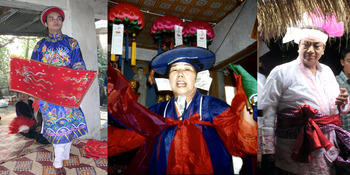
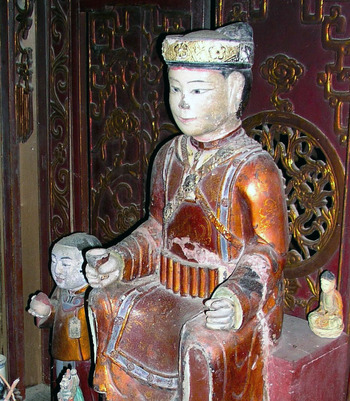
I will describe three traditions of popular religious practice where the carved or painted image functions as a container or transmitter for the gods or spirits who also animate the bodies of shamans and spirit mediums on appropriate occasions (see figure 1). These images are regarded not as symbols or representations but as presences consecrated and venerated through appropriate techniques and practices. Sacred, powerful, sometimes dangerous, but also material objects that will deteriorate over time even as the shaman's or medium's body is subject to the vicissitudes of aging flesh (see figure 2). However numinous the image, wood rots and insects feast on it, stone crumbles, moss finds purchase in its pits and crevices, paper soils and frays, and metal corrodes. The specter of decay links my discussion of sacred images in Mother Goddess temples in Vietnam, nat spirits tended by Burmese spirit mediums, and paintings of gods hung in shamans’ shrines in South Korea. The practitioners I describe—carvers, painters, shamans, and spirit mediums—no less than my colleagues in the Conservation Laboratory of the American Museum of Natural History, are not making a quixotic effort to stop time but rather they engage in choices and practices intended to postpone the prospect of deterioration or address its consequences.
Spirit medium incarnating a Mandarin, Red River Delta, Vietnam (left); shaman manifesting a Spirit Warrior, Kyŏnggi Province, South Korea (center); spirit medium returning from performing in the Taungbyon Festival near Mandalay, Myanmar (right). Photos by Laurel Kendall.

Mother Goddess or Lady in Waiting, Red River Delta, Vietnam. Photo by Laurel Kendall.

I have worked with Korean shamans for four decades. In a recent project, I joined forces with Jongsung Yang, a folklorist, and Yul Soo Yoon, an art historian, to focus on the paintings that hang in shamans’ shrines and circulate as a genre of Korean folk art (Kendall and Yang Reference Kendall and Yang2014, Reference Kendall and Yang2015; Kendall, Yang, and Yoon Reference Kendall, Yang and Yoon2015). In Vietnam, I collaborated with Vũ Thị, Thanh Tâm, and Nguyễn Thị Thu Hương, researchers from the Vietnam Museum of Ethnology, to explore the social lives of statues used in temples favored by spirit mediums in Vietnam's Mother Goddess religion (Kendall, Vũ, and Nguyễn Reference Kendall, Thanh Tâm and Thu Hương2008, Reference Kendall, Thanh Tâm and Thu Hương2010). In Myanmar, Erin Hasinoff and I, with field assistants Pyi Pyi Thant and Thei Thein Win, interviewed spirit mediums and carvers (Hasinoff and Kendall, Reference Hasinoff and Kendallforthcoming). In other words, I am an anthropologist of Korea; I am not an anthropologist of Vietnam or Myanmar. I have been in and out of Vietnam for over a decade and built working relationships with Vietnamese scholars whose translations and insights enabled what I have to say here. I have spent only a few weeks in Myanmar, and my discussion is offered with caution and humility and a heavy reliance on the work of other scholars.
Anthropology is an innately comparative discipline, but paradoxically, as Webb Keane observed in his study of sacred script, anthropologists are squeamish about making our own explicit comparisons lest we replicate the overblown generalizations of our Victorian ancestors or the retrospectively naïve, controlled comparisons of some mid-twentieth-century work (Keane Reference Keane2003, Reference Keane2013). This avoidance, Keane argues, “has come at a steep cost”; there are things to be learned by looking at the affordances that enable somewhat similar practices, not necessarily as a grand generalization but as a possibility. By analogy, Keane describes an affordance as like the ceramic handle that allows one to lift and drink from cups and mugs of different makes and manufacture, albeit there are other ways to lift a cup (Keane Reference Keane2013, 2).
I will not be offering a grand generalization much less an argument for a particularly “Asian” approach to religious images, any more than all teacups necessarily have handles, but by analogy those that do make some basic operations and operational understandings translatable across space. My three cases—temple statues in Vietnam, nat images used by Burmese spirit mediums, and paper images in Korean shamans’ shrines—spin off in their own directions, but these are directions that I might not have followed without a three-way conversation in the first instance. Like Keane (Reference Keane2013, 4), I am concerned with how “material practices make the invisible world a pre-supposable ground for what practitioners perceive[.] How do people produce the immaterial using the material means available to them?” And in my case, how does the presumption of an invisible world drive practices that must necessarily contend with the mutability of material things, with the specter of decay?
Material Religion and the Specter of Decay
This is a question for material religion studies, an interdisciplinary endeavor that draws in religious studies, art history, material culture, and the anthropology of religion. (This is not an exhaustive list.) As the editors of the field's eponymous journal describe it:
Materializing the study of religion means asking how religion happens materially, which is not to be confused with asking the much less helpful question of how religion is expressed in material form.… This entails not only paying attention to the actual use of ‘material stuff’ in religious practices, but also to religiously authorized ideas about the status, value, and the power of things, bodies, places, and other religious forms. (Meyer et al. Reference Meyer, Morgan, Paine and Brent Plate2010, 209–10)
This is a practice-oriented approach to the study of religion that takes into account the “constitutive role of objects” in the doing and feeling of religious experience (Meyer Reference Meyer, Fuglerud and Wainwright2015, 165–66; Reference Meyer2014; Morgan Reference Morgan and Morgan2010, 8, 11–12). Landscapes, architecture, the human body, and a great range of objects can all be constitutive of religious experiences. Many objects are made to be made sacred.
Alfred Gell (Reference Gell and Benthall1998) offered the once-radical suggestion that people commonly abduct agency to things—my computer becomes moody and uncooperative; acts of iconoclasm cause bad things to happen. In Gell's view, people enter relationships with things and these relationships can be studied in the manner that anthropologists examine the rights and obligations that obtain in other human relationships (16–18). This characterization seems particularly apt when the object in question is an image ritually animated or ensouledFootnote 2 as the seat of a potentially responsive Buddha, god, or spirit force. Gell deploys the example of consecrated Hindu images, their senses ritually awakened and their eyes opened, and draws a parallel to the role of the entranced spirit medium as a more temporary but performatively more mobile harborage for the god (116–26; see also Davis Reference Davis1997; Eck Reference Eck1985). The ritually awakened statue, the “idol” in Gell's writing, abides in Buddhist and popular religious practice as well,Footnote 3 and becomes in Gell's words, “a locus for person-to-person encounters with divinities … and obeys the social rules laid down for idols as co-present others (gods) in idol form” (125, 128).
This relationship, between the statue or painting and the shaman or spirit medium, and communities of their devotees, is the starting point for my discussion. In each of my three cases, “social rules” govern all aspects of the sacred image's social life: making, transporting, installing, maintaining, celebrating, and disposing. Amid these rules and protocols, and the now common notion that objects have “biographies” (Kopytoff Reference Kopytoff and Appadurai1986), we encounter the specter of decay even as intra-human relationships acknowledge, elide, and wherever possible postpone mortality (Pollard Reference Pollard, Renfrew, Gosden and DeMarrais2004, 47–48).
In the study of material religion, Birgit Meyer (Reference Meyer, Fuglerud and Wainwright2015, 167) calls for a deeper appreciation of the processes of religious fabrication, the making of sacred things that are subsequently maintained and cared for as part of an interdependent relationship between the object and the practitioner. This potentially productive conversation has thus far focused on personal acts of creation, the so-called “fetishes” of African and Afro-Caribbean religions that prompted Bruno Latour's (Reference Latour2010, 22) observation after an encounter with a Condomblé priest, “We are the offspring of our works.” But in Asia (or in Catholic Europe)Footnote 4 fabrication most often happens in sophisticated workshops where levels of material consumption enable standards and hierarchies of value with respect to materials and craft. In the Asian traditions that I will be describing, the relative quality of materials, craftsmanship, and practices that we might, for heuristic and comparative purposes, call “magic,” are all part of the process of production and are considered consequential for the image's subsequent career as an ensouled and agentive thing. In these contexts, the image is not so much “me, the offspring of my work” as “me (or my temple community)—the extension of my/our piety, wealth, and discernment.” Shoddy construction and visible decay belie these same attributes. But in contrast with Latour's Candomblé initiate who fabricates the habitation of the gods who will reside on his altar and guide his practice, those who commission, install, and subsequently venerate sacred images in Hindu, Buddhist, and many Asian popular religious traditions are dependent on the good intentions of a workshop process that has been entrusted to other hands. The ambiguities that attend transactions in potentially efficacious things are related both to understandings of how effectively they might “work” as transmitters of divine intention and to the relative speed or slowness with which this work is overtaken and compromised by decay.
The material properties of things, Tim Ingold argues, are “processual and relational”; things become active through the manner of their production, use, and eventual deterioration (Ingold Reference Ingold2007a, 1; Reference Ingold2010; Reference Ingold2013, 21; Hallam and Ingold Reference Hallam, Ingold, Hallam and Ingold2008). Those who carve wood or stone and those who laminate paper and paint on it are entangled in this larger process of becoming and deterioration both with respect to the nature of the materials they work—the texture and durability of different woods and stones, the relative tenacities of different papers and their capacity to receive ink from a brush—and the corporeal limitations of the producer's own body to engage the tools and substances at hand (Ingold Reference Ingold2007b, Reference Ingold2010, Reference Ingold2013). Archaeologists and museum conservators have long been concerned with the dynamic properties of material objects transformed over time by air, earth, water, and a given object's interactions with surrounding objects and substances. In conservation laboratories, objects are “stabilized” insofar as current methodologies permit, but truly stable objects are oxymorons and everyone understands this. Ingold's work is part of a citation circle concerned with the dynamic properties of material substances and provoked by the philosophical work of Gilles Deleuze and Félix Guattari: “How can the cosmos and Life within it exist in such a way that they are the result of change yet also be always susceptible to further change?” (Holland Reference Holland2013, 53; Bennett Reference Bennett2010, 42; Ingold Reference Ingold2010, 8–10, following Deleuze and Guattari [1980] Reference Deleuze, Guattari and Massumi1987, chap. 3). Or as Ingold (Reference Ingold2010, 8) puts it, “Life is open ended, its impulse is not to reach a terminus but to keep on going.” Decay is a process, a “keeping on going,” a sign of the “vibrancy of matter,” as when philosopher Jane Bennett (Reference Bennett2010, vii) writes that “our trash is not ‘away’ in landfills but generating lively streams of chemicals and volatile winds of methane as we speak”—cheering thought, that! Nor is vibrancy restricted to exclusively organic processes of growth and rot. Archeologist Ian Hodder (Reference Hodder2012, 4) describes how “[e]ven the hardest of inorganic solids change—rocks erode into sands that are sorted and carried in water down to the seas. Archaeologists know that even obsidian is not inert—its surface hydrates at a steady rate.”
Thinking with and through the material properties of things is a productive move (e.g., Drazin and Küchler Reference Drazin and Küchler2015; Harvey et al. Reference Harvey2014), but as I and others have noted elsewhere, Ingold's radical materialism, intended to topple and supplant the idea of object agency, elides some of the choices made by the human actors who produce and venerate sacred images (cf. Kendall, Vũ, and Nguyễn Reference Kendall, Thanh Tâm and Thu Hương2010 for Vietnam; Venkatesan Reference Venkatesan and Harvey2014 for India). Some of these choices, however entangled with the material properties of sacred images and with the vibrant prospect of decay, cannot be collapsed into pure chemistry, biology, and geology. This will become clear in the following discussion.
Vietnam: Workshop Magic Confronts the Specter of Decay
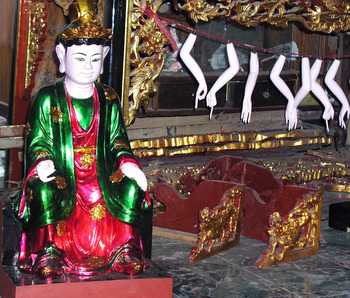
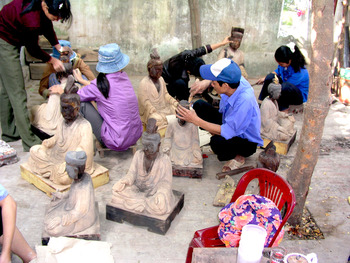
In 2004, when my Vietnamese colleagues and I visited the carving workshops of Sơn Đồng Village, Vietnam was eighteen years into economic reform and popular religion had returned with the booming market (DiGregorio and Salemink Reference DiGregorio and Salemink2007; Endres Reference Endres2011; Fjelstad and Nguyễn Reference Fjelstad, Hiên, Fjelstad and Thị Hiên2006; Lê Reference Lý2007; Malarney Reference Malarney2002, Reference Malarney and Luong2003; Nguyễn Reference Nguyễn2015; Phạm Reference Pham Quynh Phuong2009; Taylor Reference Taylor2004, Reference Taylor and Taylor2007; see figures 3 and 4). Along with these developments, there appeared a fluid and generally expansive production and consumption of sacred goods and related services financed by new wealth (Endres Reference Endres, Hüwelmeier and Krause2010; Kendall Reference Kendall and van der Veer2015; Lê Reference Lý2007; Nguyễn Reference Nguyen, Fjelstad and Thi Hien2006; Nguyễn and Phạm Reference Nguyễn Văn Huy and Hương2008; Salemink Reference Salemink and Kitiarsa2008). The activities of temple statue carvers kept pace with a flourishing of spirit mediums. Those who engaged the market—from petty smugglers to shopkeepers to real estate magnates—trafficked in risk and needed luck. Many of their number became devotees of the Mother Goddess and some, in gratitude for past favor and with the hope of future favor, became spirit mediums themselves. Material horizons were also rising, and devotees were beginning to address the ravages of decades of material neglect and official iconoclasm (see figure 5).
Carving workshop, Sơn Đồng Village, Red River Delta, Vietnam. Photo by Laurel Kendall.

Carving workshop, Sơn Đồng Village, Red River Delta, Vietnam. Photo by Laurel Kendall.

Material religion in action, altar of a ritual master and spirit medium, Red River Delta, Vietnam. Photo by Laurel Kendall.

In 2000, I visited a temple where paper images had been pasted above the altar because the original statues had been taken down and thrown in the village pond during an anti-superstition campaign sometime in the 1970s. When I returned in 2004, the temple keepers proudly showed off their recently installed new statues. Elsewhere, surviving statues were being refurbished and many new mediums were setting up their own altars with small wooden or porcelain statues rather than with the less expensive but generally less efficacious (linh) paper images they might have used in the past.
Temple statues are objects with “auras,” to use Walter Benjamin's (Reference Benjamin and Arendt1969) term. Devotees engage responsive deities via the statue, and statue presences in temples enable mediums to meet and incarnate denizens of the Mother Goddesses’ Four Palaces. But for Benjamin, who saw object auras shriveling in the glare of capitalist production and commerce, the booming Vietnamese market in ritual goods—and similar markets all over Asia—would have been difficult to imagine if not downright mind-blowing.
A shopkeeper on Hanoi's Hàng Quạt Street, a hive for these activities, described a hierarchy of value for religious statues: The least expensive and least efficacious—or least linh—images are produced for the market in rationalized workshops and sold off a dealer's shelf. These are called hàng chợ. Somewhat better statues can be commissioned through the shops and made to order for a higher fee. These are called hàng đặt. Finally, statues made by a master carver using traditional processes are the most costly and are held to have the highest linh quotient. These are called hàng thật. The carving is expected to be exquisite and the wood fine-grained and well-seasoned (Kendall, Vũ, and Nguyễn Reference Kendall, Thanh Tâm and Thu Hương2008, 233; Reference Kendall, Thanh Tâm and Thu Hương2010, 80).
Temple statues in Sơn Đồng are carved from jackfruit (mít) wood that repels insects. “It tastes bitter,” we were told, a bit of ethnobotany deployed to avert or at least postpone the decidedly nonefficacious consequences of a statue infested with insects, a frequent enough occurrence for woods in Vietnam. The wood is cut on an auspicious day and hour set by the lunar almanac after sending out any ghosts or other infelicitous elements that might have taken up residence in old wood, and cut to an auspicious measure on the scheme attributed to Lu Ban, the Chinese God of Carpentry. The master carver seeks a vision of the intended deity in his own mind's eye before he begins to carve. He makes his workers observe various workshop taboos—no bare chests, no inauspicious talk, no laundry hanging over the statue, no menstruating women touching the statue, no dog meat consumed, and no garlic or strong-smelling herbs when the final gilding is applied. Such precautions not only make for a more efficacious statue, they are a prophylactic against workshop accidents and clients who refuse to pay. Offerings and petitions punctuate the entire process, from the master carver's offerings to the goddess before going to discuss the commission with a potential patron, to the patron's final inspection and request for the goddesses’ permission to accept the statue. Once complete, the statue travels from the workshop to the temple in a lucky hour, covered with a red cloth to preserve its energy (khí), is set in its proper place on the altar by a ritual master, and on another auspicious day, at deep midnight, is ceremoniously ensouled (Kendall, Vũ, and Nguyễn Reference Kendall, Thanh Tâm and Thu Hương2008, Reference Kendall, Thanh Tâm and Thu Hương2010; Nguyễn and Phạm Reference Nguyễn Văn Huy and Hương2008).
However fine and careful the process, even well-made statues eventually require repair and a fresh application of lacquer, the more so when statues that had been stored in the back rooms of abandoned or repurposed temples could again preside from active altars. If the statue was to be repaired and relacquered, the temple-keeper would divine with a toss of coins that the deity was willing to temporarily leave the altar; if so, the statue was deanimated in broad daylight as an inversion of its original midnight ensoulment, a ritual that would be repeated after the repair. The deanimated statue is temporarily not a god, but it is something more than a block of carved wood, and statues sent out for repair traveled to and from the workshop under red cloths. Some shrine-keepers, cautious of both shoddy work and possible sorcery, had the carver do the repairs in their own temples.Footnote 5 It was a matter of debate whether statues removed from the altar but repaired inside the temple needed to be de- and reanimated, at some expense. We heard both opinions from equally venerable sources. Statues that have deteriorated beyond repair are deanimated and either cast into pure flowing water or burned and the ashes cast into the pure water, a final acknowledgment of the statue body as extraordinary matter (Kendall, Vũ, and Nguyễn Reference Kendall, Thanh Tâm and Thu Hương2008, Reference Kendall, Thanh Tâm and Thu Hương2010).
Younger mediums who use the less expensive statues maintain that a statue is a statue, that the ritual master who installs a packet of precious materials and amulets inside the statue cavity and performs the appropriate ritual in dark midnight brings the statue to life and makes it a responsive god. Older mediums and temple-keepers who commission statues for established temples consider these attitudes naïve, if not dangerous, asserting that badly made statues are not linh, do not secure the Mother Goddesses’ favor, and will likely bring inauspicious consequences (Kendall, Vũ, and Nguyễn Reference Kendall, Thanh Tâm and Thu Hương2008, Reference Kendall, Thanh Tâm and Thu Hương2010).
The production of a temple statue involves knowledgeable craftsmanship in the selection, seasoning, and working of wood as well as some other activities that might heuristically be characterized as “magic.” By “magic” I mean “traditional and efficacious action on something” in the Maussian view, acts whose intended consequences cannot solely be accounted for through a material logic of cause and effect (Warnier Reference Warnier2009, 461; after Mauss [1902] Reference Mauss and Brain2001). The carvers’ attention to auspicious measurements, workshop prohibitions, invocations of the divine, and appropriate days ordained by the lunar almanac recall Klaas Ruitenbeek's study of the Chinese Lu Ban jing carpentry manual where similar processes are “loaded with magical potency” such that “the taking of measurements is a ritual act” (Ruitenbeek Reference Ruitenbeek1993, 2, 81). Traditions associated with Lu Ban have likely informed the Vietnamese carvers who use Lu Ban's ruler to carve statues of auspicious dimensions and make passing reference to old books hidden or lost during anti-superstition campaigns. The heuristic distinction between technology and magic ultimately collapses where craftsmanship in the careful selection, seasoning, and working of wood combines with such extra-material procedures as choosing lucky days and observing workshop prohibitions. These are all similarly “efficacious actions,” or in Gell's terms, “technologies of enchantment” intended to entice a god into the statue body, the technical accomplishments of the making as consequential for the efficacy of the product in ways we might characterize as “magic” (Gell [1988] Reference Gell and Benthall2002; [1992] Reference Gell and Adamson2010; Reference Gell1998, 68–79).
The sum of these acts, both magic and craft, material technology and ritual, congeals in the production of a sacred/numinous/charged/magical/agentive/efficacious—or in local parlance an extremely linh thing inhabited by a god (for other examples elsewhere see Davis Reference Davis1997; Eiseman Reference Eiseman1990; Hingorani Reference Hingorani2012; Venkatesan Reference Venkatesan and Harvey2014). The specter of decay has a hand in this process; a statue will be less efficacious, even inauspicious where the carver substitutes cheap branch wood for more durable core wood, where improperly seasoned wood rots or becomes infested with insects, or where the ravages of time are not addressed by appropriate repairs. “If human beings do not punish the negligent or dishonest carver, the gods will,” said one master carver who described his own practice as “[d]oing the gods’ work” (Kendall, Vũ, and Nguyễn Reference Kendall, Thanh Tâm and Thu Hương2010, 80).
Myanmar: Nats and Not the Buddha
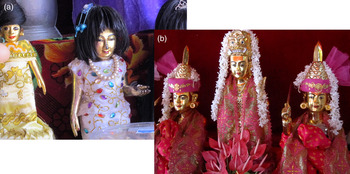
After these conversations, I went to Myanmar, a place where spirit mediums are also active, to see if the workshops that carved the wooden images of nat spirits who sit on the mediums’ personal altars were similarly attentive to both magic and craft. There was reason for Erin Hasinoff and I to think so. Bénédicte Brac de la Perrière (Reference Brac de la Perrière, Green and Richard Blurton2002, 998) describes how these wooden images contain the nat spirit's “butterfly soul” (leikpya) and thus enable the dancing medium to effectively manifest the nat. As in Vietnam and as we will see in Korea, several conversation partners suggested that treating an image well brings the nat’s favor, while improper treatment results in bad luck for the medium (see also Brac de la Perrière Reference Brac de la Perrière2009, 289–93; Reference Brac de la Perrière2016, 23). The little nat images are carefully tended by their mediums, dressed, primped, bathed, and coifed, in at least some cases, with the medium's own hair, and where the nat desires it, lustrated with whisky (see figure 6). This is a more portable practice than that of spirit mediums in Vietnam who perform their lên đồng rituals in front of the empowered and immobile statues of a major temple, and whose own statues on personal altars have been set in place by a ritual master and must not be moved. In Myanmar, on the other hand, mediums carry their nat images to rituals as their co-present enablers and to festivals in the nats’ home temples where personal images are periodically “irradiated” by the primary statues/nat presences in the temple (Brac de la Perrière Reference Brac de la Perrière1992, 213; Reference Brac de la Perrière, Green and Richard Blurton2002, 99; Reference Brac de la Perrière2009, 289; Reference Brac de la Perrière2016, 8; Rodrigue Reference Rodrigue1992, 53–54).
Nat images dressed and coiffed for the Taungbyon Festival, near Mandalay, Myanmar. Photos by Laurel Kendall.

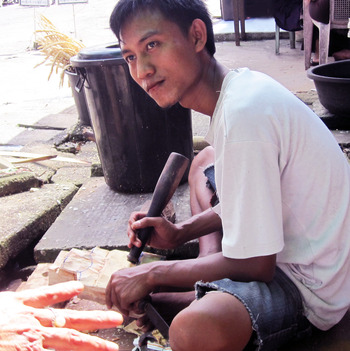
When we spoke with statue carvers near the Mahamuni Pagoda in Mandalay and the Shwedagon Pagoda in Yangon (see figure 7), carvers were familiar with our questions. Yes, the carver should abstain from alcohol and work with a clean body and respectful attitude, shoes removed (as at a pagoda or monastery), and statues must be beautifully carved following the proper prototype. A ritual offering might mark the start of a large and important commission, and depending on the client's willingness to pay, a carver will observe a more elevated number of Buddhist precepts for the duration of the work. But we soon realized that our interest in nat images was confusing to the carvers who considered the nats a sideline business, less significant than larger and more expensive Buddha images. When they described prohibitions and purifications, they referenced carving the Buddha for a major temple commission. In addition, the form of a Buddha image demands strict adherence to precise protocols which, according to Irene Moilanen (1995, 81), were so well internalized that a master carver did not need to mark the block of wood in order to produce an image of proper and exact proportion (cf. Cooler Reference Cooler2016; Swearer Reference Swearer2004, 47–48 for Thailand). Nat images need only approximate the gestures and costumes deployed by mediums, and their postures might vary following images seen in mediums’ dreams (Hasinoff and Kendall, Reference Hasinoff and Kendallforthcoming; see also Fraser-Lu [1994] Reference Fraser-Lu2002, 6). One carver told us that he felt happier when carving Buddha images than when he carved nats because he could focus his mind on his work. The nats, he said, could be rougher and cruder than a well-finished Buddha image. This seemed to be the nub of it; the relative roughness of the nat image and the relatively lesser concern for the conditions of its manufacture is appropriate to nat-ness contrasted with the refinement, purity, and overall quality of the Buddha image, objects for the medium's personal use rather than community veneration (Hasinoff and Kendall, Reference Hasinoff and Kendallforthcoming).
Statue carver at work near the Shwedagon Pagoda, Yangon, Myanmar. Photo by Laurel Kendall.

This is not to deny a medium's pride in particularly good-quality images and hisFootnote 6 ability to have them freshly gilded but, as any spirit medium will acknowledge, nats are lowly beings relative to Buddhas in the Burmese religious order. Most nats died violently, through treachery, or otherwise badly. In dying they were unable to assume a prayerful orientation toward their next life and so were denied reincarnation (Ridgeway [1915] Reference Ridgeway1964, 238–56, citing Temple Reference Temple1906; Rodrigue Reference Rodrigue1992, 25–45). As Burma scholars describe them, nats remain trapped amid the emotions and appetites they bore while alive (Bekker Reference Bekker1988; Reference Bekker, Gärtner and Lorenz1993, 296; Brac de la Perrière Reference Brac de la Perrière, Skidmore and Lawrence2007, 215; Reference Brac de la Perrière2009, 285; Schober Reference Schober, Walter and Neumann Fridman2004, 804; Spiro Reference Spiro1967, 41, 51). Where good Buddhists work toward salvation by periodically following precepts enjoining moral behavior, fasting, temperance, and other austerity, the nats exemplify the appetites and failings of the flesh in the stories told about them, the corporeal activities they enact via their mediums, and the rowdy and transgressive behaviors of roistering devotees on the periphery of nat festivals (Schober Reference Schober, Walter and Neumann Fridman2004, 803; Reference Schober2008; Spiro Reference Spiro1967; Vossion Reference Vossion1891, 113). Nats have essentially human feelings and failings, and their anger is potentially dangerous to those who engage with them, but nats also bestow aid and good fortune on devotees who please them. Nats address a range of human issues from illness to business, personal and sometimes morally ambiguous concerns that one might hesitate to impose on the transcendent Buddha (Bekker Reference Bekker1988, Reference Bekker, Gärtner and Lorenz1993; Rodrigue Reference Rodrigue1992, 19; Schober Reference Schober, Walter and Neumann Fridman2004).
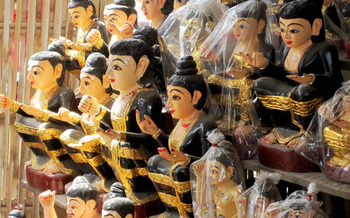
And nat images seem to decay more quickly than Buddha images. In a wall text accompanying a small section on nats in the Asia Society's recent Buddhist Art of Myanmar exhibition, the curators Sylvia Fraser-Lu and Donald Stadtner observe that “few antique effigies of nats survived Myanmar's frequently humid wet climate. Once an icon shows signs of wear and tear it is quickly replaced by a new image” (Fraser-Lu and Stadtner Reference Fraser-Lu and Stadtner2015; see figure 8). By contrast, antique wooden Buddha images do remain and were well-represented in the exhibition. The Buddha image is either carved stone, cast metal, or carved of fine hardwood—teak, ebony, ironwood, or other “rare expensive materials”—paired with the client's horoscope (Moilanen 1995, 83) or, as seemed to be the case in the workshops we visited, from fragrant and durable sandalwood. Wood is more likely to deteriorate when it has a wider grain and when it has been less carefully seasoned, and hardwoods are less appealing to insects than most softwoods. The smaller nat images might be carved out of remnant branch wood, rather than more durable core wood. Nats can even be made of plastic, while it would be difficult to find a plastic Buddha image in Myanmar. The practice of carrying nat images to rituals and festivals, the companionability of the nat, would also take a toll. This is not an argument that nat images are shabby by intention, or that like some sacred objects in some traditions, they are intended to decay as part of a cyclic process of renewal—Japan's Ise Grand Shrine, the Chinese Kitchen God burned and replaced each year, the Korean village guardian pole that rots and topples to the ground beside its recent replacement. The durability of a nat image is desirable, and well-made statues are passed on to favored apprentices. However, the accessibly and portability of these images, a function of the accessibility and portability of the nats who animate them, comes linked to the looser protocols involved in fabricating them. These are relatively inexpensive images acquired and maintained by individual practitioners (Hasinoff and Kendall, Reference Hasinoff and Kendallforthcoming).
Mat shed statue shop, Taungbyon Festival, near Mandalay, Myanmar. Photo by Laurel Kendall.

We did not have an opportunity to interview carvers associated with the maintenance of primary images in the nats’ home temples, but we suspect that these images are not only very well made but command resources for their maintenance from a network of spirit mediums and followers that extends throughout Burma. The primary images at Taungbyon, and possibly in other primary temples, are regilded each year at the conclusion of their annual festival (Brac de la Perrière Reference Brac de la Perrière and Skidmore2005, 85). In better economic circumstances, small personal statues might also be better made and better maintained, slowing the process of their deterioration. In the early 1960s, June Nash saw spirit mediums carrying “battered images” to festivals, while those we encountered seemed in good repair with many freshly gilded (Nash Reference Nash and Nash1966, 126; Hasinoff and Kendall, Reference Hasinoff and Kendallforthcoming). If, like their human hosts, the wooden nat will ultimately decay, for the duration of their gilded time upon the altar, they abide as an intimate presence.
Korea: Shedding Paper Skin
The images in a Korean shaman's or mansin’s shrine, the seats of herFootnote 7 personal gods and primary site of her encounters with them, are not wooden statues but paintings made on laminated paper or cheap, garish color prints (Kendall and Yang Reference Kendall and Yang2015; Kendall, Yang, and Yoon Reference Kendall, Yang and Yoon2015; Kim Reference T'ae-gon1989; Yang Reference Yang Jongsung and Museum2004, Reference Yang Jongsung2008a, Reference Yang Jongsung2008b, Reference Yang Jongsung2008c, Reference Yang Jongsung2010; Yoon Reference Yoon Yul Soo and Yoon1994, Reference Yoon Yul Soo and Museum2004; Walraven Reference Walraven2009; see figure 9). In contrast with the statues we have been considering, containers that envelop the ensouled presence of a god or nat spirit that has been placed there with near liturgical certainty through appropriate words and acts (cf. Warnier Reference Warnier2009, 467), the painting invites, it offers a seat, but it does not contain, and mansin are a bit vague about when and how gods enter and leave paintings.
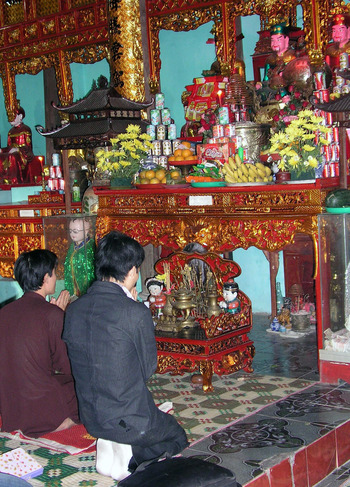
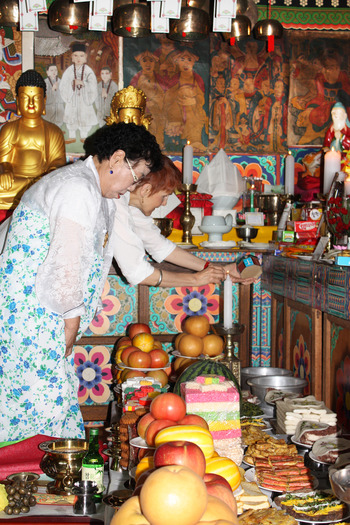
Paying respects in the shrine of a Korean shaman (mansin), Kyŏnggi Province, South Korea. Photo by Homer Williams.

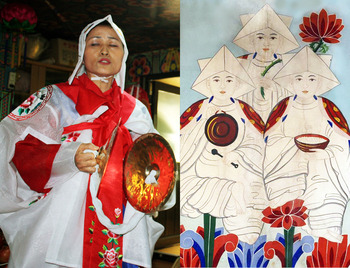
When mansin install Buddha images on their altars, they mimic Buddhist eye-opening rituals or hire monks to do this for them, but my questions about when the gods go into the paintings produced unexpected responses. “We cause the gods to be there,” one mansin said, and no, there is no special ritual for this. The gods do go into the paintings, the mansin needs them to be present, and this is supposed to happen when she sees them in front of her eyes as part of the initiation ritual. But there is no liturgical act to mark this, no gesture beyond a possible shout of “they're here!” and no painted eye. Like much in the mansin’s practice, it is all a bit ambiguous. The gods might not arrive, the initiation fails, and the paintings go back to the shop. The gods might not arrive, but a charlatan mansin performs as though they were present, or the gods might arrive without sufficient force to truly empower the mansin who bumbles through as best she can or gives up in frustration, or once-present gods might depart in a fit of pique sometime down the road. The mansin’s relationship with her gods is an emergent phenomenon; when there is compatibility, or habwi, between them, the mansin petitions the gods in front of her paintings and the gods send a clear flow of inspiration (myŏnggi), which the mansin experiences as intuitions, visions, and bodily sensations (see figure 10). The mansin transforms inspiration into the substance of her own performance, giving divinations and making embodied manifestations of gods and ancestors. When the gods are displeased with the mansin, her flow of inspiration is blocked such that when the mansin prays for guidance she experiences something like radio static, the sounds of “mumbling and grumbling,” inchoate weeping, or most ominously, the silence of an abandoned shrine (Kendall and Yang Reference Kendall and Yang2015; Kendall, Yang, and Yoon Reference Kendall, Yang and Yoon2015).
Korean shaman (mansin) manifesting the deity Sambul Chesŏk (left), photo by Homer Williams; shrine painting of Sambul Chesŏk (right), South Korea, courtesy of the American Museum of Natural History (catalogue number 70.3/6719).

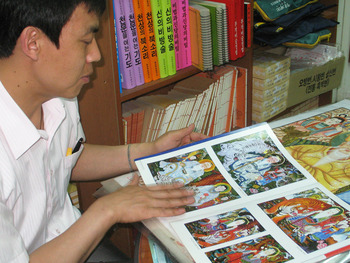
Insofar as the painting is a material extension of the god, a god can express displeasure with the location of his or her painting, contest the intrusion of incompatible new gods through the medium of paintings with whom they quarrel and cause to fall to the floor, or express displeasure with the location of the shrine itself. Some mansin, and the very few traditionalist painters who remain in South Korea, consider the careful production of a painting—including the observance of workshop protocols that would be legible in the carving workshops in Vietnam and Myanmar—as essential to the flow of inspiration through the painting. I interviewed two traditionalist painters who claimed that they sat with a mansin client and absorbed her vision of the deity in their own mind's eye, they bathed and reported to the deities before beginning their work and on completing it, they lived austerely and in monkish isolation for the duration of a commission to avoid accidents or quarrels, which would be inauspicious. Both painters related wondrous tales of their engagements with gods and paintings. Mansin who could afford the work of these painters considered their paintings a mark of distinction and good practice. But in truth, most mansin in South Korea today use paintings that are produced in commercial workshops or as cheap commercial prints. When pressed on this point, even mansin who are proud of their own traditionally produced paintings will give primacy not to the image but to the mansin’s connection with her gods such that a mansin with strong habwi can work via a commercial print or even a photograph. Most important is that the image match the mansin’s vision of the god, not just any general but a general bearing an appropriate weapon in an appropriate gesture and riding on a mount of appropriate color and markings, not just a mountain god, but with an appropriately white or black beard wearing the correct robe and accompanied by a tiger of the right color (Kendall, Yang, and Yoon Reference Kendall, Yang and Yoon2015; see figure 11).
Proprietor of shaman supply shop with pattern book used to match painting orders with shamans’ initial visions, South Korea. Photo by Laurel Kendall.

Not a fixed container like the statue, the painted image is also a more fragile, mutable thing. Paintings hung over the mansin’s altar become soiled with incense and candle smoke and are sometimes gnawed on by bugs and mice. Gods in the mansin world prefer pure, clean things (see figure 12). When the shaman can afford to replace dirty and tattered paintings, she politely petitions her gods to leave the paintings, which are taken down from the altar, burned, and replaced with fresh new ones to welcome back the gods with appropriate ceremony. While statues are tenderly repaired, the painting is, in effect, shed and replaced like an old skin. Paintings from the shrine of a retiring shaman are buried with the rest of her paraphernalia in a mountain grave to rot away as human bodies do: because the paintings had souls, “we do this just as we do for people who die” (Kendall, Yang, and Yoon Reference Kendall, Yang and Yoon2015, 89).
Altar with paintings in the tradition of Hwanghae Province (now in North Korea), South Korea. Photo by Homer Williams.

These practices, all predicated on the mutability of once-clean paper, have meant that old paintings are extremely rare, and, until recently, South Korean collectors had no interest in acquiring unclean, possibly ghost-ridden things from a shaman's shrine. This changed for some collectors in the last decades of the twentieth century, first through the interest of foreign buyers who saw them as a kind of folk art and were less concerned about ghosts, then by Korean collectors with an interest in indigenous folk culture. Some saw these paintings as Picasso before Picasso, or as bearing the authentic Korean faces of rustic ancestors. Dealers and collectors cultivated relationships with shamans, eventually making small offerings (kijŭng) to acquire paintings that would otherwise have been destroyed, providing the relatively low cost of replacing a soiled old painting with a “nice new one” as happens in the antique trade within and beyond South Korea. With a known market for old paintings, those removed from a dead shaman's shrine might also obliquely find their way to the market. In both instances, the collectors work with existing practices predicated upon the fragile materiality of paper paintings, but redirect them toward an unprecedented end (Kendall and Yang Reference Kendall and Yang2014; Kendall, Yang, and Yoon Reference Kendall, Yang and Yoon2015).
In Conclusion
I have used the prospect of decay to anchor a discussion of three material manifestations of the divine and the human subjects who engage with them. My three examples have in common a general and broadly held idea that in some Asian traditions, religious images may be ritually ensouled with the active presence of a god or spirit. In many conditions of practice, such images are produced in workshops where knowing craftsmanship entangles (what we commonly call) technique with what we might (more cautiously) call magic toward a product that overflows functionality and beauty with efficacious intentions. In my three cases, and many others, the image works with a shaman or a spirit medium to enable an active and efficacious manifestation of the god or spirit. As visible seats of the divine, statues and paintings are mutable. They will decay, but at different rates in different circumstances, fueled by climate, materials, the proximity of other matter, neglect engendered by political or economic circumstance, the craftsman's skills and honesty, the devotee's own choices, and a plethora of idiosyncratic factors affecting his or her ability to commission, repair, or replace an image.
As we moved from Vietnam to Myanmar to South Korea, things learned in one place could be productively upended in another domain of popular religious practice. Statue workshops in Vietnam introduced the idea of image-making as an enfolding of craftsmanship, protocol, and magic to produce an efficacious and agentive object with the specter of decay ever-present in the mix. The Myanmar example offered a variation on the theme: nat images decay more rapidly than Buddha images, they are made more casually and at less cost. These material conditions reflect the nat’s subordination to the Buddha, and the nats’ greater accessibility and portability. Nat images are thus likely to decay more rapidly than Buddha images, but perhaps less rapidly than would have been the case in poorer circumstances a few decades past. Paper images in Korean shamans’ shrines counter the affordance of a statue container with a more ambiguous spirit presence, a tenuous and provisional site of contact for the fluid and dynamic relationship between the mansin and the gods she serves. The god transmits through the painting but is not anchored there. The mutability of paper and the desirability of clean, fresh seats for gods have enabled a new secular market in old paintings as a genre of Korean folk art.
Things fall apart, and the relative velocity and magnitude of decay is a matter of consequence for those who enter relationships with efficacious images. The specter of decay informs the production and subsequent careers of these objects in shifting circumstances of production and consumption. With cognizance of the social and material surround, the results are neither uniform nor necessarily consistent over time. I leave you with the idea that insofar as decay is a process of becoming, as Ingold suggests, stalking the specter of decay can transport one to some unanticipated places within and beyond the study of material religion. I hope that is a cheering thought.
Acknowledgments
Most of the research for this paper was supported by the Jane Belo Tanenbaum Fund, American Museum of Natural History, with supplementary support for research on Korean shaman paintings from the Committee on Korean Studies, Northeast Asian Area Council, Association for Asian Studies; and the Wenner-Gren Foundation for collaborative research in Vietnam. Sung-ja Kim assisted in field research and transcription in Korea. Other research partners are acknowledged in the text. Katherine Skaggs, Division of Anthropology, American Museum of Natural History, assisted in the preparation of this manuscript. Kayla Younkin, also at AMNH, helped to prepare the illustrations.