Introduction
Food insecurity and periodic famines are recurring features in sub-Saharan African countries (Connolly-Boutin and Smit, Reference Connolly-Boutin and Smit2016; OCHA, 2017). Together with the increasingly negative effects of climate variability and change and soil fertility decline, they affect smallholder farming families leading to poverty and malnutrition (Wheeler and von Braun, Reference Wheeler and von Braun2013). One of the root causes of this situation is the over-dependence of farmers on maize (Zea mays L.) as the main food security crop. In Malawi, maize is the predominant crop [‘maize is life’ (Smale, Reference Smale1995)] and farmers consume close to 170 kg per person per year of maize porridge and close to 50% of the total caloric intake comes from maize (Dowswell et al., Reference Dowswell, Paliwal and Cantrell1996). In southern Africa, maize occupies 50–80% of the arable land area with limited or unstructured incorporation of legumes in the farming systems either as rotations or intercrops (Snapp et al., Reference Snapp, Rohrbach, Simtowe and Freema2002; Waddington, Reference Waddington2003; Kassie et al., Reference Kassie, Erenstein, Mwangi, La Rovere, Setimela and Langyintuo2012). This strong focus on maize in the diet limits dietary diversity with associated negative side effects of nutritional deficiencies, stunting and wasting especially with children (Manda et al., Reference Manda, Gardebroek, Khonje, Alene, Mutenje and Kassie2016; Nyakurwa et al., Reference Nyakurwa, Gasura and Mabasa2017; Chakona and Shackleton, Reference Chakona and Shackleton2018).
Several attempts have been made to change sole reliance on calories from maize by introducing more diversified cropping systems. These can be summarized under different umbrella concepts such as Integrated Soil Fertility Management (Vanlauwe et al., Reference Vanlauwe, Bationo, Chianu, Giller, Merckx, Mokwunye, Ohiokpehai, Pypers, Tabo, Shepherd, Smaling, Woomer and Sanginga2010); Conservation Agriculture (CA) (Kassam et al., Reference Kassam, Friedrich, Shaxson and Pretty2009); and Climate-smart Agriculture (Lipper et al., Reference Lipper, Thornton, Campbell, Baedeker, Braimoh, Bwalya, Caron, Cattaneo, Garrity and Henry2014). All these concepts and frameworks have tried to increase the legume component in the farming systems with varying successes (Jones et al., Reference Jones, Shrinivas and Bezner-Kerr2014; Giller and Schilt-van Ettekoven, Reference Giller and Schilt-van Ettekoven2015).
Previous research shows that smallholder farmers in southern Africa grow, to a certain extent, other crops than maize. In Zimbabwe, for example, groundnuts (Arachis hypogaea L.) occupy 30% of the land area on some farms but not every year (Waddington et al., Reference Waddington, Karigwindi and Chifamba2007). In Malawi, where farmers grow crops on small land holdings of average 0.2–3 ha only (Ngwira et al., Reference Ngwira, Thierfelder and Lambert2013), there is strong pressure to first satisfy food security needs through maize before farmers pursue diversifying the agriculture systems. As farming is the main source of livelihood for smallholder farmers in Malawi, they are faced with several challenging and sometimes competing demands: (i) they have to produce at least 1.25 t of maize per year per household from their land to become food secure (Mazunda and Droppelmann, Reference Mazunda and Droppelmann2012); (ii) they need to grow additional legumes to increase the protein in the diet to avoid protein-energy malnutrition; and finally, (iii) there is need to grow enough crops to be able to sell surplus produce in a potentially available market to address other family needs (e.g., health expenses, clothing, school fees, social needs, amongst others).
Land holdings sizes for southern African farmers are relatively small and farmers prioritize maize production as their main staple food crop to achieve food security first before they can consider other crops. Also, maize markets in southern Africa are usually well developed due to the high dependency on this crop whereas markets for rotational leguminous crops are very volatile although often higher returns on investments can be reaped. Seed companies in southern Africa mainly focus on hybrid maize seed production where there is a greater likelihood of making profits, instead of focusing on open-pollinated legume species. This affects availability of legume seed for smallholders.
In the last two decades, efforts have been made to promote CA systems in southern Africa, based on minimum soil disturbance, crop residue retention and crop diversification. The principle of crop diversification is supposed to tackle monocropping in the predominantly maize-based farming systems. The experience of the last 15 years of promotional efforts to get more legumes into the farming systems shows that in land constrained situations, farmers prefer growing legumes as intercrops, whereas in abundant land situations, full rotations of maize with legumes are preferred (Thierfelder and Wall, Reference Thierfelder and Wall2010). However, both strategies have advantages and disadvantages.
Previous studies have often focused on the contribution of maize to the overall farm productivity (Rusinamhodzi et al., Reference Rusinamhodzi, Corbeels, van Wijk, Rufino, Nyamangara and Giller2011; Thierfelder et al., Reference Thierfelder, Matemba-Mutasa and Rusinamhodzi2015; Steward et al., Reference Steward, Dougill, Thierfelder, Pittelkow, Stringer, Kudzala and Shackelford2018) and typically report the yields of single crops, such as maize (Nyagumbo et al., Reference Nyagumbo, Mupangwa, Chipindu, Rusinamhodzi and Craufurd2020) and sometimes the companion legume. Rarely do studies assess yields from a systems perspective by examining cropping-system yields (considering both maize and legumes) under the conditions of southern Africa. This can be achieved, for example, by converting yields of both maize and legumes into energy units (gigajoules) or protein yield in kilograms per hectare. Some researchers have advocated for the expression of agricultural yields in terms of the number of people nourished per ha of cropland (Cassidy et al., Reference Cassidy, West, Gerber and Foley2013). This is important as it sheds light on system contribution to nutrition demand especially in regions such as southern African where many people are at high risk of malnutrition especially children (Chakona and Shackleton, Reference Chakona and Shackleton2018). However, the number of people fed per hectare depends on the allocation of the cropland produce to human consumption per household. For example, if part of the produce is diverted for other uses such as livestock feed, then a decrease in human nutrition supply from the grain is expected which must be replaced by other nutritional sources.
In this study, we assessed the contribution of different maize diversification strategies (either intercropping or rotating maize with different grain legumes) in CA systems on human dietary contribution and total systems yield through combined maize and legume yields, assuming all produce is used for human consumption. The diversification legumes in the maize-based systems were cowpeas (Vigna unguiculata Walp) and soybeans (Glycine max L.). Cowpeas are mostly used in these areas for home consumption (leaves and grain) and only little surplus is sold to an emerging market for grain legumes. Soybeans on the other hand were recently introduced to the areas and many organizations have accompanied its introduction with nutritional training to foster human consumption. Due to its antinutritional characteristics in its raw form, people were trained on cooking relish, make soya fritters and tofu out of soybeans besides roasting it for animal feed.
We converted maize and legume yields into protein and energy units to make them more comparable and looked at the combined contribution of both to systems' yields. Further, we assessed the effect of these diversification strategies on maize grain yield and yield stability. We investigated 9 years of on-farm trial data, conducted in six farming communities of eastern Zambia with different rotation and intercropping strategies with sole maize cropping as controls.
We tested the following hypotheses: (i) maize-legume rotations increase productivity and yield stability in farming systems exposed to drought; (ii) intercropping legumes leads to yield penalties on maize but improve its yield stability; (iii) overall system productivity is increased in intercropping systems as compared to sole and rotational cropping with positive side effects on nutrition; (iv) legume integration into maize-based farming systems will raise farmers caloric yield per ha of cropland to above the minimum daily caloric threshold level.
Materials and methods
Study area
The study was conducted from 2012 to 2020 i.e., in nine consecutive cropping seasons in six target communities located in Sinda, Chipata and Lundazi Districts of eastern Zambia. The names of the communities are Kawalala, Kapara, Mtaya, Chanje, Hoya and Vuu (Table 1).
Land preparation method, geographical location, altitude, soil type, rainfall, main crop and companion crops planted in the six target communities in Eastern Zambia.

a Numbers following the seasonal rainfall in parentheses represent the standard deviation of the rainfall; m.a.s.l = meters above sea level.
Eastern Zambia lies between latitudes 10°–15° S, and longitudes 30°–33° E (Mafongoya and Kuntashula, Reference Mafongoya and Kuntashula2005) and forms the eastern part of the county bordering Malawi. The area is located in Zambia's agro-ecological Region IIa with annual accumulated rainfalls between 750 and 1000 mm. The rainfall patterns are unimodal with the first rains starting in November and ending in April of the following year. Rainfall can vary considerably and recent droughts have led to rainfalls as low as 392 mm in selected drought years (Fig. S1). The soils are moderately acidic with pH of 4.5–5.5 and soil organic carbon (SOC) levels below 1% (Simute et al., Reference Simute, Phiri and Tengnäs1998; Mafongoya et al., 2016). The plateau areas of Eastern Province have increasingly become the backbone of maize production in Zambia due to increased frequency of crop failures in other areas such as the Southern Province. More information on the study area is given in the supplementary materials.
Experimental design
Research in the six target communities was established on replicated on-farm trials (Table 1). The basic trial design was based on six target communities with farmer replicates in each community. The number of replicates considered in the analysis ranged between 24 and 36 replicates. These on-farm trial locations satisfied the following basic characteristics:
a. The treatments included a conventional tillage practice and several no-tillage treatments with and without diversification within the same farm.
b. The experimental design was randomised plots across farms with farmer fields being the replicates of a trial in each community and there were four to six replicates in each target community in each year.
c. The soil type and rainfall pattern between farmers in each community were assumed to be less variable than between communities.
d. Trials were established under rain-fed conditions and not irrigated.
e. The test crop was maize, with treatments being intercropped or fully rotated or both in the different communities (see treatment description in Table 1 as well as below––sections Manual systems and Animal traction systems).
f. Trials were managed by farmers with an agricultural extension service officer and researcher oversight.
Trials were established in plots of 50 m × 10 m size at each farmer field. Two types of management systems were investigated: (a) manual planting systems (in Mtaya, Chanje and Vuu); and (b) animal traction systems (in Kawalala, Kapara and Hoya) (Table 1). Depending on the type of trial, the overall size of trial replicates was either 2500 m2 in the manual systems or 2000 m2 in the animal traction systems (Fig. S2).
Manual systems
In manual systems, the treatments consisted of:
(1) Conventional ridge and furrow tillage (CRFM)–sole maize planting in annually constructed ridges made at a row spacing of 90 cm. Crop residues were removed in this treatment. Maize was sown at a spacing of 90 cm × 25 cm (44,444 plants ha−1 target population). Depths of seed was approximately 5 cm throughout all sown maize treatments.
(2) No-tillage planting with a dibble stick (DiSM)––sole maize planting in holes created with a dibble stick (a pointed wooden stick for making holes in the ground) in untilled soil. To avoid contact between seed and fertilizer, two holes, spaced approximately 5–10 cm apart, were drilled, one for seed and the other for fertilizer placement. Maize crop residues were added to the plots at an initial rate of 2–3 t ha−1 and retained in situ thereafter. Maize was sown at a spacing of 90 cm × 25 cm (44,444 plants ha−1 target population). Seeding depth was the same as in CRFM.
(3) No-tillage planting with a dibble stick and maize-legume rotation (DiSML)––maize was sown in rotation with cowpeas and both crops were grown in plots side by side in each year and rotated every year. Both crops were sown in holes created with a dibble stick in untilled soil. To avoid contact between seed and fertilizer, two holes were drilled adjacent to each other, one for seed and the other for fertilizer placement. Maize and legume crop residues were retained as in the DiS treatment. Maize was sown at a plant population of 90 cm × 25 cm (44,444 plants ha−1 target population) while cowpeas were sown at 45 cm × 15 cm (target population of 148,148 plants ha−1). Seeding depth was the same as in CRFM.
(4) No-tillage planting with a dibble stick and maize-legume intercropping (DiSM/L)––maize intercropped with cowpeas and both crops are sown in holes created with a dibble stick in untilled soil. To avoid contact between seed and fertilizer, two holes were drilled adjacent to each other, one for seed and the other for fertilizer placement. Maize or legume crop residues were initially added as in DiSM and retained in situ thereafter following each rotational phase. Maize was sown at a spacing of 90 cm × 25 cm (44,444 plants ha−1 target population) while cowpea spacing was at 45 cm × 15 cm (target population of 148,148 plants ha−1) and was sown in two rows in the interrow spacing between maize rows, 7–10 days after maize planting. Seeding depth was the same as in CRFM.
This trial design allowed for a simultaneous testing of both full rotations and intercropping strategies as well as sole maize under conventional agriculture and under no-tillage.
Animal traction systems
Similar to the manual systems, both tillage and no-tillage treatments were present in this trial. Farmers used animal traction to plant the trial. The conventional land preparation in the tilled practice was through mouldboard ploughing using an animal traction single furrow plough at a depth of 15 cm. In two communities (Hoya and Kawalala), farmers used an animal traction ripper, whereas in Kapara a more sophisticated animal traction direct seeder from Fitarelli® was used. Both the ripper and the direct seeder are basically used in the same manner and for the same purpose. They are used to rip a shallow furrow of 10–15 cm depth in which farmers place seed and fertilizer either manually or supplied by the seeder at 4–5 cm soil depth.
The individual treatments at each site were:
(1) Conventional ridge and furrow (CPM)––sole maize was sown on ridges formed by a ridger at a row and in-row spacing of 90 cm × 25 cm (44,444 plants ha−1). Crop residues were removed in this treatment. The seeding depths was approximately 5 cm.
(2) No-tillage animal traction ripline seeding (ATDSM)––sole maize was sown in planting lines created using either a ripper mounted on a plough beam or with a Fitarelli direct seeder in untilled fields. Maize crop residues were added to the plots at an initial rate of 2–3 t ha−1 and retained in situ thereafter. Sole maize planting in this treatment was at a spacing of 90 cm × 25 cm (44,444 plants ha−1). Rows were maintained at the same position throughout the whole trial period. The seeding depth was similar to CPM.
(3) No-tillage animal traction ripline seeding with a full rotation of maize and a legume (ATDSML)––maize was sown in rotation with soybeans and both phases of the rotation were present in each year. Both crops were sown in planting lines created using either a ripper mounted on a plough beam or with a Fitarelli direct seeder in untilled fields. Maize or legume crop residues were initially added as in ATDSM and retained in situ thereafter following each rotational phase. Maize was sown as to achieve a population of 44,444 plants ha−1 i.e., at 90 cm × 25 cm row and in-row spacing, respectively. Soybeans on the other hand were sown into lines 45 cm apart and an in-row spacing of 5 cm aiming at a plant population of 444,444 plants ha−1. In the soybean phase of the rotation, maize residues were retained whereas in the maize phase, soybean residues were retained with no additional mulch applied. The seeding depth was similar to that of CPM.
Crop management
All crops were seeded with the first effective rains which usually fell towards the end of November or beginning of December. Occasionally, seeding could only happen at the end of December. All plots (both maize and legume plots) were fertilized with granular NPK fertilizer which was applied as basal dressing annually at 165 kg ha−1, supplying 16.5 kg N ha−1, 14.4 kg P ha−1 and 7.3 kg K ha−1. Maize crops were further top-dressed at 4–5 weeks after planting with granular urea fertilizer at a rate of 92 kg N ha−1. The total nutrient content applied was therefore 108.5 kg N ha−1, 14.4 kg P ha−1 and 7.3 kg K ha−1 to maize. Fertilizer was applied in manual systems between 5 and 10 cm distance to the maize in an additional hole whereas it was dribbled in riplines without touching the seed to avoid scorching. The fertilizer depth was applied in 5–7 cm soil depths.
Soybeans in the animal traction systems were inoculated with a strain of Bradyrhizobia bacteria at planting whereas cowpeas were not inoculated. Different medium maturing commercial maize hybrids (MRI624, SC 627, PAN53, DKC8053, KK501) were sown according to farmer preference in each target community with all farmers in a respective target community planting the same cultivar. As the different cultivars were all from the same maturity group and all selected for mid-altitude maize mega-environments the variation introduced through maize varieties was considered small. The cowpea variety Lutembwe and soybean variety Lukanga were sown in all years except for 2019/2020 where Lukanga was replaced with Kafue due to unavailability of the seed.
Weeds were controlled in all conventional treatments with the plough or hoes at planting and subsequently with hand hoes when weeds were 10 cm tall or 10 cm in circumference depending on the type of weeds present. In all CA systems, initial weed control was achieved by applying glyphosate [N-(phosphonomethyl) glycine] at 2.5 l ha−1 (1.025 l ha−1 active ingredient) at seeding or 2–3 days after seeding to avoid the chemical burn of the crops. In CA sole maize treatments, glyphosate was applied in combination with Bullet® [25.4% Alachlor (2-chloro-N-(2,6-diethylphenyl)-N-(methoxymethyl) acetamide) and 14.5% atrazine (2-chloro-4-ethylamino-6-isopropylamino- 1,3,5-triazine)] as residual herbicide at 3 l ha−1. Remaining weeds were controlled with hand hoes whenever necessary (e.g., when weeds were 10 cm tall or 10 cm in circumference depending on the type of weeds present).
Field methods, data collection and calculations
Rainfall
Rainfall was recorded at each farmer field every morning around 8 am after a rainfall event using rain gauges installed at the farmer field and averaged across the community. Rainfall variability was calculated as based on the normalized anomaly (Equation 1):

where Xyear is the yearly (seasonal) rainfall received in each community, $\bar{x}$ is the long-term average for the respective community and σ is the standard deviation of rainfall across the seasons.
Harvest
Both maize and legume crops were collected at physiological maturity by harvesting 10 samples of 5 m by two rows (90 m2) for maize and 10 samples of 5 m by four rows (90 m2) for legumes per treatment. The fresh weights of maize cobs and legume pods, as well as their biomass, were recorded in the field and subsamples of 20 cobs or 500 g pods, respectively were weighed fresh, dried, shelled and then weighed again for dry weight determination. At this stage, grain moisture content was obtained to correct the grain weight for standard moisture content. For biomass, one stalk per each subsample was taken and chopped into small pieces. From these chopped stems, leaves and tussles a representative sample of approximately 500 g was taken, weighed fresh, dried, weighed again and biomass expressed on a dry matter basis in kg ha−1. The final grain yield was thus expressed in kg of dry grain yield in kg ha−1 at 12.5% and 9.0% moisture content for maize and legumes, respectively. The moisture content was measured with a mini GAC® moisture tester (DICKEY-John, USA).
Yield penalty calculation
Percentage yield penalty (YP%) of diversification i.e., intercropping and rotating maize with a legume was calculated annually as the percentage difference between sole cropping yield (only maize) and that of intercropping (maize with a legume) and rotation (maize in rotation with a legume) yields at each farmer field, respectively. Since crop diversification was done under no-tillage only, we also used sole maize from no-tillage systems (i.e., DiSM and ATDSM). The following equation was used to calculate YP% (Equation 2):

where YP% is the percentage yield penalty, $\bar{X}_{{\rm diver}}$ is the yield of the diversification (i.e., intercropping or crop rotation) treatment, $\bar{X}_{{\rm sol}}$
 is the yield of the maize sole cropping. The main crop (maize) in the diversification treatments needs to be maintained such that the yield of the companion crops will be an added benefit. Lower YP% (absolute values) are more desirable which means that the diversification systems do not compromise the yield of the main crop.
Nutritional value calculation
To evaluate the total system nutritional value (expressed in terms of protein and total energy) of each cropping system, we included grain yield of both the maize and the legume in calculation depending on their involvement in different treatments and converted calories into an energy unit. We used protein yield in kilograms per ha (kg ha−1) and giga joules per ha (GJ ha−1) calculated from the yield data. Percentage protein content for seed was obtained from the Food Nutrition Table database (http://www.foodnutritiontable.com/) which reports the percentage of protein in unprocessed seed and maize, cowpeas and soybeans have been reported to contain 10%, 28%, 36% protein, respectively. The energy content of seed for maize and the legumes were obtained from the GeNUS database (http://projects.iq.harvard.edu/pha/genus) where kcal per 100 g seed values of crops are reported. In this database, the energy values for maize, cowpeas and soybeans have been reported to be 353, 316 and 428 kcal per 100 g seed, respectively. Since the treatments differed in the crops involved, the equations used in the calculation of total system nutrition differed for the cropping systems and these are given in Table 2. The expression of total system yield in terms of energy and protein has been used in other previous research e.g., Madembo et al. (Reference Madembo, Mhlanga and Thierfelder2020) and Dubis et al. (Reference Dubis, Jankowski, Sokólski, Załuski, Bórawski and Szempliński2020). Further, we assessed how different cropping systems contributed to the human daily caloric requirements based on the basic dietary requirement of 2700 kcal per person per day (D'Odorico et al., Reference D'Odorico, Carr, Laio, Ridolfi and Vandoni2014). Based on this, we estimated that, per 365-day year, a single human being needs about 985,500 kcal. Since the household size in Eastern Zambia is on average five persons per household (United Nations, 2017), the yearly caloric requirement per household would be 4,927,500 kcal which is equivalent to 20.6 GJ. Surplus caloric yield per household per year was calculated as the difference between the total system energy yield and the caloric yield required per household per year. However, we assumed no other trade-offs (such as selling for monetary income) of the harvested grain in our calculations although we recognize that there are competing needs and demands for this surplus amount. In this study, we only consider the surplus caloric yield that could potentially be consumed.
Calculation of total system energy and protein yield for different treatments in the manual-based and animal traction-based experiments.

a Treatment names are based on the names given in the text in the sections Manual systems and Animal traction systems and N/A means treatment is absent.
b MZyield, LEGintercrop and LEGrotation are yields of maize, intercrop legume and rotation legume, respectively while Kcalmaize and Kcallegume are the kilocalories (kcal) per 100 g of maize and legumes seed, respectively. GJConv is a conversion factor that converts kcal to gigajoules (GJ), where 1 GJ is 238,845.897 kilocalories.
c Prot%maize and Prot%legume are percentage protein content of the grain for maize and involved legume, respectively.
We excluded biomass from this assessment as its nutritional value is not relevant for human consumption although some of the cowpea leaves are consumed as relish by smallholders. It is a welcome addition and source of vitamins to the cereal-based diet.
Soil carbon sampling
We collected soil carbon samples in March 2018 (4 months after crop establishment) from all trial locations, separated by each treatment in two soil depths (0–10 cm, 10–20 cm). From each treatment, six sampling points between maize rows were identified and soil samples were taken from each soil depth. A composite sample was made for each soil depth and treatment and samples sent for carbon analysis to the Zambian Agriculture Research Institute (ZARI). The Institute uses the Walkley and Black Method for carbon analysis (Walkley and Black, Reference Walkley and Black1934).
Statistical analysis
Maize grain yield, legume grain yield, yield penalty, grain yield stability and total systems nutrition
Due to the peculiarities of the experimental units and set up, manual-based and animal traction-based experiments were analyzed separately. All data were assessed for homoscedasticity and normality using graphical assessment in R statistical environment (R Core Team, 2019). The effects of cropping systems on maize grain yield and total systems nutrition were assessed using mixed models for both manual-based and animal traction-based experiments. In these models, only cropping system was regarded as a fixed effect while communities, farmer fields within communities, plots within farmer fields within communities, and seasons within communities were regarded as random effects to account for grouping factors and repeated measures across years in the same plot. A combination of communities and seasons (i.e., 27 ‘communities × seasons’ combinations for each site) was also regarded as a random factor in the statistical models and this was named ‘environments’. The significance of the cropping systems (fixed effects) was estimated using the Wald Chi-square tests in the ‘lme4’ package (Bates et al., Reference Bates, Maechler, Bolker and Walker2015) in R environment. Where significance was detected, means were separated using Tukey test with multiplicity adjustment as implemented in the ‘emmeans’ package (Lenth, Reference Lenth2019) in R. For the legumes, means of the two manual-based systems that involved legumes (cowpeas in DiSML and DiSM/L) were compared using an independent samples t test following the Welch's t test which assumes unequal variances of the two systems since the Leven's test was significant. Since only one animal-traction cropping system (ATDSML) involved legumes (soybeans) we could not conduct a separate test for this rotational crop. The t test assessments were carried out in R using the ‘rstatix’ package (Kassambara, Reference Kassambara2020).
Maize grain yield stability was assessed using Shukla's stability variance (but with a slight variation in the handling of variance components as described further below) ($\tilde{\sigma }^2$ ) (Shukla, Reference Shukla1972) (Equation 3):

where: $\tilde{\sigma }_i^2$ is the stability value for each cropping system, $W_i = \Sigma _j( {y_{ij}-{\bar{y}}_i.-\overline {y._j} + \bar{y}..} ) ^2$
 with $\bar{y}_i. = \Sigma _jy_{ij}/N$
 , $y_{\mathop {.j}\limits^\dot } = \Sigma _iy_{\mathop {ij}\limits^\ddot }/K\;$
 and $\overline {y_\cdots } = \Sigma _{ij}y_{ij}/{\rm KN}$
 . The y ij is the yield of cropping system i in environment j, $\bar{y}_i.$
 is the mean yield of all years of cropping system i, $\overline {y.} _j$
 is the mean yield of environment j, K is number of cropping systems, N is total number of observations.
The variance components for the interaction of cropping systems and environments could assume a different value for each cropping system. Cropping systems with lower values of stability were regarded as more stable as they would be more correlated to the mean of all cropping systems across all the environments. This means that such cropping systems attain reasonable yield based on the average of all environments thus performing fairly well when implemented across those environments (Bonciarelli et al., Reference Bonciarelli, Onofri, Benincasa, Farneselli, Guiducci, Pannacci, Tosti and Tei2016). To explain this stability, best linear unbiased predictors (BLUPs) were calculated based on the mixed models described above and these were submitted to additive main effects and multiplicative interaction (AMMI) analysis (Zobel et al., Reference Zobel, Wright and Gauch1988). The results were plotted on AMMI biplots for maize grain yield stability (Gauch et al., Reference Gauch, Piepho and Annicchiarico2008). The BLUPs were first double centered to remove the main effects and then the principal components of each treatment were calculated using singular value decomposition, in the ‘vegan’ package of R (Oksanen et al., Reference Oksanen, Blanchet, Kindt, Legendre, Minchin, O'hara, Simpson, Solymos, Stevens and Wagner2013). To better understand the ordination of the treatments and the environments hence their relationship, rainfall and soil carbon (soil C; this includes both SOC and inorganic carbon as carbonates) were projected onto the ordination diagram using the envfit() function (Borcard et al., Reference Borcard, Gillet and Legendre2018) in the ‘vegan’ package in R. We also calculated BLUPs for total system yield in each year and subtracted the yearly caloric requirement per household and presented these to show the surplus caloric yield per household per year.
Soil organic carbon
Effect of cropping systems and soil depth after 7 years of experimental implementation on SOC was assessed using mixed models for both manual and animal-traction systems. In these models, cropping system and soil depth and their interaction were regarded as fixed effects. Random effects were assessed as described in the previous section, but the combination of communities and seasons (environments) was not included. Likewise, the significance of the fixed factors was also assessed as described in the previous section.
Results
Rainfall plays a critical role in crop performance
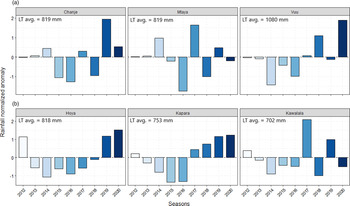
Rainfall was highly variable across the seasons in the different communities (Fig. 1). Expressed in terms of an anomaly in relation to the long-term mean of each community, variabilities of up to 200% were recorded for communities such as Mtaya in 2016 which was an El Niño year. Normalized anomaly values ranged from −150% to 200% (Fig. 1). Annual rainfall received ranged from 392 mm received in Kapara in 2015 to 1629 mm received in Vuu in 2020 (Fig. S1).
Rainfall variability in relation to the mean for communities where (a) manual systems and (b) animal traction systems were practiced from the 2012 to 2020 seasons. LT avg. stands for the long-term seasonal rainfall for each community used in the calculation of the normalized anomaly.

Maize and legume grain yield, yield penalty, grain yield stability, and total systems nutrition and soil organic carbon
Manual systems
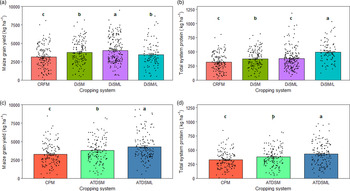
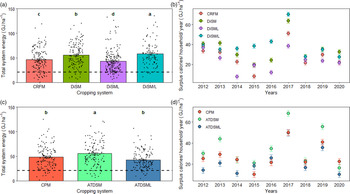
Cropping systems had a significant effect on maize grain yield, total system energy and total protein yield (P < 0.001 for all) (Table 3). For maize grain yield, DiSML had the highest average yield of 4012 kg ha−1 across all seasons (Fig. 2a). The control, CRFM, attained the least yield averaging 3045 kg ha−1 while the other cropping systems ranged in-between. Considering crop rotations, a mean grain yield benefit of 17.6% was recorded and when considering intercropping, a mean grain yield penalty of −0.2% was recorded for the maize (Table 4). Total protein yield was highest in the DiSM/L system with a mean yield of 517 kg ha−1 which was 69% more than the control (Fig. 2b). Protein yield penalty was highest under crop rotations with a mean of −7% and was least under intercropping which had a mean benefit of 59.7% (Table 4). The reason for a penalty is associated with the full rotation which implies that only half of maize yield and half of legume yield can be considered in the analysis as they are sharing the same field biannually. For total system yield, the no-tillage plus intercropping system (DiSM/L) attained the highest system energy of 59.9 GJ ha−1 while the no-tillage plus rotation system had the least overall average system energy of 34.5 GJ ha−1 (Fig. 3a). An assessment of the surplus calories per household per year as a difference of best linear unbiased predictors of calories and the basic requirement per year showed that intercropping had the highest surplus calories in 44% of the years (Fig. 3b). In the El Niño season of 2016, the DiSM/L system had a surplus caloric yield of more than 40 GJ ha−1 which is twice the basic requirement. The DiSML system yielded the least surplus calories in 55% of the years.
Effects of different cropping systems on (a and c) average maize grain yield and (b and d) total system protein yield for (a and b) manual systems and (c and d) animal traction systems across nine seasons (2012–2020) and across all communities. Columns with different letters above them are significantly different from each other at 0.05 probability level. The error bars represent standard error and the jittered points represent the individual observations.

Effects of different cropping systems on (a and c) average total system energy and (b and d) yearly average surplus calories yield per household expressed as the difference of BLUPs of yearly caloric yield and the yearly caloric requirement per household for (a and b) manual systems and (c and d) animal traction systems across nine seasons (2012–2020) and across all communities. Columns with different letters above them are significantly different from each other at 0.05 probability level. The error bars represent standard error and the jittered points represent the individual observations. The horizontal dashed lines represent the yearly caloric requirement per household. Cropping systems descriptions: CRFM = ridge and furrow; DiSM = dibble stick planting; DiSML = dibble stick planting plus maize-legume rotation; DiSM/L = dibble stick planting plus maize-legume intercropping; CPM = mouldboard ploughing; ATDSM = animal traction ripline seeding; and ATDSML = animal traction ripline seeding plus maize-legume rotation.

Mixed-effects model analysis of variance output for maize grain yield, total system energy, total system protein and soil organic carbon for manual and animal traction experiments from 2012 to 2020 in all communities.

Significance codes: ns = not significant; * P < 0.05; **, P < 0.01; ***, P < 0.001;., P < 0.1.
Effect of crop rotations and intercropping on maize grain yield, total system energy and total system protein penalty in all locations across all seasons (2012–2020).

Note: in manual systems, the treatments were conventional tillage, no-tillage with maize only, CA with maize/legume intercropping and CA with maize-legume rotation. In the animal-traction system, the treatments were conventional ploughing, no-tillage with maize only and CA with maize-legume rotation.
Yield penalty for total system energy averaged −28.2% for crop rotations and a benefit of 19% for intercropping was recorded.
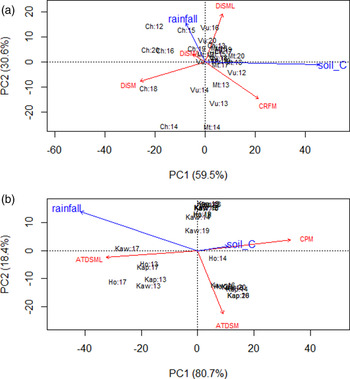
Based on the Shukla stability variance, the DiSM and the DiSM/L systems were the most stable since they had the least Shukla variance values of 0.141 (se = 0.047) and 0.125 (se = 0.074), respectively (Table 5). According to the AMMI biplot, these two cropping systems are closely associated with more environments as compared to the DiSML and CRFM which means that they are capable of adjusting their yield in an increased range of environments and to wider conditions (Fig. 4a) which leads to greater yield stability. Based on their position on the ordination space, the two most stable systems also performed well even under very low soil C making them more suitable under poor conditions. However, these systems also performed well under high rainfall especially the DiSM/L (Fig. 4a).
Additive main effect and multiplicative interaction analyses (AMMI) biplots on the best linear unbiased predictions of seven cropping systems for maize grain yield as inferred by the employed study factors community and year on maize grain yield of (a) manual systems and (b) animal traction systems across three communities for each type of system and in 9 years. The AMMI analyses are based statistical model (see Materials and Methods). The environmental variables precipitation rainfall and soil carbon (soil_C) were projected posteriori on the ordination space. Cropping systems descriptions: CRFM = ridge and furrow; DiSM = dibble stick planting; DiSML = dibble stick planting plus maize-legume rotation; DiSM/L = dibble stick planting plus maize-legume intercropping; CP = mouldboard ploughing; ATDSM = animal traction ripline seeding; and ATDSML = animal traction ripline seeding plus maize-legume rotation. Location by year combinations involved location abbreviations and last two digits of the year. Location names abbreviations: Ch = Chanje; Mt = Mtaya; Vu = Vuu; Ho = Hoya; Kap = Kapara; and Kaw = Kawalala.

Results of the assessment of cropping system stability using Shukla stability variance (Shukla, Reference Shukla1972) for manual and animal traction land preparations.

a Cropping systems descriptions: CRFM = ridge and furrow; DiSM = dibble stick planting; DiSML = dibble stick planting plus maize-legume rotation; DiSM/L = dibble stick planting plus maize-legume intercropping; CPM = mouldboard ploughing; ATDSM = animal traction ripline seeding; and ATDSML = animal traction ripline seeding plus maize-legume rotation.
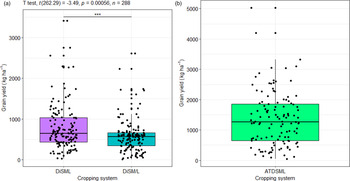
A Welch's two-sample t test comparison of cowpea grain yield between the DiSML and DiSM/L systems was significant [t(262.29) = −3.49, P < 0.0001, n = 288] (Fig. 5a). The mean grain yield in the DiSML system was 785 kg ha−1 (s.d. = 553), whereas the mean in DiSM/L system was 585 kg ha−1 (s.d. = 405).
(a) Mean cowpea grain yield comparison in manual-based cropping systems based on a Welch's t test (DiSML and DiSM/L) and (b) and soybean grain yield of animal-traction-based system (ATDSML). The T test results are above the graph with degrees of freedom inside the parentheses. DiSML––legume system planted in rotation with maize with a dibble stick; DiSM/L––legume intercropping system planted in maize with a dibble stick; ATDSML––legumes planted in an animal traction system ripline system in rotation with maize.

Animal traction systems
Maize grain yield, total system energy and total protein yield differed significantly among the cropping systems (P < 0.001 for all). Maize grain yield was highest in the system with rotation i.e., ATDSML which had a mean of 4298 kg ha−1 and the control was the least yielding with a mean of 3117 kg ha−1 (Fig. 2c). The ATDSML system, which was the highest yielding, outyielded the control by 40% in terms of total system protein yield (Fig. 2d). However, for total system energy yield, the control and the ATDSML systems yielded the same while the ATDSM system yielded the highest mean of 56.2 GJ ha−1 (Fig. 3c). Reduced tillage system without diversification i.e., ATDSM, had the highest surplus caloric yield in 67% of the years while the one that involved rotations consistently yielded lowest (Fig. 3d). Crop rotations had yield penalties of −9.8% and −17.7% for maize yield and total system energy, respectively, with respect to the no-tillage system with no diversification (ATDSM) (Table 4). However, for total protein yield, there was a yield benefit of 24.7% on the ATDSM system as compared to the ATDSML.
The significantly lowest Shukla stability variance values were observed for the ATDSM system with a value of 0.117 (se = 0.043) while the highest value was observed for the control (0.489, se = 0.105) (Table 5). The association of the ATDSM system, which was the most stable system, with many environments may explain its high dynamic stability (Fig. 3b). This system was associated with many environments that were high in rainfall but low in SOC. The least stable system, CPM, was isolated on the ordination space meaning that it had poor association with most of the environments thus making it the least stable (Fig. 4b). This means that implementing this system in different environments investigated here would likely result in yields below average. However, the CPM also performed better in environments high in SOC (Fig. 4b).
For both manual and animal traction experiments; cropping systems, soil depth and their interaction did not have a significant effect on percentage of soil organic content after seven years of experimentation (Table 3). However, for the manual systems, there was a marginal effect of the cropping system with the cropping system that involved crop rotations i.e., DiSML attaining 0.71% organic C and the control attaining 0.49% organic C (Fig. S3).
Discussion
Malnutrition is one of the major consequences of climate variability due to overreliance on maize in the diet by smallholder farmers which is less resilient against changes in climate unlike sorghum and millet (Lobell et al., Reference Lobell, Burke, Tebaldi, Mastrandrea, Falcon and Naylor2008). Most studies have assessed the impact of different cropping systems including CA on improving crop productivity (for example Thierfelder et al., Reference Thierfelder, Cheesman and Rusinamhodzi2012 and Mhlanga et al., Reference Mhlanga, Cheesman, Maasdorp, Mupangwa and Thierfelder2016), but less emphasis has been placed on the effect of these cropping systems on dietary diversity and hence nutrition security. Here, we assessed how different reduced tillage-based cropping systems, with or without crop diversification, affect maize productivity, maize yield stability, total system yields in terms of caloric energy and protein with the aim of quantifying the potential effect on food and nutrition security.
Effects of diversification on crop and system productivity and soil carbon
In this study, comparison of the effects of different diversified systems to a monocropping control showed significant effects on maize grain yield. Rotating maize with legumes such as cowpeas and soybeans increased the yield of the maize compared to intercropping or no diversification at all. The legumes involved in the rotation and intercropping systems have a high N fixing ability and thus supplement the applied mineral fertilizers leading to improved yields of the subsequent maize crop (Iannetta et al., Reference Iannetta, Young, Bachinger, Bergkvist, Doltra, Lopez-Bellido, Monti, Pappa, Reckling, Topp, Walker, Rees, Watson, James, Squire and Begg2016). However, in annual systems, this benefit may be lost during the long dry season. Also, the residual N contribution of the leguminous intercrops might be small or non-existent in the initial years, and, given the level of N fertilization might also compete for N with the maize instead of using symbiosis, at least in the initial years. Besides suppression of pest and diseases (Li et al., Reference Li, Huang, Zhang, Coulter, Li and Gan2019), crop rotations may also enhance SOC under CA (Sapkota et al., Reference Sapkota, Jat, Singh, Jat, Stirling, Jat, Bijarniya, Kumar, Yadvinder-Singh, Saharawat and Gupta2017), which was the case for one of the systems under analysis when compared to monocropping. However, the contribution of legumes in CA systems is also debated with variable results found under different contexts (Cheesman et al., Reference Cheesman, Thierfelder, Eash, Kassie and Frossard2016; Powlson et al., Reference Powlson, Stirling, Thierfelder, White and Jat2016; Corbeels et al., Reference Corbeels, Cardinael, Naudin, Guibert and Torquebiau2019). The involved legumes had a vigorous growth habit and may have further suppressed weeds leading to a reduction in their numbers over time (Mhlanga et al., Reference Mhlanga, Cheesman, Maasdorp, Muoni, Mabasa, Mangosho and Thierfelder2015). All these factors contributed to the success of diversification in improving maize yield.
However, there is likely to be high competition for essential resources such as nutrients, water and light between maize and the companion legume in intercropping systems (Madembo et al., Reference Madembo, Mhlanga and Thierfelder2020). This compromises the yield of the maize more in the same year than in rotation systems hence leading to higher yield penalties (Gebru, Reference Gebru2015). These results are consistent with the findings of previous studies (Rusinamhodzi et al., Reference Rusinamhodzi, Corbeels, Nyamangara and Giller2012, Reference Rusinamhodzi, Makumbi, Njeru and Kanampiu2020). Thus, intercropping systems benefit from complementary practices to support maize yields and these include use of inorganic fertilizers (Kim et al., Reference Kim, Mason, Snapp and Wu2019; Li et al., Reference Li, Huang, Zhang, Coulter, Li and Gan2019) to compensate for the competition between companion crops. Our data show that intercropping coupled with no-tillage and residue retention outyielded the tillage-based control without any diversification which highlights residual benefits in the longer term. Despite the competition presented by the companion legumes on the maize, there are still some residual benefits from N fixation, weed suppression, shading effects, temperature moderation and reduced evaporation that they present. These synergies improve maize yield more than sole cropped maize (Rusinamhodzi et al., Reference Rusinamhodzi, Murwira and Nyamangara2006; Li et al., Reference Li, Huang, Zhang, Coulter, Li and Gan2019). The lack of a huge difference in SOC among the systems and depths may be attributed to the slow process in its build-up. SOC build-up is determined by organic C input mainly through residue retention in the case of agricultural systems and SOC mineralization (Li et al., Reference Li, Hoffland, Kuyper, Yu, Li, Zhang, Zhang and van der Werf2020). The cropping systems in this study are characterized by long dry off-season periods which limit biomass production and hence relying mainly on maize residues for organic matter build-up, yet the amount of the residue is too low and as well of poor quality.
Intercropping and yield stability
Despite the small benefits on grain yield, intercropping systems have shown to be more resilient in terms of grain yield stability measured through the Shukla stability variance (Madembo et al., Reference Madembo, Mhlanga and Thierfelder2020). Previous meta-analytic studies by Raseduzzaman and Jensen (Reference Raseduzzaman and Jensen2017) also confirmed that intercropping cereals with grain legumes lead to greater yield stability as compared to sole cropping of both the cereal or the legumes. This means that the intercropping systems in our trials could adjust their yield more to the environment they are practiced in to attain a yield that is close to the average of all environments (Bonciarelli et al., Reference Bonciarelli, Onofri, Benincasa, Farneselli, Guiducci, Pannacci, Tosti and Tei2016). This is an important attribute especially under highly variable rainfall as presented in this study. Farmers can still achieve reasonable yields across the environments even when faced with drought or above normal rainfalls. The higher stability of intercropping as presented by results in this study can be explained by several mechanisms: for example, (a) intercropping leads to a greater niche complementarity of the involved crops (Li et al., Reference Li, Hoffland, Kuyper, Yu, Li, Zhang, Zhang and van der Werf2020). If both crops are of different rooting depths, as in our case, the deeper-rooted cowpeas (Matsui and Singh, Reference Matsui and Singh2003) may extract nutrients from deeper layers and recycle them to the surface where they can be used by maize (Brooker et al., Reference Brooker, Bennett, Cong, Daniell, George, Hallett, Hawes, Iannetta, Jones, Karley, Li, McKenzie, Pakeman, Paterson, Schöb, Shen, Squire, Watson, Zhang, Zhang, Zhang and White2015); (b) shifts from complementarity to facilitation in the uptake of P have been shown in cereal-legume intercrops especially in low P levels and this can explain the resilience of intercrops in our study since the soils were low in P in general (Li et al., Reference Li, Dong, Li, Shen and Zhang2016); (c) niche differences between the maize and cowpeas may be attributed to the promotion of efficient use of light, nutrients, water etc. (Stomph et al., Reference Stomph, Dordas, Baranger, de Rijk, Dong, Evers, Gu, Li, Simon, Jensen, Wang, Wang, Wang, Xu, Zhang, Zhang, Zhang, Bedoussac, van der Werf and Sparks2020; Tillman et al., Reference Tillman, Schomberg, Phatak, Mullinix, Lachnicht, Timper and Olson2004); (d) cereal-legume intercrops can also modify the dynamics of communities of active rhizospheric bacteria promoting the proliferation of Actinobacteria which harbours many plant growth-promoting (PGP) bacterial species (Taschen et al., Reference Taschen, Amenc, Tournier, Deleporte, Malagoli, Fustec, Bru, Philippot and Bernard2017). We can therefore assume that PGP bacteria play an important role in crop development in variable environments and moderating yield. Given all these factors and mechanisms, such cropping systems are more buffered under variable environmental conditions thus, making them more stable.
Nutrition and dietary diversity
Our main interest in this paper was assessing cropping systems' effects on food security and alleviating malnutrition which are severe challenges in southern African households and children are the most vulnerable (Chakona and Shackleton, Reference Chakona and Shackleton2018). Imbalanced diets mainly from the excessive consumption of carbohydrates such as maize causes poor dietary diversity in current cropping systems (Akombi et al., Reference Akombi, Agho, Merom, Renzaho and Hall2017) with associated stunting and wasting (Murendo et al., Reference Murendo, Nhau, Mazvimavi, Khanye and Gwara2018). Consumption of staple foods such as maize may increase energy availability but does not improve nutritional outcomes (Rajendran et al., Reference Rajendran, Afari-Sefa, Shee, Bocher, Bekunda, Dominick and Lukumay2017). Thus, the integration of leguminous crops of higher nutritional value is important which can be achieved either by intercropping or rotating grain legumes with maize (Snapp et al., Reference Snapp, Rohrbach, Simtowe and Freema2002; Jones et al., Reference Jones, Shrinivas and Bezner-Kerr2014). Dietary diversity and its positive effect on farm households depend on the absolute grain yields and nutritional content of the crops involved in the cropping systems (Snapp and Fisher, Reference Snapp and Fisher2015).
In this study, we assessed how the integration of grain legumes, soybeans and cowpeas, in maize-based systems improves dietary yield as compared to maize only. We focused on caloric energy and protein as indicators of their contribution to system dietary diversity. Since the basic daily caloric requirement per person per day is 2700 kcal and household size in Eastern Zambia is five persons, we estimated that each household would need 4,927,500 kcal per year which is equivalent to 20.6 GJ per household per year. Based on this we further estimated how much surplus calories each cropping system would produce. Intercropping cowpea with maize resulted in the highest caloric energy and protein yield as compared to integrating both crops in a rotation. In addition, intercropping systems additively combine the energy and protein yields of constitute crops in a piece of land each year while in rotations the contribution must be halved to accommodate both crops. This means that nutritional yield per unit land is higher per year in intercropping as compared to rotations. Maize is generally higher in carbohydrate and lower in protein than legume grain. Legumes are also high in other essential micronutrients such as zinc, vitamin A and iron (Messina, Reference Messina1999). This means that integrating maize and a legume in a cropping system in the form of intercropping may increase the dietary diversity of a household thus reducing malnutrition. The intercropping system had the highest surplus caloric yield after satisfying the required household yield per year. Thus, farmers who practice intercrops will likely have more to trade-off for other uses without affecting the household food security (Kim et al., Reference Kim, Mason, Snapp and Wu2019). Since agriculture is a major income activity for smallholder farmers in southern Africa, marketable surplus produce will allow for higher monetary returns for other needs through selling (Herforth and Harris, Reference Herforth and Harris2014). This kind of agriculture intervention can help alleviate malnutrition through two pathways: (a) increased caloric production and (b) increased income (Kumar et al., Reference Kumar, Harris and Rawat2015), thus it improves access to food while at the same time improving dietary quality and diversity.
However, a study that used data from southern and eastern Africa showed that on-farm cropping diversity does not always imply dietary diversity at the household level (Sibhatu et al., Reference Sibhatu, Krishna and Qaim2015). When production diversification is already high, there is a poor association with dietary diversity due to earlier income benefits from specialization (Chege et al., Reference Chege, Andersson and Qaim2015). The relationship between production and consumption is more complex as there are other factors such as markets, alternative sources of nutrition and off-farm income sources that need to be considered (Flora, Reference Flora2009).
Implications and potential adoption constraints
The results of this study show a lot of benefits of diversifying maize monocropping systems although attempts to incorporate more legumes into the cropping systems have so far failed to a large extent. The reasons for lack of widespread adoption of rotational legumes or intercropping are manifold and range from lack of availability of legume seed, lack of markets for sell and uncertainties in existing markets (e.g., soybeans and pigeonpeas have large price fluctuations). Besides this, farmers lack new knowledge on how to grow legumes as intercrops without competition in maize-based systems and have a great fear of food insecurity (maize is the staple food crop and if the land area is small, farmers believe they need to harvest enough maize to remain or become food secure). Traditionally the Zambian government has favored maize in farm input support programs (FISP) and only recently a partial shift in this approach is happening. In addition, pest and diseases are more frequent in legumes: cowpeas are heavily affected by aphids whereas soybeans suffered from leaf diseases. However, with increased emphasis by various initiatives in the last decades, including new policies on diversification in Zambia and emerging markets for such crops, there is a great push from different ends to mainstream legume rotations and intercropping systems as part of sustainable intensification in smallholder farming systems of Zambia.
Conclusion
Smallholder farming systems in southern Africa are predominantly based on maize monocropping with limited crop diversification. This has resulted in low maize yields leading to food insecurity and malnutrition. Here, we carried out on-farm trials across six target communities in eastern Zambia to assess how crop diversification through intercropping and maize-legume rotations in CA systems could alleviate these problems through the improvement of maize productivity, yield stability and contributions of energy and protein to household food and nutrition security. Results of this study show that: (a) intercropping may lead to reduced maize yield due to competition between companion crops, but crop rotations will likely lead to improved yield in the year after the legume; (b) intercrops stabilize maize grain yields across different environments; (c) diversification increases caloric energy and protein yields which are specifically enhanced if maize is intercropped with a grain legume as compared to rotation or no diversification.
We conclude that intercropping maize with grain legumes in CA systems is a practicable option to improve dietary diversity, dietary quantity and for stabilizing maize yields in smallholder farming thus contributing to sustainable intensification of agriculture systems with positive side benefits on food and nutrition security. Intercrops increase surplus caloric yield and provide additional grain for marketing to also improve incomes.
Limiting to this study is that we only focused on benefits on productivity and nutrition whereas economic benefits of these systems have been left out in this assessment. It can be assumed that if the opportunity costs are too high with respect to labor, capital and other variable costs, then it may be unlikely that these systems will be adopted and traditional practices continued over the medium- to long-term, no matter the nutritional or other side-benefits.
We recommend a more rigorous assessment of other factors that affect the relationship between production diversity and dietary diversity such as market transactions and economic benefits to fully understand how the investigated cropping systems affect household dietary diversity and nutrition as well as influencing adoption.
Code availability
The R codes used for analysis are available from the authors on reasonable request.
Supplementary material
The supplementary material for this article can be found at https://doi.org/10.1017/S1742170521000028.
Acknowledgements
This study was embedded into the CGIAR Research Program MAIZE, Flagship: Sustainable Intensification of Smallholder Farming Systems. We acknowledge the CGIAR Fund Council, Australia (ACIAR), Irish Aid, European Union, IFAD, Netherlands, New Zealand, Switzerland, UK, USAID and Thailand for funding to the CGIAR Research Program MAIZE (www.maize.org). Financial support was received by the USAID-funded Feed the Future project Sustainable Intensification in Maize-Legume Systems in Eastern Province of Zambia (SIMLEZA, Grant No EEM-G-00-04-00013), Africa Research in Sustainable Intensification for the Next Generation (Africa RISING, AID-BFS-G-11-00002) and the Sustainable Intensification of Smallholder Farming Systems in Zambia (SIFAZ, FED/2019/400-893) which are both gratefully acknowledged.
Author contributions
CT initiated the experiments and supervised data collection. MM managed the experiments and collected the data. BM and CT analyzed the data. All authors wrote the manuscript.
Conflict of interest
The authors declare no competing of interests whatsoever in publishing this research.