Introduction
The successful implementation of biological control programs critically depends on the large-scale rearing of natural enemy insects (Chen et al., Reference Chen, Liu, Chi, Li, Li and Liu2020; Parra, Reference Parra, Consoli, Parra and Zucchi2010). By elucidating the mechanisms governing their reproductive processes, we can enhance artificial breeding efficiency and facilitate the application of natural enemy insects in biological control (Zhang et al., Reference Zhang, Zhang, Zeng, Liu and Mao2017). Therefore, the investigation of the reproductive regulatory mechanism of natural enemy insects is imperative.
The lipid serves as a substantial and enduring energy source, playing pivotal roles in insect reproductive processes. The prevailing view is that fatty acid synthesis constitutes the primary synthetic pathway in lipogenesis across various organisms, with fatty acid synthases (FASs) serving as crucial and multifunctional enzymes in this process (Miao et al., Reference Miao, Kim, Kang, Fujiwara, Hsu and Bai2022; Song et al., Reference Song, Gu, Liu, Li, Wu and Sheng2022). Studies on various insect species have demonstrated the reproductive significance of FASs. In Aedes aegypti (Diptera: Culicidae), AaFAS1 deficient mosquitoes exhibited a significant reduction in egg production compared to control mosquitoes (Alabaster et al., Reference Alabaster, Isoe, Zhou, Lee, Murphy, Day and Miesfeld2011). Silencing NlFAS in Nilaparvata lugens (Hemiptera: Delphacidae) decreased fatty acid levels in both ovaries and fat body, ultimately impairing fecundity (Li et al., Reference Li, Jiang, Liu, You, Wu, Xu, Ge, Stanley, Song and Wu2016). RNA interference-mediated knockdown of LsFAS1 in Laodelphax striatellus (Hemiptera: Delphacidae) substantially downregulated vitellogenin (LsVg) and vitellogenin receptor (LsVgR) expression, leading to severely reduced egg production in treated females (Cheng et al., Reference Cheng, Yu, Xia, Zhang, Wang, Fang, Hoffmann and Luo2023). The aforementioned studies underscore the significance of fatty acid synthases in insects; nevertheless, there is no information regarding the functionality of FAS in natural enemies.
The predatory mirid bug Cyrtorhinus lividipennis (Hemiptera: Miridae) plays a crucial role in controlling the population of rice planthoppers and rice leafhoppers by preying on their young nymphs and eggs in the rice field (Bai et al., Reference Bai, Shi, Zhou, Wang, Shi, He, Li and Zhu2022; Chaiya and Rattanakul, Reference Chaiya and Rattanakul2019; Manorod and Rattanakul, Reference Manorod and Rattanakul2019; Zhu et al., Reference Zhu, Lu, Heong, Chen, Zheng, Xu, Yang, Nicol and Gurr2014). Field studies have demonstrated the efficacy of mass releases of C. lividipennis in suppressing planthopper populations (Liu et al., Reference Liu, Zhao, Hamada, Cai, Khan, Zou and Hua2019; Matsumura et al., Reference Matsumura, Urano, Suzuki, Toriyama, Heong and Hardy2005). Recent advances in understanding the reproductive physiology of C. lividipennis have revealed the positive regulatory roles of juvenile hormone (JH) and 20-hydroxyecdysone (20E) in its reproductive processes (Hu et al., Reference Hu, Fu, Wang, Liu, Tang, Zhang, Zhu, Li, Pan and Liu2022; Zhu et al., Reference Zhu, Zheng, Xu, Wu, Song and Ge2020a, Reference Zhu, Li, Tang, Liu, Chen, LV and Liu2020b). The insulin signalling (IIS) pathway has also been demonstrated to be essential for the reproduction in C. lividipennis (Hu et al., Reference Hu, Jin, Liu, Zhu, Dai, Wang, Li and Liu2024). Moreover, RNA interference-mediated knockdown of ClS6K (ribosomal protein S6 kinase) and ClFz2 (frizzled 2) revealed that the amino acid-mediated TOR pathway and Wnt/β-catenin pathway actively participate in the reproduction of C. lividipennis (Chen et al., Reference Chen, Zhu, Zheng, Zhang, Chen, Wang and Ge2021; Ge et al., Reference Ge, Jiang, Zheng, Zhou, Wu and Liu2020; Zhu et al., Reference Zhu, Zheng, Xu, Wu, Song and Ge2020a). While these studies have primarily focused on the classical pathway, the role of lipid metabolism in energy supply during the reproductive regulation of C. lividipennis remains largely unexplored.
In the current investigation, we identified and characterized the ClFAS gene from the transcriptomic data of C. lividipennis. Our findings revealed that this gene exhibits upregulated expression during adult developmental stages, with notably pronounced expression levels observed in both the ovarian tissues and fat body of adult females. RNAi-mediated silencing of ClFAS revealed its crucial positive role in regulating female reproductive processes. These findings enhance our understanding of reproductive mechanisms in natural enemy insects and provide a valuable foundation for improving their application in biological control systems.
Materials and methods
Insects
The populations of C. lividipennis and N. lugens were originally sourced from the paddy farm of Yangzhou University, Yangzhou, China. These two insects were reared on rice seedlings (Nanjing 9108) in a growth chamber at 28 ± 2℃, 70–80% relative humidity, and a 14:10 (L/D) photoperiod. The eggs and nymphs of N. lugens were provided as prey for C. lividipennis.
Total RNA extraction and quantitative real-time reverse transcription PCR (qrt-PCR) analysis
Total RNA was isolated from whole bodies or tissues of C. lividipennis using the Trizol reagent (Vazyme, Nanjing, China), and 200 ng RNA were used to synthesize first-strand cDNA using HiScript III 1st Strand cDNA Synthesis Kit (+gDNA wiper) (Vazyme) following the manufacturer protocol. A CFX96 Real-Time PCR Detection System (Bio-Rad Laboratories, CA, USA) and ChamQ Universal SYBR qPCR Master Mix (Vazyme) were used to perform the Quantitative Real-Time Reverse Transcription PCR (qRT-PCR) analysis. The C. lividipennis β‐actin was used as an internal control. All the qRT-PCR primers were listed in Table 1.
Primers for gene cloning, qRT-PCR and RNAi

Note: The primer sequences of q Vg-F/R, q actin-F/R, and T7-GFP-F/R are identical to those reported in the previous study (Hu et al., Reference Hu, Jin, Liu, Zhu, Dai, Wang, Li and Liu2024). T7 RNA polymerase promoter is underlined.
Sample collection
The expression profile of ClFAS was determined in the 1st, 2nd, 3rd, 4th, and 5th instars of C. lividipennis (with 30, 30, 15, 10, and 10 individuals contained in one replicate respectively), as well as in 5 individuals for adult females at 0, 1, 3, 5, 7, 9, and 11 days post-emergence. Additionally, the expression was also analysed in 2 days old adult males. Besides, the expression levels of ClFAS in the head, midgut, fat body, ovary, and haemolymph of 2 days old adult females were also determined. Tissues collection was performed following established protocols (Hu et al., Reference Hu, Jin, Liu, Zhu, Dai, Wang, Li and Liu2024), with each biological replicate consisting of 30 pooled dissected organs. The experimental design included 3 biological replicates.
Gene cloning and bioinformatic analysis
The sequence of ClFAS was obtained from C. lividipennis transcriptome data (our unpublished data). The open reading frame (ORF) of ClFAS was identified using the National Center for Biotechnology Information (NCBI) ORF finder (https://www.ncbi.nlm.nih.gov/orffinder/). The ORF sequence of ClFAS was amplified by reverse transcription polymerase chain reaction (RT-PCR) using the ORF-FAS-F/ORF-FAS-R primers (Table 1), and the PCR product was inserted into the pMD-18T vector (Vazyme) for sequencing. The modular domains of ClFAS were analysed with the SMART program (http://smart.embl-heidelberg.de/). The amino acid sequence of ClFAS was aligned with those of other 22 insect species and the outgroup Caenorhabditis elegans (Rhabditida: Rhabditidae) utilizing the Jalview 2.11.2.1 software. Subsequently, a neighbour-joining phylogenetic tree, based on 1000 bootstrap replicates, was constructed using MEGA 11.0 software, employing the p-distance model and pairwise deletion for gap handling.
RNAi experiment
Double-stranded RNA (dsRNA) was prepared using the T7 Ribomax Express RNAi System (Promega, WI, USA). A fragment within the ClFAS gene was amplified using a pair of specific primers (T7-FAS-F and T7-FAS-R) (Table 1), incorporating a T7 polymerase promoter at the 5’-end, which served as the template for dsRNA synthesis. The dsGFP was synthesized as a parallel control. The concentration of dsRNA was quantified using a NanoPhotometer (ImplenGmbH, Munich, Germany), and 100 ng dsRNA was administered via abdominal injection in newly emerged females using the microsyringe (MICRO2T SMARTouch). The efficiency of RNAi treatment and expression level of ClVg were assessed by collecting three replicate samples (consisting of 5 insects each) at 1-, 2-, and 3-days post-injection.
Western blot
Female individuals were collected at 1-, 2-, and 3-days post-dsRNA injection to assess the expression levels of Vg protein using western blot. A tissue protein extraction kit (Cwbio Biotech Co., Ltd, Beijing, China) was utilized to extract total proteins from the whole body of C. lividipennis females. The BCA protein assay kit (Sangon, Shanghai, China) was employed to measure the protein concentration. Twenty micrograms of protein were separated using 10% SDS-PAGE, then transferred onto a polyvinylidene difluoride (PVDF) membrane. The membrane was subsequently incubated with a Vg (GenBank No. AEL22916.1) antibody which was synthesized and purified by Genscript (New Jersey, USA), followed by incubation with a horseradish peroxidase-conjugated goat anti-rabbit secondary antibody (Cowbio). The β-Tubulin (No. BS1482M, Biogot, Nanjing, China) was used as a control. All the antibodies were diluted at a concentration of 1:3000. Protein bands were visualized by A Tanon 5200 Multi system (Shanghai, China).
Effects of dsFAS on ovary development and fecundity a of C. lividipennis
On days 1, 3, 5, and 7 following the injection of dsFAS or dsGFP, the anatomical ovaries of virgin C. lividipennis females were examined, and images were captured using a Nikon D800 digital camera.
The fecundity of dsRNA-treated females was assessed by pairing one female injected with dsRNA with one untreated male, both of which were placed in a glass cup containing rice stems with roots. Additionally, two N. lugens females in the spawning stage were included in the cup. The rice stems and N. lugens were replenished on a daily basis. The reproduction parameters including preoviposition period, oviposition period, number of eggs laid per female, longevity of female, and egg hatching rate were recorded and calculated as previous described (Dai et al., Reference Dai, Li, Zhu, Ge, Yang and Liu2019).
Data analysis
The data in this study was presented as mean ± SE. The student’s t-test and one‐way analysis of variance (ANOVA), followed by Tukey’s honestly significant difference test, were employed to examine differences among means. GraphPad Prism v. 9.0.0 (GraphPad software, La Jolla, CA, USA) was used to conduct figures and data analysis. Population parameters, including the net reproductive rate (R 0), intrinsic rate of increase (r m), and intrinsic rate of increase (λ) were obtained using TWOSEX-MSChart (Chi et al., Reference Chi, Güncan, Kavousi, Gharakhani, Atlihan, Özgökçe, Shirazi, Amir-Maafi, Maroufpoor and Taghizadeh2022, Reference Chi, Kavousi, Gharekhani, Atlihan, Özgökçe and Güncan2023).
Results
Sequence analysis of CLFAS
The ORF of ClFAS (GenBank accession number: PQ758709) spanned 7224 bp and encoded a predicted protein of 2407 amino acids. Domain analysis using the SMART database identified seven conserved functional domains in ClFAS: β-ketoacyl synthase (KS, 36–441 aa), malonylacetyl transacylase (MAT, 525–819 aa), β-hydroxyacyl dehydratase (DH, 857–1043 aa), enoyl reductase (ER, 1445–1765 aa), β-ketoacyl reductase (KR, 1796–1977 aa), acyl carrier protein (ACP, 2036–2094 aa), and Thioesterase (TE, 2168–2404 aa) (Fig. 1A). Multiple sequence alignment analysis revealed that ClFAS shares 83.82%, 60.79%, 60.18 %, and 59.98% sequence similarity with FAS in Nesidiocoris tenuis (Hemiptera: Miridae), Homalodisca vitripennis (Hemiptera: Cicadellidae), Macrosteles quadrilineatus (Hemiptera: Cicadellidae), and Locusta migratoria (Orthoptera: Acrididae), respectively (Fig. 1B). Phylogenetic reconstruction of fatty acid synthase (FAS) proteins from 23 insect species, with Caenorhabditis elegans serving as the outgroup, demonstrated that ClFAS forms a well-supported clade with FAS orthologs from hematophagous reduviid bugs, including Panstrongylus lignarius (Hemiptera: Reduviidae), Triatoma infestans (Hemiptera: Reduviidae), and Rhodnius prolixus (Hemiptera: Reduviidae) (Fig. 2).
Analysis of protein domains and alignment of FAS from Cyrtorhinus lividipennis and other insects. (A) Protein domains of ClFAS were predicted. KS, β-ketoacyl synthase. MAT, malonylacetyl transacylase. DH, β-hydroxyacyl dehydratase. ER, enoyl reductase. KR, β-ketoacyl reductase. ACP, acyl carrier protein. TE, Thioesterase. (B) Multiple-sequence alignment of the FASs from C. Lividipennis and 4 other insect species. Nesidiocoris tenuis (NtFAS, BET03043.1), Homalodisca vitripennis (HvFAS, XP_046659341.1), Locusta migratoria (LmFAS, QNU13193.1), and Macrosteles quadrilineatus (MqFAS, XP_054286913.1).

Phylogenetic analysis of fatty acid synthase (FAS) protein in Cyrtorhinus lividipennis. The amino acid sequences of each FAS were used to construct the neighbour-joining phylogenetic tree. Bootstrap values, derived from 1000 replicates, are indicated at the nodes. The GenBank accession numbers for each protein are provided following the respective protein names. The position of ClFAS is indicated by a black triangle.

Expression profiles of CLFAS
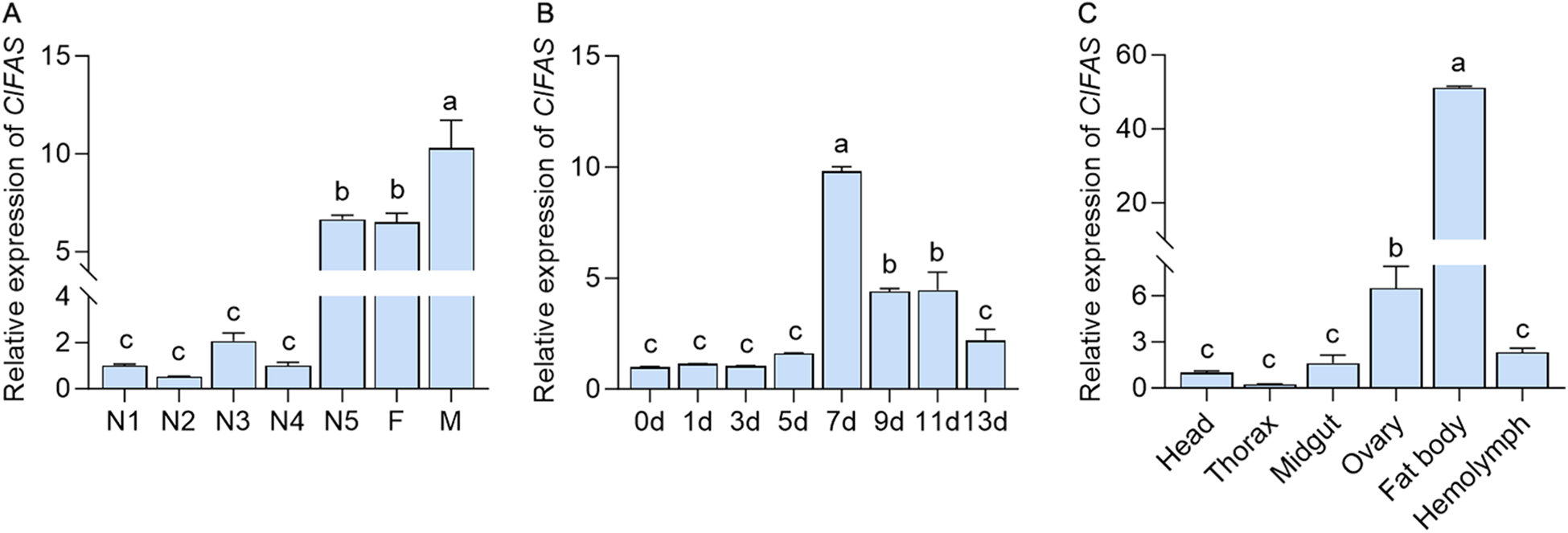
The relative expression level of ClFAS was found to be higher in 5th-instar nymphs compared to other nymphal stages (Fig. 3A). The expression of ClFAS was higher in the adult stage than in the nymphal stage, with adult males demonstrating the highest relative expression level of ClFAS (Fig. 3A). The expression level of ClFAS in adult females was significantly elevated in 7-day-old individuals, exhibiting a 9.81-fold increase compared to that observed in newly emerged females (Fig. 3B). The expression level of ClFAS was highest in the fat body among different tissues, followed by the ovaries, and lowest in the thorax. Moreover, the expression level of ClFAS in the fat body and ovaries were 229.31-fold and 29.03-fold higher than that in the thorax (Fig. 3C). These pronounced expression patterns observed in both fat body and ovarian tissues suggest a potential functional role for ClFAS in reproductive processes of adult female C. lividipennis.
Expression patterns of ClFAS in Cyrtorhinus lividipennis. (A) Relative expression levels of ClFAS were assessed across the first, second, third, fourth, and fifth nymphal stages (N1, N2, N3, N4, N5), as well as in adult females (F) and males (M). (B) Relative expression levels of ClFAS in females at various time points after emergence (0, 1, 3, 5, 7, 9, 11, and 13 days). (C) Tissue expression patterns of ClFAS in females at 2 days post-eclosion. Error bars denote the SE of the mean derived from 3 biological replicates. The distinct lowercase letters above the bars indicate groups that exhibit statistically significant differences (one way ANOVA, P < 0.05).

Function of CLFAS in the reproduction of C. lividipennis
The roles of CLFAS in vitellogenesis of C. lividipennis
At 1, 2, and 3 days after dsRNA injection, the expression level of ClFAS was reduced by 53.5% (t = 3.314, P = 0.0051), 68.7% (t = 5.134, P = 0.0002), and 76.2% (t = 6.519, P < 0.001), compared to the dsGFP treated control, respectively (Fig. 4A). The mRNA expression of ClVg was significantly suppressed by 58.4% (t = 2.525, P = 0.0325), 34.6% (t = 2.459, P = 0.0301), and 49.0% (t = 3.412, P = 0.0042) at days 1, 2, and 3, respectively, following the RNAi-mediated depletion of ClFAS (Fig. 4B). These results indicated that ClFAS is essential for maintaining normal ClVg expression.
RNAi efficiency of ClFAS, ClVg and Vg protein at 1, 2, and 3 days after dsRNA injection. (A) The expression level of ClFAS after injection of dsGFP and dsFAS. (B) The expression level of ClVg after injection of dsGFP and dsFAS. (C) Expression of ClVg protein in Cyrtorhinus lividipennis after dsRNA injection. The error bars indicate the SE for the 3 biological replicates. Asterisk above bars indicate significant differences (Student’s t-test; *P < 0.05, **P < 0.01, ***P < 0.001).

Functions of CLFAS in the oocyte maturation and fecundity in C. lividipennis female
The ovarian development of adult females treated with dsRNA for 1, 3, 5, and 7 days was examined. The results showed no significant difference in ovarian development between the groups treated with dsFAS and dsGFP on day 1 post-treatment (Fig. 5). By the third day post-treatment, the dsGFP-treated group exhibited mature oocytes, whereas ovarian development was markedly inhibited in the dsFAS-treated group (Fig. 5). Mature oocytes were observed in the dsFAS-treated group 5 days post-injection; however, their quantity was comparatively lower than that of the dsGFP control group (Fig. 5). After 7 days of treatment, both the number of mature eggs and overall ovarian development were significantly reduced in the dsFAS-treated group compared to the dsGFP group (Fig. 5). These findings suggest that ClFAS is essential for oocyte maturation in the ovary and egg development in C. lividipennis.
Ovary morphology of female adults at 1, 3, 5, and 7 days after dsRNA injection. Scale bar is equal to 200 µm.

The roles of ClFAS on reproduction and population growth in C. lividipennis were investigated. The total number of eggs laid by the dsFAS treatment was significantly lower than that of the dsGFP control, showing a reduction of 49.5% (t = 4.081, P = 0.0002) (Fig. 6A). Additionally, the daily egg production in the dsFAS treatment group consistently exhibited lower levels compared to the control group on days 4, 5, 8, 9, 10, and 11 (Fig. 6B). No significant impact was observed on either pre-oviposition period or hatchability rates after dsFAS treatment (Fig. 6C and 6D). Furthermore, the dsFAS treatment resulted in a significant reduction of 32.7% (t = 3.857, P = 0.0005) and 26.3% (t = 3.918, P = 0.0004) in both oviposition duration and female adult lifespan, respectively (Fig. 6E and 6F). The injection of dsFAS did not significantly alter the intrinsic rate of increase (r m) and the cycle rate of increase (λ). However, it significantly decreased the net reproduction rate (R 0) by 43.07%, compared to the dsGFP control (Table 2). Therefore, it can be concluded that ClFAS play a key regulatory role in the fecundity and population growth of C. lividipennis.
Effect of ClFAS RNAi on the reproduction of Cyrtorhinus lividipennis. (A) Total number of eggs laid per female during the oviposition period (n = 15). (B) The average number of eggs laid daily per female. (C) Pre-oviposition period. (D) Egg hatchability. (E) Oviposition period of females after dsRNA injection. (F) The lifespan of females after dsRNA injection. The asterisks indicated significant differences (Student’s t-test; ***P < 0.001), ns means no significance.

Population parameters of Cyrtorhinus lividipennis injected with dsRNA

Discussion
Sequence analysis revealed that ClFAS maintains a conserved architecture featuring seven canonical functional domains (KS, MAT, DH, ER, KR, ACP, TE), aligns with typical insect FAS configurations (Cheng et al., Reference Cheng, Yu, Xia, Zhang, Wang, Fang, Hoffmann and Luo2023; Finck et al., Reference Finck, Berdan, Mayer, Ronacher and Geiselhardt2016; Moriconi et al., Reference Moriconi, Dulbecco, Juarez and Calderón‐Fernández2019). Notably, domain variations observed across species, including ACP/TE deficiency in L. migratoria LmFAS3 (Yang et al., Reference Yang, Zhao, Niu, Zhao, Liu, Moussian and Zhang2020), DH domain absence in Glyphodes pyloalis (Wang et al., Reference Wang, Song, Hwarari, Liang, Ding, Yan, Wu, Wang and Sheng2022), and TE domain truncation in Spodoptera litura (Lepidoptera: Noctuidae) SlFAS2 (Song et al., Reference Song, Gu, Liu, Li, Wu and Sheng2022), highlight evolutionary adaptations to species-specific metabolic demands. Phylogenetic analysis positioned ClFAS within a clade closely related to hematophagous reduviid bugs, indicating strong evolutionary conservation relative to related species.
Our results found that the expression of ClFAS exhibited tissue- and stage-specificity. The highest expression of ClFAS was found in the fat body of C. lividipennis. This fat body-dominant expression pattern has been consistently reported across various insect species, including D. melanogaster (Garrido et al., Reference Garrido, Rubin, Poidevin, Maroni, Le Rouzic, Parvy and Montagne2015; Wicker-Thomas et al., Reference Wicker-Thomas, Garrido, Bontonou, Napal, Mazuras, Denis, Rubin, Parvy and Montagne2015), L. striatellus (Cheng et al., Reference Cheng, Yu, Xia, Zhang, Wang, Fang, Hoffmann and Luo2023), A. aegypti (Alabaster et al., Reference Alabaster, Isoe, Zhou, Lee, Murphy, Day and Miesfeld2011), Blattella germanica (Orthoptera: Blattellidae) (Pei et al., Reference Pei, Chen, Bai, Qiao, Li, Fan and Liu2019) and Acyrthosiphon pisum (Hemiptera: Aphididae) (Zhou et al., Reference Zhou, Ling, Guo, Zhu-Salzman, Ge and Sun2021). The fat body, as the primary site of fatty acid synthesis, serves as a pivotal biosynthetic and metabolic hub in insects, where lipids are predominantly stored as triglycerides (Arrese et al., Reference Arrese, Canavoso, Jouni, Pennington, Tsuchida and Wells2001; Arrese and Soulages, Reference Arrese and Soulages2010; Leyria et al., Reference Leyria, Fruttero, Canavoso, Dong, Rezaei, Steinlein, Xiao, Rosenhouse-Dantsker and Gerlai2024). These results underscore this tissue’s role as the primary site of de novo fatty acid synthesis, which is critical for provisioning lipids to developing oocytes. Furthermore, the significant upregulation of ClFAS in seven-day-old females coincides with peak vitellogenic activity, suggesting its tight synchronization with reproductive maturation in C. lividipennis.
Our study indicated that ClFAS positively involved in vitellogenesis, ovarian development, number of eggs laid, oviposition period, and longevity of female C. lividipennis. These results are consistent with prior researches in N. lugens, where NlFAS knockdown reduced female body weight, longevity, total ovarian lipids, and egg production (Li et al., Reference Li, Jiang, Liu, You, Wu, Xu, Ge, Stanley, Song and Wu2016). Similar results had also been observed in L. migratoria, the female lifespan of dsFAS injected insects was longer than that of dsGFP-injected females, and most dsFAS1-treated female adults produced no offspring (Cheng et al., Reference Cheng, Yu, Xia, Zhang, Wang, Fang, Hoffmann and Luo2023). As the pivotal enzyme in lipid biosynthesis, FAS provides essential lipids that serve as the primary energy source for oogenesis, embryogenesis, and other reproductive processes (Arrese et al., Reference Arrese, Canavoso, Jouni, Pennington, Tsuchida and Wells2001; Chen et al., Reference Chen, Zou, Zhu, Duan, Merzendorfer, Zhao and Yang2022; Choi and Jurenka, Reference Choi and Jurenka2006; Leyria et al., Reference Leyria, Fruttero, Canavoso, Dong, Rezaei, Steinlein, Xiao, Rosenhouse-Dantsker and Gerlai2024; Xiang et al., Reference Xiang, Zhang, Jing, Wang, Mao, Li, Zang and Zhang2021). Therefore, the involvement of FAS is imperative for the successful completion of a reproductive event. Moreover, the sharp decline in net reproduction rate following ClFAS silencing highlights the gene’s pivotal role in sustaining population growth. A previous study showed that linoleic acid-enriched diets increased egg production in Bactrocera tryoni (Diptera: Tephritidae) (Moadeli et al., Reference Moadeli, Mainali, Ponton and Taylor2020). Dietary supplementation with fatty acid precursors (e.g. linoleic acid or acetyl-CoA) may upregulate ClFAS expression and consequently improve C. lividipennis reproductive performance. This nutritional enhancement strategy could potentially improve the biocontrol efficacy of C. lividipennis.
The present study provides comprehensive evidence supporting the positive role of ClFAS in the reproductive physiology and population dynamics of C. lividipennis. From the perspective of plant protection and biological control, the functional characterization of ClFAS offers valuable insights into how lipid metabolism governs fecundity in predatory insects.
Funding statement
This work was funded by the National Key Research and Development Program of China (2021YFD1401100), Postgraduate Research & Practice Innovation Program of Jiangsu Province (SJCX23_1981) and Innovation and Entrepreneurship Training Program for College Students in Jiangsu Province (202411117250Y).
Competing interests
The authors declare no conflict of interest.
Data availability
Data will be made available on request.