Introduction
Informal care, which is usually provided by family, will always have a central role in dementia care and can even be considered the cornerstone of dementia care (Alzheimer's Disease International, Reference International2013) with, for example, 80% of home care being provided by family in the USA (Alzheimer's Association, 2012). With a global rise in dementia, from 35.6 million in 2010 to an estimated 115.4 million in 2050 (Alzheimer's Disease International, Reference Prince and Jackson2009), the number of informal caregivers will rise as well. Since informal caregivers of people with dementia (PwD) not only provide care, but are themselves often in need of support and guidance as well (Peeters et al., Reference Peeters, Beek, Meerveld, Spreeuwenberg and Francke2010; Zwaanswijk et al., Reference Zwaanswijk, van Beek, Peeters, Meerveld and Francke2010; Rose and Palan Lopez, Reference Rose and Lopez2012; Thompson and Roger, Reference Thompson and Roger2013), the rising number makes it ever more important to learn how formal care can be designed to support informal care. This is especially true during the more intense and difficult periods, such as during the care-transition period of the person with dementia from home-based care towards institutional long-term care (ILTC). In this article, the care-transition period is considered any amount of time starting from the period prior to admission when admission is contemplated, up to an adjustment period after actual admission. After admission many changes, ranging from the organisational aspects of the move such as emptying the house and selling the house/stopping the rent up to the emotional aspects such as getting used to the fact of living alone, can have significant impact on the informal caregiver. Besides the changes for informal caregivers, PwD also undergo changes, such as a new living environment. The time needed to adjust these changes is dependent on the individual situation of the informal caregiver and the person with dementia. The care transition period is therefore not a set period of time for everybody.
The care-transition period of PwD from home-based care to ILTC is a difficult one for informal caregivers. They are challenged with deciding what the appropriate living environment for the person with dementia is in which the needs of the person with dementia are best met. Caregivers have to decide whether and when it is the right moment for admission and they often experience adverse feelings of guilt, sadness, and self-doubt due to the decision (Dellasega and Nolan, Reference Dellasega and Nolan1997; Nolan and Dellasega, Reference Nolan and Dellasega2000; Tilse, Reference Tilse2000; Wendler and Rid, Reference Wendler and Rid2011). Evidence shows that informal caregivers appreciate formal support during this period (Butcher et al., Reference Butcher, Holkup, Park and Maas2001; Paun and Farran, Reference Paun and Farran2006; Bramble et al., Reference Bramble, Moyle and McAllister2009; Kelsey et al., Reference Kelsey, Laditka and Laditka2010). Up to now, this support is not yet fully developed and structurally offered to informal caregivers as needs are unclear and there is a lack of understanding what support should be offered.
Knowledge explicitly on the needs of informal caregivers during care-transition from home-based care to ILTC is needed. Present studies conducted on needs of informal caregivers report on the ongoing home-situation (Hileman et al., Reference Hileman, Lackey and Hassanein1992; Shankar and Muthuswamy, Reference Shankar and Muthuswamy2007; Ventura et al., Reference Ventura, Burney, Brooker, Fletcher and Ricciardelli2013), or institutional settings (Verhaeghe et al., Reference Verhaeghe, Defloor, Van Zuuren, Duijnstee and Grypdonck2005; Henriksson et al., Reference Henriksson, Benzein, Ternestedt and Andershed2011). Others studied the needs of PwD themselves (Hancock et al., Reference Hancock, Reynolds, Woods, Thornicroft and Orrell2003; Reference Hancock, Woods, Challis and Orrell2006; van der Roest et al., Reference van der Roest2009). Studies regarding informal caregivers needs during care role-transition in dementia have focused on the moment of diagnostic disclosure (Ducharme et al., Reference Ducharme, Beaudet, Legault, Kergoat, Lévesque and Caron2009; de Vugt and Verhey, Reference de Vugt and Verhey2013). These show how early diagnosis offers caregivers the opportunity to feel more competent to care and experience less psychological problems (de Vugt and Verhey, Reference de Vugt and Verhey2013). Knowledge on needs during the care-transition period is still sparse.
After admission caregivers still express a need to be involved in the care (Bramble et al., Reference Bramble, Moyle and McAllister2009; Givens et al., Reference Givens, Lopez, Mazor and Mitchell2012). Informal caregivers role thus continues even after admission, although it may be different from the home situation with informal caregivers taking on other types of tasks. Therefore, needs during the transition period may also be different. Needs can be defined in various ways, such as demand for existing services (Godfrey and Callaghan, Reference Godfrey and Callaghan2000), the result of problems related to health status and quality of health care, evoking need for further professional care (Deeken et al., Reference Deeken, Taylor, Mangan, Yabroff and Ingham2003) or “a condition that is important to the subject and that is not being satisfied in the subject's present environment” (Hileman et al., Reference Hileman, Lackey and Hassanein1992). Needs are derived from problems or dissatisfaction with the situation, making problems and needs inextricably linked.
In this review we aim to provide insight into the problems and needs as experienced by informal caregivers who care for PwD during the care-transition period from home-based care to ILTC. We focus on qualitative studies as they provide in-depth insight into caregiver experiences.
Methods
Search procedure
A systematic electronic search in CINAHL, Cochrane, Medline, PsycINFO, Pubmed, and web of knowledge was carried out. No restrictions were posed upon publication date in this search, with all possible literature up to the date of the search (September 2013) being considered. Search terms included the following: informal care* OR family care* OR family OR partner OR next of kin OR caregiver* AND dementia OR Alzheimer OR cognitive impair* AND need* OR difficult* OR support OR wants OR problems OR demands AND transition* OR institutionali* OR placement OR admission OR entry AND long-term care OR institutional care OR care home* OR nursing home*. In addition, manual reference searches were performed as to find further eligible studies.
Selection criteria
First, all publications were screened on eligibility criteria independently by two researchers (BA and HV) based on title and abstract. Next, selected publications were screened full text, and after deliberation, consensus was reached between the two researchers on which publications should be included in the review.
Publications were included if they met the following criteria: (1) The study population had to contain informal caregivers of PwD. Informal care is considered the care provided by informal caregivers, such as spouses/partners, other members of the household and other relatives, friends, neighbors, and others, usually but not necessarily with an already existing social relationship with the care recipient (OECD, 2005); (2) The study had to investigate experiences of informal caregivers regarding the care-transition process from home-based care to ILTC, describing the problems or needs of informal caregivers; and (3) Studies had to consider PwD during the care-transition period, in which home-based care may become insufficient or inadequate and the admission to ILTC may have to be, or was prompted. All publications meeting the above mentioned criteria, written in English, Dutch or German, were considered.
Publications were excluded if: (1) the sample did not primarily consist of informal caregivers of PwD. Those publications not solely consisting of caregivers of PwD had to at least differentiate between caregivers caring for people with, and without dementia in their results; (2) The studies focussed on predictors for institutionalisation; (3) The study did not use qualitative methods to gather data; (4) The target populations were people with Korsakoff's syndrome, people suffering from severe depression, mental disability or young onset dementia; (5) The research primarily focused on the beginning of the dementia process; and (6) Studies on transition to temporary/respite care or end-of-life/hospice care.
Quality appraisal
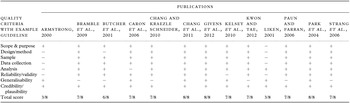
Publications included in the review underwent a quality appraisal using criteria based on an existing checklist as described by Bunn et al. to assess qualitative studies (Bunn et al., Reference Bunn2012). Two researchers (BA and HV) independently scored publications on the following eight criteria: (1) Scope and Purpose (e.g. clear statement of research question); (2) Design/Method (e.g. appropriate use of qualitative methods); (3) Sample (e.g. clear description of sample); (4) Data collection (e.g. adequate description of data collection methods); (5) Analysis (e.g. analytic methods are made explicit); (6) Reliability/Validity (e.g. presents how categories/themes are developed); (7) Generalisability (limits for generalisability clearly stated); and (8) Credibility/Plausibility (e.g. results and conclusions are supported by evidence). Each criterion was scored as sufficient (1) or insufficient (0). For each publication, results were compared and the two researchers discussed discrepancies afterwards until consensus was reached. Scores on the appraisal could range from 0 up to a maximum of 8 points.
Analysis
Thematic analysis was used to analyze the data. Initially, the problems and needs as described in the result sections of all publications were identified. Both quotations of respondents that were presented in the publications, as well as the own wording of the authors in the result sections were considered as data for this review. Those identified sections were then independently coded by the two researchers (BA and MB), using open coding. Next, the terms assigned by the two researchers were discussed. Finally, the codes were grouped to create topics. In case of discrepancy the two researchers involved in the coding procedure, supplemented by a third researcher (HV), deliberated to reach consensus.
Results
Search results, general characteristics and quality appraisal
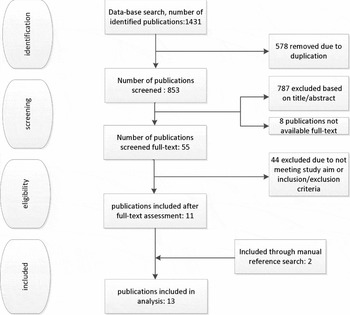
Figure 1 shows a flowchart with an overview of the search and selection of publications.
Flowchart of search and selection procedure.

The included 13 publications were published between 2000 and 2012, and originated in five countries, of which most came from the USA (46%). Other countries were: Australia, Canada, China, and Korea. Overall most of the included studies used semi-structured interviews to collect their data (85%).
The results of the quality appraisal showed that 11 studies were of sound quality, scoring 6 points or higher out of the maximum of 8 (85%) (Butcher et al., Reference Butcher, Holkup, Park and Maas2001; Park et al., Reference Park, Butcher and Maas2004; Caron et al., Reference Caron, Ducharme and Griffith2006; Paun and Farran, Reference Paun and Farran2006; Strang et al., Reference Strang, Koop, Dupuis-Blanchard, Nordstrom and Thompson2006; Bramble et al., Reference Bramble, Moyle and McAllister2009; Chang and Kraenzle Schneider, Reference Chang and Kraenzle Schneider2010; Kelsey et al., Reference Kelsey, Laditka and Laditka2010; Chang et al., Reference Chang, Kraenzle Schneider and Sessanna2011; Givens et al., Reference Givens, Lopez, Mazor and Mitchell2012; Kwon and Tae, Reference Kwon and Tae2012), of which three scored the maximum amount of points (see Table 1). The remaining two studies yielded only 3 out of 8 points (15%) (Armstrong, Reference Armstrong2000; Liken, Reference Liken2001) and were therefore classified as lower quality studies.
Quality appraisal scores

Thematic analysis
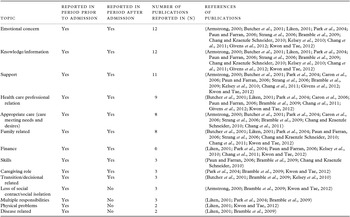
Overall, 14 main topics were found (see Table 2). The topics stated most frequently were: “emotional concern” (n = 12), “knowledge/information” (n = 12) and “support” (n = 11). Other topics that were mentioned in more than half the publications were: “health care professional relation”, “appropriate care”, “family” and “finance” related. The remaining topics were found in fewer publications. The findings of the thematic analysis are discussed in more detail below, starting with the topics appearing in most publications, then continuing with those topics mentioned less frequently. Per topic, the results of the publications scoring high on the quality appraisal are reported first. The two publications scoring lower on the quality appraisal did not add additional topics. However, they were kept in the analysis as they provided different examples within the themes.
Overview of problems experienced, and needs expressed by informal caregivers

Parallels between problems and needs
The included publications stated both problems encountered by informal caregivers, as well as explicit needs expressed by informal caregivers during care-transition. The difference lay in the phrasing. For example, whereas caregivers in one publication stated that they were disappointed with the care of quality of ILTC (Chang et al., Reference Chang, Kraenzle Schneider and Sessanna2011), in other publications this was phrased as an explicit need such as a need for more staff so the quality of care would improve (Butcher et al., Reference Butcher, Holkup, Park and Maas2001). Both state an issue that can be classified under the same theme, only one phrasing as a problem, the other as a specific need. Since needs could be considered as derived from a problem, both needs and problems are described together. The distinction between the situation prior and after admission is, where applicable, continuously made throughout the topics.
Problems and needs experienced by informal caregivers during the transition period
Emotional concerns
Prior to admission emotional concerns could be explicitly related to the decision/placement or be more general. Several publications reported on emotional concerns explicitly related to decision/placement such as grief, stress, anguish, and shame (Butcher et al., Reference Butcher, Holkup, Park and Maas2001; Park et al., Reference Park, Butcher and Maas2004; Bramble et al., Reference Bramble, Moyle and McAllister2009; Kelsey et al., Reference Kelsey, Laditka and Laditka2010; Chang et al., Reference Chang, Kraenzle Schneider and Sessanna2011; Givens et al., Reference Givens, Lopez, Mazor and Mitchell2012; Kwon and Tae, Reference Kwon and Tae2012), for example, calling the experience of the transition traumatic (Kelsey et al., Reference Kelsey, Laditka and Laditka2010). Studies originating in Asian countries also specified cultural values (filial piety) to be at the center of this emotional distress (Park et al., Reference Park, Butcher and Maas2004; Chang et al., Reference Chang, Kraenzle Schneider and Sessanna2011; Kwon and Tae, Reference Kwon and Tae2012), as illustrated by the following quote: “. . . Someone suggested that we should send her to the nursing home. I thought it was a good idea but I was afraid to do so. . . some would say, ‘You must be un-filial because you sent her to a nursing home.’ Although I really wanted to, I did not dare to do so”(Chang et al., Reference Chang, Kraenzle Schneider and Sessanna2011). Emotional concerns that are not explicitly related to the decision for admission were also reported on (Armstrong, Reference Armstrong2000; Liken, Reference Liken2001; Park et al., Reference Park, Butcher and Maas2004; Paun and Farran, Reference Paun and Farran2006; Strang et al., Reference Strang, Koop, Dupuis-Blanchard, Nordstrom and Thompson2006; Chang et al., Reference Chang, Kraenzle Schneider and Sessanna2011; Kwon and Tae, Reference Kwon and Tae2012), such as stating exhaustion of the mind, self-blame as a result of their reaction towards the PwD and feelings of pressure (Paun and Farran, Reference Paun and Farran2006; Kwon and Tae, Reference Kwon and Tae2012). Feelings of apprehension such as the feeling of being out of control, “not being heard” or awareness that the whole situation is overwhelming for them were also reported (Park et al., Reference Park, Butcher and Maas2004; Strang et al., Reference Strang, Koop, Dupuis-Blanchard, Nordstrom and Thompson2006). The two publications scoring lower on the quality appraisal added emotional concerns in the form of difficulty accepting information (Armstrong, Reference Armstrong2000), losing patience and explaining how it felt as if they were on an “emotional roller-coaster” (Liken, Reference Liken2001).
After admission emotional concerns could also be explicitly related to decision of placement, such as self-blame, self-doubt, and regret about the placement decision (Paun and Farran, Reference Paun and Farran2006; Chang and Kraenzle Schneider, Reference Chang and Kraenzle Schneider2010; Chang et al., Reference Chang, Kraenzle Schneider and Sessanna2011; Kwon and Tae, Reference Kwon and Tae2012). Other problems reported were feelings of loneliness due to missing the PwD, isolation and powerlessness (Butcher et al., Reference Butcher, Holkup, Park and Maas2001; Paun and Farran, Reference Paun and Farran2006; Bramble et al., Reference Bramble, Moyle and McAllister2009). Informal caregivers also showed concerns related to ILTC, stating worries about safety for example (Paun and Farran, Reference Paun and Farran2006), others expressed concerns about the PwD in their absence. As stated by one informal caregiver: “. . .because you’re not there, you wonder what's happening . . . so you worry” (Strang et al., Reference Strang, Koop, Dupuis-Blanchard, Nordstrom and Thompson2006). Caregivers also describe visiting the ILTC facility as a difficult experience (Strang et al., Reference Strang, Koop, Dupuis-Blanchard, Nordstrom and Thompson2006).
Knowledge/information
Prior to admission problems ranged from a lack of knowledge about dementia (Liken, Reference Liken2001; Givens et al., Reference Givens, Lopez, Mazor and Mitchell2012), to not being informed about financial options such as social welfare (Chang et al., Reference Chang, Kraenzle Schneider and Sessanna2011). Most frequently, however, the lack of knowledge concerned not knowing available care options or care alternatives for ILTC (Armstrong, Reference Armstrong2000; Butcher et al., Reference Butcher, Holkup, Park and Maas2001; Park et al., Reference Park, Butcher and Maas2004; Chang and Kraenzle Schneider, Reference Chang and Kraenzle Schneider2010; Kelsey et al., Reference Kelsey, Laditka and Laditka2010; Chang et al., Reference Chang, Kraenzle Schneider and Sessanna2011). One caregiver for example stated: “‘I didn't think there were any facilities like this in my town. I didn't know. Nobody told us about this stuff and I didn't know who to ask, so we just found this place through hearsay’” (Park et al., Reference Park, Butcher and Maas2004). Understanding the system, as in knowing the policies, rules and regulations was also reported as a need or problem (Paun and Farran, Reference Paun and Farran2006; Kelsey et al., Reference Kelsey, Laditka and Laditka2010). As reported in one publication, most caregivers stated they were not informed at the time of the admission about the transfer policy nor were they given written information about the transfer policy (Kelsey et al., Reference Kelsey, Laditka and Laditka2010).
After admission one study reported on the need of informal caregivers to improve on their knowledge and understanding about dementia (Bramble et al., Reference Bramble, Moyle and McAllister2009). They need to know and understand the rules and expectations of the ILTC system was expressed after admission as well, complemented with how this learning process was frustrating to most of them (Paun and Farran, Reference Paun and Farran2006; Strang et al., Reference Strang, Koop, Dupuis-Blanchard, Nordstrom and Thompson2006).
Support
Prior to admission support was mentioned in several publications (Armstrong, Reference Armstrong2000; Butcher et al., Reference Butcher, Holkup, Park and Maas2001; Park et al., Reference Park, Butcher and Maas2004; Caron et al., Reference Caron, Ducharme and Griffith2006; Paun and Farran, Reference Paun and Farran2006; Strang et al., Reference Strang, Koop, Dupuis-Blanchard, Nordstrom and Thompson2006; Bramble et al., Reference Bramble, Moyle and McAllister2009; Kelsey et al., Reference Kelsey, Laditka and Laditka2010; Givens et al., Reference Givens, Lopez, Mazor and Mitchell2012; Kwon and Tae, Reference Kwon and Tae2012). Some specifically reported a need for, or lack of support from their social environment, as in family and friends (Butcher et al., Reference Butcher, Holkup, Park and Maas2001; Park et al., Reference Park, Butcher and Maas2004; Caron et al., Reference Caron, Ducharme and Griffith2006; Paun and Farran, Reference Paun and Farran2006; Kwon and Tae, Reference Kwon and Tae2012). For example, mutual support for caregiving being actively and systematically sought in the family (Kwon and Tae, Reference Kwon and Tae2012). Other caregivers stated a need for formal support (Armstrong, Reference Armstrong2000; Butcher et al., Reference Butcher, Holkup, Park and Maas2001; Park et al., Reference Park, Butcher and Maas2004; Paun and Farran, Reference Paun and Farran2006; Bramble et al., Reference Bramble, Moyle and McAllister2009; Kelsey et al., Reference Kelsey, Laditka and Laditka2010; Chang et al., Reference Chang, Kraenzle Schneider and Sessanna2011), such as being educated about dementia (Kelsey et al., Reference Kelsey, Laditka and Laditka2010) or a need for counseling (Bramble et al., Reference Bramble, Moyle and McAllister2009).
After admission support was also expressed as a need. Certain caregivers expressed a need for support from their social environment (Paun and Farran, Reference Paun and Farran2006; Strang et al., Reference Strang, Koop, Dupuis-Blanchard, Nordstrom and Thompson2006). Be it from family, friends or peers. However, support was often stated just as a need for support, without explicitly specifying what this support should look like.
Health care professional relation
Prior to admission the relationship with health care professionals (HCP) was expressed in terms of lack of contact with, and information from staff (Park et al., Reference Park, Butcher and Maas2004; Bramble et al., Reference Bramble, Moyle and McAllister2009; Chang et al., Reference Chang, Kraenzle Schneider and Sessanna2011). Another type of problem in the relation with HCP could arise when the evaluation of the care situation diverged between the informal caregivers and HCP (Caron et al., Reference Caron, Ducharme and Griffith2006).
After admission issues were often due to dissatisfaction with communication, such as a lack thereof, or feeling “unheard” by HCP (Paun and Farran, Reference Paun and Farran2006; Bramble et al., Reference Bramble, Moyle and McAllister2009; Givens et al., Reference Givens, Lopez, Mazor and Mitchell2012). Others felt that HCP did not encourage them to be involved with the care of the PwD after admission and desired to build understanding, rather than clash with staff (Bramble et al., Reference Bramble, Moyle and McAllister2009). Some expressed it as an appreciation for a warm and friendly relation with the staff (Butcher et al., Reference Butcher, Holkup, Park and Maas2001) or difficulties in establishing a positive relationship (Kwon and Tae, Reference Kwon and Tae2012).One study scoring lower on the quality appraisal stated how informal caregivers felt frustrated with the way HCP treated them (Liken, Reference Liken2001).
Appropriate care
Prior to admission, problems, and needs were expressed regarding appropriate care, meaning formal care that meets the needs or expectations of the informal caregiver. In order to be considered helpful, caregivers insisted that any formal support should be available and accessible, flexible, continuous, and co-ordinated among the various service providers, and have an acceptable waiting time for services without unreasonable delays (Caron et al., Reference Caron, Ducharme and Griffith2006). Others made statements regarding limited or unsuccessful respite care (Armstrong, Reference Armstrong2000; Bramble et al., Reference Bramble, Moyle and McAllister2009). Limited numbers of ILTC beds, and a distrust of the quality of care of ILTC were also reported as issues (Chang et al., Reference Chang, Kraenzle Schneider and Sessanna2011). In one of the studies scoring lower on the quality appraisal the caregivers reported the problem of formal help coming at the wrong time. One participant reported “. . .because you could never say when you needed help and they came when you had done everything” (Armstrong, Reference Armstrong2000). This publication further reported how day-care was perceived as the most helpful service. Respite care was required to fulfil the need of having time for themselves and knowing beforehand when this time will be (Armstrong, Reference Armstrong2000), making it possible to anticipate and plan for this “alone” time.
After admission, informal caregivers conveyed disappointment with the quality of care of ILTC (Strang et al., Reference Strang, Koop, Dupuis-Blanchard, Nordstrom and Thompson2006; Chang and Kraenzle Schneider, Reference Chang and Kraenzle Schneider2010; Chang et al., Reference Chang, Kraenzle Schneider and Sessanna2011). As reported in one publication, informal caregivers state how they feel that nursing staff in the ILTC facility do not have time and are overworked (Strang et al., Reference Strang, Koop, Dupuis-Blanchard, Nordstrom and Thompson2006). One study inventoried appropriate care by asking for suggestions for how the care in ILTC can be improved (Butcher et al., Reference Butcher, Holkup, Park and Maas2001). Informal caregivers expressed a desire for a higher staff to resident ratio, which would improve the care conditions.
Family related
Prior to admission issues related to the family could be specifically due to the decisional process or placement. These problems were primarily due to disagreement about the decision (Butcher et al., Reference Butcher, Holkup, Park and Maas2001; Park et al., Reference Park, Butcher and Maas2004; Paun and Farran, Reference Paun and Farran2006; Chang and Kraenzle Schneider, Reference Chang and Kraenzle Schneider2010; Chang et al., Reference Chang, Kraenzle Schneider and Sessanna2011; Kwon and Tae, Reference Kwon and Tae2012). Some even stated that the situation resulted in damaged relations in the family (Park et al., Reference Park, Butcher and Maas2004; Chang et al., Reference Chang, Kraenzle Schneider and Sessanna2011). Informal caregivers expressed needs in terms of the entire family sharing the decision (Butcher et al., Reference Butcher, Holkup, Park and Maas2001) and family involvement in the decision (Strang et al., Reference Strang, Koop, Dupuis-Blanchard, Nordstrom and Thompson2006). Beside issues directly related to admission, other family related issues were reported as well (Liken, Reference Liken2001; Chang and Kraenzle Schneider, Reference Chang and Kraenzle Schneider2010; Kwon and Tae, Reference Kwon and Tae2012). Mostly the problem lay in insufficient assistance, such as the inability to find substitute caregivers within the family (Kwon and Tae, Reference Kwon and Tae2012).
After admission, one of the lower quality publications reported on damaged relations. The caregiver stated: “Our family has dissolved over this whole thing. To this day, my sisters are not talking to me” (Liken, Reference Liken2001).
Finance
Prior to admission, several family caregivers reported financial related issues (Liken, Reference Liken2001; Park et al., Reference Park, Butcher and Maas2004; Kelsey et al., Reference Kelsey, Laditka and Laditka2010; Chang et al., Reference Chang, Kraenzle Schneider and Sessanna2011; Kwon and Tae, Reference Kwon and Tae2012). For example, the inability to afford private care at home (Kwon and Tae, Reference Kwon and Tae2012) or inability to afford nursing care as illustrated by the following quotation: “I have to provide the living expenses for my own family. My wife does not work because she needs to take care of the children. I know it would be better for my father to live in a good nursing home but I do not think I would be able to pay for it” (Chang et al., Reference Chang, Kraenzle Schneider and Sessanna2011).
After admission financial problems were reported as well, which were primarily a result of the high costs of ILTC (Liken, Reference Liken2001; Park et al., Reference Park, Butcher and Maas2004; Paun and Farran, Reference Paun and Farran2006; Kwon and Tae, Reference Kwon and Tae2012), with some reporting extreme financial strain.
Skills
Prior to admission, informal caregivers expressed needs for skills (Paun and Farran, Reference Paun and Farran2006; Bramble et al., Reference Bramble, Moyle and McAllister2009). Especially in terms of communication, such as practicing assertive communication, but also learning how to communicate better with the person with dementia. One publication (Chang and Kraenzle Schneider, Reference Chang and Kraenzle Schneider2010) specified a problem in terms of a lack of skills to perform caregiving tasks.
After admission, informal caregivers had a need for skills in communication, assertiveness and self-care (Paun and Farran, Reference Paun and Farran2006). Regarding that last point, informal caregivers for example reported that they want to know how to take care of their own mental and physical health.
Caregiving role
Prior to admission, some informal caregivers reported problems related to the caregiving role (Park et al., Reference Park, Butcher and Maas2004; Kwon and Tae, Reference Kwon and Tae2012). These problems arose, for example, from taking over new responsibilities that traditionally speaking were unfamiliar. One male caregiver reported “I cannot even say how difficult things were. Cleaning . . . and giving baths. . . If I were a woman maybe things would have been easier, but being a man, I was going crazy” (Park et al., Reference Park, Butcher and Maas2004).
After admission, informal caregivers in one publication generally expressed a desire to be involved in their relative's care even after admission to ILTC; for example, in communicating their relative's disabilities and needs to the staff (Bramble et al., Reference Bramble, Moyle and McAllister2009). Others expressed how hard it was to adjust to a new and different caregiving role. Since informal caregivers are no longer the primary caregivers after admission, they had to relinquish the caregiver role that they used to assume at home. Some caregivers stated that it was not so easy to give up that role and adjust to the new rules in ILTC (Kwon and Tae, Reference Kwon and Tae2012).
transition related
Prior to admission, informal caregivers in general felt unprepared for the transition (Butcher et al., Reference Butcher, Holkup, Park and Maas2001; Bramble et al., Reference Bramble, Moyle and McAllister2009). In one publication it is reported that due to having to decide in a crisis, caregivers felt the situation “happened rather quickly” (Bramble et al., Reference Bramble, Moyle and McAllister2009). Caregivers reported specific needs to become more prepared, for example becoming acquainted with the ILTC prior to when it would be necessary to place their loved ones there (Butcher et al., Reference Butcher, Holkup, Park and Maas2001). Others stated a need to talk with spouses or adult children of current residents to learn about the facility (Kelsey et al., Reference Kelsey, Laditka and Laditka2010). A need for reassurance regarding the move, such as a “neutral” person validating the move was also reported regarding the situation prior to admission (Kelsey et al., Reference Kelsey, Laditka and Laditka2010).
After admission, transition needs were expressed by one publication (Butcher et al., Reference Butcher, Holkup, Park and Maas2001). A need for reassurance regarding the move was expressed, meaning that informal caregivers needed to know that they had made the right decision.
Loss of social contact/social isolation
This topic was only mentioned regarding the situation prior to admission, with statements about the informal caregiver such as a slow loss of independence, loss of social contact (Bramble et al., Reference Bramble, Moyle and McAllister2009) and isolation from surroundings (Kwon and Tae, Reference Kwon and Tae2012). In one of the publications scoring lower on the quality appraisal, caregivers explained how friends seemed to stop coming over and stopped calling (Armstrong, Reference Armstrong2000).
Multiple responsibilities
Having multiple responsibilities also showed to be a problem (Liken, Reference Liken2001; Park et al., Reference Park, Butcher and Maas2004; Bramble et al., Reference Bramble, Moyle and McAllister2009). Caregivers, for example, described difficulties in juggling their own family and work commitments and the increasing needs of the care recipient. This topic was only reported on prior to admission.
Physical problems
Physical problems were reported only prior to admission and were expressed as an exhaustion of the body over time (Kwon and Tae, Reference Kwon and Tae2012). A lower quality study further reported the inability to control health problems (Liken, Reference Liken2001).
Disease related problems
This topic consisted of problems along the line of not recognising the progress of the decline of the person with dementia, late identification of challenges associated with caring for a person with dementia and even denial of the dementia (Liken, Reference Liken2001; Bramble et al., Reference Bramble, Moyle and McAllister2009). This topic was only found regarding the period prior to admission.
Discussion
This review identified three important domains of difficulties and needs as expressed by caregivers during the care-transition period: “emotional concerns”, “knowledge/information” and “support.” Prior studies on needs of informal caregivers, some in fields other than dementia, report similar types of needs (Dellasega and Nolan, Reference Dellasega and Nolan1997; Verhaeghe et al., Reference Verhaeghe, Defloor, Van Zuuren, Duijnstee and Grypdonck2005; van der Roest et al., Reference van der Roest2009; Peeters et al., Reference Peeters, Beek, Meerveld, Spreeuwenberg and Francke2010; Zwaanswijk et al., Reference Zwaanswijk, van Beek, Peeters, Meerveld and Francke2010; Ventura et al., Reference Ventura, Burney, Brooker, Fletcher and Ricciardelli2013), highlighting the importance of these needs and problems. Other often recurring topics in this review were: “Health care professional relation”, “Appropriate care”, “Family related” and “Finance.” The remaining topics were mentioned in less than half of the included publications.
Over the course of the transition period we found similar topics and even similar needs and problems when looking at the situation prior to admission and the period after admission. Considering the many changes that occur in the relatively short timeframe of the care-transition, changes in needs and problems may be expected. The similarity in issues prior and after admission shows the transition period to be a continuum, and that despite some shifts in problems and needs, the period just before and just after admission should not be considered separately.
The findings of this review highlight the emotional turbulence informal caregivers go through when it comes to the decision regarding, and admission to ILTC. In all but one included publication, emotional concerns were mentioned in one way or another. Also, this topic was present prior as well as after admission, showing emotional issues to be continuously present along the process of care-transition and not dissolving after the decision is made. Emotional concerns can be considered a result of issues and circumstances. In this review we made the distinction between decision and non-decision related concerns, in which the decision can be considered the issue causing emotional turbulence. Non-decisional related emotional concerns can be related to other topics found in this review. Family related issues, such as disagreement, or more strongly, a damaged relation with other family members, can clearly be linked to emotional concerns. But also a lack of information, lack of appropriate care and dissatisfaction with the relationship with HCP, can lead to frustrations within the informal caregiver.
The need and lack of knowledge and information was another recurring topic, ranging from information on care options to knowledge about dementia. Whereas some issues were only relevant prior to admission, such as the need for care alternatives for ILTC, other issues were brought up both prior and after admission, such as understanding and knowing the policies, rules and regulations of the care system. As concluded by studies on service use in general among people with cognitive impairment, caregivers non-use of services lies partly in unawareness of treatment options available to them (Brodaty et al., Reference Brodaty, Thomson, Thompson and Fine2005; Wolfs et al., Reference Wolfs, de Vugt, Verkaaik, Verkade and Verhey2010). There are many websites, discussion groups, information flyers and other channels of information made available by formal care; however, it is clear that more guided ways of getting the information to informal caregivers may be necessary. The issue could lie in reaching the right persons at the appropriate moment, and not so much in a lack of available information. Now it seems the responsibility of informal caregivers to get the information they need; however, they might not know where to look for this information or are looking for the wrong information. Perhaps there is a bigger role for general practitioners or case-managers in this task, making the information more one-on-one, tailored and initiated by formal care.
The need for support both from the social environment as from formal care was reported multiple times. While support is frequently mentioned, it is important to note that the form of support was often not made explicit, with only some defining it for example as support in supervising the person with dementia when they were not around (Caron et al., Reference Caron, Ducharme and Griffith2006) up to professional counseling (Bramble et al., Reference Bramble, Moyle and McAllister2009). Whether informal caregivers could not or did not specify what support they want, or whether interviewers did not prompt for further specification when informal caregivers stated a need for support is not clear. Evidence suggests that caregivers predominantly state aspects related to PwD, such as behavioral aspects, care-dependency and cognitive decline, as reasons for admission (Afram et al., Reference Afram2014), suggesting a need for support regarding these aspects. The reported problems and needs, on the other hand, are more related to caregivers themselves. There seems to be a discrepancy between reported reasons for admission and reported needs during the care transition period. Support therefore may be needed along the line of aiding informal caregivers to handle the situation, with a focus on those aspects that are considered reasons for admission but cannot be altered. Further research is needed to investigate what the support should entail and when and by whom it should be offered.
Unmet needs of caregivers may impede the ability to care for and support the persons with dementia, due to, for example, emotional and physical effects of caregiving (Vitaliano et al., Reference Vitaliano, Russo, Young, Teri and Maiuro1991; Hwang et al., Reference Hwang2003). This in turn may result in unmet needs of the person with dementia as well, leading to earlier ILTC admission or even the demise of the person with dementia (Gaugler et al., Reference Gaugler, Kane, Kane and Newcomer2005). This all stresses the importance of meeting the needs of informal caregivers. Studies show that caregivers may not indicate a need for improving care (Wolfs et al., Reference Wolfs, de Vugt, Verkaaik, Verkade and Verhey2010), however many caregivers do express a need for additional professional support (Peeters et al., Reference Peeters, Beek, Meerveld, Spreeuwenberg and Francke2010; Zwaanswijk et al., Reference Zwaanswijk, van Beek, Peeters, Meerveld and Francke2010). There may be a need for stronger promotion of services available, and therewith improving the knowledge on what is available, keeping in mind that countries can have a wide or limited range of formal services. Like stated before, the spreading of knowledge may have to be more driven from professionals, and not as much relying on the informal caregiver to find the information that is made available. Still, with the need of support being so prominently present in this review, formal support and guidance specific to the transition period should be developed. While, at present, the situation up to admission and the situation after admission are still viewed as two adjacent periods of care, with home-based care at the one side and ILTC on the other, service providers should aim for a more integrated trajectory of care. Looking at other interventions aimed at informal caregivers, we see that multicomponent interventions, comprising education, training, support, and respite, “support caregiver's mood and morale and reduce burden” (Alzheimer's Disease International, Reference International2013). The components mentioned encompass all three main topics of problems and needs as found in this review and therefore offer a basis for developing care-transition specific support and guidance. These programmes could have multiple functions, such as guidance in the actual decision, target the emotional effects such as guilt during this process, ease informal caregivers into their new role, and equip them with the tools needed to collaborate with HCP in ILTC (e.g. communication and assertiveness).
Limitations
This review has some limitations. It should be kept in mind that many studies aimed at describing experiences during the care-transition period and not so much report explicitly on (un)met needs of informal caregivers. This may mean that more issues are experienced by informal caregivers that were not expressed in the publications. Still, when describing the care transition period, one may expect that the most important issues were mentioned, regardless of not being explicitly asked about. Furthermore, some themes were illustrated with multiple examples, while others were not. Support, for example, was often stated just as a need for support, without explicitly stating support in what area or how this support should look like. Lastly, we note a lack of European studies in the final included publications. Studies performed in Europe were identified during the search procedure, but were excluded as they did not meet the inclusion criteria. The studies did not target the transition period from home towards institutional care or focused on the needs of PwD instead of their informal caregivers (Hancock et al., Reference Hancock, Reynolds, Woods, Thornicroft and Orrell2003; Reference Hancock, Woods, Challis and Orrell2006; van der Roest et al., Reference van der Roest2009; Peeters et al., Reference Peeters, Beek, Meerveld, Spreeuwenberg and Francke2010; Wolfs et al., Reference Wolfs, de Vugt, Verkaaik, Verkade and Verhey2010; Zwaanswijk et al., Reference Zwaanswijk, van Beek, Peeters, Meerveld and Francke2010). Still the publications included had their origin in three continents, giving us results of informal caregivers from different cultures, care opportunities, care systems and organisation. The similarity of needs and problems expressed by this diverse selection of caregivers, gives confidence in some generalisability of the results for not included countries with similar situations.
Conclusions
Informal caregivers of PwD tend to express needs or issues during the care transition period regarding emotional concerns, knowledge and information and support. Though one may expect changes in needs during care-transition due to the turbulent nature of this period, similar topics and even similar needs and problems were reported prior and post admission. This suggests care-transition to be a continuum and not consisting of two separate conditions. Support should be designed in a uninterrupted way, starting prior to admission and continuing after, which could result in better continuity of care. Since it is multicomponent interventions that prove effective for informal caregivers (Alzheimer's Disease International, Reference International2013), these should also be offered specific to the care transition period. These programmes could target multiple aspects (the decision, the emotional effects, how to collaborate with HCP), and use the topics found in this review as a starting point for their development.
Conflict of interest
None.
Description of authors’ roles
BA was responsible for performing the search and drafting the manuscript. BA and HV performed the selection and inclusion of the publications, as well as performing the quality check of the included publications. BA and MB executed the thematic analysis. Results of the thematic analysis were critically reviewed by all authors. All authors approved the final manuscript.