1.1 What Is Fairness? Why Does It Matter in AI?
1.1.1 What Is Fairness in AI?
Fairness has historically been a central concern across philosophical, legal, and sociological domains, but its significance takes on new dimensions in “Responsible AI.” As AI systems are increasingly deployed in high-stakes domains such as healthcare, questions of equitable treatment and accountability have become critical. Bias in AI, manifesting as systematic distortions that disproportionately disadvantage certain individuals or groups, poses serious risks (Mehrabi et al., Reference Mehrabi, Morstatter, Saxena, Lerman and Galstyan2021). Fairness, in this context, acts as a foundational pillar of Responsible AI: without careful attention to bias and equitable outcomes, algorithmic systems risk perpetuating discrimination and undermining public trust (Caton and Haas, Reference Caton and Haas2024).
The concept of fairness has been extensively discussed in multiple fields and is a critical topic in social, cultural, and institutional frameworks (Hutchinson and Mitchell, Reference Hutchinson and Mitchell2019). It embodies both a pursuit of legitimacy and a practical need to distribute resources and opportunities equitably. However, reaching a single unified definition of “fairness” is not straightforward; different disciplines often view and emphasize fairness from their own unique perspectives. From philosophy to sociology, from law to quantitative science, there are notable differences in how fairness is conceptualized, evaluated, and implemented.
From a philosophical standpoint, fairness encompasses both outcomes and processes: not only the results of decisions (e.g., who receives what resources or opportunities), but also the procedures and principles by which those decisions are made. In ancient Greece, Aristotle proposed two forms of justice: “distributive justice,” which addresses how benefits or resources should be allocated proportionally, and “corrective justice,” which focuses on redressing errors or harms (von Leyden, Reference von Leyden1985). In the twentieth century, John Rawls introduced the idea of a “veil of ignorance,” causing people to develop social structures without knowing their own social status, thus underscoring the protection of the most disadvantaged (Rawls, Reference Rawls and Corlett1991). Around the same time, Robert Nozick focused on the legitimacy and due process of individual property rights and freedoms (Nozick, Reference Nozick1974). Although philosophers approach fairness from diverse perspectives, they generally agree on the need to consider both appropriate support for disadvantaged groups and the legitimacy of procedures and rights.
From a sociological perspective, fairness is situated within concrete social structures and group interactions. For example, social class hierarchies in educational systems or power imbalances in racially segregated neighborhoods illustrate how social structures and everyday group interactions can influence the life chances of individuals. Sociological research often highlights macro-level power relations and institutionalized inequalities, paying special attention to the lingering effects of historical and cultural factors on certain groups (Mulligan et al., Reference Mulligan, Kroll, Kohli and Wong2019), such as African American communities affected by redlining policies, or indigenous populations facing ongoing impacts of colonialism. In sociological terms, even if formal rules apply uniformly to everyone, overlooking the distinct needs of certain groups can lead to subtler forms of injustice perpetuated by institutions or technologies.
In the legal domain, fairness is closely linked to principles such as anti-discrimination and equal treatment, often manifested in prohibitions against direct or indirect discrimination. Many jurisdictions explicitly stipulate in their constitutions or civil rights laws that discrimination based on sensitive attributes, such as gender, race, religion, age, or disability, is unlawful. Legal frameworks also provide mechanisms for individuals to seek redress, such as anti-discrimination tribunals, equality commissions, and judicial review.
The rise of quantitative science has enabled more precise measurements and definitions of fairness, laying the theoretical and practical groundwork for implementing “AI fairness” in artificial intelligence systems (Hutchinson and Mitchell, Reference Hutchinson and Mitchell2019). These quantitative approaches provide mathematically formalized criteria that help evaluate whether algorithmic outcomes are equitable across or within groups. These and related fairness metrics will be introduced in more detail later in the chapter. By applying these quantitative metrics to identify and address bias or discrimination, it becomes easier to evaluate and mitigate potential unfairness between different groups.
In general, AI Fairness refers to ensuring non-discriminatory, bias-free decisions and services for different population groups throughout the entire algorithm design, training, deployment, and application (Hutchinson and Mitchell, Reference Hutchinson and Mitchell2019). This encompasses not only the statistical balance in decision outcomes but also the soundness of how models handle individual characteristics and the explainability of these processes. From the standpoint of the AI field, integrating multiple disciplinary perspectives enables a more holistic examination of values, institutional arrangements, and technical implementation. Philosophy clarifies the concept of fairness and why it is worth pursuing; sociology shows how social structures and historical factors shape inequalities among different groups; law provides baseline rules and accountability frameworks to combat discrimination; and quantitative science gives us the tools to identify and mitigate unfairness on a technical level. During this process, conflicting priorities and trade-offs can arise due to variations in context and objectives (Narayanan, Reference Narayanan2018; Mehrabi et al., Reference Mehrabi, Morstatter, Saxena, Lerman and Galstyan2021); however, it is precisely through these challenges that the notion of fairness becomes continually enriched and expanded, evolving into a shared concern that spans ethics, law, and technology.
1.1.2 Why Does Fairness Matter in AI?
As AI has been integrated into various sectors of society, AI Fairness is increasingly important in practice. This urgency lies in AI’s penetration of areas that affect people’s vital interests, such as medical diagnosis, recruitment and hiring, and financial credit. If algorithms harbor implicit bias or discrimination in these contexts, once decisions turn unfair, the consequences not only harm individual opportunities and rights but also amplify existing social inequalities. For example, using predictive models in healthcare to determine which patients should receive prioritized treatment can systematically undermine access to medical resources for certain ethnic groups or those of lower socioeconomic status if the model is biased against them (Chen et al., Reference Chen, Wang, Williamson, Chen, Lipkova and Lu2023). In recruitment and hiring, facial analysis tools embedded in video interviews have been found to rate candidates differently based on perceived gender expression or ethnicity, even when qualifications are equal (Köchling and Wehner, Reference Köchling and Wehner2020; Hemamou et al., Reference Hemamou, Guillon, Martin and Clavel2021). A similar issue may arise in financial credit: automated fraud detection systems may flag transactions from neighborhoods with higher minority populations more frequently, leading to account freezes or denials that disproportionately affect those communities (Pombal et al., Reference Pombal, Cruz, Bravo, Saleiro, Figueiredo and Bizarro2022; Genovesi et al., Reference Genovesi, Mönig, Schmitz, Poretschkin, Akila and Kahdan2024).
These concrete harms illustrate that AI fairness is not just a technical concern, but one with ethical, legal, and societal implications. In fact, the importance of ensuring AI fairness is closely tied to the protection of human rights and the maintenance of social stability (Teo, Reference Teo2024). Rapid technological advances have, to some extent, improved the efficiency and accuracy of information processing and decision-making, but they have also brought notable ethical and legal challenges. If an AI system displays overt discrimination in judicial, educational, medical, or financial decisions, it not only violates anti-discrimination legislation but also undermines individual dignity and society’s fundamental pursuit of equality. In other words, keeping AI decision-making impartial is fundamentally about safeguarding people’s basic rights and societal values: individuals should have equal access to resources and opportunities, as well as the ability to question and appeal algorithmic decisions (Constantinides et al., Reference Constantinides, Bogucka, Quercia, Kallio and Tahaei2024). When the public becomes aware of potential AI bias but lacks the means to understand or correct it, widespread skepticism and resistance to AI may ensue (Harper and Weber, Reference Harper and Weber2022). Public trust can only be maintained by ensuring that algorithmic judgments are reliable and legitimate.
1.2 Why Is Fairness Challenging in AI? Does It Create Conflicts with Other Responsible AI Principles? What Makes It So Hard to Solve?
AI Fairness remains one of the most challenging ethical issues in AI development and deployment. One of the fundamental challenges of fairness in AI is that fairness itself is a contested concept with multiple definitions. Different disciplines and stakeholders define fairness in AI differently, leading to various mathematical and ethical interpretations. The major definitions of AI fairness can be categorized into three types: group fairness, individual fairness, and procedure fairness (Mehrabi et al., Reference Mehrabi, Morstatter, Saxena, Lerman and Galstyan2021).
Group fairness ensures that individuals categorized by certain attributes (e.g., race, gender, education, or social status) receive similar outcomes from an AI system. Key metrics include: (1) Demographic parity (or statistical parity), which ensures equal outcomes across groups: for example, if an automated loan approval system approves 70 percent of applicants overall, then demographic parity would require that approval rates are also close to 70 percent across different racial or gender groups; (2) Equalized odds that ensure similar error rates across different groups: such as ensuring that false negative rates (e.g., denying a loan to a qualified applicant) are equally low for both men and women; and (3) Disparate impact, which assesses if the proportion of the positive predictions is similar across groups: for example, whether any group’s selection rate is less than 80 percent of that of the most favored group (Pessach and Shmueli, Reference Pessach and Shmueli2022; Chen et al., Reference Chen, Wang, Williamson, Chen, Lipkova and Lu2023; Caton and Haas, Reference Caton and Haas2024).
Individual fairness centers on guaranteeing that similar individuals are treated similarly, regardless of their group membership. A commonly used metric is counterfactual fairness, which ensures that an individual’s outcome remains unchanged in a hypothetical scenario in which their protected attribute (e.g., gender, race) is altered (Caton and Haas, Reference Caton and Haas2024; Moreau et al., Reference Moreau, Sinatra and Sekara2024).
Procedural fairness, unlike group and individual fairness, focuses on the process rather than the outcome. It emphasizes transparency, explainability, and accountability in AI decision-making, ensuring that AI systems are developed and deployed in a way that upholds ethical and legal standards (Juijn et al., Reference Juijn, Stoimenova, Reis and Nguyen2023; Genovesi et al., Reference Genovesi, Mönig, Schmitz, Poretschkin, Akila and Kahdan2024). These definitions often conflict with each other. For example, an AI model that guarantees demographic parity may sacrifice individual fairness by giving preferential treatment to under-represented groups. The lack of a universally accepted definition of fairness makes it challenging to design AI systems that satisfy all stakeholders.
However, standardizing fairness definitions is inherently complex as each metric reflects different ethical and philosophical priorities. For example, group fairness prioritizes equity and social justice, reflecting deontological ethics that emphasize the protection of marginalized groups and rectifying historical injustice. In contrast, individual fairness is often linked to utilitarian perspectives, prioritizing overall welfare, efficiency, and predictive accuracy over group-based interventions (Verma and Rubin, Reference Verma and Rubin2018). These ethical tensions mean that a one-size-fits-all fairness metric is neither feasible nor desirable.
Another challenge concerns bias in data and algorithms. AI systems are trained on historical data, which often reflects societal biases (Baeza-Yates, Reference Baeza-Yates2016; Mehrabi et al., Reference Mehrabi, Morstatter, Saxena, Lerman and Galstyan2021). These biases can be explicit (e.g., discriminatory hiring practices) or implicit (e.g., under-representing certain groups in training datasets). Bias in AI can arise from multiple sources, including data collection biases (historical data may disproportionately reflect past injustices), labeling biases (human annotators may introduce subjective biases when labeling training data), and algorithmic biases (machine learning models may learn and amplify biases present in training data) (Mehrabi et al., Reference Mehrabi, Morstatter, Saxena, Lerman and Galstyan2021; Pessach and Shmueli, Reference Pessach and Shmueli2022). Mitigating bias in AI requires careful curation of training data and algorithmic interventions, yet it is challenging due to the deeply embedded nature of societal inequalities.
Moreover, fairness often conflicts with other principles of responsible AI, making it difficult to optimize fairness without compromising other important ethical considerations. Many AI models optimize for accuracy, but ensuring fairness often requires adjusting decision thresholds, which may reduce overall predictive accuracy. For example, in predictive hiring models, adjusting for fairness may lead to hiring decisions that prioritize under-represented candidates over those with higher predicted success rates. Moreover, ensuring fairness may also compromise transparency, as transparency requires that AI decision-making processes be explainable, but some fairness-enhancing techniques, e.g., adversarial debiasing (Zhang et al., Reference Zhang, Lemoine and Mitchell2018; Yang et al., Reference Yang, Soltan, Eyre, Yang and Clifton2023), introduce additional complexity, making models harder to interpret. Additionally, fairness and privacy can be in tension, as ensuring fairness may require collecting sensitive demographic data (e.g., race, gender) to monitor and mitigate biases, which raises privacy concerns (Chen et al., Reference Chen, Wang, Williamson, Chen, Lipkova and Lu2023). These trade-offs highlight the difficulty of achieving fairness without compromising other ethical imperatives.
Several structural barriers contribute to the persistent difficulty of achieving fairness in AI. First, while there are multiple fairness-enhancing techniques (e.g., pre-processing, in-processing, and post-processing interventions) (Mehrabi et al., Reference Mehrabi, Morstatter, Saxena, Lerman and Galstyan2021), selecting the right approach depends on stakeholder priorities. However, different stakeholders, including AI developers, policymakers, businesses, and marginalized communities, may have competing interests in fairness. Companies may prioritize efficiency and profitability, whereas advocacy groups may push for equity and inclusion. The lack of consensus among stakeholders on what fairness means in specific AI applications makes it difficult to implement universally acceptable solutions. Second, AI does not operate in a vacuum; it mirrors and reinforces existing social inequalities. To achieve AI fairness, researchers must confront systemic injustices already prevalent in multiple fields, such as education, employment, healthcare, and criminal justice (Hutchinson and Mitchell, Reference Hutchinson and Mitchell2019). Relying solely on AI fairness interventions will not eradicate these deeply rooted disparities; comprehensive structural reforms are essential to establish equitable conditions for all groups.
1.3 How Is Fairness Applied in Practice? What Methods or Tools Are Used?
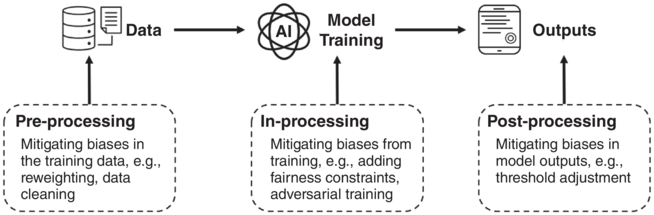
In this section, we explore the methods used to achieve AI fairness, focusing specifically on three levels: pre-processing, in-processing, and post-processing, as shown in Figure 1.1. Overall, these methods share the common goal of reducing bias in models with respect to sensitive attributes (such as gender or race), yet each approach differs in its focus, implementation, and inherent limitations. The following paragraphs introduce the fundamental principles, common techniques, and concrete examples of each category and highlight the limitations encountered in practical applications, providing a comprehensive and detailed perspective to help bridge theory and practice.
Pre-processing, in-processing, and post-processing methods

Pre-processing methods primarily concentrate on adjustments made at the data level. The basic idea is to correct for biases in the training data, so that subsequent model training can be performed on a more balanced dataset. For example, reweighting techniques assign different weights to samples corresponding to various sensitive attributes to mitigate the inherent biases in the data (Kamiran and Calders, Reference Kamiran and Calders2012; Rabonato and Berton, Reference Rabonato and Berton2024). Although this can help correct simple disparities, such as having too few female examples in a resume screening dataset, it may not address more intricate biases hidden in the relationships between features. In practice, if the model’s algorithms learn to correlate subtle patterns (e.g., certain skill keywords with particular demographic groups), simply reweighting samples may not disrupt these deep-seated, non-linear biases (subtle relationships or interactions in the data).
In addition, resampling methods, such as oversampling or undersampling, are often employed to balance the data distribution by increasing the minority group samples or reducing the majority group samples (Chawla et al., Reference Chawla, Bowyer, Hall and Kegelmeyer2002; Tayebi and Garibay, Reference Tayebi and Garibay2023). While these techniques help alleviate data imbalance, oversampling can lead to overfitting of the minority class patterns, and undersampling may discard important information, thus weakening the model’s generalization capability. Furthermore, some researchers propose feature transformation and debiasing techniques (e.g., a data transformation based on de-discrimination optimization goals) to reduce the impact of sensitive attributes (Feldman et al., Reference Feldman, Friedler, Moeller, Scheidegger and Venkatasubramanian2015; Calmon et al., Reference Calmon, Wei, Vinzamuri, Ramamurthy and Varshney2017). Although this method can protect data fairness to a certain degree, it may lose some valuable information during the transformation process and consequently reduce predictive performance.
In-processing methods are directly embedded into the model training process by adjusting model parameters or introducing specific constraints to balance predictive accuracy with fairness (Liu et al., Reference Liu, Ning, Teixayavong, Mertens, Xu and Ting2023). For example, fairness-constrained optimization incorporates fairness constraints directly into the objective function during training through regularization or explicit constraints to guide the learning process, ensuring the model meets additional fairness requirements while achieving original objectives (Zafar et al., Reference Zafar, Valera, Gomez Rodriguez and Gummadi2017; Dzakpasu et al., Reference Dzakpasu, Liu, Li and Liu2024). Additionally, incorporating fairness regularization directly into the loss function has also become a common practice; this method seeks a balance between prediction error and fairness bias, yet the setting of the regularization weight is typically sensitive and often requires careful tuning depending on the dataset and task (Kamishima et al., Reference Kamishima, Akaho and Sakuma2011; Wan et al., Reference Wan, Zha, Liu and Zou2023). Although this approach directly reduces unfairness during training, it also increases the complexity of the model training process and, in certain scenarios, may compromise prediction accuracy.
Another common technique is adversarial debiasing, which builds an adversarial learning framework that forces the main model to learn representations that do not contain sensitive information (Zhang et al., Reference Zhang, Lemoine and Mitchell2018; Wan et al., Reference Wan, Zha, Liu and Zou2023). However, its training process often suffers from instability and complex hyperparameter tuning, and it might incur information loss that affects overall performance.
Finally, post-processing methods adjust the output after the model has been trained to compensate for biases arising from internal model mechanisms (Mehrabi et al., Reference Mehrabi, Morstatter, Saxena, Lerman and Galstyan2021). However, the limitation of post-processing methods is that they can only adjust the model’s output and cannot fundamentally change the internal learning mechanisms of the model. Threshold adjustment is one commonly used technique in this category, where researchers set different decision thresholds based on the results of each group to ensure that predictive outcomes are more balanced (Wexler et al., Reference Wexler, Pushkarna, Bolukbasi, Wattenberg, Viegas and Wilson2019). Hardt et al. (Reference Hardt, Price and Srebro2016) introduced the equality of opportunity and equalized odds methods as representative examples; despite their simplicity and ease of implementation, these methods can only process existing output, leaving the internal decision mechanisms untouched, and may, in some cases, reduce overall model performance. Moreover, output modification methods adjust the predicted probabilities or rankings during post-processing to meet predefined fairness criteria, though this often comes at the cost of reduced interpretability, and adjusted results might not fully reflect the true risk (Kim et al., Reference Kim, Ghorbani and Zou2019; Rabonato and Berton, Reference Rabonato and Berton2024).
In practical applications, choosing an appropriate fairness method often depends on the specific context and requirements. In environments with large and high-quality data, pre-processing methods can provide a solid fairness foundation for the model. Conversely, in emerging fields or scenarios with scarce data, incorporating fairness constraints or adversarial debiasing directly into the training process may prove more effective, as these approaches can correct biases in real-time during learning. Furthermore, in systems that are already deployed, post-processing methods are often the preferred strategy for enhancing fairness, as they require minimal modifications to the existing model and can be applied at the output stage with relative ease.
In addition, different domains and application scenarios place varying levels of emphasis on fairness. Fairness and transparency are often paramount in high-risk fields such as finance, healthcare, and the justice system; in such cases, combining multiple methods to form a multi-layered fairness assurance system is particularly appropriate. In contrast, rapidly iterating commercial applications may require a balance between fairness and efficiency. Therefore, when developing an AI fairness strategy, researchers and engineers must consider the data characteristics, the model’s complexity, and the regulatory and ethical requirements of the specific industry, choosing and combining different methods flexibly to achieve the best practical outcome.
1.3.1 AI Fairness Toolkits
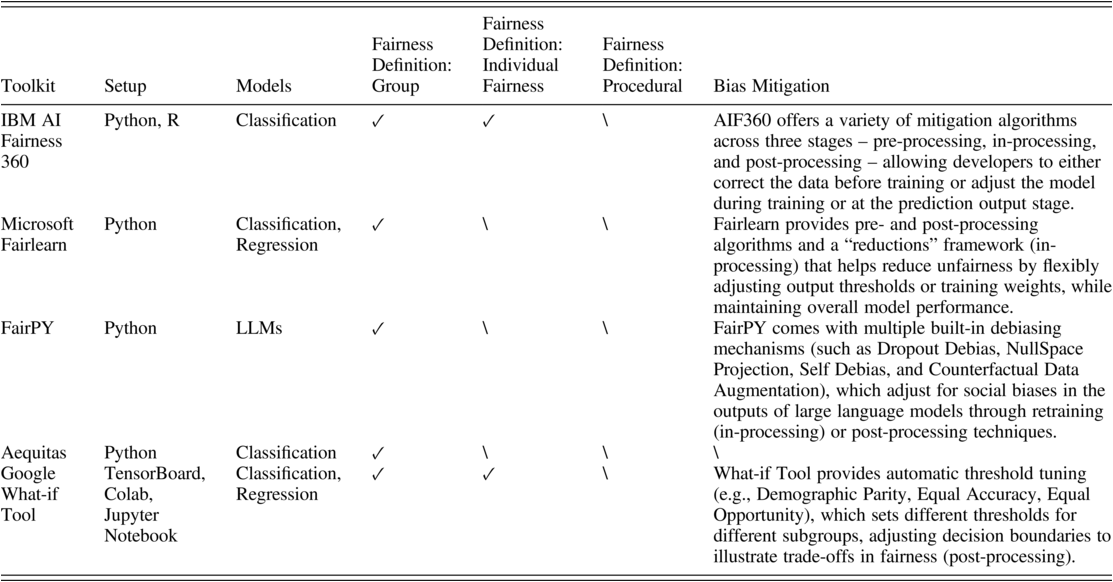
We introduce some commonly used open-source toolkits in this section, including their applicability and limitations (Lee and Singh, Reference Lee and Singh2021; Wong et al., Reference Wong, Madaio and Merrill2023; Sadek et al., Reference Sadek, Constantinides, Quercia and Mougenot2024), as shown in Table 1.1. These are only a subset of fairness toolkits, and many other useful toolkits also exist.
IBM AI Fairness 360 (Bellamy et al., Reference Bellamy, Dey, Hind, Hoffman, Houde and Kannan2019): AI Fairness 360 (AIF360) is an open-source Python toolkit designed for both industrial and research settings, offering a wide range of fairness metrics and bias-mitigation algorithms that can be applied in data pre-processing, model training (in-processing), and post-processing stages. It helps developers and data scientists in production environments detect and reduce bias in their models. The toolkit can automatically analyze structured data, supports dozens of measurement methods (e.g., statistical fairness metrics and error-rate metrics), and integrates visualization or explainability techniques, allowing users to see at a glance whether their model treats different protected groups differently. AIF360 is well-suited to machine learning applications with higher social or business risk (such as credit assessment, hiring, or criminal justice) and provides an extensible framework for researchers and practitioners to quickly compare and evaluate new fairness algorithms. However, the toolkit faces challenges in real-world deployment: its algorithms and metrics focus primarily on statistical notions of distributive fairness and are not comprehensive of more complex ethical or social considerations. Additionally, using the toolkit requires a certain level of familiarity with coding and data-processing workflows. For multi-model systems or real-time, interactive applications, extra integration with specific business logic and processes is needed to achieve fully comprehensive auditing and improvements.
Microsoft Fairlearn (Bird et al., Reference Bird, Dudík, Edgar, Horn, Lutz and Milan2020): Fairlearn is an open-source toolkit that helps data scientists and developers assess and improve the fairness of their AI systems by focusing on group-level metrics such as allocation and quality-of-service harms (pre-, in-, and postprocessing). It provides an interactive visualization dashboard for evaluating how model predictions differ across sensitive groups (e.g., race, gender, age), along with several postprocessing and reduction algorithms for mitigating unfairness in classification and regression tasks. Fairlearn’s key use cases involve any scenario in which a model’s decisions (from job candidate screening to credit assessments) may disproportionately affect specific demographic groups, and it allows practitioners to compare trade-offs between fairness goals and standard performance metrics. However, it does not address all aspects of fairness – such as stereotyping, denigration, or broader societal challenges – nor does it guarantee a “fully debiased” model. Instead, Fairlearn is designed to be part of a holistic, sociotechnical approach that pairs these technical methods with a broader understanding of context, user needs, and policy considerations.
FairPy (Viswanath and Zhang, Reference Viswanath and Zhang2023): FairPy is an open-source Python toolkit for evaluating and mitigating social biases in large pretrained language models. It offers: Bias Evaluation: Metrics like Hellinger distance, WEAT/SEAT, StereoSet, Honest, and log-likelihood to quantify language model bias toward protected attributes (gender, race, religion, etc.). Bias Mitigation: Techniques such as DiffPruning, Nullspace Projection, Counterfactual Data Augmentation, and Self-Debias to reduce bias, either by retraining the model (in-processing) on balanced data or by postprocessing its embeddings. Modular Design: “Plug-and-play” interfaces that work with popular transformers and user-defined models, plus support for custom corpora and social categories. While FairPy focuses on group-level associative biases, it does not cover all ethical complexities or ensure bias-free outputs in every context. Instead, it aims to be a practical starting point for diagnosing and reducing model biases under real-world conditions.
Aequitas (Saleiro et al., Reference Saleiro, Kuester, Hinkson, London, Stevens and Anisfeld2019): Aequitas is an open-source bias and fairness audit toolkit that integrates various commonly used group-level fairness metrics (such as distribution gaps and error-rate disparities) to assess performance differences across protected groups. It is available as a Python library, command-line interface, or web application, meeting both the quick bias analysis needs of data scientists during model development and the visual, user-friendly audit requirements of policymakers or non-technical stakeholders before model deployment. By focusing on group-level bias detection, Aequitas provides decision-makers with a set of statistics-based methods to answer core questions like which groups may be adversely impacted, whether such differences are statistically significant, and how the model’s predictions are distributed across different populations. It is particularly well-suited for risk assessment and intervention scenarios in public policy or social service contexts such as criminal justice, public health, and social welfare. However, Aequitas does not directly cover fine-grained standards of fairness (such as individual-level fairness), and for interactive or multi-model applications, it needs to be combined with other tools and domain-specific logic to achieve a more comprehensive auditing and improvement plan.
Google What-if Tool (Wexler et al., Reference Wexler, Pushkarna, Bolukbasi, Wattenberg, Viegas and Wilson2019): The What-If Tool (WIT) is an open-source visualization toolkit that requires no additional coding, enabling developers to analyze and debug machine learning models while also evaluating their performance under various fairness scenarios. WIT allows users to flexibly slice datasets based on different features and subgroups (e.g., gender, race) and observe fairness metrics such as prediction accuracy, false positive rate, and false negative rate across those groups in real time. It also supports independently setting classification thresholds for binary classification models to satisfy common fairness definitions like demographic parity and equal opportunity (postprocessing). This makes WIT especially useful for quickly comparing multiple models or testing different fairness strategies in practical settings. However, the tool also has limitations: first, WIT operates as a “black-box” analyzer, meaning it does not provide access to internal model structures. Second, it relies on user-provided data and features – if the data lacks representativeness or is biased, fairness evaluations may be compromised. Lastly, when dealing with large-scale datasets or high-dimensional features, WIT’s visualization and real-time interaction capabilities may face performance challenges.
Reaching AI fairness is not just a technical challenge or engineering task; it is an ongoing process that integrates social responsibility, regulatory compliance, and technological innovation. By employing appropriate interventions at each stage (before, during, and after model training), together with the help of specialized toolkits, one can significantly improve the inclusivity and equity of AI systems. Different organizations are already exploring domain-specific solutions, continuously refining assumptions and approaches to ensure that AI better serves the diverse needs of society. Only by maintaining humility in the face of data and sensitivity to bias can we enable AI to bring genuine human-centered value to healthcare, education, finance, justice, and beyond.

Table 1.1 Long description
The data are as follows.
I B M A I Fairness 360.
Supported language. Python and R.
Model Type. Classification.
Fairness Definition. Group Fairness, Tick mark. Individual Fairness, Tick mark. Procedural Fairness, Backward Slash.
Bias Mitigation Technique. A I F 360 offers a variety of mitigation algorithms across three stages, pre-processing, in-processing, and post-processing, allowing developers to either correct the data before training or adjust the model during training or at the prediction output stage.
Microsoft Fairlearn.
Supported language. Python.
Model Type. Classification and Regression.
Fairness Definition. Group Fairness, Tick mark. Individual Fairness, Backward Slash. Procedural Fairness, Backward Slash.
Bias Mitigation Technique. Fairlearn provides pre- and post-processing algorithms and a “reductions” framework (in-processing) that helps reduce unfairness by flexibly adjusting output thresholds or training weights, while maintaining overall model performance.
Fair P Y.
Supported language. Python.
Model Type. L L Ms.
Fairness Definition. Group Fairness, Tick mark. Individual Fairness, Backward Slash. Procedural Fairness, Backward Slash.
Bias Mitigation Technique. FairP Y comes with multiple built-in debiasing mechanisms (such as Dropout Debias, NullSpace Projection, Self Debias, and Counterfactual Data Augmentation), which adjust for social biases in the outputs of large language models through retraining (in-processing) or post-processing techniques.
Aequitas.
Supported language. Python.
Model Type. Classification.
Fairness Definition. Group Fairness, Tick mark. Individual Fairness, Backward Slash. Procedural Fairness, Backward Slash.
Bias Mitigation Technique. Backward Slash.
Google What-If Tool.
Supported language. TensorBoard, Colab, Jupyter, and Notebook.
Model Type. Classification and Regression.
Fairness Definition. Group Fairness, Tick mark. Individual Fairness, Tick Mark. Procedural Fairness, Backward Slash.
Bias Mitigation Technique. What-if Tool provides automatic threshold tuning (e.g., Demographic Parity, Equal Accuracy, Equal Opportunity), which sets different thresholds for different subgroups, adjusting decision boundaries to illustrate trade-offs in fairness (post-processing).
1.4 What Is an Example of Fairness in AI Done Well? What Is an Example of Fairness in AI Gone Wrong?
As AI technology proliferates in many fields, ensuring model fairness and preventing algorithmic discrimination have become critical social concerns. On the surface, AI decisions are based on “objective” data and complex algorithms, yet much of the data can carry existing social biases. Once implemented on a scale in automated decision-making, these biases can exacerbate the inequitable treatment of certain groups.
In healthcare, if the training data come primarily from economically developed regions or a single demographic population, a diagnostic model may struggle to accurately identify conditions in patients from other regions or ethnic backgrounds, which can lead to serious misdiagnoses (Li et al., Reference Li, Zhang, Lee, Kraut and Mohr2023).
In human resources, automated hiring systems that rely on historical data, where certain genders or educational backgrounds were favored, may inadvertently learn and reinforce these biases (Köchling and Wehner, Reference Köchling and Wehner2020; Quiñonero-Candela et al., Reference Quiñonero-Candela, Wu, Hsu, Jain, Ramos and Adams2023).
In financial services, credit assessment and risk control models are particularly susceptible to social biases. For example, if certain groups have historically weaker credit scores, machine learning models can automatically classify them as high-risk, dramatically increasing denial rates (Stevens et al., Reference Stevens, Deruyck, van Veldhoven and Vanthienen2020).
In public safety and criminal justice, predictive tools are used to gauge the likelihood of recidivism. However, if training data reflect differing arrest patterns or uneven intensity of policing for certain regions or demographic groups, the model may interpret these as indicators of criminality (Dressel and Farid, Reference Dressel and Farid2018).
In education, there have been experimental AI applications for admissions, course selection, and prediction of academic performance. If the training set includes predominantly students from prestigious high schools, wealthy families, or major cities, the system can fail to account for students from rural areas or lower-income households (Marcinkowski et al., Reference Marcinkowski, Kieslich, Starke and Lünich2020).
Next, we will explore several real-world cases to illustrate both the successes and failures of AI fairness in practice, as well as the challenges and potential solutions.
1.4.1 Example of AI Fairness Done Well
The following cases can be characterized as examples of AI systems working well in fairness. These examples share several characteristics: (1) fairness was explicitly treated as a design objective, (2) interdisciplinary collaboration was involved, and (3) systems were evaluated using real-world data with fairness metrics. They demonstrate how fairness can be incorporated at both technical and organizational levels.
Promoting Equitable Ventilator Allocation through AI
A notable example of fairness for AI comes from the context of healthcare resource allocation, particularly during crises when resources such as ventilators were in short supply. In a collaborative effort between researchers at Princeton University and Northwestern University, the study proposed a deep reinforcement learning approach to optimize ventilator allocation for critically ill patients (Li et al., Reference Li, Mao, Huang, Wang, Yu and Wang2024). Their system leverages an advanced transformer-based architecture to comprehensively analyze patients’ health trajectories and the interactions between individuals. Most importantly, fairness is explicitly incorporated as a key objective in the decision-making process. Compared to traditional rule-based or score-based protocols, this AI model can automatically learn more reasonable and human-centered allocation strategies while reducing biases related to age, race, or other demographic factors.
Beyond its technical innovation, the study also had a significant social impact. When evaluating real-world clinical data, the AI system improved overall patient survival rates and substantially reduced disparities in resource access among different demographic groups. For example, while some existing protocols tended to favor white or younger patients, the new method of Li et al. (Reference Li, Mao, Huang, Wang, Yu and Wang2024) significantly improved resource accessibility for under-represented minorities. By training the model with fairness as a core value, the approach helps address long-standing structural inequities in healthcare systems and improves access for vulnerable populations. This research highlights the potential of AI to tackle real-world societal challenges and offers an inspiring model for building fair and sustainable service allocation systems.
LinkedIn’s AI Fairness Framework
LinkedIn, a professional networking platform, not only connects hundreds of millions of professionals worldwide but also plays a key role in hiring, career development, and knowledge sharing. As the platform has grown, the algorithms behind it have become increasingly important in shaping users’ access to opportunities. Without careful design and oversight, these algorithms risk reinforcing existing social inequalities, making it more difficult for minority groups to access professional or networking opportunities. To address this challenge, LinkedIn has made AI fairness one of its core long-term product principles and developed a systematic fairness framework (Quiñonero-Candela et al., Reference Quiñonero-Candela, Wu, Hsu, Jain, Ramos and Adams2023). This framework is built on two key pillars: “equal treatment” and a “holistic fairness and inclusion strategy,” aiming to reduce algorithmic bias across groups while preserving privacy.
This framework has been successfully applied to several features of the platform. For example, in the “People Also Viewed” feature, LinkedIn found that women users with comparable levels of activity were receiving significantly lower model scores than their men counterparts, resulting in less visibility in recommendations. The team first attempted to address this gap by refining model architecture and feature engineering. When these standard approaches fell short, they cautiously introduced gender as a post-processing signal to fine-tune the outcomes. The results showed that this strategy effectively reduced gender disparities and improved overall connection success rates. This case demonstrates LinkedIn’s practical implementation of AI fairness principles and highlights how technology can support greater diversity and reduce structural inequalities. Through continuous monitoring and cross-functional collaboration, LinkedIn is steadily building a more inclusive and equitable professional platform. Its approach also offers a replicable model for other large-scale platforms and tech companies, helping to advance fairness in algorithmic systems across the industry.
1.4.2 Example of AI Fairness Gone Wrong
The following cases illustrate the consequences of neglecting fairness considerations in high-stakes applications. Common characteristics include: (1) reliance on biased or unrepresentative data, (2) lack of transparency or accountability mechanisms, and (3) failure to anticipate a disparate impact on marginalized groups. These cases underscore how algorithmic systems, when implemented without fairness safeguards, can perpetuate or even exacerbate existing inequalities.
COMPAS in Criminal Justice
One of the most infamous examples of AI fairness failure is the COMPAS (Correctional Offender Management Profiling for Alternative Sanctions) risk assessment tool (Northpointe, 2012), used in the US criminal justice system to predict recidivism (the likelihood of an offender reoffending). An investigation by ProPublica found that COMPAS disproportionately labeled black defendants as high-risk, even when their actual recidivism rates were lower than white defendants who were labeled low-risk (Angwin et al., Reference Angwin, Larson, Mattu, Kirchner and Martin2022). The algorithm also induced the opposite error, significantly underestimating future crimes among Caucasians (false-negative rate; FNR). The proprietary nature of the algorithm made it difficult to scrutinize or challenge its predictions. The algorithm prioritized predictive accuracy over fairness, resulting in systematically unfair results. COMPAS illustrates how AI fairness failures can reinforce systemic discrimination, particularly when AI is used in high-stakes decision-making without transparency and rigorous fairness testing.
Algorithmic Bias in the Housing Rental Market
SafeRent is an AI-driven service that is used in the US housing rental market to assess the risk and creditworthiness of the tenant. On the surface, it offers efficiency to landlords by automating the screening of applications through a “safety score.” However, increasing scrutiny has revealed that this seemingly neutral system may embed hidden biases (Bhuiyan, Reference Bhuiyan2024). Applicants from marginalized groups, such as people of color or low-income backgrounds, reported being unfairly scored, even when they had stable jobs and a good credit history. The system’s dependence on factors such as ZIP code, past housing records, and financial behavior, all of which can correlate with race and social class in the United States, means that it can systematically disadvantage vulnerable populations. Applicants had no way to understand, challenge, or appeal their scores, as the scoring process operates as a “black box” with little transparency or recourse.
The case of SafeRent has triggered broader concerns about fairness, transparency, and accountability in AI systems used for critical life decisions. As algorithms increasingly shape access to housing, jobs, healthcare, and education, even subtle biases can reinforce and magnify structural inequalities. In SafeRent’s case, affected individuals may face repeated rejections, limiting their access to better neighborhoods, schools, or opportunities, and contributing to long-term social stratification. Public backlash sparked renewed calls for algorithmic transparency, asking who is impacted, how decisions are made, and what safeguards exist. It also accelerated regulatory conversations around AI governance. The SafeRent example underscores a key lesson: Without proactive fairness measures and mechanisms for accountability, AI can easily become a gatekeeper that deepens inequality, rather than a tool that helps reduce it.
Lessons Learned
Together, these examples illustrate the dual potential of AI in shaping a more equitable or more divided society. When fairness is treated as a core design goal, as seen in ventilator allocation and LinkedIn cases, AI can actively help correct systemic imbalances and improve access for historically disadvantaged groups. On the other hand, when fairness is overlooked or sacrificed for efficiency, as demonstrated by the COMPAS and SafeRent examples, AI systems risk entrenching and amplifying existing inequalities, often without visibility or recourse for those affected. These cases underscore the importance of embedding fairness principles throughout the lifecycle of AI development, from data collection and model design to deployment and monitoring. They also highlight the urgent need for governance policies that ensure transparency, accountability, and redress. Ultimately, advancing AI fairness is not only a technical challenge but a social imperative – one that requires interdisciplinary collaboration, ongoing reflection, and a commitment to equity in both intention and outcome.
1.5 What Is Missing to Make Fairness Work in AI? What Needs to Change?
Achieving fairness in AI requires systemic changes in how AI is designed, developed, deployed, and regulated. Although progress has been made, several critical gaps remain. To make fairness work in AI, we need improvements in regulation, transparency, accountability, and interdisciplinary collaboration.
1. Contextualized Fairness Definitions and Metrics: A key challenge in AI fairness is the lack of universally accepted definitions and metrics, leading to inconsistencies across industries. Standardizing fairness is difficult because different metrics reflect competing ethical and philosophical priorities (Binns, Reference Binns2021). A one-size-fits-all approach is neither feasible nor desirable, as fairness must be evaluated within its specific social and ethical context. For example, fairness in criminal justice may require addressing structural racism and historical over-policing, while fairness in credit lending may need to navigate between equitable access and financial risk minimization. To address this, scholars increasingly call for contextualized, domain-specific fairness frameworks (Holstein et al., Reference Holstein, Wortman, Daumé, Dudik and Wallach2019; Mitchell et al., Reference Mitchell, Potash, Barocas, D’Amour and Lum2021). These frameworks emphasize that fairness must be defined and operationalized in ways that are sensitive to the domain of application, the impacted communities, and the goals and constraints of the specific AI system. In this view, fairness is not simply a technical property of algorithms but a normative judgment that must be negotiated among stakeholders.
2. Intersectional Fairness Models: Moreover, bias is often subtle, multidimensional, and intersectional, affecting individuals based on multiple overlapping attributes rather than single categories, which standard detection methods may miss (Crenshaw, Reference Crenshaw1989; Kearns et al., Reference Kearns, Neel, Roth and Wu2019). AI models should be evaluated not just on single demographic attributes but on combinations of attributes (e.g., Black women, Latino individuals with disabilities, etc.), such as the seminal paper on Gender Shades (Boulamwini and Gebru, Reference Boulamwini and Gebru2018). Fairness audits should incorporate real-world intersectional case studies rather than relying on abstract fairness metrics alone. Conducting multi-attribute bias testing has the potential to uncover such hidden disparities before deployment. Adding to this challenge, most fairness metrics assume that people can be neatly categorized into fixed groups (e.g., male/female, white/non-white) (Barocas et al., Reference Barocas, Hardt and Narayanan2023). Although these simplified groupings make mathematical modeling more tractable, they do not reflect the complexity and fluidity of real-world identities. In reality, sensitive attributes can be non-binary (e.g., gender diversity beyond male/female), context-dependent (e.g., fairness in hiring may differ from that in healthcare), or interconnected (e.g., racial bias may intersect with socioeconomic status). Current algorithms struggle to handle this complexity, and thus may produce outputs that appear fair when evaluated using standard metrics, but nonetheless entrench or exacerbate existing inequalities (Hanna et al., Reference Hanna, Denton, Smart and Smith-Loud2020). Addressing these limitations requires a shift toward more flexible, adaptive, and socially informed approaches to fairness, including: (1) multi-attribute fairness auditing that examines intersections of multiple identity categories; (2) causal modeling techniques to differentiate between correlation and structural bias; and (3) participatory design processes that include input from affected communities to define what fairness means in a given context. We argue that moving beyond fixed-group assumptions is essential for building AI systems that are genuinely inclusive and aligned with the complexities of human identity and lived experience.
3. More Transparent and Interpretable AI Models: A significant barrier to achieving fairness in AI lies in the opacity of machine learning models, particularly black-box models such as deep neural networks (Pasquale, Reference Pasquale2015; Burrell, Reference Burrell2016). Without transparency, it is difficult to detect or correct unfair biases. The rise of explainable AI (XAI) aims to address this issue by designing methods that make the behavior of the model more transparent, interpretable, and accountable (Hoffman et al., Reference Hoffman, Mueller, Klein and Litman2018; Molnar, Reference Molnar2020; Dwivedi et al., Reference Dwivedi, Dave, Naik, Singhal, Omer and Patel2023). Interpretability is particularly crucial in high-stakes domains like criminal justice, finance, and healthcare, where opaque decisions can have life-changing consequences. Researchers have developed a variety of XAI techniques, including feature attribution methods (e.g., SHAP, LIME), counterfactual explanations, and rule-based models that provide simplified representations of complex models (Molnar, Reference Molnar2020). These tools help uncover how models use input to generate predictions and can highlight whether unfair biases are influencing outcomes. Developers should also integrate open-source fairness and interpretability tools into their workflows, such as IBM’s AI Fairness 360, Google’s What-If Tool, and Microsoft’s Fairlearn. However, these tools remain underutilized in real-world deployments, often seen as add-ons rather than integral parts of the AI lifecycle. For fairness and transparency to become standard practice, such tools must be incorporated more seamlessly into model development, testing, and monitoring pipelines.
4. Stronger Regulations and Accountability Mechanisms: Even as AI’s societal impact grows, formal regulations specifically addressing AI fairness are in their infancy. ISO 24028:2020 covers AI fairness as part of a broader effort to guide responsible development (Constantinides et al., Reference Constantinides, Bogucka, Quercia, Kallio and Tahaei2024). However, few jurisdictions have comprehensive AI fairness laws. The European Union is pioneering an AI Act with a risk-based framework (banning some harmful uses and imposing strict rules on high-risk AI) (Petro, Reference Petro2024). In contrast, the United States has no binding federal AI law, relying instead on a patchwork of existing statutes (e.g., anti-discrimination laws like the Fair Housing Act or Equal Credit Opportunity Act) that only scratch the surface of AI’s unique risks. This lack of overarching regulation creates compliance gaps and uncertainty. Without clear policies, many companies deprioritize fairness in favor of speed, efficiency, or profit. Stronger regulations are needed to ensure that AI fairness is not just a recommendation but a legal requirement. Governments must introduce AI fairness laws that mandate fairness audits, bias testing, and transparency reports. Organizations should establish AI ethics committees that hold developers accountable for fairness issues. AI fairness violations should carry legal and financial consequences, similar to data privacy violations under the GDPR law.
5. Interdisciplinary Collaboration: AI fairness is not solely a technical issue; it lies at the intersection of technology, law, sociology, and philosophy. Yet, AI development is often dominated by engineers and data scientists, without input from domain experts. Therefore, cross-disciplinary efforts are essential to make real progress. Teams that address AI fairness should include not only data scientists but also lawyers, ethicists, social scientists, and domain experts relevant to AI applications. Governments and NGOs can facilitate interdisciplinary forums and working groups. For example, the EU’s High-Level Expert Group on AI included legal scholars, philosophers, and industry practitioners who jointly formulated ethical AI guidelines (European Commission, 2024). Universities and AI research institutes should offer interdisciplinary training on AI fairness, ensuring that developers understand both the technical and ethical dimensions. Companies that deploy AI in high-risk areas (e.g., hiring, healthcare) should partner with civil rights organizations and advocacy groups to address fairness concerns. These collaborations can generate holistic solutions to improve AI fairness.