Introduction
Harpidium Körb. is a poorly known crustose lichen genus, with trebouxioid algae, growing in rain tracks on siliceous rocks. Originally established as monospecific (Körber Reference Körber1855), with Harpidium rutilans Körb. as the type species, it was first collected in southern Poland, extending its known distribution, years later, to the Mediterranean region and dry-warm areas of Central Europe (e.g. Szatala Reference Szatala1930; Tavares Reference Tavares1949; Sancho & Crespo Reference Sancho and Crespo1983; van den Boom Reference van den Boom1992; Kossowska & Fabiszewski Reference Kossowska and Fabiszewski2004; Hafellner & Türk Reference Hafellner and Türk2016; Nimis et al. Reference Nimis, Hafellner, Roux, Clerc, Mayrhofer, Martellos and Bilovitz2018; Nimis & Martellos Reference Nimis and Martellos2020). Most recently and based on morphological and anatomical characters, two new species of Harpidium were described: Harpidium nashii Scheid. (Schultz et al. Reference Schultz, Printzen and Scheidegger2000), from Santa Cruz Island (California, USA) and Baja California (Mexico); H. gavilaniae Amo de Paz et al. (Lumbsch et al. Reference Lumbsch, Ahti, Altermann, Amo de Paz, Aptroot, Arup, Bárcenas Peña, Bawingan, Benatti and Betancourt2011), from Namaqualand (South Africa). Therefore, three allopatric species comprise this genus (Wijayawardene et al. Reference Wijayawardene, Hyde, Rajeshkumar, Hawksworth, Madrid, Kirk, Braun, Singh, Crous and Kukwa2017).
Schultz et al. (Reference Schultz, Printzen and Scheidegger2000) include a brief account of the knowledge of the genus (but see also Henssen et al. (Reference Henssen, Büdel and Titze1987)). Harpidium was firstly placed in Lecanoraceae (Zahlbruckner Reference Zahlbruckner and Engler1926), and later in Harpidiaceae together with Euopsis Nyl. (Hafellner Reference Hafellner1984). This genus has two species containing cyanobacteria as photobiont, with Euopsis granatina (Sommerf.) Nyl. also having green algae (Büdel & Henssen Reference Büdel and Henssen1988; Jørgensen Reference Jørgensen, Ahti, Jørgensen, Kristinsson, Moberg, Søchting and Thor2007). Henssen et al. (Reference Henssen, Büdel and Titze1987) ranked both genera in Lichinaceae, although currently, the phylogenetic position of Harpidium is unclear (Lücking et al. Reference Lücking, Hodkinson and Leavitt2017; Wijayawardene et al. Reference Wijayawardene, Hyde, Al-Ani, Tedersoo, Haelewaters, Rajeshkumar, Zhao, Aptroot, Leontyev and Saxena2020).
In the course of fieldwork in a siliceous inselberg near the city of Madrid (Cerro de San Pedro, Spain), a student collected material, close to rain tracks on siliceous rocks, of an unidentified crustose, areolate, black lichen, similar in appearance to species of Lichinaceae. I had the opportunity to study the morphology of three well-developed samples of this material and, to my knowledge, it represents a novel undescribed species in Harpidium.
Harpidium longisporum is therefore proposed as a new species, based on morphological and anatomical characters and is contrasted, in a synoptic way, with the other three worldwide species known in the genus. A species key is also provided.
Materials and Methods
The study is based on 27 herbarium specimens, including seven types, from G, MA, MAF, UPS and VAL. Morphological and anatomical examinations were performed under a Nikon SMZ-1500 stereomicroscope and a Nikon Eclipse-80i microscope, with bright field and differential interference contrast (DIC). Images were captured with a microscope mounted Nikon DS-Ri2 digital camera. Observations and measurements of anatomy, ascospores and conidia were made using thin hand-cut sections mounted in water. Sizes of areoles and apothecia were made with a Leitz-Wetzlar ×8 scale magnifying lens. Extreme values were noted between brackets when they represented no more than 5% of the readings. When possible, at least 30 spores and conidia from different thalli were measured at ×1000 magnification; only developed spores lying outside the asci were measured. Considering the spore shape of treated species (sigmoid to falcate, cf. Kirk et al. (Reference Kirk, Cannon, Minter and Stalpers2008)), the length was measured in its original form, from end to end and the width at its widest perimeter; number of spores and conidia readings (n) is given in parentheses. Zerene Stacker software (https://zerenesystems.com) was used to combine successive different focal image levels. Current mycological terminology is used, following Kirk et al. (Reference Kirk, Cannon, Minter and Stalpers2008). The species data in Table 1 and in the key, text and images are based on observations from the material examined in this study, including the type specimens. Standard reagents for coloured spot test reactions (Orange et al. Reference Orange, James and White2010) were used: 10% KOH (K), commercial bleach solution (C), Lugol's iodine (I) and two or three crystals of para-Phenylenediamine freshly dissolved in a few drops of ethanol (Pd). Thin-layer chromatography (TLC) was carried out following Orange et al. (Reference Orange, James and White2010), except for Harpidium nashii, with TLC solvent system C (200 ml toluene/30 ml acetic acid) and silica gel 60 F254 aluminum sheets (Merck, Darmstadt) being used.
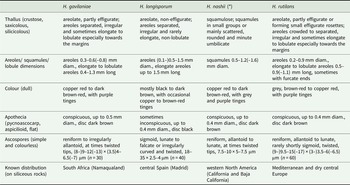
Distinguishing morphological characters observed of worldwide Harpidium species. All information is derived from material examined during this study unless otherwise noted (*). All species without lichen substances (TLC).

(*) Measurements and observations of the H. nashii specimen examined in this study overlap with those of Schultz et al. (Reference Schultz, Printzen and Scheidegger2000), so the original description data are included here.
Taxonomy
Harpidium Körb.
Syst. Lich. Germ. (Breslau) 2, 157 (1854) [1855]; type species: Harpidium rutilans Körb.
Scheidegger & Schultz (Reference Scheidegger, Schultz, Nash, Ryan, Diederich, Gries and Bungartz2004) provided a complete genus description, to which the following data are incorporated from the last two described species (Harpidium gavilaniae and H. longisporum): 1) thallus surface dull, black, grey, brown-red to copper red, sometimes with purple tinges; 2) photobiont a trebouxioid green alga up to 16 μm wide; 3) paraphyses moniliform, up to 6 μm in the apices; 4) ascospores simple, colourless, sigmoid, reniform, allantoid, lunate, falcate to irregularly curved and twisted, without halo, 7–35 × 2.5–7 μm; 5) conidia cylindrical to ellipsoid, 2.5–4 × 1–1.5 μm; 6) all pigmented parts of thallus (including epihymenium) K+ blue-purple; 7) known from Europe, western North America and western South Africa; 8) growing in seasonally humid and sunny sites on siliceous rocks of mainly arid to subhumid areas with Mediterranean or temperate climate regimes.
Notes
The genus Harpidium is well defined, uniform in morphological and chemical characteristics and all included species have a similar structure, with hemiangiocarpous pycnoascocarps forming apothecia (Scheidegger & Schultz Reference Scheidegger, Schultz, Nash, Ryan, Diederich, Gries and Bungartz2004). In contrast to other crustose lichens, Harpidium species can be distinguished in the field (with a hand lens) by their copper red to brown-red pigment tinges (K+ blue-purple) on a black, grey or brown background thallus-surface colour.
Differential characters among species are limited to those included in Table 1 and in the key.
The genus, for now, is restricted to Europe, western North America and western South Africa, and grows primarily on acid rocks mainly in the Mediterranean climate regions of these areas.
The closely related genus Euopsis, together with Harpidium, was re-established in the family Harpidiaceae under Pezizomycotina incertae sedis, forming, interestingly, a clade apparently not closely related to Lichinomycetes or any other known class in the Ascomycota (Lucking et al. Reference Lücking, Hodkinson and Leavitt2017; Wijayawardene et al. Reference Wijayawardene, Hyde, Rajeshkumar, Hawksworth, Madrid, Kirk, Braun, Singh, Crous and Kukwa2017).
The gaps in Harpidium species knowledge, and also in the family, are many and require new collections and analysis.
Harpidium gavilaniae Amo de Paz et al.
In Lumbsch et al., Phytotaxa 18, 64, fig. 14A & B (2011); type: South Africa, Northern Cape, Namaqualand, 57 km east of Springbok, Kangna's Farm, 29°34ʹ58ʺS, 18°20ʹ29ʺE, 1036 m, succulent karoo desert on quartzite creek area, on quartzite rock, 5 June 2005, A. Crespo, P. K. Divakar, D. L. Hawksworth & G. Amo de Paz SA–80b (MAF–Lich. 16488—holotype!; 16489—isotype!).
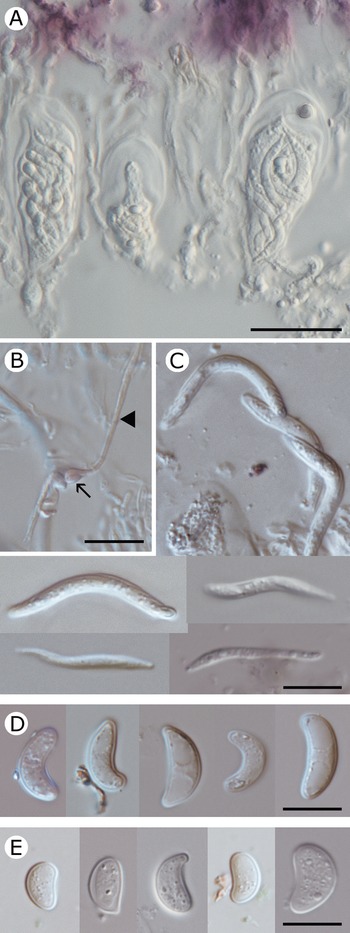
(Fig. 2E)
Known only from the type locality in South Africa (Lumbsch et al. Reference Lumbsch, Ahti, Altermann, Amo de Paz, Aptroot, Arup, Bárcenas Peña, Bawingan, Benatti and Betancourt2011, fig. 14A & B), with an arid Mediterranean climate regime, it is apparently very rare but perhaps under-recorded owing to limited lichenological explorations. No lichen substances were detected by TLC. Based on my observations of the specimens studied, the distinguishing characteristics of Harpidium gavilaniae are summarized in Table 1.
Harpidium longisporum V. J. Rico sp. nov.
MycoBank No.: MB 841482
Similar to Harpidium rutilans, but differs in developing a non-effigurate thallus, wider and mainly black to dark brown areoles with copper red and purple tinges, apothecia sometimes indistinguishable from thallus surface and longer, narrower, sigmoid, lunate, falcate to irregularly curved and twisted ascospores, 18–35 × 2.5–4 μm.
Type: Spain, Madrid, Guadalix de la Sierra, Sierra de San Pedro, ladera N del Pico de San Pedro, 40°44ʹ18ʺN, 03°42ʹ44ʺW, 1160 m, sobre ortogneis glandular, en escalones de pared vertical ±humedecida y con orientación NW, 6 February 2011, C. Llorente 227 (MAF-Lich. 23603—holotype; 23604, 23605—isotypes).
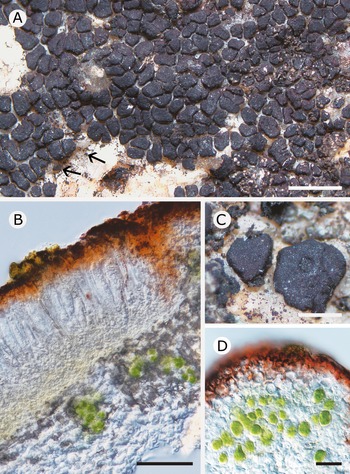
Harpidium longisporum (holotype, MAF-Lich. 23603). A, habitus, showing minute new areoles (arrows) together with threads of Stigonema sp.. B, section of apothecium, in water, DIC. C, areole with apothecium. D, section of thallus, in water, DIC. All individual photographs are composites of stacked images. DIC = differential interference contrast microscopy. Scales: A = 2 mm; B = 50 μm; C = 0.5 mm; D = 20 μm. In colour online.

A–C, Harpidium longisporum (holotype, MAF-Lich. 23603). A, section of hymenium with asci, in K, DIC. B, water squash preparation of pycnidium, showing ascogonium (arrow) and trichogyne (arrowhead), DIC. C, ascospores, in water, DIC. D, ascospores of Harpidium rutilans (MAF-Lich. 23606, 23610), in water, DIC. E, ascospores of Harpidium gavilaniae (holotype, MAF-Lich. 16488), in water, DIC. Individual photographs in A and C are composites of stacked images. DIC = differential interference contrast microscopy. Scales: A = 20 μm; B–E = 10 μm. In colour online.

Thallus crustose, areolate, continuous or in groups of a few areoles, with ±regular distance between areoles, uneven in shape and not effigurate, up to 6 cm diam., without hypothallus, fragile when moist. Areoles (0.1–)0.5–1.5 mm diam. and up to 0.9 mm high, rounded to elongate (up to 1.5 mm long) or angular, entire to sometimes fissured to divided, fastened to the substratum along its entire underside, surface flat to moderately dotted-rugose, dull, mostly black to dark brown with irregular copper, brown-red or purple tinges (observed with a hand lens), flanks marked and angled or gently descending to the substratum and concolorous with surface. Anatomy: heteromerous to indistinctly stratified in section, depending on its thickness, with a paraplectenchymatous general arrangement of hyphae mainly formed by round cells; upper cortex paraplectenchymatous, 12.5–27 μm high, structured in 2–5 rows of rounded cells 5–12 μm wide and with walls up to 3 μm thick, upper cells with pigmented walls forming a dark brown to copper red hood with occasional purple tinge, extending down the lateral sides to the dark lower stratum of the medulla, without a clear epinecral layer; photobiont layer discontinuous, up to 75 μm high, with trebouxioid unicellular green algae, up to 16 μm wide, in a paraplectenchymatous hyphal structure, now and then algal groups in the medulla and also under the apothecia; medulla compact, of paraplectenchymatous to seldom irregularly arranged fungal hyphae, greyish to translucent, 200–350(–800) μm high; a true lower cortex is lacking, but attached to the substratum is a dark brown to copper red gelatinous basal layer, of variable thickness and intermixed with ±paraplectenchymatous hyphae. Symbiotic propagules not observed.
Ascomata apothecia aspicilioid, with pycnoascocarp development type, ±frequent, rounded to irregular, up to 0.4 mm wide, sometimes indistinguishable from thallus surface, without margin or with a very shallow thalline margin surrounded by the vegetative plectenchyma of the areole, one to several per areole; ascomata development begins with ascogonia formed beneath pycnidia and trichogynes protruding into the pycnidial cavity to the outside. Disc at first ±punctiform, later plane, flat and open to slightly concave, sometimes slightly rugose, concolorous with thallus, now and then inconspicuous. Exciple paraplectenchymatous, reduced, 8–18 μm wide, hyaline with dark brown to copper red pigments in its upper and medium part. Epihymenium dark brown to copper red, sometimes with purple tinges, 9–21 μm high; hymenium hyaline, 62–95 μm tall; paraphyses mainly simple and seldom branched and anastomosing, moniliform in last 2–6(–7) cells, apices 5–8 μm wide and with dark brown to copper red pigmented walls and surrounding hood; subhymenium and hypothecium undifferentiated, variable in thickness but up to 100 μm together, hyaline, of ±rounded up to 15 μm ±gelatinized cells. Asci 8-spored, unitunicate-rostrate, thick walled, with a collar-like amyloid inner layer that expands outwards (rostrum) to eject spores when mature. Ascospores simple, colourless, sigmoid, lunate to falcate or irregularly curved and twisted, also irregular in thickness, 18–35 × 2.5–4 μm (n = 40).
Pycnidia frequent, laminal, immersed, punctiform (producing a dotted-rugose outer appearance of areolae) to invisible, globose, up to 180 μm wide; wall hyaline, ostiole surroundings dark brown to copper red. Conidia simple, colourless, ellipsoidal to cylindrical, 2.5–4 × 1–1.5 μm (n = 30). Ascogonia frequently formed beneath pycnidia, developing trichogynes that cross to the surface.
Chemistry
Thallus and medulla, I−, C−, Pd−, UV−. Cortex, epihymenium, dark stratum of medulla, and all pigmented parts in the thallus K+ blue-purple under microscope. Hymenium I+ blue to vine red, KI+ blue. TLC: no lichen substances detected.
Etymology
The specific epithet refers to the length of mature ascospores, longer in this species than in others of the genus.
Habitat and distribution
So far, Harpidium longisporum is known only from the type locality in Madrid (central Spain), growing on steps of a vertical, intermittently moist gneiss rock face exposed to sun. It is a subhumid open place with rock walls, in the supramediterranean belt of the Mediterranean region, where the typical potential forest is dominated by Quercus pyrenaica (Rivas-Martínez Reference Rivas-Martínez1987). The species was collected beside Aspicilia intermutans (Nyl.) Arnold, Buellia aethalea (Ach.) Th. Fr., Catillaria atomarioides (Müll. Arg.) H. Kilias, Circinaria hoffmanniana (S. Ekman & Fröberg ex R. Sant.) A. Nordin, Lecania sp., Rhizocarpon geographicum (L.) DC., Rinodina milvina (Wahlenb.) Th. Fr. and in some portions covered by Stigonema sp., Xanthoparmelia pulla (Ach.) O. Blanco et al. and X. tinctina (Maheu & Gillet) Hale.
Notes
This is a very rare species, and has not been collected since, despite years of searching in similar localities in Spain. Thus future collections may change the morphological description and will provide fresh material for further study.
Harpidium longisporum is easily separated from the other species in the genus by its spore shape and size, and also by the structure and colour of its thallus areoles (see Table 1 and the species key).
A sample was reported as Harpidium cf. rutilans from Yosemite NP (California, USA) by Hutten et al. (Reference Hutten, Arup, Breuss, Esslinger, Fryday, Knudsen, Lendemer, Printzen, Root and Schultz2013). The limited specimen was kindly studied morphologically by M. Schultz (Hamburg, in litt.) and he noted that it is close to Harpidium longisporum with shorter falcate ascospores and some differences in thallus development; but in conclusion more well-developed material and molecular analyses are needed.
According to my observations, this species has two ways to enlarge. A small number of areoles were seen with short fractures dividing them and forming new areoles, both in the margins and thallus centre. It is also common to see regularly separated, very small young areoles at the thallus margins (Fig. 1A), but neither a hypothallus layer nor any type of hypha has been observed interconnecting areoles or penetrating the rock to attach and join it. Each areole is attached to the substratum through a dark brown to copper red gelatinous basal layer in the medulla, similar to that developed in Harpidium rutilans (Henssen et al. Reference Henssen, Büdel and Titze1987) and in some Lichinaceae growing on hard rocks (Moreno & Egea Reference Moreno and Egea1991; Schultz & Büdel Reference Schultz and Büdel2002). These indicate that the new areoles at the thallus margins must have arisen from ascospore germination and the capture of suitable algae on the rock substratum.
Lichenicolous fungi were not observed, just like in the other species of the genus, but sometimes the areoles of Harpidium longisporum are completely covered by threads of Stigonema sp., indicating that it is seasonally covered by seeping water.
Harpidium nashii Scheid.
In Schultz et al., Bryologist 103, 802, figs 1 & 2 (2000); type: Mexico, Baja California, Ensenada, northern Vizcaino Region of the Sonoran Desert, 10 km north of Cataviña, 29°47ʹN, 114°45ʹW, 570 m, granite boulder area, 6 January 1989, C. Scheidegger (G 00291742—holotype! [scanty material]; UPS L125885—isotype! [scanty material]).
Known only from a small number of localities in western North America with an arid Mediterranean climate regime (Schultz et al. Reference Schultz, Printzen and Scheidegger2000, fig. 2; Knudsen & Kocourková Reference Knudsen and Kocourková2012), it is perhaps overlooked but certainly rare because there are only a small number of collections. The material studied is scanty, only one apothecium was used to see ascospores, unfortunately only four not well-developed spores were seen, and no images were obtained. No lichen substances were detected by Scheidegger & Schultz (Reference Scheidegger, Schultz, Nash, Ryan, Diederich, Gries and Bungartz2004). Distinguishing characters observed in studied specimens of Harpidium nashii overlap with those in the original description (Schultz et al. Reference Schultz, Printzen and Scheidegger2000), as is noted in Table 1.
Specimens examined
Mexico: Baja California: Ensenada, north Vizcaino Region of the Sonoran Desert, 1 km north of Cataviña, 29°43ʹN, 114°40ʹW, 560 m, arroyo with Washingtonia (Brusera, Idria, Lophocereus schottii, etc.), batholitic granite boulder area, 1989, C. Scheidegger (UPS L125886).
Harpidium rutilans Körb.
Syst. Lich. Germ. (Breslau) 2, 157, Taf. I, fig. 8a & b (1854) [1855].—Acarospora rutilans (Körb.) Hue, Nouv. Arch. Mus. Hist. Nat., ser. 5, 1, 121 (1909).—Lecanora rutilans (Körb.) Nyl., Actes Soc. Linn. Bordeaux 21, 326, 461 (1857), nom. illegit., Art. 53.1, non Lecanora rutilans (Ach.) Ach. 1810.—‘Zeora rutilans’ Flot., Uebersficht der Arbeiten und Veränderungen der Schlesischen Gesellschaft für Vaterländische Kultur im Jahre 1849, 122 (1850), nom. nud., Art. 38.2; ind. loc.: ‘An schroffen Felswänden im Vorgebirge (namentlich gern an Quarzadern im Granit), klafterweite Streifen bewässerter Stellen bedeckend: im Hirschberger Thale auf dem Kynast, dem Popelstein bei Gotschdorf, dem Prudelberge und den Hertelbergen bei Hirschberg (Fw. Kbr.)’; type: Poland, Schlesien, G. W. Körber s. n. (Leiden (Naturalis Biodiversity Center, Netherlands) L 0056641—holotype [?, sic], n. v., temporarily unavailable).
(Fig. 2D)
The type species of Harpidium is known from Europe in Austria (Hafellner & Türk Reference Hafellner and Türk2016; Nimis et al. Reference Nimis, Hafellner, Roux, Clerc, Mayrhofer, Martellos and Bilovitz2018), Bulgaria (Szatala Reference Szatala1930; Mayrhofer et al. Reference Mayrhofer, Denchev, Stykov and Nikolova2005), Czech Republic, Italy (van den Boom Reference van den Boom1992; Nimis & Martellos Reference Nimis and Martellos2020), France (Roux et al. Reference Roux, Poumarat, Monnat, Van Haluwyn, Gonnet, Gonnet, Bauvet, Houmeau, Boissière and Bertrand2020), Romania, Poland (Körber Reference Körber1855, Taf. I, fig. 8a & b; Kossowska & Fabiszewski Reference Kossowska and Fabiszewski2004), Portugal (Tavares Reference Tavares1949), Spain and Switzerland. It grows on open, step surfaces of siliceous rocks with periodical water seepage after rain, both in the Mediterranean region and in dry-warm areas of temperate Central Europe, and is perhaps overlooked but not frequent. Roux et al. (Reference Roux, Poumarat, Monnat, Van Haluwyn, Gonnet, Gonnet, Bauvet, Houmeau, Boissière and Bertrand2020) consider it a very rare species in France, but of international interest and critically endangered. The type material probably needs an adequate typification but is temporarily unavailable. No lichen substances were detected by TLC. Based on observations of specimens examined in this study, the distinguishing characteristics of Harpidium rutilans are summarized in Table 1 and in the key. Concerning Harpidium cf. rutilans from Yosemite NP (California, USA) reported by Hutten et al. (Reference Hutten, Arup, Breuss, Esslinger, Fryday, Knudsen, Lendemer, Printzen, Root and Schultz2013), see ‘Notes’ under Harpidium longisporum.
Specimens examined
Czech Republic: South Moravia: in valle fluvii Jihlavka prope pagum Mohelno, 300 m, ad saxa serpentinica, 1971, A. Vězda [Vězda, Lich. Sel. Exs. no. 1065] (UPS L24794).—Romania: Caras-Severin: im Szvetnik-Thale beim Dorfe Mehadia, Comitat Krassó-Szöreny in Ungarn, an der Südseite eines grossen Porphyrblockes, 1885, H. Lojka [Arnold, Lich. Exs. no. 1108b] (UPS L169771, L169772); ibid., Valle Szvetnik, Mehadia, Lojka, det. O. Szatala (originally labeled as ‘Hungary’, MA-Lichen 869).—Spain: Castellón: Chóvar, Puerto de Eslida, 30SYK2916, 580 m, comunidades de Acarospora hilaris, 1991, V. Calatayud (VAL-Lich. 1957, MAF-Lich. 23611); Almonacid, cerca del Pico Espadán, 30SYK2420, 920 m, areniscas ortocuarcíticas, 1992, V. Calatayud (VAL-Lich. 2110); Alfondeguilla, Pico Femella, 30SYK3415, 600 m, areniscas ortocuarcíticas, 1990, V. Calatayud (VAL-Lich. 1609); Azuebar, Barranco Mosquera, 30SYK2517, 620 m, areniscas ortocuarcíticas, 1991, V. Calatayud (VAL-Lich. 1965); ibid., 1992, V. Calatayud [Vězda, Lich. Rar. Exs. no. 45] (UPS L26013); ibid., (MAF-Lich. 23610). Valencia: Serra, El Garbí, 30SYJ29, 570 m, 1992, V. Calatayud (VAL-Lich. 2145). Zaragoza: Embid de la Ribera, desfiladero de río Jalón, 520 m, sobre cuarcitas compactas, en superficie vertical alejada del suelo, 1983, E. Barreno, A. Crespo, L. G. Sancho, A. G. Bueno & V. J. Rico (MAF-Lich. 2432); ibid., 41°24ʹ51ʺN, 01°36ʹ45ʺW, V. J. Rico & E. Barreno (MAF-Lich. 23606); ibid., 41°25ʹ06ʺN, 01°35ʹ46ʺW, 513 m, matorral bajo sobre cuarcitas, 2005, A. Gutiérrez & G. Amo de Paz (MAF-Lich. 16487); ibid., G. Amo de Paz (MAF-Lich. 23607, 23608, 23609).—Switzerland: Valais: Ausserberg, E of Trogdoref, Wasserleita, near the chapel, 46°18ʹN, 07°51ʹE, Grid 633:129.4, 1040 m, on rocks on the sun-exposed steep S slope, 1987, R. Moberg (UPS L9195).
Key to Harpidium species
1 Ascospores long sigmoid, lunate to falcate or irregularly curved and twisted, 18–35 × 2.5–4 μm; thallus areolate, dull, mostly black to dark brown with irregular copper to brown-red or purple tinges; central Spain ……… Harpidium longisporum
Ascospores reniform, allantoid, lunate to falcate or occasionally shortly sigmoid and twisted, 7.5–15(–17) × (3–)3.5–7.5 μm; thallus dull, grey, copper to brown-red with purple tinges ……… 2
2(1) Thallus of rounded, scattered umbilicate squamules; ascospores reniform, allantoid to lunate, 7.5–10 × 5–7.5 μm; USA and Mexico ……… Harpidium nashii
Thallus areolate, continuous or forming thalli of few areoles, sometimes distinctly effigurate with sporadically or regularly elongate to lobulate marginal areoles, areoles affixed over all its lower surface ……… 3
3(2) Ascospores reniform to irregularly allantoid, (8–)9–12(–13) × (3.5–)4–6.5(–7) μm; thalli sometimes incompletely effigurate; South Africa ……… Harpidium gavilaniae
Ascospores reniform, allantoid to lunate, (9–)9.5–15(–17) × (3–)3.5–6(–6.5) μm; thalli sometimes forming small effigurate rosettes; Mediterranean and temperate dry central Europe ……… Harpidium rutilans
Acknowledgements
This work was supported by the Spanish Ministry of Science and Innovation project PID2019-105312GB-I00. The curators of the herbaria G, MA, UPS and VAL are thanked for the loan of specimens. Patricia Jiménez-Florido (Madrid) is thanked for the English revision of the manuscript, and M. Schultz (Hamburg) for material revision. I am also grateful to the reviewers and editor for their helpful comments.
Author ORCID
Víctor J. Rico, 0000-0002-5064-2752.