In 2016, the city of Cape Town hosted the fourteenth annual meeting of the African Capital Markets Conference. Each year, the conference assembles ‘African sovereigns, corporates, regulators, local and international investors, and financial service providers with interest in fostering the diversity of investment and funding options via local capital markets’ (IMN 2016). The conference began in 2002 and, at the time, limited its geographic focus to capital markets in South Africa. But in 2012, the conference shifted its approach to ‘include all of Africa’ and to emphasize a ‘particular focus on emerging markets in Sub-Saharan Africa’ (ibid.). Indeed, its expanding geographic focus accompanied an important transformation in African capital at the time: a growing number of stock exchanges and private equity firms were springing up across the continent, and a growing number of African investors, governments and firms were starting to use them.
The rise of African capital markets is an important feature of global finance in the new millennium. Although Euro-American development institutions continue to offer financial products across the continent, these institutions have transformed how they understand the problem of economic development and are now proposing a new generation of solutions to it. In the past twenty years, international aid organizations have increasingly turned towards African stock markets, ratings agencies and commercial banks to finance projects across sectors. But the continent’s private sector has been more forcefully leading this expansion by introducing new ways to measure risk, new debt instruments, and new roles for government in the regulation of an emerging financial industry. This shift has been similarly encouraged by African investors’ increasing openness to financial assets denominated in local currencies and issued by African governments and firms. From futures markets to Bitcoin, sovereign bonds to credit scores, the continent – and especially its leading cities such as Abidjan, Nairobi, Lagos and Johannesburg – is home to a proliferation of such financial devices. But the precise causes and consequences of this transformation are not yet clear.
For critics, the growth of capital investment across the continent is another instance of a global form of financialization in which Euro-American capital is once again forcing African states into debt dependency (Kvangraven et al. Reference Kvangraven, Koddenbrock and Sylla2021). From this perspective, the expansion of sovereign bond issuances on European and American stock exchanges is understood as a shift in – but continuation of – older forms of Africa’s economic subordination and dependence. The extent of this ‘financial deepening’ is such that Stiglitz and Rashid (Reference Stiglitz and Rashid2013) issued a warning that African sovereign debt was at an historic high and that payments from these bonds were soon coming due. This was, in their view, a harbinger of a new round of sovereign defaults echoing those of prior decades. Such a concern was only heightened as this issue went to press amidst increased debt distress due, in part, to foreign investors pulling capital out of the global South in response to interest rate changes in Euro-America. Others have pointed to the role of American credit agencies in rubber stamping reckless borrowing and therefore incentivizing a looming financial catastrophe (Chelwa Reference Chelwa2020). And Daniela Gabor (Reference Gabor2021) has coined a term to summarize this series of nefarious events: the ‘Wall Street Consensus’. According to Gabor, global development banks are today working in ‘technocratic forums away from public scrutiny’ to ‘enlist’ states to ‘assume the demand risk’ on new financial assets – ‘de-risking’ for the benefit of private institutional investors (ibid.: 440–7).
Yet many African officials, professionals and investors understand finance in starkly different terms. In their vision, capital markets are part of a new chapter of African history in which economic self-determination is achieved through the harnessing of money that has long been controlled by foreign financiers. Rather than a pernicious trend, it is an opportunity to put African money to work for Africans. It is an aspiration that is often explicitly pan-African. For example, the African Union envisions its financial future in terms of African capital markets, and credit rating agencies and banks across the continent have long understood their market space as distinctively ‘pan-African’. For many of these financial actors, the aim is to wrest development planning and capital allocation away from Euro-American financial institutions and put them in African hands (Mizes Reference Mizes2016). Here, capital markets, currency swaps and financial accounting appear not as a form of dependence, but as a pathway to independence and sovereignty (Mbeng Mezui Reference Mbeng Mezui2017). In other words, many of these transformations may not have much to do with ‘Wall Street’, nor is there any global ‘consensus’ on how to organize and expand African capital and its markets.
This special issue moves beyond these duelling views. Rather than celebrate or denounce these ongoing financial transformations, the articles collected here take finance in Africa as a field of anthropological inquiry. They investigate the social worlds of finance, its technical devices, and the mundane manner in which forms of capital are being composed. They foreground the moral disagreements over the emerging infrastructures of African capital markets, and they analyse how these debates take shape around a diverse range of specific financial devices: privatization, credit scoring, shareholder associations, foreign exchange regulations and bank bailouts. In place of broad predictions on the inevitable fallouts of finance, our contributors explore new modes of popular and professional reasoning about finance in Africa by Africans, and their specific struggles over how to know, value and manage capital.
While this issue draws on exemplary cases from across the continent, it also analyses a distinctly global transformation. Scholars of finance have previously focused their analysis on ‘command and control centers’ located in ‘global cities’ such as Tokyo, London and New York (Sassen Reference Sassen1991). From this perspective, financial centres are ‘global’ in the sense that their influence extends outward to structure social and economic life across the world. In these approaches, places such as Abidjan and Accra are subject to the vicissitudes and power of financial actors – hedge funds, consulting firms, insurance companies, credit rating agencies – largely located outside the continent and looking for new investment opportunities within it (see Mawdsley Reference Mawdsley2018; Ouma Reference Ouma2020b; Roitman Reference Roitman2021). As a result, the activities and aspirations of Africans participating in the continent’s own financial industry have largely receded from scholarly view.
In this issue, we place the geography of African finance today in a different frame: our approach links the flow of African financial expertise to the flow of money in, out and across the continent (cf. Montagne and Ortiz Reference Montagne and Ortiz2013), flows that together constitute – and can potentially reconfigure – Africa’s role in the ‘world system’. We analyse how African professionals are translating financial devices from outside the continent to fit the moral dilemmas, political styles and economic practices found within it (Ong and Collier Reference Ong and Collier2007; Guyer Reference Guyer2004). Many of these professionals are claiming to harness capital to meet African needs and oppose Western control of Africa’s future. They often explicitly frame these claims in the idiom of pan-African commerce. As a result, the moral vision of a unitary ‘Africa’ is once again emerging as a way to frame efforts at promoting intra-African exchange and reversing the global flow of wealth out of the continent. At stake in this reversal is the relocation of ‘command and control’ centres from London and New York to the emerging financial centres in Africa’s cities.
The future of African capital is far from certain; indeed, financial analysts themselves ‘often fail to predict the correct future developments of financial markets’ (Leins Reference Leins2018: 4). The articles collected in this issue of Africa provide insight into the diverse locations in which this future is being made and disputed. In this introductory article, we bring a wide-angle lens to these recent transformations and the near futures of African finance that they anticipate. Why, for so many, has African political liberation become a task of financial engineering? And why have some Africans’ aspirations for development today returned to a promotion of ‘indigenous’ and ‘domestic’ finance? To address these questions, we build on our own ethnographic research, readings of key programmatic texts, analyses of related scholarship, and the articles collected in this issue. With these resources, we sketch out how the problem of African economic development is being reframed today. Yet we also examine the limits of this reframing and the potentially calamitous consequences of which many critics are already taking note.
Currency, capital, colonies
Prior to colonialism, in much of Africa, systems of production relied more on domestic labour, tributary exchange and enslaved people than on the exploitation of free wage labourers. However, capital – in the sense of money invested in commercial activities that are expected to create more wealth – predates the arrival of European merchants, slave traders and colonists. There was widespread profit-oriented merchant activity, including among North African and Saharan traders (Iliffe Reference Iliffe1983: 4–7) and lively oceanic exchange from the entrepôts of the Swahili Coast (Austen Reference Austen1987: 58–60). When Europeans began arriving in Atlantic Africa, they encountered mercantile enclaves where Islamic systems of credit, cowrie shells and silver were used. People drew on a variety of forms of credit, including the rotating Yoruba esusu groups, Nanemei Akpee used by Ga women traders, bills of exchange, or loans from landlords and rulers (Austin Reference Austin, Austin and Sugihara1993: 101–5). On the Indian Ocean littoral, prolific forms of lending facilitated the trade in dates, pearls, cloves and ivory, as well as the formation of a ‘multi-ethnic and multi-confessional commercial society’ (Bishara Reference Bishara2017: 59).
Yet wealth was not always cash or commodity. Prior to colonization, Africans tended to place value on followers and dependants rather than accumulating capital as an enduring and fungible form of wealth (Guyer and Belinga Reference Guyer and Belinga1995). In part, this was due to the paucity of labour compared with land in large parts of the region and because money was not widely standardized and rarely centralized in its issuance. As a result, wealth was stored in non-pecuniary forms: land and livestock, pre-eminently. While some money did reach general purpose standing (Hopkins Reference Hopkins1973: 70), more emblematic was the multiplicity of monies, valued for their particular meanings and affordances: from copper manillas and iron bars to textiles and beads (Guyer and Pallaver Reference Guyer and Pallaver2018).
In many cases, the violent disruptions and economic transformations of European interventions led to widespread loss of wealth. In southern and eastern Africa, for example, livestock disease and purposeful culling eliminated huge stores of such wealth. Settler enclosure of land and state limits on African agrarian production likewise inhibited widespread commodity production, let alone capital accumulation (Kanogo Reference Kanogo1987). And in Atlantic Africa, hard currencies (that retained value over time) were exported. As a result, capital accumulation became ever more heavily concentrated in other world regions, such that by the early nineteenth century Atlantic Africa’s access to capital was at a severe disadvantage (Green Reference Green2020).
Similarly, wage labour and investment in industrial production expanded only in fits and starts across the continent. They were often concentrated in infrastructural corridors, commercial hubs and export enclaves. Production for the market remained dependent on existing forms of domestic production and the labour of women and social juniors (Meillassoux Reference Meillassoux1981). Currencies were a potent form of governmental control over Africans (Mwangi Reference Mwangi2001), but colonial economies were often racked by volatility, undermining confidence in their productive capacities. The imperial enforcement of ‘customary’ land regimes and derogatory views of African acumen combined to impede lending to farmers (Cowen and Shenton Reference Cowen and Shenton1991). Even when metropolitan proponents of ‘sound finance’ were compelled to support developmental investments in the colonies, output was frustratingly limited. Viable industries were few, and African activism often unsettled the plans of government officials. In Kenya, for instance, the Mau Mau rebellion jeopardized development spending and ‘threatened the fiscal stability of the colony’ (Tignor Reference Tignor1998: 330).
This helps explain the lack of commercial credit in most African colonies. Unlike, for instance, ‘Britain’s veiled protectorate’ in Egypt, which saw a stupendous increase in bank lending directly to peasant farmers in the early 1900s (Jakes Reference Jakes2020: 84–112), financial services were more limited in colonies south of the Sahara. Some lucrative products such as Asante cocoa attracted considerable credit (in the form of advances and mortgages), from both European and African lenders (Austin Reference Austin2005). Barclays DCO (Dominion, Colonial and Overseas), the Standard Bank of South Africa and the Bank of British West Africa opened branches in many British colonies, yet what credit they provided was focused on the import of British goods and the export of raw materials (Zwanenberg and King Reference Zwanenberg and King1975: 280–1). Their loans were short-term, expensive and focused on expatriates (and sometimes commercial minorities, such as East Africa’s South Asian population).
While bankers often deemed Africans unfit as borrowers (Uche Reference Uche1996) and settlers were wary of native competition, the conservative turn in imperial governance added another impediment as paternalistic rules and worries about disintegrating tradition blocked commercial finance to Africans (Shipton Reference Shipton2010: 30–5). Colonial state financing was equally lacking, in part due to the existence of currency boards that subordinated colonial currencies to British sterling and the French franc. Only in the waning days of empire did currency boards receive the authority to offer seasonal crop financing, and even then they pursued it cautiously. As a result, banking and currency were objects of popular frustration, especially as demands for political independence merged with economic aspirations (Donovan Reference Donovan2018).
From economic independence to debt dependence
With independence, many African nation states began creating their own banks, their own stock exchanges and their own currencies. Across the continent, postcolonial states endeavoured to craft policies and institutions that would harness citizens’ labour, natural resources and international trade in the direction of ‘economic independence’ (Ghai Reference Ghai1973; Getachew Reference Getachew2019). As our contributors discuss, parastatal banks issued credit to ‘indigenous’ entrepreneurs and, beginning in the 1970s, countries privatized large public services to jump start their own newly minted stock exchanges. Yet within this broad postcolonial vision, criticisms and divisions emerged. A market-led liberation, for example, clashed with the idea of African socialism and the continental realignments taking place alongside the global Cold War. In many cases, European control over Africa’s financial and monetary institutions persisted long after formal political control ended (Gadha et al. Reference Gadha, Kaboub, Koddenbrock, Mahmoud and Sylla2021) – this is what Kwame Nkrumah (Reference Nkrumah1965) diagnosed as ‘neo-colonialism’.
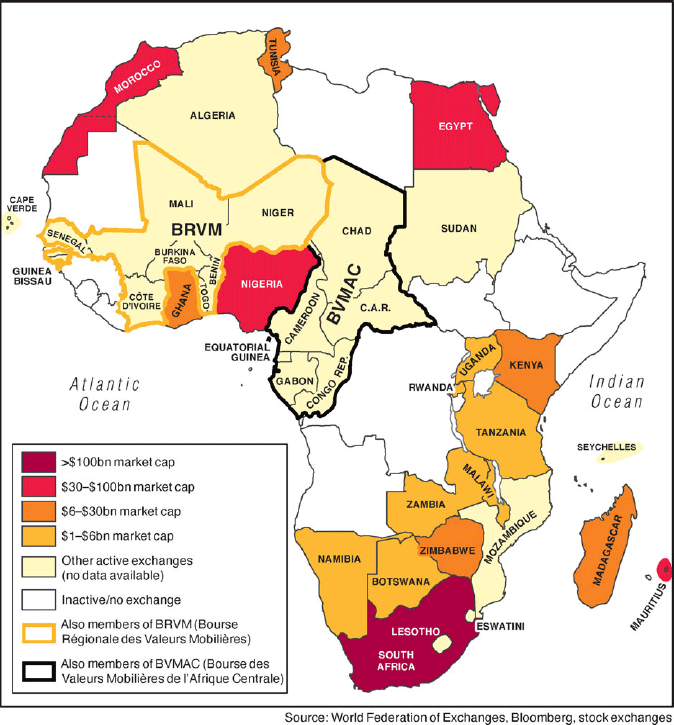
Map of market capitalization of stock exchanges, December 2019.

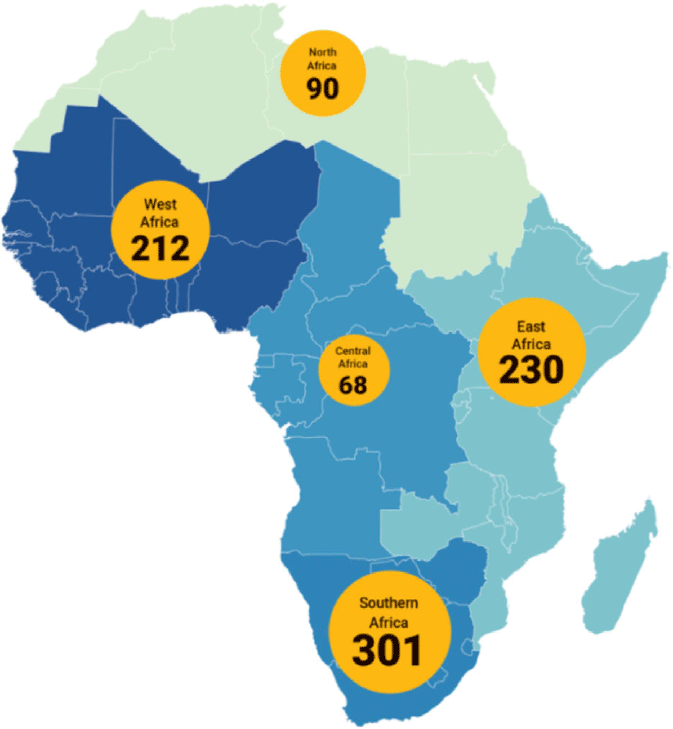
Map of private equity, venture capital and asset management firms in Africa by region. Source: Asoko Insight (Withagen Reference Withagen2021).

After national independence, commodity booms in certain countries brought years of commercial success and a decidedly unequal distribution of its monetary gains (Arrighi Reference Arrighi2002; Jerven Reference Jerven2014). The question of dependency loomed large, yet in some cases capitalist production expanded at the hands of the African bourgeoisie. Often this was furthered by more or less explicit drives to ‘Africanize’ industry, including the banking sector (Bamba Reference Bamba, Dimier and Stockwell2020). In Kenya, this bourgeoisie overcame a small domestic market and low agricultural productivity to establish themselves as central actors in the local composition of African capital (Swainson Reference Swainson1977). Similarly, in Senegal, Islamic leaders accommodated the export-oriented growth of the local peanut industry and transformed it into a cosmopolitan network of merchants that persists to this day (Diouf Reference Diouf2000). Nigerian entrepreneurs expanded not only in import–export industries and in agriculture, but in sectors such as transport, banking and packaged foods (Forrest Reference Forrest1994). This cross-continental sample offers substantial reason to understand that techniques for the composition and circulation of African capital have long been creatively invented and repurposed across the continent.
The 1980s challenged such a conception. The end of post-independence growth in the 1970s prompted a new wave of reflection on the problem of development. The Organisation of African Unity (OAU) published the Lagos Plan (1980), condemning the ‘exploitation arising from colonialism, racism, and apartheid’ (ibid.: 5) and advancing in its place ‘a far-reaching regional approach based primarily on collective self-reliance’ (ibid.: 4). Intra-African trade and the ‘mobilisation of domestic financial resources’ (ibid.: 69) emerged as key levers of this response to the inherited problems of Africa’s underdevelopment. In contrast, the World Bank published the now famous ‘Berg Report’ (World Bank 1981), which subsequently set the intellectual agenda for addressing the continent’s ‘economic development problems’ by forcefully foregrounding the development of export-oriented agriculture as a ‘prelude to industrialization’ (ibid.: 1–6). And it replaced the Lagos Plan’s vision of economic self-reliance and domestic finance with a call for a doubling of the world’s aid to Africa – aid overwhelmingly constituted by direct loans from Euro-American development banks.
Bundled together with a now familiar set of policies focused on trade liberalization and fiscal austerity, these loans remained for decades the dominant device with which African governments accessed capital and, in some cases, this focus on public debt largely replaced existing development programmes focused on lending to private enterprises (Ducastel Reference Ducastel2019). Critics pointed to the ongoing failure of structural adjustment policies to address the stagnation that both reports identified as a source of profound concern – but, of course, in radically different terms: one as a step towards ‘liberation’ and the other to address Africa’s ‘economic crisis’.
By the end of the twentieth century, scholars and development experts consolidated a focus on this historically specific framing of African economic problems. Critics and advocates alike understood this problem in terms of the dynamics of international aid, extractive export sectors and the question of ‘access’ in what came to be known as ‘the informal sector’. And they conceptualized capital as something that was either invested from outside the continent or extracted from it. Among many scholars, there remained an overwhelming view that supposedly global capital had simply bypassed risky African investments and ejected much of the continent from its global flows. Where such capital did re-route towards the continent, there was a shared sense that it was to be found beyond the city offices and branches of Africa’s banks and stock exchanges. In James Ferguson’s influential phrasing, ‘capital does not “flow” from New York to Angola’s oil fields, or from London to Ghana’s gold mines; it hops, neatly skipping over most of what lies between’ (Reference Ferguson2006: 38).
Returns to African capital
In the new millennium, there has emerged a renewed framing of African economic development that is reviving old pan-African concerns with economic independence, sovereignty and intra-continental exchange. And today there is a movement of investors, officials, firms and consumers fashioning finance into a significant sector across the African continent. The growth of this sector is linked, in part, to the financial crisis of 2007–08 and the resulting suppression of financial returns across Euro-America (Aryeetey Reference Aryeetey2009). The subsequent search for returns elsewhere encouraged a new wave of investment in African and other ‘emerging markets’. It was also linked to the discursive shift toward ‘Africa Rising’, in which the continent’s middle class was framed as a growing source of new investment opportunities. As Roitman (Reference Roitman2021) demonstrates, this notion was pushed by the Euro-American financial industry’s aspirations for frontier markets. But it also emerged from African entrepreneurs advancing concepts such as ‘Africapitalism’, in which private sector initiative is understood to be the path to economic prosperity and social wealth (Amaeshi et al. Reference Amaeshi, Okupe and Idemudia2018).
The excitement surrounding ‘Africa Rising’ and ‘Africapitalism’ has been widely criticized for its occlusion of the ongoing importance of commodity prices, the limits to industrialization on the continent, the waning gains in GDP, and for taking inspiration from deeply unequal European institutions (Rodrik Reference Rodrik2018; Sylla Reference Sylla2014; Ouma Reference Ouma2020a). Yet rather than dismiss or denounce such aspirations, we understand them as important elements in a historically specific reframing of the problem of African economic development. In this moment, African financial institutions are seizing on a critical shift in global finance – its morals, its aims, its techniques, its geography – to revive a pan-African political vision first articulated in the years prior to ‘debt dependency’.
In the past two decades, the financial landscape has changed dramatically. African nation states began drawing on an array of new credit facilities. They welcomed an immense expansion of Chinese financial investment and lending, which, by 2013, had surpassed the combined outstanding loans of the five largest development banks (Dobbs et al. Reference Dobbs, Leung and Lund2013). China is not the only significant change: between 2006 and 2014, fourteen African states issued foreign-denominated bonds for the first time, amounting to US$15 billion (Gevorkyan and Kvangraven Reference Gevorkyan and Kvangraven2016: 721). With lower returns available in Euro-American markets after 2008, international banks are keen to advance such loans. African finance ministries, for their part, are happy to draw on debt that lacks the conditions of development bank borrowing and is often cheaper and longer term than bonds in their own currencies. Yet, by 2019, the borrowing binge was raising red flags, and the Covid-19 slowdowns only exacerbated the high wire act of remaining fiscally dependent on highly volatile primary resource exports (Chelwa Reference Chelwa2020).
Analyses of microfinance have revealed a similar financial trajectory. Once grounded in a social mission to provide access to credit for individuals excluded from traditional bank lending, microfinance institutions moved towards a more limited focus on financial returns for investors (Guérin Reference Guérin2015). Many of the largest microfinance institutions in the global South are publicly listing shares on stock exchanges across the world, from New York to Nairobi. And in response to this trend, microfinance institutions are investing in the improvement of their credit scoring methodologies to ensure more predictable and profitable returns (see Opalo, this issue).
The World Bank has reacted to this new financial landscape by reconceptualizing its own role in development finance. And, as some commentators have observed, the shift towards the ‘knowledge bank’ – a store of expertise, rather than money – has also meant letting go of much of the control over development planning it once enjoyed. Thus, the Bank’s new loan programmes claim to ease many of its formerly stringent standards by relying ‘on clients to identify expected results of a program’ rather than bank officials (Runde Reference Runde2015). These experts have also turned to capital markets as a way to bridge the new ‘financing gap’, an approach that the Bank helped popularize in its agenda-setting report From Billions to Trillions (World Bank 2015). In this reframing of development lending, World Bank projects prepare governments to improve their credit ratings – these ratings are thought to reduce the cost of lending and to open up access to a new pool of capital located in the world’s growing number of stock exchanges.
Critics have focused on the expansion of African Eurobonds, sovereign debt and the integration of microfinance into Euro-American capital markets. They see in these trends the potential for powerful institutional investors such as Blackrock to begin negotiating the terms of loans and their looming default (e.g. Gabor Reference Gabor2021). Indeed, the types of finance emerging in Africa today can be volatile, extractive and predatory; capital is unevenly available and could usher in foreign institutional investors as new and more predatory creditors to Africa’s efforts at economic development. Yet there is no doubt that, from Lagos to Nairobi, Johannesburg to Dakar, there is also a new-found sense of opportunity accompanying this broader financial shift – it is an orientation towards the future and an outward-facing disposition that is not negated by ongoing volatility, precarity and inequality. A number of the articles collected here document this future-oriented excitement as a social fact, productive of new social relations, personal ethics and commercial dealings (cf. Goldstone and Obarrio Reference Goldstone and Obarrio2016). Much of this energy and activity is fuelled by younger urban professionals, often educated abroad and working in industries ranging from information technology to accounting and finance.
For these actors, African capital, African credit ratings and African stock exchanges are understood to be a politically viable alternative to the more familiar Eurobonds – sovereign debt securities issued on American or European stock exchanges – on which most scholars and global commentators have focused their critical attention. They accompany a significant institutional shift: between 1990 and 2009, the number of stock exchanges on the continent grew from five to eighteen (Andrianaivo and Yartey Reference Andrianaivo and Yartey2010). In the following years, African corporations steadily increased their issuance of equity on stock markets, from a total of approximately US$5.5 billion in issuances in 2011 to US$12.7 billion in 2015 – an increase of 44 per cent (PricewaterhouseCoopers 2016). As a result, by December 2015 African exchanges had a market capitalization of approximately US$1 trillion, with 23 per cent residing in exchanges outside South Africa (ibid.). While holdings can be concentrated in the portfolios of large institutional investors, traders and policymakers across the continent also work to make shareholding a popular activity: from investment training to promotional campaigns, the stock market is offered to citizens as a means of achieving their own goals and contributing to collective wealth (see Mizes, this issue).
For many governments, privatization was a means with which to establish the first generation of African stock markets. In the 1970s, the Côte d’Ivoire government issued certain tax rebates in the form of vouchers to purchase assets on what was then called the Abidjan Stock Exchange (Mizes, this issue). Later, Zambia and Tanzania both established a privatization trust fund that purchased and held half of the original issuance off market to be sold later at a steep discount to local investors. Such initiatives served many purposes, from national prestige to ‘political cover’ for potentially unpopular privatizations (Kenny and Moss Reference Kenny and Moss1998). East Africa’s largest bourse, in Nairobi, has expanded to a considerable degree through the sale of once public entities to private shareholders. For instance, shares of the telecommunications company Safaricom – once a department of government – are now the most valuable stock at the Nairobi Securities Exchange.
Stock markets are not alone; the continent’s private equity markets similarly appear to be on the rise. Asoko Insight, a Nairobi-based firm specializing in data and consultancy services for Africa’s private sector, recently asserted that the continent is now home to ‘over 400 private equity, venture capital and asset management firms’ (Withagen Reference Withagen2021). The geographic spread of their investments is unsurprising, with South Africa, Nigeria, Kenya, Mauritius and Egypt figuring as the leading hubs. The focus of their investments is also unsurprising: financial service and information technology were the top investment sectors in 2020 (ibid.). Consultants at Asoko lauded the US$3.3 billion in private equity investment in 2020, despite its half billion decline from the previous year – a decline largely attributed to the Covid-19 pandemic. What is remarkable about such descriptive statistics is not only the size of the investment they describe, but their existence: consulting firms on the continent have only in the past decade begun publishing these numbers as highly stylized graphic displays in Africa’s business sector media. Such facts circulate as wind in the sails of capital markets, enticing new participants and potentially cementing the legitimacy of this burgeoning industry.
Closer to the concerns of many citizens, the continent is also home to a host of consumer financial novelties. Kenya’s M-Pesa quickly expanded to a national phenomenon after its 2007 launch and is now a model for using mobile phones to send and receive money (Park Reference Park2020). While M-Pesa consolidated a domestic remittance market, subsequent investments in other enterprises are now directed at creating the infrastructure for international money transfer and new approaches to regulating it (see Ning, this issue). Diaspora remittances have grown enormously and have become a significant enough source of capital to capture the attention of governments. While Ethiopia’s first issuance of ‘diaspora bonds’ in 2007 fell short of expectations, Nigeria’s successful issuance in 2017 raised US$300 million for the government’s infrastructural ambitions and was oversubscribed by 130 per cent (Benson Reference Benson2019).
There has also been an increase in intra-African trade. While most payments on the continent remain denominated in US dollars, these payments have decreased from a rate of 51.1 per cent in 2013 to 45.1 per cent in 2017 – a six-point decline celebrated by the African Development Bank (SWIFT 2018: 3). In its place, currencies such as West Africa’s franc CFA and the South African rand were on a steady incline. Industry analysts also foreground the related trend of the increasing importance of intra-African trade such that ‘almost 20% of all cross-border commercial payments sent by African Banks now remain within the continent, up from 16.7% in 2017’ (ibid.: 4). Such an increase is, of course, a result of Africans focusing their monetary exchanges on familial, commercial and consumer payments within the continent. But these payments also figure as a central element in a broader vision of pan-African intra-continental exchange.
In 2020, the African Union anticipated the inaugural implementation of the African Continental Free Trade Agreement (ACFTA), which will eliminate 90 per cent of the existing tariffs on inter-continental exchange of goods and, eventually, services (Moore and Kenewendo Reference Moore and Kenewendo2020). As part of this agreement, a host of African institutions are thus supporting the development of the Pan-African Payment and Settlement Platform, which is anticipated to facilitate the cross-border exchanges already on the rise across much of the continent. Crucial to these transformations are the pan-African banks, which are already leading the market in facilitating such payments and positioning themselves as the largest stores of Africa’s monetary wealth. Ecobank, for example, claims to have expanded its investment banking operations by 50 per cent per annum for the last five years. Indeed, where sovereign bonds and privatizations have previously dominated the assets available for purchase on African stock exchanges, Africa’s banks are today taking steps towards expanding the listing of private firms and increasing the integration of commercial bank savings and capital markets.
And yet, at the same time in 2020, new investment in Africa’s equity capital markets was at a decade low. Far from the heady days of 2015 and its nearly US$13 billion in new corporate investment, the Covid-19 pandemic had reduced the continent’s issuances to around US$5 billion (PricewaterhouseCoopers 2021). But even with the slump in new equity issuances, a new role for capital markets emerged: as a novel financial infrastructure through which governments could issue ‘pandemic recovery bonds’ in lieu of – or in addition to – assistance from foreign governments and Euro-American development banks. In May 2021, for example, the Malian government issued its third recovery bond (obligation de relance) on the West African Stock Exchange in response to the Covid-19 pandemic. And the African Development Bank has similarly turned to capital markets – albeit outside Africa on the London Stock Exchange – to fund its own pandemic recovery bonds (Yount-André Reference Yount-André2021).
These steps remain tentative and preliminary, but they are nevertheless exemplary of a reformatted understanding of the role of finance in Africa’s politics of development. Interpretive scholars have mostly avoided these topics, ceding the study of capital markets to economics and development studies. Yet such a disciplinary division furthers a view of finance as abstract and disembedded from social relations, ethical practices and everyday activity. And while a flurry of white papers and policy reports have begun to analyse the quantitative increase of such financial transactions, there is significantly less public and scholarly attention to how many of the actors advancing this shift in African capital are drawing on the histories of solidarity, state formation and popular morality that first emerged in the early years following independence. In other words, there is an immense social universe of ordinary labour, new technologies and collective aspiration going into composing African capital today.
Haute finance par le bas
But what does it mean to ‘compose’ capital (cf. Guyer Reference Guyer2016)? And where does such a composition take place? The articles collected in this issue of Africa build on the notion of ‘capitalization’, a concept that draws attention to the array of devices, institutions, procedures and politics through which capital is mobilized. If capital is ‘value in motion’ (Harvey Reference Harvey2020), then at stake in capitalization is how that motion is inaugurated, propelled and sustained. There is, in other words, considerable labour – living, immaterial, affective, technical and legal – required for capitalization, and the goal of this part issue is to depict some of the manifold ways in which Africans are pursuing it.
‘Capitalization’ has a technical meaning for financial accountants: expected future profits adjusted for risks and discounted in their present value. The discounting of capital due to its expected future value can be traced back to fourteenth-century Italian merchants who ‘allowed customers to pre-pay their bills at a “discount”’ (Nitzan and Bichler Reference Nitzan and Bichler2009: 155). They did this because it gave them certainty of payment in the present rather than risking their clients defaulting on their debts in the future. Discounting meant the merchants received less money than they would otherwise, but it provided certainty. And this notion of discounting remains an important element of financial exchange today: ‘discounted cash flow’ is one of the most widely used methods of financial valuation across the world.
Put another way, any enterprise planning for the future faces uncertainty about what might befall its revenue streams – this means that there is a trade-off between what it can earn today and what it might earn tomorrow. ‘Capitalization’ is a way to calculate the present value of these revenue streams given their potential future value. In this sense, capitalization is an accounting practice that guides the allocation of wealth: it allows accountants to calculate the costs and returns of an asset over the extended course of its use, and to estimate the future value of that asset. Today, capitalization is an enormously influential practice guiding not only bankers but also non-financial corporations and states: calculating capitalization allows investors to evaluate firms as assets and potentially leverage this equity into new rounds of capital investment. As such, capitalization is one of the most significant categories of financial reason that has emerged alongside – and made possible – the growth of the financial industry today.
In the USA, a new wave of critical reflection on capital markets swelled around the 2007–08 crisis, and regulatory authorities and academics alike took up the familiar task of making sense of an economy in ‘crisis’ (Roitman Reference Roitman2013). In its scholarly form, capitalization thus emerged as ‘the constant searching out, or the construction of, new asset streams’ (Leyshon and Thrift Reference Leyshon and Thrift2007: 98). Here, finance is not understood to work through ungrounded speculation, but is instead founded on ‘some kind of collateral … that usually turns out to be in the form of fixed assets that will yield a predictable income stream’ (ibid.: 99). In such cases, determining ‘earning power’ – the expected rate of return on an investment – is fundamental, and capitalization is the conceptual category that renders this future capacity calculable (Muniesa et al. Reference Muniesa, Doganova, Ortiz, Pina-Stranger, Paterson, Bourgoin, Ehrenstein, Juven, Pontille, Saraç-Lesavre and Guillaum2017: 31). It is with the knowledge of this income stream that financiers can leverage their position, borrowing and engineering the speculative exercises that capture headlines and have today amassed a growing crowd of global critics.
But assets do not simply exist. Rather, they are composed through highly specific constellations of labour, law, infrastructure, accounting and rhetoric (Birch and Muniesa Reference Birch and Muniesa2020). Capital, in other words, is an achievement. So, our analytical task is to understand how cultural values, social relations and the exercise of diverse and often competing forms of power arrange themselves so that capitalization becomes a possible, knowable and controversial thing in the world. Africanist anthropology, of course, has long excelled at this sort of analysis of value and wealth: whether the importance of aesthetic and affective judgements of Nuer cattle (Evans-Pritchard Reference Evans-Pritchard1940), the communal bounding of spheres of exchange (Bohannan Reference Bohannan1955), the negotiation of cross-cultural forms of social value (Pietz Reference Pietz1985), or the distribution of resources based on social rank (Guyer Reference Guyer2004), the iconic studies in this tradition are concerned with the manner in which putatively ‘cultural’ commitments shape wealth, exchange and production.
More recent work in this tradition attends to the proliferation of consumer finance across the continent. Anthropologists emphasize how supposed abstractions such as ‘capital’ or ‘credit’ are embedded within popular ethics and transformed through consumer behaviour. Sibel Kusimba (Reference Kusimba2021), for instance, locates the success of Kenya’s breakthrough mobile money service, M-Pesa, within the country’s extended kinship networks. Growing indebtedness has been a particular focus of study, with anthropologists demonstrating not only how predatory lending fuels dispossession and subordination, but also how finance is itself dependent upon popular practices and values (Elyachar Reference Elyachar2005). Whether it is aspirations for education and consumption among South Africa’s post-apartheid middle class (James Reference James2014), or desires to secure a good death (Bähre Reference Bähre2020), novel techniques of indebtedness do not stand apart from long-standing histories and cultures.
Yet this scholarship continues to work on an unspoken division of labour: economists analyse ‘high finance’ while anthropologists attend to economic life ‘from below’ (Hull and James Reference Hull and James2012: 1). The emergence of the idea of the ‘informal sector’ – and, later, the ‘popular economy’ – is a case in point: economic anthropologists advanced this ‘sector’ as the appropriate domain of ethnographic inquiry (Hart Reference Hart1973). This has long been held up as an empirical contrast to the mistaken assumptions of expatriate development economists about economic life in Africa (Ferguson Reference Ferguson1994). Anthropologists have argued that the universalizing tendency of economists has overlooked rural inequality, the extended nature of African households, and the role of women in production (Hill Reference Hill1986). The result has been a disciplinary divide: ethnography was thought to be the appropriate method with which to witness and experience ‘third world’ bazaars; and econometrics emerged as a method that economists employed to analyse a seemingly different universe of economic phenomena.Footnote 1 Among anthropologists, the commitment to this dichotomy continues to shape understandings of the ‘opaque’ economic transformations of capital’s ‘violence of abstraction’ (Comaroff and Comaroff Reference Comaroff and Comaroff1999). Here, the financial industry appears less as an object of study than as a spectre hovering in the background and producing superstructural formations – xenophobia, witchcraft or 419 scams – only the effects of which are available for ethnographic analysis.
The avoidance of high finance by African anthropology reflects a sense not only that it is irrelevant to most Africans’ lives but that the industry is a realm of abstract uniformity, unavailable to socio-cultural analysis. Yet in recent years, anthropologists working elsewhere in the world have successfully challenged such divisions and opened up the elite universe of finance to anthropological inquiry. They have offered a new perspective on the (im)moral aspirations of stock exchange traders themselves (Ho Reference Ho2009) and the technical and performative work of financial analysts and corporate lawyers (Riles Reference Riles2011). In doing so, they have shown that supposedly ‘global’ finance is the result of emplaced activities and equipment: a derivatives market for corn, for example, exists through the embodied activities of traders in an office, communicating through particular infrastructures and socialized habits (see, for example, MacKenzie Reference MacKenzie2008: 8–37). And as Daromir Rudnyckyj (Reference Rudnyckyj2018) argues, these extant financial configurations are continually in competition with emerging financial centres in the global South. In short, these scholars have reframed high finance as a legitimate object of anthropological inquiry at a global scale. Yet Africa has made little appearance in these analyses.
Newer approaches do offer some insights for African capital and its instruments (Breckenridge and James Reference Breckenridge and James2021). Stefan Ouma (Reference Ouma2016: 84), for instance, adopts an approach to the ‘operations of capital’ that describes the ‘socio-legal and technical architecture’ through which African agriculture is converted ‘into an alternative asset class’. Such an approach focuses on the work it takes to create and sustain capital, as well as its frictions and tensions. Other approaches focus more on the professional legitimacy of experts doing this work, whether African economists or bureaucrats. According to Béatrice Hibou and Boris Samuel (Reference Hibou and Samuel2011: 12), macro-economic techniques emerged in Africa alongside the expansion of its developmental states, leading up to and in the years following national independence. Yet beyond documenting the simple appearance of such techniques, their approach to ‘macroéconomie par le bas’ (macroeconomy from below) draws attention to the universe of social relations and struggles among economic experts that exists ‘behind the frozen, ethereal image of [macro-economic] statistics’ (ibid.: 13). While many of these techniques remain the jurisdiction of governmental experts and their strategies for advancing national economic development (Samuel Reference Samuel2011), there also exists a universe of ‘politics beyond the state’ (ibid.: 9) in which credit ratings (Vallée Reference Vallée2011) and unregulated credit markets (Guyer et al. Reference Guyer, Salami, Akinlade and Warnier2011) are themselves consequential forms of macro-economic government ‘par le bas’.
The articles collected in this part issue of Africa complement this approach by centring our collective analysis on what can be helpfully termed ‘haute finance par le bas’ (high finance from below). With this approach, we aim to further elucidate the diverse devices of financial governance that are constituting the network of financial infrastructures appearing across Africa today. The contributions to this collection take the perspective of the investors, analysts, entrepreneurs, regulators, bankers and technocrats tasked with realizing this new approach to economic development, an approach often explicitly linked to African capitalization and liberation. Here, particular cultural understandings of finance are far more than a tool to legitimize, accommodate and domesticate Euro-American capital flows. As the articles collected here emphasize, long-standing visions of African economic development shape the creation of assets and their composition into African capital today.
Capitalizing Africa
The African Capital Markets Conference with which we opened this article is exemplary of the sorts of financial transformations appearing on the ground across the continent today – and in the pages of this issue. In 2016, we arrived in Cape Town to take stock of how one corner of Africa’s financial universe was making sense of these transformations, and how capital market actors themselves sought to advance or restrain them. Although the conference was held in one of the continent’s most racially exclusive enclaves, it nevertheless exemplified an aspiration for pan-African capitalization. Many of its panels were billed as an exploration of capital growth ‘throughout Africa’ or of the impact of global changes ‘across the continent’. Even if few of these could truly reckon with such an ambitious remit – whether on the dais or in more informal conversations at lunch, on cigarette breaks or in the trade show hall – the vision of a continent-wide market served as both a concrete goal and a legitimating device.
Despite these aspirations, the conference is a reminder of the continent’s uneven financial geography: South Africa has long seemed in a class of its own, and even significant hubs such as Nairobi or Lagos can seem a world apart from the economic realities a few hours away. Where conversation at the conference explicitly expanded beyond national borders, the difficulties of doing so were evident. Consider, for example, the lone round table focused explicitly on the problem of integrating Africa’s diverse capital markets. Gathering together stock exchange executives from Senegal, Namibia, Kenya and South Africa, the round table aimed at ‘improving inter-market collaboration and transparency’ across the continent. And the host began by posing several introductory questions: ‘What is necessary to foster greater … standardization among emerging African capital markets? What role can the various local exchanges and pan-African associations play?’
To elaborate this vision of pan-African integration, these executives turned to a discussion of some of the more mundane technical aspects of securities markets. They posed the question: what is the ‘requisite financial infrastructure’ needed to drive this integration? For years, these stock markets had sought to increase the cross-listing and inter-market exchange of financial assets in order to expand their liquidity and, in turn, the amount of capital flowing through their exchanges. While they had already integrated their digital platforms, trading across borders remained limited. According to the CEO of the Namibian Stock Exchange, the trouble was a lack of ‘social infrastructure’: brokers simply did not know or trust one another. Industry conferences were one way to build more confidence and stronger relationships between brokers and executives across continental borders.
At stake for these executives was, in part, capitalization. Beyond a platform for trading assets, stock markets are themselves companies seeking to increase their own returns and expand their market capitalization. But what is not immediately evident is how intra-African integration came to be an important frame within which to advance such capitalization. If the problem were simply one of liquidity and capital flow, for example, then attracting foreign investors from outside the continent might be a more suitable approach. Yet alongside an array of pan-African officials, these executives are turning towards other locations across the continent to compose and circulate the financial assets that their stock markets need to grow and survive in a globally competitive industry.
This special issue reflects this sense of geographic indeterminacy. Seen from the perspective of GDP figures or stock valuations, national economies such as South Africa, Nigeria and Kenya may capture the attention of journalists and scholars. But Johannesburg, Lagos and Nairobi fade in predominance when seen from the perspective of financiers seeking a new frontier, or from the perspective of accountants in Lomé (Opalo, this issue) and bankers in Brazzaville trying to secure their own professional futures (Ning, this issue). In other words, rather than hewing to obvious cartographies of African capital, the contributions to this issue analyse today’s unexpected effervescence of capitalization across Africa from locations in which such techniques are not yet – but may one day be – a moral and financial norm.
Consider, for example, the case of privatization in Ethiopia (Collins, this issue). Ethiopian officials have resisted the continental trend towards public listing: there is no national stock market and privatization remains selective. Yet the past decades have seen a negotiated – rather than foreclosed – process of rendering public entities into private ones. The Ethiopian state’s legitimacy depends on successful developmental outcomes, but it is also cognizant of the risks of surrendering to private actors the ability to command resources. Selective privatization, therefore, provides a means of generating revenue that can be repurposed for other domains, such as infrastructure or industry or for the anticipated construction of Ethiopia’s own national stock market. Doing so is not merely a dry technical matter of accounting. As Christina Teke Collins analyses, Prime Minister Abiy fashions it as a project of medemer, an Amharic word for ‘coming together’ or ‘synergy’ that today gestures also to economic openness.
Privatization in Côte d’Ivoire is also invested with similar moral significance – it is linked to a post-independence vision of economic self-sufficiency and growth. In line with this vision, national leaders in the 1970s created a stock exchange as their preferred vehicle for the privatization of public assets. Today, an organization of small shareholders (petits porteurs) on the Regional Stock Exchange of West Africa (La Bourse Régionale des Valeurs Mobilières de l’Afrique de l’Ouest or BRVM) is advocating for a return to the moral values that guided such reforms: they advance wider stock market participation not so much as a strategy of economic development, but as one of moral reformation of the economy (Mizes, this issue). Frustrated by the capture of commercial returns by African and European elites, the petits porteurs envision a more widely distributed equity market as a means of disciplining unaccountable elites through transparency. The petits porteurs see commercial and moral value in capital markets, and they take steps to reformulate financial instruments to maximize them.
The refashioning of such devices is also at stake in Togo, where the lending industry is home to divergent ideas and practices of establishing creditworthiness and managing risk (Opalo, this issue). Funders such as the World Bank have supported the expansion of credit bureaus that gather and standardize financial histories in order to determine assessments of creditworthiness. The resulting credit scores are promissory techniques, offering a means to know the future likelihood of repayment by individuals. They are also meant to end information asymmetries that are said to keep credit expensive and exclusive. In contrast to these ideas of risk management, the loan officers at the Lomé savings and credit cooperative where Vanessa Watters Opalo worked think that repayment is only possible through what they call the ‘real work’ of interviewing clients and visiting their homes. These ‘relational forms of assurance’ work not through the translation of past behaviours into future predictions but rather in the here and now, adapting to volatile circumstances.
Risks come in many forms. In Ghana, Anna-Riikka Kauppinen (this issue) explores how a tangle of risks was interpreted through a long history of economic nationalism and newer instruments of financial engineering. Between August 2017 and January 2019, the Ghanaian state took over nine ‘indigenous banks’. Working in one of these banks, Kauppinen tracks the values attached to indigeneity, showing how politicians, bankers and citizens aspired to economic sovereignty – a notion associated with Kwame Nkrumah but that assumed new significance in an era of economic liberalization. It was not the quantitative accumulation of capital that was at stake so much as the qualitative harnessing of capital as Ghanaian, while bankers, regulators and citizens debated the ethics of financial reform. It is through this combination of financial instruments, encounters and discontent that the moral category of ‘indigenous bank’ came to affect financial flows in Ghana.
Of course, few in Ghana wanted anything like autarky. In advocating economic sovereignty, they were advocating for a version of control over the allocation of capital on timelines and at prices that would serve the nation. The nation, though, is hardly coterminous with the territory – whether it be through cross-border commercial networks, regional monetary unions or diaspora remittances. Rundong Ning (this issue) turns our attention to these dynamics in a study of traders, foreign exchange and central bank regulation in Congo (Brazzaville). How does a state regulate monetary flows within the confines of the franc CFA regime? Ning argues that it comes down to formalities – namely, the paper forms that must accompany requests for foreign currencies. Paperwork, he argues, is not so much about the conveyance of information as it is about slowing down demand for foreign currency. Requiring new formalities allows the central bank to indirectly affect the cost of foreign exchange and the speed with which it circulates. Adjusting these channels was a central means of governing money in the aftermath of a drop in oil prices. However, the central bank cannot act unilaterally: instead, it must creatively repurpose paperwork required of Chinese and Levantine merchants who, in turn, themselves create their own ways to adjust these bureaucratic ‘valves’. The result is a set of financial flows shaped by multiple interests, technologies and norms.
Taken together, the articles in this issue reveal the emerging dynamics of African capitalization. There are, in short, immense and diverse fields of political and cultural engagement surrounding African capitalization today. They are located in the contested construction of the various devices and practices that may – or may not – come to constitute an integrated, independent network of financial infrastructures fit for African aspirations.
Acknowledgements
We are grateful for the support of Wale Adebanwi, who originally invited us to submit this collection. Many thanks go as well to Janet Roitman and Hannah Appel for their generous engagement with early versions of the articles collected here. Our anonymous reviewers offered crucial guidance through the editorial process, for which we are thankful. Thanks also to Boris Samuel for his support, inspiration and thoughtful suggestions as we composed this introduction. And finally, we are especially grateful to the contributors to this issue for offering us the chance to think through our material together.
James Christopher Mizes is an IFRIS postdoctoral research fellow at the Institut de Recherche Interdisciplinaire en Sciences Sociales, Université Paris-Dauphine.
Kevin P. Donovan is an anthropologist and historian at the Centre of African Studies, University of Edinburgh.