Introduction
Congenital heart disease represents a major global health problem Reference van der Linde, Konings and Slager1 affecting 40,000 births per year in the United States. Reference Hoffman and Kaplan2 It is becoming increasingly evident that congenital heart disease significantly impacts neurodevelopment as early as in utero. Reference Donofrio, Duplessis and Limperopoulos3 The impact of congenital heart disease on prenatal brain development reveal some forms of congenital heart disease are associated with gestational age- and weight-adjusted overall brain volumetric growth when compared to normal fetuses. Reference Limperopoulos, Tworetzky and McElhinney4 Further, fetuses with congenital heart disease exhibit disturbances in cortical folding, and biochemistry in utero. Reference van der Linde, Konings and Slager1,Reference Clouchoux, du Plessis and Bouyssi-Kobar5 It is well-known maternal distress (stress, anxiety, or depression) during pregnancy can also alter brain development of the offspring (e.g. cortical thinning, Reference Sandman, Buss, Head and Davis6 altered amygdala Reference Buss, Davis, Shahbaba, Pruessner, Head and Sandman7 and hippocampal growth Reference Qiu, Rifkin-Graboi and Chen8 and altered brain microstructure Reference Rifkin-Graboi, Meaney and Chen9 and functional connectivity Reference Scheinost, Kwon and Lacadie10 ). Recent data suggest maternal distress is associated with impaired hippocampal and cerebral growth in fetuses with congenital heart disease. Reference Wu, Kapse and Jacobs11 These disturbances significantly impact development throughout the lifespan. Reference Simeone, Pucciarelli and Perrone12–Reference Marino, Lipkin and Newburger14
Although pregnancy is often considered a period of joy and hope for parents, receiving a fetal congenital heart disease diagnosis can alter this sense of parental optimism and instead spark an array of unexpected emotions including grief, fear, confusion, and self-blame. Reference Wei, Roscigno, Hanson and Swanson15–Reference Sockol19 Parents quickly need to make decisions regarding whether they should continue with their pregnancy, discern between treatment options, evaluate short- and long-term risks, understand the risk of complications, conceptualise their baby’s quality of life, and determine whether they are adequately supported to manage through these decisions. Reference Wei, Roscigno, Hanson and Swanson15,Reference Rychik, Donaghue and Levy16,Reference Bratt, Järvholm and Ekman-Joelsson20–Reference David Vainberg, Vardi and Jacoby22 Parents are now faced with much more adversity and stress, as they are needing to make these difficult decisions in the time of an unprecedented global pandemic. Reference Almeida, Shrestha, Stojanac and Miller23,Reference Adadms, Smith, Caccavale and Bean24 As families brace for the impact of congenital heart disease, both mothers and fathers are psychologically affected at the onset of the fetal diagnosis to post cardiac programmes. Reference Marino, Lipkin and Newburger14,Reference Woolf‐King, Anger, Arnold, Weiss and Teitel17,Reference Wray, Cassedy, Ernst, Franklin, Brown and Marino18,Reference Hoffman, Karpyn and Christofferson25 Further, the amount of stress significantly increases with this diagnosis, and parents report greater stress, anxiety, trauma, and depression relative to the general population. Reference Bratt, Järvholm and Ekman-Joelsson20,Reference McKechnie, Pridham and Tluczek21,Reference Werner, El Louali, Fouilloux, Amedro and Ovaert26,Reference Wei, Roscigno, Hanson and Swanson27
Research has demonstrated the efficacy of psychological interventions implemented during pregnancy in reducing maternal anxiety, depression, and stress, Reference Sockol19,Reference Bischoff, Howland and Klinger-König28–Reference Marokakis, Kasparian and Kennedy30 but very few trials have included pregnant women receiving fetal cardiac diagnoses Reference Kasparian, Kan, Sood, Wray, Pincus and Newburger31 even though studies assessing prenatal counselling and pre-surgery education have supported a reduction in parental anxiety. Reference Marokakis, Kasparian and Kennedy30 As greater insights into fetal brain growth and development emerge, the need for surveillance, assessment, and targeted psychological interventions prenatally are warranted, Reference Wu, Kapse and Jacobs11 to ensure children with congenital heart disease are given the best opportunity to thrive from the outset. To date, there are no standardised evidenced based interventions addressing the mental health needs for pregnant women during this period. Reference Kasparian, Kan, Sood, Wray, Pincus and Newburger31,Reference Gramszlo, Karpyn and Demianczyk32 To address this gap, the goal of this qualitative study was to identify the emotional experiences, coping and resilience resources, and mental health treatment preferences of pregnant and postpartum mothers receiving a congenital heart disease diagnosis to inform the development of a psychological intervention to reduce maternal distress prenatally.
Materials and Methods
Participants and recruitment
Participants were recruited from Children’s National Hospital between May and June, 2020. The duration of recruitment spanned one month and within this limited period only seven participants were enrolled. This study is phase 1 of a larger study analysing the effect of prenatal CBT intervention on maternal stress and fetal brain development. To be eligible, participants were fluent in English, had access to the internet on a computer, tablet, or mobile device, had a confirmed fetal diagnosis of congenital heart disease requiring neonatal open-heart surgery, and were receiving services at this hospital. The research team sent a study announcement via email to current participants enrolled in one of the hospital’s larger studies on impaired brain development in fetuses with congenital heart disease to participate in an online 60−90-minute interview on Zoom. Prenatal participants were identified from the hospital’s fetal cardiology clinic and who expressed interest in enrolling in the study. Postpartum women were identified as eligible through their prior enrolment in one of our congenital heart disease studies. The study team approached six postpartum research participants whose children were still living. One was lost to follow up due to their child’s hospital admission and lack of availability.
The purpose of the study was to identify emotional experiences among pregnant women and postpartum mothers with a congenital heart disease fetal diagnosis, and to understand their preferences with psychological interventions delivered prenatally. After enrolment, a licenced psychologist conducted recorded semi-structured interviews, with each participant individually and accompanied by the clinical research coordinator and two investigators observing. Informed consent was obtained electronically from all participants following a protocol approved by the Institutional Review Board and prior to study procedures. Following completion of the interviews, all participants were mailed monetary compensation in the form of a Health Insurance Portability and Accountability Act compliant, Institutional Review Board approved debit card.
We approached medical staff ranging from fetal cardiologists to nurse coordinators with clinical experiences ranging up to 25 years who are caring for pregnant women with a fetal congenital heart disease diagnoses to participate in an individual semi-structured interview. Seven providers were approached, five of which agreed to participate, one declined due to lack of availability, and one did not respond. We explained the purpose of the study was to understand the mental health issues pregnant women whose fetuses have been diagnosed with congenital heart disease experience during their services rendered with them. Pregnant and postpartum patients typically seen at this hospital receive care from multiple providers in the Fetal Heart Program, including a fetal cardiologist, licenced social worker, and fetal nurse coordinator. The initial diagnosis is given to families in the presence of these three providers. We aimed to gather information on current resources available for these women and the components of a psychological intervention the medical staff consider would be helpful and/or feasible for this specific population.
Three groups of interviews with research participants were conducted. The prenatal group comprised of pregnant women (n = 2) with a fetal diagnosis of congenital heart disease and actively receiving services in the fetal cardiology clinic at this hospital. The postnatal group was comprised of women (n = 5) having already given birth to newborns with congenital heart disease ranging from 4 to 16 months of life and having received fetal cardiology services at this hospital. The provider group (n = 5) from the fetal cardiology team included four cardiologists, and one nurse coordinator working closely with pregnant women diagnosed with fetal congenital heart disease.
Procedures and measures
All participants completed a demographic questionnaire and a semi-structured interview, with questions stemming from the following domains: challenges faced during pregnancy; methods of coping; changes related to childbirth; available resources; perspectives on mental health and mental health treatment. The interview was conducted by a licenced psychologist with expertise in working with this population and who would be an integral part in the future development of a therapeutic intervention. Questions were developed by core study team with the aim of understanding sources of stress, resilience, and treatment preferences specific to this population; questions were also tailored to each of the three samples. Pregnant women were asked questions regarding the emotions and challenges when faced with receiving a fetal diagnosis of congenital heart disease, how they were managing through hardships, and what resources were available and most helpful for them. Postpartum mothers were asked questions regarding emotions and challenges upon receiving the fetal diagnosis, how these challenges evolved from pregnancy to time of baby’s birth, what coping skills were helpful, and what their perspective is on mental health and receiving a therapy treatment prenatally. The medical staff were asked questions about what challenges they perceived pregnant mothers faced with receiving a fetal diagnosis, what resources are offered to these women to cope, and what their thoughts regarding additional helpful programming to manage their patients’ distress. Collectively, all participants were asked about what components of an intervention they believe would be the most supportive during the prenatal period.
Data analysis
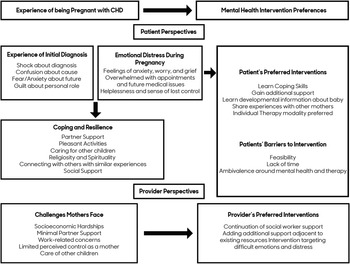
All interviews were recorded and transcribed verbatim. Qualitative data were analysed using thematic analysis. First, the psychologist (K.E) interviewing participants developed a codebook of initial themes, based on the participants’ responses regarding experiences of being a mother with a fetus or offspring with congenital heart disease or as a medical provider working closely with this population. Second, two coders (K.E and C.L) participated in identifying the quotes corresponding to these themes. Third, another researcher (M.J) determined the level of agreement between the coders. Finally, all three researchers met with a clinical supervisor (H.L) to discuss areas of disagreement and reached consensus among these areas and subsequent themes. This consensus process took place on several occasions and culminated in a model describing the inter-relationships among these themes by stakeholder (patients and providers) perspectives (Fig 1).
A conceptual summary of themes from patients and providers.

Results
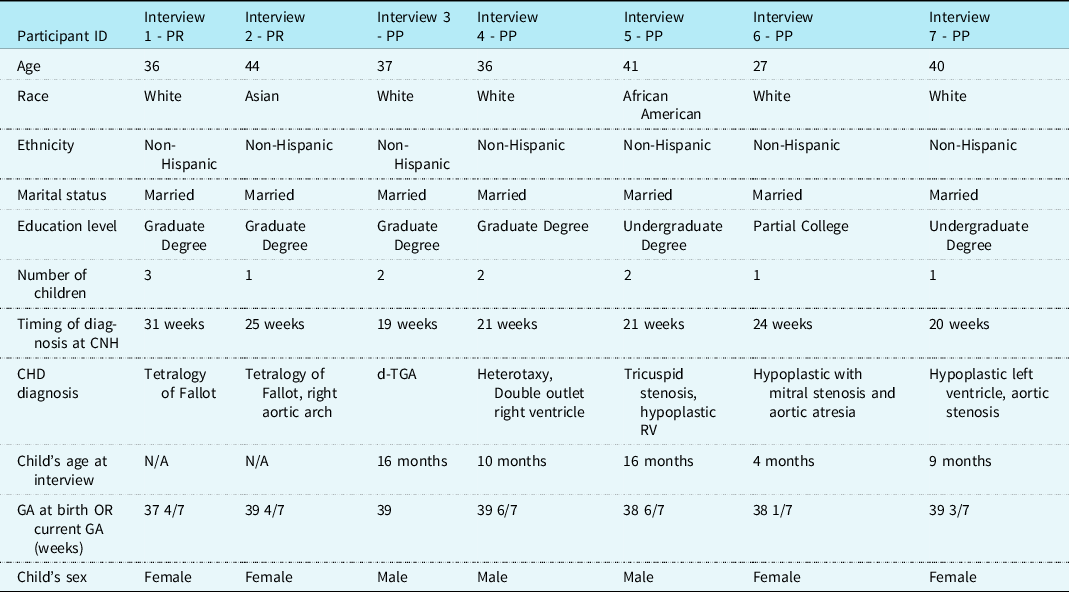
The sample consisted of mothers included five pregnant and two postpartum mothers. Participant mean age was 37.28 (SD = 5.01) and four out of seven participants presented with graduate level education. Mean gestation at time of receiving a congenital heart disease fetal diagnosis was 23 weeks gestation with varying severity of congenital heart disease diagnostic groups. Five women self-identified as Caucasian, one African American, and one Asian. All women were married. Providers’ experience ranged from 2 to 20 years. Data of study participants and providers are summarised in Table 1.
Summary of mother participant’s sociodemographic information.

PP=postpartum; PR=prenatal.
Qualitative themes: pregnant women and postpartum mothers
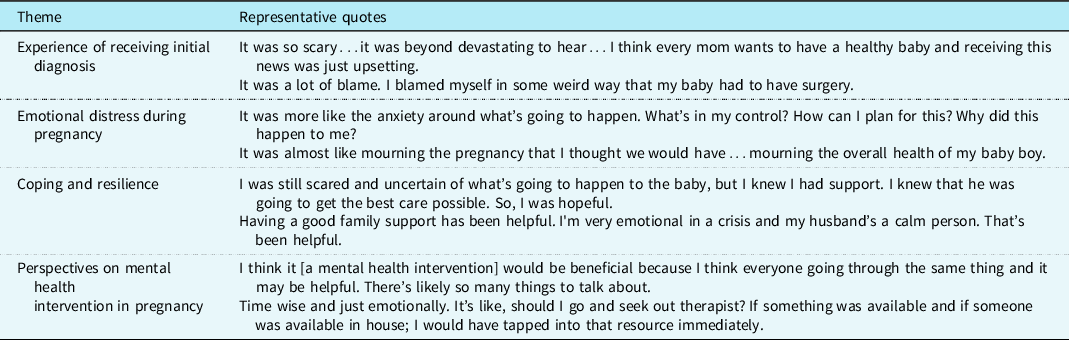
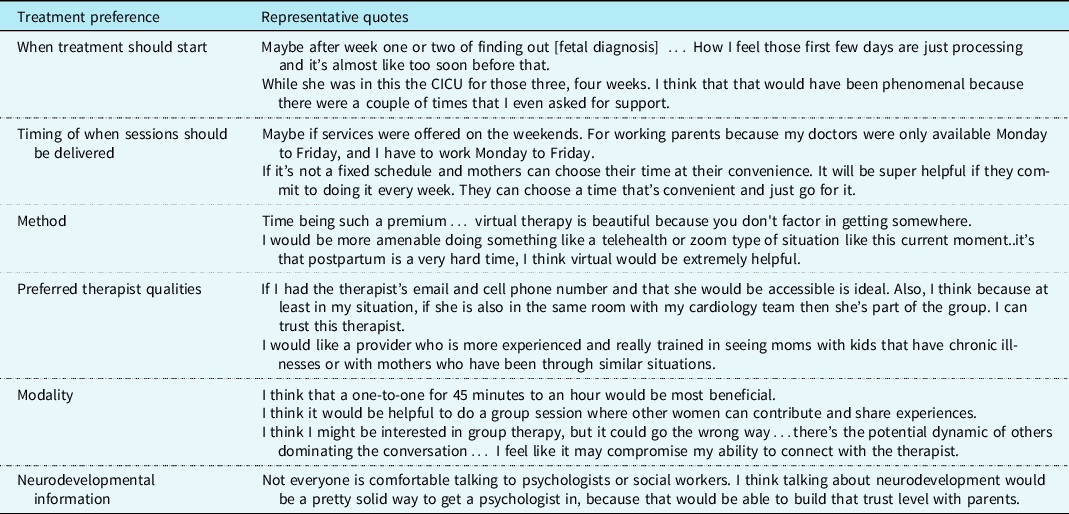
The responses of most women fell into one of the categories below. Overall, both pregnant women and mothers reported comparable emotions and experiences related to receiving the initial diagnosis and the duration of their pregnancy. Women reported varying coping and resilience resources, including physical exercise, prayer, and spending time with other children, among several others. Generally, they agreed the ideal timing of treatment delivery would be at least two to three weeks after receiving a prenatal fetal diagnosis. Given the endorsement of busy schedules, time-limited and brief interventions appear warranted (e.g. maximum 1 hour, one time per week, etc.). Flexibility in scheduling on weekends and evenings are also preferred options. Using a virtual telehealth platform to deliver the intervention was voiced as most feasible, accessible, and appropriate considering current global events and typical commute times. Desired therapist qualities included approachability and availability, and to be integrated as part of a team alongside cardiologists, nurses, and social work. While women considered the benefits of being part of a group of mothers going through similar challenges, an individual modality was preferred given the gravity and uniqueness of each fetal diagnosis and the associated dynamic stressors. However, women who opposed group formats were open to at least one group session focused on information rather than processing personal experiences. Representative quotes from the main themes and intervention preferences are presented in Tables 2 and 3. Figure 1 summarises all themes from both stakeholder perspectives.
Broad themes and representative quotes of participants: pregnant women and postpartum mothers.

Treatment preferences and representative quotes: pregnant women and postpartum mothers.

Experience of initial diagnosis
Mothers described experiencing several emotions at the time of receiving a fetal diagnosis of congenital heart disease. They noted initially feeling shocked, scared, confused, and then later a sense of guilt and anxiety. They noted an immediate sense of mourning and devastation of the loss of the idealised or “healthy child.” There was uniformly a sense of fear regarding the baby’s prognosis after birth and what the baby’s future would look like regardless of the severity of the fetal diagnosis. Many women described feeling confused as to what caused their baby to have a problem and some wondered whether they could have done something to prevent it or if they did something to cause the diagnosis.
Emotional distress during pregnancy
Mothers reported experiencing a variety of emotions, predominantly negative, during their pregnancy after receiving a fetal diagnosis. Primary emotions were a sense of anxiety, worry, grief, and loss of control. Women described feeling overwhelmed with the amount of varying appointments and future issues they would need to manage during pregnancy and after the baby arrives. Related to this were several feelings of anxiety and concern about something going wrong in the pregnancy (e.g. further complication; fetal demise). Women felt a loss of control in the pregnancy, feeling as though they were helpless, without an opportunity to do something to make the baby healthier.
Coping and resilience
Despite the range of negative emotional experiences mothers reported, they also identified protective factors and methods of coping with emotional distress during their pregnancies. Some resources included religiosity and spirituality, focusing on increasing pleasant activities, caring for their other children, connecting with others having gone through a similar issue, and relying on others for support. For example, some women noted taking walks or continuing with their exercise regimen were useful. Other women noted that being able to rely on their husbands for support was helpful in their coping with distress.
Perspectives on mental health intervention in pregnancy
Perspectives on mental health and related interventions occurring during the prenatal period varied. Concerns were raised regarding comfort with a mental health professional, feasibility, lack of time in their schedules, or retelling distressing thoughts and emotions related to receiving the congenital heart disease diagnosis. Advantages included gaining additional support, learning about adaptive ways to cope, learning information about the neurodevelopmental future of the baby, and sharing experiences with other mothers.
When considering an intervention, preference for individual versus a group therapy experience were mixed. Mothers preferring individual therapy expressed wanting a sense of confidentiality, tailored treatment, and information related specifically to their baby’s CHD diagnosis. Some mothers noted becoming more anxious when exposed to stressful stories from other mothers, while others believed talking to other women going through a similar experience would be helpful. Women described it would be helpful to talk to someone with prior experience in addition to learning about neurodevelopmental information about the baby as part of the therapy for themselves. Regarding an intervention including their significant partner, mothers noted having at least one session where they could both attend the session.
Perspectives on standard of care
Mothers generally perceived the current standard of care as thorough and supportive, especially with their fetal cardiologists and fetal care team; however, some women noted the amount of information given at the initial diagnosis was overwhelming. Some participants stated that while they had multiple helpful interactions with social work shortly after receiving the diagnosis, they had difficulty with accessing or being connected to psychological services thereafter (e.g. too much information, did not know who to contact, etc.).
Qualitative themes: healthcare providers
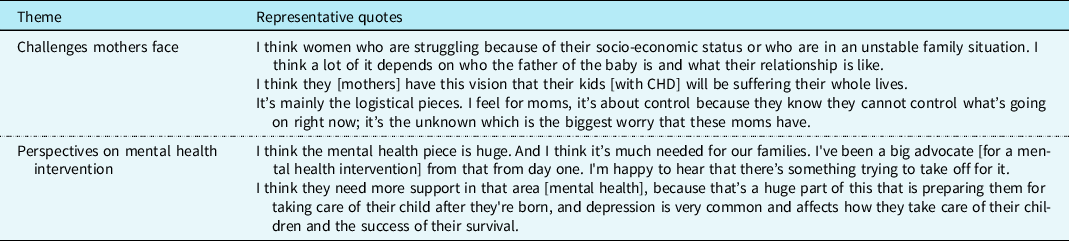
The healthcare provider interviews focused on the challenges their patients face and the need for professional mental health support. Representative quotes are outlined in Table 4.
Broad themes and representative quotes: health care providers.

Challenges mothers face
Providers highlighted several multifaceted factors contributing to stressful challenges for pregnant women at the point in which they receive a fetal congenital heart disease diagnoses (e.g. socio-economic hardship; minimal support; work-related concerns; limited control as a mother).
Need for professional mental health support
Overall, healthcare providers uniformly agreed having a mental health care professional work with women whose fetuses have been diagnosed with congenital heart disease would be useful given the overwhelming emotions accompanying the diagnosis which warrant support. Unanimously, medical providers confirmed the support from their social work team, which is embedded within the cardiology unit, serves to effectively navigate and support the mental well-being of the mother. Providers noted the implementation of an evidenced-based intervention designed to follow patients throughout pregnancy and into the postpartum period may be useful as an adjunct to an already existing relationship with the social worker.
Discussion
The current study examined the subjective experiences of pregnant women, mothers, and medical providers related to carrying a fetus with a congenital heart disease diagnosis that would require open heart surgery, and to understand preferences for a potential psychological intervention. Collectively, all participants, both providers and perinatal women, believe women in the prenatal period receiving a congenital heart disease diagnosis would significantly benefit from a targeted prenatal psychological intervention addressing the specific emotional distress associated with being a parent carrying a fetus with congenital heart disease. To date, there are no standardised and evidence-based interventions addressing the mental health needs for prenatal women carrying a fetus with congenital heart disease.
Implementing an evidence-based psychotherapeutic intervention delivered in the prenatal period would allow providers the opportunity to address mothers’ acute psychological needs and strengthen their ability to adaptively cope with the many ongoing stressors they will continue to face throughout their child’s development. We found pregnant and postpartum women experience shock, grief, a sense of helplessness and loss of control of the pregnancy when first receiving the fetal diagnosis and long after. Women primarily expressed feelings of anxiety and guilt. Women also revealed several positive resources that allowed them to cope through their pregnancies and in the postpartum period. These findings are consistent with previous studies within this population examining their psychological functioning and perspectives on coping within the context of congenital heart disease. Reference Bratt, Järvholm and Ekman-Joelsson20–Reference Adadms, Smith, Caccavale and Bean24,Reference Werner, El Louali, Fouilloux, Amedro and Ovaert26–Reference Isgut, Smith, Reimann, Kucuk and Ryan29
Given the distress women endorse and their agreement on the benefit of a prenatal psychotherapeutic intervention, development of an evidence-based targeted intervention is warranted. Pregnant women and mothers in this study provided important information on the preferred structure and content of potential interventions. Provider feedback demonstrated support for a psychotherapeutic intervention in the prenatal period. Further, provider feedback suggested any new intervention should be complimentary to current social work services. In addition to incorporating information obtained from the current study to tailor a future intervention, incorporation of theoretical frameworks proven efficacious in addressing perinatal depression and anxiety, such as cognitive behavioural and interpersonal psychotherapy, Reference Sockol19 would be most useful.
Our data suggest there exists a certain degree of apprehension around the usefulness of a psychotherapeutic intervention. However, given the high emotional distress these women face, it is critical for care teams and frontline providers to normalise these experiences to increase engagement with mental health intervention. Reference Gramszlo, Karpyn and Christofferson33 Specifically, to mitigate the development of more clinically relevant symptoms of depression, anxiety, and distress it may be helpful to present the intervention as a preventative measure, rather than treating an existing mental health condition. As such, interventions may then focus on building coping skills and resources for fostering resilience.
Finally, both patients and providers in this study noted the usefulness of a portion of the intervention devoted to learning more about the neurodevelopmental trajectories specific to congenital heart disease. While research informs us children with congenital heart disease are at increased risk of developmental disorder or disabilities or developmental delay, Reference Marino, Lipkin and Newburger14 neurodevelopment is multi-factorial and includes child specific risk factors. Reference Peyvandi, Latal, Miller and McQuillen34 If embedding this information within the intervention is planned, it is paramount the therapist has background knowledge and experience with this population. Research shows neurodevelopmental follow-up and any necessary interventions should begin early in infancy. Reference Butler, Sadhwani and Stopp35 However, future research should consider whether neurodevelopmental information (e.g. ways to support neurodevelopment during infancy; overview of early intervention services, etc.) would be helpful as part of a prenatal psychotherapeutic intervention or would be better suited to another setting.
Limitations
Although the information gained from participants in this study will be essential in developing resources to aid pregnant women with a fetus diagnosed with congenital heart disease, several significant limitations to this study should be noted. First, participant interviews were conducted with a small sample of predominantly Caucasian, highly educated, and relatively financially comfortable women. Given the extensive evidence of the effects of race, ethnicity, and socio-economic status on disease risk and treatment response, Reference Williams36 future studies must include more participants across racial, ethnic, socio-economic, and cultural groups. Second, our sample only included mothers, not fathers nor same-sex partners, which will be important for future studies to consider as past studies have demonstrated fathers too experience significant distress and emotional strain during this vulnerable time. Reference Hoffman, Karpyn and Christofferson25,Reference Sood, Karpyn and Demianczyk37 Third, our sample included more mothers with a child diagnosed with congenital heart disease than pregnant mothers. This is an important factor to consider given information regarding emotions, coping mechanisms, and thoughts at time of pregnancy were provided to us retrospectively. Memories of postpartum mothers may have been influenced by hormonal changes, Reference Shin, Bak and Nah38 passage of time, Reference Sun, Gu and Yang39 current emotional state, Reference Pio de Almeida, Jansen, Köhler, Pinheiro, da Silva and Bonini40 or the gravity of recent stressors. Our study used semi-structured interviews and analysed data using qualitative thematic analysis. Future studies should use mental health screening tools, self-administered surveys, and focus groups in addition to individual interviews to elicit more information across different types of modalities. Finally, we were unable to interview any members of the social work team due to their own time constraints. Given provider responses highlighting the importance of social workers during the initial diagnosis, future studies should consider their perspectives on any psychotherapeutic intervention.
Conclusion
This current study was developed with the intent of informing a larger initiative to develop and implement a preventive psychological intervention for pregnant women who receive a fetal diagnosis of congenital heart disease. It is evident that the prenatal maternal experience associated with a fetal diagnosis of congenital heart disease can cause significant distress. A targeted evidence-based intervention supporting mothers, children, and families by strengthening a mother’s capacity to cope is clearly warranted. It will be critical to consider to the severity of congenital heart disease diagnosis, culture of the target population, and existing access to resources when developing and implementing future interventions. Mothers are faced with the compounding emotional experience associated with the fetal congenital heart disease diagnosis, and thus evidence-based psychological support has become exceedingly essential.
Acknowledgements
We acknowledge the contributions of every mother who candidly shared their stories with us and medical staff for sharing their experiences and recommendations with the goal of helping other families impacted by CHD.
Financial support
This work was supported by the Brain & Behavior Research Foundation-NARSAD, Grant no: 28218 (PI: Yao Wu), and National Institutes of Health-R01 HL116585-01 (PI: Catherine Limperopoulos).
Conflicts of interests
The authors declared no potential conflicts of interest with respect to the research, authorship, and/or publication of this article.
Ethical standards
The study was approved by the IRB review board at Children’s National Hospital in Washington, DC. Written and verbal information about the study was given, emphasising participation was fully voluntary, and informed consent was obtained. Confidentiality was guaranteed.