Pulmonary arterial hypertension is a severe disease characterised by a sustained elevation of pulmonary vascular resistance, ultimately leading to right heart failure and death.Reference Galiè, Humbert and Vachiery1 Disease progression occurs despite the availability of drugs that are specific for the disorder.Reference Benza, Miller and Barst2 Endothelin receptor antagonists, phosphodiesterase type 5 inhibitors, and prostacyclin and its analogues have been approved for the treatment of pulmonary arterial hypertension.Reference Channick, Simonneau and Sitbon3–Reference Pulido, Adzerikho and Channick9
Macitentan is an orally active, potent, dual endothelin receptor antagonists developed by modifying the structure of bosentan to increase efficacy and safety and characterised by sustained receptor binding and enhanced tissue penetration.Reference Bolli, Boss and Binkert10–Reference Keating13 Compared with the dual endothelin-A/endothelin-B receptor antagonist bosentan and the endotelin-A selective receptor antagonist ambrisentan, macitentan has slower receptor dissociation kinetics, longer duration of action which allows once-daily dosing.Reference Gatfield, Mueller Grandjean and Sasse12 The safety profile of macitentan appears to be superior with respect to hepatic safety and edema than bosentan and ambrisentan, respectively, and in contrast to bosentan macitentan is not known to interact with plasma levels of sildenafil.Reference Pulido, Adzerikho and Channick9,Reference Dingemanse, Sidharta and Maddrey14 In the adult studies, no liver toxicity was reported and anaemia was observed in 4.3% of patients receiving 10 mg macitentan.Reference Pulido, Adzerikho and Channick9
Macitentan’s effectiveness was established in the double-blind, randomised, placebo-controlled SERAPHIN study (Study with an Endothelin Receptor Antagonist in Pulmonary arterial Hypertension to Improve Clinical Outcome) in 2013.Reference Pulido, Adzerikho and Channick9 The large phase III study SERAPHIN tested macitentan in more than 700 patients and provided unique long-term outcome data not available for other members of this class.Reference Pulido, Adzerikho and Channick9,Reference Dingemanse, Sidharta and Maddrey14 Macitentan is the only registered treatment for pulmonary arterial hypertension that significantly reduced morbidity and mortality as a combined endpoint in the SERAPHIN study and is approved by the United States Food and Drug Administration for adults in 2013 in the United States of America, the European Union and various other countries for the treatment of pulmonary arterial hypertension.Reference Pulido, Adzerikho and Channick9,15,16
Few studies compared clinical efficacy, safety of switch from bosentan to macitentan only in adult patients with pulmonary arterial hypertension.Reference Blok, van Riel, van Dijk, Mulder and Bouma17,Reference Safdar, Thakur and Frost18 We have recently reported that switch from bosentan to macitentan significantly improved exercise capacity in children and young adults with pulmonary arterial hypertension in a 24-week prospective study and well tolerated without adverse events.Reference Aypar, Alehan, Karagöz, Aykan and Ertugrul19 We now aimed to evaluate clinical efficacy, safety of switch from bosentan to macitentan in a larger patient population and in a 24-month prospective study due to desirable features (once-a-day profile and freedom from monthly liver function tests) of macitentan.
Materials and methods
Study design
The study was designed as a single-institution, 24-month prospective observational study in an existing cohort of pulmonary arterial hypertension patients and was conducted in Hacettepe University Hospital, Department of Pediatric Cardiology, Ankara, Turkey. The study was approved by the University Institutional Ethics Committee. Written informed consent was obtained from all patients and/or patients’ relatives.
Selection of patients
Patients ≥12 years who had idiopathic or heritable pulmonary arterial hypertension or related to CHD or residual pulmonary arterial hypertension due to repaired congenital systemic-to-pulmonary shunts or had pulmonary arterial hypertension pulmonary arterial hypertension with right heart catheterisation were required. Patients were required to be in class II or III according to the World Health Organization functional classification (an adaptation of the NYHA functional classification). Concomitant treatment with oral phosphodiesterase type 5 inhibitors, inhaled prostanoids, digoxin, oral diuretics and angiotensin converting enzyme inhibitors was allowed, provided that the patient had been receiving a stable dose for at least 3 months before the study. Patients with Down syndrome or with other syndromes were included. Patients in class IV, or receiving intravenous prostanoids, or with liver or renal impairment, any other systemic disease were excluded. Macitentan was approved only in patients ≥12 years. Therefore, our study group consisted of patients ≥12 years.
Procedures
Within 1 month after screening, the treatment of patients who were eligible for the study were switched from bosentan to macitentan at a once-daily dose of 10 mg after a 24-hour wash-out period following cessation of bosentan. Only patients who were taking bosentan at maximum dose were included. Dose of bosentan was twice a daily dose of 125 mg before the switch. The maximum plasma concentrations of macitentan are reached in approximately 8 hours, and macitentan had elimination half-life of approximately 16 hours. We provided a wash-out period to avoid hepatotoxicity and hypotension, when taking bosentan and macitentan consecutively, by taking a risk that patients on monotherapy did not take any specific treatment for a definite time interval.Reference Keating13,Reference Blok, van Riel, van Dijk, Mulder and Bouma17,Reference Safdar, Thakur and Frost18 Patients on combination treatment continued oral phosphodiesterase type 5 inhibitors and inhaled prostanoids. Clinical assessment (physical examination, 6-minute walk distance test, and functional class) and transthoracic echocardiography were performed by the same cardiologist. Laboratory data (haemoglobin, alanine aminotransferase, aspartate aminotransferase, and brain natriuretic peptide levels) were obtained at screening, beginning of the study, and at every 3 months until 24 months. Adverse events (anaemia, hepatotoxicity, peripheral edema, or other) were recorded throughout the treatment period.
Outcome measures
Outcome meaures included change from baseline to 6 months, 12 months, 18 months, and 24 months in the 6-minute walk distance, functional class, oxygen saturation at rest and after 6-minute walk distance test, brain natriuretic peptide levels. Safety end points included adverse events and laboratory abnormalities.
Statistical analysis
Change in 6-minute walk distance from baseline to month 6, 12, 18, and 24 were analyzed by repeated measures (within subjects) analysis of variance. Changes between –12 months, 12–18 months, and 18–24 months were analyzed by paired sample t-test. Oxygen saturations at rest, brain natriuretic peptide levels at 6, 12, 18, and 24 months were compared with those at baseline using Friedman’s two-way analysis of variance by Ranks. Change in oxygen saturations after 6-minute walk test from baseline to month 6, 12, 18, and 24 was also analyzed by repeated measures (within subjects) analysis of variance. Non-parametric correlations (association between disease duration, bosentan duration, number of specific drugs, and 6-minute walk distance at 6, 12, 18, and 24 months) were evaluated by Spearman’s rank-order correlation (rho) coefficient. A p value of less than 0.05 was considered to indicate statistically significant difference. The data analysis was performed by using IBM SPSS Statistics 23 software, New York, United States of America.
Results
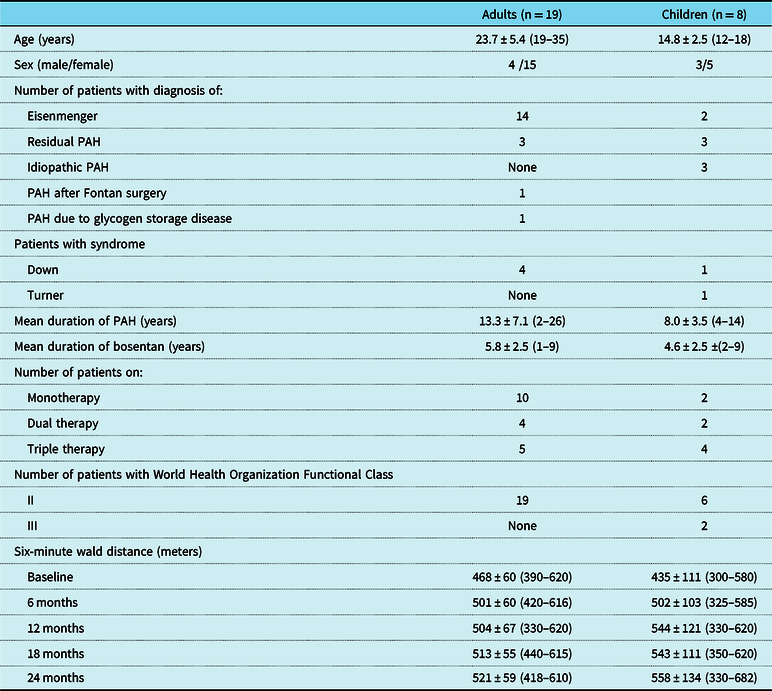
Twenty-seven patients (10 male and 17 female) were included in the study. Mean age was 21.1 ± 6.3 years (12–36), and weight was 53.1 ± 15.7 kgs (26–87). Eight patients (30%) were children (≤18 years). The mean macitentan treatment duration was 22.3 ± 3.9 months (9–24). Clinical features and 6-minute walk distance test results of adult and children with pulmonary arterial hypertension were shown in Table 1.
Clinical features and 6-minute walk distance test results of adult and children with pulmonary arterial hypertension*

PAH = pulmonary arterial hypertension.
* Data were presented as mean ± SD (range).
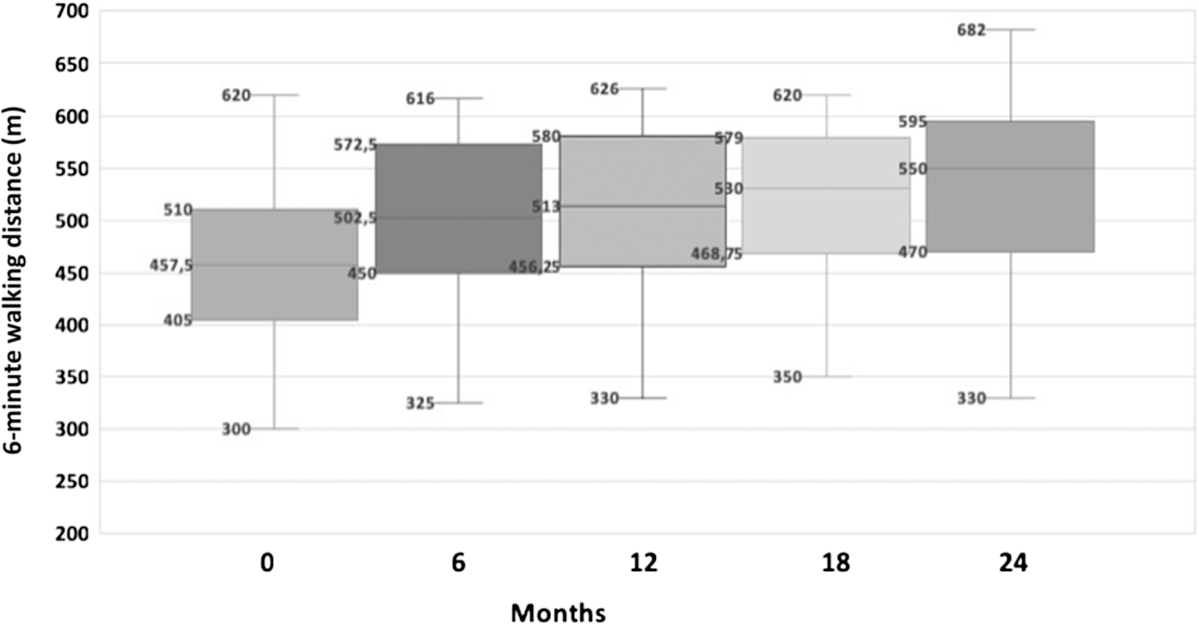
Macitentan significantly improved 6-minute walk distance from baseline (mean: 458 ± 79 m (300–620)), at 6 months (mean: 501 ± 73 m (325–616) + 43 m) (p < 0.05), at 12 months (mean: 514 ± 82 m (330–626) + 56 m) (p < 0.05) at 18 months (mean: 521 ± 71 m (350–620) + 63 m) (p < 0.05), and at 24 months (mean: 532 ± 85 m (330–682) + 74 m) (p < 0.05) (Fig 1). Although we observed a statistically significant improvement between baseline and 6 months (p < 0.001), we did not observe any incremental improvement after 6 months. There was no statistically significant difference between 6–12 months (p = 0.371), 12–18 months (p = 0.395), and 18–24 months (p = 0.85). Seventeen patients (63%) had Eisenmenger syndrome and/or pulmonary arterial hypertension related to CHD, four patients (22%) had residual pulmonary arterial hypertension due to repaired congenital systemic-to-pulmonary shunts, three patients (11%) had idiopathic pulmonary arterial hypertension, one patient (4%) had pulmonary arterial hypertension related to glycogen storage disease, one patient (4%) with unguarded tricuspid valve had pulmonary arterial hypertension after Fontan surgery, and one patient (4%) had pulmonary arterial hypertension related to complex CHD. Of 27 patients, 24 (89%) were in World Health Organization functional class II, and 3/25 patients (12%) in World Health Organization functional class III. The mean duration of pulmonary arterial hypertension was 11.7 ± 6.7 years (2–26), and patients were on bosentan for 5.5 ± 2.5 years (1–9). Twelve patients (45%) were on monotherapy (bosentan), six patients (22%) were on dual therapy (bosentan+sildenafil or bosentan+tadalafil), nine patients (33%) were on triple therapy (bosentan+sildenafil+inhaled prostanoid), or (bosentan+tadalafil+inhaled prostanoid). Five patients (19%) had Down and one patient had Turner syndrome. Patients with Down syndrome could not perform 6-minute walk distance test.
Effect of switch from bosentan to macitentan on 6-minute walk distance over time in patients with pulmonary arterial hypertension.

Functional class of the patients remained unchanged in all patients. Macitentan did not significantly change brain natriuretic peptide levels from baseline and resting oxygen saturation levels from baseline (median: 90% (75–98)), at 12 months (median: 92% (76–98)), and at 24 months (median: 91% (65–99)), oxygen saturation levels after 6-minute walk distance test from baseline (median: 86% (55–97)), at 12 months (median: 90% (75–96)), and at 24 months (median: 88% (62–98)).
We did not find any significant correlation between pulmonary arterial hypertension duration, bosentan treatment duration and between number of specific drugs and change from baseline to month 6, 12, 18, and 24 in the 6-minute walk distance (p > 0.05).
Both the children and young adults responded similarly to macitentan effect in respect to change in 6-minute walk distance from baseline to month 6, 12, 18, and 24.
None of the patients had anaemia, hepatotoxicity, peripheral edema, or any other adverse events.
Discussion
Endothelin system is upregulated in pulmonary arterial hypertension and plays an important role in the pathogenesis of pulmonary arterial hypertension.Reference Giaid, Yanagisawa and Langleben20,Reference Galié, Manes and Branzi21 The binding of ET-1 to ETA and ETB receptors in pulmonary vascular smooth muscle cells produces vasoconstriction and mitogenic effects, whereas the binding of ET-1 to ETB receptors in pulmonary endothelial cells stimulates the production of nitric oxide and prostacyclin.Reference Giaid, Yanagisawa and Langleben20 Blockade of both ETA and ETB receptors appears more effective than blockade of either receptor subtype alone in terms of counteracting the effects of the endothelial dysfunction induced by ET-1.Reference Keating13
Macitentan is an orally active, potent, dual endothelin receptor antagonist which antagonizes both ETA and ETB receptors, with an ETA:ETB inhibitory potency ratio of 50.Reference Bolli, Boss and Binkert10,Reference Iglarz, Binkert and Morrison11 Compared with the dual ETA/ETB receptor antagonist bosentan and the ETA selective receptor antagonist ambrisentan, macitentan had slower receptor dissociation kinetics and a receptor occupancy half-life that was approximately 15-fold longer in human pulmonary arterial smooth muscle cells.Reference Gatfield, Mueller Grandjean and Sasse12 Macitentan, but not bosentan, significantly prevented pulmonary vascular remodeling and right ventricular hypertrophy in bleomycin-treated rats.Reference Iglarz, Landskroner and Bauer22 In addition, adding macitentan when the maximum bosentan effect had been reached further decreased mean pulmonary arterial pressure in bleomycin-treated rats, whereas no further reduction in mean pulmonary arterial pressure was seen when bosentan was added after the maximum macitentan effect had been reached.Reference Iglarz, Bossu and Wanner23 In human studies, in SERAPHIN, the addition of macitentan had a beneficial effect in the subgroup of patients already receiving background pulmonary arterial hypertension therapy.Reference Pulido, Adzerikho and Channick9
According to our results, switch from bosentan to macitentan improved exercise capacity in children and young adults with pulmonary arterial hypertension significantly in the first 6 months, but not incrementally thereafter and well tolerated without any adverse events in the long term.
Few studies have compared the clinical efficacy and tolerability of switch from bosentan to macitentan only in adult patients with pulmonary arterial hypertension.Reference Blok, van Riel, van Dijk, Mulder and Bouma17,Reference Safdar, Thakur and Frost18 Blok et al. evaluated the effect of a switch from bosentan to macitentan on clinical status after 24 weeks in 40 adult patients with pulmonary arterial hypertension due to CHD (mean age: 45 ± 13 years, 40% Down, 75% Eisenmenger, median bosentan treatment duration 7.2 years).Reference Blok, van Riel, van Dijk, Mulder and Bouma17 The authors observed an improvement in functional class, N-terminal-pro-brain natriuretic peptide levels, tricuspid annular plane systolic excursion, but not in 6-minute walk distance, and resting oxygen saturation levels without serious adverse events and concluded that adult patients with pulmonary arterial hypertension due to CHD using bosentan might improve from a switch to macitentan under careful follow-up.
Our study included the youngest patients compared to other studies and approximately one-third of our patients were children.Reference Blok, van Riel, van Dijk, Mulder and Bouma17,Reference Safdar, Thakur and Frost18 We included not only patients with pulmonary arterial hypertension related to CHD as in Blok et al.’s study but also patients with idiopathic/heritable pulmonary arterial hypertension and residual pulmonary arterial hypertension due to repaired congenital systemic-to-pulmonary shunts. We were unable to make statistical comparison in 6-minute walk distance according to different pulmonary arterial hypertension etiology due to small number of patients. We propose that macitentan might have different effect on pulmonary arterial hypertension patients with respect to etiology, and the effect of switch from bosentan to macitentan in various pulmonary arterial hypertension patients requires further investigation. Although Blok et al. reported an improvement in functional class (number of patients in functional class III or IV decreased from 48 to 23%, but no change in fuctional class II), in our study, functional class of all patients was maintained. Small number of patients in functional class III in our study might have affected our results. In Blok et al.’s study, the number of patients with hospitalisation and syncope did not change. Liver function tests remained unchanged, and >1 mmol/l drop in haemoglobin was seen in two patients. We also did not observe any clinical worsening during macitentan treatment.
Although the most common laboratory abnormality with macitentan was reported as anaemia in SERAPHIN trial (a haemoglobin level of <8 g/dL in 4.3% of the macitentan group and 0.4% of the placebo group), we did not observe any drop in haemoglobin levels.Reference Pulido, Adzerikho and Channick9 In SERAPHIN trial, the incidence of peripheral edema and hepatotoxicity were similar across macitentan and placebo groups, and the incidence of headache and nasopharyngitis was higher with macitentan than with placebo.Reference Pulido, Adzerikho and Channick9 In our study, none of the patients had headache, nasopharyngitis, peripheral edema or hepatotoxicity, or any other adverse events.
Study limitations
We performed only routine measurements (change in 6-minute walk distance, functional class, oxygen saturation at rest and after 6-minute walk distance test, and serum brain natriuretic peptide levels). Haemodynamic data by cardiac catheterisation, before and after the switch, were not available and would have provided more valuable data. Our study was an unblinded study showing an endpoint that has a degree of patient effort (change in 6-minute walk distance), which could bias the study. As this is a single-arm prospective clinical study and we did not compare the results with a placebo group, our findings cannot be assertive.
Conclusions
Our study is the first study which showed that switch from bosentan to macitentan improved exercise capacity in children and young adults with pulmonary arterial hypertension significantly in the first 6 months and compared to baseline in 24 months and well tolerated without any adverse events in the long term.
Acknowledgements
We would like to thank you for Umut Ece Arslan for her contribution in statistical analysis of the data.
Financial Support
This research received no specific grant from any funding agency, commercial or not-for-profit sectors.
Conflicts of Interest
None.