Introduction
Mobile theatre in the north-east Indian state of Assam serves as a prominent site through which ‘Assamese’ culture is produced, contested, and negotiated with. It is known as Bhramẏamān (being ‘on the move’) theatre in local parlance.Footnote 1 Around 30 such theatre groups, each comprising roughly 80–150 members, travel across the state—in both rural and urban areas—for stretches of up to nine months to stage their plays. In the current Assamese context,Footnote 2 mobile theatre has taken a commercial turn,Footnote 3 with back-to-back performances staged during the theatre season.Footnote 4 Itinerant theatre troupes recruit actors and crew members, while their management teams schedule performances through negotiations with local booking committees, known as āhbāẏak committees. Female performers are mainly employed as actors and dancers, with the latter regarded as junior artistes. For an insight into the power dynamics among performers working in these mobile theatres, I recount here an instance from a rehearsal (ākharā) session:
The two male characters of the play are in conversation with each other, delivering their dialogues. The female lead character enters the stage carrying food items she has prepared. Facing the actors, the director—with the script in his hand—is seen calling the shots during the ground rehearsals on a humid summer evening. Change of scene. When the female lead enters again to deliver her dialogue, the director mentions that she is supposed to carry food and corrects her. The female lead takes note and questions, out of character, why she is being made to enter the stage with food every time. This is followed by silence on the part of the director and faint laughter from the female lead herself. Back to business as usual. [Field notes, July 2022]
The female performers continued their rehearsal of the scene, following the director’s cues and the playwright’s ideas on womanhood to be depicted on stage. The women performer’s position was therefore relegated; she was considered a ‘bearer of meaning, not [a] maker of meaning’,Footnote 5 with the latter regarded as the male domain in Bhramẏamān theatre. This is evident in the above-mentioned exchange between the female lead actor and the male director of a popular mobile theatre group. While studying gender in the field of performance arts, it is therefore important to examine both on-stage roles and off-stage dynamics in conjunction.
Gender dynamics in Bhramẏamān theatre can be traced back to the popularity of the seventeenth-century Ahom princess, Joymoti, whose story has been retold in various forms—from Lakshminath Bezbaruah’s (1868–1938) drama Joymoti Konwari (1915) to the first Assamese talkie film, Joymoti (1935), by cultural icon and nationalist Jyoti Prasad Agarwala (1903–1951). Legend has it that Princess Joymoti, wife of Prince Gadapani (Gadadhar Singha), sacrificed her life for the sake of her husband and the nation at large. She endured days of punishment at the hands of the royal executioners without disclosing the whereabouts of Prince Gadapani,Footnote 6 who had fled the Ahom kingdom (1228–1826) and was living as a fugitive in the Naga hills. This archetypal image of the sacrificial woman has been repeatedly glorified in various literary and artistic representations, cementing it in the Assamese cultural imagination. Recently, the Awahan Theatre adapted Joymoti (2021–2022) for the mobile theatre stage as well.
Historian Aparna Mahanta traces the ‘rise of the cult of Sati Joymoti’ and the celebration of Joymoti Utsav since 1914 by linking it to the spread of nationalism in the early decades of the twentieth century.Footnote 7 While Joymoti has been apotheosised in her posthumous incarnation for what she was made to represent, she has been ignored in historical records as she died before her husband became king.Footnote 8 This article will examine the representations of the eponymous female protagonist through a critical reading of Agarwala’s Joymoti (1935) and Awahan Theatre’s Joymoti (2021–2022), reflecting on the shifts, continuities, and interconnections between these representations and the lives of female performers. Even though she was the female lead in the film Joymoti (1935), Aideu Handique (d. 2002) was ostracised by Assamese society as coacting was taboo for ‘honourable’ women and she never married.Footnote 9 On the other hand, Prastuti Porasor (b. 1980),Footnote 10 who was the female lead on stage in Joymoti (2021–2022), received huge applause and appreciation for her performance.Footnote 11 The main aim of this article is to explore the differences in the reception of female actors in film and theatre, along with an analysis of how the image of the ‘ideal woman’ is produced and reproduced in the cultural domain. By juxtaposing these representations with the subjective life stories of travelling female performers, this article foregrounds the gendered realities of female performers in Assam.
Gender, mobility, and agency: from the theatre and performance studies perspective
In his manifesto, cultural critic Stephen Greenblatt asserts that mobility needs to be studied in both its literal and metaphorical sense.Footnote 12 This is closely connected to how mobility operates in both the hidden and visible movements of peoples, images, ideas, and other cultural goods.Footnote 13 In theatre and performance studies, the question of mobility is complex, involving diverse forms of movement—both literal and metaphorical—occurring on-stage/on-screen or off-the-stage/behind-the-scenes. This can include travel undertaken by actors from their home(s) to work locations to join the media production units, as well as the representation of movement in literature, theatre, and cinema. In studying representations of ‘movement enacted, felt, perceived, expressed, metered, choreographed, appreciated and desired’,Footnote 14 its corporeality comes into sharp focus. The literary scholar Marshall Brown argues that ‘mobility and identity are dialectically inseparable’,Footnote 15 which has a huge impact on how we perceive agency. Hence, it becomes significant to explore how one’s social location and gender play a role in enabling processes of mobility or in creating new forms of im/mobility.
In the specific context of colonial India, the rise of woman performers in the public sphere was accompanied by their stigmatisation as ‘prostitutes’ and the ‘Other’ of the ‘honourable women’ in domestic spaces.Footnote 16 In her translation of the autobiography of the famous female Bengali actor Binodini Dasi, Rimli Bhattacharya highlights the ‘various kinds of estrangements and betrayals’ Dasi experienced from her teacher and guru, her patrons, and society when she tried to build a life beyond the theatre.Footnote 17 In northern India too, the apprehension around women on the public stage was palpable. Even ‘female supporters of actresses’ were concerned about the ‘sanctity of theatre’.Footnote 18 Such tensions were also present in Indian cinema. Film producer Dadasaheb Phalke expressed the need for ‘women from good families’ to act in films,Footnote 19 which would then accord them with a better reputation.Footnote 20 Jyoti Prasad Agarwala’s Joymoti (1935) constructed a normative idea of womanhood, directly linking it to suffering and sacrifice in colonial times. This article examines whether Awahan Theatre’s stage adaptation of Joymoti (2021–2022) reproduces a stereotypical image of womanhood or resists it. The narratives portrayed on-screen/on-stage have wider ramifications for gender discourse in Assamese society, and these become apparent as we note the shifts and continuities as these texts move from colonial to contemporary contexts. Before tracing the links between representations and the history of women’s entry into theatre and performance spaces in colonial Assam, I will clarify my methodological framework.
Methodology
Using a textual analysis of the production and continual reconstitution of stereotypical images of women in Joymoti across theatre and cinema,Footnote 21 I will expose the mechanisms used to maintain or challenge existing gender hierarchies in Assam. This will also help in highlighting modes of resistance, if any, towards such normative image constructions and address the question of agency and mobility of women characters on-stage/on-screen.
Taking gender as an analytical category,Footnote 22 I will investigate the social and institutional relationships and the experiences of women performers associated with mobile theatre groups. I will also interrogate the marginalisation of women’s roles and their contributions in Assamese cinema. I use feminist ethnography along with oral history methods and archival materials to reconstruct the history of female performers in cinema and mobile theatre through an intersectional approach across the axes of class, caste, ethnicity, and gender.Footnote 23 To delve into the archival materials in search of the travelling female performer, I visited various museum spaces,Footnote 24 which exposed the marginalisation of their work and contributions to the production of media and culture.
Coacting in Assam: gendered negotiations
Mobile theatre as it exists today has its roots in open-air Jatra performances. Jatra as a performance art was introduced in western Assam from colonial Bengal during the second half of the nineteenth century and was performed in Bengali initially.Footnote 25 The term Jatra, or yatra, ‘carries a sense of motion or dislocation’,Footnote 26 but there is also a religious connotation attached to it. Inspired by Bengal’s Jatra performances, many Jatra groups or opera parties were formed in Assam. In the district of Barpeta, Tithiram Bayan formed the first Jatra group between 1860 and 1865.Footnote 27 Then, in the same district, Jaydev Sarma of Murukuchi village began another Jatra troupe for commercial purposes, but in this case the earnings were mainly for the owner rather than for the artistes. Here, Brajanath Sarma’s initiative becomes significant as he was a social reformer, artist, and freedom fighter who took part in the non-cooperation movement in 1921. Upon his return from Bengal in 1921 (where he was deployed as part of the British Army), he founded the Shila Kalika Opera Party, which is considered the first professional Jatra group of Assam, in which artistes were paid for their performances.Footnote 28
In the 1930s, when this group was disbanded, Sarma formed the Assam Kohinoor Opera Party, which laid the foundation for mobile theatre in Assam. Unlike the previous all-night performances, they now performed for just three hours and apart from changing the duration of the live performances, the Assam Kohinoor Opera Party also began to perform in halls instead of giving open-air performances.Footnote 29 It was the Assam Kohinoor Opera Party that introduced coacting in the 1930s when the proscenium stage was set up.Footnote 30 For the first time in Assam, female roles were played by women:Footnote 31 in the play Morān Jīorī (Moran’s daughter).Footnote 32 This initiative faced a lot of societal backlash: women’s performances on stage had to be discontinued, and Brajanath Sarma was boycotted.
Contrarily, in Natya Parampara, local historian Munindra Nath Sarma asserts that it was the Dubi Parihareswar Jatra group that pioneered coacting in Assam.Footnote 33 Female performers associated with devadasi nritya (dance of devadasis) in Parihareswar temple, Dubi village, Barpeta district, which later came to be referred to as natinach (dance of natis), were part of this Jatra group formed in 1927.Footnote 34 This historical account is based on M. N. Sarma’s interviews with two artists from the group, namely Baliram Bharali and Sasibala Das.Footnote 35 According to M. Deka, the social status of devadasis (female performers associated with a caste-based performance art) in Assam is ambiguous as they ‘belonged to the nat community of the Kalita caste’, which is considered upper caste, yet the natis ‘also held at once a low and at the same time a somewhat elevated, though not defined, status in society and religion’.Footnote 36 Historical sources also highlight that ‘while the natis were regarded not as “common prostitutes”, they were “prostitutes” nevertheless’.Footnote 37
Therefore, due to their social location and gender identity, the female performers associated with the Dubi Parihareswar Jatra group were doubly marginalised. Their involvement with the performance art form and their profession were mainly viewed in a negative light and stigmatised. Brajanath Sarma had also planned to stage two women from the now-disbanded Jatra group, Savitri and Sajani, but due to opposition from some local individuals who exerted their power, they were unable to join his opera party.Footnote 38
Breaking away from the rigid code of theatre in 1933, the opera party then recruited women from eastern Assam (which was geographically closer to the performance location). They included women actors such as Sarbeswari Das, Golapi Das, Sailabala Devi, Binada Gogoi, Phuleswari Das, and Labanya Das, who acted on-stage in the Doomdooma Natya Mandir public auditorium.Footnote 39 Thus, Sarma’s was the second group to stage a coacting play.Footnote 40 Yet, what needs to be emphasised here is the controlled mobility of devadasis. Their social/caste status rendered them ‘immobile’, limiting them to temple spaces and open-air Jatra performances and denying them access to the proscenium stage in public auditoriums, which speaks to the prevalent power dynamics. Some accounts also mention that three female performers from the Dubi Parihareswar temple—Savitribala, Sarojinibala, and Rohinibala—did advance to the training stage; however, they had to return to their village as they could not ‘fit into’ the mobile theatre culture and were ultimately not included in the stage performances in Doomdooma.Footnote 41 The women recruited by the opera party seemed to have belonged to diverse communities, so the question of mobility is complex here: Did the stigma attached to devadasis render them unsuitable for the proscenium stage even though they were part of Jatra?Footnote 42 Or was it the long distance from western to eastern districts of Assam that made it difficult for some female performers to be part of the stage performances? Or was linguistic politics between the two districts at play? The linguistic politics between eastern Assam (Ujani) and western Assam (Namoni) is worth noting here, as the standardised Assamese spoken in eastern Assam and dialects like Kamrupiya and Goalpariya, prevalent in western Assam, ‘creates a relation of domination and subordination’, respectively.Footnote 43 In this regard, Greenblatt’s theorising on cultural mobility is particularly apt: ‘in given historical circumstances, structures of power seek to mobilise some individuals and immobilise others’.Footnote 44
The 1930s were significant with regard to female performers as the first Assamese film, Joymoti (1935), was directed by Jyoti Prasad Agarwala, starring Aideu Handique as its eponymous heroine. Handique portrayed the role of a ‘devoted wife’ in the film and ‘bore facial features that fit in well with given conceptualizations of beauty’.Footnote 45 The film also exposed the double standards of the audience of the time as ‘they lapped up the represented image and shunned the vehicle of the said representation’.Footnote 46 Handique, who remained unmarried in real life, faced ostracisation as she addressed her on-screen husband as ‘Baṅahar Deo’, meaning ‘Dear Husband’. While the male director of the film gained praise and recognition, Handique was treated as an outcast and forced to stay unmarried and live a solitary life. In the context of their search for female actors for Agarwala’s film Joymoti (1935), Sangeeta Barooah Pisharoty has recently reported on how ‘stories about Jyoti Prasad and a few friends being chased away by villagers suspecting to be chōwālī cōr (stealing girls) in parts of upper Assam is common knowledge’.Footnote 47 Pisharoty further elaborates:
Ultimately, Jyoti Prasad got lucky in Golaghat, in upper Assam. All the three top female actresses for the film could be picked from the area—Aideu Handique to play the role of Ahom queen Joymoti; Mohini Rajkumari to act as the queen mother (Rajmau) and Swargajyoti Baruah as the Naga woman Dalimi who would hide Ahom king Gadadhar Singha from his enemies.
Swargajyoti Baruah ended up as one of my grand-aunts. However, what needs to be highlighted here is also that, while Swargajyoti, after the film’s release, could leave her husband and re-marry a top lawyer (my grandfather’s brother) from a respectable Assamese family of the times, Aideu and Mohini Rajkumari were ultimately ostracised in their villages for having sullied the reputation of their villages by featuring in a film. Aideu, for having called Assamese actor Phunu Boruah who played her husband in the film as bongohordeu (husband), could never find a match to marry and remained single all her life.Footnote 48
The entry of Indian women on the public stage had given rise to moral panic, especially in the colonial period. By the end of the fourth decade of the twentieth century, the image of Sati Joymoti in Assam had become a composite symbol, integrating heroic nationalism with the pativratā (chaste wife) ideal and was popularised.Footnote 49 In addition to a patriarchal society and gendered roles, this also needs to be understood within the context of Gandhian nationalism, which had a significant influence on the political scenario in Assam. In 1926, the women’s association known as Assam Mahila Samiti (AMS) was formed against the backdrop of the anti-colonial mass movement. It was led by Chandraprabha Saikiani, a feminist figure belonging to a mixed caste (Sut/Boria) who ‘mobilized a gendered public in the Brahmaputra valley in colonial Assam’.Footnote 50 During the first annual conference of AMS in 1927, in Saikiani’s address as secretary, she linked ‘education to women’s freedom, including the freedom to move about outside the home’.Footnote 51 In the early twentieth century, questions about women’s access to public spaces and mobility, raised in the context of women’s liberation, also paved the way for women’s participation on the public stage. However, the entry of women performers on stage was fraught with moral tensions and social ostracisation.
At the age of 13, Aideu Handique entered the world of films, courtesy of her maternal uncle, Dimba Gohain. He lured her into acting and took her to the studio set up by Agarwala—an ‘act of treachery’ that highlights how the control over female performers’ agency and mobility remained firmly in the hands of their male counterparts during the first half of the twentieth century. In an interview with Bobbeeta Sharma in 1997, Handique shared that:
Once a relative of ours … told me that a big house was floating on the river which had lots of people, shops, market, etc. … I had never heard nor seen such a thing in my life…
Phani Sarma was supposed to beat me … and, to tell you the truth, he would drink a little bit before beating me! I was a healthy girl, and it was only later that I felt the wounds. I cried and fell down, and then I was hospitalised for a week. I was not given any rice but only milk.Footnote 52
This was corroborated by a family member of Aideu Handique, S, who shared the difficulties faced by Handique who was bedridden in the later years of her life. S had married one of the sons of Aideu Handique’s younger brother in 1984, and much of the caregiving work fell on her shoulders once she became part of the family:
We used to stay together, and later when everyone got jobs, they started staying separately. On 17 December 2002, Aita [addressing Aideu Handique as grandmother] passed away. I witnessed it all … she was not able to move much on her own. During the cinema shooting, she fell and got hurt. She was given a wheelchair from the government’s side. I would take her outside in the wheelchair … She would relieve herself while being bedridden, and we would clean up after her. I would bathe her outside on that wheelchair. I would look after her food and everything … maybe those blessings are what’s sustaining us now. [Interviewed on 13 March 2023.]
In the pursuit of a ‘realistic’ portrayal, Handique also suffered physically, which impacted her mobility later in life. The 1930s were a crucial decade for performance arts and female performers in Assam, marking the introduction of coacting on stage and on screen. However, the experiences of female performers’ remain largely invisible in theatre and performance historiography. While interviewing S regarding the Aideu Handique Museum in the Golaghat district of Assam, she mentioned how Handique wanted the archival materials to be retained in the family home instead of in the museum (which stays closed/locked, with its keys in the hands of the Sahitya Sabha committee members). Thus, by exercising her agency and taking an ‘anti-archival’ stance,Footnote 53 Handique foregrounds the family/community while rejecting the official archival space that had historically marginalised her. The Jyoti Chitrabon Film Studio in Guwahati, named after Jyoti Prasad Agarwala, houses a digitised music archive and film sets. Although the museum narrates the story of its foundation and the contribution of Agarwala, Aideu Handique’s work and life experiences are nowhere to be found. Cultural theorist Brahma Prakash points out the ‘deep Brahmanical and colonial legacies’ of archives in India.Footnote 54 I extend this critique to argue that archival practices have an inherent gender bias as the archival marginalisation of women’s work serves as a stark reminder of the gendered imbalance that persists in the way we remember history of the arts and women’s roles in it. My search for travelling female performers also led me to Mumbai’s National Museum of Indian Cinema (NMIC), which acknowledged that Joymoti (1935) was the first Assamese talkie to be screened in America. While it visibilised images and video clips of Aideu Handique as Joymoti, it remained silent about the im/mobilisation she faced in her life off-screen. Therefore, to explore questions of mobility and agency, studying the lived experiences of travelling female performers in conjunction with their portrayals on-screen and on-stage becomes a significant area of focus, which will be delineated next.
Joymoti on-screen/on-stage: analysing texts and contexts
In this section, a close reading of representations of movement and stasis through the characterisation of the female protagonist in the performance texts of Joymoti will be explored. In Jyoti Prasad Agarwala’s Joymoti (1935),Footnote 55 Aideu Handique plays the lead female role, Princess Joymoti, and is shown as a devout, married woman, offering prayers at home and looking after her children, Lai and Lechai. Amidst political turmoil, the Ahom king Sulikpha (Ratnadhwaj Singha), known as Lora Roja (Boy King), plans to kill Prince Gadapani (Gadadhar Singha) as he is perceived to be a threat to his throne. During a private conversation with Gadapani, Joymoti places her head on his lap while sitting on the floor (reinforcing a subjugated position), trying to convince him to flee the kingdom. Later, when the soldiers do not find Gadapani, they take Joymoti to the king’s court, which is the first instance in the narrative when Joymoti’s character ventures into the public space. Following the king’s orders, Joymoti is shown travelling in a palanquin supported by two male bearers. In the court, when asked about her husband’s whereabouts, she maintains her silence.
As the heroine of the first Assamese talkie film, Jyoti Prasad Agarwala aimed to use the historical/literary/mythical figure of Joymoti to speak to the contemporary nationalist sentiments in colonial Assam. Regarding Joymoti’s portrayal on screen, Agarwala wrote:
I have tried to direct the film and its characters realistically. The same realistic portrayal of characters is also noticeable in first-class English, American, and Russian films. That is why the Joymoti of my film neither speaks much at the royal court nor speaks publicly in any place. She is represented as a stoic alpa-bhāṣinī (Assamese aristocratic bowārī (daughter-in-law)) who maintains her silence, speaks only when required, proves herself through her actions … I have sketched out the character of Joymoti following my understanding of the Assamese woman. Silence is one of the features of the Assamese character. It is the quality that I have tried to highlight in my portrayal of Joymoti.Footnote 56
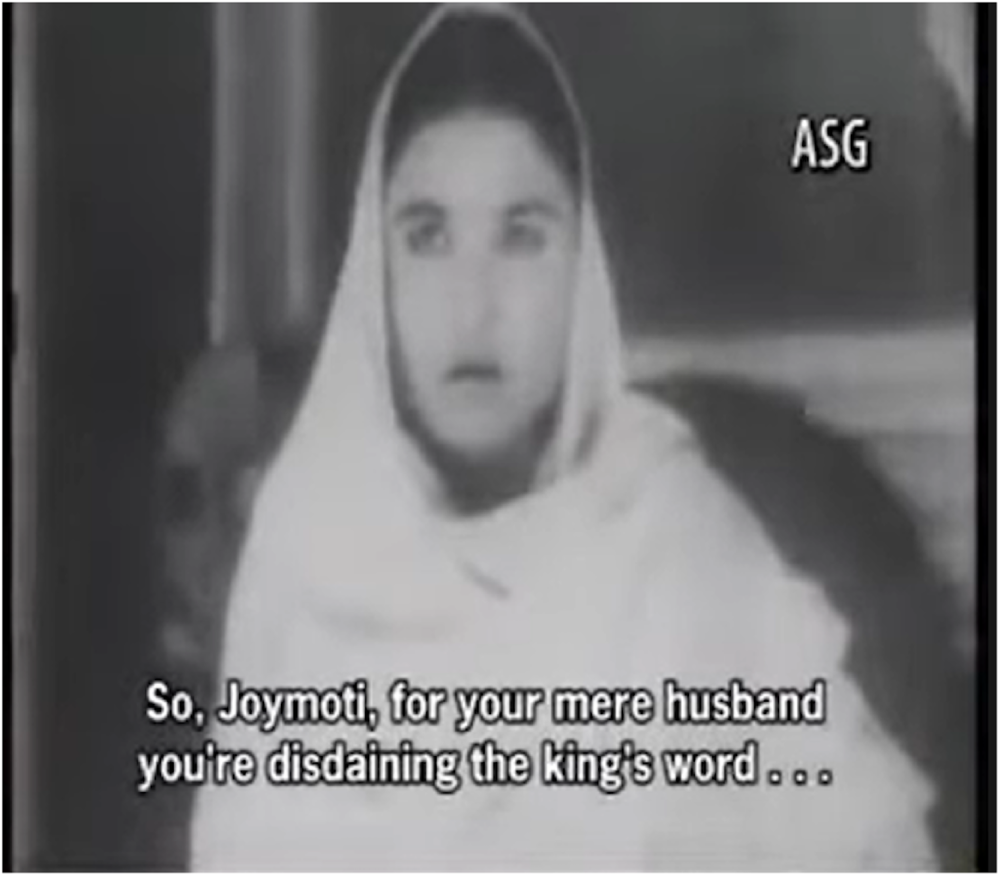
With a traditional Assamese mēkhēlā cādar covering her head,Footnote 57 as depicted in Figure 1, Joymoti becomes the epitome of silent suffering and sacrifice in the name of one’s husband and for the cause of the ‘nation’. Moreover, through the sartorial depiction here, Agarwala prioritised markers of a generic ‘Assamese’ identity instead of highlighting distinct Ahom traits in order to invoke a nationalist sentiment that was pan-Indian and anti-British.Footnote 58
Aideu Handique as Joymoti, wearing a mēkhēlā cādar covering her head while being presented at the king’s court. Source: YouTube.

Figure 1 Long description
A woman, identified as Joymoti, is shown wearing traditional attire with a head covering. The image includes subtitles that read, 'So, Joymoti, for your mere husband you're disdaining the king's word...' indicating a scene of defiance or confrontation. The setting suggests a formal or significant context, possibly a court or important gathering.
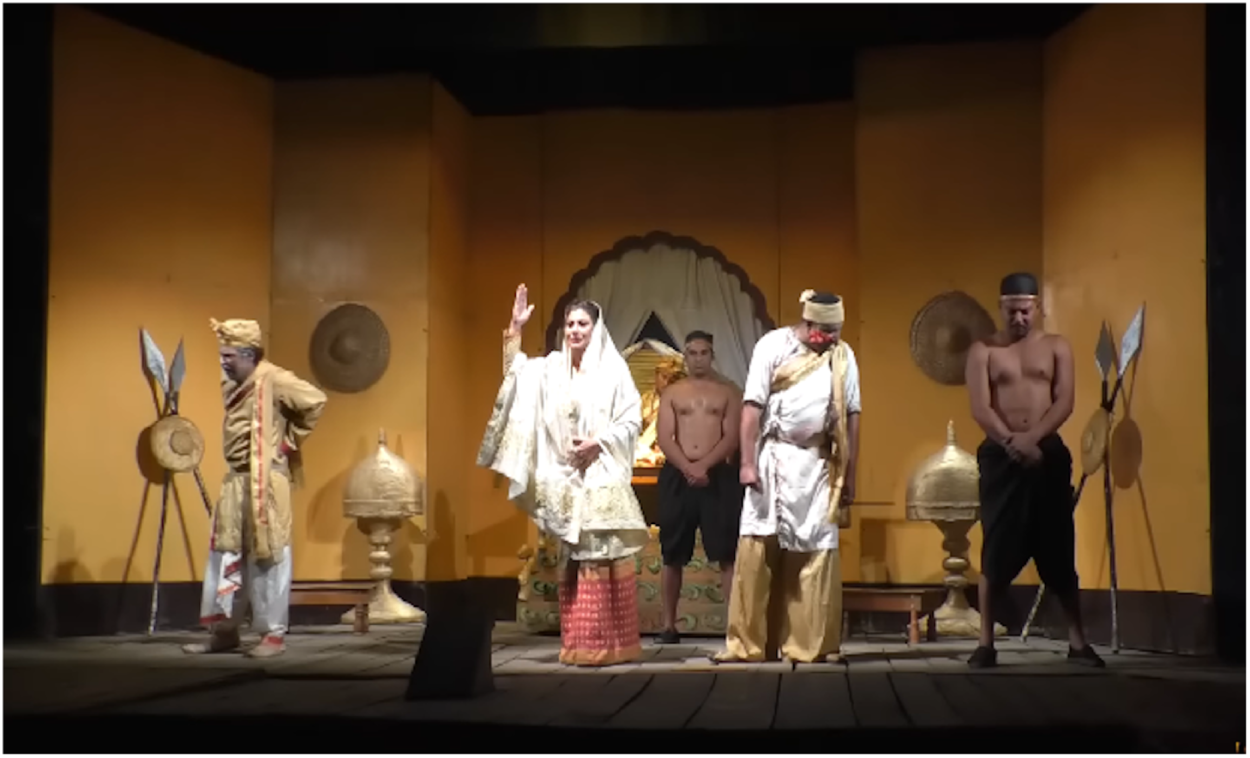
On the other hand, in Awahan Theatre’s stage adaptation of Joymoti (2021–2022),Footnote 59 Prastuti Porasor, who takes on the role of the protagonist, is showcased both before and after her marriage to Gadapani. As a young unmarried woman, she is asked by her father to accompany Gadapani to a nearby pond (enabling a form of mobility) and is also introduced on stage through a Bihu dance sequence. This characterisation is imbued with a sense of agency as, being impressed by the young prince’s strength and integrity, she makes the decision to marry him. The caklaṃ wedding sequence with 101 earthen lamps lit for the ceremony is used as a pertinent semiotic device to assert Ahom identity, achieved through sartorial refashioning with the actors donning traditional Ahom attire.Footnote 60 Post-marriage, Joymoti convinces Gadapani to leave the kingdom with the rise in political turmoil. She also questions why women are kept away from politics.Footnote 61 Then, Joymoti and Gadapani embrace each other on stage (as equals?), just before Gadapani flees to save his life. The soldiers interrogate Joymoti about Gadapani’s whereabouts but are met with silence. Later, Joymoti enters the court on her own and refuses to bow and pay respect to the king. Instead, she delivers a powerful dialogue about the ideal ruler and the rightful heir to the throne, with a distinctive shift in body language and movements like the hand gestures depicted in Figure 2. When threatened with punishment, she laughs in the face of patriarchal oppression, thereby transgressing societal norms.
Prastuti Porasor, as Joymoti, faces the hearing at the king’s court and voices her political opinions. Source: YouTube.

Figure 2 Long description
Five people are standing on a stage. Prastuti Porasor, a woman, is positioned in the center, wearing traditional attire and gesturing with her right hand raised. To her left, a man in traditional clothing stands with his hands clasped. To her right, another man is dressed similarly, facing forward. Two men are positioned at either end of the stage, both shirtless and wearing traditional lower garments. The stage is decorated with spears and shields and a large archway is visible in the background.
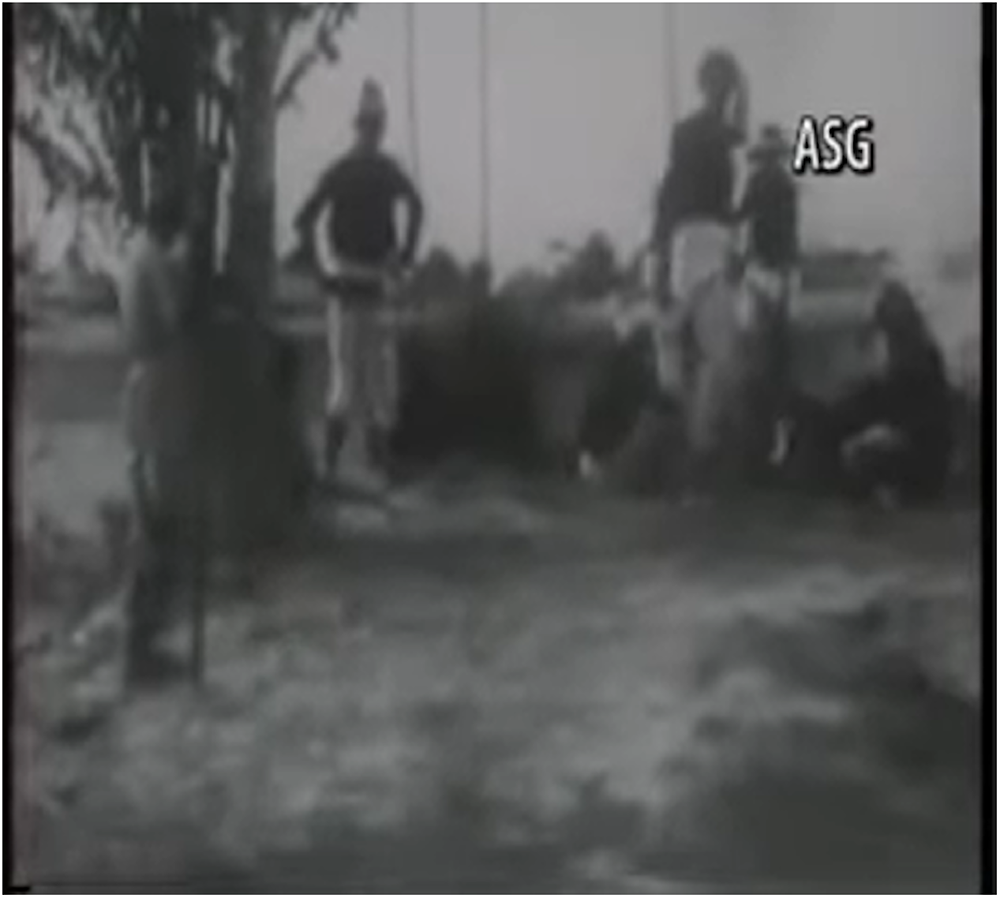
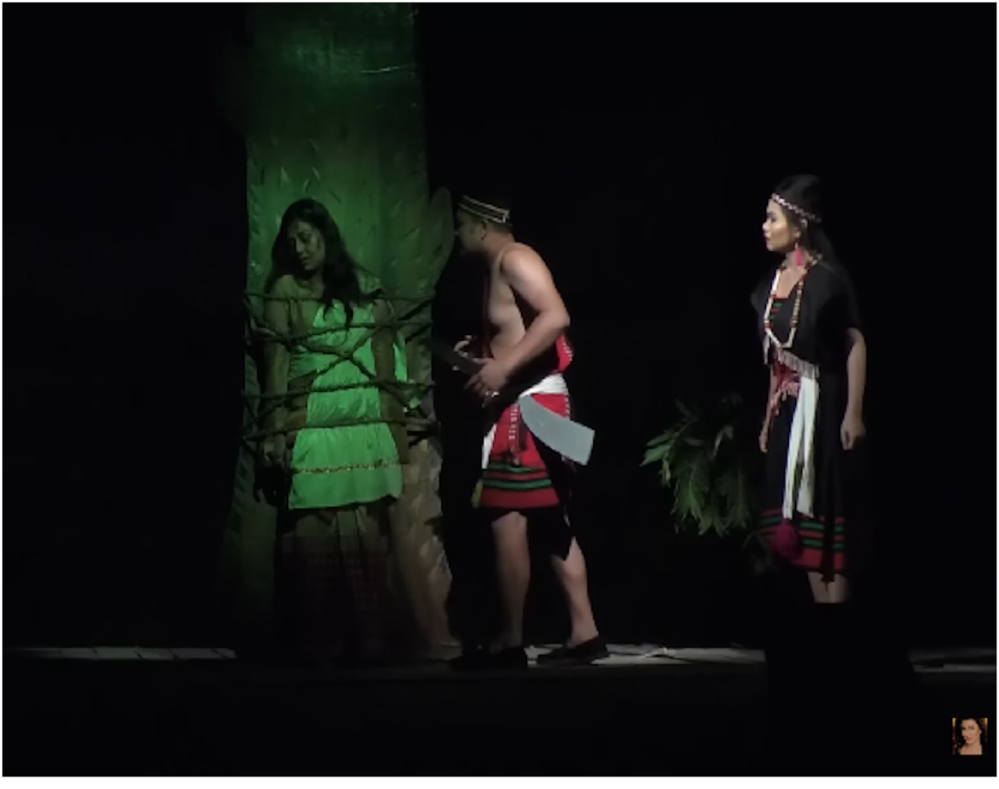
Separated by almost nine decades, the film and the theatrical text point to the prevalent codes in a given culture’s system of constraint and mobility.Footnote 62 In both texts, however, Joymoti plans her husband’s escape successfully but ends up im/mobilising herself—in Figure 3, Joymoti is tied to a tree as she sits on the ground, and in Figure 4, she is standing while being tied against a tree. By aiding Gadapani’s mobility, although his life is at risk as a fugitive, the gendered nature of Joymoti’s sacrifice is glorified. After several days of torture in Jereṅā Pathār (lit. ‘a field of thorns’),Footnote 63 Aideo Handique’s Joymoti utters the following words before her death, ‘Ah! My lord, my husband … let the country prosper, let our people strive…’.
Joymoti is punished in Jereṅā Pathār. Tied to a tree, she sits on the ground, surrounded by royal executioners. Source: YouTube.

Figure 3 Long description
Joymoti is tied to a tree, sitting on the ground in a field. She is surrounded by five men, who appear to be royal executioners. The men are standing and sitting in various positions around her, with some leaning against the tree and others standing nearby. The setting is an open area with sparse vegetation visible in the background.
Gadadhar, in Naga attire, along with Watlong, a Naga girl, visit Joymoti in Jereṅā Pathār. Source: YouTube.

Figure 4 Long description
Gadadhar, a man dressed in traditional Naga attire, stands to the right of Joymoti, who is tied to a tree. Joymoti is positioned on the left, with ropes securing her to the tree. Watlong, a Naga girl, stands to the right of Gadadhar, observing the scene. The setting is dimly lit, emphasizing the dramatic nature of the scene.
In Awahan Theatre’s version, Joymoti recovers her agency even in her im/mobile state. Through her impactful dialogue delivery, she challenges the power of the state, which amplifies her status from a woman/wife/mother to ‘Nation’ personified. One of the ministers is shown to fall at her feet asking for forgiveness. Hence, she mobilises her voice to awaken people’s consciousness, urging them to take action for political change, thereby taking an agential role.
In Lakshminath Bezbaruah’s Joymoti Konwari (1915), he introduces a new character in Act 3, Scene 2: Dalimi, a Naga woman.Footnote 64 During Gadapani’s stay with the village headman’s family in the Naga hills, he meets their daughter Dalimi, who falls in love with him. She is characterised as Nature’s child and is shown to roam around in the hills. When Gadapani decides to leave for the valley to visit Joymoti, a heartbroken Dalimi takes her own life by jumping off a cliff. Maitri Baruah illustrates how Dalimi provides a counterpoint to the gendered modernity in Joymoti’s representation within the construct of Ahom–Vaishnav unity and thus Dalimi’s ‘final erasure keeps her outside the imagined frame of modern Assam’.Footnote 65 Her simple pastoral verses as opposed to Joymoti’s literary (high) language consolidates hierarchies between the Asamīẏā and the other linguistic groups and tribal communities in the region.Footnote 66 While scholars and intellectuals dismiss Dalimi as a work of Assamese literary fiction, anthropologist Dolly Kikon traces the burial site of Dalimi in a town called Naginimora in the north-eastern state of Nagaland.Footnote 67 Moreover, Kikon foregrounds the story from a Phom Naga village where the villagers claimed that Dalimi belonged to their tribe and was known as Watlong.Footnote 68 In Awahan Theatre’s adaptation, a binary ‘hills’ versus ‘valley’ narrative is established through Watlong’s character. Watlong accompanies Ang (lit. ‘king’, Gadapani’s Naga name as a fugitive) when he visits Joymoti in Jereṅā Pathār, thus travelling from the hills to the valley (in contrast to Joymoti’s stillness), a departure from Dalimi’s portrayal in Bezbaruah’s play and Agarwala’s cinematic text. In the theatrical adaptation, Watlong then jumps into the river when her love is unreciprocated. A hierarchy is constructed as the sacrifice made for love by the Naga tribal woman Watlong is overlooked, while Joymoti’s sacrifice to save her husband for the nation’s cause catapults her into the image of the ‘ideal woman’. Her death, as Gaurav Rajkhowa asserts, ‘only sanctifies the satitva that was immanent all along’.Footnote 69
Significantly, the actor playing Watlong’s role, Jinu Boro, belongs to the tribal Bodo community. Her career trajectory illustrates an upward mobility that exists within mobile theatre groups—she initially joined as a dancer but now takes on meaningful acting roles on stage. However, in casting Porasor (an upper-caste Brahmin woman) in the role of an Ahom character, there is an appropriation of the Ahom identity with the caste-Hindu Assamese identity. It could be a deliberate move given the shift in mobile theatre from popular to populist representations in the twenty-first century.Footnote 70 It needs to be emphasised that Porasor is also the producer of the Awahan Theatre group and occupies the unique position of being the only female producer-cum-lead actor in the mobile theatre culture-scape. Unlike the social media channels of other theatre groups, Porasor uploads video recordings of the live theatre plays through her own YouTube channel, a form of agency, as she commands a celebrity status in Assam and has a huge audience/fan base.
In one of the field sites, during a rehearsal (ākharā) session, I observed that lead actors were seated on the left side of the stage, one of the senior female actors was shifting from one side to the other occupying both spaces, while the dancers were seated on the right side. They were also being served tea in different types of cups—the senior artists would pick up the ceramic cups, while the steel cups would be picked up by the junior artists. A subtle form of hierarchy is practised, although it is termed as ‘discipline’ by the performers. There seemed to be a divide between ‘glamour’ artists and junior artists/dancers. Some women performers had joined mobile theatre before or after their matriculation exams, while a few of them had completed their graduation and post-graduation as well. During my interview with one of the leading female actors, Nandita, she invoked Aideu Handique to reflect on the situation during the early twentieth century and whether it has changed:
…since we are part of a patriarchal society. We all know about Aideu Handique, the situation at that time, and now we are also acting. Even now, I face certain situations … when girls approach me, they are passionate about wanting to pursue acting but their fathers will not allow it. This still exists. Since this is an extra medium, you have to stay away from your natal family for nine months, it is a different environment. At times, people watch from afar and analyse in a peculiar way. [Interviewed on 14 August 2022.]
In the above statement, it is important to notice the contestation amidst which mobile theatre actors pursue their work in public spaces. What Nandita refers to as ‘an extra medium’, I interpret as engagement with a public medium, since she refers to the family and domestic realm as a contrast immediately after that. My interviews with male producers of mobile theatre mostly point towards a tussle between power and control.Footnote 71 They made decisions around mobility in and out of the rehearsal camps, and these rules differed for male and female actors. Yet, this form of entertainment came with a nine-month contract, so actors could also negotiate their position and remuneration based on their decision to continue with the same theatre group or to join another competitive one the following season. Since the beginning of the twenty-first century, there has been a pattern of ‘reverse mobility’ in which film stars/celebrities and popular television actors migrate towards mobile theatre as it is comparatively more lucrative. In this regard, Chandrima, a senior female actor with 26 years of experience shared that:
There were so many good plays where at that time I took up the role of the heroine. But during our time, the remuneration was very different from what it is today. We worked with very little payment. There also wasn’t much price rise then. Gradually, the nayak/nayika (actor/actress) from TV and cinema entered Bhramẏamān theatre; that’s when the remuneration increased. We heard so and we saw that too, maybe they are deserving of it….
With the entry of glamour from TV or film to theatre, payments increased … From the time that changed in mobile theatre, the payments did increase, and then we gradually went for secondary characters. [Interviewed on 3 August 2022.]
Chandrima points out how this movement of ‘glamour’ actors from one medium to another ensured higher pay and better living conditions at times. Female performers are mainly employed as actors and dancers, and as they grow in seniority and experience, they acquire more power to negotiate. During an interview, Dilip, a veteran male producer spoke about the concerns around mobility for the female performers within the theatre spaces:
And one has to give them freedom … around ten years back the girls were not allowed to venture into market places … they were educated girls. They would shop for their basic necessities or clothes. If they required something, why should they not go to the market? During yesteryears, it was difficult to find women, one would have to convince their parents. [Interviewed on 5 August 2022.]
Such restrictive practices are prevalent even today. In the name of decorum and discipline, the mobility of female performers is controlled, especially during the rehearsal period in the theatre camps. Such decisions are mainly taken by the all-male management teams of the theatre groups, headed by the mostly male proprietors.
To say that women performers are marginalised within mobile theatre spaces would be an overly simplified demarcation. It is important to note that while there is a power hierarchy that exists amongst the female performers (not a homogenous category) within each mobile theatre group, they still depend on the male members for major decision-making processes. Among my respondents, women performers of mobile theatre groups belonged to diverse social locations, including tribal indigenous women, but only Brahmin and upper-caste women were cast in lead roles as the ‘heroine’. Their experiences are varied and determined by their social and class position. A few leading female protagonist ‘stars’ have been on stage since the late 1990s, but such cases are quite rare. Usually, after a certain amount of time, they move on from playing the roles of ‘heroine’ to other supporting roles, while senior male actors continue to be cast as the main lead or take up additional responsibilities like script-writing and directing.
Depending on their seniority, current role, and past experiences, their agency within the theatre space brings out myriad narratives. For instance, Priyanka is a female protagonist who debuted in 1997–1998, and regarding choosing her roles on stage, she said:
But one thing that I am careful about is in terms of the play itself. Whichever theatre group it is, I am careful about the dialogues that I am uttering, no matter what kind of characters I get to play … Whatever I say, the audience will accept it, but that is why I have to be careful that the dialogues I deliver, I have to be aware and give significance to those words. [Interviewed on 15 November 2022.]
Along with the agency to decide on on-stage roles,Footnote 72 the way one navigates the theatre space is also important. When I asked about the newcomers in the industry and the newer trends and latest changes that have taken place, Priyanka said:
Nowadays, women desire a lot of freedom, so that change has also come in [slight laughter] … There were certain rules to be followed before … [Talking about the producer-director who introduced her to theatre in 1997] he would hit me in the leg and say, ‘Arē bēṭī [addressing the actor as his daughter], is that how you walk!?’ [Interviewed on 15 November 2022.]
This form of behaviour is portrayed as acceptable in the name of dedication to and respect for the craft. Priyanka talks about yesteryear with a sense of nostalgia. Yet, this form of violence and control exercised by the senior male members of theatre groups cannot be overlooked. Mostly, (male) producers or management teams make the final call on the suitability of actors for particular roles. On the surface level, this seems to be part of the working process, but when it centres around the female performer’s indigenous identity, it becomes very problematic. Tribal, indigenous community members and Muslim women are never considered for the role of the female protagonist. In this regard, I met Munmi, who introduced herself by claiming her Mising tribal identity.Footnote 73 She shared the trials and tribulations she underwent when joining a mobile theatre group in 2017–2018:
When the proprietor spoke with me, he told me, ‘You will be able to do this, your voice is clear. You will have to take up the role of heroine.’ He said such things … I quite liked it, although I had no idea about theatre. It was my first time in theatre. I did not know how to go about it. I was told if you join the theatre, you will be paid for it, you will get the opportunity to dance and act. You will meet good people. So, I went … After meeting the owner of the theatre group, I started rehearsals as well, for the role of the heroine. Later, when the playwright came to the scene, he did not let me say even one dialogue. ‘She is a Mising girl, she won’t be able to do this.’ Then they immediately searched for a second heroine. They looked for a second heroine, brought an actor. I did not mind it as I did not have much idea. I would like it if I am given the chance to dance or act, both would work for me. [Interviewed on 8 April 2023.]
Munmi was in her early 20s when she first joined the theatre, and her excitement was palpable as she talked about her initial aspirations. Her experience showcased how theatre spaces could also become exploitative and exclusionary. As part of the informal economy, members generally work on contracts, and the position they hold within the theatre group determines how much power and agency they can assert. This exclusionary act based on the female actor’s identity exposes a bigger issue for the cultural sphere and the politics of representation both on- and off-stage. Since the early twentieth century, female travelling performers have struggled to traverse long distances and although at times they found roles in mobile theatre and films, these very spaces have not always been inclusive.
Conclusion
Mobile theatre is a product of the social milieu it caters to, yet it has also garnered criticism in recent years. Although Bhramẏamān theatre emerged as a socially responsible cultural forum, by the end of the twentieth century it took the form of commercial theatre, turning towards the capitalist interests of profit-making.Footnote 74 With increasing commercialisation, travelling female performers remain marginalised, but their bodies have also become hyper-visible, as they are commodified in the media industry. As opportunities for mobility increase, so does the level of precarity; theatre work becomes more exploitative for some, yet there are economic and social capital gains for others.Footnote 75
Through cinematic representations and theatrical adaptations, mediated images have popularised ideas of womanhood from colonial to contemporary times. However, these representations of historical/literary/mythical figures like Joymoti need to be studied along with the mobility or lack of mobility or restricted mobility of the female performer who enacted these roles. As shown in this article, in the colonial context these mobilities were severely restricted. Reminiscent of colonial modernity, the image of the ‘ideal woman’ imbued with ‘feminine virtues’ of sacrifice and suffering has been repurposed as a nostalgic trope in recent times, reinforcing the power dynamics that produced these differences in the first place.Footnote 76 This article reaffirms that in the context of female performers in Assam, mobility in its embodied and gendered forms is a complex and ongoing process.
Acknowledgements
I am grateful to Dr Radha Kapuria, Dr Shweta Sachdeva Jha, and Dr Jennifer Howes for bringing this panel together at the European Conference on South Asian Studies (ECSAS) 2023 and for their feedback at different stages of writing. The detailed feedback from the two anonymous reviewers helped me to rethink my ideas and strengthen my arguments. I would like to thank Dr Faiz Ullah for his valuable guidance and Dr Sujatha Devarapalli for her insightful suggestions on the earliest draft of this article. This research work was supported by the Indian Council of Social Science Research (ICSSR) through the award of Centrally-Administered Full-Term Doctoral Fellowship [File No. RFD/2021-22/GEN/GEND/227]. I presented parts of this article at the Indian Association for Women’s Studies (IAWS) Northern Regional Conference at the University of Delhi, India, in 2023, the Theatre and Performance Research Association (TaPRA) Annual Conference at the University of Leeds, UK, in 2023, and the XVII National Conference of the Indian Association for Women’s Studies (IAWS) at Government College for Women, Thiruvananthapuram, Kerala, India. I thank the audience members for their responses to my conference presentations.
Conflicts of interest
None.