Implications
Knowledge of the response of pigs to essential amino acids (AA) is crucial for formulating low-CP diets that allow pigs to maintain growth. The results of this study show that the Ile requirement estimate for maximum performance in cereal–soybean meal-based diets is lower than the National Research Council (NRC, 1998) estimate. The requirement estimates for His and Leu are in agreement with those of the NRC. A supply of 49%, 32% and 102% standardized ileal digestible Ile : Lys, His : Lys and Leu : Lys, respectively, is sufficient to maintain performance, indicating that the CP content in diets can be further decreased with supplementation of currently available crystalline AA.
Introduction
The formulation of low-CP diets supplemented with the crystalline amino acid (AA) l-Lys, l-Thr, dl-Met, l-Trp and l-Val enables the improvement of nitrogen efficiency while maintaining the performance of pigs. Valine is the fifth limiting AA in a cereal–soybean meal-based diet (Figueroa et al., Reference Figueroa, Lewis, Miller, Fischer and Diedrichsen2003; Lordelo et al., Reference Lordelo, Gaspar, Le Bellego and Freire2008; Barea et al., Reference Barea, Brossard, Le Floc'h, Primot, Melchior and van Milgen2009b). On the basis of the current AA requirement estimates (National Research Council (NRC), 1998; British Society of Animal Science (BSAS), 2003), Ile, His or Leu may be the sixth limiting AA in cereal–soybean meal-based diets. However, experimental information on the standardized ileal digestible (SID) Ile : Lys, His : Lys and Leu : Lys requirements is scarce, and the current requirement estimates for pigs weighing 10 to 20 kg are 54%, 32% and 101%, respectively, according to the NRC (1998), and 58%, 34% and 100% according to the BSAS (2003). Knowledge on the response of piglets to the Ile, Leu and His supply allows identifying the order of AA limitation and is essential to further reducing the CP content in diets.
The objective of the present study was to determine the effect of supplementing a low-CP diet with l-Ile, l-His and l-Leu on feed intake and growth in pigs. One experiment was carried out to identify the most limiting AA for performance among Ile, His and Leu. Five subsequent dose–response experiments were carried out to estimate the SID Ile : Lys, His : Lys and Leu : Lys requirements that maximize feed intake and growth in pigs.
Material and methods
Experimental procedures and animal care were carried out according to current French legislation, and authorizations to experiment on living animals were provided by the French Ministry of Agriculture (certificate numbers 7704 and 7719 for Jaap van Milgen and Nathalie Le Floc'h, respectively).
General
For all experiments, the methods were similar and have been described in detail by Barea et al. (Reference Barea, Brossard, Le Floc'h, Primot, Melchior and van Milgen2009b). Briefly, 6-week-old Pietrain × (Large White × Landrace) barrows and female piglets from the experimental herd of INRA (St-Gilles, France) were used. After weaning at 4 weeks of age, pigs received a commercial pre-starter diet, which was gradually replaced by the experimental diets at 10 days post weaning so that from 12 days post weaning pigs were offered only the experimental diets. At 5 weeks of age, pigs were blocked by sex, BW and origin (siblings or half-siblings), housed individually and allotted to different treatments within a block. Feed and water were offered ad libitum. The experiments lasted for 21 days and pigs were weighed at the beginning and at the end of the experimental period after an overnight fast. Feed intake was measured weekly after the collection of feed refusals. The ambient temperature was maintained at 28°C the week after weaning and was decreased by 1°C per week afterwards.
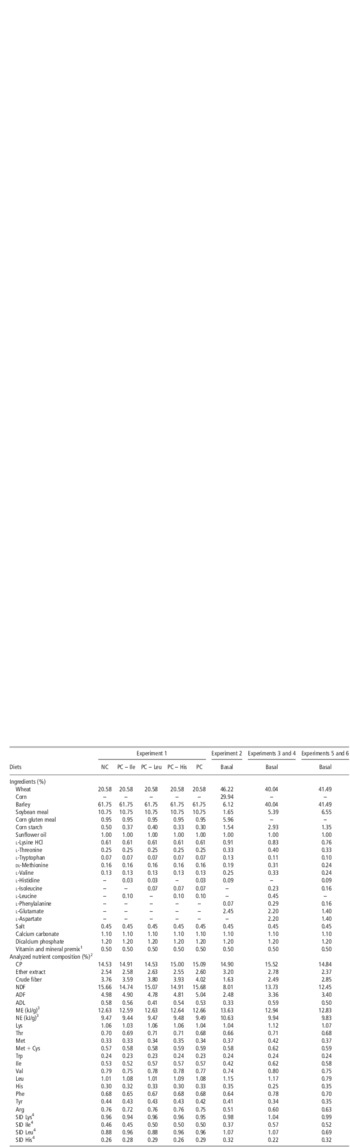
Low-CP diets (≈15% CP) were formulated to be sub-limiting in Lys at 1.00% SID (Table 1) to express the AA supply relative to Lys (Boisen, Reference Boisen2003; Barea et al., Reference Barea, Brossard, Le Floc'h, Primot, Melchior and van Milgen2009b). Crystalline AAs were supplied to match or exceed the NRC requirement estimates for essential AA and nitrogen in pigs weighing 10 to 20 kg.
Composition of experimental diets (as-fed basis)

NC = negative control diet; PC = positive control diet; ME = metabolizable energy; NE = net energy; SID = standardized ileal digestible.
1Supplied per kilogram (as-fed basis) of diet: vitamin A, 10 000 IU; vitamin D3, 2000 IU; vitamin E, 20 mg; vitamin K3, 2 mg; vitamin B1, 2 mg; vitamin B2, 5 mg; niacin, 20 mg; pantothenic acid, 10 mg; vitamin B6, 5 mg; biotin, 0.2 mg; folic acid, 1 mg; vitamin B12, 0.03 mg; chloride de choline, 600 mg; vitamin C, 40 mg; Fe as iron sulfate, 100 mg; Cu as copper sulfate, 20 mg; Zn as zinc oxide, 100 mg; Mn as manganese oxide, 40 mg; I as calcium iodate, 0.6 mg; Se as sodium selenium, 0.3 mg; and Co as carbonate cobalt, 1 mg.
2Adjusted for 87.3% DM.
3Values for ME and NE were calculated according to Noblet et al. (Reference Noblet, Fortune, Shi and Dubois1994).
4SID Lys, Val, Ile and Leu, calculated from the analyzed amino acid composition and table values of the digestibility of feed ingredients (Sauvant et al., Reference Sauvant, Perez and Tran2004).
Experiment 1
Fifteen blocks of five piglets each were allotted to one of the five experimental diets based on wheat, barley and soybean meals (Table 1). A negative control diet (NC) was formulated to contain 10% less Ile, His and Leu than the NRC (1998) requirement estimates (54%, 32% and 101% relative to Lys, respectively). The positive control diet (PC) was similar to the NC diet but supplemented with l-Leu, l-His and l-Ile to achieve 100% of the NRC requirement estimate. In addition, diets deficient in Ile (PC – Ile), Leu (PC – Leu) or His (PC – His) were obtained by supplementing the NC diet with AA so that the supplies of Ile, Leu and His were 10% below the NRC requirement estimate.
Experiments 2, 3, 4, 5 and 6
Five dose–response experiments were carried out to estimate the response of pigs to the Ile, His and Leu supply. In Experiments 2, 3, 4, 5 and 6, 14 blocks of six piglets each were allotted to six levels of SID Ile : Lys (40%, 43%, 46%, 49%, 52% and 55%), His : Lys (20%, 24%, 28%, 32%, 36% and 40%), His : Lys (21%, 24%, 27%, 30%, 33% and 36%), Leu : Lys (70%, 78%, 86%, 94%, 102% and 110%) and Leu : Lys (80%, 90%, 100%, 110%, 120% and 130%), respectively, achieved by the addition of l-Ile, l-His or l-Leu to a basal diet first limiting in Ile, His or Leu (Table 1). Two batches of feed were manufactured with the basal and the highest AA levels and were mixed thereafter to obtain the anticipated SID AA : Lys.
Chemical analysis
Chemical analyses have been described in detail by Gloaguen et al. (Reference Gloaguen, Le Floc'h, Brossard, Barea, Primot, Corrent and van Milgen2011). Briefly, the gross energy content was measured with an adiabatic bomb calorimeter (ISO, 1998; method 9831; IKA C2000 and IKA C5000, Staufen, Germany). Crude protein (N × 6.25) was obtained after N analysis according to the Dumas procedure using a Rapid N cube (Elementar France, Villeurbanne, France) using the AFNOR method NF V18-120 (AFNOR, 1997). Total AAs from protein were obtained after acid hydrolysis for 23 h at 110°C under reflux. For Met and Cys, hydrolysis was performed after oxidation with performic acid. The AA content was determined by ion exchange chromatography and ninhydrin derivatization (JLC-500/V AminoTac Amino Acid Analyzer, Jeol, Croissy-sur-Seine, France) using the AFNOR method NF EN ISO 13903 (AFNOR, 2005). Total Trp was analyzed by HPLC with a fluorescence detector (RF 10AXL, Shimadzu, Bonneuil sur Marne, France) after alkaline hydrolysis with barium hydroxide.
Data analysis
Data were analyzed using the PROC MIXED procedure (SAS Institute Inc., Cary, NC, USA) with diet as the fixed effect and block as the random effect. Results are reported as least-square means. Probabilities <0.05 were considered significant.
The response to the Ile, His and Leu supply was also analyzed by regression with a curvilinear plateau (CLP) model using the PROC NLIN procedure of SAS (Robbins et al., Reference Robbins, Saxton and Southern2006). The model was parameterized to include a plateau for each block, the minimum SID AA concentration to reach the plateau (i.e. the requirement estimate) and the response at 90% of the requirement relative to the plateau value. The latter two parameters were assumed to be common for all blocks (Gloaguen et al., Reference Gloaguen, Le Floc'h, Brossard, Barea, Primot, Corrent and van Milgen2011).
Results
In general, the pigs appeared healthy throughout the experiments. Some cases of diarrhea occurred and these pigs then received colistin orally (CEVA Santé Animale, Libourne, France). In Experiment 3, one pig receiving the diet containing 24% His : Lys died without an apparent relation to the dietary treatment. Data from another pig receiving the diet with 36% His : Lys were removed before data analysis because of an error in recording the BW. The analyzed and calculated compositions of the experimental diets were in agreement with the anticipated values (Table 1).
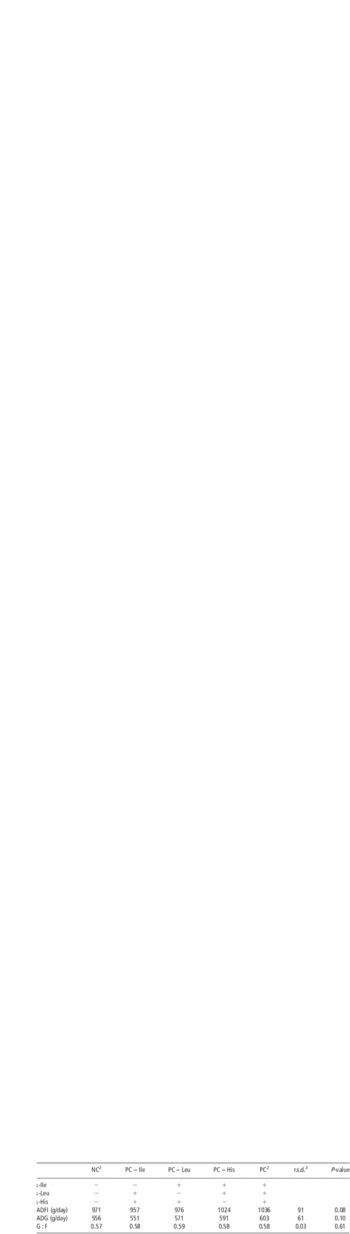
In Experiment 1, the final BW of pigs offered diets NC and PC – Ile was about 5% less than that of pigs offered diets PC – His and PC (P = 0.03) (Table 2). When piglets received diet PC – Leu, the final BW was intermediate between those receiving diets NC and PC. These effects tended to be similar for average daily feed intake (ADFI) and average daily gain (ADG) (P = 0.08 and 0.10, respectively), but no diet effect was observed for the gain-to-feed ratio (G : F).
Effect of Ile, Leu and His supply on performance in piglets (Experiment 1)1

ADFI = average daily feed intake; ADG = average daily gain; G : F = gain to feed ratio, adjusted for 87.3% DM; BW = body weight; DM = dry matter.
1Data are presented as least-squares means. Diet n = 5, block n = 15.
2NC = negative control diet containing 48%, 90% and 29% SID Ile : Lys, Leu : Lys and His : Lys, respectively; PC = positive control diet containing 54%, 101% and 32% SID Ile : Lys, Leu : Lys and His : Lys, respectively.
3n = 75.
The average initial and final BWs were 12.6 ± 1.0 and 24.6 ± 1.9 kg, respectively.
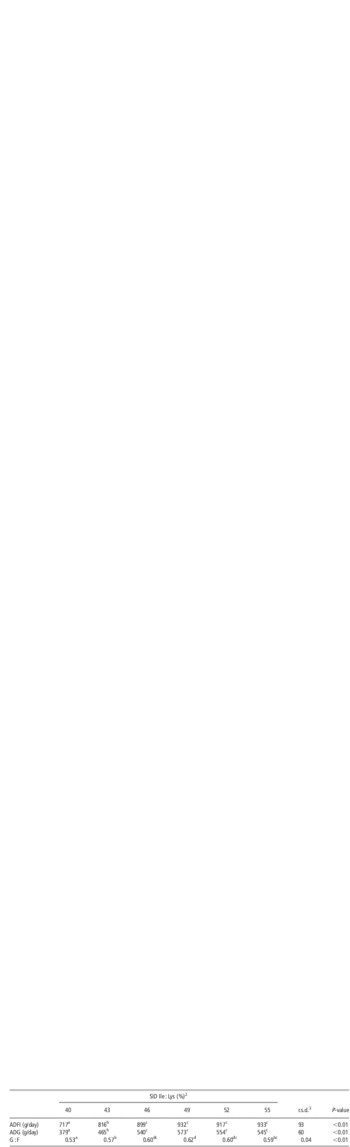
In Experiment 2, supplementation of l-Ile resulted in an increase in ADFI, ADG and G : F (P < 0.01; Table 3). Maximum ADFI, ADG and G : F were reached at 50.0%, 49.4% and 48.3% SID Ile : Lys, respectively (Table 6; Supplementary Figure S1). Plateau values of the blocks ranged from 689 to 1062 g/day for ADFI, from 448 to 654 g/day for ADG and from 0.52 to 0.61 for G : F. A reduction of 10% relative to the Ile requirement resulted in a 6%, 9% and 4% decrease in ADFI, ADG and G : F, respectively, compared with the plateau value.
Effect of the SID Ile : Lys supply on performance in piglets (Experiment 2)1

SID = standardized ileal digestible; ADFI = average daily feed intake; ADG = average daily gain; G : F = gain to feed ratio, adjusted for 87.3% DM; DM = dry matter.
1Data are presented as least-squares means. Diet n = 6, block n = 14.
2Anticipated SID Ile : Lys values. The SID Ile : Lys from the measured Lys and Ile contents and the estimated SID values from feed ingredients (Sauvant et al., Reference Sauvant, Perez and Tran2004) were 38%, 41%, 43%, 47%, 50% and 52%.
3n = 84.
a,b,c,dValues with different superscript letters are different by pairwise comparison, P < 0.05. The average initial and final BW were 12.4 ± 1.4 and 21.1 ± 3.0 kg, respectively.
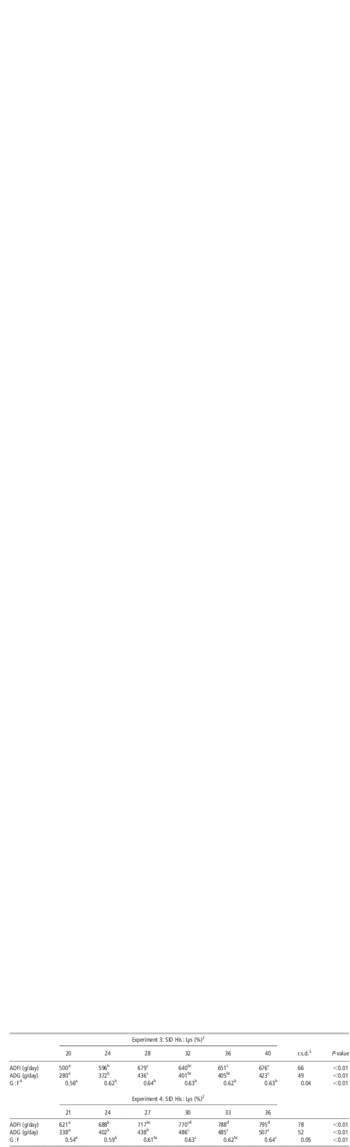
In Experiments 3 and 4, ADFI and ADG increased (P < 0.01) when SID His : Lys increased from 20% to 30% (Table 4). There was no increase in G : F above a supply of 27% SID His : Lys. The response to the His supply was analyzed by regression in both experiments (Table 6; Supplementary Figure S2). Plateau values of the blocks ranged from 570 to 885 g/day for ADFI, from 318 to 570 g/day for ADG and from 0.55 to 0.68 for G : F. Maximum ADFI, ADG and G : F were reached at 32.7%, 31.6% and 28.8% SID His : Lys, respectively. A reduction of 10% relative to the His requirement estimate resulted in a 2%, 3% and 2% reduction in ADFI, ADG and G : F, respectively.
Effect of SID His : Lys supply on performance in piglets (Experiments 3 and 4)1

SID = standardized ileal digestible; ADFI = average daily feed intake; ADG = average daily gain; G : F = gain to feed ratio, adjusted for 87.3% DM; DM = dry matter.
1Data are presented as least-squares means. Diet n = 6, block n = 14.
2Anticipated SID His : Lys values. The SID His : Lys from the measured Lys and His contents and the estimated SID values from feed ingredients (Sauvant et al., Reference Sauvant, Perez and Tran2004) were 21%, 24%, 27%, 31%, 33% and 36% for Experiment 3 and 21%, 23%, 26%, 29%, 32% and 34% for Experiment 4.
3n = 82 for Experiment 3 and n = 84 for Experiment 4.
a,b,c,dValues with different superscript letters are different by pairwise comparison, P < 0.05.
In Experiment 3, the average initial and final BWs were 10.0 ± 1.2 and 18.1 ± 2.3 kg, respectively.
In Experiment 4, the average initial and final BWs were 11.9 ± 1.4 and 21.3 ± 2.7 kg, respectively.
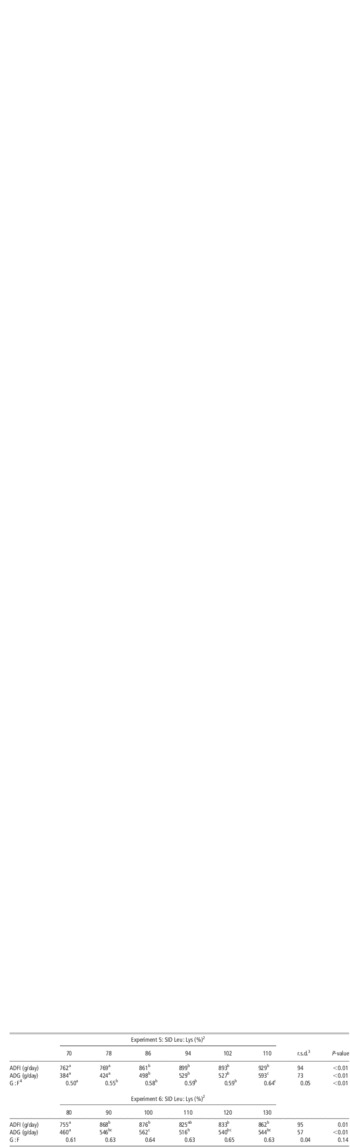
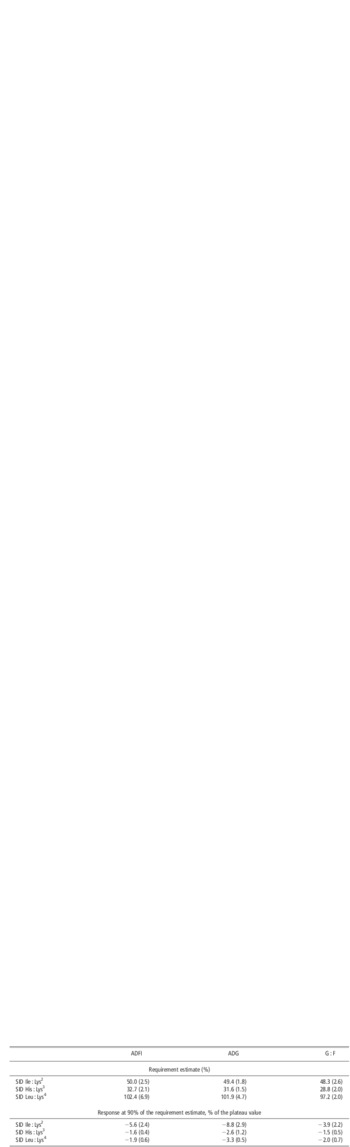
The effects of Leu intake on performance are given in Table 5. Increasing the SID Leu : Lys supply from 70% to 90% increased ADFI and ADG (P < 0.01). In Experiment 5, ADG and G : F increased by 13% and 8%, respectively, when SID Leu : Lys increased from 102% to 110% (P < 0.05). However, in Experiment 6, ADFI, ADG and G : F did not change when SID Leu : Lys increased from 90% to 130%. For the separate experiments, ANOVA did not indicate a clear response to the increasing Leu supply and the response could not be analyzed by regression. Therefore, a regression analysis was carried out combined for both experiments. Plateau values of the blocks ranged from 689 to 1079 g/day for ADFI, from 424 to 646 g/day for ADG and from 0.55 to 0.67 for G : F. The minimum SID Leu : Lys intakes to maximize ADFI, ADG and G : F were 102%, 102% and 96%, respectively (Table 6; Supplementary Figure S3). A reduction of 10% relative to the Leu requirement estimates resulted in a decrease of 2%, 3% and 2% for ADFI, ADG and G : F, respectively.
Effect of the SID Leu : Lys supply on performance in piglets (Experiments 5 and 6)1

SID = standardized ileal digestible; ADFI = average daily feed intake; ADG = average daily gain; G : F = gain to feed ratio, adjusted for 87.3% DM; DM = dry matter.
1Data are presented as least-squares means. Diet n = 6, block n = 14.
2Anticipated SID Leu : Lys values. The SID Leu : Lys from the measured Lys and Leu contents and the estimated SID values from feed ingredients (Sauvant et al., Reference Sauvant, Perez and Tran2004) were 69%, 78%, 85%, 91%, 102% and 106% for Experiment 5, and 79%, 91%, 100%, 108%, 117% and 128% for Experiment 6.
3n = 84 for both experiments.
a,b,cValues with different superscript letters are different by pairwise comparison, P < 0.05.
In Experiment 5, the average initial and final BWs were 11.3 ± 1.4 and 21.7 ± 3.0 kg, respectively.
In Experiment 6, the average initial and final BWs were 11.3 ± 1.4 and 22.4 ± 2.1 kg, respectively.
Estimated (SID) Ile : Lys, His : Lys, and Leu : Lys requirement ratio for performance of pigs analyzed by the curvilinear-plateau model (parameter estimates and asymptotic standard error given in parentheses)1

SID = standardized ileal digestible; ADFI = average daily feed intake; ADG = average daily gain are in g/day; G : F is in g/g.
1The model was parameterized to include the SID Ile : Lys, His : Lys or Leu : Lys requirement, the response at 90% of the requirement relative to the plateau and the plateau value.
2n = 84.
3n = 166.
4n = 168.
Discussion
The results of this study show that a low-CP diet formulated to supply 10% less SID Ile : Lys, His : Lys and Leu : Lys compared with the NRC (1998) requirement estimates (54, 32 and 101, respectively) for pigs weighing 10 to 20 kg slightly reduced ADG, indicating that Ile, His, Leu or all three were limiting for growth. The ADG, ADFI and G : F were similar in pigs receiving diets with 29% or 32% SID His : Lys, suggesting that the former level of His was not limiting for performance. No improvement in ADG was observed when His and Leu were added to the NC diet, suggesting that Ile was the first limiting AA in the NC diet. The response of piglets receiving a diet supplemented with Ile and His was intermediate to those receiving the NC and PC diets, indicating that a 10% Leu deficiency had a moderate effect on performance. Because the difference in ADG between NC and PC diets was low, it was not possible to identify whether the NC diet was deficient in Ile, Leu or both. Nevertheless, the results of the present experiment indicate that the SID Ile : Lys, His : Lys and Leu : Lys requirements are not greater than the current NRC (1998) requirement estimates.
Using literature data, van Milgen et al. (Reference van Milgen, Gloaguen, Le Floc'h, Brossard, Primot and Corrent2012) reported that there was no strong ADFI and ADG response to Ile supplementation when diets do not contain blood cells. These authors recommended that diets should provide at least 50% SID Ile : Lys. In the present study, a supply of 49% SID Ile : Lys was necessary to maximize the ADG, which is considerably lower than the Ile requirement estimate of the NRC (54%). This lower Ile requirement estimate confirms the results of our previous experiments in which no response was observed above 50% SID Ile : Lys (Barea et al., Reference Barea, Brossard, Le Floc'h, Primot and van Milgen2009a). Inclusion of 7.5% of spray-dried blood cells in diets for pigs weighing 8 to 23 kg required 59% SID Ile : Lys to maximize ADG (Wiltafsky et al., Reference Wiltafsky, Bartelt, Relandeau and Roth2009). Blood cells have a high or very high content of Leu, Val, His and Phe and these AAs compete with Ile in the transport and catabolic pathways (Kerr et al., Reference Kerr, Kiddt, Cuaron, Bryant, Parr, Maxwell and Weaver2004; Barea et al., Reference Barea, Brossard, Le Floc'h, Primot and van Milgen2009a). As a result, a greater Ile supply is required to maintain performance. In contrast, the requirement for Val does not appear to increase when Leu is supplied in excess (Gloaguen et al., Reference Gloaguen, Le Floc'h, Brossard, Barea, Primot, Corrent and van Milgen2011). It is possible that this difference comes from the high or very high Phe and His contents of blood cells that compete for transport with Ile (Pardridge, Reference Pardridge1977). The ADG decreased by 9% when the Ile supply was 10% below the Ile requirement estimate of the NRC. In comparison, when Val was supplied 10% below the requirement, the ADG decreased by only 5% (Barea et al., Reference Barea, Brossard, Le Floc'h, Primot, Melchior and van Milgen2009b). As a result, if excess Leu increases the catabolism of Val and Ile, the Ile–Leu antagonism may be more detrimental for BW gain than the Val–Leu antagonism. Therefore, the Ile requirement estimate to maximize growth may be affected more by a branched-chain AA unbalance than the Val requirement estimate. It is not clear why a deficient Ile supply results in such a drastic reduction in performance.
In pigs, His has been considered an essential AA for growth by Mertz et al. (Reference Mertz, Beeson and Jackson1952). However, there are indications that histidinol dehydrogenase, the enzyme that catalyzes the terminal step in the biosynthesis of His, is expressed in the liver and kidney but not in the muscle of pigs (Onodera, Reference Onodera2003). In humans, the essentiality of His in healthy adults has been a controversial topic because His is not required to maintain the nitrogen equilibrium (Rose et al., Reference Rose, Haines, Warner and Johnson1951). When a diet deficient in His is ingested, His may be released from hemoglobin and carnosine, a dipeptide present in large quantities in skeletal muscle (Robbins et al., Reference Robbins, Baker and Norton1977; Clemens et al., Reference Clemens, Kopple and Swendseid1984). These His releases may allow muscle protein accretion, even though the diet is deficient in His. This may explain why His requirement estimates using ADG or G : F as response criteria are about 30% lower compared with plasma His concentration as a response criterion (Robbins et al., Reference Robbins, Baker and Norton1977). Izquierdo et al. (Reference Izquierdo, Wedekind and Baker1988) failed to estimate a His requirement using plasma His concentration as a response criterion in pigs and observed a linear increase in plasma His without a breakpoint. This suggests that plasma His is not a good indicator of the His requirement to maximize growth. In the present study, the SID His : Lys requirement estimate for ADG was 32%, which is identical to the NRC (1998) requirement estimate. The latter value was based on the His requirement estimate of Izquierdo et al. (Reference Izquierdo, Wedekind and Baker1988) in pigs weighing 10 to 20 kg (0.36% total His). However, because the basal diet used by Izquierdo et al. (Reference Izquierdo, Wedekind and Baker1988) was not sub-limiting in Lys, the SID His : Lys requirement estimate of the NRC may be an overestimation. In addition, Li et al. (Reference Li, Zhang and Gong2002) estimated that the His requirement and this estimate (30% His : Lys, apparent ileal digestibility, which corresponds to 91% of the NRC requirement estimate) is lower than the value obtained in the present study.
To determine the Leu requirement for maximizing ADG with the use of the CLP model, the Leu supply should be sufficient to reach a plateau. However, in Experiment 5, ADG remained unchanged when SID Leu : Lys increased from 86% to 102% but increased when SID Leu : Lys increased from 102% to 110%. The increase in ADG from 102% to 110% SID Leu : Lys resulted mainly from an increase in feed efficiency. Leucine is not only a substrate for protein synthesis but also acts as a signal stimulating protein synthesis and inhibiting protein degradation in skeletal muscle (Tischler et al., Reference Tischler, Desautels and Goldberg1982; Escobar et al., Reference Escobar, Frank, Suryawan, Nguyen, Kimball, Jefferson and Davis2005; Li et al., Reference Li, Yin, Tan, Kong and Wu2011). Experimental data reporting the effect of supplementing Leu on ADG in piglets are limited. The addition of 1%, 2% or 4% l-Leu to a basal diet formulated to meet the Leu requirement had no impact on performance (Edmonds and Baker, Reference Edmonds and Baker1987). However, Yin et al. (Reference Yin, Yao, Liu, Gong, Ruan, Deng, Tan, Liu and Wu2010) reported an increase in ADG, but not in ADFI, in weanling pigs supplemented with 0.55% of l-Leu to a low-protein diet (16.9% CP), suggesting that the addition of free Leu above the Leu requirement could increase performance. In contrast to Experiment 5, the results of Experiment 6 did not indicate that increasing the Leu supply (100% to 130% SID Leu : Lys) increased G : F. Therefore, the SID Leu : Lys requirement may not be >100%. This is in agreement with the results from Augspurger and Baker (Reference Augspurger and Baker2004), who estimated an SID Leu : Lys close to that recommended by the NRC (101%). Nevertheless, the results of the AA deletion study (Experiment 1) and also the results of Experiments 5 and 6 indicate that an Leu supply of 10% below the requirement has little impact on performance. As discussed previously, an increase in Leu supply stimulates the catabolism of Ile and Val. Most feed ingredients have a high Leu : Lys ratio and the estimation of the Leu requirement is of great importance to avoid an AA imbalance and antagonism among AAs. The results of the present study indicate that a Leu supply above 102% SID Leu : Lys is not required for protein deposition but may be a potential source of AA competition for transport with large neutral amino acid or catabolic pathways with Val and Ile.
On the basis of the marginal efficiency of Ile utilization for ADG and ADFI (obtained from the linear-plateau model as the slope of the linear phase; 3.14% and 4.68% for ADG and ADFI, respectively; data not shown), we estimated that 67% of the reduction in ADG could be accounted for by the reduction in ADFI. Similarly, 69% and 60% of the decrease in ADG with a His and Leu deficiency, respectively, was due to the reduction in ADFI. An AA deficiency should limit protein deposition and thus growth. Because feed intake increases with increasing BW, part of the reduction in ADFI may be a consequence of a reduced growth rate. Moreover, pigs are able to detect a diet deficient in AA and select a more balanced diet (Ettle and Roth, Reference Ettle and Roth2003; Gloaguen et al., Reference Gloaguen, Le Floc'h, Corrent, Primot and van Milgen2012). In the present study, it is possible that the pig rejects the feed because of the absence of feed choice. In addition, the AA requirement estimate was greater for ADFI than for G : F, suggesting that the main response of the piglet to a Leu, His or Ile deficiency was to reduce its feed intake. Therefore, when ADFI and ADG are used as dose–response criteria in piglets offered feed ad libitum, the requirement estimate may result from the ability of the pig to detect and reject the AA-deficient diet.
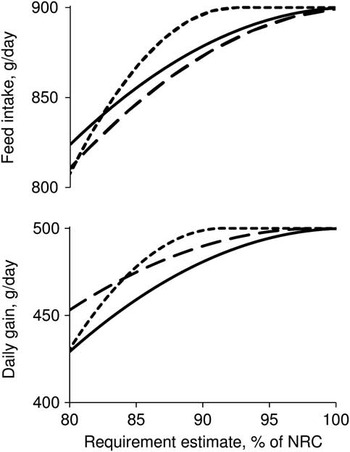
As illustrated in Figure 1, the Ile requirement estimate is lower than the current NRC value. This means that there is a greater potential to reduce the CP content of the diet, because Ile becomes limiting for performance at a lower level. Although the requirement estimate with the CLP model satisfies the objective of ‘maximizing growth’, a nutritionist should also have an interest in the response to AA deficiency. The CLP model is based on the concept of diminishing returns, and the economically most ‘optimal’ AA supply depends on the marginal cost of the AA relative to the marginal return of performance. As indicated in Figure 1, an Ile deficiency has a greater impact on performance than a His or Leu deficiency. Consequently, although the estimated Ile requirement was lower than that of the NRC, care must be taken that the Ile supply is sufficient for the majority of the pigs in a population. This is less of a problem for His and Leu, as the pigs respond to a lesser extent to a deficient AA supply (Figure 1).
Effect of the supply of standardized ileal digestible (SID) Ile : Lys (Experiment 2; - - -), His : Lys (experiments 3 and 4; –– ––) and Leu : Lys (Experiments 5 and 6; ––––) relative to the National Research Council (NRC, 1998) requirement estimate on average daily feed intake (ADFI; top panel) and average daily gain (ADG; bottom panel) in piglets. The response curves were adjusted for a common plateau value of 900 g/day for ADFI and 500 g/day for ADG. The estimated SID Ile : Lys, His : Lys and Leu : Lys requirements from Experiments 2, 3, 4, 5 and 6 were 50.0%, 32.7% and 102.4% for ADFI and 49.4%, 31.6% and 101.9% for ADG, respectively.

In conclusion, in cereal–soybean meal-based diets, the SID Ile : Lys requirement does not seem to be >49%, which is lower than the current requirement estimates from NRC (1998; 54%), BSAS (2003; 58%) and Henry (Reference Henry1993; 60%). However, the SID His : Lys and Leu : Lys requirement estimates of 32% and 102%, respectively, are in agreement with those of the NRC (32% and 101%), BSAS (34% and 100%) and Henry (32% and 100%).
Acknowledgments
The authors thank A. Méresse, Y. Jaguelin, A. Pasquier, M. Eudaimon, H. Demay, P. Touanel, F. Guerin, B. Carrissant, G. Guillemois and J. F. Rouaud for their skillful technical assistance and helpful collaboration.