I. INTRODUCTION
A total of 77 Jomon pottery shards were excavated from the Hinoki site in Motegi city, Tochigi Prefecture, Japan. These potteries were originated from the Middle Jomon period (2500–1500 BC). Fifty-five shards of those potteries were “Atamadai type”. This type has the major characteristic that the green body contains abundant biotite fragments in comparison with other Jomon potteries. Many Japanese archeologists (e.g., Shimizu, Reference Shimizu1984; Taniguchi, Reference Taniguchi1999; Tsukamoto, Reference Tsukamoto and Kobayashi2008) noted that the biotite fragments came from the granite fragments gathered around the site, whereby the granite fragments were purposely mixed as a temper into the clay material for the improvement of strength and viscosity of the green body.
We focused on X-ray diffractometry (XRD) to identify the minerals' origin (i.e., the clay material and/or the temper) and to archeologically characterize the clay and the temper using the d-spacing shift of solid solution minerals because mean chemical composition analysis (e.g., X-ray fluorescence spectrometry) cannot distinguish between the clay from the temper. A previous study (Ichikawa et al., Reference Ichikawa, Morikawa, Kurisaki and Yamaguchi2018) revealed that plagioclase, hornblende, and biotite, which are solid solutions, might be useful for provenance characterization of the Atamadai type pottery according to the XRD profiles of 13 Atamadai type potteries and two other types.
Geological materials from Mt. Tsukuba were reported to possibly be useful for pottery production in the Hinoki site (e.g., Tsukamoto, Reference Tsukamoto and Kobayashi2008). In particular, the river sands could reflect temper materials rather than clay materials because the sands originated from the rocks and sands of this mountain. Therefore, we analyzed 37 river sand samples around Mt. Tsukuba to compare the minerals of the Atamadai type pottery.
In this paper, using the XRD analyses of 77 Jomon potteries (containing 59 Atamadai potteries), we report the following conclusions: (1) the origins (clay or temper) of minerals in the Atamadai type potteries were estimated by the comparison between mineral assemblages of the Atamadai types and other types; (2) the relationship between the river sands and the temper in the Atamadai types was verified using the XRD results; and (3) focusing on solid solution, fingerprint minerals were determined for provenance study of clay and temper in the Atamadai type pottery.
II. SAMPLE DESCRIPTION
A. Pottery
Seventy-seven Jomon pottery shards (Kasai et al., Reference Kasai, Matsumoto, Ichikawa, Nakamura and Tsukamoto2014) were found in the Hinoki site (Tochigi, Japan). These pottery shards were originated from the Middle Jomon period (2500–1500 BC) in Japan. Fifty-nine of these shards were classified into Atamadai type pottery. Moreover, the Atamadai type pottery was generally grouped into four types (Ib, II, III, and IV) based on the pattern, decoration, and impression. In this excavation, the following Jomon potteries were dug out in the Hinoki site: Atamadai Ib type, 15 shards (Ib01–15); Atamadai II type, 17 shards (II01–17); Atamadai III type, 13 shards (III01–13); Atamadai IV type, 14 shards (IV01–14); and other Jomon potteries (Katsusaka, Daiki, Kasori, Daiki8b, and Kaen types), which are non-Atamadai type, 18 shards. It should be noted that the other types were also distributed in the eastern Kanto region of Japan in the Middle Jomon period, just like the Atamadai type. Japanese prehistorical potteries, distinguished by their pattern, decoration, and impression, were also described elsewhere (e.g., Kasai et al., Reference Kasai, Matsumoto, Ichikawa, Nakamura and Tsukamoto2014 for Atamadai type; Tsukamoto, Reference Tsukamoto2006 for Kasori type; and Tanii and Hosoda Reference Tanii and Hosoda1995 for Daiki type).
B. River sands
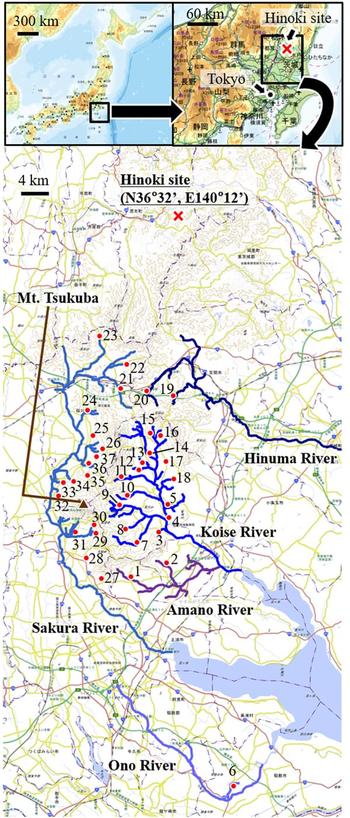
Thirty-seven sand samples were collected from tributary streams of the following rivers: Amano River (Nos. 1 and 2), Koise River (Nos. 3–5 and 7–18), Ono River (No. 6), Hinuma River (Nos. 19 and 20), and Sakura River (Nos. 21–37) around Mt. Tsukuba. This mountain is located south of the sites. Somewhere on the mountain might be collection points for the pottery's materials.
C. Sampling points
Figure 1 shows the sampling points. These geological sites are surrounding Mt. Tsukuba. Additionally, some river branches flow near the sites. Furthermore, Mt. Tsukuba contains some types of granitic plutons, and some archeologists (e.g., Tsukamoto, Reference Tsukamoto and Kobayashi2008) concluded that the granite fragments were mixed into clay materials to manufacture the Atamadai type potteries.
Sampling locations for the pottery around the Hinoki site (Tochigi) and Mt. Tsukuba. Numbers 1–37 are sampling points for the river sands.

III. EXPERIMENTAL
A. Samples
Pottery samples (about 1 g) obtained from each shard using a router were finely ground and homogenized with an alumina mortar and pestle. River sand samples (about 5 g) were pulverized by the same method as the pottery samples.
B. XRD measurement
Powder XRD was performed using a Rigaku SmartLab diffractometer equipped with a Cu anode X-ray tube (1.542 Å for Cu Kα) operated at a voltage of 40 kV and a current of 30 mA. Bragg–Brentano focusing geometry with a Rigaku D/teX Ultra 250 detector was used. A nickel filter was set in front of the receiving slit for removing Cu Kβ. The data for qualitative analysis were recorded in the 5–65° 2θ range, with 2θ steps of 0.01° and a scanning speed (2θ) of 1° min−1. The powdered sample was placed on a silicon reflection-free sample plate with a 20 mm × 18 mm × 0.2 mm square space. The diffraction patterns were measured three times. Each diffraction peak was identified based on the Powder diffraction File™ issued by The International Centre for Diffraction Data (ICDD, 2010).
IV. RESULTS AND DISCUSSION
A. Potteries from the Hinoki site
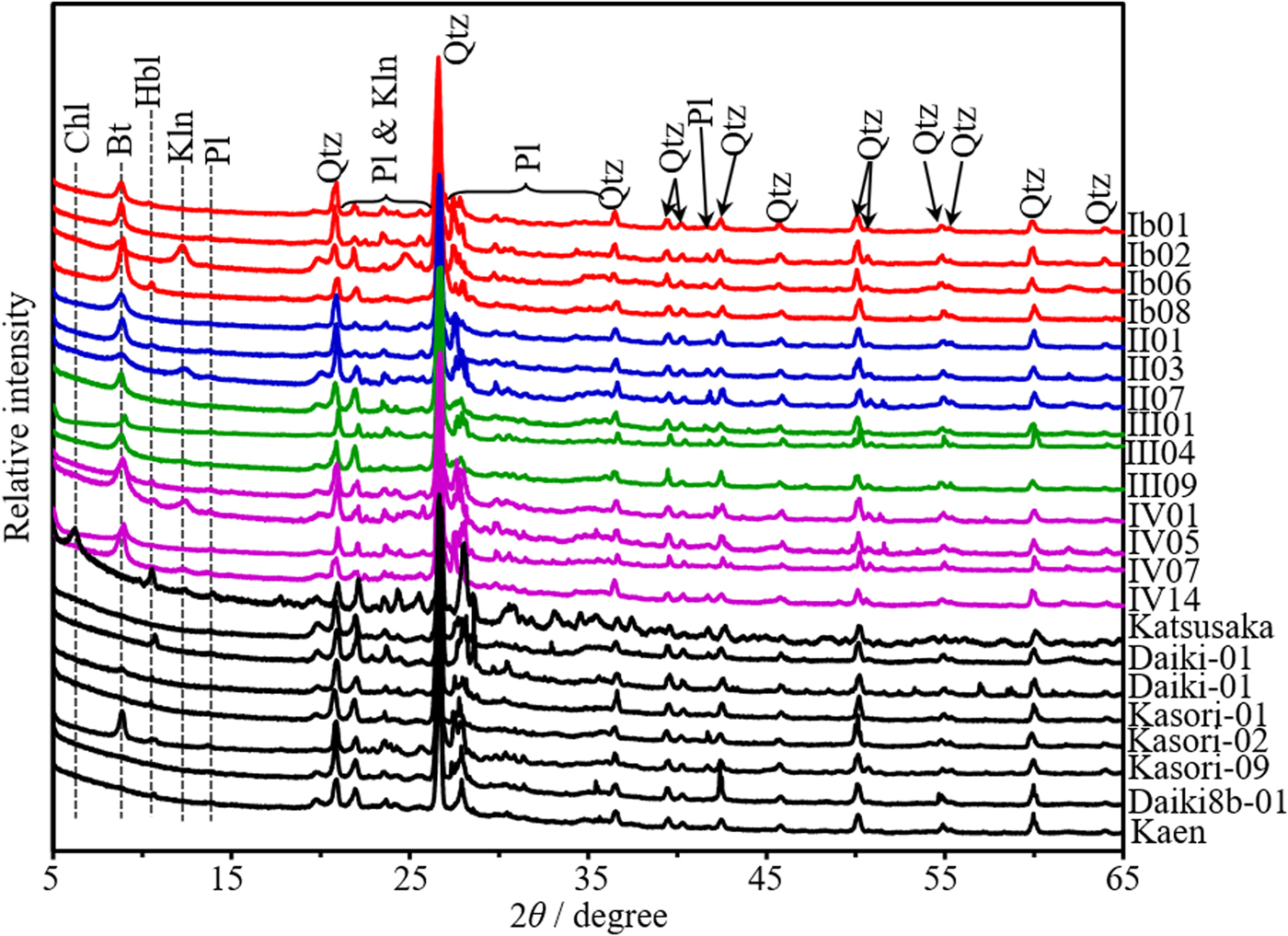
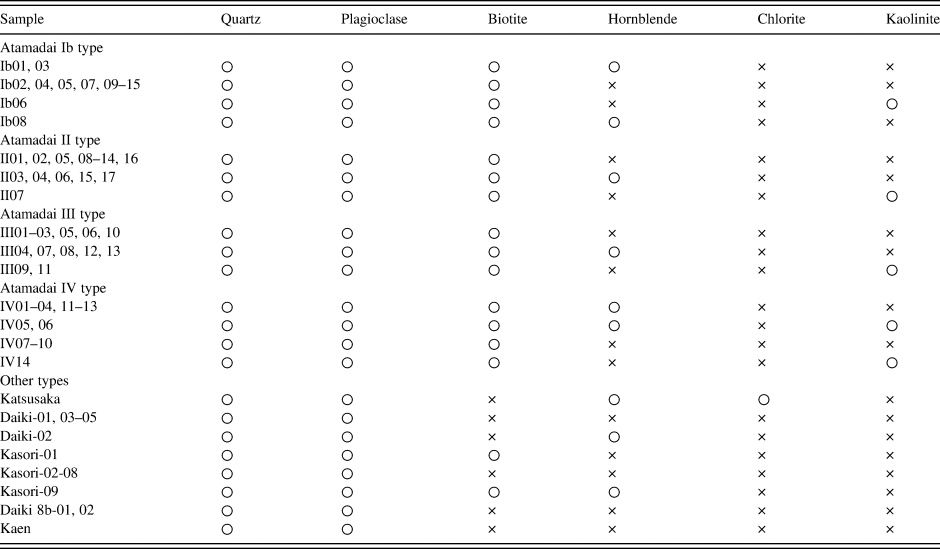
A total of 77 Jomon pottery shards were analyzed by powder XRD to estimate the origin (clay or temper) of minerals in Atamadai type pottery. Figure 2 shows the examples of these XRD profiles. Table I outlines the mineral assemblages of these potteries according to the XRD profiles. All samples contained quartz (SiO2) and plagioclase ((Ca,Na)Al(Al,Si)Si2O8), which are the major mineral components. Despite the pottery type, several shards contained hornblende (Ca2[(Mg,Fe)4Al](Si7Al)O22(OH)2) and kaolinite (Al2Si2O5(OH)4) which is a clay mineral. Biotite (K(Mg,Fe)3AlSi3O10(OH,F)2) was contained in all Atamadai types. The XRD profiles of Atamadai Ib-IV types showed little difference.
XRD profiles of pottery samples from the Hinoki site. Qtz, quartz; Pl, plagioclase; Bt, biotite; Hbl, hornblende; Chl, chlorite; and Kln, kaolinite.

Mineral assemblage of Jomon potteries from the Hinoki site.

○, present; and ×, absent.
These potteries originated from the same site and period. In this case, generally, they were supposed to be made from the same geological materials. However, biotite was only found in the Atamadai types, except for two Kasori types. This result shows that biotite was purposely mixed into the clay materials, i.e., the biotite was found originated in the temper. On the other hand, quartz, plagioclase, hornblende, and kaolinite might be originated from the clay and the temper because these minerals were contained in all types, yet it cannot be concluded that these minerals originated from only the clay materials because these minerals are commonly found.
B. River sands around Mt. Tsukuba
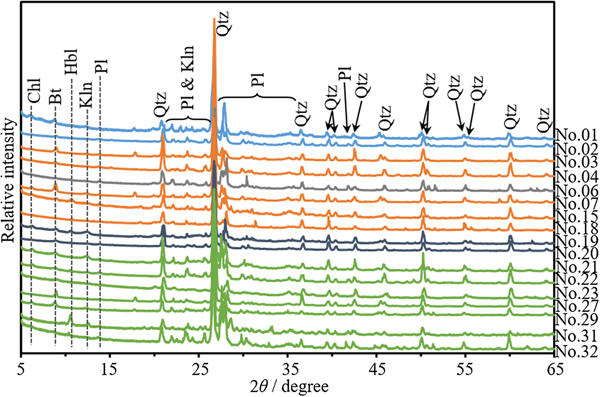
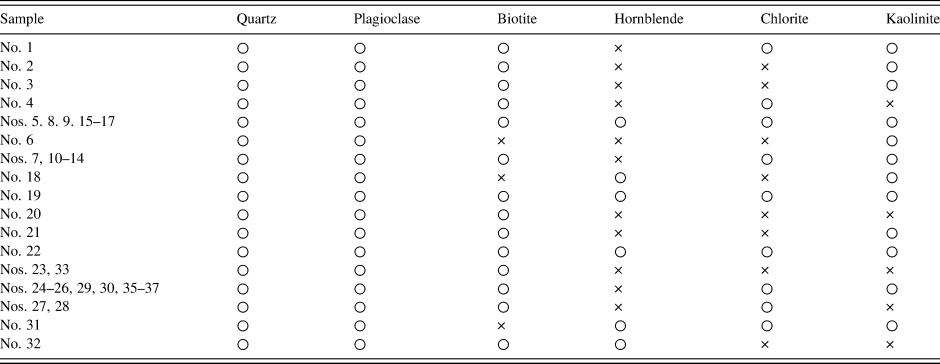
The samples of river sand around Mt. Tsukuba were analyzed by XRD to verify the relationship between the river sands and the temper in the Atamadai type potteries. Figure 3 shows the XRD profile examples of 37 river sand samples. Table II outlines the mineral assemblages of these pottery shards according to the profiles. All samples contained the major minerals of quartz and plagioclase. In spite of the stream area, the following minerals were found in some samples: biotite in 34 samples, hornblende in 12 samples, chlorite ((Mg, Fe)5Al(AlSi3O10)(OH)8) in 28 samples, and kaolinite in 30 samples. Since most of the sand samples contained biotite, the geological materials from some areas around Mt. Tsukuba might be used as the temper for production of Atamadai type potteries.
XRD profiles of river sands around Mt. Tsukuba: sky blue lines, Amano River; orange lines, Koise River; gray line, Ono River; dark blue lines, Hinuma River; and yellowish green lines, Sakura River. Qtz, quartz; Pl, plagioclase; Bt, biotite; Hbl, hornblende; Chl, chlorite; and Kln, kaolinite.

Mineral assemblage of river sands around Mt. Tsukuba.

Nos. 1 and 2 from Amano River; Nos. 3–5 and 7–18 from Koise River; No. 6 from Ono River; Nos. 19 and 18 from Hinuma River; and Nos. 21–37 from Sakura River.
○, present; and ×, absent.
C. Fingerprint minerals for Atamadai type pottery
The quantitative XRD data of the pottery and river sand samples revealed that the following minerals in the Atamadai types originated from the clay and/or temper: quartz, plagioclase, and hornblende from the clay and temper, while biotite from the temper. However, since the crystalline minerals of the Atamadai type potteries and river sands were almost the same, we could not estimate the provenance of the clay and temper in the Atamadai type potteries from the Hinoki site.
Among the minerals, plagioclase, biotite, and hornblende are solid solutions. Plagioclase is a solid solution between anorthite (CaAl2Si2O8) and albite (NaAlSi3O8). Biotite is a solid solution between phlogopite (KMg3AlSi3O10(OH,F)2) and annite (KFe3AlSi3O10(OH,F)2). Hornblende is a very complex solid solution of various minerals, such as tremolite–actinolite (Ca2(Mg,Fe)5Si8O22(OH)2) and tschermakite–ferro-tschermakite (Ca2(Mg,Fe)3Al2Si6Al2O22(OH)2). The composition of the solid solution is reflected by geological characteristics and shift of the d-spacing. Thus, measurements of the d-spacing could be useful for identifying the difference of each mineral in Atamadai types. Therefore, the following solid solutions could be fingerprint minerals: plagioclase and hornblende for clay and temper, while biotite for temper.
The biotite was found in almost all the river sand samples which might be then used as temper materials. Therefore, the comparison among the d-spacings of Atamadai type potteries and the river sands might allow us to estimate the collection spots of the temper for the pottery production. Additionally, if clay layers could be found around Mt. Tsukuba, the d-spacings of plagioclase and hornblende in the clay might be available for estimating the collection spot of the clay material for the production.
V. CONCLUSIONS
We estimated the origins (clay and/or temper) of minerals in Atamadai type pottery from the Hinoki site in order to determine the fingerprint minerals for a provenance study by XRD. For this purpose, the XRD profiles of 59 shards of Atamadai type pottery were compared with those of 18 shards of other Jomon type potteries found in the same site and period as the Atamadai types. The comparison revealed the following findings: biotite found only in the Atamadai types (except for two Kasori type potteries) originated from the temper; quartz, plagioclase, hornblende, and kaolinite in the Atamadai and other types were from the clay and temper. The plagioclase, biotite, and hornblende are solid solutions, which demonstrate some d-spacing shifts according to the composition reflecting the geological origin. Therefore, these minerals might be useful as fingerprint minerals to clearly indicate the difference between local characteristics of the raw clay and the temper. Additionally, a total of 37 river sand samples around Mt. Tsukuba, which is near the Hinoki site, were analyzed by XRD to study the provenance of the temper in the Atamadai type potteries. Based on the XRD profiles, these sands contained quartz, plagioclase, biotite (in 34 samples), hornblende (in 12 samples), chlorite (in 28 samples), and kaolinite (in 30 samples). Biotite in the Atamadai type potteries originated from the temper materials. The comparison among the d-spacings of biotite in Atamadai type potteries and river sands might allow us to estimate the provenance of the temper.
ACKNOWLEDGEMENT
We are grateful to Prof. Takehaya Matsumoto from the Department of History, School of Letters, Tokai University, Japan, and Dr. Manabu Kasai from the Research Institute of Cultural Properties, Teikyo University, Japan, for providing the samples and excavation reports.