Introduction
Fascioliasis is an infection of herbivores caused primarily by the parasitic trematodes Fasciola hepatica and F. gigantica. The former has a worldwide distribution mainly in temperate climates; whereas the latter is primarily of tropical climates in Africa and Asia (Hillyer, Reference Hillyer2005). Heavy economic losses are inflicted on the livestock industry in tropical countries due to F. gigantica infection (Raina et al., Reference Raina, Yadav, Sriveny and Gupta2006). Early diagnosis of fascioliasis is vital to avoid all the complications of this disease. There are three different known approaches for diagnosis of parasitic infections: direct parasitological methods, indirect methods relying on clinical and biochemical assays, and immunological methods measuring the immune response to certain parasitic antigens and/or detecting circulating parasitic antigens (Feldmeier & Poggensee, Reference Feldmeier and Poggensee1993). Direct parasitological methods usually lack sensitivity and reproducibility and are not reliable (Hillyer, Reference Hillyer, Baloes, Hausler, Ohashi and Turano1988; Shehab et al., Reference Shehab, Hassan, Basha, Omar, Helmy, El-Morshedy and Farag1999; Carnevale et al., Reference Carnevale, Rodriguez, Santillan, Labbe, Cabrera, Bellegarde, Velasquez, Trjoveic and Guernera2001). On the other hand, immunodiagnosis of fascioliasis by detecting antibody to the antigen produced from Fasciola worms has several disadvantages. First, the antibody cross-reacts with other trematode antigens, including those of Schistosoma spp., giving a false-positive result (Hillyer, Reference Hillyer2005). Second, detection of Fasciola-specific antibodies does not discriminate between previous and current infection. Therefore, the use of specific antibody to detect antigens secreted by the living flukes into their host's body fluids may be a better approach, not only in diagnosing active infection but also in assessing treatment efficacy and the effectiveness of future vaccines (Fagbemi et al., Reference Fagbemi, Aderibigbe and Guobadia1997; Guobadia & Fagbemi, Reference Guobadia and Fagbemi1997).
Antigen detection assays are considered of prime importance for immunodiagnosis, as the detection of circulating Fasciola antigens and coproantigens can indicate an active infection (Espino et al., Reference Espino, Marcet and Finlay1990, Reference Espino, Millan and Finlay1992; Abdel-Rahman et al., Reference Abdel-Rahman, O'Reilly and Malone1999). Several antigens are needed for efficient diagnostic methods. Fasciola antigens are mostly released from rapid turnover of the external covering, the tegument. In Fasciola, fatty acid binding proteins (FABPs) are the carrier proteins that help in the uptake of fatty acids from the hosts' fluids (Ockner, Reference Ockner1990). Several attempts have been made to utilize both native and recombinant FABPs with different molecular weights for protection and vaccine development against both fascioliasis and schistosomiasis (Tendler et al., Reference Tendler, Brito, Vilar, Serra-Freire, Diogo, Almeida, Delbem, De Silva, Sanivo, Garratt and Simpson1996; Estuningsih et al., Reference Estuningsih, Smooker, Wiedosari, Widjajanti, Vaiano, Partotomo and Spithill1997; Ramajo et al., Reference Ramajo, Oleaga, Casanueva, Hillyer and Muro2001; Sirisriro et al., Reference Sirisriro, Grams, Vichasri-Grams, Ardseungneon, Pankao, Meepool, Chaithirayanon, Viyanant, Tan-Ariya, Upatham and Sobhon2002; Hillyer, Reference Hillyer2005; Nambi et al., Reference Nambi, Yadav, Raina, Sriveny and Saini2005). On the other hand, Rabia et al. (Reference Rabia, Salah, Neamat and Raafat2007) reported that FABPs could be used as a diagnostic antigen for human fascioliasis. In our earlier study on human fascioliasis, the 14.5 kDa F. gigantica FABP showed high diagnostic efficacy in the detection of this infection in human patients (Allam et al., Reference Allam, Bauomy, Hemyeda and Sakran2011). The present study was aimed at evaluating the diagnostic potential of this antigen in natural F. gigantica-infected buffaloes.
Materials and methods
Collection of flukes
Adult live F. gigantica flukes were collected from the liver and the bile ducts of naturally infected bubaline host (water buffaloes, Bubalus bubalis) at a local abattoir (Moneeb, Giza, Egypt). Worms were extensively washed with chilled physiological saline and phosphate-buffered saline (PBS, pH 7.2).
Maintenance of rabbits
Three parasite-free, 8-month-old female New Zealand white rabbits (about 2 kg in weight) were used for monospecific anti-FABP antibody production. Rabbits were kept under standard laboratory conditions at 21°C, 45–55% humidity, filtered drinking water and standard diet (24% protein and 4% fat).
Preparation and purification of F. gigantica FABP
Adult live F. gigantica flukes were homogenized in 20 mm Tris-HCl buffer (BDH Chemicals, England) containing 5 mm phenylmethylsulphonyl fluoride (PMSF) as a protease inhibitor (Sigma-Aldrich, St. Louis, Missouri, USA). The parasite homogenate was centrifuged at 10,000 g for 15 min at 4°C. The supernatant was collected and the protein content was determined according to Bradford (Reference Bradford1976). The crude extract was subjected to the ammonium sulphate precipitation method according to Nowotny (Reference Nowotny1979). FABP was purified from the crude extract by a combination of ion-exchange chromatography on DEAE-Sephadex A-50 at pH 7.0 and gel filtration using Sephacryl HR-100. At pH 7.0 FABP binds strongly to the column and is selectively eluted with a salt gradient (van Nieuwenhoven et al., Reference van Nieuwenhoven, Vork, Surtel, Kleine, van der Vusse and Glatz1991). Absorbance of each fraction was measured at 280 nm and the purity of the produced protein was assayed by sodium dodecyl sulphate-polyacrylamide gel electrophoresis (SDS-PAGE) under reducing conditions, according to Laemmli (Reference Laemmli1970).
Production, purification and labelling of anti-FABP polyclonal antibodies
One milligram of F. gigantica FABP was mixed with an equal volume of complete Freund's adjuvant and injected intramuscularly into each rabbit, according to Guobadia & Fagbemi (Reference Guobadia and Fagbemi1997). Booster doses (0.5 mg mixed with an equal volume of incomplete Freund's adjuvant) were administered at week 2 and 3 after the initial dose, according to Fagbemi et al. (Reference Fagbemi, Obarisiagbon and Mbuh1995). Sera were collected from an ear vein 4 days after the last injection, to detect the titre of antibodies produced. When the titre was high, the animal was scarified and blood samples were collected and antisera were stored at − 80°C until used.
Anti-FABP IgG was purified by the ammonium sulphate precipitation method (Nowotny, Reference Nowotny1979), followed by the caprylic acid purification method (McKinney & Parkinson, Reference McKinney and Parkinson1987), and finally DEAE-Sephadex A-50 ion-exchange chromatography (Sheehan & FitzGerald, Reference Sheehan and FitzGerald1996). The protein content was estimated by a Bio-Rad protein assay (Bradford, Reference Bradford1976) and the purity of the produced IgG was identified by SDS-PAGE according to Laemmli (Reference Laemmli1970). Anti-FABP IgG was conjugated with horseradish peroxidase (HRP) according to the periodate method of Tijssen & Kurstak (Reference Tijssen and Kurstak1984).
Collection and examination of samples from naturally infected buffaloes
A total of 126 samples (faeces and blood) were collected from buffaloes during several visits to a local abattoir (Moneeb area, Giza, Egypt), out of which 99 samples were collected from buffaloes infected with F. gigantica, 10 samples infected with Ascaris, 7 samples infected with Schistosoma mansoni, and 10 samples from healthy buffaloes used as negative control samples. Blood was collected during slaughtering. Sera were prepared and stored at − 80°C until used. The liver, gall bladder and the general viscera of each animal were checked for adult flukes and for other parasites. Samples of faeces were collected from the rectum in clean, wide-mouthed containers with tight-fitting covers. After repeated sieving of these samples, coprological examination was carried out microscopically by the Kato–Katz technique according to Engels et al. (Reference Engels, Nathimana, De Vias and Gryseels1997). Buffaloes with mixed infections were excluded from this study.
Detection of circulating antigen and coproantigen by sandwich ELISA
This method was performed according to Allam et al. (Reference Allam, Bauomy, Hemyeda and Sakran2011). Briefly, for detection of circulating Fasciola antigen in sera, the microtitre plates (Dynatech, Chantilly, Virginia, USA) were coated with 100 μl/well of purified anti-FABP IgG (10 μg/ml in 0.06 m carbonate buffer, pH 9.6) and incubated overnight at room temperature. Plates were washed three times with washing buffer (0.1 m PBS/T20, pH 7.4), then blocked with 200 μl/well of 1% bovine serum albumin (BSA) in 0.1 m PBS for 2 h at 37°C. The plates were washed three times with washing buffer, then 100 μl of serum samples were added into the wells in triplicate and incubated for 2 h at 37°C. The plates were washed three times as before. Then 100 μl of peroxidase-conjugated anti-FABP IgG of dilution 1/250 was added and the plates were incubated for 1 h at room temperature. After washing the plates five times, 100 μl of ortho-phenylenediamine (OPD) substrate solution was added to each well and the plates were placed in the dark at room temperature for 30 min. To stop the enzyme–substrate reaction 50 μl/well of 2 n H2SO4 was added to each well. The absorbance (OD) was measured at 492 nm using an ELISA reader (Bio-Rad, Hercules, California, USA) .
For detection of coproantigen, stool was diluted in a ratio of 1:3 with saline and the exact method used for serum ELISA was applied to detect the presence of coproantigen.
Key features in reliability of test results
The cut-off point for positivity was measured as mean OD reading of negative controls +3 standard deviations (SD) of the mean. The tested samples showing OD values greater than cut-off value were considered positive. Test sensitivity, specificity and efficiency were calculated according to the following formulae (Zane, Reference Zane2001):
 $$\begin{eqnarray} Sensitivity\,(\%) = (no.\,of\,true\,positive\,results\times 100)/(no.\,of\,positive\,results + no.\,of\,false\,negative\,results). \end{eqnarray}$$
 $$\begin{eqnarray} Specificity\,(\%) = (no.\,of\,true\,negative\,results\times 100)/(no.\,of\,negative\,results + no.\,of\,false\,positive\,results). \end{eqnarray}$$
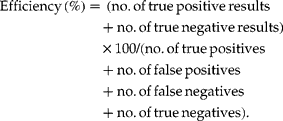 $$\begin{eqnarray} Efficiency\,(\%) = \,(no.\,of\,true\,positive\,results + no.\,of\,true\,negative\,results)\times 100/(no.\,of\,true\,positives + no.\,of\,false\,positives + no.\,of\,false\,negatives + no.\,of\,true\,negatives). \end{eqnarray}$$
Statistical analysis
The data were presented as mean (x) ± SD. The means of the groups were compared by analysis of variance (Snedecor & Cochran, Reference Snedecor and Cochran1981) using either Student's t-test or ANOVA. The correlation analysis between circulating antigen (CA) and ova count was performed by correlation coefficient (r). The data were considered significant if P≤ 0.05. All statistical analyses were performed using the SPSS program (SPSS Inc., Chicago, Illinois, USA).
Results
Purification of FABP from crude extracts of F. gigantica adult worms
The total protein of crude extracts that were obtained from adult F. gigantica worms was 20 mg/ml as measured by Bio-Rad protein assay. Crude extracts of F. gigantica were subjected to 50% ammonium sulphate saturation. The protein content of the post-saturation supernatant was 5 mg/ml. This protein was purified by DEAE-Sephadex A-50 ion-exchange column chromatography at pH 7.0 and the protein content after this step was 2.5 mg/ml. The two-step procedure showed a high degree of reproducibility. The yield of FABP as a protein content after gel filtration chromatography was 1.5 mg/ml.
Production and purification of anti-FABP polyclonal IgG
Rabbits were immunized three times with 1 mg of FABP at 1-week intervals. The antibody level reached the highest titre (2.75 OD reading at 492 nm) after the second booster dose. The total protein content of crude rabbit serum containing anti-Fasciola antibody was 10.2 mg/ml. The yield of purified anti-FABP IgG antibody following each purification step was determined by the assessment of protein content. Using the 50% ammonium sulphate precipitation method, the protein content was 4.7 mg/ml. However, the content dropped to 2.3 mg/ml after the 7% caprylic acid precipitation method. Finally, the protein content of highly purified anti-FABP IgG antibody after ion-exchange chromatography was 1.1 mg/ml.
Parasitological examination of stools using Kato–Katz technique
By naked eye examination during slaughtering, 99 buffaloes were found to harbour Fasciola worms in the liver and the bile ducts. However, according to stool analysis by Kato–Katz quantitative technique, only 73 animals were true positives and the rest of the animals (26) gave false-negative results (73.74% sensitivity). Three slides were counted for each buffalo and the mean number of eggs/g (epg) in faeces was calculated. The intensity of infection was estimated and animals were classified into three subgroups: low, moderate and high infection. The mean number of epg ± SD was 11.81 ± 6.59, 34.6 ± 5.63 and 75.4 ± 16.06, respectively.
Detection of coproantigen in faeces of naturally infected buffaloes by sandwich ELISA
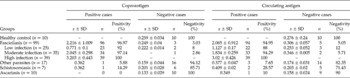
Sandwich ELISA was applied using purified and HRP-conjugated anti-FABP polyclonal IgG to detect FABP antigen in stools of naturally infected buffaloes. The antigen level was measured as OD reading at wavelength 492 nm. As depicted in table 1, mean OD value of the Fasciola-infected group was significantly (P< 0.01) higher than both the healthy control group and the other-parasites-infected group. Three out of 99 Fasciola-infected animals showed false-negative results and the sensitivity of the assay was 96.97%. Negative controls were below the cut-off value (0.361), while 1 of 17 other-parasite-infected groups was at the borderline of the cut-off value, giving 94.12% specificity.
Detection of coproantigen in faeces, and circulating antigen in sera, of naturally infected buffaloes.

Data are expressed as mean (x) optical density (OD) ± standard deviation (SD) at 492 nm. Cut-off value was equal to 0.361 and 0.348 for coproantigen and circulating antigen detection, respectively. n, Number of animals.
In the fascioliasis group, the highest OD readings were observed in the highly infected cases, giving 100% positivity, followed by the moderately infected cases (97.14% positivity), and cases with low infection showed 92% positivity. However, schistosomiasis mansoni cases showed only 14.29% positivity and ascariasis cases gave 0% positivity (table 1).
Detection of FABP in serum of naturally infected buffaloes by sandwich ELISA
As shown in table 1, the mean OD value of Fasciola-infected buffaloes was significantly (P< 0.01) higher than those of the negative control group and the other-parasites-infected group. Out of 99 cases of Fasciola-infected animals, 94 cases were detected as positive samples. The sensitivity of the assay was 94.95%. However, buffaloes infected with other parasites showed 82.35% specificity. All the 10 negative controls were below the cut-off value (0.348).
In the fascioliasis group, the highest OD readings were observed in those cases with high infection, giving 100% positivity, followed by moderately infected animals, giving 94.29% positivity, while the lowest readings were observed in the group with low infection, giving 88% positivity. However, schistosomiasis and ascariasis cases showed 28.57 and 10% positivity, respectively (table 1).
Percentage positivity for coproantigen in stool and circulating FABP antigen in serum of naturally infected animals
As shown in table 1, the data of sandwich ELISA with coproantigen showed that 39 cases out of 39 of the high infection group were positive (100%), and 34 cases out of 35 of the moderate infection group were positive (97.14%), while 23 cases out of 25 of low infection group were positive (92%).
Similarly, the data of sandwich ELISA with circulating FABP antigen in buffalo sera showed that 39 cases out of 39 of the high infection group were positive (100%), 33 cases out of 35 of the moderate infection group were positive (94.29%), while 22 cases out of 25 of the low infection group were positive (88%).
To clarify the cross-reactivity with other helminths, sandwich ELISA was applied to detect the FABP in the stool and the serum of buffaloes infected with Schistosoma mansoni and Ascaris. The positivity of sandwich ELISA with coproantigen in the stool was 14.29 and 0% for schistosomiasis and ascariasis, respectively. On the other hand, the positivity of sandwich ELISA with circulating antigen in the serum was 28.57 and 10% for schistosomiasis and ascariasis, respectively (table 1).
Sensitivity, specificity and diagnostic efficacy of sandwich ELISA for detection of coproantigens and circulating FABP antigens in buffaloes with low and moderate Fasciola infection
The sensitivity of sandwich ELISA for detection of both coproantigen and circulating FABP antigens in groups with low and moderate infection was 95 and 91.67%, respectively; while the specificities were 94.12 and 82.35%, respectively; and the diagnostic efficacies were 94.81 and 89.61%, respectively. The present data demonstrated that sandwich ELISA is more sensitive and more specific in coproantigen detection than circulating antigen detection in cases of low and moderate infection.
Sensitivity, specificity and diagnostic efficacy of parasitological analysis and sandwich ELISA for diagnosis of bubaline fascioliasis
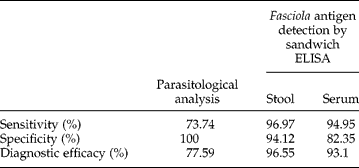
In Fasciola-infected buffaloes, the sensitivity, specificity and the diagnostic efficacy of parasitological analysis were 73.74, 100 and 77.59%, respectively. However, the sensitivity, specificity and the diagnostic efficacy of sandwich ELISA for coproantigen detection were 96.97, 94.12 and 96.55%, respectively. Similarly, the sensitivity, specificity and the diagnostic efficacy of sandwich ELISA for circulating FABP antigen detection were 94.95, 82.35 and 93.10%, respectively (table 2).
Sensitivity, specificity and diagnostic efficacy of parasitological analysis and sandwich ELISA used for detection of Fasciola antigens in stool and serum of Fasciola-infected buffaloes.
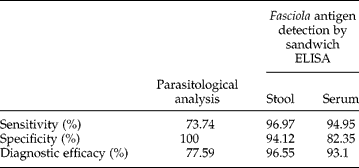
The present data clearly showed a higher diagnostic efficacy of sandwich ELISA in diagnosis of bubaline fascioliasis than parasitological analysis. Moreover, the use of purified and HRP-conjugated anti-FABP IgG in sandwich ELISA is more sensitive and more specific for detection of Fasciola coproantigen than detection of circulating antigen in Fasciola-infected animals.
Discussion
The present study was conducted to evaluate the diagnostic capacity of one of the F. gigantica antigens, 14.5 kDa FABP, in diagnosis of bubaline fascioliasis. The FABP antigen was purified from the crude adult worm extracts by DEAE-Sephadex A50 ion-exchange chromatography and Sephacryl HR-100 gel filtration methods. FABP appeared as a single band at 14.5 kDa by reducing SDS-PAGE. In our previous study, the reactivity of the purified anti-FABP IgG was tested by indirect ELISA against FABP antigen. It was found that anti-FABP IgG was highly sensitive, highly specific and reliable for the detection of circulating FABP antigen until 1 ng/ml (Allam et al., Reference Allam, Bauomy, Hemyeda and Sakran2011).
The data of the present study showed that the sensitivity, specificity and the diagnostic efficacy of coprological analysis were 73.74, 100 and 77.59%, respectively. These data are parallel to those reported by Anderson et al. (Reference Anderson, Luong, Vo, Bui, Smooker and Spithill1999), who indicated that the sensitivity of the egg counting method was 66.7% and specificity was 100%, whereas the overall accuracy was 73.9%. On the other hand, the sensitivity, specificity and diagnostic efficacy of sandwich ELISA for detection of coproantigens were 96.97, 94.12 and 96.55%, respectively. Such a finding coincides with that obtained by Hassan et al. (Reference Hassan, El-Bahy, Abou-Zinadah and Shalaby2008) who found that use of monoclonal antibody against some 26–28 kDa antigens of F. gigantica in sandwich ELISA, for detection of coproantigen in stool of naturally F. gigantica-infected animals, revealed 81.8% sensitivity and 90.9% specificity. In a field study, a survey screening for human fascioliasis using ELISA and coprology in endemic locations had 95.5% sensitivity and 86.6% specificity (Espinoza et al., Reference Espinoza, Timteo and Herrera-Velit2005). In addition, Moustafa et al. (Reference Moustafa, Hegab and Hassan1998) concluded that ELISA proved to be a rapid, easy and sensitive test for diagnosing fascioliasis, by detection of F. hepatica coproantigens earlier than routine stool examination. Fasciola coproantigens were detected in the stools of both infected animals and human patients several weeks before eggs were detectable in the stool (Youssef et al., Reference Youssef, Mansour and Aziz1991). Therefore, detection of coproantigens in stools is useful for early diagnosis of fascioliasis to avoid clinical complications of the disease.
In the current study, anti-FABP IgG was tested by sandwich ELISA to detect Fasciola antigen in sera collected from naturally infected buffaloes. The sensitivity, specificity and diagnostic efficacy of the test were 94.95, 82.35 and 93.1%, respectively. These data are parallel to those reported by Rabia et al. (Reference Rabia, Salah, Neamat and Raafat2007) who recorded 91% sensitivity and 86.7% specificity when they used rabbit anti-FABP as antigen capture for detection of this Fasciola antigen by indirect ELISA in sera of infected patients. The sensitivity and specificity of serodiagnosis were slightly different, depending on the antigen and techniques that were used in many different studies; 91% sensitivity and 92% specificity have been achieved by using anti-49.5 kDa Fasciola-specific excretory-secretory (ES) fraction and sandwich ELISA for detection of circulating antigens in fascioliasis patients (Espino & Finlay, Reference Espino and Finlay1994; Espino et al., Reference Espino, Diaz, Perez and Finlay1998).
The results presented here indicate that the sandwich ELISA for detection of coproantigen is more sensitive and specific than circulating antigen for immunodiagnosis of fascioliasis in cases of low and moderate infection as well as high infection. This result could be attributed to immune complex formation with host antibodies that tend to decrease the potential rate of circulating antigens. Therefore, levels of coproantigens are less affected by immune complex formation than circulating antigens (Mezo et al., Reference Mezo, González-Warleta and Ubeira2007). Moreover, the use of serum samples has several disadvantages; for example, antigenaemia develops mainly during the acute phase of infection (prepatent phase), whereas after this period, antigens decrease and become undetectable over the course of infection (Espino et al., Reference Espino, Diaz, Perez and Finlay1998). Accordingly, coproantigen assay could be the most feasible procedure for diagnosing active acute and chronic infections, while serodiagnosis of fascioliasis is recommended only for the early stages of infection.
Cross-reactivity with other parasites is a major problem in specificity of the immunodiagnosis of fascioliasis, especially in countries where schistosomiasis and fascioliasis are endemic (Carnevale et al., Reference Carnevale, Rodriguez, Santillan, Labbe, Cabrera, Bellegarde, Velasquez, Trjoveic and Guernera2001; Rabia et al., Reference Rabia, Salah, Neamat and Raafat2007). Interestingly, the present study revealed minimal cross-reactivity between 14.5 kDa F. gigantica FABP antigen and either circulating antigens or coproantigens of both Schistosoma mansoni and Ascaris. This finding indicates that 14.5 kDa FABP is a more specific antigen for diagnosis of fascioliasis than other tested antigens (O'Neill et al., Reference O'Neill, Parkinson, Strauss, Angles and Dalton1998; Rabia et al., Reference Rabia, Salah, Neamat and Raafat2007; Hassan et al., Reference Hassan, El-Bahy, Abou-Zinadah and Shalaby2008). Such slight cross-reactivity may be due to the presence of shared antigenic epitopes between 14.5 kDa F. gigantica FABP antigen and one of Schistosoma mansoni and Ascaris antigens.
In conclusion, the present study clearly showed that the purified 14.5 kDa FABP obtained from crude extracts of F. gigantica worms could be introduced as a suitable candidate antigen for immunodiagnosis of bubaline fascioliasis by using sandwich ELISA. The sensitivity and specificity of sandwich ELISA for the detection of Fasciola coproantigen in stools are higher than those obtained by sandwich ELISA for the detection of circulating Fasciola antigen in serum. In addition, coproantigen detection was shown to be a good correlate to intensity of infection and hence could be used as an alternative to counting ova.