Modernisation at the end of the 20th century
The latter half of the 20th century witnessed a reshaping of government and public services across the western world (Organisation for Economic Co-operation and Development (OECD) 2003). By the early 1980s, the post-1945 monopoly of central provision was being called into question, with concerns raised over quality and choice within public services and the increasing financial burden they placed on governments. A number of administrations of the 1980s and 1990s (as in the United Kingdom (UK), New Zealand and Australia) adopted management theories from the private sector and applied them in a raft of public-sector reforms (Hood Reference Hood1991), but these did not take into account the complexity of public services when applying management processes and ‘created a greater need for co-ordination while reducing governmental ability to co-ordinate’ (Rhodes Reference Rhodes2000).
In the UK, the self-styled modernisation reforms of the incoming Labour administration of 1997 drew heavily upon the neo-liberal reforms of the preceding Conservative administrations whilst attempting to overcome their failings. The modernisation reforms in health and social care exemplified this approach to public policy. For example, The New NHS: Modern – Dependable White Paper stated, ‘There will be no return to the old centralised command and control systems of the 1970s … but nor will there be a continuation of the divisive internal market system of the 1990s. … Instead there will be a “third way” of running the NHS (National Health Service) – a system based on partnership and driven by performance’ (Cm 3807 1997: para 2.1–2.2).Footnote 1 In the social care White Paper, Modernising Social Services, published the following year, the emphasis was very much on empowering the service user: ‘Our third way for social care moves the focus away from who provides the care, and places it firmly on the quality of services experienced by, and outcomes achieved for, individuals and their carers and families’ (Cm 4169 1998: para 1.7).
Thus the consumerist approach underpinning the Conservative reforms (Cm 1599 1991), which promoted the direct accountability of public services to the service user and the idea that service quality could ultimately be enhanced through consumer choice, was still clearly evident in the modernisation reforms of the Labour government (Newman Reference Newman2001). Characteristic of these reforms, however, was their particular emphasis on partnerships and joined-up working (Cowell and Martin Reference Cowell and Martin2003). One important aspect of the modernisation of public services in the UK was a pragmatic emphasis on ‘what counts is what works’. A belief in evidence-based policy making was evident in key modernisation policy documents, for example, the 1999 White Paper Modernising Government, which stated: ‘Government should regard policy making as a continuous, learning process, not as a series of one-off initiatives. … We will ensure that all policies and programmes are clearly specified and evaluated, and the lessons of success and failure are communicated and acted upon’ (Cm 4310 1999: 17).
Background to the study
In 2002, as part of its stated commitment to evidence-based policy making, the UK Department of Health (DH) commissioned a review of the delivery, commissioning and impact of social care services for four adult user groups (with mental health problems, with physical and/or sensory impairments, with a learning disability, and older people) before the influence of modernisation, with the aim of producing a baseline from which to measure the success or otherwise of the reforms (DH 2007a). As part of this, four systematic literature reviews were undertaken to find, assess and synthesise empirical studies of adult social-care services. The aim of this paper is to provide an overview of the peer-reviewed research literature pertaining to the social care of older people in the UK from the introduction of the community care reforms of the early 1990s to the New Labour reforms at the turn of the 21st century. In particular, it will describe the evidence base that supported the underlying themes of the modernisation process as applied to older people's services in social care. The paper begins with an analysis of UK modernisation policy as applied to social care for older people, providing a framework for the findings. After describing the review methodology, the findings are presented in two ways. Firstly, an overview of the coverage, quality, methods used and overall strengths and weaknesses of the research literature is presented. Secondly, a synthesis of selected substantive findings is presented within the modernisation framework. A full report of the findings may be found in Challis et al. (Reference Challis, Xie, Hughes, Jacobs, Reilly and Stewart2004a).
Modernising social care for older people in the UK
To meet the needs of the research commission, the prevailing themes of the modernisation reforms for adult social care were derived from an analysis of key UK policy and legislation documents. Six themes were thus derived, associated with 20 areas of reform (19 in the case of older people's services: see Table 4).
Integrated health and social care
The compartmentalisation of health and social care services in many countries is rooted in the regulation of health care by either a national health system (as in the UK and Nordic countries) or a social insurance system administered by central government (as in Germany and The Netherlands), whereas social care is overseen by local or regional government (Leichsenring Reference Leichsenring2003). Recognition of the need to achieve greater integration of health and social care in these countries is by no means new, but rather has been a recurrent policy theme for 50 years. In 1997, however, the incoming UK Labour government made one of its top priorities to bring down the ‘Berlin Wall’ that divides health and social services to create a system of integrated care that puts users at the centre of service provision (Cm 4169 1998: 97). Nowhere was this more apparent than in its health and social-care policy proposals, those for older people's services being no exception. Modernisation has entailed a series of initiatives: the single assessment process (DH 2002); Health Act 1999 flexibilities; NHS Care Trusts (Cm 4818-I 2000); a health and social care model for the management of long-term conditions (DH 2005); and most recently, the joint health and social care White Paper for community services, Our Health, Our Care, Our Say (Cm 6737 2006).
Independence
Townsend (Reference Townsend1981) argued that the use of long-stay hospital provision for older people and continued investment in the residential care market had contributed towards the structural dependency of older people. Subsequently, many developed-country governments invested in community-based alternatives to institutional care, to promote the independence of older people and to release hospital bed-days (Jacobzone Reference Jacobzone2000). Independence emerged as an enduring feature of British policies for modernising social care services. For frail older people, initiatives in this regard focused primarily on shifting the location of care away from hospitals and care homes and into people's own homes (Cm 4169 1998; Cm 4818-I 2000; DH 2001; Cm 6737 2006). Policy developments in four constituent areas were apparent: hospital discharge, rehabilitation, the provision of care at home or in home-like environments, and direct payments.
Whilst the closure of long-stay hospital provision for older people predated the recent drive to modernise social care, it is pertinent to this review because of the legacy of community-based services that were its substitute. Subsequently, discharge from acute hospital settings has become a prominent concern of modernisation policies in the UK and elsewhere (Australia, Department of Community Services and Health 1991; Ikegami, Yamauchi and Yamada Reference Ikegami, Yamauchi and Yamada2003). In the UK, the Griffiths Report (1988) put forward ‘care at home’ as a key principle and objective of community care – it has guided the development of services ever since. For example, Modernising Social Services stated the following national objective for social services: ‘To enable adults assessed as needing social care support to live as safe, full and as normal a life as possible, in their own home wherever feasible’ (Cm 4169 1998: 111). Linked to the emphasis on care closer to home, the development of rehabilitation services for older people was promoted. For example, ‘active recovery and rehabilitation services’ was a core dimension of the development of intermediate care services (broadly defined as services promoting independence, facilitating hospital discharge and/or preventing unnecessary hospital admission), and one of the standards set by the National Service Framework for Older People (NSFOP) (DH 2001) that set out the process for modernising older people's services. A final area of enquiry concerned the introduction of direct payments. Cash-for-care schemes that offer cash payments or vouchers in lieu of services have been introduced by the United States and several European countries (Ungerson Reference Ungerson2004). In the UK, direct payments were introduced by local authorities with the aim of giving users freedom and independence in running their own lives (DH 2003a).
Consistency
Modernisation policies in the UK sought to standardise the response of local authorities in respect of service provision, and three specific initiatives were apparent: the development and implementation of eligibility criteria; extending the range of services available to meet assessed need; and developing effective and transparent costing and charging procedures. The idea of social-care eligibility criteria originated in the White Paper Caring for People (Cm 849 1989), and subsequently their purpose was described as to inform users ‘about what sorts of people with what kinds of need qualify for what types of service’ (Cm 4169 1998: 23). The community care reforms of the early 1990s required local authorities to commission and purchase social care, not to be the primary provider, and thereby to make maximum possible use of voluntary-sector and private-sector provision, but one consequence of this approach has been the fragmentation and uneven development of services. Thus, extending the range of services available to meet assessed need for social care was accorded importance in modernisation policy initiatives such as Modernising Social Services (Cm 4169 1998) and the NSFOP (DH 2001). The principle of charging for social-care services predates both the modernisation agenda and the 1993 community care reforms. Variations in charges for various user groups within and between authorities have since been noted (Cm 4169 1998; Audit Commission Reference Audit2000). Subsequently it was required that the charges are part of the written record of the individual client's care plan (DH 2002).
Support to carers
The care provided to older people through informal mechanisms is an essential backdrop to community care policies in the UK and other industrialised nations (Gibson, Gregory and Pandya Reference Gibson, Gregory and Pandya2003). The division of responsibility between state and family appears to stem from both the culture and traditions of a country as well as social policy. For example, in Scandinavian countries and The Netherlands, community service provision is better developed than in central and southern European countries, where family obligations are either assumed or else legislated for (Daatland Reference Daatland2001). During the last three decades of the 20th century, UK policy increasingly recognised the contribution of informal carers to the care of vulnerable adults (Cmnd 4683 1971; Cmnd 6233 1975; Cmnd 8173 1981). Carers were accepted as service users in their own right by the Carers (Recognition and Services) Act 1995, and the first UK national strategy for carers was launched four years later (DH 1999).
Making sure services fit individuals' needs
The norm of fitting care and services to individuals' needs has long been evident in the professional literature (e.g. Warren Reference Warren1946). Based on early experiments in case management in the United States (US) and UK (Huxley Reference Huxley1993), care management became a key change in the UK community care reforms, being identified as a means of providing an effective method of targeting resources and planning services to meet individual's specific needs (Cm 849 1989). It continued to be endorsed in modernisation policies for older people (DH 2001) and in social services more widely (Cm 4169 1998). Modernising Social Services also provided guidance to local authorities about how best to commission services. The desired outcome was that commissioning would ‘help to ensure that services meet people's specific individual needs, and that groups with particular needs, such as people from ethnic minorities, are better served’ (Cm 4169 1998: 36).
The debate about the value of low-level preventative services has been a longstanding concern, evident in From Home Help to Home Care (Social Services Inspectorate 1987) and later policy documents. To a considerable extent, however, prevention was given a relatively low priority immediately after the introduction of the community care reforms, for the emphasis was then on targeting resources to those in greatest need (Cm 849 1989). A focus on ‘prevention’ has returned in recent policy documents (Cm 6737 2006) and been expressed in older people's services in the form of ‘Partnerships for Older People Projects’ (Cm 6499 2005: para 8.6). At the other end of the care spectrum, the need to target resources – by which frail older people with complex needs receive care of different intensity and content to that received by service users with less complex needs – currently finds expression in the single assessment process, which specifies four levels of assessment in relation to need (DH 2002).
The workforce
In common with other developed countries (Hussein and Manthorpe Reference Hussein and Manthorpe2005), UK policy has recently emphasised the recruitment and retention of staff in the social care of frail older people (DH 2001). In A Quality Strategy for Social Care, the importance of the workforce was reiterated: ‘Social care staff comprise the greatest asset services possess’ (DH 2000: 9). It argued that to develop a competent workforce for the modernising agenda requires (amongst other things) improved recruitment and job retention. Furthermore, in Modernising Social Services, an objective for social services was ‘to ensure that social care workers are appropriately skilled, trained and qualified, and to promote the uptake of training at all levels’ (Cm 4169 1998: 111).
Methodology of the literature review
The review systematically identified, selected, extracted and appraised information from descriptive, evaluative, qualitative and quantitative peer-reviewed research articles that examined social care services for older people in the UK and were published between 1990 and 2004. The key features of the methodology are summarised here, but fuller details may be found in Reilly et al. (Reference Reilly, Xie, Jacobs and Challis2008).
Literature searches
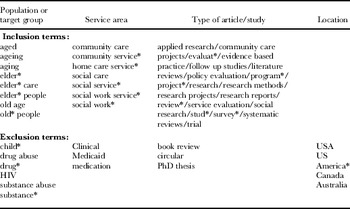
Searches of 10 diverse electronic databases were carried out between November 2003 and May 2004.Footnote 2 The main search terms included several for social and community care and others for ageing and older people's services (Table 1). To supplement the electronic searches, a number of general journals and those specific to old ageFootnote 3 were hand-searched for relevant research papers published during 1990 to 2004. The reference lists of the retrieved articles were also scanned.
Keywords and search terms employed in electronic searches

Note: * indicates any suffix or none.
Inclusion and exclusion criteria
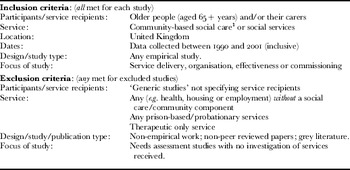
The remit for the review from the commissioners was exceedingly wide – to describe the state of social-care services for older people at the turn of the 21st century. Several criteria were required to accommodate the breadth and focus of the review and to keep the task manageable (Table 2). The inclusion and exclusion criteria were applied at two stages. At the first stage, the title and abstract (if available) were examined by the lead author of this paper (SJ). If it was expected that the study would meet the inclusion criteria, the full text of the article was obtained. At the second stage, the full article was examined and the full criteria applied. Any queries at both stages were addressed collectively by the review team.
Inclusion and exclusion criteria applied in selecting papers for review

Note: 1. Social care was defined as services provided, commissioned, funded or facilitated by the lead social services agency in a locality.
Data extraction and assessment of methodological quality
Each paper that met all the inclusion criteria (and none of the exclusion criteria) was abstracted to elicit the following information: study aims, research paradigm, study design, methods of data collection, dates, scope of the study, unit of analysis, key findings and implications for policy and ratings of methodological quality.Footnote 4 Most of this information was coded using pre-determined categories that were based on work by Boruch (Reference Boruch1997), Gray (Reference Gray1997), and Petticrew and Roberts (Reference Petticrew and Roberts2003). In addition, each paper was categorised by its ability substantially to inform or address the six themes of modernisation outlined above.
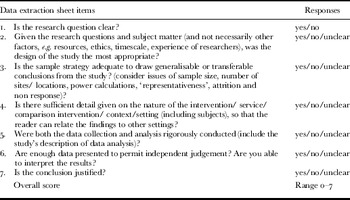
The scientific quality of papers was assessed in relation to a set of seven a priori quality attributes that measured internal, descriptive, construct and external validity (Table 3). Although measures of methodological quality for designs other than randomised-controlled trials (RCTs) are available (Mays and Pope Reference Mays and Pope2000; Spencer et al. Reference Spencer, Ritchie, Lewis and Dillon2003), none were suitable for a high volume review that included diverse research designs. Aided by these sources and the general evaluation literature, the research team devised hybrid criteria. Positively-rated items (response=‘yes’) were assigned one point each and these were summed into a total score. The maximum possible score was ‘7’, denoting high methodological quality. The internal consistency of this scoring system was examined using Cronbach's alpha, the overall score of 0.56 indicating acceptable internal consistency.Footnote 5 Each paper included in the study was read, extracted for information and rated by the lead researcher for this review (SJ). The team of reviewers met regularly to compare and discuss ratings across the four reviews being simultaneously conducted to maximise reliability.
Assessing methodological quality

Note: ‘yes’=1; no, unclear=0.
Data management, synthesis and reporting
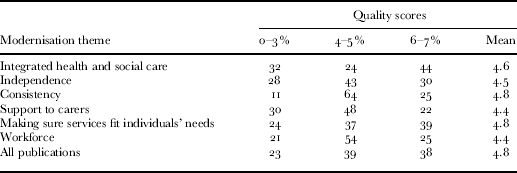
The unit of analysis was the research paper rather than the study because some studies tackled several research questions and generated multiple publications, sometimes under different authorship. This report opens with an overview of the coverage, study quality and methods used, and a summary account of the strengths and weaknesses of the evidence. Then, reflecting the heterogeneity of the studies, a narrative synthesis rather than a quantitative report is provided (Mays, Roberts and Popay Reference Mays, Roberts, Popay, Fulop, Allen, Clarke and Black2001). The scope of the review makes it impossible to describe or even list all the included studies (for which see Challis et al. Reference Challis, Xie, Hughes, Jacobs, Reilly and Stewart2004a). Instead, literature under three of the six modernisation themes is discussed: integration, independence and individuals' needs. These three were selected for three reasons: (i) their dominance in the UK older people's social-care modernisation policies; (ii) their international relevance – many OECD countries have framed policies to promote deinstitutionalisation and the community care of frail older people (Anderson and Hussey Reference Anderson and Hussey2000), and that require integrated systems of service delivery (Johri, Belland and Bergman Reference Johri, Beland and Bergman2003); and (iii) the high volume of identified literature from which the state of services before modernisation can be described. To exemplify, whilst the theme support to carers met criteria (i) and (ii), the sparse research evidence prevented a full analysis of these services. Similarly, consistency in service provision may have a growing evidence base but the coverage is mainly limited to the UK. Furthermore, the narrative synthesis concentrates on the higher quality studies – those scoring ‘5’ (the median) or above using the seven-point rating described above.
Limitations of the review
Before presenting the findings, it is important to note the limitations of the review. It was not a standard clinical or health-services research review with a narrow focus on the effectiveness or cost-effectiveness of a particular intervention or group of interventions. Difficulties therefore arose with the scope, synthesis and reporting, and these required modifications to the standard methodology of systematic reviews (discussed more fully in Reilly et al. Reference Reilly, Xie, Jacobs and Challis2008). Firstly, the remit of the review was to describe social care at the end of the 20th century, before recent modernisation policies had had a full impact on services. To capture research evidence from the beginning of the community care reforms to the emergence of the modernisation agenda, a specific time frame was therefore applied – between the NHS and Community Care Act 1990 and the Health and Social Care Act 2001. Studies conducted outside this period were not included, which explains some gaps, e.g. more recently published evidence on direct payments for older people's services.
Secondly, we fully recognise that much research evidence on social care has been published in books and reports rather than journal papers. Given the available resources, however, it would have been impossible to review systematically the non-journal literature. Pragmatically selecting peer-reviewed publications did however impose a rough quality-control filter (although clearly there are many exceptions). Thirdly, the review was only concerned with services specifically for older people. In the course of the review, however, some articles were identified that investigated social care in general but that were relevant to older people's services. Such studies were not included as they did not meet the original inclusion criteria and, most importantly, the search strategies were not designed to identify all ‘generic’ articles. Given the review's design, some relevant publications will have been missed; this influenced our decision not to report work on the workforce theme.
One final consideration regards the study quality rating applied to each publication. A scoring system was devised which had to be applicable to both qualitative and quantitative studies, as well as those with mixed methods. There were difficulties, however, primarily as a result of the different traditions and styles of reporting by researchers using the different paradigms and from different disciplines. Qualitative papers as a whole scored less than quantitative papers, with mixed methods papers in between. This did not, however, always reflect less rigour in the research process but sometimes a failure to report in sufficient detail one or more of: the methods of data collection and analysis, information about the sample or sampling; and the findings. It was such deficiencies that prevented a full judgement of quality (not the reviewers' methodological bias, for we have used and published qualitative and quantitative research). It is debatable whether qualitative research should be reported using the same scientific method as, for example RCTs (Mays and Pope Reference Mays and Pope2000). However, papers that do not enable the reader to form their own judgement of the quality of a study also prevent the presented evidence being used to inform further research or, more importantly, to improve services and inform policy.
Findings: an overview of the literature
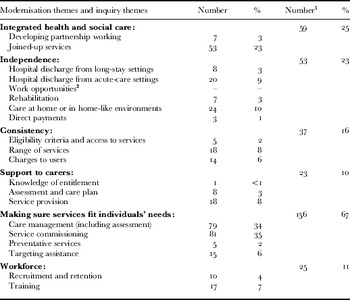
From just over 7,000 retrieved references, 234 peer-reviewed papers that reported UK studies conducted between 1990 and 2001 of social care in older people's services met the inclusion criteria. Almost one-fifth were identified by hand searches of relevant journals and the reference lists from other publications. Each study was categorised according to the modernisation theme(s) and area of enquiry(s) that it informed (Table 4). Two-thirds of these studies addressed the theme of making sure services fit individuals' needs, in particular care management and commissioning, but notably only 10 per cent addressed support to carers. The majority (76%) of the publications were descriptive and addressed the scope of a particular problem or needs, the services provided and the process of service delivery. By comparison, far fewer (33%) measured the impact of services for older people in terms of effectiveness, cost effectiveness, acceptability or satisfaction. It is striking that only 10 papers reported RCTs, and another four quasi-experimental trials. Furthermore, because there have been so few RCTs, no systematic reviews were found. The studies represent a wide range of research paradigms, from in-depth qualitative investigations of service users' experiences, to economic modelling of service costs. One-half (52%) of the studies were exclusively quantitative, over one-quarter (27%) were entirely qualitative, and the remainder (21%) used a combination of methods.
Peer-reviewed publications addressing the themes of modernisation and their associated areas of enquiry

Notes: 1. Aggregates of sub-totals exceed totals due to multiple categorisation of some review papers. 2. Not operationalised in older people's review.
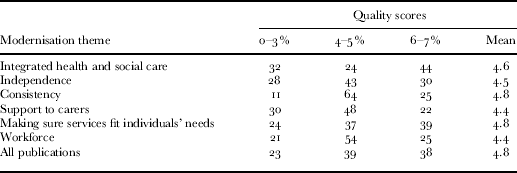
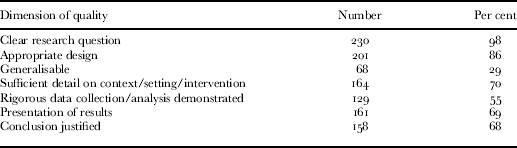
The methodological quality of the included studies is presented in Tables 5 and 6. It is important to bear in mind the distributions of quality scores for each modernisation theme when considering the review's findings. In particular, it is notable that 23 per cent of the studies were of relatively poor methodological quality (scored between ‘0’ and ‘3’, see Table 5), and less than one-third were assessed as being generalisable or transferable to a wider population (Table 6). Noteworthy also is the fact that almost one-half of the publications failed to demonstrate rigorous data collection or analysis. Whilst for many studies this reflected low scientific rigour, others failed to score positively through poor reporting.
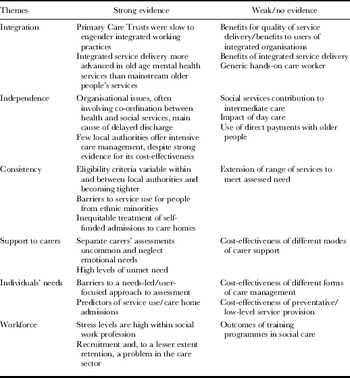
The findings concerning study methodology and quality from this review, and for the parallel reviews for the other adult user groups, are discussed in greater depth elsewhere (Reilly et al. Reference Reilly, Xie, Jacobs and Challis2008). A summary of the key strengths and weaknesses of the evidence supporting UK modernisation policies for older people's services is presented in Table 7. A strong evidence base may be down to one or two highly generalisable, good quality studies or to a larger number of small studies of lesser quality all of which reached the same or similar conclusions. Instances of a ‘weak’ or ‘null’ evidence base arise when only one or two methodologically weak studies were identified or none at all.
Assessment of methodological quality of studies by modernisation theme
Frequencies of attainment of dimensions of methodological quality
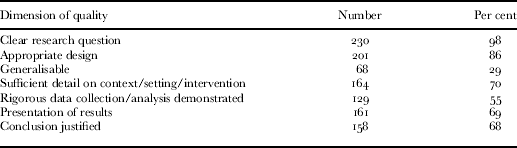
Note: Sample size, 234 publications.
Summary of the strengths and weaknesses of the evidence supporting the modernisation of social care for older people

Details of the studies
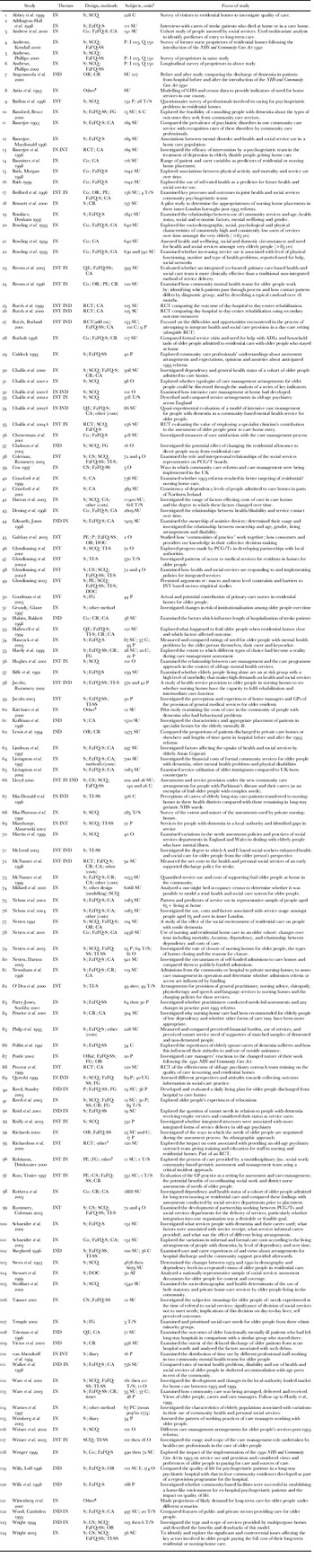
The following section of the paper syntheses the key substantive findings from the reviewed papers that are categorised under the themes of integration, independence and individuals' needs. As explained above, high quality articles that scored ‘5’ or above (on the seven-point scale) were selected for this paper and their key features are presented in Table 8. Where these are cited below, the figures in parentheses refer to the study reference numbers in Table 8. On the few occasions where studies of lesser quality are cited, these are referred to in the conventional manner, as are papers not included in the literature review.
Characteristics of high-quality studies informing review themes of integration, independence and meeting individuals' needsFootnote 1

Key to themes: IN individuals' needs; IND independence; INT integration.
Key to design and methods: Co cohort; CA client assessed; CS case study; DOC document review; F2FQ-S structured face-to-face interviews; F2FQ-SS semi-structured face-to-face interviews; FG focus group; OB observation; OR outcome evaluation; P participatory; PE process evaluation; QE quasi-experimental; SCQ self-completion questionnaire; TI-S telephone interviews (structured); TI-SS telephone interviews (semi-structured).
Key to subjects or units of analysis: AF assessment forms; C carers; I interviews; O observations; P professionals; PC postcode sectors; Q questionnaires; RCT randomised-controlled trial; SU service users; T/S team/service; UG user groups.
Other notes: 1. Papers scoring ‘5’ or above out of a possible ‘7’ on different aspects of quality. 2. Other design (modelling); other method (secondary analysis). 3. Other design (cost analysis); diary; other method (costs). 4. Other design (economic evaluation); other method (costs). 5. Other method (critical incident technique). 6. Other design (modelling); other method.
Integrated health and social care
Beginning with evidence of partnership working, the identified studies demonstrate that, with particular reference to services for older people, partnerships between social services and the NHS were variable and progressing slowly by the end of the 20th century. Two linked studies (38, 46, 48, 49, 99) described the development of partnerships between health and social services at the NHS primary care group or trust (PCG/T) level. They found that, despite the mandated local authority social services representation on PCG/T boards, general practitioners dominated decision making and social services representatives could be marginalised. Although relationships were improving over time, particularly among frontline staff, the studies concluded that considerable effort was still needed to build relationships and develop trust between agencies. Moreover, continuing organisational flux in the NHS had been likely to disrupt any established relations with social services departments.
Little empirical evidence was identified that demonstrated the often-assumed benefits of agency-level partnership working, either for service delivery or in terms of outcomes for service users. Only one paper (93) sought to address whether integrated structures, such as NHS care trusts, associated with more integrated forms of service delivery. This compared old-age psychiatry services in England with those in Northern Ireland, where health and social services have been jointly administered since 1973. They found that whilst the more integrated structures of Northern Ireland were associated with more integrated systems of service management, aspects of service delivery at the interface with the service user, such as referral and assessment practices, were no more likely to be integrated. Not one paper looked at the associated outcomes for older people.
Turning to the topic of joined-up services, the reviewed papers suggest that more progress had been made towards joined-up services in old-age mental health services than in mainstream older people's services, possibly following the lead of old-age psychiatry. The evidence for integrated working in old-age mental health services was strongest for liaison and training (33). In particular, there were many close links with care homes, which had better access to and relationships with psychogeriatric services than with other specialist health services (9, 58). There was less evidence, however, of formal integration through, for example, shared management of staff. In 2000, only 59 per cent of old-age psychiatry teams had social-care staff as members (33).
Some papers documented the benefits of social worker placement in general practitioners' (GP) surgeries, both for users and their carers (ease of access) (23) and for the staff involved (closer inter-professional working) (97). Integrated systems of care management, however, by which health-care staff assume responsibility for co-ordinating care packages, as suggested in the early guidance (Social Services Inspectorate and Social Work Services Group (SSI/SWSG) 1991a, 1991b), were slower to develop and difficult to maintain. A national survey of local authorities in 1997/8 demonstrated that only 21 out of 101 respondents had NHS staff acting as care managers for older people (31). A follow-up study in 2001 found that this was still the case in only 14 of these authorities (117). Moreover, the effectiveness of this and other existing models of integrated care-delivery in the UK remains to be evaluated.
This review revealed little evidence of the development of a generic health and social-care worker for older people. Whilst earlier studies had demonstrated the role's potential (e.g. Challis et al. Reference Challis, Darton, Johnson, Stone and Traske1991a, Reference Challis, Darton, Johnson, Stone and Traske1991b), only one paper meeting the inclusion criteria for the current review (but not the median quality score) explicitly evaluated the development – it was a small process evaluation that demonstrated equivocal success (Taylor Reference Taylor2001). Indeed, despite the widely held presumption that integrated services are favourable for older people, evidence of their benefits was generally lacking, as other reviews have found (Dowling, Powell and Glendinning Reference Dowling, Powell and Glendinning2004). There is, however, clear evidence of the barriers to integrated health and social care among the reviewed paper (23, 97) and elsewhere (Johnson et al. Reference Johnson, Wistow, Schulz and Hardy2003). They include professional mistrust, threats to professional identities, and problems with information sharing.
Independence
Studies of hospital discharges of older people from long-stay hospital wards were not well represented during the review period – in contrast to the 1980s, when discharge from acute hospital care, in particular delayed hospital discharge, was a prominent theme. The reported incidence of delayed discharge in studies identified for the current review averaged around 25 per cent of admissions (61, 109). The identified reasons for delayed discharge were delays in: care-home placement (7, 52, 61, 109), the assessment process (7, 109), and the completion of care packages including necessary home adaptations and equipment (52), and the absence or breakdown of carer arrangements (7, 109). Other factors such as access to rehabilitation in hospital, dependency and age were not found to be significant causes. In other words, organisational issues, including many involving co-ordination with social services, were identified as the main cause of delayed discharges.
Moving on to rehabilitation, few peer-reviewed publications were found on the contribution of social services to rehabilitation in older people's services, and those identified did not rate highly on the seven quality criteria. For example, one study which sought to identify the different models of community rehabilitation in the UK and that collected data on the structure of 98 different teams failed to examine explicitly the involvement of social-care staff (Enderby Reference Enderby2002). Another study of community rehabilitation that did investigate aspects of integration with social care compared only six teams (Geddes and Chamberlain Reference Geddes and Chamberlain2001). Variations in team structure and the services offered were assumed to relate directly to the particular purpose of each team, and a taxonomy of four types of rehabilitation service was proposed. It is hard to draw any conclusions relating to social care from such a small sample, however, and no identified studies investigated the relative benefit of integrated teams for older service users. One of the few identified RCTs was high quality and compared day-hospital rehabilitation to rehabilitation by health staff in a social-services day centre (25, 26, 27). Whilst the outcomes were similar for older people and their carers in each setting, the day-centre model was less popular.
The focus on rehabilitation in older people's services has been largely subsumed by the intermediate care agenda in the UK (Cm 4818-I 2000), but peer-reviewed evaluations of intermediate care services that explicitly involved social services were scarce: only three papers were identified in the current review and only two scored ‘5’ or above on quality. One of these was an RCT of an integrated supported early-discharge team for stroke patients (72). Despite the small sample size, this study suggested that the intervention was a cost-effective alternative to hospital care in the management of stroke. The remaining paper which could inform developments in intermediate care was descriptive and examined access to health care for older residents of care homes taking a mixed-methods approach. It found that whilst access to therapy services was possible for most homes, it was often difficult and had to be paid for privately, with potentially some negative consequences for the sector's capacity to provide intermediate care services (58).
Care at home or in homelike environments
In relation to this area of enquiry, two services covered by the research literature will be considered here: day-care services and intensive care management for older people. Day-care services offer both social and respite care and facilitate interactions between older people. Several benefits of day care were suggested in the reviewed papers but they had below the median quality scores: social interaction, improvements in mood and behaviour of dementia sufferers, improved social functioning and avoidance of admission to residential care (Curran Reference Curran1996; Powell Reference Powell2000). No rigorous evaluations of the impact of day care were identified, but included papers did suggest that day services were changing. For example, new developments, such as integrated day-centre rehabilitation and day-care provision in multi-purpose care homes were evaluated but demonstrated variable success (25, 26, 27). An intensive-care management demonstration study (34) met the inclusion criteria and indicated the capacity of this approach not only to provide an alternative to care-home admission but also to improve wellbeing and support to carers. By 1997/8, however, only five per cent of English local authorities provided such a service (32), despite no evidence of the cost effectiveness of less targeted forms of care management (discussed further below).
Direct payments
Given the reference period of the current review (1990–2001), it is unsurprising that little empirical evidence was identified concerning the use of direct payments by older people. Just one small study in a peer-reviewed journal was identified (Leece Reference Leece2001), for which only three older users of direct payments were interviewed.
Making sure services fit individuals' needs
Assessment and care management
The general anxiety felt by community-care professionals prior to the introduction of the ‘new’ process of assessment for care management was highlighted in a 1993 paper, the year of full implementation of the community care reforms (29). This qualitative study identified three issues of concern that later became recurrent themes in the literature: the conflicting role of the assessor; the identification of unmet needs; and, in particular, difficulties in conducting a needs-led assessment. Most papers in this review that examined the assessment process were concerned with the success or failure of a needs-led approach to assessment. In this respect, studies provided evidence of the way in which social workers' concepts of needs were inextricably linked to services and eligibility criteria (83); that with ever-tightening budgets, assessments were becoming even more resource-led (83); that user choice in the assessment process was restricted (55, 113); and that despite older people's reluctance to enter care homes, they often acquiesced to professional recommendations (91). There was also debate about the desirability of structured assessments. A nationally-representative survey of 50 assessment documents, whilst highlighting wide variations in the domains covered by these instruments, found that most were structured, some highly so (104). Whilst promoting consistency in the assessment process and aiding the generation of aggregate data, structured assessment forms were also criticised for their inflexibility (Ellis, Davis and Rummery Reference Ellis, Davis and Rummery1999), and incompatibility with users' perceptions of need (Rummery, Ellis and Davis Reference Rummery, Ellis and Davis1999). These papers did not provide a full account of their methodology and did not reach the median quality score.
Despite the provision of guidance on care management (SSI/SWSG 1991a, 1991b), this review found marked variation in the ways in which care management developed following the NHS and Community Care Act 1990 (32, 116, 117). In particular, as reported earlier, very few local authorities employed NHS staff as care managers, indicative of more integrated forms of care co-ordination, and even fewer operated intensive-care management schemes for older people. Budgetary devolution to care managers was rare (39), and systems for the monitoring and review of care packages poorly developed (55, 113). Many of these aspects of care management were vital to the success of the original demonstration studies (Challis Reference Challis1993) that targeted the most highly dependent older people at high risk of care-home admission. Instead, the identified papers suggested that care management had become a process applied to all older people referred to social services departments, irrespective of need. Moreover, there was no evidence of the relative cost-effectiveness of different models of care management for older people.
Service commissioning
Included papers provided useful information for service commissioning in terms of measuring service use, unmet needs and costs; issues affecting social-care markets; methods for measuring outcomes; and user involvement in commissioning processes, but few looked at the commissioning process itself in detail. Several studies aimed to identify the predictors of domiciliary and day-care use and care-home admissions. The most commonly identified predictors of home care, and those most strongly associated with service use, were dementia (64, 73, 76, 100), living alone (or the absence of a cohabitant or family carer) (19, 51, 64, 73, 76, 100, 114), physical dependency (or activity limitation) (12, 19, 21, 22, 64, 73, 76) and age (19, 43, 44, 51, 64). Living alone (19, 57, 65, 75) and dementia (19, 65, 75, 85) were also the most commonly reported predictors of using day-care services. Of particular interest to policy-makers and planners aiming to divert older people away from institutional care were studies that identified factors associated with care-home admission. Again, dementia (and its severity) was identified as one of the strongest predictors of admission (3, 14, 17, 78), but also influential was whether there was a family carer, her or his ability to cope and their level or stress (3, 14, 17, 51, 78). This is a clear indication of the potential of carer-support services to help maintain older people for longer in their own homes. Interestingly, a national study of care-home admissions (78) concluded that characteristics of the individual explained over 80 per cent of admissions, and that supply factors, although significant, added nothing to the power of the statistical model developed. One surmises, therefore, that up to 20 per cent of admissions may be explained by service-related factors, which are open to modification by service planners.
Preventative services
Only two papers that explicitly investigated the provision of low-level preventative services met the inclusion criteria. Both qualitative studies, they provided evidence of the value placed on such services by older people. One suggested that help with housework was instrumental in allowing older women in particular to remain in their own homes (Clark and Dyer Reference Clark and Dyer1998), but provided insufficient detail of the methodology to allow a full judgement of quality. The other described difficulties faced by older people in asking for help from others when statutory services were unavailable (106).
Targeting assistance
Most publications on targeting concerned the appropriateness of care-home placements. It has been estimated that almost one-third of those admitted are inappropriately placed or have a low level of dependency (18, 30, 81, 84, 124). Variation in placement decisions between different areas was demonstrated for both England (78) and Northern Ireland (41). These authors suggest this is likely to be due to the availability and success of alternative services aimed at maintaining people at home for longer.
Discussion
This review has uniquely taken a systematic approach to the identification, critical appraisal and synthesised evaluation of the peer-reviewed research literature pertaining to social care for older people. By doing so, it has provided not only a picture of the state of these services in the United Kingdom at the end of the 20th century but also identified where further investment in research is required to improve the evidence base. The review has demonstrated where the research evidence is strong (Table 7) and may have helped inform policy change. For example, in relation to delayed hospital discharge, the evidence strongly suggests that the main causes relate to organisational issues, particularly at the interface of hospital and community. The Community Care (Delayed Discharges etc.) Act 2003 subsequently placed new duties and responsibilities on both social services authorities and the NHS, thereby recognising the joint responsibility for ensuring timely discharges (DH 2003 b). Whilst this may represent ‘evidence-based policy’ in action, it could also be argued that other drivers for change were as important, such as financial and political pressures to eliminate problems of ‘bed-blocking’.
The review has also identified weaknesses in the evidence base, both in terms of gaps (Table 7) and in respect of the quality of published studies (Tables 4 and 5); in these areas, policy and practice appears to have advanced without research evidence. For example, in the case of intermediate care services, the dearth of peer-reviewed publications is surprising. Even within the health-care sector where there is a stronger tradition of evidence-based policy and practice, developments in intermediate care have been viewed as lacking an evidence base (Vetter Reference Vetter2005). Although the national ex post evaluation of intermediate care has now reported (Intermediate Care National Evaluation Team 2006), questions remain over the relative cost effectiveness of the different forms, functions and processes of intermediate care (of which there are many), and for different types of service user.
This review suggests that there is a general need for higher quality and fuller methodological reporting of studies of the social care for older people. If evidence-based practice and policy is to become a reality in social care for older people, it requires a solid foundation of scientific research, rigorously designed, executed and disseminated, and that addresses an appropriate range of research questions. High-quality research is required on the structure and process, as well as outcomes of services, reflecting the nature of the subject being investigated and its state of development. We need to know not just what to provide, but how to provide it in such a way that will maximise the benefits for older people. More investment is required in research to determine the effectiveness and cost-effectiveness of: modes of service integration for different groups of older service users, how best to confer the same degree of choice, control and independence afforded to some younger disabled adults through direct payments, and how to commission and organise services around the needs of the individual older person. For the studies to be useful to policy makers, service commissioners and practitioners, they must deliver on the different dimensions of methodological quality assessed in this review, for only then will they constitute a sound evidence base.
The systematic review has also provided baseline information from which to judge the impact of the modernisation of social care for older people. Public-services reform is a continuous process in the UK. With roots in the neo-liberal reforms of the 1980s and 1990s, it continued through a ‘radical programme’ of reform during the Labour party's third subsequent administration (Blair Reference Blair2005). For older people's services, the standards set out in the NSFOP continue to be reflected in the 2006 White Paper for community services, Our Health, Our Care, Our Say (Cm 6737 2006), whilst new initiatives are in train to promote the integration of health and social care, independence and person-centred care (DH 2007b), underpinned by the ‘choice’ agenda that is applied to many public services. Modernising social care for older people is no small task. Social-care spending runs at £13.8 billion in adult services – older people being the single largest user group and accounting for 44 per cent (Health and Social Care Information Centre 2006). Moreover, increasing financial pressures are inherent in many of the recent modernisation reforms that seek to divert further the care of older people from acute hospitals to the community, e.g. intermediate care and the new health and social care model for managing long-term conditions (DH 2005). Without an adequate evidence base, however, policy makers and commissioners will struggle to ensure that service improvements can be made with finite resources.
Acknowledgements
This study was funded by the UK Department of Health Policy Research Programme. We are grateful to Helen McEvoy and Mary Ingram who helped with the initial searches for literature and with setting up databases to manage the review process. We also thank Ross Millar who helped with the retrieval of articles. The views expressed are those of the authors alone.