In recent years, interest in the influence of hospital safety culture on professional performance has grown, specifically with regard to guideline adherenceReference Dodek, Cahill and Heyland 1 and infection control.Reference De Bono, Heling and Borg 2 In infection control, hand hygiene has proven particularly important.Reference Pittet, Allegranzi and Sax 3 Large interventional studies have shown that increases in hand hygiene compliance can decrease nosocomial infection rates.Reference Pittet, Hugonnet and Harbarth 4 , Reference Kirkland, Homa, Lasky, Ptak, Taylor and Splaine 5 Still, adherence to hand hygiene guidelines is notoriously poor.Reference Huis, Holleman, Van Achterberg, Grol, Schoonhoven and Hulscher 6
Many methods have been applied to enhance hand hygiene compliance,Reference Huis, Van Achterberg, De Bruin, Grol, Schoonhoven and Hulscher 7 but achieving structural improvement is challenging, and interventions rarely have long-term effects.Reference Erasmus, Daha and Brug 8 , Reference Tromp, Huis and De Guchteneire 9 In addition, newly developed interventions are typically less successful when applied in other hospitals.Reference Gould, Hewitt-Taylor, Drey, Gammon, Chudleigh and Weinberg 10 Although differences in organizational factors may play a role, failure to implement previously successful interventions is often attributed to differences in hospital culture.
Not only is there great variation in hand hygiene compliance among hospitals,Reference Creedon 11 differences are also observed among units of the same hospital.Reference Cantrell, Shamriz, Cohen, Stern, Block and Brezis 12 – Reference Saint, Conti and Bartoloni 14 As hospital units often work with designated teams and care for a specific patient population, this intrahospital variation could be attributed to differences in the safety culture at the unit level. Although changing the safety culture is challenging, it has been suggested that improving the safety culture could positively influence outcomes,Reference Dodek, Cahill and Heyland 1 , Reference De Bono, Heling and Borg 2 and interventions to change the organizational safety culture have been shown to improve infection control.Reference Peterson, Teman and Connors 15 , Reference Larson, Early, Cloonan, Sugrue and Parides 16
The relationship between patient safety culture and the ability to improve has not yet been clearly defined, but it could provide insight on how efforts to increase hand hygiene compliance, or guideline adherence in general, can be optimized. In our hospital, we assessed the effects of a 2-year, institution-wide hand hygiene improvement program, and we observed large differences among hospital units. We investigated the patient safety culture on these units and assessed the relationship between the level of safety culture and the ability to improve hand hygiene compliance.
METHODS
Study Design
We conducted a mixed-methods study by performing a qualitative investigation following a before-and-after study. We observed hand hygiene compliance in each hospital unit before and after interventions; we evaluated changes in compliance over 2 years, and we assessed safety culture through semistructured interviews.
In 2014, we launched an extensive hand hygiene improvement project. Several hospital-wide interventions provided the infrastructure and requisites for improvement, and individual hospital units were called upon to be responsible for their own improvements. Hospital management declared hand hygiene a top priority. We compiled a “Hand Hygiene Improvement Toolkit,” after an extensive literature review of effective interventions (see the Supplementary Material online).Reference Tromp, Huis and De Guchteneire 9 All units received feedback on baseline compliance. Hospital management then sent the Toolkit to unit managers and encouraged them to devise a plan of action for improvement, using Toolkit interventions they considered useful for their team. Unit managers were presented with compliance results after every measurement and were encouraged to discuss these results with the staff. Possible explanations for findings were addressed, including any problems the unit might experience. We additionally conducted pilot tests to select the alcohol-based hand rub that healthcare workers preferred, and we installed dispensers on the ends of all hospital beds to enhance availability.
Hand Hygiene
Study Population
We measured hand hygiene compliance on all units between January 2014 and March 2016. We selected 8 units for closer monitoring; these units represented a cross-section of the hospital (ie, surgical and nonsurgical units, intensive care units and non-intensive care units, pediatric and adult patient wards). On these units, we performed 2 baseline measurements and 4 postintervention measurements.
Data Collection
Observers were trained according to the WHO’s Hand Hygiene Technical Reference Manual and Training Films. Observations were unannounced and discrete, but not covert, and were registered in iScrub Lite, an application based on the WHO Five Moments of Hand Hygiene.Reference Hlady, Severson, Segre and Polgreen 17 Measurements took place on at least 2 nonconsecutive days. A minimum of 2 observers collected data for at least 140 hand hygiene opportunities, per unit, per measurement, as proposed by the WHO. 18
Statistical Analysis
We calculated compliance using the sum of all observed opportunities in which hand hygiene was performed divided by the sum of all observed opportunities in which hand hygiene was indicated. We assessed changes in compliance through longitudinal logistic regression analyses; we corrected for correlated observations through stratification per unit and by adding a time-dependent covariate.
Interviews
Study Population
5 hospital units were selected to investigate the relationship between safety culture and the ability to improve. We used the positive deviance approach, which identifies behavior that enables groups or individuals to outperform their peers.Reference Curry, Spatz and Cherlin 19 We defined positive deviance as the ability to improve hand hygiene compliance during the intervention period and selected the 2 best performing and 2 least performing units. A fifth unit that did not improve, but consistently showed the hospital’s highest compliance, was also included as high performing. With purposeful sampling, we selected interviewees from each unit, to encompass both managers’ and nonmanagers’ perspectives, and both medical and nursing points of view: the management (medical director and nurse manager), 2 doctors and 2 nurses (to encompass both managers’ and nonmanagers’ perspectives), and both medical and nursing points of view, until data saturation. Interviewees had to have been employed for at least 24 months to ensure both pre- and postintervention experiences.
Data Collection
The interview guide consisted of open-ended questions based on COMPaZ, the validated Dutch version of the Hospital Survey on Patient Safety Culture.Reference Smits, Christiaans-Dingelhoff, Wagner, Wal and Groenewegen 20 To fit our study, some adaptations were made. (The interview guide, COMPaZ description, and adaptations are provided in the Supplementary Material online.) An independent, experienced observer (P.K.) conducted semistructured interviews from May through July 2016. To prevent bias, he had no knowledge of each hospital unit’s compliance prior to the interviews.
Analysis
Interviews were transcribed verbatim. Analysis followed 3 steps: (1) Open coding was conducted to name and categorize phenomena and to ensure data completeness; (2) with axial coding, connections were drawn between answers; and (3) selective coding further refined answers while linking them to the dimensions of patient safety culture. Quotes that exemplified responses from the same unit were selected to illustrate meaning. The coding frame was developed iteratively as 2 researchers (M.C. and P.K.) read the transcripts. To prevent bias in the coding frame, P.K. was still blinded to hand hygiene performance, and M.C. was blinded to the respondent’s unit. Recurrent themes were noted, both topics that were covered by the interview guide and topics raised by participants. Excerpts from the transcripts were allocated to these codes. After double-coding 5 transcripts, we discussed findings and defined the coding structure. We then proceeded with a single coder (P.K.) for the remaining transcripts. To avoid coder drift, we regularly evaluated whether adjustments in the coding frame were needed.
The Manchester Patient Safety Assessment Framework (MaPSaF) proposed categorization of safety culture maturity in 5 levels (Table 1),Reference Law, Zimmerman, Baker and Smith 21 based on earlier adaptations.Reference Westrum 22 , Reference Parker, Lawrie and Hudson 23 The MaPSaF method has been adapted for all healthcare settings and is listed by the WHO as a valid way to assess safety culture. 24 We used this framework to assess the level of safety culture: individual responses were categorized as pathological, reactive, bureaucratic, proactive or generative, receiving 1 to 5 points, respectively. A summary score was calculated to assign an overall level of safety culture to each unit.
Categorization of Safety Culture in 5 Levels, Proposed by the Manchester Patient Safety Assessment FrameworkReference Law, Zimmerman, Baker and Smith 21

RESULTS
Hand Hygiene
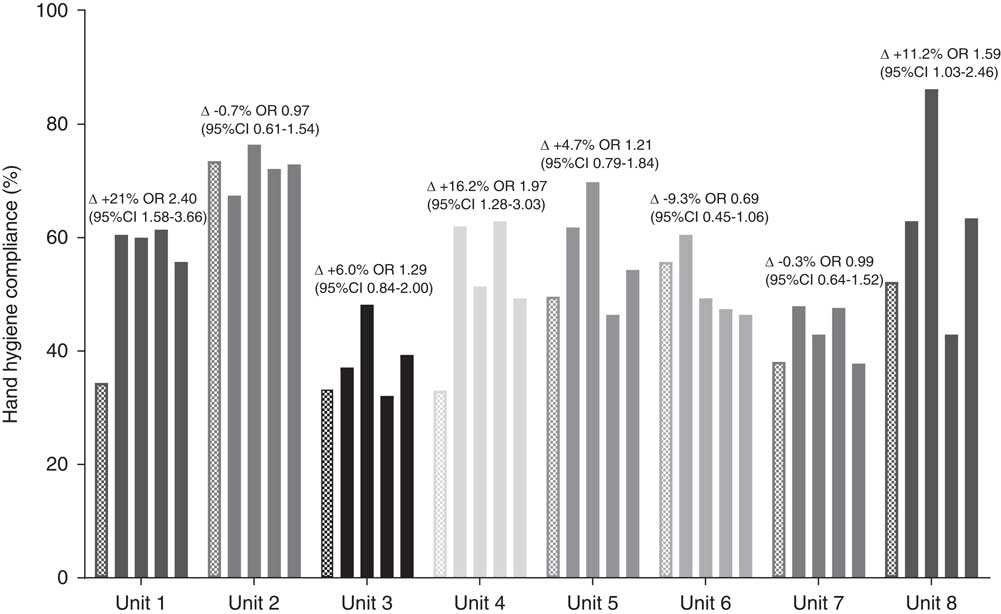
We observed 6,401 hand hygiene opportunities in 8 hospital units (Figure 1). Mean baseline compliance was 46% (range, 33%–74%). Units 1 and 4 showed the largest improvements (21% and 16%, respectively). Unit 2 consistently showed the hospital’s highest compliance (74%). These 3 units were selected as high performing. Units 3, 6, and 7 showed no changes from baseline. During interventions, unit 7 underwent reorganization and was excluded because such changes can affect safety culture and can confound findings. We selected units 3 and 6 as low performing.
Hand hygiene compliance per unit, per measurement. First bar represents pooled baseline compliance, other bars represent measurements during the intervention period. OR, odds ratio; CI, confidence interval.

Safety Culture
We interviewed 24 respondents, 4 on unit 3, and 5 on all other units (see Distribution in the Supplementary Material online). Table 2 shows unit characteristics. High-performing units showed high levels of safety culture, while low-performing units showed low levels. The most striking differences were found in the dimensions described in the following section. (A full description and additional quotes are provided in the Supplementary Material.)
Characteristics of Selected Hospital Units

NOTE. Δ, change from baseline; OR, odds ratio; CI, confidence interval; ICU, intensive care unit.
Teamwork and Hierarchy
High-performing units consistently reported close collaboration and involvement of unit management. Units 1 and 2 considered their unit free of hierarchy. The managers on unit 4 set the standards, but with staff involvement, resulting in collective efforts to improve.
“Hierarchy is almost nonexistent. There are just differences in responsibilities.” (doctor HU2)
Low-performing units showed opposing points of view on collaboration. Medical staff and managers mentioned that existing hierarchy was not an obstacle to collaboration, while nursing staff expressed contrasting opinions.
“There […] is some discontent. […] projects that were forced through, of which the [nursing] team had a clear opinion, and still does. Which is ignored. And that can be difficult sometimes.” (nurse HU3)
Overall Perception of Safety
On high-performing units, staff were aware of the consequences of noncompliance and showed a clear and consistent attitude toward patient safety.
“[The department manager] has a clear vision on quality and safety. […] We are doing projects on medication safety and prescribing errors. [Hand hygiene] is an integral part of your work.” (doctor HU 4)
On these units, safety issues were anticipated and efforts were made to improve patient safety in general, while low-performing units described more reactive or even pathological approaches.
“We try to, well, keep an eye on the aspects of patient safety, assessment of scores, fall risk, things like that […]. We try to do, what we can, to monitor patient safety, but things can go wrong, also in our unit.” (medical director HU3)
“[Other units] all stick to the rules, while we have a tendency to work around them. Or deviate from them.” (nurse HU6)
Addressing Noncompliance
Addressing coworkers in cases of noncompliance was common on high-performing units. On low-performing units, this was not the case; staff were mainly focused on their own performance.
“I always do that. […] that’s just common practice for the unit.” (doctor HU4)
“[…] with co-workers, I don’t really pay attention. It’s not on me. I have enough on my plate.” (nurse HU6)
Feedback and Improvement
Participation in hand hygiene improvement interventions was obligatory on high-performing units, closely involving staff and managers.
“Everyone had to pass the test [on hand hygiene technique] and everyone did, it received a lot of attention, also from [unit] management, I think that’s important.”(nurse HU2)
Low-performing units showed discrepancies in their views on improvement strategies. On unit 3, the nurse manager was scarcely aware of interventions, while staff specifically mentioned measures that had created more awareness. In contrast, the nurse manager of unit 6 mentioned many interventions that were not recognized by staff.
Combining Specialties
Although it was not part of the interview guide, collaboration with different specialties on 1 unit emerged as an important factor. Nursing staff on these wards consistently described differences in communication with the medical staff of the 2 specialties. Measures taken to align the specialties did not seem to have an effect.
“So the logistics are different. That can be difficult. To work with. […] They just are in different fields and have […] their own way of communicating.” (nurse HU3)
DISCUSSION
We assessed the ability of individual hospital units to improve hand hygiene compliance during a hospital-wide improvement program. We observed large differences in safety culture between high-performing and low-performing units. Units with high levels of safety culture showed improvement or had high baseline compliance, while units with lower levels of safety culture did not.
These differences were striking because all units had enjoyed the same opportunities, resources, and support to improve compliance. Interestingly, units that cared for patients of 2 different medical specialties consistently showed difficulties in collaboration between medical and nursing staff. This factor clearly had an impact on the safety culture in the unit and appeared to be a barrier to improvement. This finding is supported by earlier studies showing that effective leadership improves safety performanceReference Westrum 22 and that team training can reduce surgical mortalityReference Young-Xu, Neily and Mills 25 , Reference Neily, Mills and Young-Xu 26 and forms the basis of the TeamSTEPPS approach to safety and quality.Reference Epps and Levin 27
Although a minor finding, high-performing units had implemented more interventions (6, 8, and 9 interventions) than low-performing units (4 interventions each). This finding is in line with studies showing that less hierarchical and more collaborative units more easily accept new ideasReference Kilbride, Powers and Wirtschafter 28 and that units with higher levels of safety culture are more open to interventions to improve performance.Reference Parker, Lawrie and Hudson 23
Although hand hygiene is the most effective strategy to prevent healthcare-associated infections, compliance is poor and notoriously hard to improve. Several researchers have observed differences in culture between hospitals that may impact the success of interventions.Reference Cantrell, Shamriz, Cohen, Stern, Block and Brezis 12 , Reference Cumbler, Castillo and Satorie 29 , Reference Kilbride, Wirtschafter, Powers and Sheehan 30 It has been suggested that hand hygiene compliance reflects the perceived vulnerability of patients.Reference Cantrell, Shamriz, Cohen, Stern, Block and Brezis 12 Critical pediatric care units have higher level of compliance,Reference Homa and Kirkland 13 which could reflect their overall safety culture. The highest level of compliance in our hospital was observed on the pediatric critical care unit. Of the 2 other high-performing units, one unit does not provide intensive care and the other unit does; however, their baseline compliance was low. In addition, while the 2 low-performing units both care for vulnerable patients, this did not affect either safety culture or compliance. This finding strengthens the idea that safety culture influences the ability to improve more than absolute hand hygiene compliance.
The idea that culture influences performance is not a new concept. Earlier publications have clearly demonstrated the importance of organizational culture in improving adherence to infection control measuresReference Larson, Early, Cloonan, Sugrue and Parides 16 , Reference Kilbride, Wirtschafter, Powers and Sheehan 30 and correlations between unit culture and successful practice have been observed.Reference Westrum 22 , Reference Kilbride, Powers and Wirtschafter 28 However, most studies focus on changing culture at the hospital level, with huge numbers of employees (>20,000) undergoing safety culture training,Reference Hoyt 31 presumably against considerable cost and time investments. A few intervention studies have shown that changing (elements of) hospital or unit culture can enhance adherence to infection control measures.Reference Peterson, Teman and Connors 15 , Reference Hoyt 31 – Reference Jain, Kralovic and Evans 33 However, safety culture is usually not measured at the unit level,Reference Cantrell, Shamriz, Cohen, Stern, Block and Brezis 12 , Reference Cumbler, Castillo and Satorie 29 , Reference Kilbride, Wirtschafter, Powers and Sheehan 30 , Reference Hessels, Genovese-Schek, Agarwal, Wurmser and Larson 34 and simplistic correlations such as ‘a strong culture leads to good performance’ have not been scientifically supported.Reference De Bono, Heling and Borg 2
Our study has strengths and limitations. The use of a hand hygiene observation tool with clearly defined standard operating procedures adds to the value of our findings. Observations were unannounced and discrete, but not covert. Overestimation of absolute compliance rates is probable,Reference Huis, Holleman, Van Achterberg, Grol, Schoonhoven and Hulscher 6 as individuals tend to modify their behavior when they become aware of being observed (ie, the “Hawthorne effect”).Reference Hagel, Reischke and Kesselmeier 35 With ongoing interventions, the Hawthorne effect may have had greater influence over the course of our study. However, instead of absolute compliance, we used changes in compliance, which do not rely on validity but on responsiveness of the measurement tool. Still, the Hawthorne effect should be taken into account when interpreting these findings. We defined “high performing” as the hospital’s highest compliance or showing the greatest improvement in compliance. Still, our high-performing units showed 49%–74% compliance. Although compliance rates approaching 100% have been reported, in the Netherlands compliance is generally low,Reference Huis, Holleman, Van Achterberg, Grol, Schoonhoven and Hulscher 6 making the ability to improve, rather than absolute compliance, acceptable and relevant as an outcome.
We performed a single-center study; our findings may therefore not be completely generalizable. However, a multicenter study would present problems of comparability because we aimed to assess the influence of safety culture on the ability to improve when all prerequisites for optimal compliance have been met, and, most importantly, are the same for all units. In addition, we selected units to represent an average cross-section of a hospital, thus enhancing generalizability. Safety culture is a complex topic, and its role in the ability to improve has not been previously defined. Therefore, we gained in-depth knowledge by adapting the most commonly used questionnaire for our interview guide.Reference Fleming 36 , Reference Nieva and Sorra 37 Both management and nonmanagement perspectives were obtained, as well as both medical and nursing points of view, with which we achieved data saturation. Although our sample was small, differences between the high-performing and low-performing units were unmistakable, indicating strong associations.
Although a strong safety culture appears to be a prerequisite for change, a reverse relationship has been hypothesized as well; working together toward the same goal can positively influence teamwork. In our study, safety culture may have improved with interventions, although a recent study showed that successful improvement strategies in catheter-associated infections were not associated with changes in safety culture.Reference Meddings, Reichert and Greene 38 To our knowledge, our study is the first exploration of the relationship between level of safety culture and the ability to improve. Repeating safety-culture assessment before and after interventions, preferably through interviews, could further confirm this relationship. In our study, teamwork and addressing noncompliance proved important components of unit culture. Resolving these issues before implementing interventions (eg, through team-building exercises) could provide the changes needed to achieve improvement. Future studies, especially interventional trials targeting low levels of safety culture, could investigate this more explicitly.
Our findings may have important implications for the implementation of hand hygiene interventions. Costly and time-consuming interventions may not affect compliance when they are applied in hospital units with a low level of safety culture. In addition, although hand hygiene is an essential aspect of safe care, it is only one of many. Our findings, therefore, do not apply to hand hygiene alone but possibly to improvement strategies in general. Factors that hinder a high level of unit safety culture might prove pivotal to the success of improvement programs.
ACKNOWLEDGMENTS
The authors would like to thank L. A. Armstrong, Drs A. M. Kaiser, H. van de Laar, Dr S. D. van der Werff, and Dr P. W. van Wijk, for their contributions to the collection of hand hygiene compliance data.
Financial support: No financial support was provided relevant to this article.
Potential conflicts of interest: All authors report no conflicts of interest relevant to this article.
SUPPLEMENTARY MATERIAL
To view supplementary material for this article, please visit https://doi.org/10.1017/ice.2017.209