

International prevalence studies have indicated that up to 22% of school-aged children exhibit emotional and behavioural difficulties (Oh & Bayer, Reference Oh and Bayer2017). These difficulties are commonly referred to as externalising and internalising problems, with externalising problems typically presenting as overt disruptive behaviours (such as aggression, defiance and hyperactivity) and internalising problems usually appearing as overcontrolled emotional behaviours (such as anxiety, social withdrawal and sad affect; Gilliom & Shaw, Reference Gilliom and Shaw2004). Research suggests that early emerging difficulties tend to persist into adolescence, and adulthood if left untreated, often resulting in a range of negative long-term outcomes, including psychosocial difficulties, educational underachievement, and more severe forms of mental illness (Boulter & Rickwood, Reference Boulter and Rickwood2013; Harwood, O’Brien, Carter, & Eyberg, Reference Harwood, O’Brien, Carter and Eyberg2009). This indicates that childhood presents a critical window for professional services to interrupt the negative trajectories children may follow if problems remain untreated.
Despite the substantial prevalence of child mental health problems, there is a significant discrepancy globally between the number of children requiring mental health services and the number of children who actually receive intervention (Zwaanswijk, Verhaak, Bensing, van der Ende, & Verhulst, Reference Zwaanswijk, Verhaak, Bensing, van der Ende and Verhulst2003). Such disparities are prevalent in Australia, where only a quarter to half of children with mental health problems have had access to professional help (Lawrence et al., Reference Lawrence, Johnson, Hafekost, Boterhoven, Sawyer, Ainley and Zubrick2015; Oh & Bayer, Reference Oh and Bayer2015; Sawyer et al., Reference Sawyer, Arney, Baghurst, Clark, Graetz, Kosky and Zubrick2001). It is widely recognised that young children’s utilisation of mental health services is highly dependent on parents, as children lack the autonomy and the means to initiate help seeking independently (Boulter & Rickwood, Reference Boulter and Rickwood2013). Parents play a critical role in first identifying their child’s problem, opening the gate to services, and maintaining continued receipt of professional help (Godoy, Mian, Eisenhower, & Carter, Reference Godoy, Mian, Eisenhower and Carter2014). Therefore, to clarify and address issues underlying a lack of engagement in professional services, it is critical to examine factors that impact on parents’ decisions to seek professional help for their children.
According to Zwaanswijk et al. (Reference Zwaanswijk, Verhaak, Bensing, van der Ende and Verhulst2003), variables that may influence parental recognition of child mental health difficulties and their subsequent decision to seek help from a general practitioner (GP) can be conceptualised as falling into three categories: (a) child variables (e.g., child age and gender); (b) environmental variables (e.g., availability of services and sociodemographic factors); and (c) parent variables (e.g., beliefs and attitudes). While it is important to note that no research to date has extended Zwaanswijk et al.’s categories to parents seeking help from professionals other than GPs, they are often the first professional parents will consult to obtain a referral for a consultation with a mental health practitioner. Therefore, it seems reasonable to expect that variables influencing parents to seek help from mental health professionals might be the same.
Both child and environmental variables impacting on help seeking have been investigated in the literature. For example, it has been found that parents are more likely to seek help for boys than girls (e.g., Bussing, Zima, Gary, & Garvan, Reference Bussing, Zima, Gary and Garvan2003; Haines, McMunn, Nazroo, & Kelly, Reference Haines, McMunn, Nazroo and Kelly2002), and several studies have found that parents of a higher socio-economic status (SES) are more likely to seek help compared with their lower SES peers (e.g., Bussing et al., Reference Bussing, Zima, Gary and Garvan2003; Haines et al., Reference Haines, McMunn, Nazroo and Kelly2002). However, it is important to note that child variables such as gender and current age are fixed, and environmental variables such as SES are generally non-modifiable without significant societal change. While knowledge of these factors can be used to inform effective engagement strategies for particular at-risk populations, the benefits of further examining them as influences on help-seeking behaviours are limited as they are not modifiable. In contrast, parent variables such as attitudes and beliefs are potentially modifiable, making them an important area of focus for both research and intervention, yet they have been considerably less well researched.
One recent study by Morawska and Sultan (Reference Morawska and Sultan2016) aimed to examine both parent attitudes towards service utilisation and beliefs about the causes of child problems across a community sample of 204 parents of children aged from 4 to 14 years from the Sultanate of Oman. Participants with higher education and income levels were compared to those with lower education and income levels on a measure of help-seeking attitudes. Results indicated that parents with higher education levels and higher household income levels exhibited significantly more positive help-seeking attitudes. Additionally, participants with higher education levels were compared to those with lower education levels on their beliefs that child mental health concerns result from external forces, such as spirits and superstitions. Contrary to predictions, results indicated that parents with lower levels of education were not more likely to attribute their child’s difficulties to external forces. Instead, it was found that most parents attributed child difficulties to interactions with other children and people outside of the home, and parents commonly agreed that their child’s problematic behaviours were intentional (i.e., within the child’s control).
While the overarching rationale of Morawska and Sultan’s (Reference Morawska and Sultan2016) study was to investigate parent beliefs and attitudes as potentially modifiable variables impacting on help-seeking behaviour, the findings were limited to examining how levels of education and income impact on help-seeking attitudes and attributional beliefs. This presents a theoretical limitation, as education level and income are noted to be less readily modifiable. Furthermore, the results do not give insight into how parental attributional beliefs affect the help-seeking process and translate into actual help-seeking behaviours. Boulter and Rickwood (Reference Boulter and Rickwood2013) suggested that the beliefs a parent holds about the nature and causes of their child’s difficulties are likely to influence whether parents seek help and what type of help they seek. This idea was based on the earlier work of Srebnik, Cauce, and Baydar (Reference Srebnik, Cauce and Baydar1996), who suggested that an individual’s attribution of problems to stable, internal, dispositional causes predicts professional mental health service utilisation. However, the relationship between attribution style and actual help-seeking behaviour is yet to be specifically investigated in terms of parents seeking help for their children.
In addition to attributions of problems, there is also some research investigating perceived barriers to help-seeking. In a New Zealand community study of 272 parents of preschool children, the barriers to help seeking for child behaviour problems were investigated (Pavuluri, Luk, & McGee, Reference Pavuluri, Luk and McGee1996). The findings indicated that perceiving barriers to help seeking largely influenced why parents did not seek professional help for their children. The results also indicated that the two most common barriers to help seeking for parents who recognised that their child’s behaviour was problematic were attitudinal barriers: beliefs that their child’s problem would get better by itself (79.4%), and beliefs that they should be strong enough to handle their child’s problems alone (58.8%). These preliminary findings suggest that parent beliefs about their own parenting ability may impact on help-seeking behaviour.
A limitation of existing research is the current lack of consensus as to whether a parent’s sense of competence increases or decreases the likelihood of seeking help. Turner and Liew (Reference Turner and Liew2010) discussed how a low sense of self-efficacy may prevent parents from seeking help for the fear or shame of being perceived as an incompetent parent. Conversely, Janicke and Finney (Reference Janicke and Finney2001) proposed that a low sense of self-efficacy may drive parents’ decisions to seek professional help, particularly if the parent feels that it will help them to handle the stress of their child’s problem and maintain a sense of wellbeing and security. Moreover, for parents who have a high sense of parental competence, the impact on help-seeking behaviours is poorly understood. It is yet to be determined as to whether beliefs about being a competent parent would increase or decrease the likelihood of seeking help.
The current study presents exploratory research examining the impact of parent beliefs on help-seeking behaviour. The first aim of this study was to compare parents who have and have not sought help from a psychologist for their children, with regard to their perception of barriers to help seeking, sense of competence, and attributional beliefs. The second aim was to examine how parents’ perceived barriers to help seeking relate to their sense of competence and attribution styles.
Method
Participants
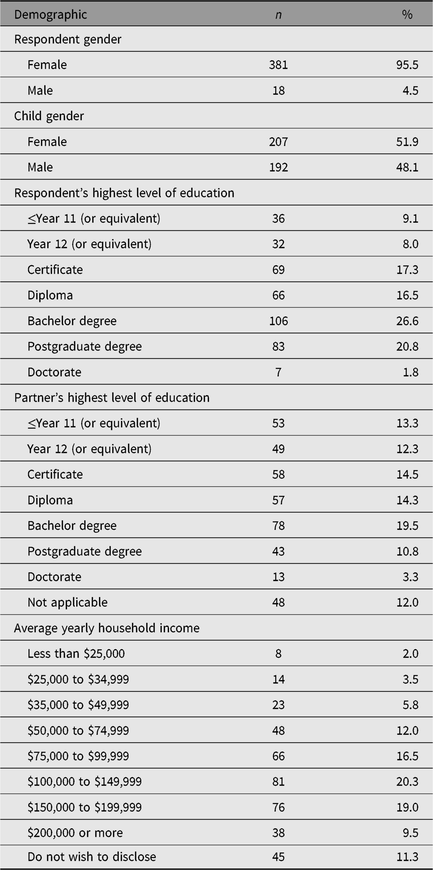
A total of 420 participants were initially recruited into this study. Twenty-one cases were removed due to participants failing to move beyond the informed consent page, indicating postcodes outside of Australia, or basing their responses on children younger than 4 years. Following this, the final sample comprised 399 parents of children aged between 4 and 14 years (M = 7.40, SD = 3.18). The majority of respondents were mothers (n = 381, 95.5%). Demographic characteristics are outlined in Table 1. Participants were recruited through the researchers’ personal networks and various internet platforms (e.g., Facebook, parenting website forums).
Participant Demographics

Procedure
Ethics approval was obtained from the Human Research Ethics Committee at the Australian Catholic University. Participants in this study completed an online survey, which included a series of demographical questions followed by four structured questionnaires measuring emotional and behavioural difficulties in their child, attributional beliefs, perceived barriers to help seeking, and sense of competence. The survey was compiled using Qualtrics, and a web link to the survey was distributed across a range of online community forums and the researchers’ personal networks. Informed consent was obtained at the onset of the survey. Parents with more than one child within the specified 4- to 14-year-old age range were instructed to focus their answers on their youngest child. Participants were required to complete the survey within one sitting at the time and place of their convenience, with participation taking an average of 27 minutes. Due to the anonymous nature of the data, participants were unable to withdraw their responses after the survey had been submitted.
Measures
Each participant was presented with the series of measures in the following order. The data collected for this study were part of a larger questionnaire, but only those measures relevant to the current study are reported here.
Help-seeking behavior
Following the set of demographic questions, each participant’s history of help-seeking behaviour for their child was measured by the questions ‘Have you ever sought help for your child from a GP for non-health related problems (e.g., behavioural and emotional problems)?’ and ‘Have you ever sought help for your child from a therapist/psychologist?’ Participants were required to indicate yes or no. For the purpose of the present study, parents were categorised as help seekers only if they indicated having sought help from a therapist/psychologist.
Strengths and Difficulties Questionnaire (SDQ; Goodman, Reference Goodman1997)
An evaluation of each child’s emotional and behavioural difficulties was gathered via the SDQ, which was originally developed to measure psychosocial problems in children aged 3–18 years. The SDQ provides an overall total difficulties score, as well as five subscale scores for conduct problems, emotional problems, hyperactivity, peer relationships and prosocial behaviour. Using a Likert-type scale ranging from 1 (Not true) to 3 (Certainly true), parents indicated whether a series of 25 descriptive phrases (e.g., ‘Often fights with other children or bullies them’) were indicative of their child’s behaviour over the last six months. For the purpose of the present study, total difficulties scores were dichotomised into ‘nonclinical’ (0–13) and ‘subclinical/clinical’ (14–40) cases. Subclinical cases were grouped with clinical cases, as parents should ideally seek consultation if their child is a subclinical case to determine the extent of the mental health difficulties (Haines et al., Reference Haines, McMunn, Nazroo and Kelly2002). Cronbach’s alpha scores for the present sample was .86.
Parents’ Attributions for Child’s Behaviour Measure (PACBM; Sanders et al., Reference Sanders, Pidgeon, Gravestock, Connors, Brown and Young2004)
The PACBM is a parent survey originally developed to assess how parents attribute the causes and nature of problematic child behaviours across three dimensions: internal attributions (i.e., the belief that difficulties are internal to the child’s disposition), intentional/blame attributions (i.e., the belief that difficulties are within the child’s control), and stable attributions (i.e., the belief that child difficulties are resistant to change). Parents were asked to imagine their own child in a range of written scenarios depicting a behaviour, and respond to four statements assessing attributional beliefs. For example, ‘My child’s behaviour is due to something about my child’ examined internal attributions, ‘My child intended to behave this way on purpose’ examined intentional attributions, and ‘The reason my child behaved this way is unlikely to change’ examined stable attributions. Parents ranked each statement on a Likert-type scale ranging from 1 (Strongly disagree) to 6 (Strongly agree). Higher scores indicated more negative attributional beliefs. Cronbach’s alpha in this study were .90 for the internal subscale, .91 for the blame and intention subscale, and .89 for the stability subscale.
Barriers to Adolescents Seeking Help (BASH; Kuhl, Jarkon-Horlick, & Morissey, Reference Kuhl, Jarkon-Horlick and Morissey1997)
Parental beliefs about barriers to seeking professional help were evaluated through the BASH questionnaire. The original version of the questionnaire, which targeted adolescents’ barriers to seeking help for themselves, was slightly modified for the present study so that parents were required to consider their responses in terms of seeking help for their children. For example, the item ‘Therapy can often help teenagers with problems’ was adapted to ‘Therapy can often help children with problems’. Participants were asked to indicate their level of agreement with 37 items on a Likert-type scale ranging from 1 (Strongly agree) to 6 (Strongly disagree). Higher scores indicated more perceived barriers. Cronbach’s alpha for the current study was .86.
Parenting Sense of Competence Scale (PSOC; Ohan, Leung, & Johnston, Reference Ohan, Leung and Johnston2000)
The PSOC was developed to measure participants’ beliefs about their parenting ability across two dimensions: satisfaction and efficacy. Parents were required to indicate the extent to which they agreed with 17 items, such as ‘I honestly believe I have all the skills necessary to be a good parent to my child’. Each item was ranked on a Likert-type scale ranging from 1 (Strongly disagree) to 6 (Strongly agree). Five items were slightly modified to apply to parents in general, rather than targeting mothers specifically. Higher scores indicated a higher sense of parental competence. Cronbach’s alpha for this sample was .82.
Data Preparation
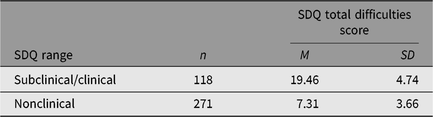
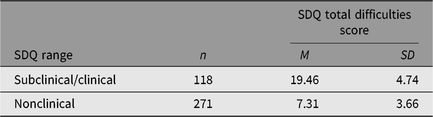
An initial screening of total SDQ scores was conducted to categorise each participant’s child into either the subclinical/clinical or the nonclinical range. Ten cases were omitted from the original sample due to noncompletion of the SDQ. Table 2 presents the descriptive statistics for SDQ total difficulties scores as a function of subclinical/clinical and nonclinical groups.
Means and Standard Deviations of SDQ Total Difficulties Scores as a Function of Subclinical/Clinical and Nonclinical Groups
Results
Preliminary Analyses
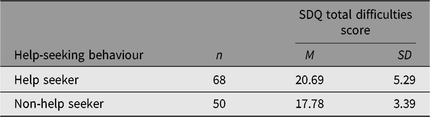
In order to address the first aim, the following analyses examined parents with children falling within the subclinical/clinical range, comparing those who have sought help with those who have not sought help. Table 3 presents the descriptive statistics for SDQ total difficulties scores within the subclinical/clinical group as a function of parents’ help-seeking behaviour.
Descriptive Statistics for SDQ Total Difficulties Scores Within the Subclinical/Clinical Group as a Function of Parents’ Help-Seeking Behaviour
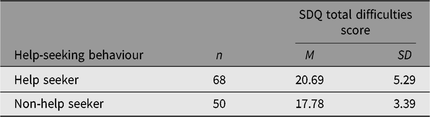
A preliminary t test was conducted to examine whether the total SDQ scores of children whose parents had sought help differed from those of children whose parents had not sought help. Results revealed that children of parents who had sought help presented significantly higher total difficulties scores, t(114) = 3.67, p < .001, d = .65.
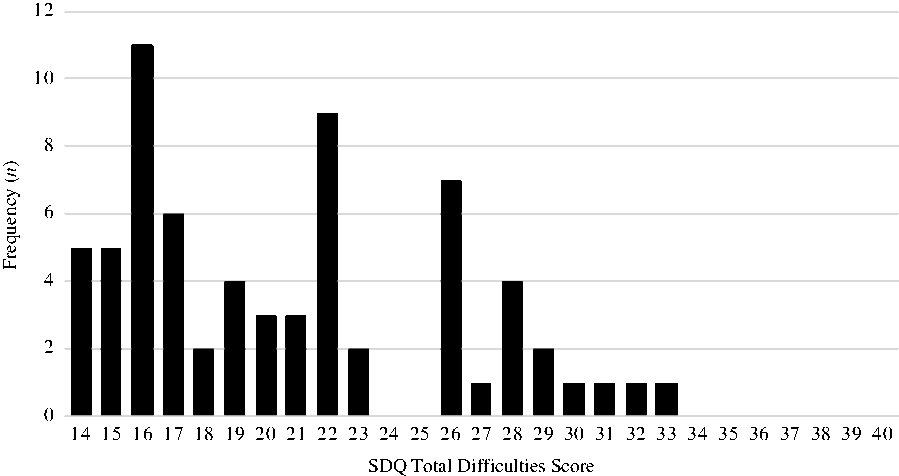
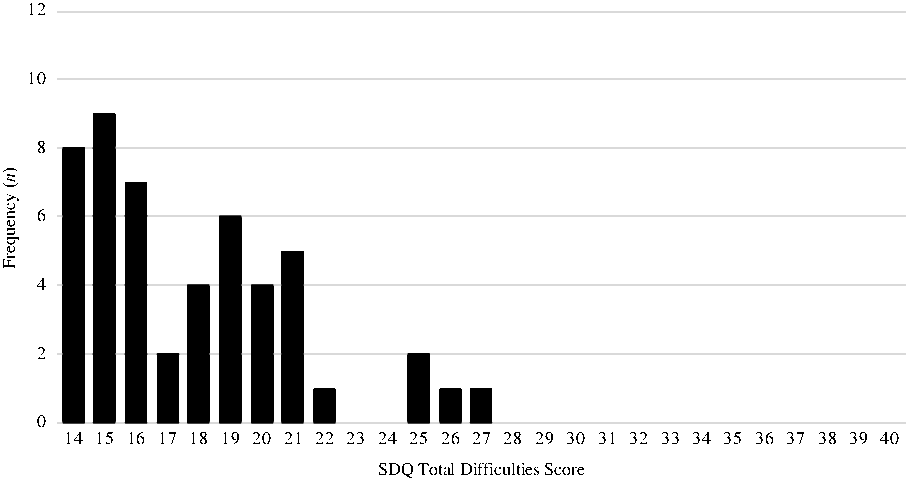
Upon visually assessing the spread of data, it was seen that the majority of participants across both groups had total difficulties scores between 14 and 23 (see Figure 1 and Figure 2). However, in the group of parents who had sought help, there was a cluster of more severe cases of total difficulties scores above 27, that is, impacting on the mean difference. The following analyses were run both with and without participants who scored over 24, and the results of the significance testings remained the same. Therefore, all participants within these groups remained in the analyses.
Distributions of SDQ total difficulties scores of children within the subclinical/clinical range whose parents have sought help.

Distributions of SDQ total difficulties scores of children within the subclinical/clinical range whose parents have not sought help.

A preliminary analysis of demographic variables was conducted. Results of Mann-Whitney tests indicated that there was no significant difference between the average yearly income, U = 1438.5, p = .149, r = –.13, education levels, U = 1539.5, p = .374, r = –.08, or partners’ education levels, U = 1119.5, p = .391, r = –.09, of participants who had sought help and participants who had not sought help for their child.
Assessing Group Differences
Table 4 presents the means, standard deviations, and mean differences for help-seeker and non-help-seeker groups across the five measured belief variables: sense of competence, perceived barriers to help seeking, internal attributions, intentional attributions, and stable attributions. In assessing normality, stable attribution scores were found to be significantly positively skewed (z skew = 3.41) using the z-score skewness criterion of /z skew/ > 3.29 as suggested by Kim (Reference Kim2013). All other variables did not significantly deviate from normal. Thus, a logarithmic transformation was used on the stable attribution variable only, resulting in a normal distribution. However, the mean and standard deviation scores are reported in the original scale for ease of interpretation.
Descriptive Statistics and Independent Samples t-tests for Equality of Means

Note: CI = confidence intervals; LL = lower limit; UL = upper limit. Equal variances assumed. n varies due to incomplete questionnaires.
* p < .01. ** p < .001
Results indicated that parents who had not sought help for their child perceived significantly more barriers to help seeking than parents who had sought help. Moreover, parents who had not sought help for their child held significantly stronger beliefs that child behavioural difficulties are intentional.
Relationships Between Key Variables
To investigate whether there is a relationship between barriers to help seeking and beliefs about competency, causes and nature of child difficulties, correlational analyses were conducted using data from all completed surveys to assess any general trends. Parents whose children were not currently exhibiting emotional or behavioural difficulties were also included in this analysis, as the variables relate to their overall beliefs rather than being restricted to current difficulties.
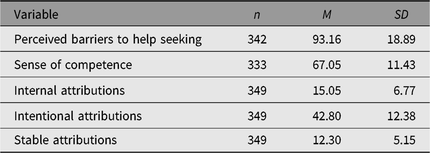
Table 5 presents the means and standard deviations for each of the five belief variables. Assumption testing revealed that the data for all variables did not significantly deviate from normality, according to the criterion for sample sizes larger than 300 specified by Kim (Reference Kim2013).
Means and Standard Deviations of Belief Variables
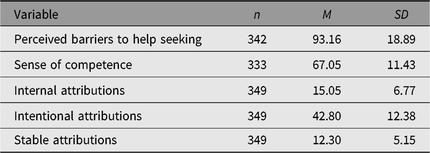
Note: n varies due to incomplete questionnaires. Cases were excluded pairwise.
Results indicated a significant negative correlation between parents’ perceived barriers to help seeking and sense of competence, r(333) = –.23, p < .001. Moreover, there was a significant positive correlation between parents’ perceived barriers to help seeking and stable attributional beliefs, r(349) = .26, p < .001.
Discussion
The current exploratory study sought to address two aims. First, the study aimed to investigate how parents who have sought help for their children and parents who have not sought help for their children differ in their beliefs about the barriers to help seeking, their parenting ability, and the perceived causes and nature of child difficulties. Second, the study aimed to examine how parents’ sense of competence and attribution styles related to the number of barriers perceived. An indication of parent beliefs about the barriers to help seeking was obtained through a measure of their perceived attitudinal and practical barriers, and an indication of each parent’s belief about their parenting ability was obtained through a measure of their sense of parental competence. Each parent’s beliefs about the causes and nature of child difficulties was obtained through a measure of three attribution styles. That is, parents were surveyed on the extent to which they believe child behavioural and emotional difficulties are internal to the child’s disposition (i.e., internal attributions), intended on purpose (i.e., intentional attributions), and resistant to change (i.e., stable attributions).
In addressing the first aim, only parents of children whose SDQ total difficulties scores fell within the subclinical/clinical range were examined. This allowed for a comparison of parents who had sought help with parents who had not sought help in cases where their children were currently presenting emotional or behavioural difficulties. It was assumed that parents who had not sought help but whose children fell within the nonclinical range may not have sought help primarily because they had reason to (i.e., because their children have not presented any significant difficulties), rather than their lack of help-seeking being a result of specific beliefs.
Preliminary analyses of the data found that children of parents who had sought help presented significantly greater emotional or behavioural difficulties than children of parents who had not sought help. An examination of the overall spread of SDQ total difficulties scores indicated that despite a cluster of more extreme scores in the help-seeker group, the majority of parents across both groups still had children who scored between 14 and 23. Therefore, further examination of potential variables impacting on help-seeking behaviour was required.
A brief inspection of demographic variables revealed that parents who had sought help and parents who had not sought help did not significantly differ in their average yearly income, education level, or partner’s education level. These findings differ from those of Morawska and Sultan (Reference Morawska and Sultan2016), who found that parents with higher levels of education and higher levels of income were more likely to endorse positive attitudes towards seeking help for their children. However, their study did not examine how positive attitudes towards help seeking translated into actual help-seeking behaviour.
When examining the impact of the five proposed belief variables (i.e., perceived barriers to help-seeking, sense of competence, internal attributions, intentional attributions, and stable attributions), results first indicated that parents who had not sought help for their child perceived significantly more barriers to help seeking than parents who had sought help. While this was the first study to consider the impact of specific belief variables on parents’ actual help-seeking behaviour, this finding is in line with the work of Pavuluri et al. (Reference Pavuluri, Luk and McGee1996), who found that a major block to help seeking for preschool children was in overcoming perceived barriers by the parents. Through targeted strategies, beliefs about perceived barriers may be amenable to change.
Previous literature has suggested that the beliefs a parent holds about the causes and nature of child difficulties are likely to influence whether they seek help (Boulter & Rickwood, Reference Boulter and Rickwood2013). This was the first study to empirically investigate the relationship between attribution styles and actual parent help-seeking behaviour, finding that parents who had not sought help for their child held significantly stronger beliefs that child behavioural difficulties are intentional. It is likely that parents who believe their child’s difficulties are intentional in turn believe that their child is actively choosing to behave this way on purpose, and are within the child’s control. Hence, one possible explanation for this finding is that parents endorsing this belief may not recognise their child’s difficulties as mental health difficulties that would benefit from professional intervention and instead may view them as problems that can be addressed themselves in the home. These findings reflect some similarities to those of Morawska and Sultan (Reference Morawska and Sultan2016), who found that their sample of Omani parents also held beliefs that child emotional and behavioural difficulties are intentional. While their study did not consider these beliefs in relation to impacting on parents’ actual help-seeking behaviour, their findings, along with the findings of the present study, together suggest that intentional attributional beliefs may be particularly problematic to help seeking, even across cultures.
Furthermore, to investigate whether there was a relationship between barriers to help seeking and beliefs about competency, causes and nature of child difficulties, correlational analyses were conducted using data from all parents, regardless of whether their children were exhibiting difficulties. Results indicated that as parents’ sense of competence increased, perceived barriers to help seeking decreased. Perceived barriers to help seeking also decreased as parent beliefs that child difficulties are stable decreased. This may be explained as the more stable a parent perceives a child’s difficulties, the less likely they perceive that help seeking will be effective. Srebnik et al. (Reference Srebnik, Cauce and Baydar1996) discussed theoretically the relationship between stability and help seeking; however, this current study is the first to empirically investigate the relationship between attributions, sense of competence and perceived barriers. Prior literature has suggested that parents with a low sense of self-efficacy may prevent parents from seeking help for the shame of being perceived as an incompetent parent (Turner & Liew, Reference Turner and Liew2010). Therefore, a possible explanation for the current finding is that parents with negative beliefs about their parenting ability perceive a barrier to help seeking as a result of a sense of shame in their incompetence. Further research into the relationship of specific barriers and their relationship to parent sense of competence is needed.
As previously mentioned, it is important to recognise that many environmental and child variables also impact on parent help-seeking behaviour. Similarly, it is difficult to isolate the exact effect that specific variables exert on parents’ decisions. For example, while a parent’s sense of competence might impact on their help-seeking behaviour, this belief about their parenting ability might be influenced by a combination of other factors, such as their education level and the severity of their child’s problem. However, while parent attitudes and beliefs may be one of many factors impacting on parent help seeking, an understanding of these variables that are more readily modifiable provide a promising basis for the development of effective strategies to improve service utilisation.
Several important implications emerge from the current study. Based on the findings that parents who have not sought help endorsed stronger beliefs that child difficulties are intentional, early childhood health and education services should aim to promote awareness of how evidence-based early intervention for behavioural and emotional difficulties may be effective for their child who is in need. Psycho-education initiatives should also aim to address any potentially unhelpful or inaccurate thoughts about professional help seeking that parents may perceive as barriers. Targeting maternal and child health services and medical centres, as well as providing accessible written information for parents about available help for child problem behaviour, would be ideal given the high level of utilisation of these services. Additionally, the current findings suggest that efforts to increase parental sense of competence and decrease beliefs that child behavioural and emotional difficulties are stable and resistant to change may be useful strategies in lowering the number of barriers that parents perceive towards seeking help for their child. In turn, based on the present findings that parents who have sought help perceived less barriers, it is anticipated that decreasing perceived barriers may increase help-seeking behaviours.
Limitations and Future Directions
Some methodological limitations of the present study were noted. First, it is acknowledged that conducting multiple t tests runs the risk of Type I errors. However, given that this study is the first of its kind, this analysis was sufficient in providing baseline data on which to build future research. Participants in the study were largely accessed through social media and internet platforms, inherently limiting the sample to parents who have access to the internet, speak English and are literate. Moreover, as the measures used in the current study were part of a larger survey, some evidence of survey fatigue was observed. A number of participants failed to reach the end of the survey, with a slight variation in the number of participants that completed each measure. Further, the BASH and PSOC questionnaires were slightly modified, which may be a possible limitation.
An indication of each parent’s help-seeking behaviour was limited to a single yes or no answer in response to the question, ‘Have you ever sought help for your child from a psychologist?’ Upon inspection of the data, it became evident that further information may have been useful. For example, it would be beneficial to obtain information regarding what specific interventions were engaged in, whether parents who seek help commit to the therapy, how long ago the help was sought, and so forth. Future research should consider obtaining such information to further extend the analysis of help-seeking behaviour patterns.
Furthermore, the SDQ is generally only useful as a preliminary screening tool, which was limited to providing an indication of each child’s behaviour over the preceding six months. A number of parents indicated having sought help for their child, yet had children with SDQ scores falling within the nonclinical range. It is possible that help seeking and effective engagement in treatment by parents within this group may have led to a reduction in their child’s symptoms by the time of completing the questionnaire. Therefore, although parents whose children currently fell within the nonclinical range were not considered when addressing the first aim, this particular subgroup may still have been of interest to investigate. For the purpose of this initial study, the SDQ was adequate, but future research should aim to obtain a more comprehensive history of each child’s emotional and behavioural difficulties.
Conclusion
The findings of the present study offer a foundation for further hypothesis-driven research on parent help-seeking behaviour, as a thorough understanding of factors impacting on parents’ decisions to seek help for their children is critical for informing effective engagement strategies to improve service utilisation. With increased service utilisation there is evidence that the impacts and length of childhood emotional and behavioural problems can be reduced through evidence-based interventions (e.g., Öst & Ollendick, Reference Öst and Ollendick2017; Thomas, Abell, Webb, Avdagic, & Zimmer-Gembeck, Reference Thomas, Abell, Webb, Avdagic and Zimmer-Gembeck2017). The current research gleans important insight into why some parents and not others may seek professional help for children’s early mental health concerns. Given that this study is the first of its kind, future research should aim to replicate the current findings, as well as further investigate the specific types of barriers that are perceived by parents in an Australian population. With this knowledge, professionals can explore whether addressing potentially modifiable parent beliefs that underlie help-seeking behaviour could promote better access to professional services for children in need. Understanding which variables are likely to be barriers to help seeking allows for identification of those families most at risk. This could facilitate targeted resources through accessible locations such as community health and medical centres where parents are likely to first present with concerns.
Acknowledgments
None.
Financial support
This research received no specific grant from any funding agency, commercial, or not-for-profit sectors.
Conflicts of interest
None.
Ethical standards
The authors assert that all procedures contributing to this work comply with the ethical standards of the relevant national and institutional committees on human experimentation and with the Helsinki Declaration of 1975, as revised in 2008.