The past 25 years have been accompanied by more advances in medicine and technology than at any point in human history. At the same time, the evaluation of novel medicines and technologies, beyond registration issues related to safety and efficacy, has become a core component in a process that includes healthcare professionals, providers, and payers. In the more regulated or tax-financed systems, governments have institutionalized regulatory systems to evaluate medicines.
This type of evaluation has been driven by several distinct, yet linked, movements. The most significant of these is the movement toward evidence-based medicine (EBM), which has changed daily medical practice into a more scientifically grounded discipline (2;16). Whereas EBM categorizes and ranks all types of medical evidence by the quality of the results provided, the randomized controlled trial (RCT) is given preferential recognition because of its ability to identify (average) treatment effects (18). Unfortunately, RCTs are costly, frequently underpowered, and too often not representative of the broader population of patients who must receive treatments in different settings (22). In addition, RCTs may not adequately reflect values of patients, as they so often are focused solely on outcomes defined by the scientific and medical community, without consideration of the patient's needs and desires (7).
Contemporaneous with the EBM movement, several specific disciplines have evolved to better accommodate diverse issues such as quality of life, economics, and other social issues. These disciplines comprise (i) outcomes research, (ii) pharmacoeconomics, (iii) medical decision making, and (iv) health technology assessment (HTA). The latter discipline (iv) is more than just a regulatory and fourth hurdle agency, but is probably best seen as a super set of the other three (as well as EBM) (17;27). This collection of movements (which we will refer to collectively as HTA for the remainder of the study) have all been supported by advances in health economics, particularly in terms of evaluation methods, outcome measures, and the many educational activities that health economists have supported.
Figure 1 illustrates the interdisciplinary nature of HTA. On reflection, it is easy to see that this paradigm emerged from the uncontrolled diffusion of costly medical equipment (21) and the more recent desire to control the growth in drug costs. A need to evaluate the effectiveness of health services was at the foundation of this movement (20), and it was perpetuated by the need to set priorities for the systems within which care is provided (1). However, present day HTA serves a much broader role than marrying the economic costs and consequences of treatments and technologies. HTA has the charge to consider all the intended and unintended consequences of medicine (12;13). As such, HTA has become an important bridge between research and (societal) decision making (4). As stated above and indicated in Figure 1, HTA is a broad movement that includes, as well as transcends, the important work of HTA agencies. Whereas the institutional arrangements surrounding HTA agencies may differ across jurisdictions (5) and some agencies may have an unclear or undefined relation to the healthcare system (19), the mission of the movement is clear.

Health technology assessment (HTA) is an interdisciplinary movement.
HTA has overcome many obstacles during the past 25 years, many of which have also helped shape its present course. Rather than using individual patient perspectives from the start of HTA, the societal perspective (or that of the “average patient”) is taken. This is explained by both the methodological environment (which requires validity, reliability, and generalizability) and that HTA has been perpetuated by national healthcare systems looking to ease the burden on tax payers. As such, HTA has embraced RCTs and cost-effectiveness analysis (CEA), the latter of which has become its preferred economic tool with the assumption of scarce resources. This motivation to promote “value for money” has outweighed those who have questioned CEA and its grounding on economic theory or reality (6;7;15). Another criticism of HTA systems that focus on CEA is that they espouse the societal perspective and thus fail to adequately incorporate individual patient preferences (9;28).
Many academics associated with HTA, and even several HTA agencies, are now considering if these methods are too focused on clinical outcomes and societal issues, rather than incorporating the perspectives of patients (15;26;29). Although many agencies have reacted to this call to become more patient centered, this action has often been limited to giving “professionalized” patients a seat, but quite often not an adequate voice, at the decision-making table. Furthermore, this patient centered approach is yet to be widely adopted in HTA as a whole. In this study, we describe a vision of the future that sees HTA embrace the patient as its most important stakeholder in decision making. In doing so, we draw from a range of current best practice, but also challenge HTA to enter into new perspectives and endeavors to become more patient based in their activities and outputs.
PATIENT-BASED HTA
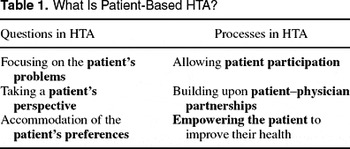
One of the major fears regarding HTA is that it can be used to shift medical treatment decisions away from physicians to financial managers. By focusing on the patient, the doctor–patient relationship can be preserved, and HTA can still provide a critical assessment that includes the needs and preferences of everyone involved (assuming of cause that everyone has the patient's best interest at heart). Table 1 presents a conceptual model of patient-based HTA that focuses on six key stages that can be considered in two broad areas: (i) questions asked during HTA and (ii) processes engaged during HTA. Here it can be argued that, to deliver a patient-based HTA, the questions posed must relate to patients specifically. Furthermore, the processes that constitute HTA must be related to empowering patients in their decision making, rather than promoting other social or political agendas.

Questions in HTA
If patient-based HTA is to be enacted, then the problems of patients need to be primary, rather than those related to payers, regulators, institutional providers, regulators, or governments. Given the complexity of medicine, patients often work through their healthcare problems with their physician, and this dyad relationship needs to be recognized and respected by HTA. HTA should work to inform this relationship, rather than the traditional view that physicians should follow the guidance of HTA agencies (that is HTA works for patients and providers and not visa versa).
To be relevant, the patient's perspective (rather than one of a citizen, tax payer, provider, or payers) must be addressed (7;10). HTA must be constructed in a way so that it is relevant to patients, and it must be respectful of the important role that physicians play in a shared decision-making environment. This approach suggests that we need to consider how patients make decisions and the processes involved in decision making. For example, patients often make decision under distress and with a sense of urgency.
Finally, a patient-based HTA must be aware and respectful of patient preferences. This is not to suggest that patients must be autonomous decision makers, nor are they always the best judge of what the best treatment path is. To ignore patient preferences would be to ignore a major piece of the puzzle, which might cause HTA to be discarded due to irrelevance, or for patients to be noncompliant with any treatment that is seemingly forced upon them. This is not to say that preferences should override, say, clinical efficacy, but that these issues have to be considered jointly. The complexities of these problems is why HTA is so very important, for example, how do we interpret clinical efficacy in light of patient preferences, especially when patients vary in their preferences.
Processes in HTA
Once HTA becomes more patient-based in terms of the questions that it attempts to address, it must also consider the processes it adopts. As shown in Table 1, the most important process in a patient-based HTA is the inclusion of patient participation in all aspects of HTA. One cannot develop a patient-based HTA by simply incorporating professional patients on decision-making boards. Patients need to be invited to participate in all levels of HTA, from conducting the research on which many of the decisions are based, through to the implementation processes. By involving patients in the entire HTA process, whether by means of preference elicitation, participation in research, or another type of inclusion, patients can develop a sense of ownership in the evaluation and decision-making processes.
It cannot be overemphasized that to be truly beneficial to patients, HTA must be respectful of the patient–physician partnership, and promote shared, and informed, medical decision making. Patients rely upon the support and advice of their physician, just as the physician relies on the patient in understanding medical histories, symptoms, and preferences for an optimal care path. HTA assessment should never supersede this vital relationship, but rather aim to inform it so that the patient feels empowered to make informed decisions concerning treatments and healthcare provisions and the physician has the tools to guide the patient toward the optimal choices.
The final process that HTA needs to adopt is the natural culmination of the other patient-based questions and processes: it must develop process by which it can empower patients in decision making to improve their own health. This applies equally to medical and lifestyle choices. Rather than promoting rationing or the distortion of incentives to restrict the options available to patients, a patient-based HTA needs to promote the development of human capital in patients, such as knowledge and skills. These empowering processes should prepare patients for difficult decisions and facilitate the management of treatments rather than just the management of resources.
Why Patient-Based HTA Is Needed
With the continued rise in the prevalence of chronic disease, there is a pressing need for patients to take part in the HTA decision-making process, not least because patients' behaviors (for example, diet and exercise) have direct relevance on their long-term prognoses. To combat lifestyle-related diseases such as obesity, non–insulin-dependent diabetes, and coronary artery disease, HTA must involve the patient. In other words, patients must take greater responsibility for their own health.
The ability to personalize or tailor-make medicines and tissues that will likely become more widespread over the coming decades further reinforces the need to adopt a patient-based HTA. To continue with the one-size fits all approach to HTA in such an environment could prove to be far more expensive than tailoring treatments to each patient.
Barriers to a Patient-Based HTA
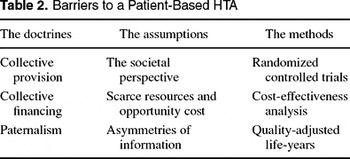
As addressed above, HTA has developed in a political environment that has shaped its perspectives, assumptions, and methods. Given that HTA evolved predominantly in socialized health systems (especially in United Kingdom, Australia, and Canada), it has assumed some of the doctrines that persisted in these countries. As seen in Table 2, these doctrines have been centered primarily on issues of collective provision, collective financing, and/or paternalism.

These doctrines have led to institutions and methods associated with HTA making several key assumptions, which have naturally led to specific methods. Collective provision in countries like the United Kingdom led to HTA focusing on the societal perspective. Thus methods such as large RCTs that aim to be generalizable to entire population (at least in theory) often support this view.
Likewise, the collective financing of health care, such as in Australia, has led to a continued reliance on the assumption of scarce resources and opportunity cost (despite that drug costs have continued to grow in those countries). In turn, these assumptions are used, both rightly and wrongly, as a justification of CEA.
Finally, it could be argued that the methodological focus on quality-adjusted life-years (QALYs), often justified by the assumption of asymmetries of information, is merely the manifestation of the doctrine of paternalism particularly found in Europe (28). That is, patients do not know what is good for them, so we need a “special” formula to calculate it for them.
These doctrines, assumption, and methods all pose a significant barrier to a patient-based HTA. Although these are particular to the political and social environment in which HTA finds itself, it is important to note that this environment is changing. Countries such as Australia and The Netherlands have reformed their system to promote choice in health care and managed competition in healthcare markets. One of the biggest barriers to a patient-based HTA comes, not from social institutions, but from those that have a vested interest in maintaining the status quo (7;8). It is important to note that all of these interests, whether it be from government, industry, academia, or medicine, should really only have one objective in mind—the well-being of the patient.
DISCUSSION
To make HTA more patient-oriented, questions that are relevant to patients must be addressed. HTA should start to focus on patient values so that it can inform patient decision making, not merely societal decision making. To achieve this, patients must be received as partners in the HTA process. This means that patients have rights and responsibilities within any HTA system. Patients need to actively inform HTA about their needs, wants, aspirations, as well hopes and fears. It is also important for patients to inform HTA about what works and does not work for them, as well as the costs and consequences of interventions. Most importantly, patients need to inform HTA about their preferences for health care from the start of consultation, throughout treatment, follow-up, and beyond. Because such a process may be considered burdensome to the patient, HTA needs to develop streamlined mechanisms for communicating with patients and understanding their collective values, as well as the variance and concordance between these values.
In recent years, there has been resurgence in the consideration of various methods to understand patient preferences. These preferences can be estimated in two ways: the actions of individuals who make decisions when presented with choices (revealed preference) or, alternatively, the expressed wishes of patients who are presented with such choices (stated preference) (9). Revealed preferences (choices) of individuals is found in the actual consumption patterns when they are presented with choice in the market. An example of this type would be whether a patient is compliant with a given treatment. Given that markets are also affected by supply side features (such as shortages and inefficiencies), the estimation of patient preference under such circumstances involves very complex econometric problems. An example of this would be whether noncompliance is related to preference or a difficulties or expenses in purchasing the health care.
In contrast, stated preferences (valuations or choices) relate to hypothetical situations. These types of preferences are ideal for nonmarket or novel commodities and as such are ideal for developing new products (9). Their measurement can take the form of qualitative analysis (interviews/surveys), conjoint analysis (discrete choice modeling), willingness-to-pay (contingent valuation), and budget allocation games (i.e., asking patients to prioritize public funds). The benefits of using stated preferences are chiefly that they value all aspects of health care and not only utilities such as QALYs (8). Stated preference methods are well supported by economic theory (11;25) and, hence, can be used to provide a scientific support to what is often considered the “soft-side” of HTA.
CONCLUSIONS AND POLICY RECOMMENDATIONS
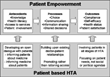
In conclusion, we have attempted to demonstrate some policy recommendations for patient-based HTA by demonstrating how we might better address patient empowerment. Patient empowerment is the process of enabling individuals to have control over their own health (23). As shown in Figure 2, patient empowerment is a system that relies upon antecedents, processes, and outcomes. Patient empowerment as a concept depends upon human capital and is facilitated by a patient-oriented system that not only accepts, but actively uses, their involvement.

The role of health technology assessment (HTA) in empowerment.
As described in Figure 2, to be fully empowered, patients need to be informed, capable, and allowed to express their views. Healthcare professionals need to develop an open dialogue with patients to involve them directly in making informed decisions, and thus improve both their knowledge on medicine and access to services. Access to healthcare needs to be promoted rather than rationed, and information sharing needs to be promoted to develop the political will to provide this type of access. Looking at the outcomes of the empowerment process, by involving patients at all stages of HTA and focusing on their needs more than social or political agendas, we can increase compliance, satisfaction, and overall wellness.
A patient-based HTA can promote the antecedents of empowerment by both informing patients about medicine and informing medicine about patients. This is already happening to a limited degree. For example the Institute for Quality and Efficiency in Health Care (IQWiG) in Germany provides an information service to patients about medicine through www.gesundheitsinformation.de (3). Although the National Institute of Health and Clinical Excellence (NICE) has an established program of Patient and Public Involvement Programme (PPIP) to provide information, support, and training to patients and to the broader public, it is not exactly clear how this system works, and whether it has the best interest of patients at heart.
In terms of promoting the processes of empowerment, such as choice and shared decision making, a patient-based HTA would endeavor to build upon the existing doctor–patient relationship and would promote, rather than ration, access. Although this might imply that differing patients may have differing levels of access (dependent both on their preferences and income), such an outcome is closer to economic reality, rather than the imposed social doctrine of equity (find me one parent with a sick child who does not want the absolute best care that they can afford). Finally, by moving to a patient-based HTA and involving patient in our processes, we would better align the objectives of HTA with that of the patient. Rather than issues of cost-effectiveness, we should strive to promote compliance and self-efficacy, as well as find a happy balance between health status and patient satisfaction. By adopting a patient-based approach, it is quite probable that we end up finding society paying less in aggregate, while getting better outcomes. Paradoxically, we could find ourselves having a more cost-effective outcome than if we were obsessed with cost-effectiveness because we would empower patients and stop giving them care that they neither want nor need. Alternatively, we would allow the patient to get the care they want and need without having to jump through all the obstacles that healthcare rationing might lay before them.
Whether patient-based HTA can be achieved will rely on an ability to think outside the box; more specifically, successful implementation of HTA is predicated on the willingness of patients to become active players in the entire research process (24). To promote patient-based HTA, it is necessary to consider removing some of the doctrines, such as medical paternalism, even where collective provision and financing make patient-based HTA, and indeed patient-based care, difficult (19). To encourage patient-based HTA, it will also be necessary to remove some of the historical assumptions of the “mainstream” methodology, including the perpetual fascination with scarce resources and opportunity costs.
CONTACT INFORMATION
John F. P. Bridges (jbridges@jhsph.edu), Assistant Professor, Christopher Jones, PhD (chjones@jhsph.edu), Research Associate, Health Policy and Management, Johns Hopkins Bloomberg School of Public Health, 624 North Broadway, Baltimore, Maryland 21205
This study is based on a presentation given at the Third Annual Meeting of Health Technology Assessment International (HTAi), Adelaide, Australia, 2–5 July, 2006. We are grateful for the support received from participants of this conference, especially members of the HTAi special interest group on Patient and Citizen Involvement in HTA.