In the second half of the nineteenth century, many European cities experienced food supply problems and established large market halls. In Japan, following the Russo-Japanese War (1904–05), central and local governments started to investigate the food market and its distribution, drawing upon European experiences. For instance, Tokyo was considered a potential location for a municipal wholesale fish market. In 1912, the Osaka Chamber of Commerce made futile efforts to establish a ‘public market’ in Osaka.Footnote 1 In such trials, they considered the municipal markets of Europe, especially those of large cities, as models for their plans. Although it is difficult to determine precisely which markets in which countries or cities served as models, it is highly likely that the markets of France, England and Germany and their respective capitals – Paris, London and Berlin – served as important models for Japan.
This article examines the characteristics of modern Japanese municipal retail and central wholesale markets by comparing them with those of Europe. Given the explicit and detailed manner in which European markets were considered as a model for developments in Japan, it is unsurprising that the two systems had much in common, but there were also significant differences. The key similarity is that municipal markets were introduced into existing systems. However, while European countries established modern municipal markets under local government acts, Japan created a central wholesale market under national legislation exclusively concerning markets, which enabled municipal corporations to form their own markets. Since the pre-modern era, there have been many large traditional wholesale markets in Japanese cities. Therefore, when municipal corporations sought to establish their own wholesale markets, the central government had to enact specific legislation. In Europe, by contrast, there was no such umbrella legislation, since acts allowing municipal markets were incorporated into those related to local government.
Delving deeper reveals more differences. Europe's municipal markets were established in the Middle Ages as markets for citizens and, even at the end of eighteenth century and in the first half of nineteenth century, they functioned as an urban institution for citizens and urban residents. European municipal markets were often situated in the centre of cities and towns. The effect of this is the historical continuity of municipal markets from the Middle Ages to the modern era in Europe. There are, however, exceptions to this continuity. The French Revolution abolished the old privilege system of market rights and many European countries followed suit. Instead, a modern urban system, enabling municipal corporations to establish their own markets, arose (see, for example, the papers by Toftgaard, and Fava, Guàrdia and Oyón). In pre-modern Japan, there was no market similar to that established by European citizens and corporations in the Middle Ages. Peddlers played a central role in the retail distribution of food in pre-modern Japan and the only markets were wholesale markets authorized by feudal lords. Japan had no markets established as a civic virtue or as a source of urban pride, as in Europe. The historical development of retail and wholesale markets constitutes another difference. In European cities, it was not until the second half of the nineteenth century that a functional specialization into retail and wholesale markets occurred, thus creating the first dedicated wholesale markets. In contrast, in pre-modern Japan, wholesale markets were already a familiar part of the market system.
Japan experienced major political and economic changes in the late nineteenth century, but these left retailing largely unaffected: most retailers continued to do business as they always had done until the 1880s. For example, the proportion of retail outlets by shop type in Hiroshima Prefecture, located in western Japan, in 1892 was 62.2 per cent peddlers, 36.4 per cent fixed shops and 1.4 per cent street vendors. Most peddlers dealt in vegetables, fish and simple handmade products, and operated in much the same way as they had done in the Edo era.Footnote 2 Peddlers bought goods at markets and sold them on the street and directly to households in urban area and rural areas. This illustrates that there was an absence of retail markets in Japan. Before the Russo-Japanese War the word ‘market’ meant only wholesale markets in most cases. There were 11 fish markets and 17 vegetable and fruit markets in Tokyo Prefecture in 1883. The merchants in those markets consisted of only wholesalers and jobbers; their customers were the peddlers who served end consumers.Footnote 3 It was not until the Russo-Japanese War that Japanese society started to discuss the necessity of retail markets, and it was only in 1918 that municipal retail markets were instituted in Japan.
The aim here is to examine some of the reasons for this late development and some of the peculiar characteristics of the Japanese market system that resulted from attempts to accommodate established practices within new systems of exchange. In particular, it emphasizes the importance of the relationship between local and central government in structuring municipal market systems and practices. There are, in fact, two historical lineages for municipal markets in modern Japan which in many ways operated separately from one another. The first involves municipalities that established their own markets to secure municipal revenue. As we shall see, establishing municipal markets of this type in Yamaguchi Prefecture led to the problem of needing to compensate already existing wholesalers for their trade losses which led to the compensation clause of the Central Wholesale Market Act. The second historical lineage comprises municipalities which sought to establish their own markets to provide food supply to their urban residents. Arguments in favour of municipal markets were made on this basis, and the planning of the municipal wholesale fish market by Tokyo City Corporation was such an instance. This type also contributed to the establishment of municipal retail markets and the enactment of the Central Wholesale Market Act.
Fish markets played an important role in Japanese market history. Japanese society, for a long time, has preferred fish over other animal proteins. In ancient times, the intake of meat was common practice, but from the second half of the Middle Ages, the cultural idea that meat was foul was disseminated. Moreover, the prohibition of hunting, under the influence of Buddhism, accelerated the intake of fish. The Edo era exemplified this transition in food customs. During the Meiji Restoration, the emperor lifted the ban on eating meat, but an increase in consumption was not immediately achieved. Kamakichi Kishinoue, a professor at Tokyo Imperial University, published Fish and Life in 1915 and emphasized the importance of fish consumption and fish markets: ‘No nation eats more fish than Japan. Japanese people receive their essential proteins chiefly from fish, since Japanese people eat less of other types of animal protein than fish. Therefore, fish markets are really important places to Japanese people.’Footnote 4 By the 1910s, Japanese society became explicitly aware of the importance of fish consumption and fish markets and their role in providing necessary animal protein.
Municipal markets: developments in Europe and Japan
In the Middle Ages in Europe, monarchs granted corporations and private individuals market rights, and with these rights only these individuals and corporations were able to establish markets (see also the introduction by Van Damme and Stobart). The market right was a franchise or privilege to hold a market and levy market tolls and other dues.Footnote 5 As mentioned earlier, market rights were abolished during the French Revolution and, in 1791, a draft bill was proposed which gave municipal corporations the freedom to establish their own markets, provided they gave informal notice of the market days to the prefect of the state. The National Convention accepted the proposal and issued an act enabling corporations to form their own markets without the consent of the prefect. However, in 1852, an edict was issued stipulating that markets should be held under the authority of the prefects. After a request to hold a new market was examined by the Council and the situation in neighbouring communities was considered, the prefect decided whether the new market would be permitted.Footnote 6 The French system was similar to that of the Japanese in that the prefect had ultimate authority over the establishment of a market, but there was a crucial difference between their systems. In Japan, only the governor had such ultimate authority, while in France, the municipal corporation had the right to found markets, albeit with the permission of the prefect.
In England, historic market rights were never abolished and, by 1850, the improvement and establishment of markets had become a serious social problem. Parliament enacted the Local Government Act in 1858, which enabled corporations or local boards to establish their own markets. The Act ‘inaugurated a new era in the history of markets’ because ‘it gave local authorities conditional powers to establish markets’.Footnote 7 However, the Act could make no alteration to market rights and no market was meant to be established that would interfere with any privileges chartered without the consent of the chartered party.Footnote 8 Charles Bradlaugh MP successfully proposed the establishment of a Royal Commission on Market Rights and Tolls in 1889 and tried to abolish existing rights so that local governments could establish their own markets even if they had no established market rights. Although the commissioners presented many reports to parliament, they never proposed formal legislation. Nonetheless, English municipal markets gradually increased, accounting for 40.7 per cent of all markets in England (excluding London) and Wales by the late nineteenth century (on English markets, see the paper by Kelley).
In Prussia, the early nineteenth century saw the abolishment of market rights experienced earlier in France,Footnote 9 and modern municipal corporations were able to establish their own markets. Heinrich Friedrich Karl vom Stein successfully issued a measure for municipal reform which granted local self-government, including the ability of all Prussian towns to establish markets. Indeed, Stein's Municipal Ordinance of 1808 was so wide-ranging that municipal authorities in Prussia became largely autonomous – a system later copied by other German states. This autonomy was thus described: ‘German councils can do anything that seems necessary to the good government of their areas and populations.’Footnote 10 Under the Ordinance, municipal authorities could voluntarily establish public utilities such as market halls, public baths and abattoirs. It was after the second half of the nineteenth century that Germany fully industrialized and urbanized, and municipal authorities developed municipal trading. As for markets, a weekly market was the main system of food supply in urban areas until the mid-nineteenth century. In Berlin, a food riot broke out in 1847–48 and the Council investigated the markets of other European countries. German municipal corporations began to establish market halls after the mid-nineteenth century, especially in Berlin after the 1880s. In the second half of nineteenth century, Germany experienced a rapid transition from uncovered weekly markets to large covered market halls.
In Japan, wholesale markets and even a few large-scale wholesale markets appeared in the pre-modern Edo era, but it was not until 1918 that retail markets appeared. Japanese market history seems to have developed in reverse order to European market history. Why should this have been the case?
In Europe, markets were established within cities to supply essential food to citizens in the Middle Ages. In Japan, two factors prevented such developments before the early twentieth century. First, is the limited capability of urban communities to take autonomous actions in pre-modern Japan and the late establishment of the law for municipalities of 1888 in modern Japan. There were many cho (small autonomous community organizations) authorized by feudal lords in the Edo era – Kyoto, for example, consisted of about 1450 cho in the early nineteenth century.Footnote 11Cho established their own rules and administered their own regions in addition to organizing certain services such as fire-fighting. However, cho were too small to establish and administer markets. It was not until 1889 that the modern municipal corporations of city, town and village were instituted by the law for municipalities of 1888. This formation of modern municipal corporations was a historical precondition for the establishment of municipal markets in Japan, although the law had no clause relating directly to markets.
The second key factor is that towns during the Edo era were Jokamachi, urban areas under the control of feudal lords. The castle of a feudal lord and the residential areas of samurai families were situated in the centre of the Jokamachi, and traders and craftsmen lived around this central focus. There were neither street markets nor retail markets – only wholesale markets. Feudal lords permitted wholesalers to trade in the market as long as they paid tributes or taxes. Japanese markets originated in this feudal system.Footnote 12 This system produced neither the substance of nor the idea of market rights. Isamu Ohno, the first manager of Kyoto Central Wholesale Market in 1927, called Japanese traditional markets Ichiba-gai. These included market streets where wholesalers gathered with their trading houses along both sides of the street, but where there was no market owner. Ohno found that there were not only Ichiba-gai in Japan but also in Shanghai and Tsingtao in China, and in Seattle and San Francisco. He also pointed out that Ichiba-gai did not produce the notion of market rights, but the idea of the right to trade.Footnote 13 It is interesting that, although a Japanese article published in 1907 referred to market rights in Europe,Footnote 14 little attention was drawn to such rights in the country as a whole. From the mid-Edo era, unauthorized distribution routes – created so that producers and unauthorized traders could avoid routes controlled by authorized wholesalers – attracted an increasing proportion of distribution.Footnote 15 These unauthorized routes of distribution naturally disappeared after the Meiji Restoration because the feudal system was abolished. Modern governors then introduced new market permission systems.
Municipal market policy and trade rights of wholesalers
In modern Japan, government authorities abolished the system of paying tributes or taxes to establish markets and trade in markets, but this system did not produce market rights such as those in Europe. Instead, the appearance of municipal markets in Japan created a programme to compensate existing wholesalers for loss in trade. Anyone who intended to establish a market needed to submit an application form through the municipal corporation office or district (gun) office to the prefectural governor. The form was thoroughly investigated by the police chief and district governor, who attached their report and opinion and submitted the form to the governor. The governor made a decision about the application on the basis of both the reports and the opinions of the police chief and district governor. Within this system, Yamaguchi Prefecture situated in western Japan took the lead in introducing municipal market policy. It introduced a regulation in 1895 that the governor should permit one wholesale fish market within any particular area, and another regulation in 1903 that the governor should give municipal corporations priority over other private applicants. The governor Shigeru Furusawa, who had been interested in the food markets of Europe and America,Footnote 16 introduced both regulations so that municipalities would secure municipal revenue (a stance which offers an interesting comparison with the processes described in the article by Baics). As a result, there were 58 municipal wholesale fish markets in the Prefecture, accounting for 64.4 per cent of 90 wholesale fish markets in 1910.Footnote 17
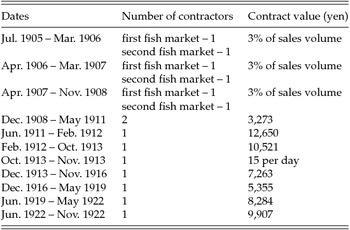
Table 1 indicates how the municipal corporation of Shimonoseki City, the largest city in Yamaguchi Prefecture, managed its municipal fish market. In September 1908, the corporation merged two privately owned wholesale fish markets into one municipal market (hence the reduction to a single contractor) and introduced a competitive bidding system to select a fish wholesaler every three years. The contract was such that its renewal became more expensive on each occasion, until established wholesalers were unable to afford the renewal fee. Unauthorized wholesalers who were not selected had to continue their wholesale trade outside the municipal market. Therefore, the corporation repeatedly petitioned the governor of Yamaguchi Prefecture to stop the activities of the unauthorized wholesalers by using police power. This market policy created much chaos for municipal corporations regarding the administration of markets in its municipalities.Footnote 18 In many cases, corporations established their own markets without compensating the existing wholesalers which led to a backlash against the municipal market policy.
Municipal fish market of Shimonoseki City

Source: M. Tsuda, ‘Shiei Karato uoichiba’ (Municipal Karato fish market), Kanmon Chihokeizai Chosa, 2, 11–2 (1929); Zenkoku Jyuyo Uoichiba Rengokai, Dainikai Zenkoku Juyo Uoichiba Rengokai Yoroku (The Second Record of the National Association of Important Wholesale Fish Markets) (1913), 17–21.
In 1903, a wholesaler called Toyozo Kawamura, along with two others from Shimounorei Village in Yamaguchi Prefecture, contested in administrative court the refusal of the governor to allow them to trade in the market. The main issue between the plaintiff (Kawamura) and the defendant (the governor) was whether article 9 in the market regulation of 1895, which permitted only one market in a certain area, constituted an obligation to establish a market in that area. The plaintiff claimed that the governor should recognize that the article did provide an obligation to establish a market and that he should be permitted to trade at the market because there were no other applicants in the village. On the contrary, the governor claimed that there was no such obligation. Moreover, the governor had the authority to regulate who could establish a market on the basis of the necessary investigation of the market's location, structure, supply and demand and public advantages and disadvantages, where appropriate. The defendant also claimed that the plaintiff's proposed location for a fish market was at the end of the village and was 16 kilometres away from a municipal market in the neighbouring Yamaguchi Town. Accordingly, the governor claimed that, if he permitted the plaintiff's market, it would have become a second market to Yamaguchi Town and would go against article 9 of the market regulation of 1895. Moreover, the governor claimed that the plaintiff's application had the intention of poaching some of the trade from Yamaguchi Town's municipal market, although he did recognize the necessity of establishing a fish market in the village due to the needs of a restaurant in the resort, Yuda, within the village.
The judgment, passed in 1904, fully accepted the defendant's claim. The court stated that the provision of article 9 did not grant the right for the establishment of a market and the location of Kawamura's proposed market would interfere with trade in Yamaguchi Town's municipal market. Kawamura's claim was completely rejected. However, it is telling that Kawamura's belief that he had the right to his own market was based on the fact that his family had been running his market and wholesale trade since the Edo era; it is equally significant that the administrative authority and the court emphasized the public interest and denied the rights of Kawamura's private wholesale market.Footnote 19 Nevertheless, Yamaguchi Prefecture's authority hesitated in completely denying Kawamura's rights to a wholesale market. In August 1904, when the governor Furusawa left his position and four months had passed since the judgment, the authority held a consultation with Kawamura and permitted him to establish a fish market at a different location within the village. However, Kawamura was to encounter more difficulties again in 15 years.
Shimounorei Village was incorporated into Yamaguchi Town in 1915. In 1919, Kawamura again submitted an application to establish a fish market, but his application was again rejected because Yamaguchi Town's application was preferred. As before, he brought the case to the administrative court and claimed that the governor's refusal of his application was illegal because his family had run his wholesale market and wholesale trade for more than a hundred years since the Edo era; thus, he had acquired the right to continue his wholesale market trade and that such rights should never be infringed by private individuals, public corporations or national governments. In short, he claimed that his right to continue the wholesale market trade was established on the basis of ‘a natural law and the custom of continuity of his market’. However, the governor claimed in his rebuttal statement that there was no other right than that set forth by law and that the right could not arise from nature. In 1920, a judgment found that the administrative disposition was reasonable and Kawamura's claim was eventually rejected.Footnote 20
Thus, an examination of municipal market policy in Yamaguchi Prefecture illustrates that the private rights of wholesale traders to markets was not guaranteed as long as prefectural authorities decided municipal market policy. Therefore, in September 1912, when the minister of agriculture and commerce drafted a bill on wholesale fish markets with the National Government's Council (Seisanchosakai), the draft incited a nation-wide movement against the bill. This is because it adopted a municipal market policy and reminded many fish wholesalers of the harmful effects of the bill on private fish wholesalers in Yamaguchi Prefecture. Many Japanese fish wholesalers assembled and organized the National Association of Important Wholesale Fish Markets in October of the same year. The Association petitioned the Council to delete the clauses relating to municipal markets from the draft bill and explained their reasons as follows:
Recently, the municipal corporations of cities, towns and villages have often launched municipal fish markets, and those municipal fish markets seemed to have become a sort of a trend. Municipal fish markets in every municipal region of Yamaguchi Prefecture and in some municipal regions of Oita Prefecture were typical instances. Since these municipal fish markets were established for the purpose of securing of municipal revenue, wholesalers of private fish markets were ‘severely persecuted’ and suffered from ‘the direst distresses’. Therefore, the meeting of the Association addressed the important issue of ‘disorder’ caused in the municipal fish wholesale market of Shimonoseki City, and determined to carry out a survey of it. As a result of the survey, the Association found that our rights to private markets were affected by an administrative power, and therefore, we petitioned the Council to require that municipal corporations compensate existing wholesalers for their trade losses. Moreover, that municipal corporations grant the existing wholesalers priority to rent space in the municipal markets, and municipal corporations should not be financed by the fees of municipal markets.Footnote 21
In fact, the Association declared themselves to be against the municipal fish market policy and petitioned that if the ministry adopted the municipal market policy, then private market wholesalers should be compensated, and municipal corporations should grant existing wholesalers priority when renting space in the municipal markets. The spirit of this petition was eventually accepted and incorporated into a provision of the Central Wholesale Market Act of 1923 and an additional resolution of the House of Peers (Kizokuin) of the same year.
Social reaction to the draft fish market bill was very negative with respect to municipal market policy. Many were of the opinion that the municipal market system was a ‘great mistake’ and that ‘private markets would be better than municipal markets’. Fishery Corporations held a convention and proposed an amendment bill against the municipal market system in the draft bill.Footnote 22 In light of this, how could Japanese society accept municipal market policy?
Arguments for the establishment of municipal markets and the planning of Tokyo City's municipal fish market
From the early twentieth century, drawing on the experiences of European cities, arguments for the establishment of municipal markets emerged in Japan. Ryuji Otsuki, deputy mayor of Kyoto City, published Past and Present of Urban Administration of Berlin in 1901. He was the first Japanese person to be sent to European cities to inspect their municipal administration, and selected Berlin as the model for Japanese municipal administration. In Berlin, some markets built by private companies in the 1860s were closed down because of the business recession, and in 1871 the German Building Company made an application to the Metropolitan Police Department and the Municipal Board to open 12 food markets, but the superintendent-general declared that food markets should not be left to the private sector but should be under municipal administration. In fact, Berlin built 13 market halls in the 1880s and 1890s. Although Otsuki made no mention of the application of Berlin's markets to Japanese cities, he probably regarded the municipal market as a necessary institution for modern Japan.Footnote 23
Sen Katayama, later a globally recognized socialist, had left Japan for America in 1884 and studied urban problems at Yale College. He published Municipal Socialism in 1903. In this book, dealing with the municipal administration of electricity, gasworks and parks in European cities, Katayama admired Berlin's municipal markets, he stated ‘it is Berlin that has the most beautiful and perfect markets’ and therefore ‘Berlin is really the city practising municipal socialism.’ From his point of view, the food markets in Tokyo were just markets where many small wholesalers pursued their own profit at the expense of the citizens. The wholesalers occupied public roads, polluted the air and discharged contaminated water. He proposed the municipalization of markets in Tokyo and all other Japanese cities because he thought the administration of markets should not be left to a private individual or private organization, but should be under a municipal corporation.Footnote 24
Isoo Abe, a professor at Tokyo Technical College, also argued for the municipalization of markets in his On Applied Municipal Administration published in 1908. He saw European municipal administration as the model for Japanese municipal administration and proposed the ‘eternal policy’. In this policy, Abe suggested that the municipal corporation should convert private ownership of the water supply, tramways, roads, parks and markets to a system of municipal ownership. Referring to the municipal markets of Berlin, Paris and Glasgow, he expressed strong interest in practical considerations, such as the sanitary regulations for the food supply and the municipal market's contribution to municipal revenue. Abe said of the wholesale markets for fish and fruit and vegetables in Tokyo that they were lacking in sanitary arrangements and regulations. He therefore proposed converting the existing markets into municipal markets.Footnote 25
A rise in prices, especially food prices, after the Russo-Japanese War encouraged a series of national inquiries into retail and wholesale organizations and stirred up arguments regarding municipal markets. The National Government's Council reported that it was urgently necessary to establish municipal retail markets for improving the living standard of ‘the working poor’.Footnote 26 The Ministry of Agriculture and Commerce conducted an investigation and published An Inquiry into Retail Organizations in 1911 and An Inquiry into Open Markets in 1912. These official reports drew attention to the importance of municipal markets.
Kaichi Toda, a professor at Kyoto Imperial University, argued the necessity of municipal markets, indicating that in the markets of those days, it was not consumers, but only producers and merchants, retailers and wholesalers who came to sell and buy everyday necessities such as meat, fruit and vegetables. He therefore proposed the establishment of municipal markets, where consumers could come and obtain such everyday goods directly.Footnote 27 Susumu Kawatsu, a professor at Tokyo Imperial University, also wrote a number of articles on municipal markets. He emphasized the necessity of municipal markets to overcome such problems as the unsanitary situations in markets and high retail food prices caused by the mediation of many middlemen and the credit system. He assumed municipal markets to be a public service, not a source of revenue for a municipal corporation, and emphasized the necessity for the improvement of retail organizations, with the aim of developing the national economy.Footnote 28
Finally in 1912, the Tokyo City Corporation released its plans to launch its own municipal wholesale fish market. The Corporation explained the importance of municipal markets in its investigative report as follows:
The corporations of the cities of Japan have neglected the food supply problem for a long time. There was no public institution to supply citizens with safe food, but only negative inspections for toxic and harmful foods by the police. . .Why did corporations not think about the importance of food problems relating to the life and health of its citizens? That the market was an institution where only traders assembled and dealt was part of the past. The present urban development transformed the notion of old markets into a new notion of public institutions serving to supply citizens with fresh food at a low price. . .It is of vital importance to contemporary cities that corporations establish municipal wholesale food markets and municipal retail markets, and positively promote public welfare from the aspect of civic rights and public health.Footnote 29
For many years, Japan's municipal corporations had taken no interest in supplying urban residents with food, regarding markets purely as a place where traders assembled. However, many later changed their viewpoint and recognized markets as institutions essential to the subsistence and health of urban residents. The Tokyo City Corporation, among others, thus found itself indispensable in establishing municipal markets for the promotion of the public welfare.
The Tokyo City Corporation indicated an important fact regarding the establishment of municipal markets in Japan: viz. that Japanese municipal governments did not have regulatory power over markets. As soon as it started planning a municipal wholesale fish market, Tokyo City Corporation realized that existing private wholesale fish markets would emerge as competitors to the municipal fish market. The municipal corporation thus proposed to enact a law that would grant the Corporation administrative powers over markets. Indeed, an Investigative Report of Municipalisation of Market, published by the Tokyo City Corporation, focused on the regulation of unauthorized traders by public authorities in Germany and the prohibition of any private markets established by municipal ordinance or national law in other European cities. As mentioned, in Japan, where prefectural authority had constituted the permission system, the municipal corporation had no regulatory power over the market. Moreover, when the Tokyo City Corporation began planning a municipal market, it recognized that it needed a law that guaranteed the existence of municipal markets.Footnote 30
The difference between the modern municipal system in Japan and Europe is that Japan's municipal corporations were aware of the necessity of giving priority to municipal markets, and that this should be supported by a Japanese national law. Indeed, article 1 of the Central Wholesale Market Act of 1923 entitled the corporation of a city to give priority to the creation of a central wholesale market. Nevertheless, a corporation could not establish a central wholesale market unless it was nominated and its plan was permitted by the ministry. In reality, therefore, the Japanese central wholesale market system was not as autonomous as those in Europe.
In the end, plans for Tokyo City's municipal wholesale fish market were not realized. One reason was that the municipal corporation was not granted priority in establishing markets. A special issue of Journal of the Fisheries Society of Japan in June 1918 included the results of a survey on ‘Problems of Tokyo fish market’. Published just two months before the outbreak of the Rice Riots, these form a revealing picture of thinking at this time. The respondents included the deputy mayor of Tokyo City, an engineer from the Ministry of Agriculture and Fisheries, directors of fisheries experimental stations and fishing communities. One of the survey questions was ‘Which fish market would you prefer, a municipal market or a private market?’ Of the 29 participants, 11 were in favour of a municipal market, 8 were in favour of a private market and 11 were indifferent or did not answer.Footnote 31 That only one third of the total respondents were in favour of a municipal market suggests that Japanese society did not support a municipal market system before the Rice Riots, which in effect functioned as a catalyst for the municipalization of retail markets.
Establishment of municipal retail markets
While retail markets appeared long before wholesale markets in European cities, they were a much later development in Japan. Indeed, it was not until the outbreak of the Rice Riots of 1918 that municipal retail markets appeared and prevailed. They were an urgent response to the outbreak of these disturbances, many municipal corporations selling rice at low prices in their outlets after riots. The municipalities took over the operation of such outlets and established municipal retail markets, with rice quickly becoming one of the most important commodities sold therein. It constituted, for example, 51.3 per cent of all commodities sold in Tokyo City's municipal retail markets in 1919 and 48.8 per cent in 1920, although thereafter the percentage gradually diminished.
Municipal corporations focused on selling goods at a low price in their retail markets. There were even strong assertions that municipal retail markets should sell rice and the necessities of life to poor urban residents at a lower price because municipal retail markets were established for social relief.Footnote 32 Corporations attempted to achieve these lower prices by administering the retail markets and selling directly to consumers, thus shortening the distribution process from producers to consumers. Moreover, agricultural producers from urban neighbourhoods were preferentially accommodated in stalls at municipal retail markets, again in an attempt to achieve lower prices. However, this method faced the problem that urbanization weakened agriculture in urban areas, limiting the supply of locally produced foods.
Fixed and marked prices and cash payments were the operating principles of municipal retail markets. These principles represent the characteristic features of the modern retail trade. Such municipal retail markets played an important role in the modernization of the retail trade in Japan because traditional retail trade had continued to sell commodities on credit and without price tags. In this sense, municipal retail markets developed a modern social relationship in which the retailer could sell commodities to anyone if money was paid.
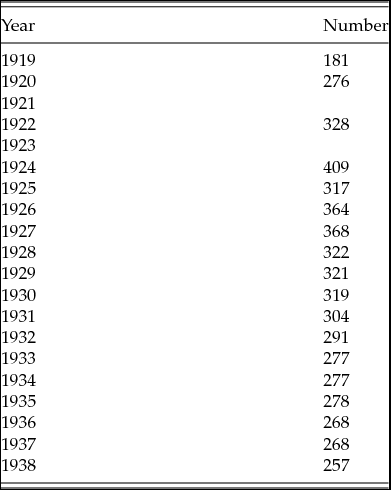
Table 2 presents statistics for the number of municipal retail markets established in Japan between 1919 and 1938. It suggests that Japanese society experienced a rapid increase in municipal retail markets in the first half of the 1920s, a plunge in 1925, a slight seesaw from 1925 to 1930 and a gradual fall thereafter. This indicates that Japanese society immediately accepted municipal retail markets and reached equilibrium at an early stage. According to previous studies, the equilibrium is because traditional retail traders and private retail markets developed opposition movements against the establishment of municipal retail markets.Footnote 33
Number of municipal retail markets in Japan
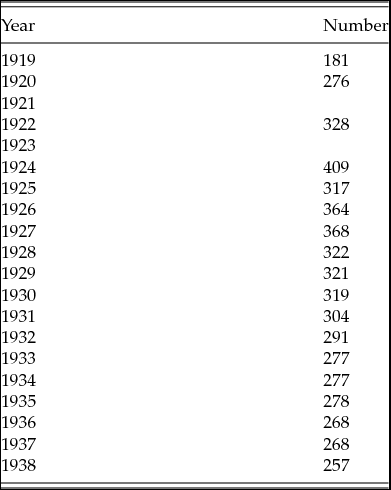
Note: The years between 1928 and 1938 are fiscal years.
Source: Nippon Teikoku Tokei Nenkan (Japanese Imperial Statistical Year Book); Y. Kinebuchi, Honpo Shakaijigyo (Japanese Social Work) (Tokyo, 1922); Naimusho (Home Ministry), Shakaijigyo Yoran (Handbook of Social Work) (Tokyo, 1923, 1925); Koseisho (Health and Welfare Ministry), Kosei Gyosei Yoran (Handbook of Administration of Health and Welfare) (Tokyo, 1940).
After the recession in April 1920, Japanese society became aware of the faults and limitations of municipal retail markets and discussed methods to improve them. This discussion led the Home Ministry to consult the Inquiry Committee on Social Work on how to improve the municipal retail market. In 1922, the committee submitted its ‘outline for the improvement of municipal retail markets’ and ‘outline for the establishment of a central market’. The latter recommended that the central government should take a leading role in the establishment of a central wholesale market.Footnote 34 This recommendation eventually led to the enactment of the Central Wholesale Market Act which had the following characteristics: (1) ownership of central wholesale markets was restricted to municipal corporations; (2) market hall transactions were governed by two principles: commodities were to be sold at auctions and these sales would take place on consignment; and (3) when the central markets were established, the municipal corporations and the Ministry of Commerce and Industry merged each category of existing wholesalers into a single wholesale company for that category. In the discussion leading up to the legislation, the House of Peers had already determined that the wholesalers in existing markets should be prioritized in accommodations within the central wholesale market. Under the Act, the corporations of the five largest cities – Kyoto, Yokohama, Osaka, Kobe and Tokyo – and three corporations of mid-sized cities – Kochi, Kagoshima and Sasebo – had established central wholesale markets by 1945.
Conclusions
Change in the market system and in particular the emergence of municipal markets in Japan arose from a range of pressures, many of them largely unrelated to one another, with the Rice Riots of 1918 forming perhaps the key catalyst. The central wholesale market system was characterized by bureaucratic control resulting from the structure of the Japanese municipal market system. The Central Wholesale Market Act of 1923 did not transfer market authority to municipal corporations as was the case in many European countries. Although the central wholesale market in Paris was under the control of the prefect of the Seine, it was far more common for market authority to be transferred to municipal corporations by way of local government acts. In Japan, however, even after the central government made municipal corporations responsible for establishing central wholesale markets, they still had to get permission from the central government for their plans and approval for the operational rules for these wholesale markets. The process of establishing a central wholesale market in Tokyo City is characteristic of this. In 1936, the Ministry of Commerce and Industry finally issued an executive order and compelled the existing fresh fish wholesale companies to organize into a single company, although the Council of Tokyo City had already determined to organize two companies in 1934 and wholesalers had organized two companies in 1935.Footnote 35 This case illustrates that the Japanese municipal market system lacked full autonomy because it remained under strong control from central government.
In the establishment of central wholesale markets, wholesalers in the existing markets were preferentially accommodated within the central markets. Since the existing markets had to be closed, a crucial problem was compensating the existing wholesalers for their losses. The established wholesalers became conscious of the importance of such compensation and began to discuss how and to what extent they should be compensated. Thus, they came to use the term ‘market right’ – a new concept in Japan. However, ‘market right’ has a different meaning from the European use of the term. Renkichi Ikeuchi, a professor at Tokyo College of Commerce and the first scholar to discuss market rights, insisted that everyone should be compensated for his or her trade rights, which are guaranteed by the Constitution, when his or her right of free trade is infringed by the state or a municipality on public interest grounds, and pointed out the necessity of compensating existing wholesalers for their trade rights.Footnote 36 The right of market wholesalers to continued trade was a social custom since the Edo era. The right for trade in the central wholesale markets was transformed as goodwill into stocks in a new company. To this effect, it is certain that the trade rights of wholesalers were incorporated into the central wholesale market system on the basis of its long history.