INTRODUCTION
The human immunodeficiency virus (HIV) enters the central nervous system (CNS) early in the course of HIV infection (Navia et al., 1986) and leads to neurocognitive complications in approximately 30% of asymptomatic individuals and up to 50% of individuals with advanced HIV infection (Heaton et al., 1995; White et al., 1995). Also commonly observed in HIV-infected individuals is major depressive disorder (MDD; Ciesla & Roberts, 2001).
In cross-sectional studies, current major depressive episode (MDE) and MDD in psychiatric (non-HIV) populations have been shown to be associated with somewhat worse performance on a range of cognitive functions such as attention, learning and memory, psychomotor speed, and executive functions (Austin et al., 1999; Cassens et al., 1990). Such associations with neuropsychological (NP) deficits appear to be related to several factors such as the severity of the depressed mood (Grant et al., 2001), age (Austin et al., 2001), presence or absence of melancholia (Austin et al., 1999) or psychotic features (Basso & Bornstein, 1999; Jeste et al., 1996), and medication status (Porter et al., 2003).
Moreover, there is some evidence that persons with a lifetime history of MDD may demonstrate persisting cognitive deficits (i.e., a “trait depression” effect on cognitive functioning that does not improve with treatment; Coello et al., 1990; Marcos et al., 1994; Weiland-Fiedler et al., 2003), whereas others suggest the cognitive effects of specific MDEs that are successfully treated may be only temporary (a “state depression” effect on cognitive functioning; Bulbena & Berrios, 1993; McNeil, 1999; Stoudemire et al., 1991; Tarbuck & Paykel, 1995).
Pathogenesis of HIV-associated neurocognitive impairment and major depression appear to share some common features involving frontostriatal neural circuits (Tekin & Cummings, 2002). From this perspective, it could be expected that deficits in attention, psychomotor speed, and motor functions, which are common features in HIV-infection (Heaton et al., 1995), may increase when patients are depressed.
Although a majority of cross-sectional studies have not found any consistent link between depressed mood or major depression and NP impairment in HIV infection, these results were derived primarily from cross-sectional studies that concentrated on the current depression status (more often defined by depressed mood than standard diagnosis of MDE) and without considering lifetime depression (Bornstein et al., 1993; Goggin et al., 1997; Grant et al., 1993; Hinkin et al., 1992; Millikin et al., 2003; Richardson et al., 1999; von Giesen et al., 2001). They also mostly involved group mean comparisons of NP results, rather than NP results of individual participants. Consequently, it could still be the case that incident MDE in individuals with HIV infection is associated with neurocognitive disturbances in at least a proportion of cases. The best evidence of this would come from a longitudinal study of incident MDE, with group level analyses supplemented by single case analyses to identify individuals who may cognitively deteriorate during a MDE.
To address these issues, we present a retrospective study of 227 HIV-infected men, without current MDE at baseline, who were followed for a median of 24 months [range, 6–84 months; mean, 28; standard deviation (SD) =16] and were assessed for NP functioning, lifetime and current psychiatric disorders, and neurocognitive complaints at each evaluation. Two different group assignments were performed for exploring the effects of major depression on neuropsychological functioning (i.e., each subject had two definitions, one assigned to trait status, positive or negative, and one assigned to state status, positive or negative). First, MDD “trait status” was assigned to those participants who had a lifetime history of MDD before baseline and/or developed MDE between baseline and their final study evaluation. Cognitive effects of trait status were assessed only at baseline, when none of the participants met criteria for current MDE. Second, MDE “state status” was assigned to those individuals who met criteria for current (incident) MDE at a follow-up visit. Worsening of NP performance, and increased prevalence of NP impairment in association with incident MDE at follow-up, would constitute evidence of cognitive effects of state status.
METHODS
Participants
Participants were selected from a longitudinal cohort study assessing the effect of HIV infection on the CNS. Cross-sectional, baseline results from a larger group that included the present participants were described in Heaton et al. (1995). Participants who completed both a neuropsychological and a psychiatric evaluation at baseline, and at least one follow-up visit between 1987 and 1995, were considered for the study. Timing for the follow-up visits was semi-annual for patients with AIDS and annual for asymptomatic or mildly symptomatic patients. Another inclusion criterion for participation was that each NP examination had to occur within 14 days after the psychiatric evaluation, or within 30 days before that evaluation. Subjects were excluded if they had a history of non-HIV–related neurological disorder, or any non-HIV disorder that affected CNS function (e.g., diabetes, seizure disorder, head trauma with more than 30 minutes loss of consciousness or other complications). Also excluded were people with a history of learning disability, current substance dependence, intravenous drug use more than 10 times, and non-native English speakers. The psychiatric exclusions, meant to reduce confounding of neuropsychological assessment, were meeting Diagnostic and Statistical Manual of Mental Disorders, Revised Third Edition (DSM III-R), criteria for (1) serious mental illness (i.e., schizophrenia, bipolar disorder); (2) current (i.e., within 1 month) alcohol or other psychoactive substance use disorder; and (3) current major depressive episode or dysthymia at baseline.
Based on the above criteria, there were 257 participants who were eligible for the study. Seven participants were found to be neurocognitively impaired due to factors other than HIV infection and were excluded. Potential participants also were excluded if they met criteria for alcohol or drug dependence at any visits, if their urine toxicology screens were positive for drugs of abuse at the time of any NP assessment, or if this information was missing. The final sample, who met all of the above criteria, consisted of 227 HIV-infected gay or bisexual men.
Among the 227 HIV+ individuals who were included in the study, 197 were evaluated for both lifetime and current non-MDD psychiatric disorders, including panic disorder, obsessive compulsive disorder, and generalized anxiety disorder. We found one case of lifetime and current panic disorder, one case of lifetime obsessive compulsive disorder (none current), and seven cases of lifetime generalized anxiety disorder (none current).
All participants had a neuromedical examination to exclude those with non HIV-related neurological disorder. Staging of HIV disease in our sample was made according to the CDC 1993 classification criteria (for additional information, see Heaton et al., 1995).
This research was approved by the Institution Review Board (IRB) from The University of California, San Diego. Written informed consent was obtained from all participants after the research procedure had been fully explained to them.
Neuropsychological Evaluation
Details of the NP assessment are given in Heaton et al. (1995). Briefly, the assessment covered eight NP domains (see also Table 3). The battery included subtests of the Wechsler Adult Intelligence Scale-Revised (WAIS-R; Wechsler, 1981) and the Halstead-Reitan Battery (Heaton et al., 1991; Heaton, 1992), as well as additional tests of attention and speed of information processing, expressive and receptive language skills, verbal and visual learning efficiency and delayed recall, and motor skills. Raw scores on the NP tests were converted to T scores correcting for age, education. and gender, and were grouped in eight ability areas (Heaton et al., 1991; Heaton, 1992). NP tests with more than 25% of the subjects missing in either the state-positive depressed or state-negative group were omitted from analysis.
To classify NP impairment, two methods were used (Heaton et al., 1995). The first one was the NP clinical global rating, which results from a blinded, manualized evaluation of patient history and test results by an experienced neuropsychologist (R.K.H.; see also Woods et al., 2004, for detailed description of the clinical rating methods). The clinician rated the eight ability areas using the following nine-point scale: 1, above average; 2, average; 3, below average; 4, borderline/atypical; 5, definite mild impairment; 6, mild to moderate impairment; 7, moderate impairment; 8, moderate to severe impairment; 9, severe impairment. To be considered as NP impaired on the global NP rating, an individual had to obtain a rating of five or greater on at least two of the eight ability areas. The second method is based on the computation of a Global Deficit Score (GDS; Heaton et al., 1995). Here, a reduced set of tests that has been identified as best discriminators between large groups of seronegative individuals and of HIV-infected individuals was included. This set of tests covered five of the eight ability areas: attention/working memory (Paced Auditory Serial Addition Test), learning and delayed recall (Figure Memory Test, Story Memory Test), language (Boston Naming Test; Thurstone Word Fluency Test), and motor skills (Finger Tapping; Grooved Pegboard). T scores were converted into deficit scores according to the following criteria: T > 39 = 0 (normal), 39 ≥ T ≥ 35 = 1 (mild impairment), 34 ≥ T ≥ 30 = 2 (mild to moderate impairment), 29 ≥ T ≥ 25 = 3 (moderate impairment), 24 ≥ T ≥ 20 = 4 (moderate to severe impairment), T < 20 = 5 (severe impairment). Deficit scores were summed across the test battery and then divided by the number of individual measures to compute the GDS (GDS ≥ .5 indicated cognitive impairment) (see also Carey et al., 2004, and Heaton et al., 2004, for further information about the Deficit Score approach). The advantage of the GDS scores over mean scores is that it provides a clinically relevant classification of presence and severity of cognitive impairment (Carey et al., 2004). Both the GDS and the global NP rating were used as continuous and dichotomous variables in the analyses.
Psychiatric Evaluation
At baseline, the examination covered lifetime and current (1 month) evaluation of psychiatric disorders, using the Structured Clinical Interview for DSM III-R (SCID, Spitzer et al., 1990). At each follow-up visit, patients were examined with an interval version of the SCID for current (i.e., 1 month) disorders, and for episodes of new onset or recurrent disorder that may have occurred during the follow-up interval (i.e., the prior 6 or 12 months, depending on whether the individual was classified with or without frank AIDS). This method allowed us to distinguish individuals who “never” or “ever” had evidence of a MDD, either before of during engagement with the study. At baseline and each visit, mood symptoms were assessed using the Beck Depression Inventory-I (BDI, Beck, 1976), the Hamilton Rating Scale for Depression (HDS, Hamilton, 1960), the Hamilton Rating Scale for Anxiety (HAS, Hamilton, 1960), and the Spielberger State Anxiety Inventory (STAI; Spielberger, 1983).
Assessment of Neurocognitive Complaints
Subjective neurocognitive complaints were assessed using the Patient's Assessment of Own Functioning Inventory (PAOFI; Chelune et al., 1986). The PAOFI includes 33 items on which participants rate themselves as having neurobehavioral difficulties in their everyday lives, using a six-point scale: almost never, very infrequently, once in a while, fairly often, very often, and almost always, in domains of memory, language and communication, sensory–perceptual and motor skills, and higher level cognitive functions. The score used is the sum of items on which the participants reported experiencing difficulties as either “fairly often,” “very often,” or “almost always” (Chelune et al., 1986).
Group Assignments
The cohort was categorized into two groups to examine whether MDD “trait status” was associated with differences in NP performance at baseline. Individuals who had no history of MDD and who did not meet criteria for a MDE during the study period were classified in the “trait-negative” group (n = 129). Individuals who had a past history of MDD and/or who met criteria for a MDE during the study period were classified in the “trait-positive” group (n = 98; 52 had past MDD; 23 had MDE between baseline and follow-up, 13 had both past MDD and incident MDE, and 10 had only incident MDE). Trait-positive and trait-negative groups were only compared using baseline NP performance.
“Incident MDE” was defined as the development of MDE at the indexed follow-up. The indexed follow-up refers to the last postbaseline visit between 1987 and 1995 for individuals who never developed MDE, and the first postbaseline for individuals who developed MDE. To specifically investigate the effect of incident MDE or “state depression” on NP performance, participants were classified as “state-positive” (n = 23) versus “state-negative” (n = 204) at the time of the indexed follow-up. The numbers of visits from the baseline to the indexed follow-up visit were similar for the two “state status” groups (mean of visits = 3.1, SD = 1.2, for state-positive group; mean of visits = 3.5, SD = 1.4, for state-negative group). On average, the state-positive individuals participated for 23.7 months (SD = 15.0), whereas the state-negative individuals participated for 28.9 months (SD = 15.8) after baseline. State-positive individuals developed an MDE between a range of 12 and 72 months with an average of 24 months. Among the state-positive participants, none developed an MDE between baseline and index follow-up, that is, the MDE at the indexed follow-up was the only one that they experienced during the course of this study period. Although some state-positive participants received evaluations for other purposes after the indexed follow-up, the evaluations were not considered for the current study.
Statistical Analysis
Both types of groups were compared on demographic, clinical, and laboratory data (baseline and follow-up) using the Student t test, Pearson chi-square test, or Fisher's Exact Test, as appropriate.
Student t tests were used to compare MDD trait-positive and -negative groups, only at baseline, on NP test scores, subjective complaints, and scores on depression and anxiety scales. In addition, between-groups NP impairment status based on the GDS and NP global rating scores was compared, using Pearson Chi-Square test or Fisher's Exact Test as appropriate.
Differences in subjective neurocognitive complaints and scores on depression and anxiety scales, between the state-positive and state-negative groups, were assessed with repeated measures analysis of variance (ANOVA) to test group effect, time effect, and group by time interaction. In addition, question 34 of the PAOFI scale (that is, “Do you think you are as bright now as you were before your present illness?”) was used to specifically test whether self-perceived overall change in cognitive abilities was associated with the “state status.”
To determine whether the transition to state MDE was associated with HIV disease progression, the state-positive and state-negative groups were compared according to the degree of change in their HIV disease (based on the CDC 1993 classification) using Pearson chi-square test. In addition, change in CD4 cell count was compared between the state-positive and state-negative groups.
Repeated measure ANOVAs were used to investigate whether the state-positive and state-negative groups differed in their longitudinal NP performance. Effects of group, time, and group by time interaction were tested.
Finally, to explore further the effect of incident MDE on the NP performance of individual participants, norms for change on all NP test scores were developed using a linear regression model based on the test re-test results of the state-negative comparison group coded so that higher values on each NP measure signified better performance (n = 204; see Heaton et al., 2001, for details of this procedure). From the predicted values, the standardized residuals were computed for each observed follow-up value. Using the state-negative group's change scores as a normative reference, a 5% cutoff was defined (one-tailed) to identify worsening performance. Therefore, for each NP measure, 95% of cases are expected to be unchanged in the impaired direction in either group. Using this criterion, the proportion of subjects with a change score falling beyond the cutoff for lowest 5% level was computed in the state-positive group, for each NP measure. Comparisons of proportions between groups were made with Fisher's Exact Test.
To partially take into account multiple comparisons in the analyses of the 23 individual NP test measures, the level of significance for these analyses was designated as .01, two-tailed. For the other data, it was set at the conventional .05 level. We chose relatively liberal alpha cutoffs to ensure that we would not miss any potentially significant, depression-related change in patient functioning.
RESULTS
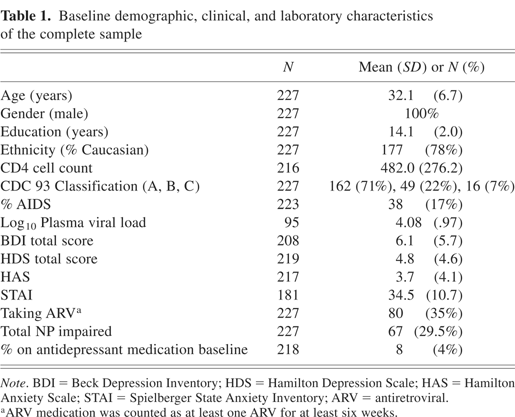
Baseline demographic, clinical, and laboratory data are presented for the complete group in Table 1. In general, this is a young, fairly well-educated adult sample, of mostly Caucasian individuals who were in relatively early stages of HIV infection at baseline (93% in CDC stages A and B; 17% had histories of AIDS-defining illnesses). Most were not taking antiretroviral (ARV) medications, and only 29.5% were classified as being NP impaired at baseline by clinical rating.
Baseline demographic, clinical, and laboratory characteristics of the complete sample

Comparisons of Major Depression Trait-Negative and Trait-Positive Groups on Baseline Test Results
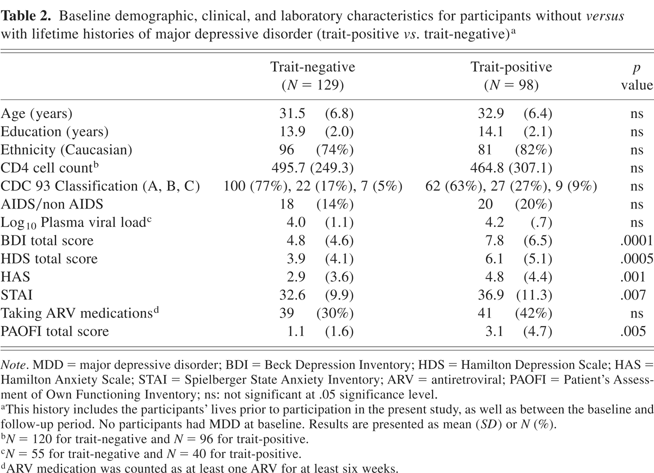
Baseline MDD trait-positive versus trait-negative comparisons are presented in Table 2. There were no significant differences between trait-positive and trait-negative groups in terms of demographic, baseline HIV disease markers, or ARV medication status. Even though the trait-positive group did not meet criteria for current MDE at baseline, they obtained higher scores on the BDI (p = .0001), HDS (p = .0005), HAS (p = .001) and STAI (p = .007) compared with the trait-negative group. There were no significant correlations between NP performance (as assessed by the global rating scores and the GDS) and trait status groups' anxiety levels, as reported on each of the HAS and STAI. Moreover, on the PAOFI, the trait-positive group reported significantly more neurocognitive complaints than did the trait-negative group (p = .005).
Baseline demographic, clinical, and laboratory characteristics for participants without versus with lifetime histories of major depressive disorder (trait-positive vs. trait-negative)a

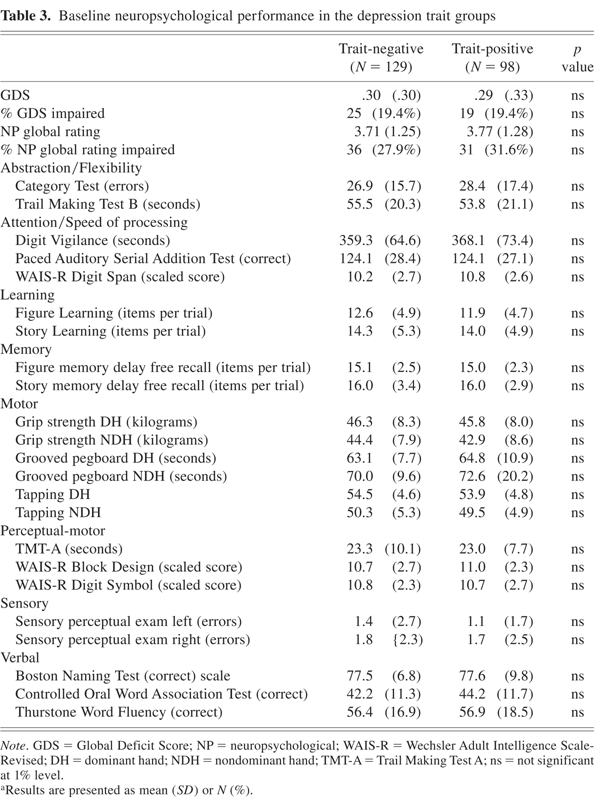
Overall NP performance at baseline did not differ between the two groups when considering global NP rating or GDS (Table 3). Similarly, there were no significant group differences on individual NP test measures at baseline (Table 3).
Baseline neuropsychological performance in the depression trait groups

Comparisons Between the State-Positive Depression and State-Negative Groups
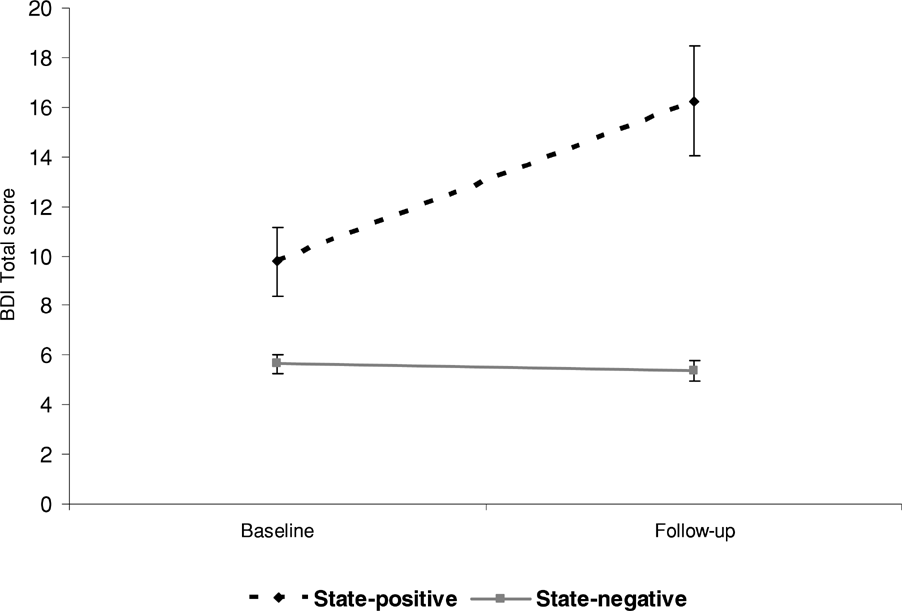
At baseline, groups with and without later MDE diagnoses did not differ significantly on demographic, clinical, HIV-disease markers, or treatment variables, except that there was a higher percentage of Caucasians in the incident MDE group (p < .03). Repeated measures ANOVA showed that state-positive participants obtained higher baseline and follow-up scores on the BDI (p < .01 and p < .0001, respectively) and HDS (p = .004 and p < .0001, respectively) in comparison with the state-negative participants. In addition, we found significant group by time interaction effects on both depression scales, indicating that participants with incident MDE showed an increase in depressive symptomatology while state-negative participants remained stable [F(1,189) = 25.2; p < .001; See Figure 1 for BDI; HDS pattern is comparable]. The state-positive group reported significantly more anxiety symptoms compared with the state-negative group on the HAS at baseline (p < .0001) and follow-up (p < .0001). We did not observe any time effects, or group by time interaction effects on this measure. The state-positive group reported significantly more anxiety symptoms compared with the state-negative group on the STAI at both baseline (p < .0001) and follow-up (p < .0001). Moreover, we found a significant group by time interaction effect on the STAI scale (p < .0004), indicating that state-positive participants showed an increase in anxiety symptoms while state-negative participants remained stable.

Beck Depression Inventory (BDI) scale results (mean & Standard Error = SE) for the state-negative and state-positive groups across the study period. A higher GDS indicates worse NP performance. GDS, Global Deficit Score; NP, neuropsychological.
Similarly, on the PAOFI (total score), the incident MDE group also demonstrated more subjective neurocognitive complaints at both baseline and follow-up (p < .01) and evidenced an increase in subjective neurocognitive complaints from baseline to follow-up, while the state-negative participants remained stable (interaction, p < .03). At baseline, participants who would later develop incident MDE did not differ from those who would remain state-negative, in terms of whether they considered themselves “as bright as they were before their present illness.” However, at follow-up, 63% of state-positive participants thought that their cognitive abilities were worse than they were in the past or that they were unsure about this, whereas only 29% of the state-negative participants thought so (p < .01).
At follow-up, there were no significant differences between the state-positive and state-negative groups in terms of progression to AIDS (in both groups, 30% of the non-AIDS cases at baseline progressed to AIDS). In addition, the proportion of participants who transitioned from one CDC stage to another was not significantly different between the state-positive and -negative groups (36.4% for state-negative group vs. 26.1% for state-positive group, p > .3). There was no between-group difference regarding the change in CD4 cell count across the study period. In both groups, 48% were on antiretroviral monotherapy at follow-up. Lastly, as expected, the proportion of participants on antidepressant medications at follow-up was significantly higher in the incident MDE group in comparison with the state-negative group [32% vs. 9%; χ2(1) = 10.7; p < .005].
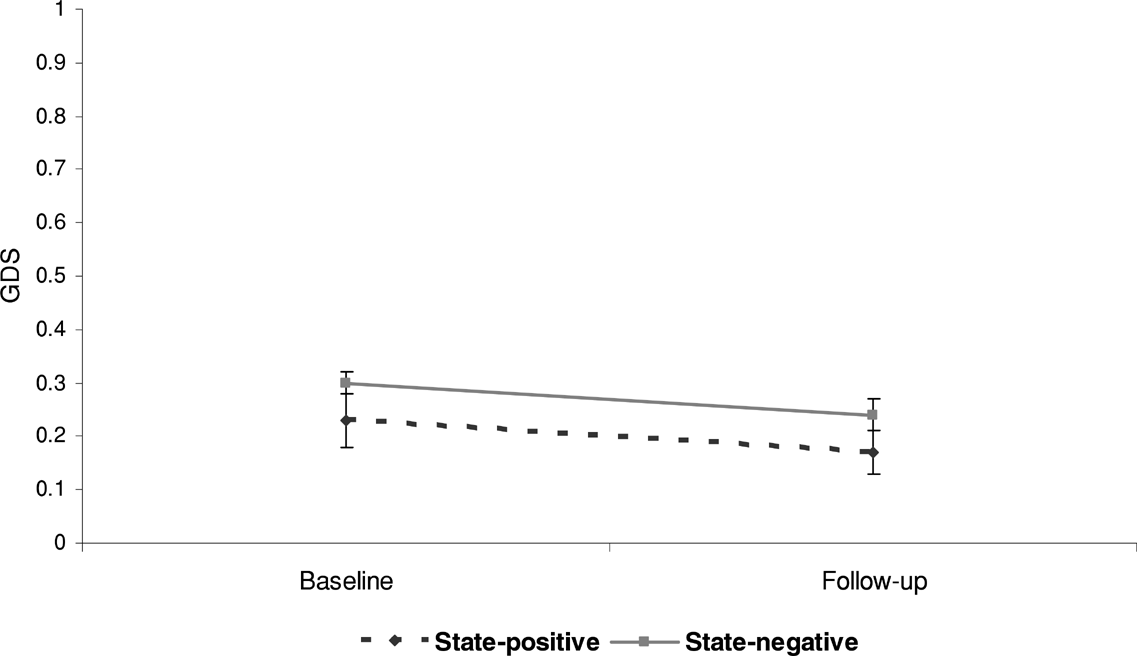
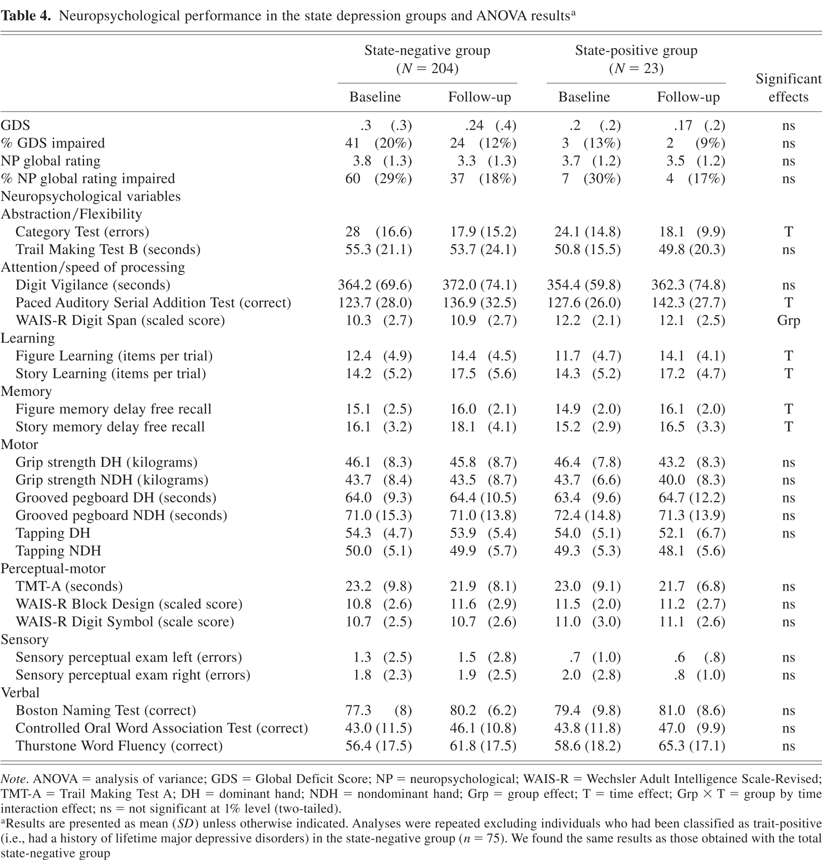
These groups also did not differ significantly on any NP measures (see Figure 2) except for the WAIS-R Digit Span, which was significantly better in the group with incident MDE (see Table 4). In addition, some measures of attention, abstraction, learning, and memory showed a significant time effect, consistent with practice effect. Importantly, no significant group by time interaction was found for any NP measure, meaning that the NP performance change was not related to incident MDE at the group level. Because some individuals in the state-negative group had had a lifetime history of MDD (trait-positive, state-negative, n = 75), we repeated the longitudinal analyses with those participants excluded. We obtained the same results as we had with the total state-negative group.

Neuropsychological [NP; Global Deficit Score (GDS) (mean & SE)] results for state-negative and state-positive groups from baseline to follow-up. A higher GDS indicates worse NP performance.
Neuropsychological performance in the state depression groups and ANOVA resultsa

The percentage of state-positive participants with change scores that indicated declining NP performance (5% cutoff derived from the state-negative group) ranged from 0 to 13% on the various NP measures, with a median of 4.5%. The proportion of declining scores was not significantly different between the two groups on any individual NP test measure.
DISCUSSION
Consistent with prior reports (Atkinson & Grant, 1994), we found a high prevalence (43.2%) of lifetime MDD among our cohort of HIV-infected, gay or bisexual men, as well as a high incidence of new or recurrent depression at the indexed follow-up (10.13%) over an average 2-year period. In terms of HIV disease, this cohort was mostly healthy at baseline (17% had AIDS), but 35% progressed to a worse CDC stage during the follow-up period and 30% converted to AIDS during the study follow-up. Progression of HIV disease, however, was not associated with higher risk for incident MDE (36.4% for state-negative group vs. 26.1% for state-positive depression group).
To our knowledge, this is the first longitudinal study to consider both trait and state effects of major depression on NP functioning of a large cohort of HIV-infected adults. We found no evidence of MDD trait effects on NP functioning at baseline, even though the trait-positive group evidenced more severe symptoms of depressed and anxious mood, and had higher levels of cognitive complaints.
As expected, incident MDE was associated with substantial increases in not only depressed mood (BDI and HDS scales), but also in neurocognitive complaints (PAOFI). Nevertheless, these changes in mood and cognitive symptoms were not accompanied by evidence of increased neurocognitive impairment on our comprehensive NP test battery, supporting the cross-sectional findings of Millikin et al. (2003). The only changes observed at the group level were modest improvements on 6 of 23 individual NP tests measures, consistent with practice effects, and these changes were the same in the state-positive and state-negative groups. Moreover, careful analyses of NP changes in individual participants failed to identify even a subgroup of people whose incident MDE negatively impacted their NP performance.
The longitudinal findings just discussed are generally consistent with previously reported cross-sectional evidence that (1) MDD is not responsible for the substantially increased rates of NP impairment that are seen in HIV-infected populations and (2) MDD is not usually a significant confound in interpreting NP results of individual patients with HIV infection. There are several limitations of the study. In terms of psychiatric and medical history, state-positive participants in this study were relatively young, ambulatory adult men, who developed MDEs that were of mild to moderate severity. Our results may not generalize to more disabling forms of MDE, particularly in older and/or more medically ill persons with more chronically advanced HIV infection (Hinkin et al., 2001). Our results tend to support studies in non HIV-infected ambulatory populations showing that, if other non-MDD psychiatric conditions are controlled for, MDD-associated cognitive deficits are mild or nonexistent (Grant et al., 2001).
Although MDD does not appear to significantly impair NP performance of HIV-infected persons, the current longitudinal findings support prior cross-sectional evidence that depressed mood often is associated with increased rates of cognitive complaints. This finding is important because self-reports of difficulties with cognition in everyday functioning may be used to help diagnose HIV-associated neurocognitive disorders (Minor Cognitive Motor Disorder or HIV-associated dementia; American Academy of Neurology, 1996). Our findings strongly suggest that self-reports of impaired functioning should not be accepted uncritically in HIV-infected persons with significantly depressed mood. Although such reports by depressed patients may have some validity (Carter et al., 2003), they should be confirmed by independent informants and/or objective tests of instrumental activities of daily living (Heaton et al., 2004), as well as by formal NP testing.
Our findings support the view that depression and neurocognitive impairment should be considered as two independent processes in HIV-infected individuals. This finding suggests that the etiologies of any combined neurocognitive impairment and MDD in HIV-infected individuals are probably distinct, despite the presumed involvement of common neuroanatomical pathways (Tekin & Cummings, 2002). In contrast to the hypothesis formulated in the context of Parkinson's disease, this suggestion would tend to support that MDD is not likely to be a comorbid effect of HIV-related neuropathogenesis. It is, however, possible that this interpretation may not hold when HIV+ individuals are moderately to severely NP impaired (demented), as only three such individuals were included in our sample. Future studies with HIV groups having a higher prevalence of dementia are needed to answer this question.
In conclusion, this is the first longitudinal study to provide evidence that depressive symptoms are dissociated from the occurrence of HIV-associated neurocognitive impairment, extending previous findings of cross-sectional studies. This finding suggests that the neuropathogenesis underlying the two processes is most often distinct.
ACKNOWLEDGMENTS
The San Diego HNRC group is affiliated with the University of California, San Diego, the Naval Hospital, San Diego, and the San Diego Veterans Affairs Healthcare System, and includes: Director: Igor Grant, M.D.; Co-Directors: J. Hampton Atkinson, M.D., and J. Allen McCutchan, M.D.; Center Manager: Thomas D. Marcotte, Ph.D.; Naval Hospital San Diego: Mark R. Wallace, M.D. (P.I.); Neuromedical Component: J. Allen McCutchan, M.D. (P.I.), Ronald J. Ellis, M.D., Scott Letendre, M.D., Rachel Schrier, Ph.D.; Neurobehavioral Component: Robert K. Heaton, Ph.D. (P.I.), Mariana Cherner, Ph.D., Steven Paul Woods, Psy.D.; Imaging Component: Terry Jernigan, Ph.D. (P.I.), John Hesselink, M.D., Michael J. Taylor, Ph.D.; Neuropathology Component: Eliezer Masliah, M.D. (P.I.), Ian Everall, FRCPsych., FRCPath., Ph.D., Dianne Langford, Ph.D.; Clinical Trials Component: J. Allen McCutchan, M.D., J. Hampton Atkinson, M.D., Ronald J. Ellis, M.D., Ph.D., Scott Letendre, M.D.; Data Management Unit: Anthony C. Gamst, Ph.D. (P.I.), Clint Cushman, B.A. (Data Systems Manager), Daniel R. Masys, M.D. (Senior Consultant); Statistics Unit: Ian Abramson, Ph.D. (P.I.), Deborah Lazzaretto, M.S., Tanya Wolfson, M.A. The views expressed in this article are those of the authors and do not reflect the official policy or position of the Department of the Navy, Department of Defense, nor the United States Government. This project was also partially supported by NIH M01 RR000827 (R.D.).