Non-technical Summary
The genus Aporia represents a modern group of Palearctic pierid butterflies. A fossil forewing from the caldera lake deposits to the Late Pliocene–Early Pleistocene (2.8–2.2 million years ago) is described and assigned to Aporia potanini. This specimen constitutes the oldest known fossil record of this extant butterfly species. The fossil also provides direct evidence that A. potanini was historically distributed in Japan, at the eastern margin of the Palearctic, and that the species originated no later than the Late Pliocene.
Introduction
The genus Aporia Hübner, 1819, is a Palearctic group of approximately 40 known pierid butterflies in the subfamily Pierinae, with its center of diversity in the Himalaya–Hengduan Mountains region (Della Bruna et al., Reference Della Bruna, Gallo and Sbordoni2013). While some species such as A. crataegi (Linnaeus, Reference Linnaeus1758) have wide geographic distributions, many species and subspecies are geographically restricted, and confined to specific subalpine regions (Della Bruna et al., Reference Della Bruna, Gallo and Sbordoni2013).
Species delimitation within Aporia has long been problematic. Della Bruna et al. (Reference Della Bruna, Gallo and Sbordoni2013) conducted a comparative study of wing patterns and male genital uncus morphology and recognized 33 species within the genus. Huang (Reference Huang2016) upgraded A. wolongensis Yoshino, Reference Yoshino1995, from a subspecies of A. acraea (Oberthür, Reference Oberthür1885) to species rank. Using next-generation sequencing, Todisco et al. (Reference Todisco, Vodă, Prosser and Nazari2020) demonstrated that the monotypic genus Mesapia Gray, Reference Gray1856, should be synonymized with Aporia, thereby including M. peloria (Hewitson, Reference Hewitson1853) within Aporia. Aporia chunhaoi Hu, Zhang, and Yang, Reference Hu, Zhang and Yang2021, from northwest Yunnan, China, was later downgraded to a subspecies of A. lhamo (Oberthür, Reference Oberthür1893) by Huang (Reference Huang2023). Yoshino (Reference Yoshino2022) showed that A. bernardi Koiwaya, Reference Koiwaya1989, is a junior synonym of A. extrema Bailey, Reference Bailey1945. Nazari et al. (Reference Nazari, Lukhtanov, Naderi, Della Bruna, Zahiri, Cesaroni, Sbordoni and Todisco2024) further revised the A. leucodice Eversmann, Reference Eversmann1843, complex elevating several Central Asian and northern–northeastern Iranian subspecies to species status, including A. illumina Grum-Grshimailo, Reference Grum-Grshimailo and Romanoff1890, A. belucha Marshall, Reference Marshall1883, and A. soracta Moore in Horsfield and Moore, Reference Horsfield and Moore1857. Additional recent taxonomic changes include the description of a new species, A. ahura Nazari and Naderi in Nazari et al., Reference Nazari, Lukhtanov, Naderi, Della Bruna, Zahiri, Cesaroni, Sbordoni and Todisco2024. Based on mitogenomic data and genital morphology, Hu et al. (Reference Hu, Jia, Zhang, Hsu, Monastyrskii, Vu, Ge, Duan, Jiang, Sbordoni and Wang2024) revised the A. agathon (Gray, Reference Gray1831) species group, recognizing A. japfuensis Yoshino, Reference Yoshino2015, A. bifurcata Tytler, Reference Tytler1939, A. kuangtungensis Mell, Reference Mell1935 , A. moltrechti (Oberthür, Reference Oberthür1909), and A. omotoi Yoshino, Reference Yoshino2003, as distinct species. Hu et al. (Reference Hu, Jia, Zhang, Hsu, Monastyrskii, Vu, Ge, Duan, Jiang, Sbordoni and Wang2024) also treated A. lemoulti Bernardi, Reference Bernardi1944, and A. gigantea Koiwaya, Reference Koiwaya1993, as subspecies of A. largeteaui (Oberthür, Reference Oberthür1881). As a result of these revisions, the genus Aporia currently comprises 42 species.
Fossil records of Aporia have remained ambiguous. Fossils attributed to the genus consist primarily of wing impressions and compressions from Late Pliocene deposits (3.6–2.6 Ma) in Germany. Kernbach (Reference Kernbach1967) reported a fossil hindwing from Willershausen, Brandenburg, as A. crataegi, and Branscheid (Reference Branscheid1968) later described a partly preserved forewing as A. cf. crataegi from the same locality. However, Kozlov (Reference Kozlov and Ponomarenko1988) reassigned these specimens to Pierites Heer, Reference Heer1849, a collective fossil genus for pierid wings of uncertain subfamilial placement, due to the similarity of wing venation patterns between Pierinae and Coliadinae. This interpretation was adopted in a subsequent fossil catalog summarized by Sohn et al. (Reference Sohn, Labandeira, Davis and Mitter2012), and later wing fossils tentatively attributed to Aporia by Branscheid (Reference Branscheid1969, Reference Branscheid1977) and Brauckmann et al. (Reference Brauckmann, Brauckmann and Gröning2001) were likewise treated as species of Pierites. There is also the perspective that the original Pierites is so poorly preserved that it is impossible to make any reliable observations about its affiliation (de Jong, Reference de Jong2017). The fossil identifications of Kernbach (Reference Kernbach1967) and Branscheid (Reference Branscheid1968, Reference Branscheid1969) were discussed by de Jong (Reference de Jong2017), who concluded that it is difficult to definitively identify these specimens as Aporia. Consequently, no unequivocal fossil record of Aporia has been recognized to date.
Recent advances in the taxonomy and morphology of extant Aporia, however, allow more reliable identification based on wing characters alone. The forewing of Aporia is typically characterized by an elongated discal cell exceeding half the wing length, the presence of four radial veins, veins R1 and R2+3 arising from the discal cell, veins R4 and R5 sharing a long common stalk, and vein M1 branching from the stalk of veins R4 and R5, approximately one-third of its basal length (Della Bruna et al., Reference Della Bruna, Gallo and Sbordoni2013; Monastyrskii, Reference Monastyrskii2024). Here, we describe a Late Pliocene–Early Pleistocene fossil representing a modern species of Aporia, providing the oldest fossil record of the genus and of an extant butterfly species.
Material and methods
The fossil specimen was collected from the Haruki Mud (ca. 2.8–2.2 Ma: Late Pliocene–Early Pleistocene), caldera–lacustrine deposits of the Teragi Group. The group is distributed in eastern Tottori and northwestern Hyogo prefectures, southwest Japan. For more detailed geological and paleontological information on the Haruki Mud, see Furuyama and Nagao (Reference Furuyama and Nagao2004), Aiba et al. (Reference Aiba, Takahashi and Saito2025), and Takahashi and Takahashi (Reference Takahashi and Takahashi2025).
The studied fossil was preserved in the whitish tuffaceous siltstone of Haruki Mud. Observations were made using a Leica microscope (model: M205 C). Photographs were taken with a Leica microscope (model: MC170HD, Leica Application Suite Version 4.1.3.). The images were polished, and their contrast and tonality were adjusted using Adobe Photoshop (Version CS6). Comparative material and taxonomic assessments were based on Della Bruna et al. (Reference Della Bruna, Gallo and Sbordoni2013), Huang (Reference Huang2016), Kanoh and Sakai (Reference Kanoh and Sakai2017), Kanoh et al. (Reference Kanoh, Sakai and Hayashi2017), Hu et al. (Reference Hu, Zhang and Yang2021, Reference Hu, Jia, Zhang, Hsu, Monastyrskii, Vu, Ge, Duan, Jiang, Sbordoni and Wang2024), and Nazari et al. (Reference Nazari, Lukhtanov, Naderi, Della Bruna, Zahiri, Cesaroni, Sbordoni and Todisco2024). Wing vein nomenclature follows Solonkin et al. (Reference Solonkin, Zakharova and Shkurikhin2021).
Repositories and institutional abbreviations
The fossil specimen is deposited in the Museum of Unique Insect Fossils (managed by the Shin’onsen Town Board of Education, Shin’onsen Town, Hyogo Prefecture) with repository number U1001. Comparative material was examined from the butterfly collections of the Research Institute of Evolutionary Biology (RIEB) at Kami-Yōga, Tokyo, Japan; private collections of second author K. Saito (SP) at Shibadaimon, Tokyo, Japan; and the collections of Keio Yochisha Elementary School (KY) at Shibuya, Tokyo, Japan.
Systematic paleontology
Order Lepidoptera Linnaeus, Reference Linnaeus1758
Superfamily Papilionoidea Latreille, Reference Latreille1802
Family Pieridae Duponchel in Godart, Reference Godart1835
Subfamily Pierinae Duponchel in Godart, Reference Godart1835
Tribe Pierini Duponchel in Godart, Reference Godart1835
Genus Aporia Hübner, 1819 [Reference Hübner1816]
Type species
Papilio crataegi Linnaeus, Reference Linnaeus1758.
Aporia potanini Alphéraky, 1889
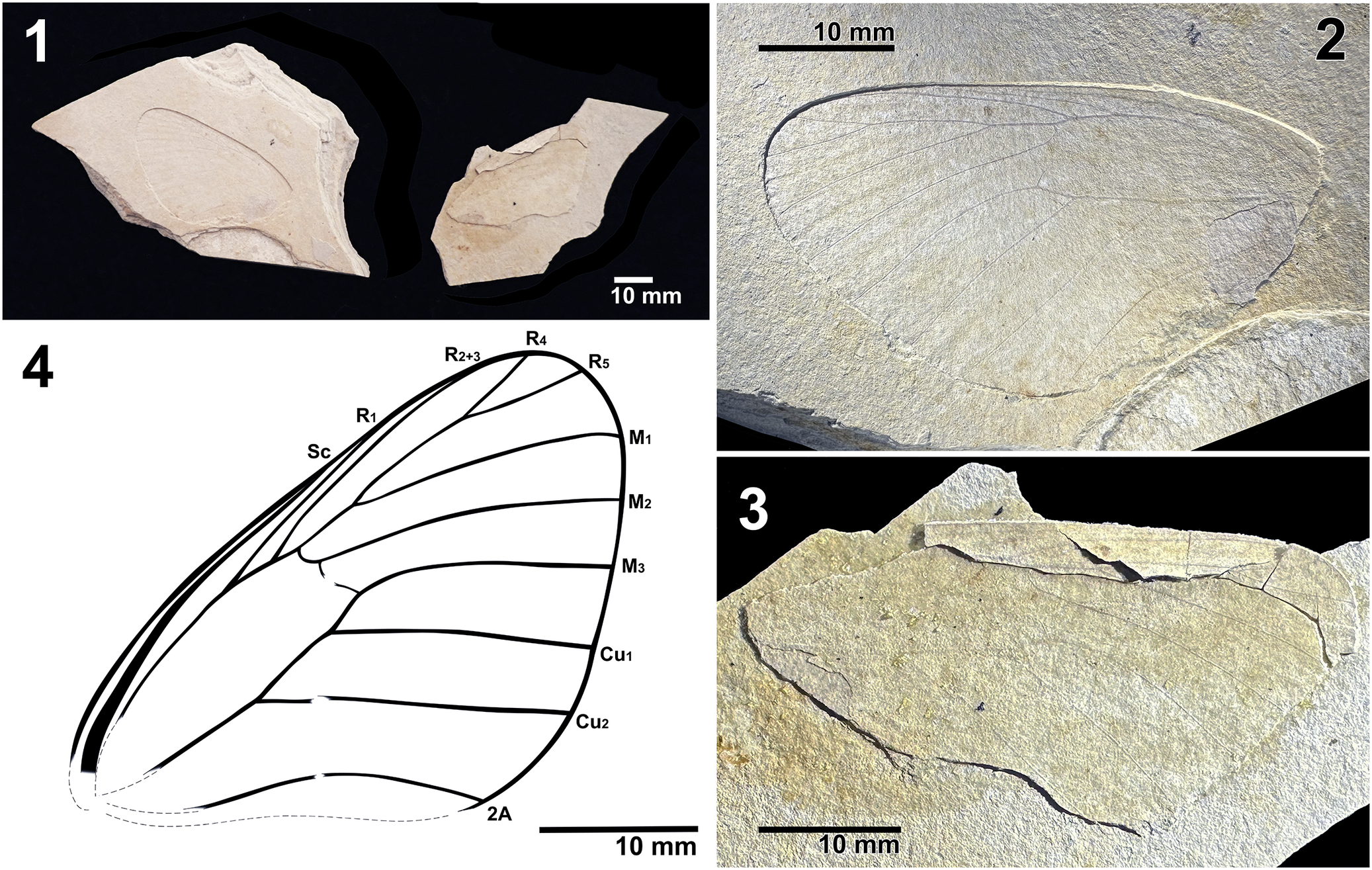
(1–3) Fossil specimens of Aporia potanini. (1) U1001A and B; (2) U1001A; (3) counterpart of A (U1001B). (4) Line drawing of fossil forewing with vein labels. A = anal vein; Cu = cubital vein; M = median vein; R = radial vein; Sc = subcostal.

Figure 1 Long description
The display consists of four panels.
Panel 1 shows two light-colored rock fragments, labeled U 1 0 0 1 A and B, containing fossilized wing impressions against a black background. A 10 mm scale bar is at the bottom right.
Panel 2 is a close-up photograph of specimen U 1 0 0 1 A, showing a clear, triangular wing impression with visible veins on a textured stone surface. A 10 mm scale bar is at the top left.
Panel 3 is a close-up of the counterpart specimen U 1 0 0 1 B, showing the opposing impression of the wing. A 10 mm scale bar is at the bottom left.
Panel 4 is a black and white line drawing of the forewing. Labels along the outer margin, starting from the top left and moving clockwise, include S c, R sub 1, R sub 2 plus 3, R sub 4, R sub 5, M sub 1, M sub 2, M sub 3, C u sub 1, C u sub 2, and 2 A. The veins radiate from the wing base toward these terminal points. A 10 mm scale bar is located at the bottom right.
Holotype
Alphéraky (Reference Alphéraky and Romanoff1889) in Romanoff, p. 96, pl. 6, fig. 1. Type locality: “… la vallée du Heï-hò, Kan-sou” [Gansu, China].
Specimen
U1001: a separated forewing (Fig. 1.1). U1001A (Fig. 1.2) represents a nearly complete forewing, lacking basal and posterior margins. U1001B (Fig. 1.3) is a counterpart of U1001A with varnish-like coating on the surface.
Occurrence
The Haruki Mud, Teragi Group (ca. 2.8–2.2 Ma: Late Pliocene–Early Pleistocene) distributed in Umigami, Shin’onsen Town, Hyogo Prefecture, Japan.
Description
Forewing approximately 41.7 mm long (as reconstructed) and 23.3 mm wide without any distinct black markings. Length-to-width (L/W) ratio of 1.79. Apex round; termen nearly straight; tornus round; costa mostly straight, curved near base; discal cell open, lower discocellular vein incomplete; cell measuring 20.9 mm long (as reconstructed) and 6.6 mm wide, extending roughly half-length of wing; discal cell length-to-cell width ratio 3.17 and cell length-to-wing length ratio 0.50. Veins Sc and R1 originate close together towards costal margin; R1 and R2+3 arise separately from upper edge of discal cell, running parallel toward costal margin; R1 approximately three-fourth the length of R2+3; originating points of R2+3 and stalk of R4 and R5 are not close; R4 and R5 share a long stalk, arising from upper end of discal cell, running to apex, with their free parts not short. M1 originates from stalk of veins R4 and R5, at roughly one-third of its basal length; M2 arising from middle angle of discal cell and runs paralleled to M1; M3 strongly curves basally from the lower angle of the cell; cubitus appears trifid; with Cu1 and Cu2 emitted from lower edge of discal cell, running parallel; distance between origin of M3 and Cu1 approximately half that between Cu1 and Cu2; 2A anteriorly bowed, runs towards tornus.
Comparisons
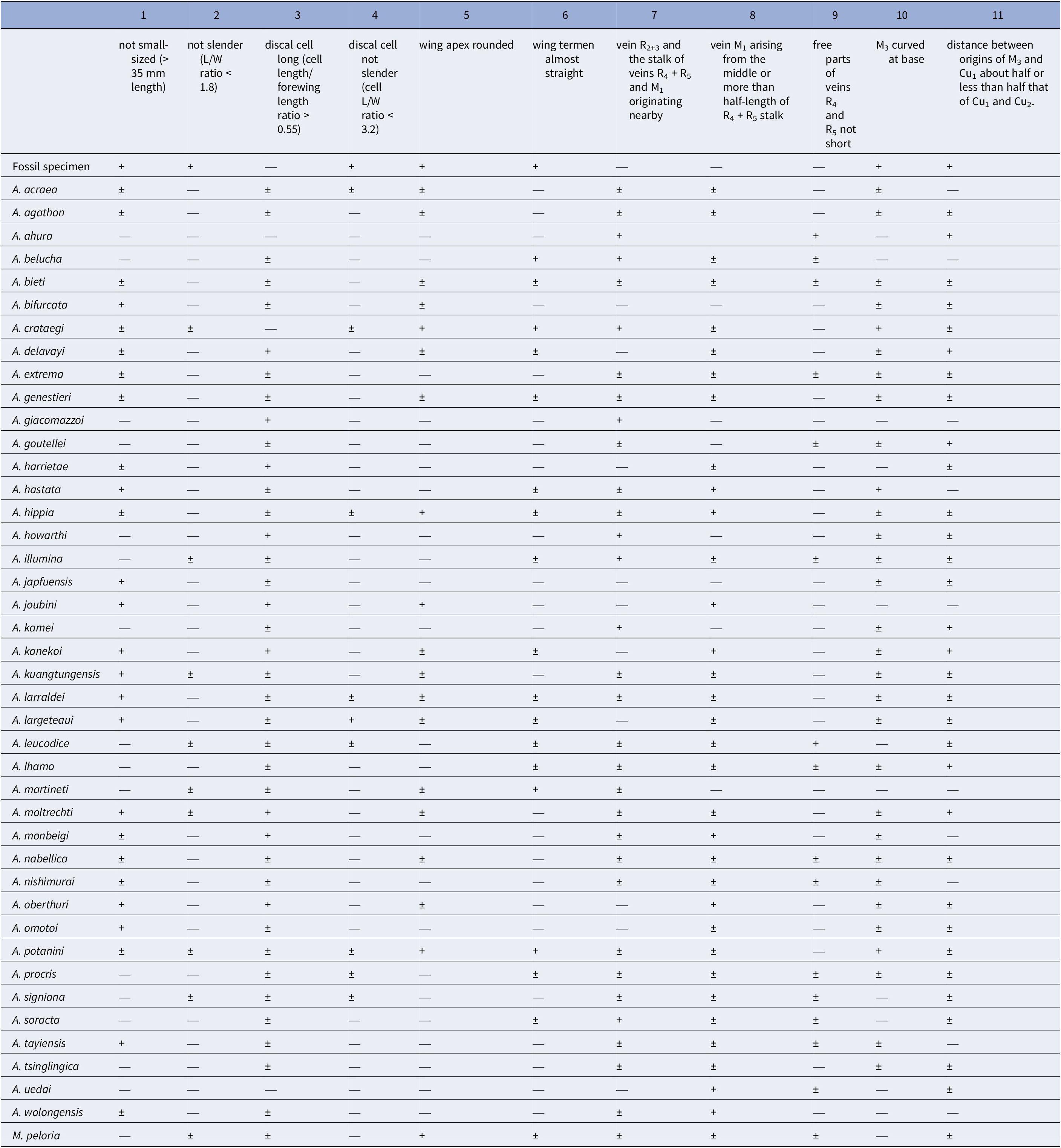
The forewing fossil exhibits all the general diagnostic venation characteristics of the genus Aporia. Eleven forewing characters were compared across all Aporia species (Table 1): (1) forewing not small-sized (> 35 mm length), (2) forewing not slender (L/W ratio < 1.8), (3) discal cell long (cell length/forewing length ratio > 0.55), (4) discal cell not slender (cell L/W ratio < 3.2), (5) wing apex rounded, (6) wing termen almost straight, (7) vein R2+3 and stalk of veins R4 + R5 and M1 originating nearby, (8) vein M1 arising from the middle or more than half-length of R4+R5 stalk, (9) free parts of veins R4 and R5 not short, (10) vein M3 curved at base, and (11) distance between origins of M3 and Cu1 about half or less than half that of Cu1 and Cu2.
Correlations of forewing shapes and venations with 11 character-elements: (1) forewing not small-sized (> 35 mm length), (2) forewing not slender (L/W ratio < 1.8), (3) discal cell long (cell length/forewing length ratio > 0.55), (4) discal cell not slender (cell L/W ratio < 3.2), (5) wing apex rounded, (6) wing termen almost straight, (7) vein R2+3 and stalk of veins R4 + R5 and M1 originating nearby, (8) vein M1 arising from the middle or more than half-length of R4+R5 stalk, (9) free parts of veins R4 and R5 not short, (10) vein M3 curved at base, and (11) distance between origins of M3 and Cu1 about half or less than half that of Cu1 and Cu2.

Table 1. Long description
The table consists of 12 columns. The first column lists the specimen or species name, and columns 1 through 11 represent specific character-elements.
Character-elements are defined as follows.
1. Forewing not small-sized (greater than 35 mm length).
2. Forewing not slender (L / W ratio less than 1.8).
3. Discal cell long (cell length / forewing length ratio greater than 0.55).
4. Discal cell not slender (cell L / W ratio less than 3.2).
5. Wing apex rounded.
6. Wing termen almost straight.
7. Vein R sub 2 plus 3 and the stalk of veins R sub 4 plus R sub 5 and M sub 1 originating nearby.
8. Vein M sub 1 arising from the middle or more than half-length of R sub 4 plus R sub 5 stalk.
9. Free parts of veins R sub 4 and R sub 5 not short.
10. M sub 3 curved at base.
11. Distance between origins of M sub 3 and C u sub 1 about half or less than half that of C u sub 1 and C u sub 2.
The first data row for Fossil specimen shows plus signs for elements 1, 2, 4, 5, 6, 10, and 11, and minus signs for 3, 7, 8, and 9.
Subsequent rows list 41 species, primarily from the genus Aporia (A. acraea, A. agathon, A. ahura, etc.) and one Mesapia peloria. Data points are represented by plus, minus, or plus-minus symbols indicating the presence, absence, or variability of the character-element in that species.
Character 1 in the upper list excludes small-sized congeners such as A. ahura, A. belucha, A. giacomazzoi Della Bruna, Gallo, and Sbordoni, Reference Della Bruna, Gallo and Sbordoni2003, A. goutellei (Oberthür, Reference Oberthür1886), A. howarthi Bernardi, Reference Bernardi1961, A. illumina, A. kamei Koiwaya, Reference Koiwaya1989, A. leucodice, A. lhamo, A. martineti (Oberthür, Reference Oberthür1884), A. procris Leech, Reference Leech1890, A. signiana Sugiyama, Reference Sugiyama1994, A. soracta, A. tsinglingica (Verity, Reference Verity1911), A. uedai Koiwaya, Reference Koiwaya1989, and M. peloria. Character 6 also excludes more than 10 species including A. acraea, A. agathon, A. extrema, A. harrietae (de Nicéville, Reference de Nicéville1893), A. japfuensis, A. joubini (Oberthür, Reference Oberthür1913), A. kuangtungensis, A. moltrechti, A. monbeigi (Oberthür, Reference Oberthür1917), A. nabellica (Boisduval, Reference Boisduval, Boisduval and Guénee1836), A. nishimurai Koiwaya, Reference Koiwaya1989, A. oberthuri (Leech, Reference Leech1890), A. omotoi, A. tayiensis Yoshino, Reference Yoshino1995, and A. wolongensis. Additionally, the fossil’s broad forewing and discal cell distinguish it from A. bieti (Oberthür, Reference Oberthür1884), A. bifurcata, A. delavayi (Oberthür, Reference Oberthür1890), A. genestieri (Oberthür in Launay, Reference Launay1902), A. hastata (Oberthür, Reference Oberthür1892), A. hippia (Bremer, Reference Bremer1861), A. kanekoi Koiwaya, Reference Koiwaya1989 , A. larraldei (Oberthür, Reference Oberthür1876), and A. largeteaui (characters 2, 4). Only these four characteristics distinguish the studied specimen from most Aporia species.
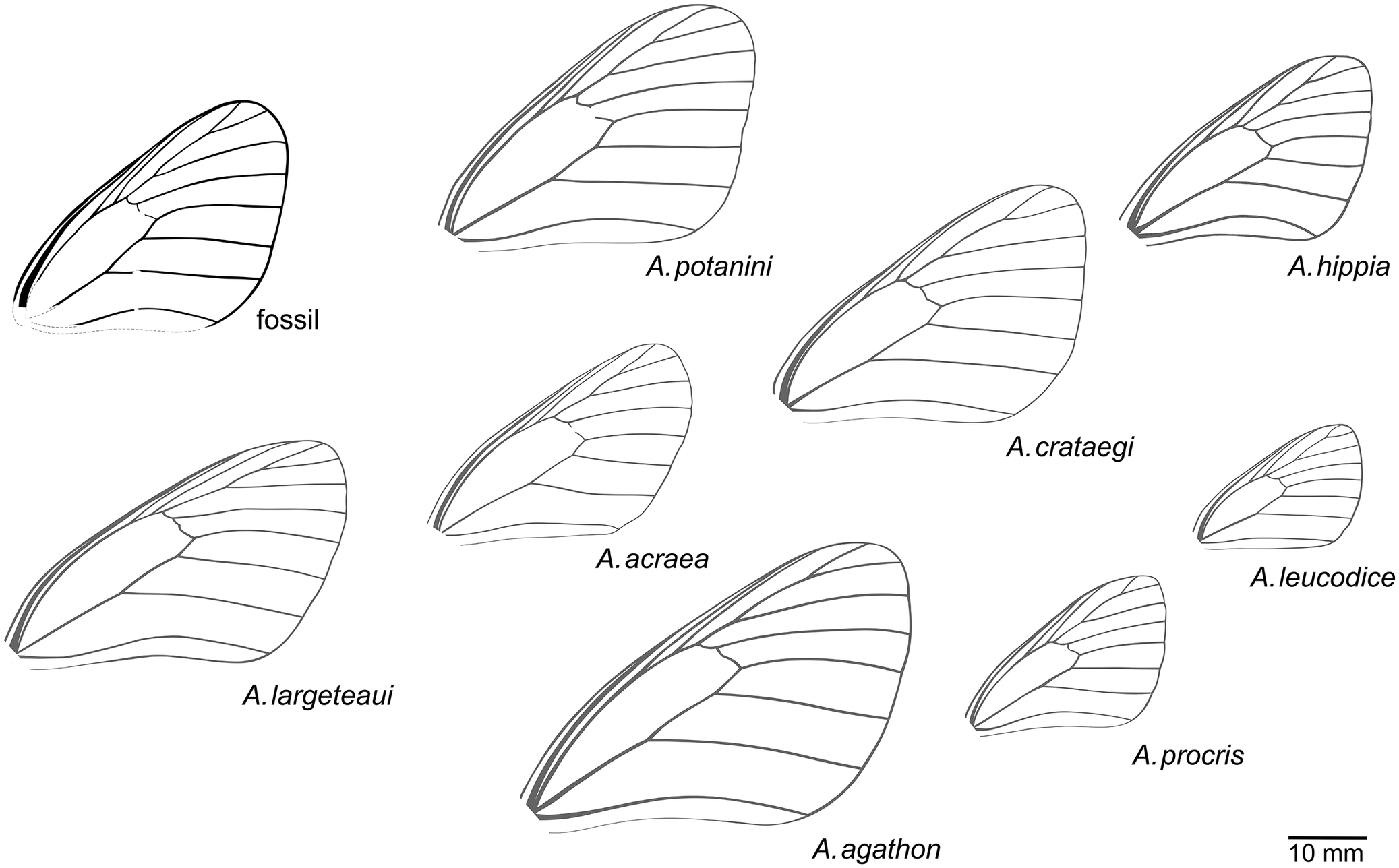
The fossil specimen clearly resembles the remaining two species: A. crataegi and A. potanini (Fig. 2). It differs from A. crataegi in character 7, whereas all features match A. potanini. The absence of conspicuous dark markings in the fossil is consistent with A. potanini, whose forewings are occasionally whitish without black patterns (see Remarks). Therefore, the fossil specimen is identified as a forewing of A. potanini.
Line drawings of forewings for comparison using A. acraea (Konga Shan, Sichuan, China), A. agathon (Sapa, Vietnam), A. crataegi (Biei, Hokkaido, Japan), A. hippia (Tonghe, Heilongjiang, China), A. largeteaui (Ha Giang, Vietnam), A. leucodice (Boro Horo Shan, Xinjiang, China), A. potanini (Xi’an, Shaanxi, China), and A. procris (Batang, Garzi, Sichuan).

Figure 2 Long description
The drawing displays nine butterfly forewings arranged in three irregular rows. Each wing shows a distinct venation pattern with a central discal cell and branching veins extending to the outer margins.
* Top row from left to right.
1. A fossil specimen with a thick costal margin and a large discal cell.
2. A. potanini, showing a broad wing shape with widely spaced veins.
3. A. hippia, a smaller wing with more compressed venation.
* Middle row from left to right.
4. A. largeteaui, a large wing with a prominent subcostal vein.
5. A. acraea, featuring a more elongated discal cell.
6. A. crataegi, showing a standard venation pattern for the genus.
* Bottom row from left to right.
7. A. agathon, the largest specimen in the set with elongated veins.
8. A. procris, a smaller wing with a rounded apex.
9. A. leucodice, the smallest specimen with simplified branching.
A 10 millimeter scale bar is located in the bottom-right corner.
Remarks
Although the original wing coloration of the fossil is uncertain, the whitish coloration of the fossil, similar to the host rock, suggests that the forewing lacked dark markings. Impression/compression fossils are known to preserve their original patterns (e.g., Durden and Rose, Reference Durden and Rose1978; Aiba et al., Reference Aiba, Takahashi and Saito2025), and color shades observed in nymphalid fossils from the same locality are interpreted as preserved wing patterns (Aiba et al., Reference Aiba, Takahashi and Saito2025).
Discussion
Butterfly fossil records are notably uneven, with most Eocene to Miocene specimens originating from Europe and North America (e.g., Sohn et al., Reference Sohn, Labandeira, Davis and Mitter2012). Fossil representatives from the Pliocene to Pleistocene are comparatively rare, but recent discoveries have begun to fill this temporal gap. Several nymphalid extinct species have recently been described from Japan, including Neptis kabutoiwaensis Aiba, Takahashi, and Sakamaki, Reference Aiba, Takahashi and Sakamaki2023, from the Motojuku Group (Gunma Prefecture) and Tacola kamitanii Aiba, Takahashi, and Saito, Reference Aiba, Takahashi and Saito2025, from the same locality as the present specimen. Hestina japonica (Felder and Felder, Reference Felder and Felder1862) from the Middle Pleistocene Shiobara Group (Tochigi Prefecture) is the oldest fossil example of an extant butterfly species (Fujiyama, Reference Fujiyama1983), whereas all older named butterfly fossils represent extinct species. Therefore, the occurrence of Aporia potanini in Pliocene to Early Pleistocene deposits establishes it as the oldest fossil record of an extant butterfly species.
The present fossil also provides important biogeographic insights. First, it demonstrates that Aporia potanini was historically distributed in Japan, at the eastern margin of the Palearctic region. In modern Japan, only two congeners of Aporia are known: A. crataegi, in the Hokkaido Prefecture, and A. hippia (Bremer, Reference Bremer1861) are restricted to subalpine areas in some prefectures, such as Nagano, Gunma, Yamanashi, and Shizuoka (Yata, Reference Yata2007). The present study therefore suggests that at least one additional species of Aporia inhabited Japan during the Late Pliocene to Early Pleistocene, and subsequently became locally extinct. Second, the fossil suggests that A. potanini historically possessed a much broader geographic distribution than observed today. The extant distribution of A. potanini is currently limited to southern and central Gansu, northern Sichuan, western Shaanxi, and the Beijing region of China. Its presence in Japan during the Late Pliocene–Early Pleistocene thus represents a significant eastward extension of its former range, implying a substantially wider habitat during this period.
Finally, the fossil record of A. potanini provides critical calibration for molecular phylogenetic hypotheses. Recently, Nazari et al. (Reference Nazari, Lukhtanov, Naderi, Della Bruna, Zahiri, Cesaroni, Sbordoni and Todisco2024) presented a comprehensive and time-calibrated phylogeny of Aporia, in which multigene BEAST (Bayesian evolutionary analysis by sampling trees) phylogeny indicated that the genus occurred during the Oligocene, with A. potanini diverging during the Late Miocene. The discovery of a Pliocene–Early Pleistocene fossil of A. potanini bridges the gap between these molecular age estimates and the previously lacking paleontological evidence, thereby strengthening evolutionary interpretations of the genus.
Acknowledgments
We express our gratitude to K. Nakai (Shin’onsen Town Board of Education) and T. Uemura (Museum of Unique Insect Fossils) for providing access to the fossil material. We are grateful to the Keio Gijuku Fukuzawa Memorial Fund for the Advancement of Education and Research for financially supporting this study. We also extend our thanks to K. Kanoh (Research Institute of Evolutionary Biology), K. Ueda (Kitakyushu Museum of Natural History & Human History), A.L. Monastyrskii (Vietnam National Museum of Nature), R. Kukihara, and T. Suguro (Keio Yochisha Elementary School) for assistance and support during this study. Thanks also to two anonymous reviewers for constructive comments, which improved our manuscript.
Competing interests
The author/authors declare none.
Data availability statement
Data available from the DRYAD Digital Repository: https://doi.org/10.5061/dryad.ns1rn8q70