Change, uncertainty, and novelty are necessary and inevitable factors of life. An individual will experience many such factors throughout their lifespan, including beginning school, making new friends, moving away from home, beginning university/college, marriage or partnership, child rearing, and caring for others (Martin, Nejad, Colmar, & Liem, Reference Martin, Nejad, Colmar and Liem2013). The ability to effectively navigate change, uncertainty, and novelty by regulating and monitoring cognitive, behavioural, and emotional responses has been referred to as ‘adaptability’ (Martin, Reference Martin, McInerney, Marsh, Craven and Guay2013b; Martin, Nejad, Colmar, & Liem, Reference Martin, Nejad, Colmar and Liem2012, Reference Martin, Nejad, Colmar and Liem2013). In recent research, adaptability has been found to predict positive academic (e.g., motivation, engagement) and personal (e.g., self-esteem, life satisfaction) outcomes (Martin et al., Reference Martin, Nejad, Colmar and Liem2012, Reference Martin, Nejad, Colmar and Liem2013). It therefore appears to be a factor that is important for academic and non-academic functioning.
Given adaptability has been identified as a tripartite function comprising cognitive, behavioural and emotional regulation in the face of uncertainty and novelty (Martin et al., Reference Martin, Nejad, Colmar and Liem2012, Reference Martin, Nejad, Colmar and Liem2013), it may be the case that some groups of students are at a particular disadvantage in relation to this construct (Martin, Reference Martin2013a). Although recent studies have found that adaptability has distinct academic and non-academic yields among ‘typical’ student populations (Martin et al., Reference Martin, Nejad, Colmar and Liem2012, Reference Martin, Nejad, Colmar and Liem2013), it is possible that students with executive function disorders such as attention-deficit/hyperactivity disorder (ADHD) may be at a distinct risk. Executive functioning is the “complex cognitive processing requiring the co-ordination of several sub-processes to achieve a particular goal” (Elliott, Reference Elliott2003, p. 49). These subprocesses include, inter alia, sustained attention, working memory, verbal fluency, planning, and motor responses (Barkley, Reference Barkley and Barkley2006; Biederman, Carter, Fried, Fontanella, Doyle, Seidman, & Faraone, Reference Biederman, Carter, Fried, Fontanella, Doyle, Seidman and Faraone2006; Elliott, Reference Elliott2003). Particularly in relation to cognitive and behavioural regulation, those with executive function disorders face significant challenges — and by implication, may struggle with adaptability more than their counterparts with no such disorders or impairments.
The purpose of this article is threefold. First, it reviews and discusses the theoretical and empirical bases for the challenges students with ADHD may have with adaptability. This will be examined through salient frameworks and models of ADHD. Second, it presents preliminary findings on adaptability among students with ADHD. Third, the article discusses ideas for successful adaptability intervention for students with ADHD.
Adaptability
The American Psychological Association defines adaptability as “the capacity to make appropriate responses to changed or changing situations; the ability to modify or adjust one's behavior in meeting different circumstances or different people” (VandenBos, Reference VandenBos2007, p. 17). Martin et al. (Reference Martin, Nejad, Colmar and Liem2012, Reference Martin, Nejad, Colmar and Liem2013) extended this definition to include not only cognitive and behavioural regulation, but also emotional regulation in response to change, uncertainty, and novelty. Cognitive regulation refers to one's ability to adjust thoughts and thinking to deal with new, changing, and uncertain situations. Behavioural regulation refers to one's ability to adjust the nature, level, and degree of behaviour or action to successfully navigate novel, changing, and uncertain situations. Emotional regulation refers to one's ability to adjust usual or typical emotional responses to successfully interact with a new, uncertain, or changing environment. Taken together, this is known as the ‘tripartite perspective’ on adaptability (Martin, Reference Martin, McInerney, Marsh, Craven and Guay2013b; Martin et al., Reference Martin, Nejad, Colmar and Liem2013). Each facet of the tripartite perspective is necessary for maintaining a positive relationship between the individual and his/her changing environment, both academically and non-academically (Wessel, Ryan, & Oswald, Reference Wessel, Ryan and Oswald2008).
Following from this definition, Martin et al. (Reference Martin, Nejad, Colmar and Liem2012) developed and validated the Adaptability Scale. The scale comprises nine items, each of which meet four key criteria: (1) response to novelty, change, and uncertainty; (2) cognitive, behavioural, and emotional functions; (3) regulation, adjustment, or revision of one or more of these three functions; and (4) a constructive purpose or outcome (Martin et al., Reference Martin, Nejad, Colmar and Liem2012). There are three items for each of cognitive adaptability (sample item: ‘I am able to adjust my thinking or expectations to assist me in a new situation’), behavioural adaptability (sample item: ‘To assist me in a new situation, I am able to change the way I do things’), and emotional adaptability (sample item: ‘When uncertainty arises, I am able to minimise frustration or irritation so I can deal with it best’).
While the concept of adaptability and the Adaptability Scale are relatively new, Martin et al. (Reference Martin2013) have shown that there are several factors that influence one's capacity to be adaptable, including one's personality and implicit theories. Personality traits that positively predict adaptability are agreeableness and consciousness; neuroticism is negatively related to adaptability (Martin et al., Reference Martin, Nejad, Colmar and Liem2013). Implicit theories, or the degree to which one views intelligence as either fixed or malleable, have also proven to significantly predict adaptability (Martin et al., Reference Martin, Nejad, Colmar and Liem2013). Those who have fixed beliefs about intelligence (‘entity’ views) are less likely to be adaptable, whereas those who have malleable beliefs about intelligence (‘incremental’ views) are more likely to be adaptable (Martin et al., Reference Martin, Nejad, Colmar and Liem2013). There are also socio-demographic factors that positively predict adaptability. These include parent education and age, as well as higher levels of prior achievement (Martin et al., Reference Martin, Nejad, Colmar and Liem2013). In terms of outcomes, adaptability is significantly correlated with achievement, enjoyment of school, sense of meaning and purpose, and life satisfaction (Martin et al., Reference Martin, Nejad, Colmar and Liem2012). In longitudinal work, adaptability is found to predict gains in class participation, enjoyment of school, self-esteem, life satisfaction, and sense of meaning and purpose (Martin et al., Reference Martin, Nejad, Colmar and Liem2013).
To date, adaptability research has focused on ‘general’ samples of young people. Yet, as noted earlier, given its reliance on regulatory processes, there may be some young people who are at particular risk in relation to this factor. To the extent that this is the case, it may place them at risk for a variety of academic and personal outcomes that adaptability is known to predict. The present discussion considers this with particular focus on ADHD; a disorder known to involve cognitive, behavioural, and emotional regulatory impairments (Barkley, Reference Barkley and Barkley2006).
Attention-Deficit/Hyperactivity Disorder (ADHD)
ADHD is defined as “a persistent pattern of inattention and/or hyperactivity-impulsivity that interferes with functioning or development” (American Psychiatric Association, 2013, p. 59). In essence, those with ADHD have significant difficulty regulating their pre-potent thoughts, behaviours, and emotions during a given task, and this directly impacts their successful management of that task and its outcome (Barkley, Reference Barkley and Barkley2006). A hallmark of ADHD is the lack of behavioural inhibition and self-regulation. While there are several general models that emphasise this (Bandura, Reference Bandura2001; Baumeister, Gailliot, DeWall, & Oaten, Reference Baumeister, Gailliot, DeWall and Oaten2006; Cleary & Zimmerman, Reference Cleary and Zimmerman2004; Kewley, Reference Kewley1999), one model that more closely relates ADHD and constructs such as adaptability is that put forth by Barkley (Reference Barkley and Barkley2006). This model serves to examine the behavioural disinhibition that results in the impairment of the subprocesses of executive functioning. Barkley argues that the foundation for the major symptoms of ADHD (specifically, impulsivity, inattention, and hyperactivity) is the result of an initial inability to dampen pre-potent responses to a given situation (Barkley, Reference Barkley and Barkley2006). Behavioural inhibition is the ability to stop an ongoing response or response pattern in order to create a delay during which self-directed action can take place (Barkley, Reference Barkley and Barkley2006). This self-directed action takes one of the many forms of EF subprocesses, including planning and working memory (Barkley, Reference Barkley and Barkley2006; Biederman et al., Reference Biederman, Carter, Fried, Fontanella, Doyle, Seidman and Faraone2006; Elliott, Reference Elliott2003). This time delay and executive functioning is what allows the individual to apply effectual and appropriate thoughts, behaviours, and emotions to a task.
For those with ADHD, the inability to inhibit behaviour and create this delay is one reason they are often unable to inhibit immediate (and sometimes unhelpful) responses to situations, such as answering or talking out of turn, moderating emotional responses, controlling movements, or maintaining attention and focus on tasks with little immediate reward or consequence (Barkley, Reference Barkley and Barkley2006; Martin, Reference Martin and Hollar2012; Martin, Reference Martin2014b; Travell & Visser, Reference Travell and Visser2006). Young people with ADHD often describe their experience as feeling a lack of personal control and feeling different from other students due to the disinhibition of their thoughts, behaviours, and emotions (Travell & Visser, Reference Travell and Visser2006). Following this lack of control, those with ADHD often describe themselves in terms of their diagnosis, and see it as wholly defining, rather than one of many facets of themselves (Martin, Reference Martin and Hollar2012; Robin, Reference Robin and Barkley2006).
ADHD and Adaptability
The impairments to executive functioning that those with ADHD experience may pose unique challenges in terms of adaptability. Specifically, executive function impairments may impact one's capacity to regulate cognition, behaviour, and emotion at important times of change, uncertainty, and novelty. To provide a sense of some of these challenges as they relate to the tripartite (cognition, behaviour, emotion) model of adaptability, three functions — planning, temporal discounting, emotional hyper-responsiveness — are briefly described here.
Planning is the cognitive ability to use hindsight and forethought to inform and regulate future behaviour. This cognitive function has been described as a necessary capacity for adaptability (Bandura, Reference Bandura2001; Barkley, Reference Barkley and Barkley2006; Cleary & Zimmerman, Reference Cleary and Zimmerman2004). For example, cognitive adaptability requires one to think about how best to adjust thought in order to navigate uncertainty, novelty, and change (Martin, Reference Martin, McInerney, Marsh, Craven and Guay2013b). As such, it requires one to review past behaviours and mindsets to determine the degree to which they were either successful or unsuccessful. Those with ADHD are less likely to review their actions or thoughts based on immediate and recent outcomes, and as such, experience difficulty preparing and initiating effective anticipatory behaviour (Barkley, Reference Barkley and Barkley2006). In sum, the inability to plan by those with ADHD is likely to impede the cognitive regulation required for successful adaptability.
Temporal discounting refers to the extent to which an individual discounts a future reward before he or she can receive the reward. This requires both impulse control and planning (Barkley, Reference Barkley and Barkley2006; Barkley, Edwards, Laneri, Fletcher, & Metevia, Reference Barkley, Edwards, Laneri, Fletcher and Metevia2001). The ability to minimise temporal discounting may be deemed an important aspect of behavioral adaptability (Barkley, Reference Barkley and Barkley2006). To be adaptable, one must be able to recognise that immediate changes to thought, behaviour, and emotion can have positive distal outcomes (Martin, Reference Martin, McInerney, Marsh, Craven and Guay2013b). Students with ADHD struggle with tasks that do not have immediate rewards, often choosing smaller immediate rewards over larger future rewards, and thus not regulating important functions to the extent needed to optimise future outcomes (Barkley, Reference Barkley and Barkley2006; Barkley et al., Reference Barkley, Edwards, Laneri, Fletcher and Metevia2001). Hence, individuals with ADHD have difficulty looking ‘long term’ and adjusting their actions accordingly (Barkley, Reference Barkley and Barkley2006). The problems those with ADHD have with temporal discounting therefore have a direct relevance to the behavioural regulation required for adaptability.
Emotional hyper-responsiveness, or emotional reactivity, is a common clinical trait described in ADHD literature (Barkley, Reference Barkley and Barkley2006; Parker, Majeski, & Collin, Reference Parker, Majeski and Collin2002). In academic settings, students with ADHD express frustration, irritability, and hostility more easily than their non-ADHD peers (Barkley, Reference Barkley and Barkley2006; Parker et al., Reference Parker, Majeski and Collin2002; Pisecco, Wristers, Swank, Silva, & Baker, Reference Pisecco, Wristers, Swank, Silva and Baker2001). In out-of-school or social settings, the data on emotional hyper-responsiveness is less definitive; however, it may be speculated that any ongoing emotion-related academic difficulties could generalise to one's non-academic life (Hoza, Waschbusch, Pelham, Molina, & Milich, Reference Hoza, Waschbusch, Pelham, Molina and Milich2000). To the extent that emotional regulation is a major tenet of adaptability, and to the extent that young people with ADHD experience emotional challenges, so too may they experience difficulties in their capacity to adapt.
Taken together, it is evident that executive function impairments experienced by young people with ADHD intersect core components of the tripartite adaptability construct. Research suggests there are cognitive, behavioural and emotional regulatory implications arising from the disorder. Notably, however, there appears to be a more consistent line of evidence suggesting cognitive and behavioural regulatory problems; evidence in relation to emotional regulation difficulties is less clear. The task now is to empirically assess this proposition. Here, we conduct a preliminary assessment of this using data from the first study to administer the Adaptability Scale to a large sample of high school students that included a subsample of students with ADHD (as most large comprehensive samples of students will).
Preliminary Analysis of Existing Data on ADHD and Adaptability
Due to the impairments of executive functioning and self-regulation that those with ADHD experience, it is contended that individuals with ADHD will have more difficulty adapting to uncertain, novel, or changing conditions or circumstances. Martin et al. (Reference Martin, Nejad, Colmar and Liem2012; see also Martin, Reference Martin2014b for use of these data investigating ADHD and academic adversity) collected adaptability and related data from nine mainstream (mixed ability) schools throughout the urban centres of east coast Australia. For the purposes of this commentary, the existing data are used to conduct this preliminary exploration of ADHD and adaptability.
Four schools in the dataset were co-educational, three were male only, and two were female only. The total sample of students was 3,905, taken from both junior high (ages 11–14 years) and senior high school (ages 15–19 years). The ADHD sample comprised 136 students, 59% of whom were from junior high and 41% of whom were from senior high school. This subsample of 136 represents approximately 3.5% of the total sample, which is a prevalence in broad alignment with estimates of ADHD adolescents (Barkley, Reference Barkley and Barkley2006; Purdie, Hattie, & Carroll, Reference Purdie, Hattie and Carroll2002). The mean time since diagnosis was 5 years (SD = 4.61). Approximately half the sample (46%) took medication to help with the management of the condition. The study was not able to identify whether students were of the predominantly inattentive presentation, the predominantly hyperactive/impulsive presentation, or the combined presentation (American Psychiatric Association, 2013) and so a general ADHD designation was employed. Sixty-eight per cent (68%) of the ADHD sample was male and 32% of the sample was female. This ratio is broadly consistent with demographic prevalence of ADHD (Purdie et al., Reference Purdie, Hattie and Carroll2002), χ2(1) = 12.97, p < .001. The non-ADHD sample comprised 3,769 students, 58% of whom were from junior high and 42% of whom were from senior high school. Of this sample, 53% was male and 47% percent of the sample was female.
Students were presented with the Adaptability ScaleFootnote 1 (among other measures), a measure developed by Martin et al. (Reference Martin, Nejad, Colmar and Liem2012) to assess a student's level of adaptability. Each item was rated on a continuum scale of 1–7, determining the degree of how much a student agreed with the item in question. A score of 1 corresponded to strongly disagree and a score of 7 corresponded to strongly agree. Of interest was the ADHD and non-ADHD pattern of average adaptability scores for each of the three subscales and for the total adaptability factor.
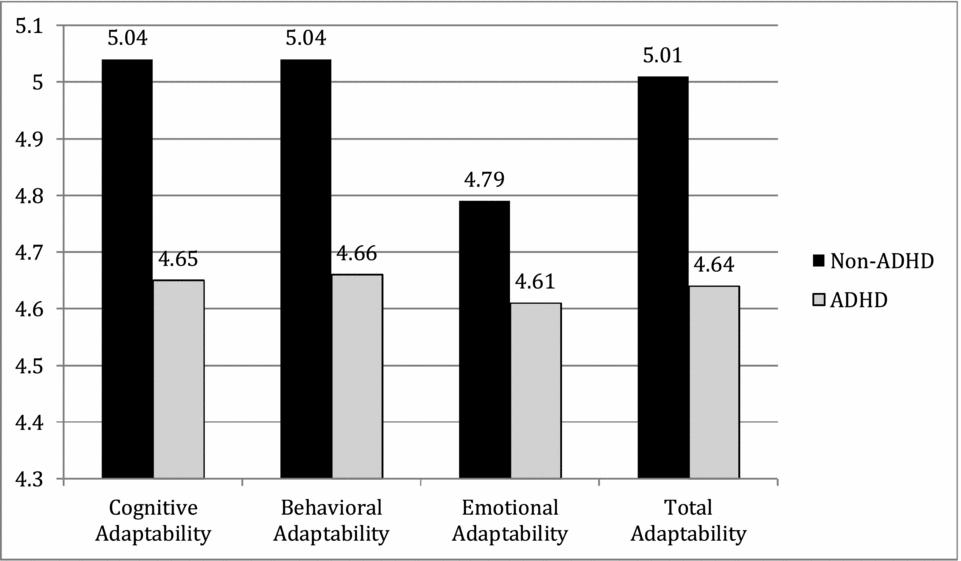
Findings from preliminary analyses are seen in Figure 1. They show that students with ADHD scored lower on all adaptability factors. When testing for statistical significance using paired samples t tests, results show ADHD students are significantly lower than non-ADHD students on cognitive adaptability, t(3913) = 4.47, p < .001, d = .39; behavioural adaptability, t(3913) = 4.41, p < .001, d = .39; and, total adaptability, t(3913) = 3.75, p < .001, d = .33. In relation to emotional adaptability, ADHD students were somewhat lower than non-ADHD students, t(3913) = 1.93, p = .054, d = .17, though not quite statistically significant.
Mean Adaptability Scale scores (on a 1 strongly disagree to 7 strongly agree rating continuum) for students with and without ADHD

These preliminary findings are in line with expectations, particularly in relation to cognitive and behavioural adaptability that featured more prominently in the ADHD literature on executive function impairments. Although the trend for emotional adaptability follows that of the other adaptability factors, the marginal significance is in line with the somewhat inconsistent research findings to date. Perhaps most importantly, these preliminary results suggest there is an empirical basis to further investigate the relationship between ADHD and adaptability and the implications of this relationship for the academic and personal outcomes of young people with ADHD. The findings also support the feasibility of developing interventions targeting young people with ADHD that seek to enhance their cognitive, behavioural, and emotional regulation when faced with change, uncertainty, and novelty. Some possible practical approaches for counsellors, psychologists and educators are now discussed.
Current ADHD Interventions of Relevance to Adaptability
As it stands, there are numerous forms of ADHD intervention. Most researchers and clinicians tend to agree that a multidimensional or multimodal approach is best (Anastopoulos, Rhoads, & Farley, Reference Anastopoulos, Rhoads, Farley and Barkley2006; Cunningham, Reference Cunningham and Barkley2006; Cunningham & Cunningham, Reference Cunningham, Cunningham and Barkley2006; DuPaul & Kern, Reference DuPaul and Kern2011; Kewley, Reference Kewley1999; Morris & Mather, Reference Morris and Mather2008; Pfiffner, Barkley, & DuPaul, Reference Pfiffner, Barkley, DuPaul and Barkley2006; Purdie et al., Reference Purdie, Hattie and Carroll2002; Robin, Reference Robin and Barkley2006; Travell & Visser, Reference Travell and Visser2006; Young & Bramham, Reference Young and Bramham2012). A multidimensional approach might include not only pharmacological treatment (a common and often effective approach to managing symptoms), but also psycho-social treatment for the individuals in terms of adaptability functions, including: (1) cognition, focusing on inattention, problem solving, and self-reinforcement; (2) behaviour, focusing on hyperactivity and social interaction; and (3) emotion, focusing on anger management, anxiety, and depression (DuPaul & Kern, Reference DuPaul and Kern2011; Morris & Mather, Reference Morris and Mather2008; Young & Bramham, Reference Young and Bramham2012). Whereas pharmacological treatments are often aimed at managing symptoms, the latter treatments are aimed at building skills and strategies the individual can apply in a given domain, be it academic or otherwise. Thus, while pharmacological treatments are successful in reducing symptoms of ADHD, they may not be sufficient to successfully improve the academic and non-academic skills that those with ADHD continue to lack (Safren, Otto, Sprich, Winett, Wilens, & Biederman, Reference Safren, Otto, Sprich, Winett, Wilens and Biederman2005). As such, it may be necessary to also provide treatments that support the development of these skills in combination with approaches such as medication (Anastopoulos et al., Reference Anastopoulos, Rhoads, Farley and Barkley2006; Cunningham, Reference Cunningham and Barkley2006; Cunningham & Cunningham, Reference Cunningham, Cunningham and Barkley2006; Kewley, Reference Kewley1999; Martin, Reference Martin, McInerney, Marsh, Craven and Guay2013b; Pfiffner et al., Reference Pfiffner, Barkley, DuPaul and Barkley2006; Robin, Reference Robin and Barkley2006; Travell & Visser, Reference Travell and Visser2006; Young & Bramham, Reference Young and Bramham2012). In line with the tripartite approach to adaptability, we discuss the current cognitive, behavioural, and emotional interventions that are shown to be successful for young people with ADHD.
Cognitive Interventions
Cognitive interventions that focus on the development of problem solving and attentional skills have shown some promise (Morris & Mather, Reference Morris and Mather2008; Pfiffner et al., Reference Pfiffner, Barkley, DuPaul and Barkley2006; Young & Bramham, Reference Young and Bramham2012). Problem-solving interventions are important for those with ADHD, as problem solving is often an impaired skill. A problem, as defined by Young and Bramham (Reference Young and Bramham2012), “is any life situation or task that requires something to be changed or resolved [in order to] allow a person to function adaptively” (p. 115). Those with ADHD often have difficulty with problem solving due to their inability to look ‘long term’, and as such, often do not see a problem approaching (Barkley, Reference Barkley and Barkley2006; Young & Bramham, Reference Young and Bramham2012). As a result, they often respond impulsively to a problem, rather than planning a more appropriate solution (Barkley, Reference Barkley and Barkley2006; Young & Bramham, Reference Young and Bramham2012). Young and Bramham (Reference Young and Bramham2012) proposed the Five-Stages of Problem Solving as an effective intervention for students with ADHD:
1. Identify and define the problem: focus on teaching the student to distinguish the problem from general anxieties and to determine what they would like to achieve.
2. Generate solutions: focus on brainstorming as many solutions as possible, ranging from possible to probable.
3. Evaluate solutions: determine effort required, examine alternatives, rehearse solutions, practise perspective taking, and challenge cognitive distortions and negative self-talk.
4. Implement chosen solution: as rehearsed during Stage 3.
5. Evaluate success: determine if goal was achieved.
Young and Bramham (Reference Young and Bramham2012) emphasise the importance of a consistent, methodical, and timely application of problem-solving intervention in order to prevent maladaptive cognitive coping strategies. With this consistent support, the student learns to plan solutions rather than respond impulsively, and develops a more positive attitude towards his/her ability to solve a problem.
Improving attention is another essential facet of many ADHD interventions. Attention is a core construct of executive functioning. Its impairment in ADHD leads to an inefficiency in directing attention to appropriate stimuli (Young & Bramham, Reference Young and Bramham2012). These instances of misallocation of attention often cause the student to struggle in academic and social situations (DeRuvo, Reference DeRuvo2009; Hoza et al., Reference Hoza, Waschbusch, Pelham, Molina and Milich2000; Lougy, DeRuvo, & Rosenthal, Reference Lougy, DeRuvo and Rosenthal2007; Young & Bramham, Reference Young and Bramham2012). For example, students with ADHD are less sensitive to social cues, thus leading to higher rates of peer rejection, both inside and outside the classroom (Hoza et al., Reference Hoza, Waschbusch, Pelham, Molina and Milich2000). Similarly, in terms of adaptability, an inability to attend to particular aspects of a changing, uncertain, or novel environment may make it difficult to navigate that environment effectively. Although there are many proposed interventions, the Young and Bramham (Reference Young and Bramham2012) intervention is detailed here. They suggest a combination of both external and internal attentional control:
External control: removing unnecessary visual and auditory stimulation from the environment. For this strategy to be successful, the student must be able to identify distracters and determine how to reduce/eliminate them. For example, if distracted by auditory stimuli, a student may wear headphones; if distracted by visual stimuli, better arrangement of posters and visually stimulating material may occur.
Internal control: learning to develop persistent effort and consistent suppression of internal urges in order to increase motivation and sustained attention. This strategy often employs high intensity reinforcers to encourage sustained focus throughout a task and places an emphasis on task completion. Examples of such reinforcers are goal charts, immediate rewards, and breaks.
Both methods of control require coordination with the school, home, and practitioner in order to create an optimal learning environment. For primary school age students, creating a structured and calm classroom is an important means of increasing attention (DeRuvo, Reference DeRuvo2009). Similarly, adopting beneficial forms of accommodation (e.g., headphones, breaks, written directions, removal from/modified activity) is useful for early interventions that will promote attention and longer-term success (DeRuvo, Reference DeRuvo2009). For high school students, intervention becomes more self-directed as the student is encouraged to take more personal responsibility for his/her actions (Lougy et al., Reference Lougy, DeRuvo and Rosenthal2007). However, collaboration between students and practitioner is still essential, as academic support for complex and difficult schoolwork at the high school level will often be necessary. The teacher–student relationship also plays a critical role in all forms of intervention at both the primary and high school levels (Barkley, Reference Barkley and Barkley2006; Lougy et al., Reference Lougy, DeRuvo and Rosenthal2007; Martin & Dowson, Reference Martin and Dowson2009).
Behavioural Interventions
Behavioural interventions most often focus on minimising a child's off-task and problematic behaviours and increasing their productivity in the classroom and other performance scenarios. Behavioural interventions tend to be most effective when put in place at a young age, before problematic behaviours become entrenched and automatic. DuPaul and Kern (Reference DuPaul and Kern2011) proposed a Three Tier Model as successful early intervention for children with ADHD. The ultimate goal of the Three Tier Model is to use a generalisable method across the classroom, school, and home to minimise or remove problematic behaviours (DuPaul & Kern, Reference DuPaul and Kern2011). The structure of the Three Tier Model is as follows:
• Tier 1: ‘Universal Intervention’. At home, this focuses on effective and thorough parent/carer education of how best to handle and interact with the problem behaviours. At school, this focuses on the entire student body, including creating agreed behavioural expectations for all students and focusing on reward rather than punishment. DuPaul and Kern have found that most behaviours can be minimised at this level.
• Tier 2: ‘Secondary Intervention’. One moves to this tier when the child has been unresponsive to the universal interventions. At home, this focuses on one-on-one coaching to more closely instruct and correct parents/carers on effective behavioural interventions. Similarly, it allows for adjustments for personal problematic situations. At school, this focuses on small group intervention especially during unstructured activity time, such as social skills groups.
• Tier 3: ‘Tertiary Intervention’. One moves to this tier when the child has been unresponsive to universal and secondary interventions. This level of intervention is for a small percentage of children. At home and school, this involves individual assessment of the child's problematic behaviours, as well as their causes and reinforcements. A personal intervention plan is then implemented consistently across home and school settings.
Social skills training is another recommended form of behavioural intervention, as children with ADHD often do not have effective or positive social interactions (Hoza et al., Reference Hoza, Waschbusch, Pelham, Molina and Milich2000; Pfiffner et al., Reference Pfiffner, Barkley, DuPaul and Barkley2006). Such interventions are designed to be engaging and active for the participants so that they receive real-time feedback and enjoy a social learning process (Anastopoulos et al., Reference Anastopoulos, Rhoads, Farley and Barkley2006; Cunningham, Reference Cunningham and Barkley2006). While the effectiveness of social skills training can vary, most studies conclude that with appropriate and consistent application, social skills groups are beneficial; and with a more developed evidence base, hold promise for future directions in behavioural intervention (Pfiffner et al., Reference Pfiffner, Barkley, DuPaul and Barkley2006).
‘Antecedent and consequence interventions’ are also a common form of behavioural intervention in the classroom and home (Morris & Mather, Reference Morris and Mather2008). Antecedent interventions are proactive and preventative, often involving small manipulations of the environment, such as placing the child's desk towards the front and centre of the classroom so that cues and prompts from the teacher can best be delivered (Morris & Mather, Reference Morris and Mather2008). Consequence interventions are more reactionary, often involving a reward or punishment for a particular behaviour. Consequence interventions capitalise on the effectiveness of visual aids for those with ADHD by using reward and target behaviour charts (Cunningham, Reference Cunningham and Barkley2006; Morris & Mather, Reference Morris and Mather2008; Pfiffner et al., Reference Pfiffner, Barkley, DuPaul and Barkley2006; Travell & Visser, Reference Travell and Visser2006). As students grow older, consequence interventions take the form of ‘contingency contracts’, which is an agreement negotiated by the student and parent/carer/teacher that determines rewards and punishments for expected and unexpected behaviour (Morris & Mather, Reference Morris and Mather2008).
Finally, self-management interventions (i.e., antecedent and consequence interventions) aim to transfer the management of behaviours from the teacher and parent/carer to the student (Pfiffner et al., Reference Pfiffner, Barkley, DuPaul and Barkley2006). This method of intervention requires the student to be able to distinguish between on-target and off-target behaviour and adjust behaviour accordingly (Morris & Mather, Reference Morris and Mather2008; Pfiffner et al., Reference Pfiffner, Barkley, DuPaul and Barkley2006). These interventions often begin with a reward-based system, where the teacher/parent/carer rates the child's behaviour (Morris & Mather, Reference Morris and Mather2008; Pfiffner et al., Reference Pfiffner, Barkley, DuPaul and Barkley2006). Over time, these ratings become less frequent as the child learns to judge behaviour and determine his/her own reward. Quality of the child's judgment is maintained with random matching tests, in which the teacher/parent/carer compares their rating with that of the child's (Morris & Mather, Reference Morris and Mather2008). These interventions require consistent application and reinforcement over all environments so that the child becomes accustomed to the expected behaviours for each setting (Pfiffner et al., Reference Pfiffner, Barkley, DuPaul and Barkley2006). Progressively, the responsibility of the student increases as they become more cognisant of their control over their behaviours and responses to a situation or task.
Emotional Interventions
Emotional interventions often focus on the emotional symptoms of the comorbidities of ADHD, rather than ADHD itself. These interventions generally focus on comorbid anxiety disorders, depression, and oppositional defiant disorder (Pliszka, Reference Pliszka2009). Each of these emotional interventions is typically implemented in interpersonal therapy and begins with psycho-education, in which the therapist explains what happens physically, cognitively, and behaviourally when these emotions are experienced at normal and excessive levels (Young & Bramham, Reference Young and Bramham2012). Emotional interventions often involve challenging negative thoughts and perceptions, reframing situations, and changing and managing behaviours (Young & Bramham, Reference Young and Bramham2012). These interventions generally involve a form of daily diary or log to help the individual track when these emotions are triggered, as well as their cognitive and behavioural responses. Over time, the child learns to assert positive alternatives to these negative emotions in order to respond more effectively to the situation (Young & Bramham, Reference Young and Bramham2012).
Emotional interventions may also place an emphasis on relaxation practices. Due to the highly somatic response to anxiety, depression and anger, the child often describes feeling ‘out of control’ (Young & Bramham, Reference Young and Bramham2012). For these interventions to be successful in the moment, the child must be able to relax in order to engage with the strategies they have learned in therapy. Two popular forms of strategy are breathing exercises and progressive muscle relaxation (Young & Bramham, Reference Young and Bramham2012). Both combine physical relaxation and calming visualisation. For example, when practising deep breathing, the child is asked to visualise his/her body sinking into a further state of relaxation with every breath. Similarly, while the child moves through stretching and relaxing each large muscle group, he/she is asked to imagine a tranquil place, such as a beach or forest (Young & Bramham, Reference Young and Bramham2012). Ideally, each relaxation strategy is practised for 10 minutes daily, so that it becomes a familiar process (Young & Bramham, Reference Young and Bramham2012). The relaxation strategies not only reduce the physical stress, but also help the child to focus on their internal state and separate themselves from the external issue (Young & Bramham, Reference Young and Bramham2012). Being able to engage in these relaxation strategies may be useful for the success of emotional regulation that is a salient factor in adaptability.
Direct Adaptability Intervention
In addition to cognitive, behavioural and emotional interventions that seek to target subcomponents of adaptability, other recent advice building on resilience interventions may also be helpful. Adapting some of the resilience work by Rutter (Reference Rutter1987) and Morales (Reference Morales2000), Martin and colleagues (Reference Martin, Nejad, Colmar and Liem2013) have proposed a series of steps a student can engage to help them deal with change, uncertainty and novelty. The process is as follows:
1. The student is taught how to recognise change, uncertainty, and novelty that require adaptability.
2. The student adjusts his or her cognition, behaviour, and/or emotion.
3. This adjustment helps the student deal with the change, uncertainty, or novelty.
4. The student recognises the yield of this psycho-behavioural adjustment.
5. There is ongoing implementation of cognitive, behavioural, and/or emotional adjustment.
Clearly, Step 2 is the most critical and is the essence of adaptability. According to Martin (Reference Martin, Street and Porter2014a), ways students might adjust their cognition/thinking include:
• thinking about an uncertain or new situation in a different way (e.g., they might think about the opportunities this new situation might create);
• adjusting expectations or assumptions at a time of transition (e.g., they may assume that change is not necessarily a ‘bad’ or undesirable thing).
Ways students might adjust their behaviour include:
• seeking out new or more information, help and resources (e.g., they might ask a teacher to recommend some further reading for a new topic);
• taking a different course of action (e.g., they might reorganise their study timetable based on new assessment announced that day).
Ways students can adjust their (positive and negative) emotions include:
• minimising negative emotions (such as frustration, disappointment, fear or anger) when the situation changes (e.g., they may choose to not focus on disappointment when an enjoyable activity is cancelled);
• drawing on fun and curiosity when a situation changes (e.g., they can focus on the fun or intriguing aspects of a new activity);
• managing excitement (e.g., they might strive to keep a ‘level head’ when in a winning or fluid position in a task or event).
It is interesting to note that recent research has identified the role of control in the adaptability process (Martin, Nejad, Colmar, & Liem, Reference Martin, Nejad, Colmar and Liem2014). It appears that adaptable students take steps to seize control in situations of change, uncertainty, novelty, and transition. Unfortunately, control is an executive function with which ADHD students struggle (Barkley, Reference Barkley and Barkley2006). In terms of intervention, it is important to emphasise the factors that are in students’ control. These include: effort — how hard they work (quantity of effort); strategy — the way they work (quality of effort); and attitude — what they think of themselves, the task and the teacher (Martin, Reference Martin2010). The more young people focus on these factors, the more in control they are likely to feel. Alongside this, it is also important to dissuade students from focusing on things such as good or bad luck, good or bad teaching, and easy or hard test questions. These factors are not in their control and excessive focus on them will diminish their sense of empowerment and, potentially, their consequent capacity to adapt.
Additional Intervention Considerations
When applying these cognitive, behavioural, and emotional interventions, in potential combination with adaptability interventions, it is worth also recognising operational elements found to optimise the effectiveness of these interventions for students with ADHD. Regularity and consistency, for example, are of vital importance for both the effectiveness of the intervention itself and for the ADHD student (Pfiffner et al., Reference Pfiffner, Barkley, DuPaul and Barkley2006). This is not to suggest that the nature of the tasks given to the child become mundane, which may increase off-task behaviour; rather, the time and length of the intervention remains routine over the course of a week (Pfiffner et al., Reference Pfiffner, Barkley, DuPaul and Barkley2006). In addition, consistency across home and school is also suggested by researchers (DuPaul & Kern, Reference DuPaul and Kern2011; Kewley, Reference Kewley1999; Travell & Visser, Reference Travell and Visser2006). Increased and frequent communication between the home and school is necessary for effective progress (Pfiffner et al., Reference Pfiffner, Barkley, DuPaul and Barkley2006). Similarly, family-oriented training about ADHD is necessary for success for both the child and the family. Parents/carers who are more informed are better equipped to handle the child's behaviour at home and are also reported to be less stressed (Anastopoulos et al., Reference Anastopoulos, Rhoads, Farley and Barkley2006; Robin, Reference Robin and Barkley2006; Travell & Visser, Reference Travell and Visser2006). Similarly, parents/carers who are well informed of the nature of the condition and their child will be able to more effectively implement the programs (behavioural, reward, adaptability, and so on) designed by the practitioner, thus increasing the efficacy of intervention.
Tangible and credible rewards are another feature to which those with ADHD respond well (Parker et al., Reference Parker, Majeski and Collin2002; Pfiffner et al., Reference Pfiffner, Barkley, DuPaul and Barkley2006). Immediate or short-term rewards are often more enticing than long-term rewards to those with ADHD (Barkley et al., Reference Barkley, Edwards, Laneri, Fletcher and Metevia2001). While it is important to not diminish the value of the long-term benefits and goals of adaptability intervention, combining the cycle with a more immediate reward or sticker chart could be beneficial for a child with ADHD. It can make concrete a sometimes abstract concept and enable the student to actively track his/her progress over time (Pfiffner et al., Reference Pfiffner, Barkley, DuPaul and Barkley2006). Breaking down the process is also an effective delivery method that helps to minimise difficulties with executive functioning (Pfiffner et al., Reference Pfiffner, Barkley, DuPaul and Barkley2006). As the complexity and length of a task increases, the demands on executive functioning increase, making it more likely for a student with ADHD to lose track in the task (Barkley, Reference Barkley and Barkley2006). However, by breaking down the process step by step and reviewing what is expected of the individual, they are more likely to succeed. This is also an area in which visual reinforcements and guides may be effective (Martin, Reference Martin2010).
Conclusion
Adaptability comprises cognitive, behavioural, and emotional regulation that assists the individual to effectively respond to change, uncertainty, and novelty. Students with ADHD have known impairments with regulatory functions and thus may be at a distinct disadvantage with respect to adaptability. Indeed, preliminary data presented here suggests as much, with particular deficits in cognitive and behavioural regulation, as well as overall adaptability. Identifying the conceptual and empirical dimensions of adaptability deficits among students with ADHD lays a foundation for counselling, psychological and educational practice aimed at enhancing the capacity of students with ADHD to more effectively navigate their ever-changing world.
Acknowledgments
Thanks are extended to Brad Papworth, Harry Nejad, Farideh Nejad, and Marianne Mansour for data collection and data entry, Gregory Liem for data management, Susan Colmar for early conceptual input, the Australian Research Council for funding, and participating schools and students.