Introduction
The 1994 Rwandan genocide sparked a new era of violent instability in Eastern Democratic Republic of Congo (DRC), leading to years of protracted violence involving both foreign and national militaries as well as local militia groups. The war has resulted in an estimated 5.4 million deaths,1 making it the deadliest conflict since World War II. In addition, millions of people have been displaced from their homes, with many being forced to seek asylum in neighboring countries.
The war in Eastern DRC officially ended in 2003, and a new government was elected in 2006. However, the violence and insecurity continue, particularly in Eastern DRC, where armed militias exert local political influence in the largely un-policed region. Although ethnic violence between tribal groups has been responsible for many deaths, competing interests, and varying agendas continue to fuel the conflict. These include control of the DRC mineral reserves, which has now emerged as a major driving force for much of the violence. Sexual violence, used as a strategic weapon of war, has been one of the most devastating aspects of the armed conflict in DRC.2–9 While sexual violence has been a known feature of armed conflict throughout history,Reference Brownmiller10 the scale and extent of sexual violence in Eastern DRC is unprecedented. Mass rape requires opportunity and thrives in an environment of impunity with the practice widespread in the provinces of North and South Kivu. Such systematic sexual violence destabilizes communities and threatens the personal dignity of its survivors.Reference Gingerich and Leaning11 Its persistence is regarded as an impediment to achieving peace and stability in Eastern DRC.
The incidence of sexual violence in Eastern DRC has been challenging to estimate accurately. In 2011, a nationally representative household survey estimated that 1.69 to 1.80 million Congolese women had been raped in their lifetime and 407,397 to 433,785 women reported having been raped over the preceding 12 months.Reference Peterman, Palermo and Bredenkamp12 A 2010 cross-sectional, population-based, cluster survey in Eastern DRC estimated that 39.7% of women and 23.6% of men had lifetime experiences of sexual violence.Reference Johnson, Scott, Rughita, Kisielewski, Asher and Ong13
Panzi Hospital, in the capital city of Bukavu, serves as a major referral hospital for South Kivu Province. It offers services in obstetrics/gynecology, pediatrics, internal medicine, surgery, dentistry, and nutrition. Although it is a full service 334-bed medical facility, Panzi Hospital has become known for its care of sexual violence survivors and receives approximately 10 new survivors daily under the center's Victims of Sexual Violence Program.14 The Victims of Sexual Violence Program provides rape survivors with free medical treatment and free psychological and spiritual care in addition to socio-economic assistance.
Given the security and logistical constraints of working in Eastern DRC, it has been difficult to collect rigorous data regarding the ongoing sexual violence epidemic. Even less data exists on the evolution of sexual violence patterns over the years. To help address this question, researchers from the Harvard Humanitarian Initiative, in collaboration with Panzi Hospital staff, performed a retrospective cohort study of sexual violence survivors presenting to Panzi Hospital between 2004 and 2008 inclusive. This study aimed to: (1) establish overall frequency in number of reported sexual assaults throughout the five years; (2) determine if peak reports of sexual violence coincided with known military campaigns in Eastern DRC; and (3) describe the types of violence and types of perpetrators as a function of time.
Methods
This study was a retrospective, descriptive registry-based evaluation of female sexual violence survivors. The study was performed at Panzi Hospital. Individual women were chosen for interview based on staff availability and perceived severity of trauma. The interviews were conducted in private by trained female health providers using a two-paged, semi-structured questionnaire. The questionnaire asked basic demographic information and then allowed the patient to describe her sexual violence experience in an open, self-reporting narrative.
Between November 2007 and April 2009, researchers reviewed a total of 4,311 interview records. This number represents all women who were interviewed under the Victims of Sexual Violence Program from 2004 through 2008. In each year, approximately half of all survivors presenting to the hospital were interviewed. Therefore, over the five-year period, another 4,709 women accessed post-sexual violence care at Panzi Hospital, but because of staffing limitations did not undergo the in-depth interview.
For each questionnaire, a single sexual violence experience was recorded and this experience was the most recent sexual assault prompting the woman to seek medical attention. The dataset included 4,311 sexual assaults.
Data were entered into a Microsoft Excel 2004, Version 11.5.5 spreadsheet (Microsoft Corp., Redmond, Washington, USA) and quality assurance checks were performed. Quantitative analysis was performed using STATA (Statistical Software: Release 10.0, Stata Corporation, College Station, Texas, USA). This study was approved by the Institutional Review Board at the Harvard School of Public Health and by the Medical Director of Panzi Hospital.
For the purposes of this study, “sexual violence” was defined as any unwanted physical contact of a sexual nature. “Gang rape” was defined as sexual violence committed by two or more assailants. “Sexual slavery” was defined as being held captive for the purpose of sexual violence for more than 24 hours. Combined “gang rape and sexual slavery” was used to describe any assault that constituted both gang rape and sexual slavery as defined above. “Rape Not Otherwise Specified” (rape NOS) was taken to be sexual violence committed by a single assailant and not involving sexual slavery. It was also used to describe a sexual assault in which the survivor simply stated that she was raped without providing any further details. “Other” included rape in the presence of family members, forced rape between victims, anal penetration, forced oral sex, sexual harassment, forced to undress, forced rape between victims and insertion of foreign objections into the vagina.
For this analysis, perpetrators were classified into three categories: (1) “Non-Specified” referred to those perpetrators simply identified as being assailants without further identifying information; (2) “Armed combatants” were perpetrators referred to as soldiers or assailants in military uniform without specified military affiliation, and also refers to those perpetrators identified as belonging to a specific military group; and (3) “Civilian” referred to perpetrators clearly identified by the survivor as non-combatants according to their dress (wearing civilian clothes), by their familiarity to the survivor (e.g., boy next door) or by their role within society (e.g., driver or vendor in the market).
Results
Demographics of sexual assault survivors interviewed at Panzi Hospital from 2004 through 2008 include a mean age of 35 years, 53% were married, and 59% were illiterate. Agriculture was the most common source of livelihood (74%).Reference Bartels, Scott, Leaning, Kelly, Joyce and Mukwege15 The majority of women self-identified with the Bashi tribe (65%). The educational status,16,17 occupations18 and ethnicities17 reflected the demographics of women in South Kivu Province.
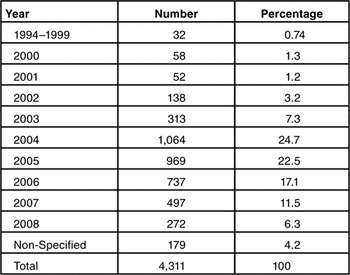
The reported attacks extended back as far as 1994 with <1% occurring in the 1990s. The highest number of reported attacks within this database occurred in 2004, and the reported number of assaults among women interviewed steadily decreased between 2004 and 2008 (Table 1). A small percentage of the sexual assaults occurred between 1994 and 1999 inclusive and are reported together for the purpose of this analysis.
Reported year of sexual assault among sexual violence survivors presenting to Panzi Hospital

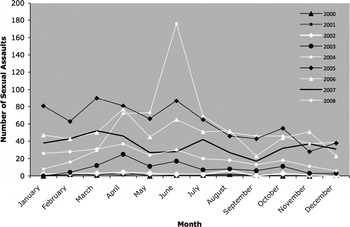
Thirty-four percent of sexual violence survivors did not report the month that the sexual assault occurred. Among those who did report the month of attack, there was a significant increase in the number of reported sexual assaults in June of 2004 (Figure 1). Smaller spikes in reported cases of sexual violence were noted in April 2004, March 2005, June 2005, and April 2006.
Number of reported sexual assaults by month and year

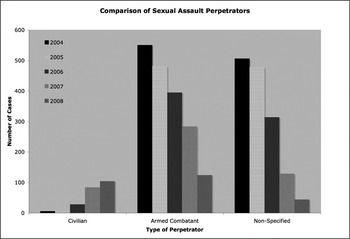
A comparison of types of perpetrators in 2004 with types of perpetrators in 2008 revealed significant differences. As illustrated in Figure 2, there was a 17-fold increase in the number of reported civilian perpetrators between 2004 and 2008 (p <0.0001). During the same time period, the number of rapes reportedly perpetrated by armed combatants decreased by 77% (p = 0.086), and the number of rapes reportedly perpetrated by non-specified perpetrators decreased by 92% (p <0.0001). Despite the reported increase in civilian perpetrators over the five-year period, armed combatants were still the predominant perpetrators in 2008 (52% in 2004 vs. 46% in 2008). Of all rapes reported for 2004, fewer than 1% were perpetrated by civilians versus 38% of all rapes reported in 2008.
Comparison of sexual assault perpetrators reported by survivors presenting to Panzi Hospital according to year of assault

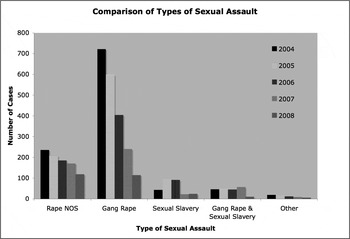
Figure 3 demonstrates differences in the reported types of sexual assaults committed in 2004 as compared with 2008. Within that time period, there was a 50% decrease in the total number of reported rapes NOS (p <0.0001), a 44% decrease in the total number of reported sexual slaveries (p = 0.001), an 84% decrease in the total number of reported gang rapes (p <0.001) and a 78% decrease in the total number of reported assaults that involved both gang rape and sexual slavery (p = 0.635).
Comparison of types of sexual violence between 2004 and 2008. “Other” includes rape in the presence of family members, forced rape between victims, anal penetration, forced oral sex, sexual harassment, forced to undress, forced rape between victims and insertion of foreign objections into the vagina or rectum

Discussion
Trends over time suggest that the total number of women presenting to Panzi Hospital requesting post-sexual violence care declined between 2004 and 2008. This trend was also reported by Malteser, an NGO providing post-rape services in South Kivu.Reference Steiner, Benner, Sondorp, Schimitz, Mesmer and Rosenberger7 The reduced number of reported sexual assaults between 2004 and 2008 may represent an actual decrease in the amount of sexual violence being committed in South Kivu during that time. This decrease, if real, may reflect a general decrease in the levels of military violence within the region. However, given that there are significant delays between sexual assault and time of presentation,Reference Steiner, Benner, Sondorp, Schimitz, Mesmer and Rosenberger7,Reference Bartels, Scott, Leaning, Mukwege, Lipton and VanRooyen19,Reference Bartels, VanRooyen, Leaning, Scott and Kelly20 it is expected that the numbers of reported cases for later years will increase as women continue to access care up to several years following the sexual violence. It is uncertain whether the trend will hold once these delays are taken into account. The decline in number of reported sexual assaults could also arise because fewer women sought care at Panzi Hospital in the later years studied. This is one of the important limitations of data derived from a hospital registry.
Despite the above downward trends, there is recent evidence that the number of sexual assaults again increased in 2009 during the joint Rwandan-Congolese military offensive against the Forces Démocratiques de Libération du Rwanda (FDLR).21,22 However, the current study does not include that time period.
To explore the relationship between reported rapes in South Kivu and the region's militarization, the number of reported sexual assaults by month and year were studied. This number was compared with documented military offensives for the area; several of the peaks in reported sexual assault numbers could be explained by a military strike or an intensification of military activity. For instance, there was a significant increase in the number of reported rapes for June 2004. In early June 2004, Laurent Nkunda and his troops seized control of Bukavu, claiming that they were protecting ethnic Congolese Tutsis from genocide.23 During the attack on Bukavu, there was a significant increase in the number of sexual assaults in the region with some reports that as many as 16,000 women were raped in a single weekend.Reference Scwabe24 This military advance likely contributed to the dramatic increase in the number of sexual assaults reported to have occurred in June 2004. Similarly, there was an increase in the number of reported sexual assaults in April 2004 coinciding with a known clash between Congolese government troops and Rwandan Hutu rebels near Bukavu.25 During this clash, rebels were reported to have attacked villagers as they retreated, and this may explain the increased number of reported rapes in April 2004.
From previous work, it is known that military perpetrators are more likely to commit gang rape and sexual slavery.Reference Bartels, VanRooyen, Leaning, Scott and Kelly20,Reference Bartels, Kelly, Scott, Leaning, Mukwege and Joyce26,Reference Bartels, Scott, Mukwege, Lipton, VanRooyen and Leaning27 The number of reported gang rapes was highest in 2004 (Figure 3), coinciding with the peak in military activity during the five years captured in this dataset. The drop in the number of gang rapes between 2004 and 2008 may therefore be a reflection of decreases in the number of military offenses during the later years.
It is also known from previous work that civilian perpetrators are more likely to commit rape NOS.Reference Bartels, VanRooyen, Leaning, Scott and Kelly20,Reference Bartels, Kelly, Scott, Leaning, Mukwege and Joyce26,Reference Bartels, Scott, Mukwege, Lipton, VanRooyen and Leaning27 Thus, the rise in number of civilian perpetrators demonstrated in Figure 2 may help explain why the decrease in number of rapes NOS between 2004 and 2008 is so much smaller (50%) in comparison to the decrease in the number of reported gang rapes (84%).
This hospital-based data suggests that the instances of civilian rape are on the rise in South Kivu. The results of this study support concerns that a kind of “normalization” of sexual violence among the community has occurred as a result of widespread rape during the conflict. Other studies note that the number of rapes committed by civilians in DRC is increasing,9,28 and local community members in South Kivu also report increasing numbers of civilian perpetrated rape.29 In focus groups, Congolese men acknowledged that rape had become a norm for young males who had grown up during the conflict in Eastern DRC.29 Many of these men also carefully stress that sexual violence was not a Congolese problem until foreign militias introduced it during the conflict.29 Congolese women similarly report their experiences of increased numbers of rape by local community members since the beginning of the war.29 At least some of these civilian perpetrators are thought to be demobilized combatants, who were reintegrated into society without adequate rehabilitation.Reference Solhjell30 Further study is needed to investigate this potential trend of increased civilian rape, to identify the extent to which demobilized combatants are responsible, and to determine the impact of the military rape epidemic on the valuation of women within Congolese culture.
Limitations
This study has a number of limitations. First, its retrospective nature prevented clarification of data inconsistencies and prohibited the completion of missing data. The nature of the original information and the manner in which it was collected also cannot be verified or validated.
Second, this study was limited by its sampling methodology. Because the data represent only those sexual violence survivors who presented to Panzi Hospital for post-sexual violence care, there is an inherent selection bias. The sampling within Panzi Hospital was also a limitation. The Victims of Sexual Violence Program was sporadically understaffed; at times there were an insufficient number of trained interviewers to interview all presenting survivors. During these times of understaffing, the interviewers chose for interview those women whom they believed to have experienced the most traumatic violence, based on interactions during the triage process. No discernible patterns in the data registry gaps at Panzi Hospital were detected. Rather, the gaps appeared to have arisen sporadically based on irregular staffing of the Victims of Sexual Violence Program. It is possible that the sexual violence survivors presented here have in fact experienced the most severe violence. However, it would be challenging to determine at first glance during the registration process which women had suffered the most severe trauma.
A third limitation of this study was the open, self-reporting format. Without asking specific questions regarding types of perpetrators, types of sexual violence and other assault characteristics, the database has recurrent gaps, reflecting what the women chose to volunteer. And finally, several translations were required before the analysis of these data, thus introducing potential errors. Additionally, cultural differences have the potential to introduce error. To limit the latter potential source of error, results were discussed with local Panzi Hospital staff, who provided cultural background and context.
Conclusions
After more than a decade of conflict in South Kivu, civilian rape may be a common feature of daily life. If civilian perpetrated sexual violence is truly on the rise, communities will have to rebuild social mechanisms that prevent sexual violence and work to effectively punish those who do rape. Sexual violence laws will need to be fully enforced, and justice will need to be accessible for survivors. It will also be important to create the capacity to investigate and prosecute crimes against women within Eastern DRC, including the incorporation of trained female officers into investigation teams. Proper rehabilitation and reintegration of ex-combatants may also be an important step towards reducing civilian rape in Eastern DRC.
Acknowledgments
We thank the staff of Panzi hospital that provides frontline care to survivors of sexual violence. Without their hard work and support of the Victims of Sexual Violence Program, this research project would not have been possible. We are indebted to Oxfam America who generously supported this research. Thank you to our local data entry personnel, as well as to Sadia Haider and Julie VanRooyen who offered research support. We are also grateful to PMU InterLife (The Swedish Pentecostal Mission Relief and Development Cooperation Agency), who funds the Victims of Sexual Violence Program at Panzi Hospital.
Conflict of Interest
The authors declare that they have no competing interests.
Author's Contributions
S.B. extracted, entered and helped to analyze the data. S.B also aided in preparing the manuscript. J.S. extracted and entered the data and helped with writing the manuscript. J.L. guided analysis of the data and helped write the manuscript. J.K. provided administrative assistance throughout the project, aided data entry and helped with manuscript preparation. D.M. provided help with extracting and entering the data, provided important context and background for the discussion and critiqued the manuscript. N.J. performed the analysis and reviewed the manuscript. M.V. helped design the study, guided analysis and helped prepare the manuscript.
Abbreviations:
DRC = Democratic Republic of Congo
FDLR = Forces Démocratiques de Libération du Rwanda
MSF = Médecins sans Frontières
NOS = Not Otherwise Specified
UN = United Nations