1. Introduction
The Early Palaeozoic is a critical period in the history of Life, which saw the rise of macroscopic animals (metazoans) and their organization into increasingly complex ecosystems (e.g. Bambach, Bush & Erwin, Reference Bambach, Bush and Erwin2007; Erwin et al. Reference Erwin, Laflamme, Tweedt, Sperling, Pisani and Peterson2011). Our understanding of this early evolution of metazoan communities has benefited greatly from the study of exceptionally preserved biotas, for they provide a substantially enhanced window on the composition of ancient ecosystems compared with the shelly fossil record (Conway Morris, Reference Conway Morris1986). However, the picture depicted by these exceptional fossil assemblages remains severely impeded by their uneven distribution through the Early Palaeozoic (Allison & Briggs, Reference Allison and Briggs1993). This is particularly true for the late Cambrian Epoch, a time interval lying between the Cambrian Explosion and the Great Ordovician Biodiversification Event, for which no diverse macroscopic ‘soft’-bodied fauna was known until the discovery of the Weeks Formation fauna (Utah, USA). Dominated by arthropods and ‘worms’ (e.g. palaeoscolecids, priapulids; Lerosey-Aubril et al. Reference Lerosey-Aubril, Hegna, Babcock, Bonino and Kier2014), this exceptionally preserved fauna of late Guzhangian age represents a unique window on the evolution of animal life during late Cambrian time. For a long time, Beckwithia typa Resser, Reference Resser1931 was the only non-trilobite arthropod to have been described from the Weeks Formation (Raasch, Reference Raasch1939; Hesselbo, Reference Hesselbo1989). This taxon is closely related to aglaspidids (Ortega-Hernández, Legg & Braddy, Reference Ortega-Hernández, Legg and Braddy2013), a group of arthropods mostly known from slightly younger (Furongian) strata (Lerosey-Aubril et al. Reference Lerosey-Aubril, Ortega-Hernández, Kier and Bonino2013). More recently, the occurrences of Anomalocaris (Lerosey-Aubril et al. Reference Lerosey-Aubril, Hegna, Babcock, Bonino and Kier2014), a genus previously known from older Konservat-Lagerstätten (e.g. Chengjiang, Burgess), and the Ordovician-type aglaspidid Tremaglaspis (Lerosey-Aubril et al. Reference Lerosey-Aubril, Ortega-Hernández, Kier and Bonino2013) were also reported, which highlighted the transitional nature of the fauna. Here I describe a new arthropod from the Weeks Formation with no clear affinities with any known groups of arthropods. This description illustrates the fact that the late Cambrian Epoch was a period of morphological diversification, during which major components of the Palaeozoic Evolutionary Fauna emerged (Zhuravlev, Reference Zhuravlev, Zhuravlev and Riding2001), as well as groups with more limited evolutionary success.
2. Geological setting
The Weeks Formation is a c. 300 m thick succession of carbonates and shales exposed in the central House Range of Utah (USA). This succession accumulated within a fault-controlled trough, which locally developed within the carbonate platform during Cambrian Epochs 2 and 3 (Rees, Reference Rees1986). It conformably overlies the relatively deep-water deposits of the Marjum Formation and is conformably overlain by the shallow-water carbonates of the Orr Formation, thus recording a progressive shallowing (Miller, Evans & Dattilo, Reference Miller, Evans, Dattilo, Derby, Fritz, Longacre, Morgan and Sternbach2012). The Weeks Formation has yielded a rather diverse shelly fauna, which is composed of c. 30 species of trilobites, abundant but less diverse inarticulate brachiopods, and rare hyolithids, sponge spicules and echinoderms (Lerosey-Aubril et al. Reference Lerosey-Aubril, Hegna, Babcock, Bonino and Kier2014 and references therein). It also preserves non-biomineralizing or weakly biomineralizing organisms, which include the new arthropod described herein. Trilobites associated with this exceptionally preserved fauna are indicative of a late Guzhangian age (Cambrian Series 3, Cedaria Zone; formerly ‘late Cambrian’) and an open-marine environment (Robison & Babcock, Reference Robison and Babcock2011).
3. Material and methods
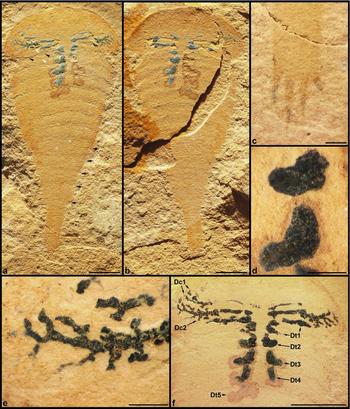
UU14022.01a, b are the part and counterpart of the only specimen available for study. This specimen was collected in an abandoned quarry in North Canyon, House Range, Utah, USA (locality 824 of Robison & Babcock, Reference Robison and Babcock2011), where a c. 20 m thick section within the upper part of the Weeks Formation is exposed. The part and counterpart are composed of the internal mould (UU14022.01a; Figs 1a, c–e, 2a) and external mould (UU14022.01b; Figs 1b, 2b), respectively, of the dorsal exoskeleton of a complete individual that retains the remains of its digestive glands (Fig. 1d–f). The specimen is orientated parallel to the bedding plane and dorsoventrally flattened, except for the digestive structures that are three-dimensionally preserved.
Notchia weugi gen. et sp. nov. from the upper part of the Weeks Formation, upper Guzhangian (Cedaria Zone), House Range, Utah, USA. (a–f) Holotype (UU14022.01a, b), internal and external moulds of the dorsal exoskeleton of a complete dorsoventrally flattened individual with remains of digestive glands; dorsal views with anterior end facing to the top. (a, c–e) Part (UU14022.01a), dry specimen under low-angle light (a) or immersed under ethanol (c–e). (a) General view. Note the posterior margin of the cephalon (black arrow heads), the anterior and posterior margins of T1 (white arrow heads) and tergite boundaries from T8 to telson (black arrows). (c) Detail of telson showing the four terminal spines. (d) Detail of two Dt. (e) Detail of two Dc (distal parts). (b) Counterpart (UU14022.01b), general view, dry specimen under low-angle light. (f) Digestive glands, composite made by superposition of two photographs, one of UU14022.01a and one (mirrored; remains of digestive glands only) of UU14022.01b. Abbreviations: Dc1, 2 – cephalic digestive glands 1 and 2; Dt1–5 – trunk digestive glands 1–5. Scale bars represent 5 mm for (a, b) and (f), 1 mm for (c–e).

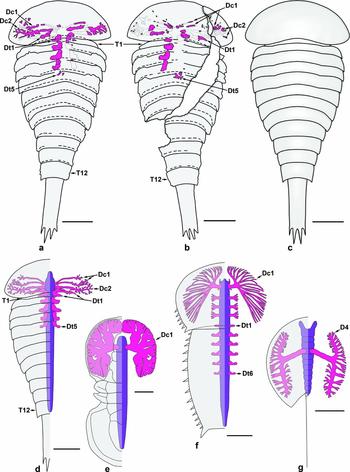
Cambrian arthropods with ramified digestive glands. (a–d) Notchia weugi gen. et sp. nov., upper part of the Weeks Formation, upper Guzhangian (Cedaria Zone), House Range, Utah, USA. (a, b) Interpretative drawings of UU14022.01a (a) and UU14022.01b (b). (c, d) Reconstructions of the dorsal exoskeleton (c) and the digestive system (d); the shape of the digestive tract is hypothetical. (e–g) Reconstructions of comparable digestive systems in other Cambrian arthropods. (e) Acidusus (Agnostida), middle Cambrian, Queensland, Australia (based on Whittington et al. Reference Whittington, Chatterton, Speyer, Fortey, Owens, Chang, Dean, Jell, Laurie, Palmer, Repina, Rushton, Shergold, Clarkson, Wilmot, Kelly and Kaesler1997, fig. 223.2); the shape of digestive glands is inferred from impressions on the exoskeleton only and that of the digestive tract is hypothetical. (f) Naraoia (Nektaspidida), lower Cambrian, Chengjiang, China. (g) Burgessia, middle Cambrian, Burgess Shale, Canada. Abbreviations: D4 – digestive gland associated with the fourth anteriormost appendage-bearing segment; Dc1, 2 – cephalic digestive glands 1 and 2; Dt1, 5, 6 – trunk digestive glands 1, 5 and 6; T1, 12 – trunk tergites 1 and 12. Scale bars represent 5 mm for (a–d), (f) and (g), 1 mm for (e).

The specimen was photographed using a Leica DFC420 digital camera mounted on a Leica MZ12.5 microscope, both under low-angle light and immersed in dilute ethanol. Interpretative drawings and a reconstruction were made from these photos using Adobe Photoshop CS 5. This software was also used to artificially illustrate the remains of digestive structures present on the two parts of the fossil on a single image. This illustration was created by superimposing a mirrored picture of the counterpart on a photograph of the part, aligning the two pictures, and only retaining the image of the remains of the digestive structures on the counterpart. The material replacing the digestive glands was investigated using a scanning electron microscope (FEI Verios 460) equipped with an energy dispersive X-ray module (EDAX). UU14022.01a, b are deposited at the University of Utah, Salt Lake City, USA (UU).
4. Systematic palaeontology
Terminology. The term ‘telson’ is used here instead of ‘tailspine’ to refer to the posteriormost part of the exoskeleton to avoid confusion with the spines that it bears. The shape of the posterior margin of the cephalon is described from sagittal axis to genal angle, using the terms ‘procurved’ and ‘opisthocurved’ where it curves anterolaterally and posterolaterally, respectively (Dunlop & Selden, Reference Dunlop, Selden, Fortey and Thomas1997; Lerosey-Aubril, Ortega-Hernández & Zhu, Reference Lerosey-Aubril, Ortega-Hernández and Zhu2013). Digestive glands are numbered from front to rear and separated into cephalic ones and trunk ones.
Abbreviations. Dc1, 2 – cephalic digestive glands 1 and 2; Dt1–5 – trunk digestive glands 1–5; exs. – exsagittal; sag. – sagittal; tr. – transverse; T1–12 – trunk tergites 1 to 12.
ARTHROPODA von Siebold, Reference Siebold, Siebold and Stannius1848
Class, Order, Family uncertain
Genus Notchia gen. nov.
Type species. Notchia weugi sp. nov. (by monotypy)
Etymology. From Notch Peak, one of the highest peaks in the House Range, which is located c. 10 km SW of the type locality.
Diagnosis. Arthropod characterized by the following unique combination of characters: cephalon particularly short, with opisthocurved medially and procurved abaxially posterior margin, but apparently no dorsal eyes; 12 trunk tergites, with T1 reduced, T2–8 curved backwards abaxially and T9–12 long (sag.) and straight (tr.); telson elongate (sag.), rectangular and with four spines projecting backwards from its posterior tip; two pairs of long (tr.), ramifying cephalic digestive glands.
Discussion. With its short (sag.) cephalon and non-styliform telson, the new genus is somewhat similar to Early Palaeozoic arthropods known as strabopids. The order Strabopida initially included six genera: Lemoneites, Neostrabops, Paleomerus, Strabops and tentatively Caryon and Khankaspis (Hou & Bergström, Reference Hou and Bergström1997). Since then, Caryon, Lemoneites and Neostrabops have been reinterpreted as a trilobite (Ortega-Hernández, Braddy & Rak, Reference Ortega-Hernández, Braddy and Rak2010), a glyptocystitid echinoderm (Moore & Braddy, Reference Moore and Braddy2005) and a cheloniellid arthropod (Dunlop & Selden, Reference Dunlop, Selden, Fortey and Thomas1997), respectively. The extremely poor preservation of the type material of Khankaspis (Repina & Okuneva, Reference Repina and Okuneva1969) precludes detailed comparisons with other Cambrian arthropods. However, study of new photographs of this material makes me believe that Khankaspis best compares with Beckwithia (upper Cambrian, Utah; Hesselbo, Reference Hesselbo1989), both taxa having similarly shaped eyes and a wide and flat cephalic border. Tetlie & Moore (Reference Tetlie and Moore2004) have shown that the early Cambrian Paleomerus possesses 11 trunk tergites like Strabops (upper Cambrian; Beecher, Reference Beecher1901), not 12 as described by Størmer (Reference Størmer1956; see also Orłowski, Reference Orłowski1983). It has also been suggested that the two genera might be synonymous (Jensen, Reference Jensen1990; Van Roy, Reference Van Roy2006), but I consider that they significantly differ regarding their cephalic outlines, the position of their eyes and the shapes of their trunk tergites. Lastly, Parapaleomerus (lower Cambrian, Chengjiang) may also belong to the Strabopida, but unlike Paleomerus and Strabops, it lacks dorsal eyes and only possesses ten trunk tergites (Hou et al. Reference Hou, Bergström, Wang, Feng and Chen1999, Reference Hou, Aldridge, Bergström, Siveter, Siveter and Feng2004).
Notchia gen. nov. is easily differentiated from Paleomerus, Parapaleomerus and Strabops by the morphology of its trunk, which is composed of 12 tergites, with a reduced T1, abaxially curved backwards T2–8 and straight (tr.) T9–12 (Figs 1a, b, 2a–c). All trunk tergites are straight (tr.) abaxially in Paleomerus (Størmer, Reference Størmer1956; Orłowski, Reference Orłowski1983) and Strabops (Beecher, Reference Beecher1901), and they increasingly curve backwards abaxially from T4–10 in Parapaleomerus (Hou et al. Reference Hou, Aldridge, Bergström, Siveter, Siveter and Feng2004). The lateral margins of the trunk also become less convergent backwards from T9–12 in the new genus, while they increasingly converge backwards in Paleomerus and especially Parapaleomerus. The rectangular telson of Notchia gen. nov. (Fig. 1c) notably differs from the trapezoidal telsons of Paleomerus and Parapaleomerus, and the almond-shaped telson of Strabops. Paleomerus and Strabops possess prominent dorsal eyes, which are apparently absent on the specimen from the Weeks Formation. Lastly, the posterior margin of the cephalon is opisthocurved medially and procurved abaxially in the new genus (Figs 1a, b, 2a–c), not straight (tr.) as in Paleomerus.
The new genus is also somewhat reminiscent of the middle Cambrian Sidneyia, both taxa displaying a short (sag.) cephalon and 12 trunk tergites forming two morphologically differentiated regions. The cephalon of Sidneyia was described by Bruton (Reference Bruton1981) as being approximately three times as wide (tr.) as long (sag.), but this has been contested by Stein (Reference Stein2013), who argued that its width (tr.) did not exceed twice its length (sag.); this would represent a notably smaller width/length ratio than in the new genus. The cephalon of Sidneyia also differs from that of the new genus by the presence of lateral notches accommodating antennae and stalked eyes. As to the trunk, Notchia gen. nov. does not display the abrupt narrowing (tr.) at the boundary between anterior and posterior regions observed in Sidneyia, and it shows a different distribution of tergites between these two regions (eight and four tergites, respectively, instead of nine and three in Sidneyia; Bruton, Reference Bruton1981). Lastly, its telson is rectangular, devoid of lateral flaps, and it bears spines, all features distinguishing it from that of Sidneyia. By its shape, it is more comparable to the telson of an arthropod from the lower Cambrian of Chengjiang initially described as a new species of Sidneyia (Zhang, Han & Shu, Reference Zhang, Han and Shu2002; see Briggs et al. Reference Briggs, Lieberman, Hendricks, Halgedahl and Jarrard2008 for a different opinion), but it bears spines instead of flaps along its posterior margin. Compared with the Chinese taxon, Notchia gen. nov. also displays a much shorter (sag.) cephalon, an extra trunk tergite and four, rather than two, tergites in the ‘posterior trunk’.
Notchia weugi sp. nov.
Figures 1, 2
Material, locality, horizon. Holotype (Figs 1, 2), part (UU14022.01a) and counterpart (UU14022.01b) of a complete dorsoventrally flattened individual, composed of the internal mould and external mould of the dorsal exoskeleton, respectively, and phosphatized digestive glands; silty lime mudstone of the upper part of the Weeks Formation, Cedaria Zone, upper Guzhangian, Cambrian Series 3, locality 824 of Robison & Babcock (Reference Robison and Babcock2011), North Canyon, House Range, Utah, USA.
Etymology. In honour of Andries Weug, who donated the holotype specimen to the University of Utah.
Diagnosis. As for the genus.
Description. The holotype is 29 mm long (sag.; telson excluded). Cephalon short (c. 20 % of total body length sag., telson excluded), but wide (maximum width (tr.)/length (sag.) ratio: 2.7), and slightly rotated anticlockwise relative to sagittal axis of anterior part of trunk (Figs 1a, b, 2a, b). Anterolateral margin broadly elliptical in outline. Genal angles rounded. Posterior margin opisthocurved medially, but procurved laterally.
Trunk composed of 12 tergites and a telson, widening (tr.) from T1 to T3, where it reaches its maximum width (c. 90 % of maximum width of cephalon, tr.), but narrowing from T3 to T8 (c. 61 % of maximum width of cephalon, tr.) and more gently from T8 to T12 (c. 32 % of maximum width of cephalon, tr.). Posterior part of trunk from T8 to telson slightly rotated clockwise relative to sagittal axis of anterior part. Tergite boundaries marked by shallow and narrow furrows, becoming particularly faint in posterior part of trunk, and often forming pairs suggesting tergite overlaps; for a given pair, the deeper, but usually discontinuous anterior furrow (dashed lines on Fig. 2a, b), is interpreted as the anterior margin of a tergite concealed under the tergite immediately in front, while the shallower, but more continuous posterior furrow (continuous lines on Fig. 2a, b), is thought to represent the posterior margin of the more anterior tergite. Slight deflections of these furrows suggest a faint differentiation of an axial region anteriorly (T2–6). T1 short (sag.), especially narrow (only c. 60 % of maximum width of cephalon, tr.) and partially concealed under cephalon anteriorly, except on right side due to slight rotation of cephalon. T2–8 all similar to one another, except for a progressive increase in length (reaching 12 % of trunk length sag., tailspine excluded, in T7 and T8) and in rearward curvature of abaxial portions from T2–8. T9–12 almost straight (tr.) and all equal in length (sag.) to T8, except T9 that is c. 25 % longer. Lateral margins straight to slightly convex and posterolateral angles acute, but non-spinose in all trunk tergites. Telson rectangular (width/length ratio: 0.36), c. 35 % longer than cephalon (sag., spines excluded) and bearing four spines projecting backwards from apparently straight (tr.) posterior edge; the two spines located close to sagittal axis sturdier and longer than the two spines inserting abaxially (Fig. 1c).
UU14022.01a and UU14022.01b exhibit three-dimensional remains of paired structures under the posterior part of the cephalon and T1–5 (Fig. 1f), which are preserved in fluorapatite as revealed by EDX analyses. They are comparable in shape, position (along antero-posterior body axis, as well as relative to sagittal axis), distribution (one pair per segment) and preservation to structures repeatedly described in Cambrian arthropods as digestive glands (see Section 5 below). Remains present on both parts have been artificially combined on Figure 1f to facilitate interpretation. This enables the identification of seven pairs of digestive glands (2 Dc, 5 Dt), which decrease in length (tr.) and complexity posteriorly. Dc1 incomplete, but apparently composed of two, particularly thin branches that extend anterolaterally almost to anterolateral margin of cephalon; distal portion of posterior branch (at least) ramifying. Dc2 composed of two branches extending abaxially; anterior branch slightly longer (tr.) than posterior branch of Dc1, giving rise to at least three, apparently paired, secondary branches before ramifying at its distal tip (Fig. 1e); posterior branch short (tr.) and apparently unbranched. Dt1 located at level of cephalon/trunk boundary and composed of two, rather thick branches extending abaxially; anterior branch rather long, approximately half length (tr.) of anterior branch of Dc2, and possibly bearing a pair of tiny secondary branches abaxially; posterior branch approximately three times shorter than anterior branch and unbranched. Dt2–4 approximately similar in shape and position relative to segmentation of dorsal exoskeleton (i.e. slightly shifted forwards relative to tergites; Fig. 1d, f); they are large (exs.) and club-shaped; Dt2 also exhibits a tiny anterolateral extension that slightly overlaps posterior branch of Dt1 (Fig. 1f). Only left Dt5 is represented by patches of apatite on both parts; a reddish halo surrounding them suggests that Dt5 were comparable in shape to Dt2–4.
Remarks. The furrows marking the boundaries between trunk tergites are shallow and therefore difficult to illustrate on a photograph. This is particularly true for the extremely faint posteriormost ones. Likewise, the furrow marking the limit between T1 and T2 is clearly visible on the left side of the body (Fig. 1a), but much less so on the right side, and therefore the presence of two tergites in this region may seem uncertain. However, a careful examination under low-angle light leaves little doubt about the presence of 12 tergites in the trunk. Moreover, the presence of a reduced (tr.) T1 is supported by the distribution of digestive glands. Two pairs of them occur under this part of the trunk (Fig. 1a, b, c) and in my interpretation (Fig. 2a, b, d) their anteriormost portions lie under tergite boundaries (cephalon/T1 and T1/T2), like the anteriormost portions of the succeeding digestive glands.
5. Discussion
Notchia weugi gen. et sp. nov. is an exceedingly rare arthropod in the Weeks Formation, being known from the holotype specimen only, despite the examination of more than 200 exceptionally preserved fossils. This is all the more frustrating given that this taxon displays a unique combination of morphological characters. With its short (sag.) cephalon and non-styliform telson, its general morphology recalls that of strabopids. However, detailed comparisons reveal that it differs from them in many aspects, including the absence of prominent dorsal eyes, the number of trunk tergites, the (weak) differentiation of the trunk into two morphological regions and the shape of the telson. To me, these differences do not support close phylogenetic relationships between Notchia gen. nov. and strabopids, even if I acknowledge that this hypothesis cannot be entirely ruled out. The same is true between Notchia gen. nov. and Sidneyia, the latter taxon displaying clearly differentiated thoracic and abdominal regions, with nine and two/three tergites, respectively (eight and four in the new genus), and a tail fan composed of a telson and lateral flaps. Strabopids and Sidneyia have been frequently discussed in relation to the origin of chelicerates (e.g. Beecher, Reference Beecher1901; Raasch, Reference Raasch1939; Størmer, Reference Størmer1956; Bruton, Reference Bruton1981; Dunlop & Selden, Reference Dunlop, Selden, Fortey and Thomas1997; Stein, Reference Stein2013), but arguments supporting such affinities remain weak (Budd & Telford, Reference Budd and Telford2009). Interestingly, Notchia gen. nov. also displays some features evocative of the morphologies of some chelicerates (i.e. chasmataspidids, eurypterids, synzyphosurines), such as a reduced T1 and an elongate trunk differentiated into two regions (e.g. Lamsdell, Reference Lamsdell2013), but no chelicerates have such a short (sag.) cephalon or a similar number of tergites in each trunk region.
The uniqueness of Notchia gen. nov. is also evinced by the organization of its digestive system. Ramified digestive glands are present in the Cambrian arthropods Burgessia (e.g. Hughes, Reference Hughes1975), Naraoia (e.g. Vannier & Chen, Reference Vannier and Chen2002; Zhang, Shu & Erwin, Reference Zhang, Shu and Erwin2007) and possibly in agnostids (Öpik, Reference Öpik1961; Bergström, Reference Bergström1973), as well as in living limulids, and branchiuran and achelatan crustaceans (e.g. Vannier et al. Reference Vannier, Liu, Lerosey-Aubril, Vinther and Daley2014). However, Notchia gen. nov. is unique in possessing two pairs of such organs (Fig. 2d–g). Additionally, these are associated with simple digestive glands similar to those of trilobites (Lerosey-Aubril et al. Reference Lerosey-Aubril, Hegna, Kier, Bonino, Habersetzer and Carré2012) in the new arthropod, while they are the only type encountered in Burgessia and agnostids (Fig. 2e, g). The ramified digestive glands belong to the first appendage-bearing somite of the cephalon in agnostids and Naraoia and the fourth in Burgessia. The number of cephalic appendage-bearing somites is not known in the new arthropod, but the ramified digestive glands were associated with the two posteriormost ones. In summary, Notchia gen. nov. further illustrates the fact that ramified digestive glands evolved repeatedly in independent arthropod lineages, possibly as an adaptation to infrequent feeding (Vannier & Chen, Reference Vannier and Chen2002). Interestingly, this is the first case of phosphatization of this type of digestive glands, which are usually preserved filled with sediment-like material or more rarely, as carbon or iron oxide films (e.g. Bergström, Hou & Hålenius, Reference Bergström, Hou and Hålenius2007). Whether this unique preservation is the result of a particular physiology, a singular taphonomic pathway or both is unknown.
6. Conclusion
The study of the Weeks Formation fauna carries great significance, for little is known about the evolution of non-biomineralizing metazoans during the late Cambrian Epoch. Previous works (Hesselbo, Reference Hesselbo1989; Lerosey-Aubril et al. Reference Lerosey-Aubril, Ortega-Hernández, Kier and Bonino2013, Reference Lerosey-Aubril, Hegna, Babcock, Bonino and Kier2014) have shown that this fauna contains typical components of older or younger exceptionally preserved biotas, suggesting that it was somewhat transitional. The discovery of Notchia weugi gen. et sp. nov. reveals that this fauna also contains unique taxa. This suggests that the description of the Weeks Formation fauna could significantly contribute to a better assessment of the disparity of soft-bodied metazoans in late Cambrian time.
Acknowledgements
A. Weug donated the specimen described herein to UU. J. Ortega-Hernández and P. Van Roy provided me with photographs of the type materials of Khankaspis and Strabops thacheri, respectively. K. McNamara corrected an earlier draft of this manuscript. J. Ortega-Hernández and an anonymous referee provided constructive comments. All of these people are thanked for their generous help. This work was funded by the Agence National de la Recherche (grant number ANR RALI).