INTRODUCTION
Since the 1980s, interpretations of Early Bronze Age burial practices have been dominated by discussions of chronology, memory, and temporality (Braithwaite Reference Braithwaite1984; Thorpe and Richards Reference Thorpe and Richards1984; Garwood Reference Garwood2007:31; Garrow et al. Reference Garrow, Meadows, Evans and Tabor2014:208). Garrow et al. (Reference Garrow, Meadows, Evans and Tabor2014:209) and Garwood (Reference Garwood2007:49) note that much previous work on the investigations of memory and temporality in Early Bronze Age cemeteries are too abstract and uncritically speculative to be seriously accepted. Bayesian modeling has been used to enhance chronologies of Neolithic monuments and practices (Whittle et al. Reference Whittle, Barclay, Bayliss, McFadyen, Schulting and Wysocki2007, Reference Whittle, Healy and Bayliss2011), effectively revolutionizing chronologies in the period and providing a level of resolution in some cases equivalent to human generations. While Bayesian modeling has not been as widely used for the Bronze Age, the method has a lot of potential to improve understanding of Bronze Age burial grounds.
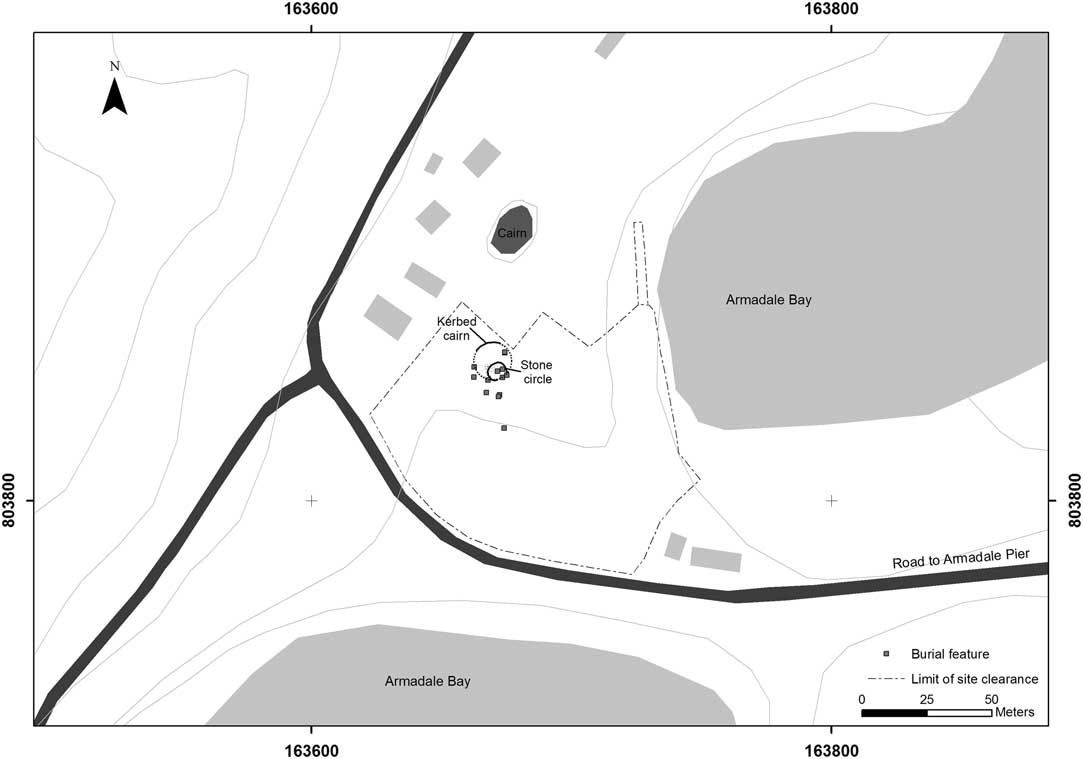
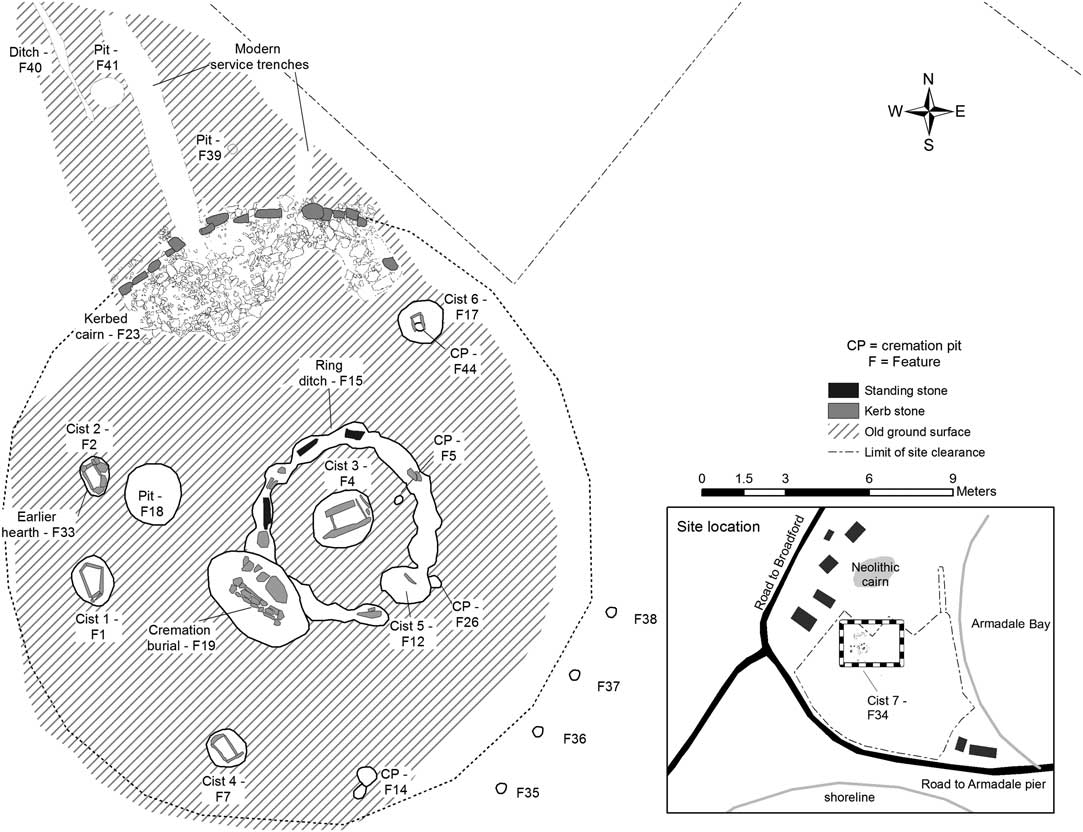
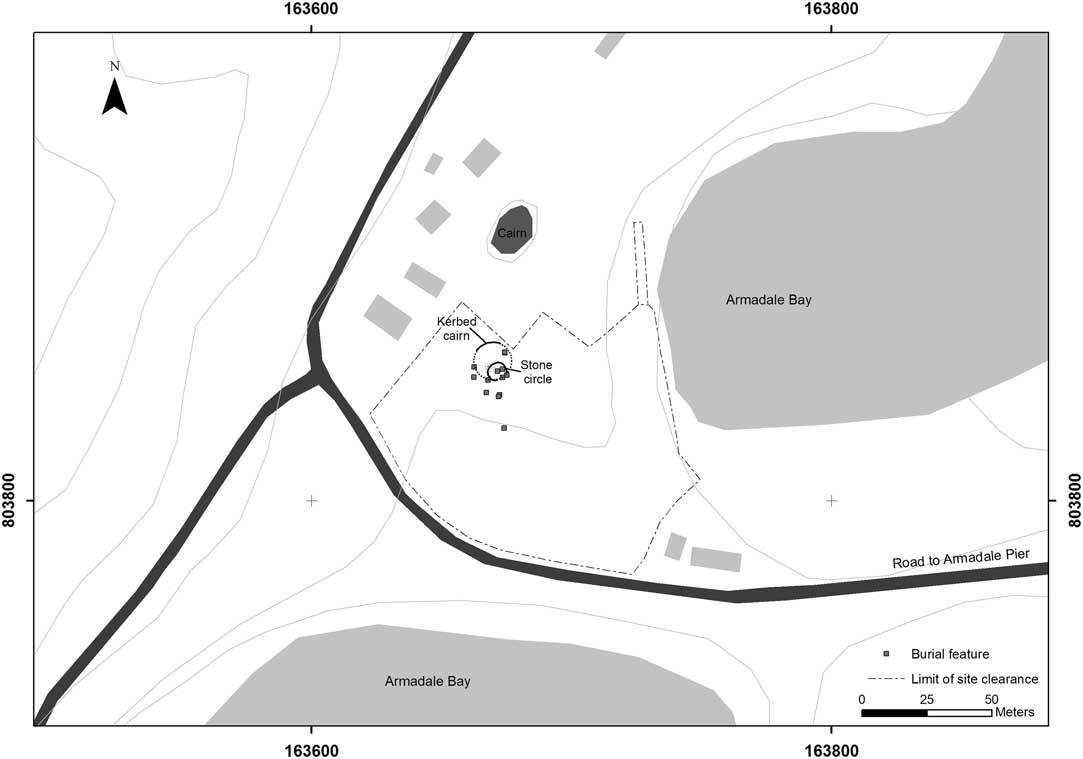
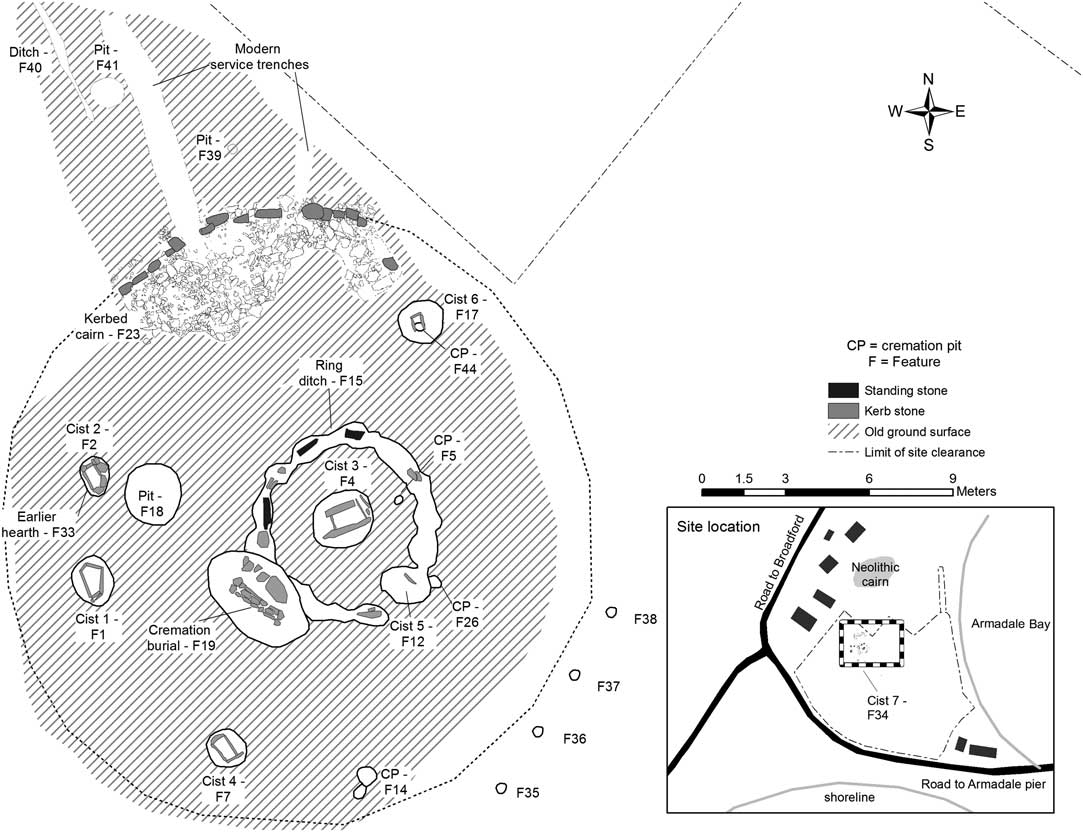
One such burial ground, Armadale (Figure 1), is located at the southern end of the Sleat Peninsula, Isle of Skye, on the west coast of Scotland, on a spit of shingle beach situated approximately 50 m south of a Neolithic chambered cairn. The settlement is in a prominent location, as it would have been observable by sea travelers entering the Sound of Sleat from the Atlantic. Excavations at Armadale in 2009–2010 encountered a dismantled stone/post circle consisting of a ring of interconnected pits with three standing stones, seven cists, pits containing cremation burials, and the remains of a kerbed cairn that had probably sealed the main burial ground (Figure 2). The cists contained both cremated and inhumed remains while the pits contained cremated remains.
Armadale location plan
Armadale excavation plan
A mixture of grave good types were identified, specifically: (1) three complete Food Vessel pots and sherds belonging to a fourth incomplete vessel; (2) a group of three flint arrowheads, a plano-convex flint knife, and a double-edged flint knife; (3) half of a barbed and tanged flint arrowhead; and (4) a fragment of a stone wrist guard that had been reused as a pendant (Saville Reference Saville2011; Sheridan Reference Sheridan2011a, Reference Sheridan2011b). Diagnostic artifacts are largely Early Bronze Age forms (Peteranna Reference Peteranna2011; Saville Reference Saville2011; Sheridan Reference Sheridan2011a, Reference Sheridan2011b). Diagnostic evidence for Neolithic activity consists solely of the nearby cairn. Redeposited bloodstone and flint lithics recovered across the site indicate brief Mesolithic activity (Peteranna Reference Peteranna2011; Saville Reference Saville2011).
No domestic features were identified and the site consists predominantly of funerary features. The central structure at Armadale is a stone/post circle, which originally contained timber posts and was later adapted into a stone circle. The placement of cists closely around or atop the stone circle suggests that these cists postdate the stone circle’s dismantlement. However, the placement of a cist at the center of the stone circle suggests that part of the monument or at least remnants of the stone circle were prominent at the time of the cist’s creation and that the selection of this location as a burial ground was potentially an intentional reuse of an existing monument.
We hope that this analysis demonstrates what is possible to achieve by modeling scientific dates from a Bronze Age burial ground. It is important to understand the chronology at Armadale because excavations of such burial grounds in the region are rare. While no two Early Bronze Age burial grounds are completely alike, there are some similarities in the settlement layout and burial sequence at Armadale to other Neolithic–Bronze Age burial grounds in northern Scotland (Peteranna Reference Peteranna2011). It is imperative that each individual burial ground has its own independent chronology developed and the Armadale chronology provides a good case study for northern Scotland.
Advances in the statistical modeling of radiocarbon dates and archaeological data within a Bayesian framework have allowed researchers to better understand site chronologies and even produce date estimates at generational levels (Bayliss Reference Bayliss2009; Bayliss et al. Reference Bayliss, Bronk Ramsey, van der Plicht and Whittle2007, Reference Bayliss, van der Plicht, Bronk Ramsey, McCormac, Healy and Whittle2011). In the case of Armadale, what is of interest is the timing and span of mortuary activity. The chronology of this activity can be estimated not only by using the absolute dating provided by the 14C measurements, but also by utilizing the relative dating information provided by stratigraphy and feature groupings. Bayesian modeling of Armadale’s 14C data and the archaeological evidence has allowed for estimates of the site chronology that provide further clarity into understandings of the temporality of Bronze Age burial practices in northern Scotland.
RADIOCARBON SAMPLING
Twenty-one 14C measurements were made on samples from Armadale. The samples were single entities of wood charcoal, carbonized residues on pottery sherds, and cremated human bone, and were measured by accelerator mass spectrometry (AMS). Samples of unburnt bone from the inhumation burials were not selected due to the degraded condition of the remains within the acidic soils of the burial environment.
Charcoal and pottery residue samples were pretreated with a standard acid-base-acid pretreatment scheme (Dunbar et al. Reference Dunbar, Cook, Naysmith, Tripney and Xu2016) and combusted in the manner described by Vandeputte et al. (Reference Vandeputte, Moens and Dams1996). Cremated human bone samples were pretreated following the method described in Dunbar et al. (Reference Dunbar, Cook, Naysmith, Tripney and Xu2016). Graphite targets were prepared and measured following Naysmith et al. (Reference Naysmith, Cook, Freeman, Scott, Anderson, Dunbar, Muir, Dougans, Wilcken, Schnabel, Russell, Ascough and Maden2010). SUERC maintains rigorous internal quality assurance procedures and participates in international intercomparisons (Scott Reference Scott2003). The results indicate no laboratory offsets, thus validating the measurement precision quoted for the 14C ages.
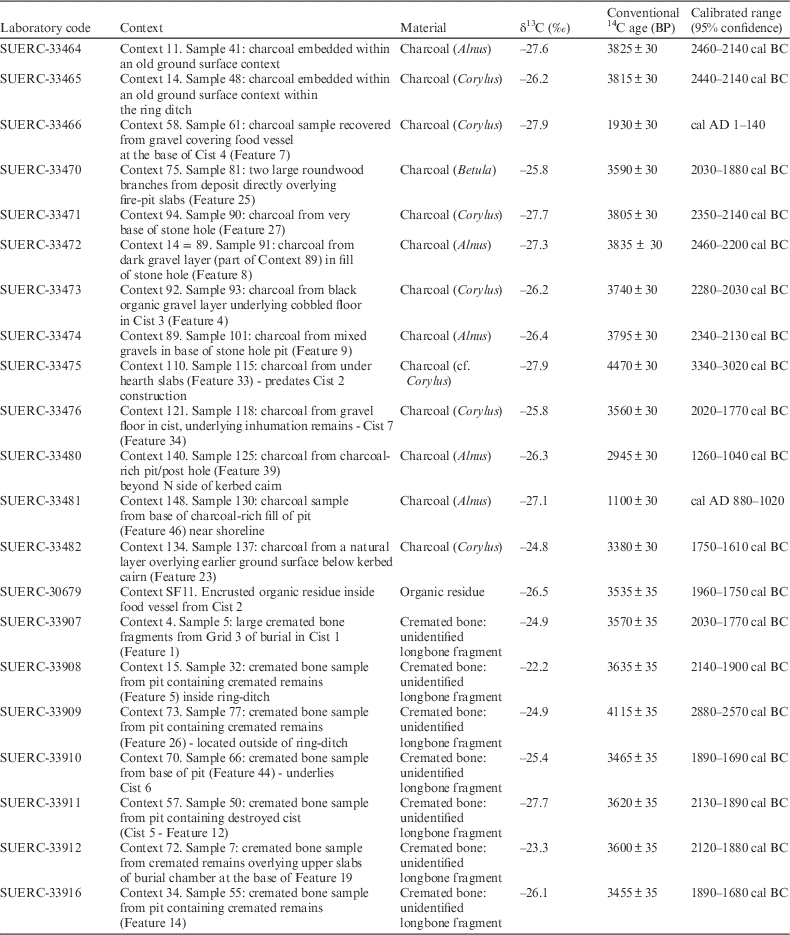
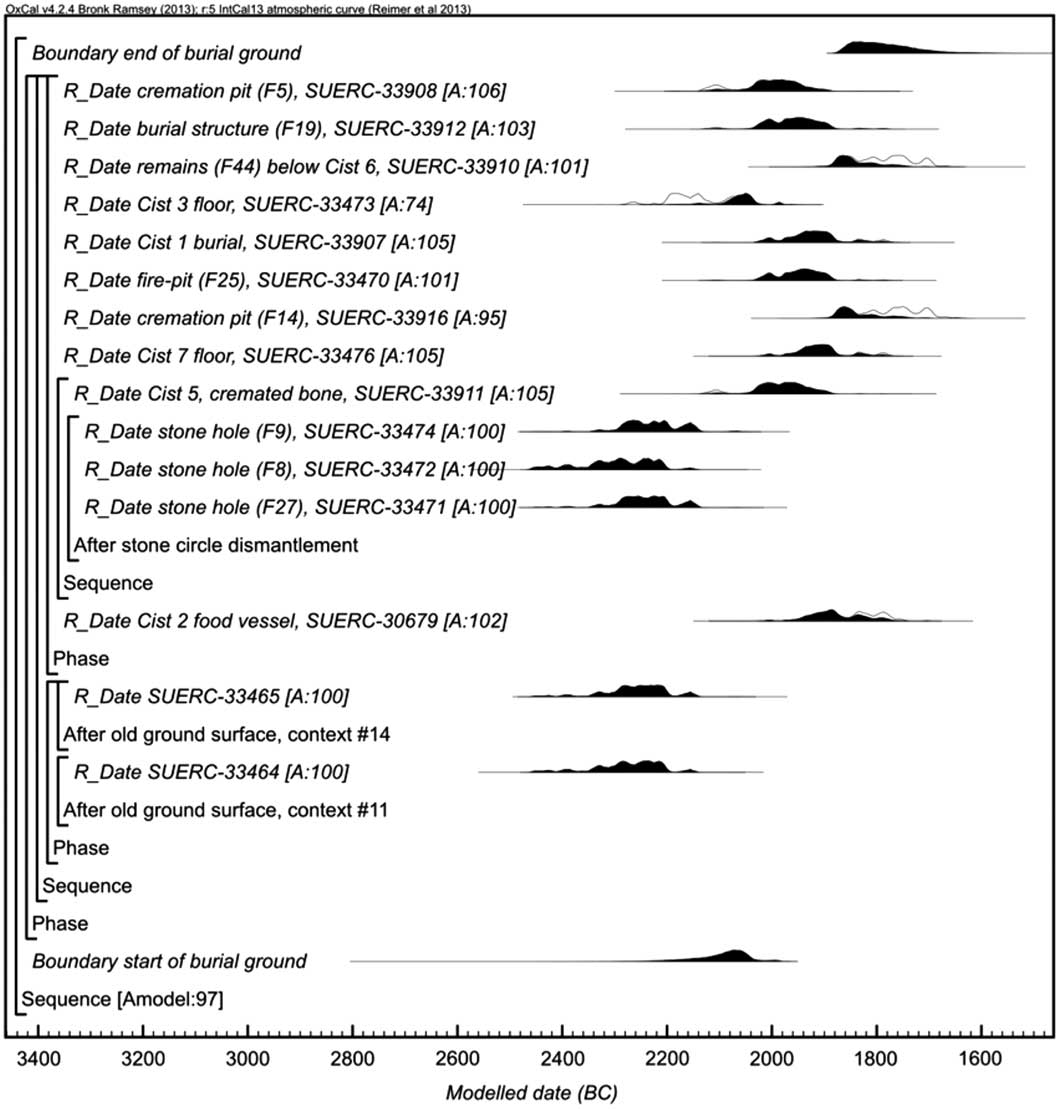
Conventional 14C ages (Stuiver and Polach Reference Stuiver and Polach1977) are presented in Table 1, quoted according to the international standard set at the Trondheim Convention (Stuiver and Kra Reference Stuiver and Kra1986), and calibrated with the internationally agreed curve of Reimer et al. (Reference Reimer, Bard, Bayliss, Beck, Blackwell, Bronk Ramsey, Grootes, Guilderson, Haflidason, Hajdas, Hatte, Heaton, Hoffmann, Hogg, Hughen, Kaiser, Kromer, Manning, Niu, Reimer, Richards, Scott, Southon, Staff, Turney and van der Plicht2013) using OxCal v 4.2 (Bronk Ramsey Reference Bronk Ramsey1995, Reference Bronk Ramsey1998, Reference Bronk Ramsey2001). The date ranges in Table 1 have been calculated using the maximum intercept method (Stuiver and Reimer Reference Stuiver and Reimer1986) and quoted with the end points rounded outward to 10 yr. The probability distributions seen in Figure 3 and Figure 5 were obtained by the probability method (Stuiver and Reimer Reference Stuiver and Reimer1993).
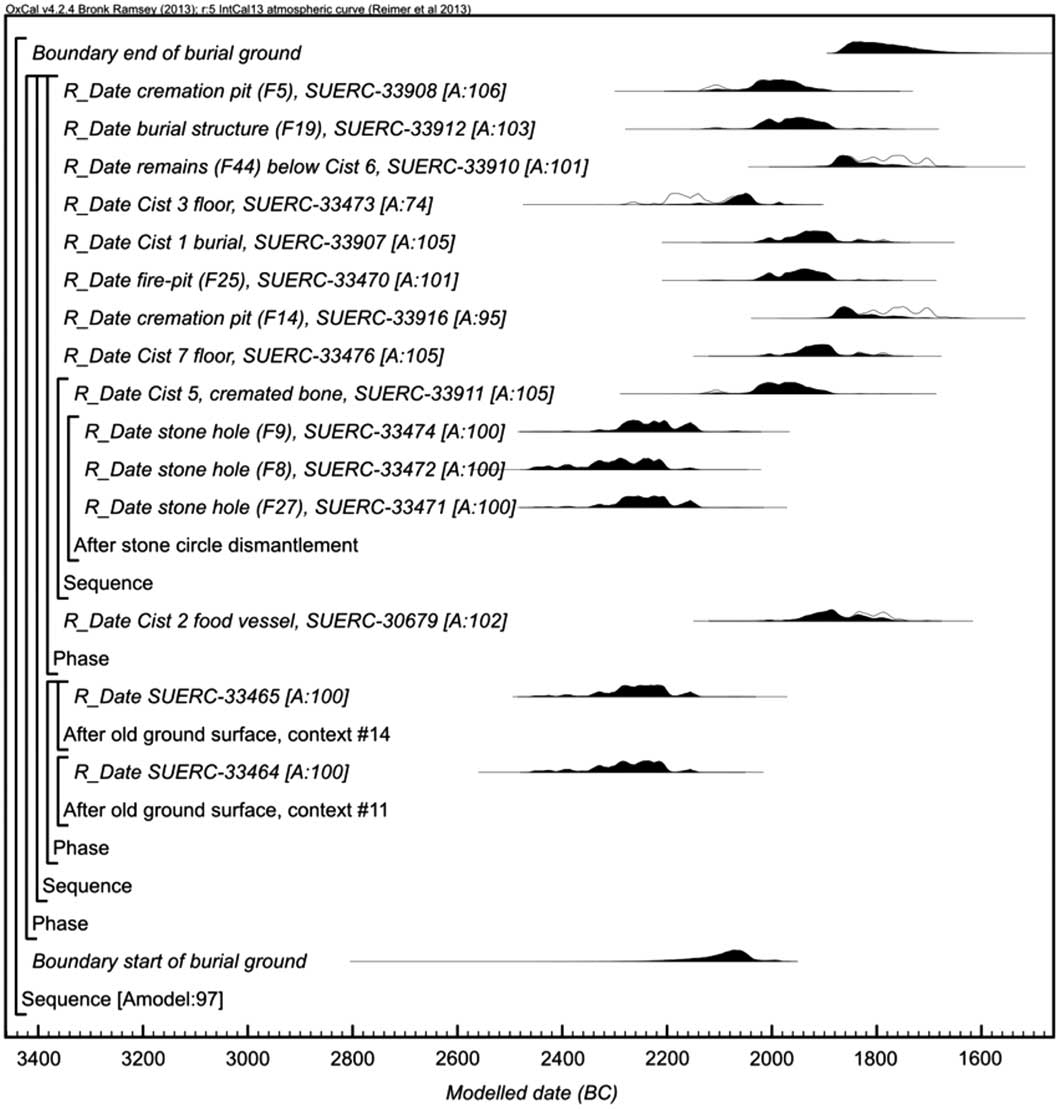
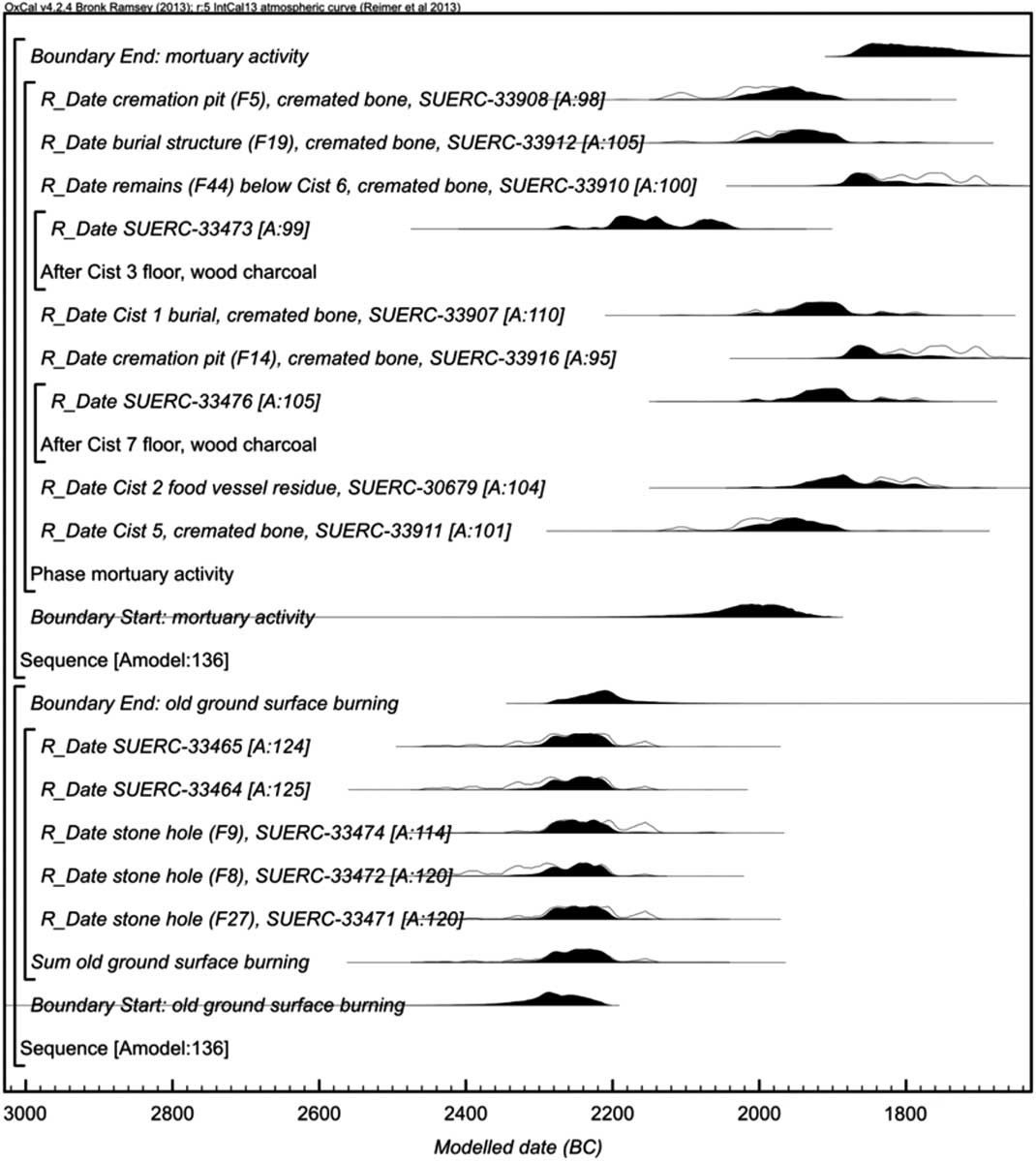
Results and structure of the primary chronological model. The brackets and keywords define the model structure. The outlined distribution is the result of 14C calibration and the solid distributions are the chronological model results.
Armadale 14C data.

METHODOLOGY
The technique used for Bayesian chronological modeling is a form of Markov chain Monte Carlo sampling (Buck et al. Reference Buck, Kenworthy, Litton and Smith1991, Reference Buck, Cavanagh and Litton1996) and has been applied using the program OxCal v 4.2 (http://c14.arch.ox.ac.uk/). Details of the algorithms employed by OxCal v 4.2 are available in Bronk Ramsey (Reference Bronk Ramsey1995, Reference Bronk Ramsey1998, Reference Bronk Ramsey2001, Reference Bronk Ramsey2009) or from the online manual. The fit between the OxCal model and data is gauged with the Amodel agreement index and values higher than 60 indicate good agreement between the model parameters and the dates (Bronk Ramsey Reference Bronk Ramsey1995). Resulting posterior density estimates from OxCal are calendar years and presented in italics as probability ranges with end points rounded to the nearest 5 yr. The algorithms used in the models can be derived from the OxCal keywords and bracket structure shown in the probability distribution plot. It should be emphasized that the posterior density estimates produced by modeling are not absolute. They are interpretative estimates, which can and will change as further data become available and as other researchers choose to model the existing data from different perspectives.
THE SAMPLES AND MODEL
The oldest dated feature at the site is a hearth (Feature 33) located outside of the dismantled stone circle and below a cist (Cist 2). The hearth is dated with a 14C sample (SUERC-33475) from a single fragment of charcoal (Corylus) that calibrates to the Neolithic period (3340–3020 cal BC, 95% confidence). The second oldest feature at Armadale is a cremation pit (Feature 26) located outside of the stone circle and dated through a single-entity cremated human bone fragment (SUERC-33909) that calibrates (2880–2570 cal BC, 95% confidence) to the Neolithic period. The dates from the Neolithic hearth (Feature 33) and the Neolithic cremation burial (Feature 26) were excluded from modeling because they do not directly relate to Bronze Age mortuary activity.
Other evidence of remote antiquity includes the remains of an old ground surface represented by four ground surface contexts located throughout the site (Context 11, Context 14, Context 48, Context 49). Two of these contexts (Context 11, Context 14) are dated with 14C samples (SUERC-33465, SUERC-33464) from embedded single-entities of charcoal (Corylus). Context 11 is a black surface surrounding the satellite cists and the stone circle, consisting of a gray-black silty gravel with scattered charcoal fragments and peat ash. Context 14 is a black surface within the dismantled stone circle and around the central cist (Cist 3, Feature 4), consisting of a gray-black compact silty gravel surface with cremated bone and charcoal scatters. While it is possible that the dated charcoal samples from the old ground surface contexts relate to the burning of the surface in preparation for the creation of the cemetery (Alison Sheridan, personal communication, 2015), these dates were modeled as termini post quos (TPQ) because the dated charcoal samples are potentially residual and may not actually provide a date for the use of their context.
The old ground surface contexts overlie the Neolithic hearth (Feature 33) and underlie the remains of the kerbed cairn and much of the main burial site. Additionally, the old ground surfaces formed prior to the dismantlement of the stone circle, which is apparent from the collapse of the surface layers into infills in the stone holes.
The stone circle consisted of an arc of three standing stones and 10 pits overlying a timber post circle of eight post holes. Most of the stone holes appeared to be post holes augmented for use by the insertion of upright stones. A shallow ring ditch (Feature 15) links the arc of upright stones and stone/post holes. Three dates (SUERC-33471, SUERC-33472, SUERC-33474) are from single-entity charcoal (Alnus, Corylus) fragments from stone hole fills (Feature 27, Feature 8, Feature 9) of the stone/post circle. The stone/post holes contained predominantly redeposited mixed layers of the surrounding old ground surface context (Context 14) and gravel fill that were likely mixed together during the process of stone removal. The dates from these samples were modeled as TPQ for the removal of the stones because they are likely residual due to the mixture of fills in the stone holes.
Two cists (Cist 3, Cist 5) were constructed within the stone circle. Cist 3 (Feature 4) was located at the center of the dismantled stone circle and is the largest cist at Armadale. Cist 3 comprised of large basalt side slabs and a 2-ton rhomboid-shaped basalt capstone. The large size of the capstone suggests that it may have originally been part of the stone circle, possibly removed to construct the cist. Cist 3 contained an inhumation burial with degraded bone preservation that was too poor for 14C dating. A black organic gravel layer underlying the cobbled floor in Cist 3 is dated through a single charcoal (Corylus) fragment (SUERC-33473), although there is a possibility that this charcoal fragment may be residual and that it may not date the use of the cobbled floor.
The remnants of Cist 5 (Feature 12) were located inside one of the stone holes and the burial appears to have been disturbed, possibly in antiquity as part of a later act of closure to the cemetery site. It contained cremated bone and 37 sherds belonging to an incomplete tripartite bowl of the Food Vessel ceramic tradition. There was no evidence of unburnt bone or other organic material in the grave. Cist 5 is dated through a cremated bone sample (SUERC-33911).
Cist 1 (Feature 1) and Cist 2 (Feature 2) appeared to be completely undisturbed until the time of their discovery. Situated just over 2 m apart on the west side of the stone circle; both cists were built on exactly the same north-south alignment within close-fitting cuts. The internal slab construction of both cists is identical: five upright schist slabs built to the same design that are supported by recumbent slabs on the surface. Complete tripartite vases belonging to the Food Vessel ceramic tradition were found in both cists. Degraded bone was identified in Cist 1, which could have been either a degraded inhumation or faunal remains. Cist 1 is dated through a single-entity cremated bone fragment (SUERC-33907). Cist 2 is dated (SUERC-30679) through encrusted organic residue inside the deposited food vessel.
Cist 4 (Feature 7) is located 6.5 m southeast of Cist 1 and comprised two schist side slabs and two schist end slabs, which had partially collapsed inward and allowed for the ingress of gravel into the grave. The upper fill contained schist slabs that may have been the capstone broken in situ. Degraded human remains were found in Cist 4 with a wrist guard fragment reused as a pendant and a complete bipartite vase belonging to the Food Vessel ceramic tradition. Cist 4 is dated (SUERC-33466) through a single charcoal (Corylus) fragment and is included in the model as an outlier because its calibration dates to the Late Iron Age and does not directly relate to Bronze Age mortuary activity.
A small sub-oval pit, located 5 m to the northeast side of the stone and post circle, held a close-fitting cist structure (Cist 6, Feature 17) comprised of two schist side slabs and one schist end slab with no covering slabs or stones. The side slabs were supported upright in shallow cuts and the end slab filled the space between the north end of the side slabs against the pit cut. Cist 6 had been backfilled with gravel and a deposit of cremated bone (Context 60) was uncovered in an underlying pit at the center of the south end of the cist. Cist 6 is dated through a cremated bone sample from the base of this pit (SUERC-33910).
Cist 7 (Feature 34) was uncovered just over 13 m southeast of the stone circle, under what appeared to be the natural beach gravel deposits. The overlying capping slabs were badly degraded and could have originally consisted of one single schist capstone slab. The internal side slabs were also degraded, fragmented, and partially collapsed. Machinery movement over the site could have contributed to this disturbance. However, the scattered presence of plant roots and fill mixed with the upper cist fill suggests there may have been other disturbance previous to the development. Cist 7 contained inhumed remains with degraded bone preservation too poor for 14C dating. Cist 7 also contained a group of three flint arrowheads with a plano-convex flint knife and a double-edged flint knife. A gravel floor (Feature 34) in the base of Cist 7 is dated through a single charcoal (Corylus) fragment (SUERC-33476), although there is a possibility that this charcoal fragment may be residual and that it may not date the use of the cobbled floor.
Five pits across the site contained unurned deposits of cremated remains. Two pits (Feature 5, Feature 14) and a large burial pit (Feature 19) are dated through samples of cremated bone (SUERC-33908, SUERC-33916, SUERC-33912). Feature 14 contained half of a barbed and tanged flint arrowhead.
The remains of a kerbed cairn (Feature 23) were uncovered on the north side of the main burial site. The kerbed cairn (Feature 23) appeared to have been the final phase of construction on the burial site based on the projection of the surviving kerbstone alignment, suggesting that it may have originally covered the majority of the burial site. The cairn had been mostly robbed out and had been at least partially disturbed by the installation of the electricity services. A pit or post hole (Feature 39) beyond the north side of the kerbed cairn was dated through a single-entity charcoal (Alnus) fragment (SUERC-33480) and was excluded from modeling because its relationship to the rest of the burial site is unclear. Charcoal from a layer of light brown compact silt (Context 134) overlying a ground surface below the kerbed cairn was also submitted for dating (SUERC-33482) and was excluded from modeling because this appears to be a naturally formed context that does not date human activity.
A fire-pit (Feature 25) is dated (SUERC-33470) through a large roundwood branch (Betula). This date was excluded from modeling as it did not appear to represent mortuary activity, although has a calibration (2030–1880 cal BC, 95% probability) that dates to the Early Bronze Age. Likewise, a charcoal-rich pit (Feature 46) uncovered some distance from the burial site is dated through a single-entity charcoal (Alnus) fragment (SUERC-33481) and was excluded from modeling because its calibration dates to the medieval period and does not directly relate to Bronze Age mortuary activity.
The 14C dates were modeled with the prior assumption that they are representative of a single, relatively uniform phase of mortuary activity. Boundaries were placed around this sequence in OxCal to estimate a start and end date. Sequences were created in this phase to reflect the stratigraphic ordering of the 14C samples (Figure 3).
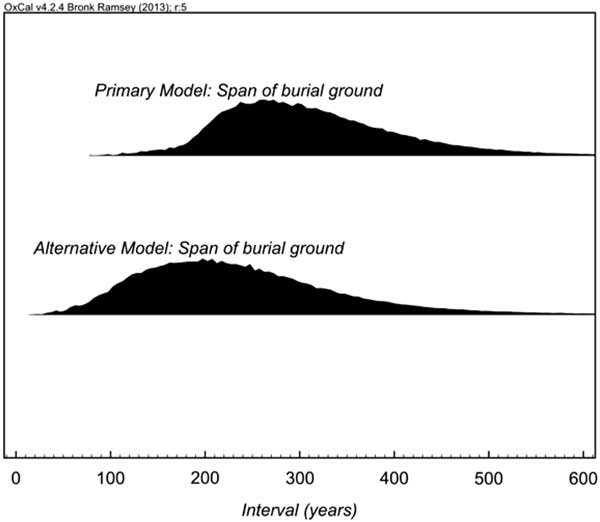
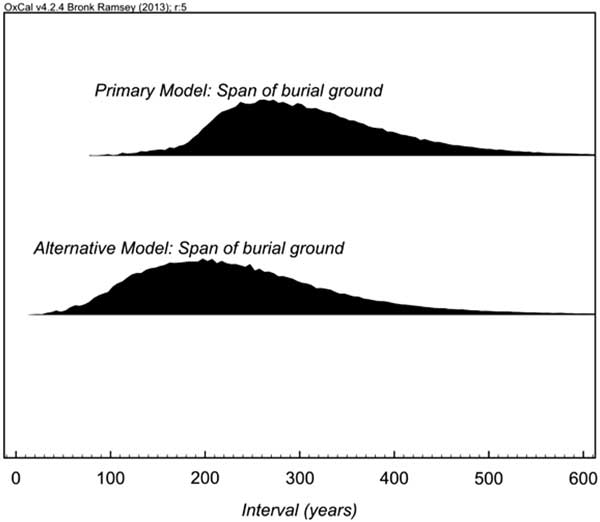
Calibrated dates are given in Table 1. The 14C dates are in good agreement with the model assumptions (Amodel=97.1). Modeling estimates that mortuary activity on the site began in the Early Bronze Age in 2220–1985 cal BC (95% probability; Figure 3; Boundary start of burial ground), likely 2130–2040 cal BC (68% probability). Modeling estimates that mortuary activity on the site ended in 1880–1660 cal BC (95% probability; Figure 3; Boundary end of burial ground), likely 1860–1750 cal BC (68% probability). The estimated span of Bronze Age mortuary activity at the site is 140–520 yr (95% probability; Figure 4; Primary Model: Span of burial ground), likely 200–370 yr (68% probability).
SENSITIVITY ANALYSIS
An alternative Bayesian model was created to account for the possiblity that the dated charcoal samples from burials were actually residual. In this model, the 11 14C results (SUERC-33911, SUERC-30679, SUERC-33476, SUERC-33916, SUERC-33466, SUERC-33907, SUERC-33473, SUERC-33910, SUERC-33912, SUERC-33908, SUERC-33909) from the dated burials [Cists 1–7, Feature 14 (cremation pit), Feature 19 (burial pit), Feature 5 (cremation pit), Feature 26 (cremation pit)] were placed in a seperate unordered bounded phase with the prior assumption that they are representative of a single, relatively uniform phase of mortuary activity. Boundaries were placed around this phase in OxCal to estimate the start and end date.
The date (SUERC-33476) from a single charcoal (Corylus) sample from the gravel floor (Feature 34) of Cist 7 is modeled as a TPQ because this charcoal fragment may be residual and it may not date the use of the cobbled floor. The date (SUERC-33473) from a wood charcoal sample from the floor of Cist 3 is modeled as a TPQ because this charcoal fragment may also be residual and it may not date the use of the cobbled floor.
A date (SUERC-33466) from a single charcoal (Corylus) fragment from Cist 4 is included in the model as an outlier because its calibration dates to the Late Iron Age and does not directly relate to Bronze Age mortuary activity. A date (SUERC-33909) from a single-entity cremated human bone fragment from a cremation pit (Feature 26) is also included in the model as an outlier because its calibration dates to the Neolithic and does not directly relate to Bronze Age mortuary activity.
It is possible that much of the charcoal in the old ground surface is from an episode of ritual burning. This interpretation is strengthened because the five 14C results (SUERC-33471, SUERC-33472, SUERC-33474, SUERC-33464, SUERC-33465) from the stone circle post holes (Feature 27, Feature 8, Feature 9) and the old ground surface (Context 11, Context 14) pass a chi-square test [T=1.1; df=4; T’(0.05)=9.5], which suggests that these five samples were deposited over an extremely short period of time. The three dated (SUERC-33471, SUERC-33472, SUERC-33474) samples of single-entity charcoal (Alnus, Corylus) fragments from stone hole fills (Feature 27, Feature 8, Feature 9) are possibly residual from the surrounding burnt old ground surface context (Context 14) and arguably may provide a date for burning associated with the old ground surface.
In this model, the 14C dates from the old ground surface (Context 11, Context 14) and the stone/post holes are treated as a phase of activity independent from the mortuary features. Five 14C results (SUERC-33471, SUERC-33472, SUERC-33474, SUERC-33464, SUERC-33465) from the stone circle post holes (Feature 27, Feature 8, Feature 9) and the old ground surfaces (Context 11, Context 14) were placed in an unordered bounded phase with the prior assumption that they are representative of a single, relatively uniform phase of activity. Boundaries were placed around this phase in OxCal to estimate the start and end date. Following Hamilton and Kenney (Reference Hamilton and Kenney2015), the Sum function was used to add together the probability density functions of the modeled 14C dates to produce a single probability for the formation/burning of the old ground surface.
The algorithm used for the alternative model can be directly derived from the model structure shown in Figure 5. The alternative model shows good overall agreement (Amodel=135.4) between the 14C dates and the model assumptions. The application of the Sum function in this model estimates that the event involving the burning of the dated old ground surfaces occurred in 2310–2195 cal BC (95% probability; Figure 5; Sum old ground surface burning), likely 2280–2210 cal BC (68% probability).
Results and structure of the alternative chronological model. The brackets and keywords define the model structure. The format is as described in Figure 3.
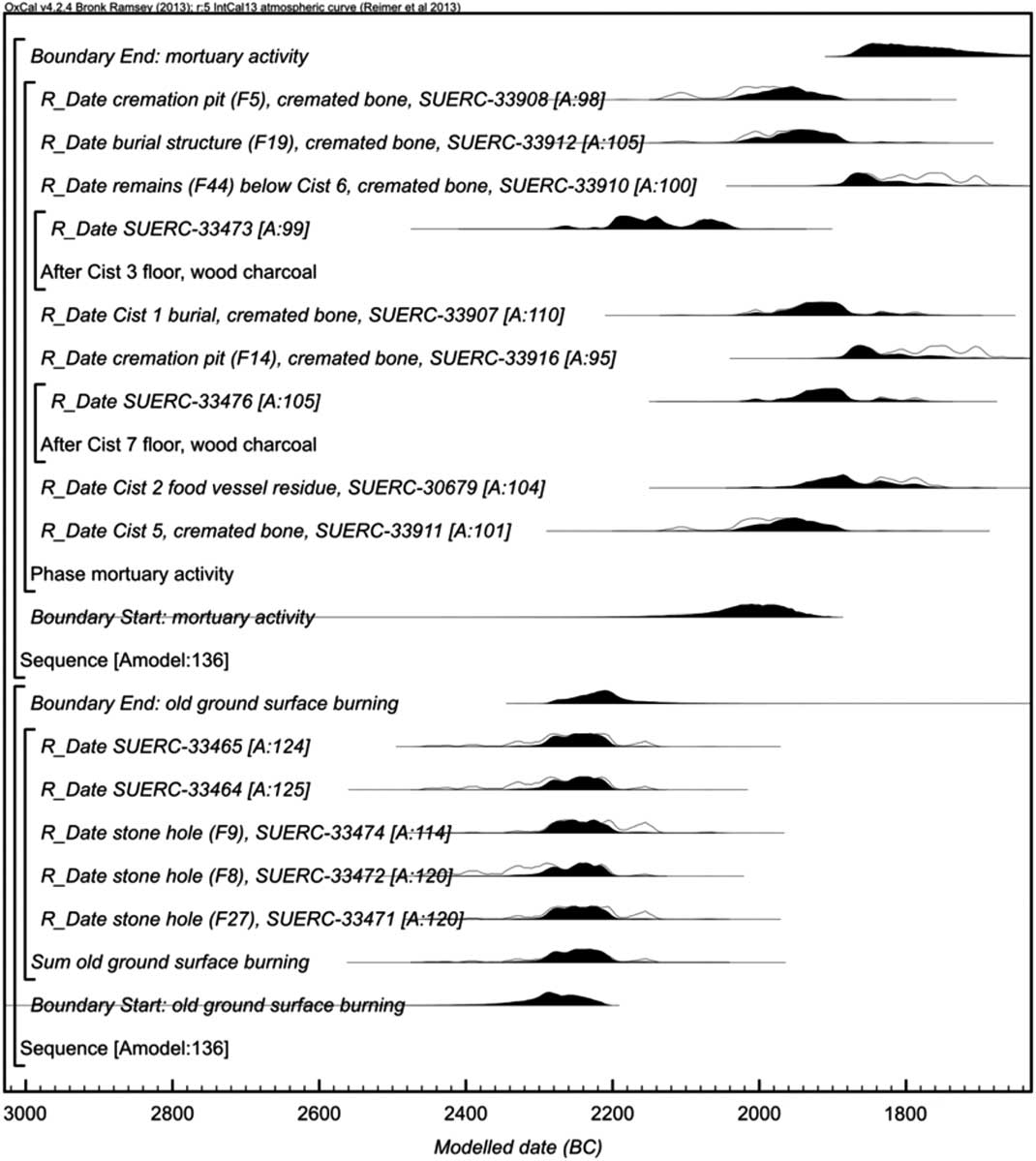
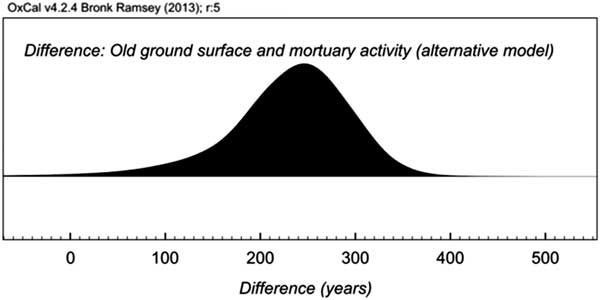
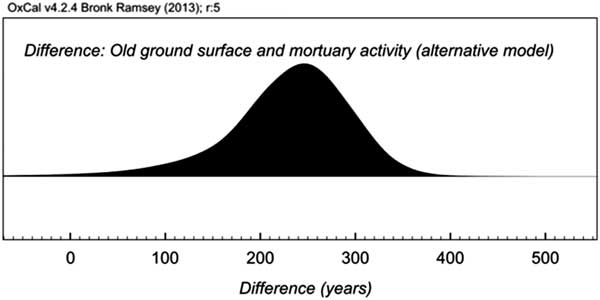
The model estimates that the mortuary activity began in the Early Bronze Age in 2160–1915 cal BC (95% probability; Figure 5; Start: mortuary activity), likely 2055–1950 cal BC (68% probability). Activity associated with mortuary activity is estimated to have ended in 1885–1630 cal BC (95% probability; Figure 5; End: mortuary activity), likely 1865–1740 cal BC (68% probability). This mortuary activity is estimated to have spanned 50–470 yr (95% probability; Figure 4; Alternative Model: Span of burial ground), likely 115–310 yr (68% probability). The difference in the summed probability for the burning of the dated old ground surface (Figure 5; Sum old ground surface burning) and the estimated start of this mortuary activity (Figure 5; Start: mortuary activity) is 80–355 yr (95% probability; Figure 6; Difference: Old ground surface and mortuary activity (alternative model)), likely 185–300 yr (68% probability).
DISCUSSION
Armadale was host to thousands of years of discontinuous activity beginning with a little understood Mesolithic component indicated by redeposited lithics materials and later continuing in the Middle Neolithic with a hearth (Feature 33; 3340–3020 cal BC; 95% probability; Table 1; SUERC-33475) and the Late Neolithic with a cremated burial (Feature 26; 2880–2570 cal BC; 95% probability; Table 1; SUERC-33909). It is feasible that the very first Neolithic activity at the site may have been contemporaneous with a Neolithic chambered cairn situated approximately 50 m to the north (Figure 1). The creation of the stone and post circles is currently not dated and could feasibly have happened in either the Neolithic and/or the Early Bronze Age. The placement of Cist 3 at the center of the stone circle suggests that at least remnants of the stone circle were prominent at the time of Cist 3’s creation in the Early Bronze Age (Figure 3; Figure 5).
The Bayesian chronological models provide robust estimates for the timing and span of Bronze Age mortuary activity during the site’s reuse. This mortuary activity is estimated in the primary model to have begun in 2220–1985 cal BC (95% probability; Figure 3; Boundary start of burial ground), likely 2130–2040 cal BC (68% probability) and in the alternative model to have begun in 2160–1915 cal BC (95% probability; Figure 5; Start: mortuary activity), likely 2055–1950 cal BC (68% probability). The alternative model estimates this activity to have been 80–355 yr (95% probability; Figure 6; Difference: Old ground surface and mortuary activity (alternative model)), likely 185–300 yr (68% probability), after the burning of ground surfaces in 2310–2195 cal BC (95% probability; Figure 5; Sum old ground surface), likely 2280–2210 cal BC (68% probability). Mortuary activity at the site is estimated in the primary model to have ended in the Early Bronze Age in 1880–1660 cal BC (95% probability; Figure 3; Boundary end of burial ground), likely 1860–1750 cal BC (68% probability) and in the alternative model to have ended in 1885–1630 cal BC (95% probability; Figure 5; Start: mortuary activity), likely 1865–1740 cal BC (68% probability).
The Early Bronze Age burial component was likely a re-establishment rather than a continuation of the Neolithic burial tradition given the gap in time between Armadale’s Neolithic activity and Early Bronze Age reuse. Armadale’s location in close proximity to a pre-existing funerary monument—the Neolithic chambered cairn situated approximately 50 m to the north (Figure 1)—indicates that ancestral veneration was a purpose in choosing the location of the post/stone circle and the burial ground (Sheridan Reference Sheridan2004). Further, ancestral authority may have been invoked during Early Bronze Age ceremonies (Pitts Reference Pitts2000; Sheridan Reference Sheridan2004).
A Bronze Age burial component near a Neolithic monument is not entirely unexpected. Machrie Moor on the Isle of Arran and Temple Wood in Kilmartin, Argyll, are two particular parallels on the west coast of the country. Both sites had distinct phases of reuse and rebuilding of timber circles into stone circle monuments, as well as Bronze Age insertion of burials (Scott 1988–Reference Scott1989; Haggarty Reference Haggarty1991). Another possible parallel to Armadale is at Cairnpapple Hill, where the stones from a stone circle were removed and reused to build an individual cairn (Armit Reference Armit2005). Perhaps in the same way at Armadale, two basalt stones were removed from the stone circle to construct the central cist (Piggot Reference Piggott1949).
Neolithic monuments held a continuing attraction for Bronze Age communities (Higginbottom et al. Reference Higginbottom, Smith and Tonner2013; Noble Reference Noble2006). Neolithic structures and places were a physical manifestation of the meaning, power, and memories of past activities (Chapman Reference Chapman1994:53; Tilley Reference Tilley1994:204) and may have been embedded within a social memory or mythical history extending into the Bronze Age (Rowlands Reference Rowlands1993:144; Gosden and Lock Reference Gosden and Lock1998:6; Bradley Reference Bradley2003; Rogers Reference Rogers2013). After all, old monuments are often incorporated into folk histories (Holtorf Reference Holtorf1998; Moore Reference Moore2010; Rogers Reference Rogers2013) and used to construct group identities (Cooney Reference Cooney2014; Quinn Reference Quinn2015:6).
An osteological assessment of the burials identified that a minimum of 24 individuals were buried in the 14 known mortuary features at Armadale, 11 of which have been dated (Table 1). The estimated span of mortuary activity at the site during its Bronze Age reuse is 140–520 yr (95% probability; Figure 4; Primary Model: Span of burial ground) in the primary model, likely 200–370 yr (68% probability), and 50–470 yr (95% probability; Figure 4; Alternative Model: Span of burial ground) in the alternative model, likely 115–310 yr (68% probability). At 68% probability, the average rate of construction of these mortuary features was approximately one every 10–30 yr, about one to two mortuary features every human generation.
It is clear that burial at Armadale was an infrequent event, yet the memory of the location and social role of Armadale as a burial ground persisted throughout much of the Early Bronze Age. The process of returning to Armadale for a burial was a once or twice in a lifetime event that may have been reserved for special occasions and individuals. Furthermore, Food Vessel pottery is very rare in northwest Scotland but more common in western Scotland, Ireland, and northern England (Simpson Reference Simpson1968; Sheridan Reference Sheridan2011a). The presence of Food Vessel pottery in four of the cists and the presence of a wrist guard reused as a pendant in a cist, in conjunction with a cist containing flint arrowheads and knives, suggests an amalgam of mortuary customs were practiced in the cemetery and some of these may have signaled social differentiation from local groups (Saville Reference Saville2011; Sheridan Reference Sheridan2011a, Reference Sheridan2011b).
CONCLUSION
Armadale played an important role as a symbolic location in the Early Bronze Age landscape and social fabric of the Isle of Skye. Located 50 m south of a Neolithic chambered cairn in a prominent coastal location, the site would have been visibly observable by sea travelers in the Sound of Sleat and along the western seaboard of Scotland. The stone circle, cairns, and cists visibly demarcated the site as a burial ground. The social memory of the site is further reflected in the consistent placement of burials around the stone circle.
Often the chronology of Bronze Age burial grounds is presented with coarse resolution, due to large error ranges and large date calibrations. As a result, much previous work on the investigations of memory and temporality in Early Bronze Age cemeteries has been too abstract and uncritically speculative to be seriously accepted (Garwood Reference Garwood2007:49; Garrow et al. Reference Garrow, Meadows, Evans and Tabor2014:209). We hope that the Bayesian chronology presented here has offered a more finite and less abstract level of chronological resolution.
The Armadale chronology demonstrates the longevity that ancient burial grounds in northern Scotland may have had. Bayesian modeling suggests that the site was used as a burial ground throughout the first centuries of the Early Bronze Age with burials occurring once or twice every human generation. We believe this analysis shows what is possible to achieve by modeling scientific dates from a Bronze Age burial ground. Future research that conducts the necessary work to better understand the chronology of similar Scottish Neolithic and Bronze Age burial grounds will allow for comparison to Armadale and a better understanding of the significant relationships and connections between Bronze Age people in northern Scotland.
ACKNOWLEDGMENTS
Alison Sheridan and Derek Hamilton generously provided helpful comments on various drafts of this manuscript.