

INTRODUCTION
High-quality chronologies associated with sediment records have the potential to elucidate decadal to century-scale paleoenvironmental changes and have a pivotal role in providing the chronological context for many fields of environmental sciences and archaeology (Santos et al. Reference Santos, Southon, Griffin, Beaupre and Druffel2007; Grimm et al. Reference Grimm, Maher and Nelson2009). Sedimentary records retrieved from lakes, in particular, hold invaluable information for assessing past ecosystems and climates (Last and Smol Reference Last and Smol2002; Yang et al. Reference Yang, Yim and Huang2008; Schneider et al. Reference Schneider, Haberle, Maher, Krikowa, Zawadzki and Heijnis2016). Nevertheless, constructing age-depth models based solely on bulk sediments can be highly problematic (Deevey Reference Deevey1954; Broecker and Walton Reference Broecker and Walton1959; Hall and Henderson Reference Hall and Henderson2001; Hendy and Hall Reference Hendy and Hall2006; Grimm et al. Reference Grimm, Maher and Nelson2009; Soulet Reference Soulet2015), and even targeted organic debris such as seeds, leaves, and pollen can be subject to contamination from older and/or younger carbon (Olsson Reference Olsson1986; Wohlfarth et al. Reference Wohlfarth, Skog, Possnert and Holmquist1998; Fletcher et al. Reference Fletcher, Zielhofer, Mischke, Bryant, Xu and Fink2017). Low pollen concentrations, poor preservation and potential for reworking may preclude pollen separates being used as an alternative dating option (cf. bulk sediments) (Thorley Reference Thorley1981; Harle et al. Reference Harle, Kershaw and Heijnis1999).
Here we highlight the occurrence of old carbon within sediments of Lake Kutubu in Papua New Guinea (PNG), a phenomenon known as “radiocarbon (14C) reservoir effect.” We discuss methods to overcome this issue and provide guidance for future sedimentary studies from this and other lakes within the limestone-dominated Papuan Fold Belt that require chronological definition and evaluation.
The reservoir effect occurs because the ordinary procedure of 14C dating assumes that the carbon, before entering the material under investigation, has achieved isotopic exchange equilibrium with the CO2 of the air (Deevey Reference Deevey1954). This assumption may not be valid in some cases. For example, hard-waters derived from old limestone that does not contain any 14C may cause the reservoir effect in materials formed in such water. Colloidal CaCO3 may provide a reservoir of carbon of low 14C activity even in water that is in equilibrium with the atmosphere (Ohle Reference Ohle1952; Deevey Reference Deevey1954). Decomposition of old organic material (e.g. peat) may also supply old carbon/bicarbonate to lakes (Bengtsson and Törneman 2004).
Dating sediment from archaeological sites in limestone catchments in PNG has proven to be problematic. 14C ages on calcite flowstones associated with archaeological and palaeontological material excavated from Nombe Rockshelter in the highlands of PNG (Gillieson and Mountain Reference Gillieson and Mountain1983) yielded results estimated to be at least 2000–5000 yr too old due to the reservoir effect. A recent highland wide assessment of archaeozoological records has shown that dating uncertainties, most likely introduced by a reservoir effect, hinder detailed temporal analysis of faunal assemblages (Sutton et al. Reference Sutton, Mountain, Aplin, Bulmer and Denham2009).
In the freshwater lakes within limestone catchments of PNG, the impact of the reservoir effect on 14C dates has received only limited attention in the literature. In a PhD thesis (Garrett-Jones Reference Garrett-Jones1979) a sediment record from Lake Yanamugi, a small lake in the Markham Valley west of Lae, contained evidence of a volcanic ash of known age (Tibito Tephra, at that time thought to date ~1700 AD) that had 14C dates ranging from 380 to 1730 yr older than they should have been when calibrated against Tibito Tephra. Oldfield (Reference Oldfield1977), who has worked on lakes in PNG, also notes that the error introduced by the photosynthesis of aquatic organisms in hard-water lakes is well documented (e.g. Deevey et al. 1954). This phenomenon of “apparent age” is of major importance in evaluating 14C age determinations based on material wholly or partly subaqueous in origin. Oldfield (Reference Oldfield1977) reports that attempts to correct for this “hard-water” effect have mainly been assessing the difference between real and expected 14C activity for contemporary surface sediment, and then applying this correction factor to each date down a profile. But although this method provides a conformable sequence of dates, the assumptions upon which it rests have never been fully justified nor have independent age determinations on 14C dates “corrected” in this way confirmed their accuracy.
The present study tackles Oldfield’s last point and, using techniques vastly improved since 1977, examines independent age determinations as a means of applying corrections to dates affected by old carbon. We now have a much better understanding of the utility of multiple dated tephra layers that provide isochronous horizons wherever they might be in PNG. Using tephrochronology we are able to validate 14C ages and allow for the correction of age offsets caused by the reservoir effect.
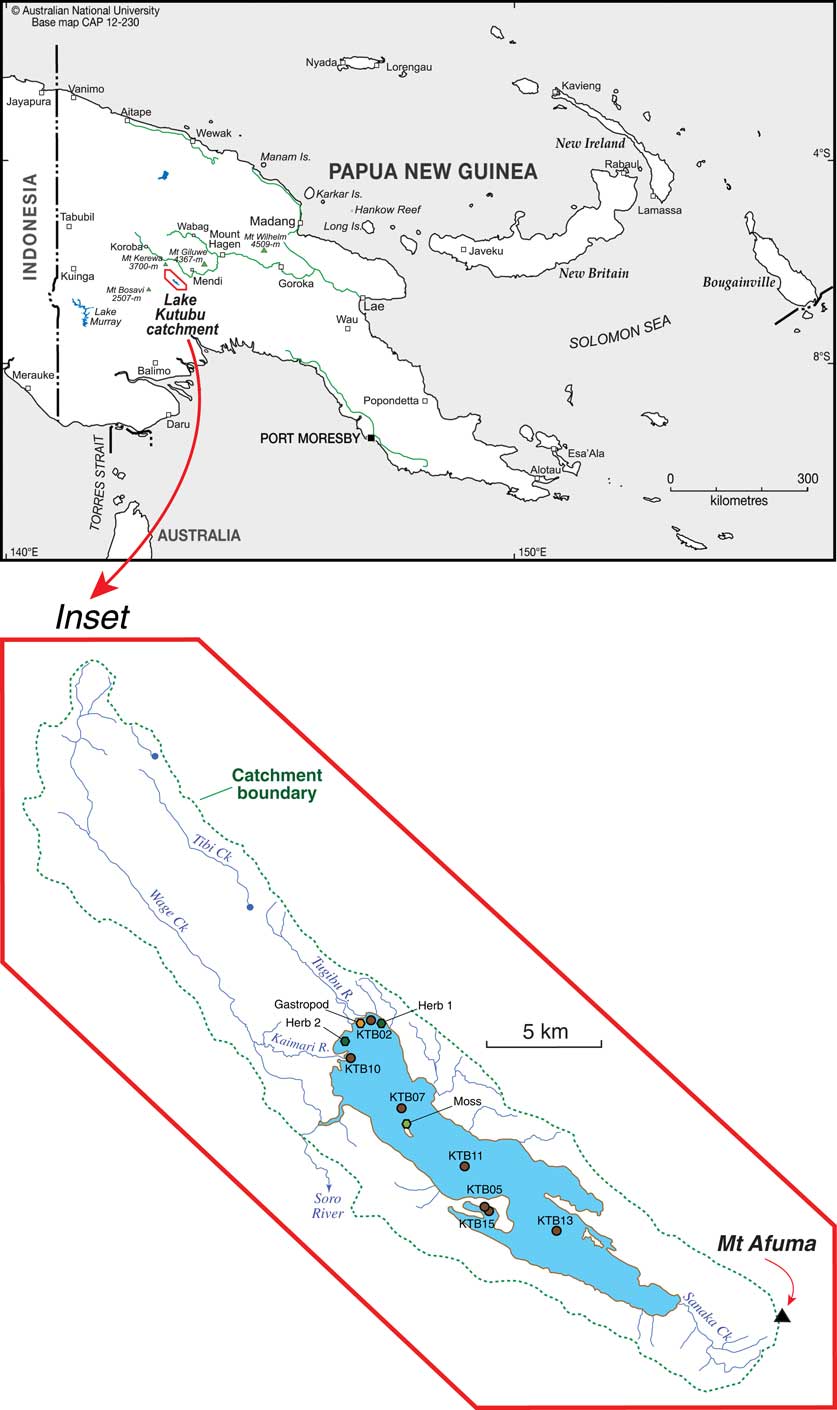
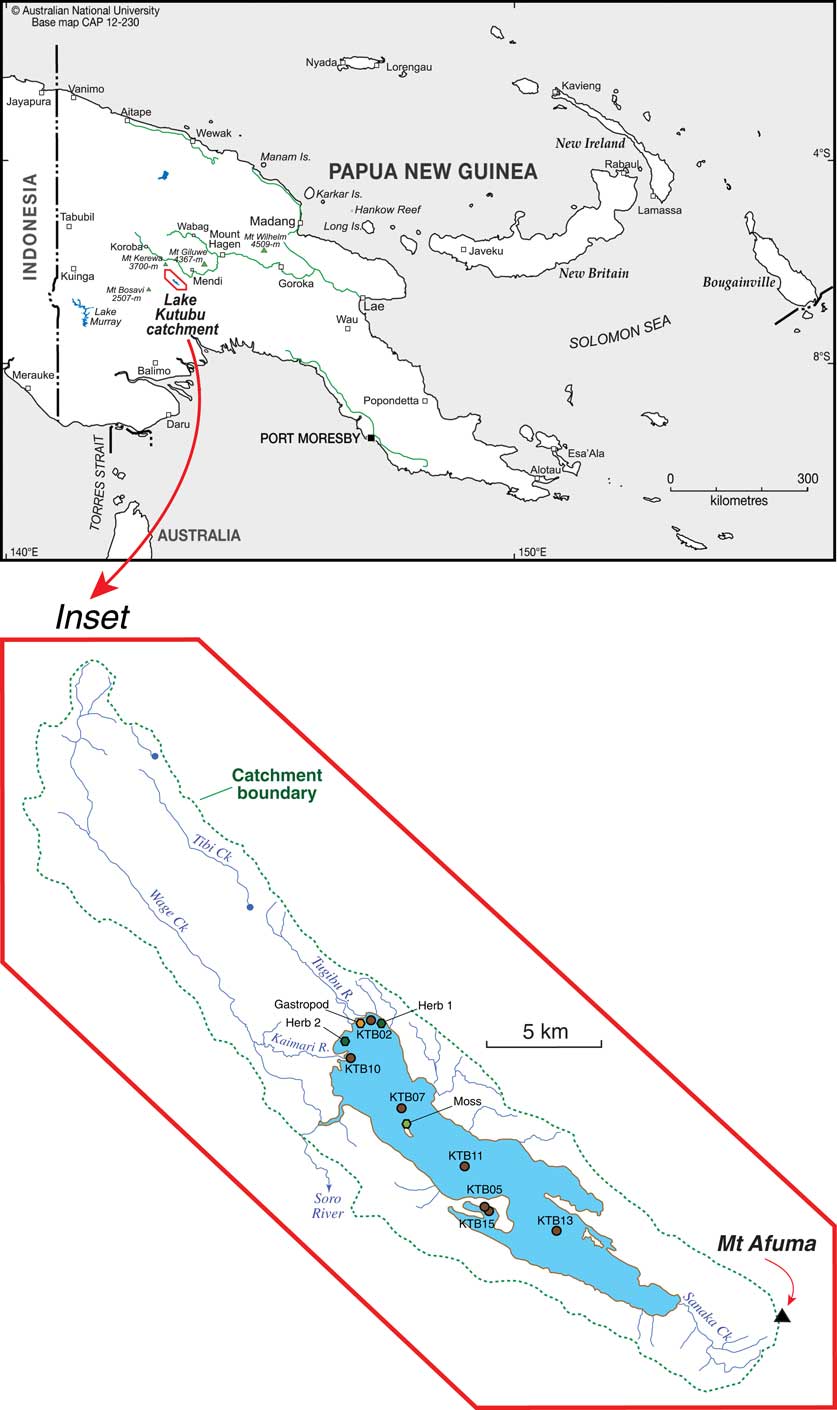
Here we examine two cores from Lake Kutubu in the Southern Highlands of PNG (Figure 1) to provide a precise age-depth profile and sedimentation rates for the lake. Based on the presence of two widespread thin (~1 cm) distal tephra layers (Olgaboli and Tibito), which have been 14C dated at many coastal and highland localities and in different sedimentary settings (Blong et al. Reference Blong, Pain and McKee1982; Haberle Reference Haberle1998; Coulter et al. Reference Coulter, Denham, Turney and Hall2009; Blong et al. Reference Blong, Fallon, Wood, McKee, Chen, Magill and Barter2017b; Schneider et al. Reference Schneider, Alloway, Blong, Hope, Fallon, Pain, Maher and Haberle2017), we are able to compare these previously acquired 14C ages with those obtained from Lake Kutubu where old carbon appears to have influenced the 14C ages obtained. Finally, based on geological maps, we indicate those PNG lakes most likely to be affected by the 14C reservoir effect to alert researchers to the likely need to correct 14C dates from these lakes.
Map of Papua New Guinea and adjacent offshore islands. The red inset denotes the location of Lake Kutubu within the highlands. The inset map of Lake Kutubu shows the location of sediment cores and other samples used in this study. Note that the largest inlets and the outlet are confined in the northwest portion of the lake. Blockage of the catchment and formation of Lake Kutubu has been attributed to Plio-Pleistocene volcanism associated with Mt Afuma at the southeast end of Lake Kutubu (Bayly et al. Reference Bayly, Peterson and St John1970). (Please see online version for color figures.)
METHODS
Location
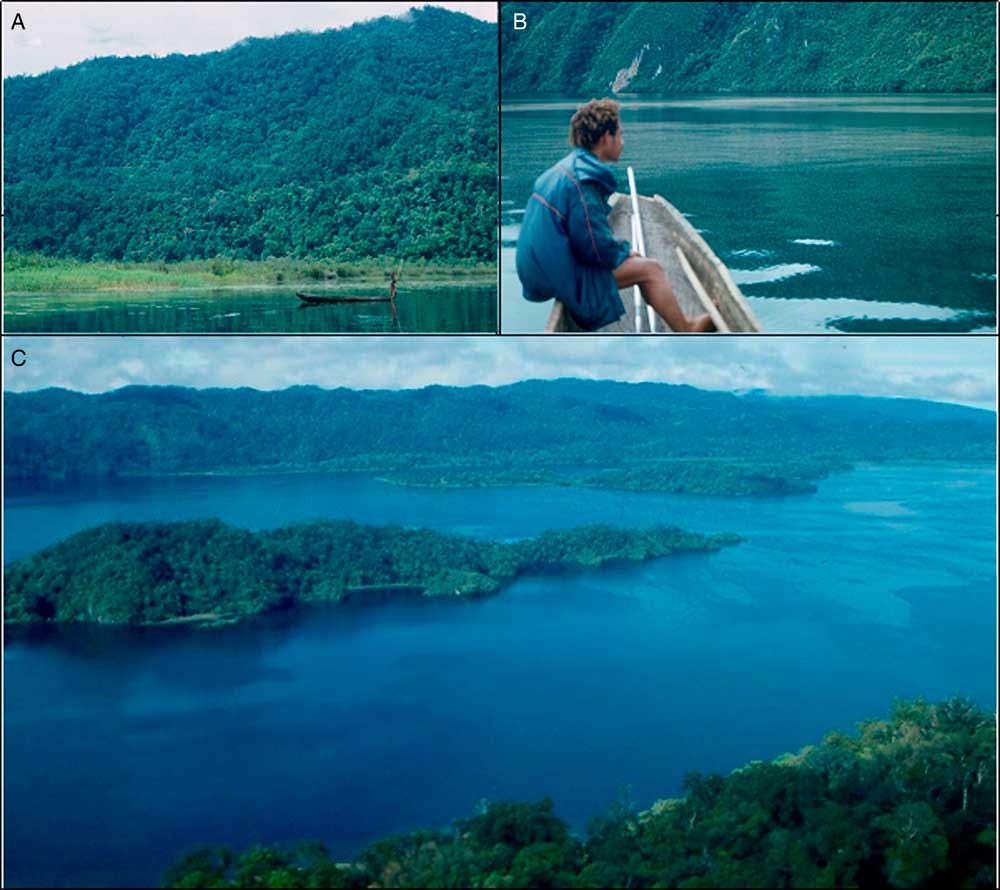
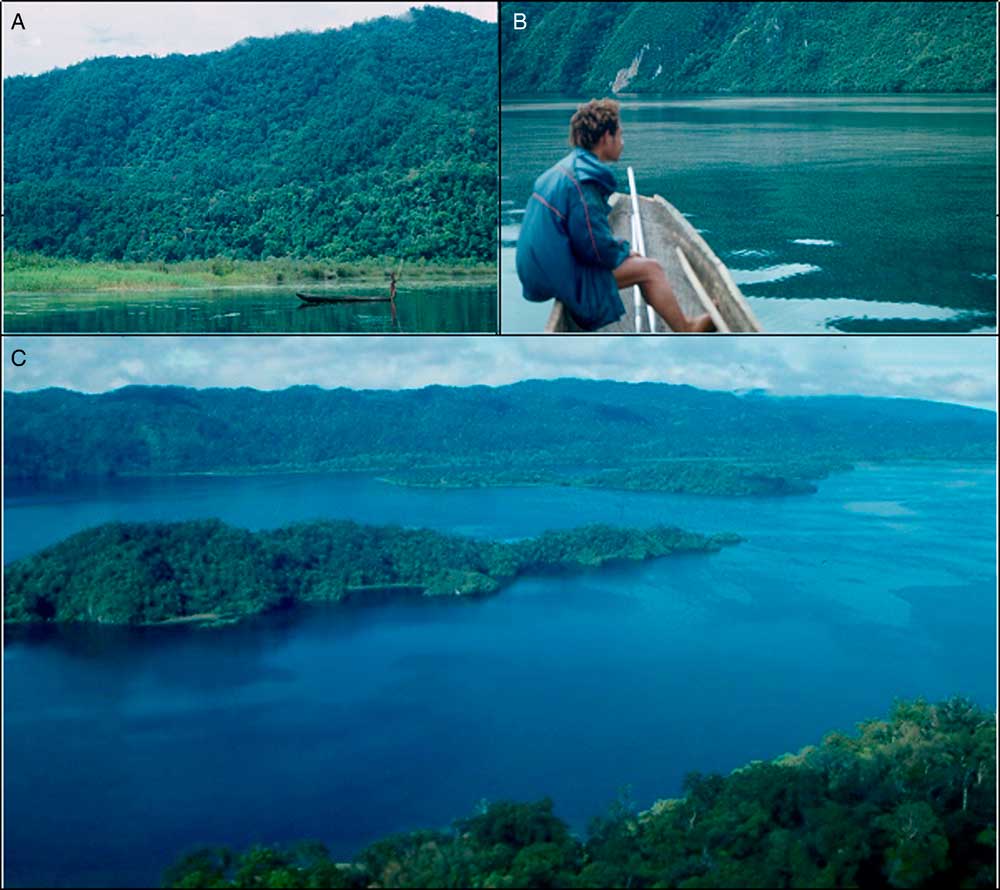
Lake Kutubu (latitude 06°25.79′S, longitude 143°20.22′E, altitude 808 m; Figure 1) in the Southern Highlands Province of PNG has been recognized as one of the most pristine freshwater lakes in the whole of the Asia-Pacific region (D’cruz Reference D’cruz2008). Lake Kutubu is approximately 19 km long and 4 km wide and is flanked by high hills along its length. The lake is fed by a series of small creeks and subterranean rivers that flow through and within the surrounding limestone and karst ranges (Osborne and Totome Reference Osborne and Totome1992; WWF 2008). The lake has an estimated area of about 50 km2 and a volume of 1.825 km3 (D’cruz Reference D’cruz2008). Approximately 20 km2 of wet land reed‐beds and swamp forest is found on the lake shore. Establishing definite boundaries to the catchment is difficult because of the complex karst terrain, but the total catchment area is about 260 km2, which is covered mainly by tropical rainforest (D’cruz Reference D’cruz2008) (Figure 2).
(A) Southwest margin of Lake Kutubu looking towards Mt Afuma ridge; (B) Local dugout canoe on Lake Kutubu with remains of non-biting midges (Chironomids) on the surface of the lake and limestone geology exposed in the background; (C) Aerial view of the central area of Lake Kutubu. Photos from Simon Haberle 1992.
Physical and Chemical Characteristics
The climate in the Lake Kutubu catchment is warm and wet, with little variation throughout the year. The mean annual temperature is 23°C, with a minimum recorded temperature of 5°C, and maximum of 39°C. The mean annual rainfall is 4500 mm, with rain being recorded throughout the year (D’cruz Reference D’cruz2008).
Lake Kutubu is an oligomictic lake with a maximum depth of ~60 m and is characterized by distinct thermal stratification with irregular periods of mixing (Osborne Reference Osborne2012). Mixing events may be triggered when abnormally cold and stormy weather occurs, resulting in mixing of the deoxygenated layers (hypolimnion) with the oxygenated layers (epilimnion) (Osborne and Totome Reference Osborne and Totome1992).
Two mixing events have been reported for Lake Kutubu. There is anecdotal evidence of mixing in 1960 (Osborne and Totome Reference Osborne and Totome1992). A second mixing event in 1990 was studied in detail by Osborne and Totome (Reference Osborne and Totome1992). This latter event, driven by cool temperatures and strong southeast winds, caused vertical mixing and overturning in the lake towards the middle of September 1990 (Osborne and Totome Reference Osborne and Totome1992).
During the second mixing event in Lake Kutubu, anoxic water bubbles were released to the surface at the southeastern end of the lake and the lake water became cloudy with iron particles. At the other end of the lake, dissolved oxygen was delivered to depth (Osborne Reference Osborne2012). Prolonged stratification and irregular periods of mixing have pronounced effects on the spatial distribution of elements in the water column and the sediments (Osborne and Totome Reference Osborne and Totome1992). This process is likely to add to the potential for old carbon to be incorporated into bulk sediment samples derived from the lake deposits.
The lake was formed when the southeastern end of the valley was blocked off by lava flow from Mount Afuma (Bayly et al. Reference Bayly, Peterson and St John1970) in the late Pliocene to Pleistocene (Brown and Robinson Reference Brown and Robinson1982). The upland areas of the catchment are a dissected terrain of Darai Limestone (Upper Oligocene to Middle Miocene) with minor interbedded mudstones and sandstones (Brown and Robinson Reference Brown and Robinson1982). The limestone surface is dominated by numerous sinkholes. Along its length the lake is flanked by karst landforms; it was the first subterranean karst wetland type to be added to the Ramsar Classification System by Resolution VI.5 (Ramsar site no. 961). Karst (cave) wetland systems are connected to underground rivers and act as recharge areas when the surrounding water table is low, and as discharge areas when it is high.
Lake Kutubu has high chemical concentrations relative to other lakes in PNG (Bayly et al. Reference Bayly, Peterson and St John1970), with total cations ranging from 1.02–1.99 meq/L, total anions from 1.48–2.11 meq/L and conductivities from 110–182 µS/cm. Because it receives water from limestone areas, its water has a high alkalinity of 48–94 mg/L CaCO3 (Chambers Reference Chambers1987), with a pH of 8.1 (Osborne and Totome Reference Osborne and Totome1992).
The waters of Lake Kutubu are usually clear (Secchi disc depths of 7.0–8.3; Osborne and Totome Reference Osborne and Totome1992). This high water clarity is due to the usually low nutrient status of the epilimnetic waters, which results from the low phosphorus and nitrogen loadings from the predominantly limestone and sparsely populated catchment area (Osborne and Totome Reference Osborne and Totome1992).
Sediment Core Collection
In this study, multiple mud-water interface sediment cores were retrieved from Lake Kutubu to assess paleo-environmental baselines. Fieldwork was conducted between 2007 and 2009 with the logistical support of the World Wildlife Fund (PNG) and Oil Search Ltd. (PNG). Sediment cores were obtained from seven sites: KTB-02, KTB-05, KTB-07, KTB-10, KTB-11, KTB-13 and KTB-15 (Figure 1 inset and Figure 3). These sites were chosen on the basis of their positions relative to river outlet and inlets. Cores of ca. 1 m length were extracted using a universal coring system with polycarbonate tubes (Aquatic Research Instruments). After retrieval, cores were sub-sampled at 1 cm intervals and placed in airtight zip-lock plastic bags for transport from the field to the Australian National University. Sediment samples were then stored at 4°C at the Archaeology and Natural History cool-store quarantine facilities at the Australian National University.
Coring the mud-water interface, Lake Kutubu, PNG. (A) Core collected on the shallow margins (<2 m water depth) of central-southern shore of Lake Kutubu showing carbonate sediments (lighter sediments). (B) Core KTB15 showing the universal coring device retrieving ~95 cm of sediment. The arrow shows Tibito Tephra at 45 cm depth in the core. Photos from Simon Haberle 2007.
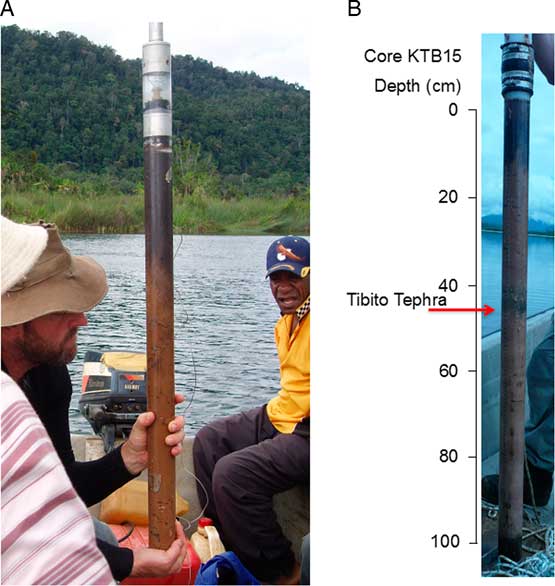
The cores extend along a northwest to southeast transect (core KTB-02, -10, -07, -11, -05, -15 and -13 respectively; Figure 1). The sedimentation rate of each core is related to its position relative to river inlets and outlet in the northwest end of Lake Kutubu. Cores KTB-2 and KTB-10 are close to the Tugibi and Kaimari inlet rivers, respectively. Both rivers have small deltas, and high rates of sediment influx occur in their vicinity. For this reason, they could be precisely dated using 210Pb because of high deposition rates and young sediments. In contrast, cores KTB-07, -05, -15, -11 and -13 retrieved in the central and eastern portions of the lake, and well away from present-day points of river inflow, contain the most complete sedimentary records with two macroscopic (~1 cm) tephra beds (Tibito and Olgaboli) showing clearly visible upper and lower contacts (Figure 3).
Although well-positioned in relation to sedimentation rates to offer 14C dates, cores KTB-05 and -15 were not used in this study to calculate the reservoir effect because of the predominance of Chara spp. growing at the coring site. Chara spp. is a multicellular green algae that resembles land plants because of stem-like and leaf-like structures (Berg et al. Reference Berg, den, Scheffer, Nes and Coops1999). They are found in fresh water, particularly in limestone areas where they grow submerged, attached to the muddy bottom. They prefer less oxygenated and hard water and are covered with calcium carbonate deposits (Berg et al. Reference Berg, den, Scheffer, Nes and Coops1999).
Cores KTB-05 and -15, in the littoral zone where Chara spp. grows in abundance, are subject to the addition of organic matter derived from floating vegetative mats at the lake surface and present a more complex dating environment than those in the centre of the lake. Accordingly, only cores KTB-07, -11 and -13 were used for calculations of the reservoir effect because these are the most reliable in relation to the continuity of the sediment profiles.
In addition to the sediment cores, three plant samples were collected, two herbaceous plants (Cyperaceae) unidentified sedges (Herb 1 and Herb 2) growing at the edge of the lake (emergent), and one moss sample (Moss) growing above the waterline of the lake on an exposed rock outcrop (Figure 1). The moss sample is not expected to have received any source of carbon from Lake Kutubu. One gastropod snail shell (Melanoides sp.), still alive at the time of core collection, was retrieved from top of core KTB-2 to check for the reservoir effect on modern shells.
Lead-210 Dating
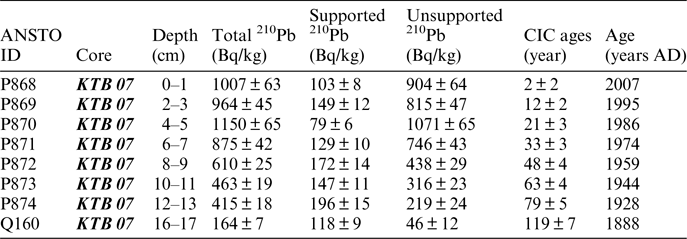
Lead-210 (210Pb) samples were processed at the Australian Nuclear Science and Technology Organisation (ANSTO), following methods described by Harrison et al. (Reference Harrison, Heijnis and Caprarelli2003). The alpha spectrometry method, which requires only 2 g of sample, was chosen. Each dried sediment sample was spiked with polonium-209 (209Po) and barium-133 (133Ba) tracers. Each sample was then leached with hot concentrated acids to release polonium and radium. Polonium was autoplated onto silver disks after adding the reducing agent hydroxylammonium chloride. Radium and barium were isolated by co-precipitation and collected as colloidal micro-precipitates of barium sulphate on fine membrane filter papers. The activities of 210Po on the silver disks and 226Ra on the membrane filters were determined by alpha spectrometry. Each membrane filter was also counted by gamma spectrometry to measure the 133Ba tracer activity. Chemical yield recoveries of 210Po and 226Ra were calculated using the recoveries of 209Po and 133Ba tracers, respectively. Unsupported 210Pb activities between 4 and 17 cm depth exhibit a decreasing trend with depth. The top 3 cm is more disturbed than the lower part of the core, which may be caused by disturbance at the sediment/water interface or a more rapid sedimentation rate. Using unsupported 210Pb data between 3 and 17 cm depth for the Constant Initial Concentration (CIC) model, and 0–17 cm depth for the Constant Rate of Supply (CRS) model (Appleby and Oldfield. Reference Appleby and Oldfield1978) sediment ages and mass accumulation rates were calculated. The CIC model is suitable for dating only sediment cores with a monotonic unsupported 210Pb profile against depth, and thus calculates only a single mass accumulation rate over the whole core. The CRS model is the preferred model for dating sediment cores with varying mass accumulation rates, or non-monotonic unsupported 210Pb profiles. Lead-210 results from Lake Kutubu are presented in Table 1.
Summary of 210Pb age data collected from Lake Kutubu sediment core KTB-07. The CIC mass accumulation rate was calculated to be 0.059±0.003 gcm–1yr–1.

Caesium Dating
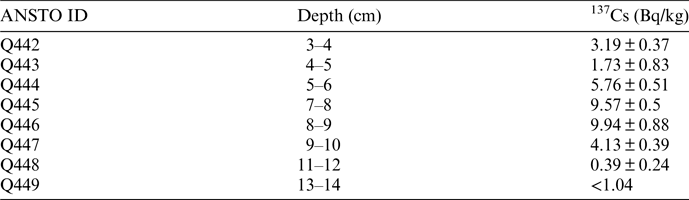
Caesium analyses were carried out at ANSTO. Between 1 and 2 g of dried and ground whole sediment were analyzed for caesium-137 (137Cs) activity by gamma-ray spectrometry using a High Purity Germanium (HPGe) detector. The detector system energy calibration was carried out using a National Institute of Standards and Technology (NIST) traceable multi-nuclide standard source and the detector system efficiency calibration was determined using IAEA reference materials including RGU-1, RGTh-1, RGK-1 and Soil-6. 137Cs was analyzed to validate the 210Pb chronology. Fallout from the atmospheric testing of nuclear weapons, such as 137Cs, accumulates in sediment materials and can be used to validate 210Pb chronologies. The horizon with the maximum activity of 137Cs should indicate the year 1963. 137Cs results from Lake Kutubu are presented in Table 2.
Radiocarbon Dating
Samples were analyzed for 14C using bulk sediment. Ages were obtained by accelerator mass spectrometry at DirectAMS (Washington, USA), NOSAMS Woods Hole Oceanographic Institution (Massachusetts, USA) and at the Research School of Earth Sciences at the Australian National University. The dried, crushed samples were pre-treated with HCl–NaOH–HCl to remove carbonates, humic and fulvic acids and washed with milli-Q, and the insoluble residue was freeze-dried for AMS analysis (Fallon et al. Reference Fallon, Fifield and Chappell2010). All samples were normalized to the AMS δ13C and background subtracted using 14C free coal.
14C ages were calibrated using the northern hemisphere terrestrial curve IntCal13 14C calibration data set (Reimer et al. Reference Reimer, Bard, Bayliss, Beck, Blackwell, Ramsey, Buck, Cheng, Edwards, Friedrich, Grootes, Guilderson, Haflidason, Hajdas, Hatté, Heaton, Hoffmann, Hogg, Hughen, Kaiser, Kromer, Manning, Niu, Reimer, Richards, Scott, Southon, Staff, Turney and van der Plicht2013) in the Bayesian age depth modelling R programme Bacon (Blaauw and Christen Reference Blaauw and Christen2011). We have opted to use the Northern Hemisphere curves as PNG lies very close to the January inter-tropical convergence zone, which is probably strongly influenced by northern air masses (McKee et al. Reference McKee, Baillie and Reimer2015; Blong et al. Reference Blong, Fallon, Wood, McKee, Chen, Magill and Barter2017b). We also consider that the Southern Hemisphere calibration curve SHCal13 (Hogg et al. Reference Hogg, Hua, Blackwell, Niu, Buck, Guilderson, Heaton, Palmer, Reimer, Reimer, Turney and Zimmerman2013) is less relevant to our age conversions because this calibration curve is dominated by tree ring chronologies from New Zealand that are more strongly influenced by upwelling in the Southern Ocean (McCormac et al. 2004).
Reservoir Effect Calculation
The presence of two closely spaced tephra beds within Lake Kutubu sediments provided an ideal opportunity to calculate the reservoir effect in this large oligomictic lake system. These tephras, Tibito and Olgaboli, have been widely recognized and dated in a variety of depositional settings throughout the PNG highlands (Blong Reference Blong1982; Haberle Reference Haberle1998; Blong et al. Reference Blong, Fallon, Wood, McKee, Chen, Magill and Barter2017b; Schneider et al. Reference Schneider, Alloway, Blong, Hope, Fallon, Pain, Maher and Haberle2017). Both tephra beds can be distinguished by their major and trace element glass shard compositions and therefore represent important inter-regional chronostratigraphic marker horizons (Schneider et al. Reference Schneider, Alloway, Blong, Hope, Fallon, Pain, Maher and Haberle2017).
To correct 14C dates derived from bulk-sediment that may have been contaminated with old carbon, we calculated the reservoir offset by associating the 14C age with 210Pb ages and mean ages for tephra beds extracted from the same depth interval. The mineralogical and geochemical details of these tephras were previously studied to determine their sources and refine their chronology based on past geological and palaeoenvironmental events (Haberle Reference Haberle1998; Coulter et al. Reference Coulter, Denham, Turney and Hall2009; Schneider et al. Reference Schneider, Alloway, Blong, Hope, Fallon, Pain, Maher and Haberle2017; Blong et al. Reference Blong, Kemp and Chen2016, Reference Blong, Wagner and Golson2017a, Reference Blong, Fallon, Wood, McKee, Chen, Magill and Barter2017b). Tibito tephra dates ca. 305–270 cal BP (2σ) (Blong et al. Reference Blong, Fallon, Wood, McKee, Chen, Magill and Barter2017b) and Olgaboli ca. 1180–980 cal BP (2σ) (Schneider et al. Reference Schneider, Alloway, Blong, Hope, Fallon, Pain, Maher and Haberle2017).
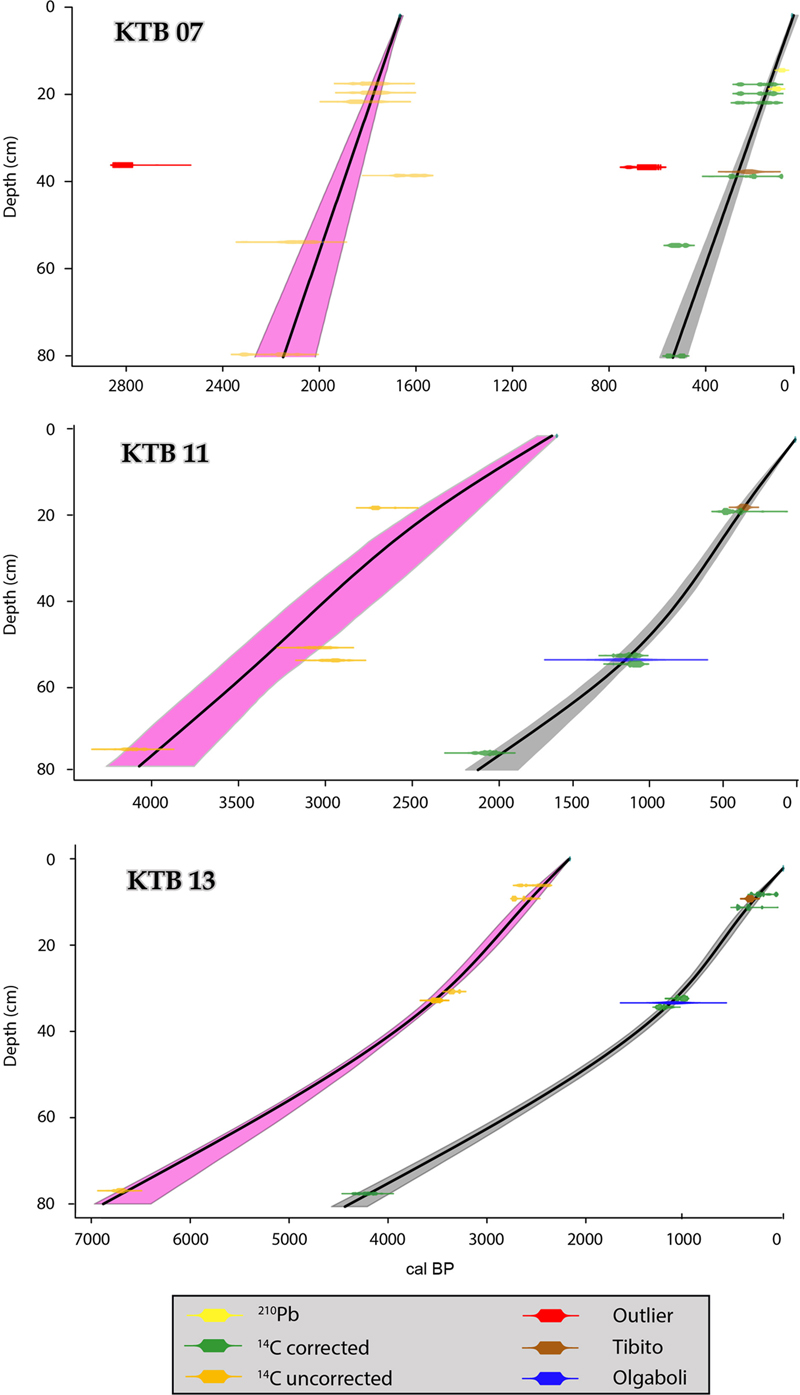
In this study, the 14C age of each tephra bed was determined from bulk sediment samples collected immediately above and below its upper and lower contact (Figure 3), supported by the overall age/depth profile (Dugmore et al. Reference Dugmore, Cook, Shore, Newton, Edwards and Larsen2006). One outlier was detected in core KTB07 and this is removed from the age-depth model and reservoir age offset calculations.
Three cores were used for tephra pairing (see sediment core collection above for more details): KTB-07, -11 and -13. In core KTB-07 it was possible to retrieve only Tibito tephra as the sedimentation rate was too high because of its close proximity to the lake inlets (Figure 1). The high sedimentation rate of core KTB-07 meant it could be dated using only 210Pb as this method is only able to date a horizon less than approximately 200 yr old.
The uncorrected 14C age for each tephra was calculated using the midpoint between the two bracket ages for each tephra (Table 3). Dating the sediment above and below a tephra is important to accurately date an ash fall. In addition, given that the ages of these tephras are known, they can be used as a control to calculate the off-set age of the sediments.
In dating both above and below the tephra layers, we note that, because Lake Kutubu sediments are mainly of an anoxic nature, biological bioturbation is unlikely to have occurred in the layers dated in this study. We also note that the preservation of tephra layers only ~1 cm thick suggests minimal disturbance by either physical or biological agencies.
For Tibito tephra in cores KTB07 and KTB11, only one 14C date adjacent to the tephra was available. In these two cases, the single 14C age is used, immediately below the tephra deposit in KTB07 and immediately above the tephra deposit in KTB11.
In addition to the bulk-sediment method, living biological samples were collected in surface layers of sediment (Herb 1, Herb 2, Moss and Gastropod) and used to calculate the reservoir age offset. The Moss sample, collected above the waterline of the lake in an exposed rock outcrop, was used as a control. Terrestrial plants take up CO2 directly from the atmosphere and their carbon-isotopic composition is expected to have been in equilibrium with contemporary atmospheric CO2 concentration and thus not prone to 14C age offsets.
All reservoir offset ages were calculated using the R package ResAge (Soulet Reference Soulet2015) run in the free open-source statistical software R (R Development Core Team 2017). The calibration curve used to calculate the reservoir age offsets was IntCal13 (Reimer et al. Reference Reimer, Bard, Bayliss, Beck, Blackwell, Ramsey, Buck, Cheng, Edwards, Friedrich, Grootes, Guilderson, Haflidason, Hajdas, Hatté, Heaton, Hoffmann, Hogg, Hughen, Kaiser, Kromer, Manning, Niu, Reimer, Richards, Scott, Southon, Staff, Turney and van der Plicht2013).
The age-depth models in this study were built using the R package Clam (Blaauw Reference Blaauw2010).
RESULTS AND DISCUSSION
Dating Results and Reservoir Age Offsets
210Pb dating results for core sediments collected in Lake Kutubu are shown in Table 1. As the 137Cs results support the constant initial concentration (CIC) model (Table 2), only CIC ages were considered to calculate the reservoir effect in Lake Kutubu. As in many other limestone-sediment records, the 210Pb dates in core KTB07 do not correlate with 14C dates.
137Cs activities from Lake Kutubu sediment core KTB-07, showing the maximum activity between 7 and 9 cm depth, validating the ages calculated from the CIC 210Pb chronology.

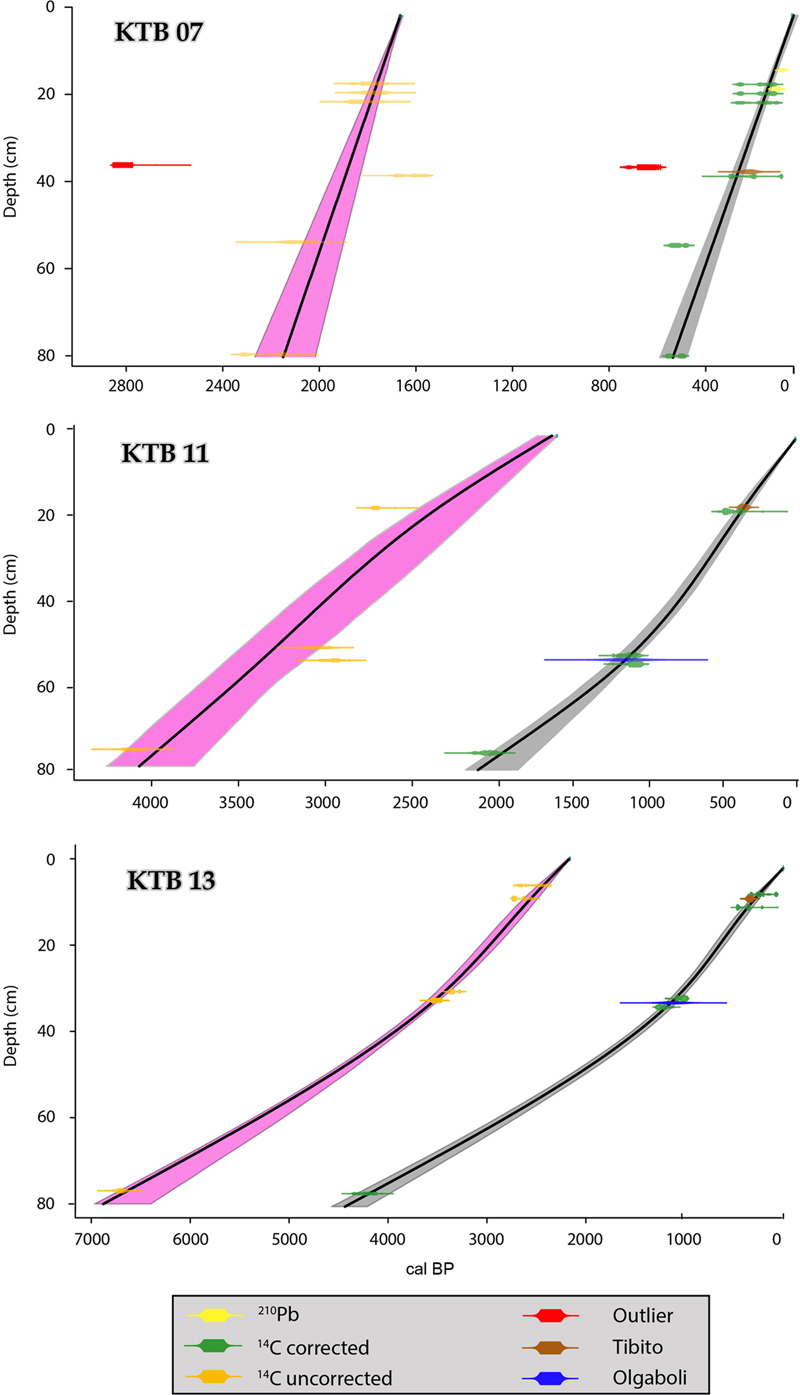
14C calibrated ages for sediments and modern plant and shell samples are presented in Table 3. The stratigraphic distribution of 14C dates in Lake Kutubu sediments did not correspond to the known tephra ages. This age offset, the reservoir effect, is demonstrated in Figure 4.
Age-depth model of cores KTB 07 (linear regression), KTB11 and KTB13 (smooth spline). In grey is the age-depth model corrected and in pink is the age-depth model not corrected for the 14C ages reservoir effect.
Radiocarbon sample and age data collected from Lake Kutubu sediment cores.
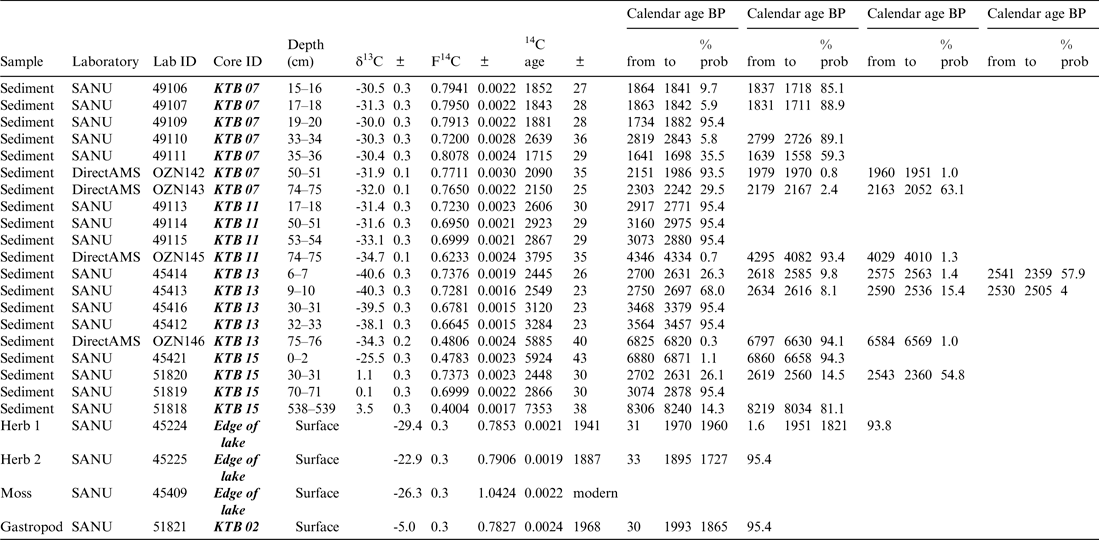
SANU: Radiocarbon Laboratory at the Australian National University. Canberra, ACT. Australia.
DirectAMS: DirectAMS commercial laboratory. Seattle, Washington, USA.
Calculated reservoir values (in 14C yr) and associated uncertainties (1σ) are shown in Table 4. The reservoir mean value for core samples varied between 1490 and 2280 14C yr.
Reservoir calculation (R) of sediments from Lake Kutubu, PNG.

The moss sample, which was growing above the waterline of the lake on an exposed rock outcrop, did not display a 14C reservoir effect as it receives rainwater in equilibrium with atmospheric CO2. The submerged biological samples had a reservoir value between 2220±37 and 2270±34 14C yr (Table 5). This result agrees with a previous study showing that submerged aquatic plants and animals living on sediments of lakes with 14C reservoir effect metabolize the 14C-depleted C from the environment, becoming markedly depleted in 14C compared to organisms utilising atmospheric CO2 as their source (Deevey and Stuiver Reference Deevey and Stuiver1964).
Reservoir calculation (R) of plants and gastropod from Lake Kutubu, PNG.

The modern submerged biological samples presented a much higher offset reservoir age (2220–2270, x̅=2250±41 14C yr) than those calculated in sediments for the period before AD 1950 (1490–2280, x̅=1900±286 14C). Delayed transport of bomb 14C from the atmosphere to aquatic and sedimentary systems is almost certainly the reason for the higher R values for recent time (Srdoč Reference Srdoč1986).
Effect of Depth and Distance From Lake’s Inlet on the Reservoir Effect
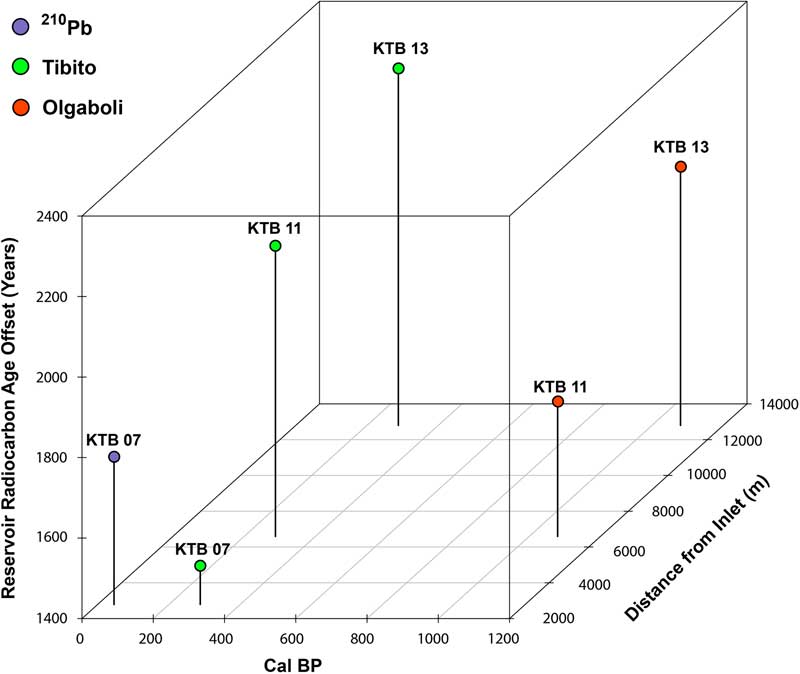
Core depth and distance from the inlet both had an effect on the freshwater reservoir effect in sediments of Lake Kutubu. The freshwater reservoir effect increased with distance from the inlet, with core KTB07 having the lowest reservoir offset (1490–1820 14C yr), KTB11 having an intermediary offset (1530–2200 14C yr) and KTB13 having the highest offset (1800–2360 14C yr) (Figure 5). This is explained by the hydrodynamics of Lake Kutubu where only one small part of the lake (northwest side, Figure 1) is reliably flushed and the water leaving (through the northwest side as well) is largely epilimnetic (Osborne Reference Osborne2012). Creek water probably enters the lake at depth depositing dissolved and suspended materials directly into the hypolimnion (Osborne and Totome Reference Osborne and Totome1992) and most likely brings outside carbon source to the northwest side of the lake.
3D scatterplot of the reservoir effect showing the effect of distance from the lake inlets (m) and depth of sampling points indicated by ages (cal BP).
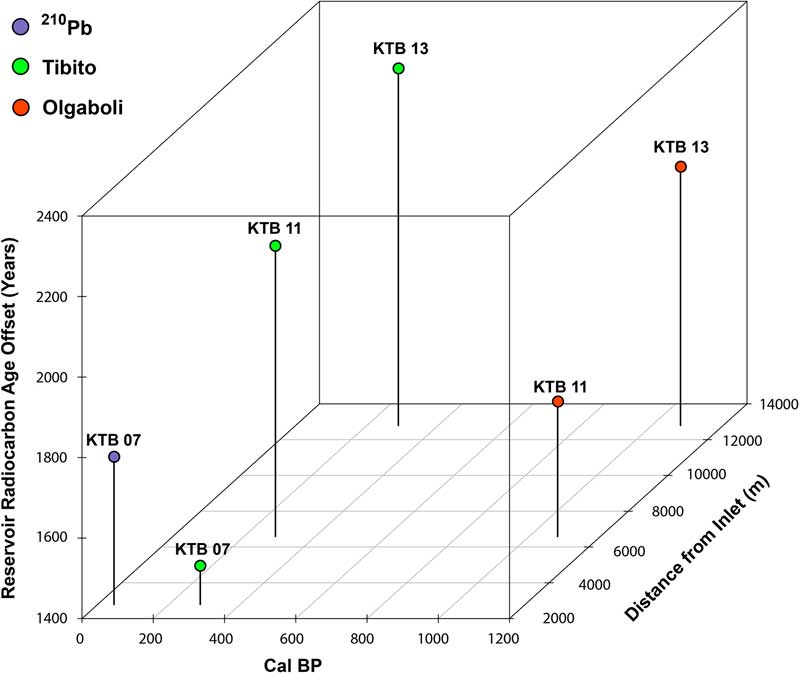
The reservoir age offset decreased with increasing depth for the three cores (Figure 5). Unfortunately, the number of data points used for the reservoir calculation is too limited to allow statistical analyses quantifying the effect of depth and distance from lake’s inlet on the reservoir effect in this lake.
The distance and depth effects shown in Figure 5 are difficult to interpret. Statistical analyses of the results do not allow definite conclusions, mainly because there are several factors causing the reservoir effect. Figure 5, however, does show a clear increase in reservoir age with distance northwest to southeast, and with core depth, which is indicative of age. There is also river input at depth (hypolimnion), and increased gas bubbling and iron precipitation in the southeast in response to strong cold southeast winds as probable initiator of overturning circulation. Figure 5 fits these circumstances, but speculation about these factors is premature and would require more data to be collected.
Changes and environmental events have been reported elsewhere as influencing the reservoir effect and causing a within-depth difference in reservoir years (Blaauw et al. Reference Blaauw, van Geel, Kristen, Plessen, Lyaruu, Engstrom, van der Plicht and Verschuren2011). In Lake Kutubu, enhanced sedimentation may have resulted from an intensification of agricultural activity in the Kutubu catchment around the time of the fall of Tibito Tephra, possibly as a result of the arrival of the South American sweet potato in the PNG highlands (Bayliss-Smith et al. Reference Bayliss-Smith, Golson and Hughes2017). However, while such changes occurred elsewhere in the highlands, we have no evidence that they occurred in the Kutubu catchment. In any case, human disturbance in the catchment seems to have been very minor until the last few decades (Schneider et al. 2015).
These results demonstrate that it is not advisable to use one core to extrapolate dating results for the entire lake. It is necessary to validate 14C dates with other proxies at different sites and depths to understand the hydrodynamic and environmental effects on sediments of lakes that are suspected of a freshwater reservoir effect. That other factors may change reservoir ages over time is important, and suggests that the primary 14C data are much more precise, and should be used rather than the averages.
Source of Old 14C in Lake Kutubu
There are multiple possibilities for the contamination of 14C-dated bulk-organic matter with carbon older than the time of deposition (Bjork and Wohlfarth Reference Bjork and Wohlfarth2001; Blaauw et al. Reference Blaauw, van Geel, Kristen, Plessen, Lyaruu, Engstrom, van der Plicht and Verschuren2011): (i) groundwater input containing 14C-depleted CO2 (e.g., from leaching old soils or volcanic activity), (ii) dissolution of 14C-depleted carbon from surrounding carbonate-rich bedrock or old lake deposits (e.g., the limestone occurring locally), (iii) emanation of 14C-depleted biogenic gas (CO2 or CH4) from organic bottom deposits followed by CH4 oxidation at the oxycline, (iv) direct in-wash of old soil or vegetation remnants from the catchment, or (v) reworking of organic material from older lake-sediment horizons through bioturbation or a resuspension event.
Process (i) is known to happen in Lake Kutubu as the nature of the limestone substrate in this area allows groundwater to travel to the lake. The lake is an exposure of the regional groundwater table, and the surrounding limestone is highly porous. D’cruz (Reference D’cruz2008) mentions seasonal changes of water level of over a meter which are probably, at least in part, a consequence of fluctuations in the regional groundwater table. There is no information on the location of groundwater drainage divides. This underground water connection was demonstrated in a previous study that detected barium (Ba) within Lake Kutubu sediments from oil field drilling activities located outside of Lake Kutubu’s surface catchment (Schneider et al. Reference Schneider, Haberle, Maher, Krikowa, Zawadzki and Heijnis2016). Barium concentrations in the northwest side of the lake followed a clear temporal connection with the start of mining exploration drilling activities outside of Kutubu catchment (Schneider et al. Reference Schneider, Haberle, Maher, Krikowa, Zawadzki and Heijnis2016). No other sources of anthropogenic inputs of Ba to the lake are known.
Process (ii) is most likely to happen in Lake Kutubu, as it is in a karst area consisting of limestone plateaus and broad ridges separated by narrow corridors formed in clastic sedimentary rocks. Process (ii) is further supported by the mean annual rainfall of 4500 mm in this lake. When rain permeates through limestone, dissolved (soil) CO2 forms carbonic acid (H2CO3) that can dissolve carbonates. As it infiltrates cracks or crevices it dissolves the bedrock through a complex chemical reaction that results in the influx of old carbon to the lake (Ford and Williams Reference Ford and Williams2007).
Process (iii), although it is not certain how significantly, occurs in Lake Kutubu during mixing events. Gas emissions are quite strong at the southeastern end of the lake. The lake water releases bubbles with gases likely to be a combination of CO2, CH4 and H2S (P. Osborne, personal communication, 4 January 2018). We could speculate that climate dependent overturning circulation influences the reservoir age distribution in Lake Kutubu, but with only 2 overturning events recorded it is not possible to assess this.
Process (iv), as for process (ii), is supported by the lake geology and high precipitation. The limestone catchment promotes the uptake of old carbon by plants and the high precipitation supports the washing of old soil and vegetation remnants from the catchment to the lake. In addition, turbidite flows from the edge of lake slopes can also cause reservoir effects by washing old carbon into lakes (Blaauw et al. Reference Blaauw, van Geel, Kristen, Plessen, Lyaruu, Engstrom, van der Plicht and Verschuren2011; Karlin and Abella Reference Karlin and Abella1996), but no evidence has been yet recorded for this in Lake Kutubu. It is, however, a common process reported in large lakes (Blaauw et al. Reference Blaauw, van Geel, Kristen, Plessen, Lyaruu, Engstrom, van der Plicht and Verschuren2011) and is likely to happen in Lake Kutubu because of its steep basin and rapid inputs of sediments at the northwestern end, as shown by the small deltas.
Process (v) is believed to have contributed to the reservoir effect of Lake Kutubu at some level, but in an inverse role. As an oligomictic lake, Kutubu has a distinct stable thermal stratification where water at the bottom of the lake is prevented from mixing thoroughly with the atmosphere (Osborne and Totome Reference Osborne and Totome1992). The residence time of these stratified waters, therefore, may also amplify the 14C reservoir effect in Lake Kutubu, as described by Hall and Henderson (Reference Hall and Henderson2001). This process could be one of the causes of the depth effect on the reservoir effect.
Although we have not conducted chemical analyses of the lake water, a previous study has shown that alkalinity and hardness in waters of Lake Kutubu are a result of 14C-depleted limestone in the catchment area (Osborne and Totome Reference Osborne and Totome1992), thus supporting processes (ii) and (iv) as main contributors to the recorded 14C reservoir effect.
Implications for Lake Sequences Elsewhere in PNG
Limited attention has been given to the issue of freshwater reservoir effects in the carbonate catchment lake sediments of PNG. This is worrisome given the geological context of the island, which is favourable to the 14C reservoir effect.
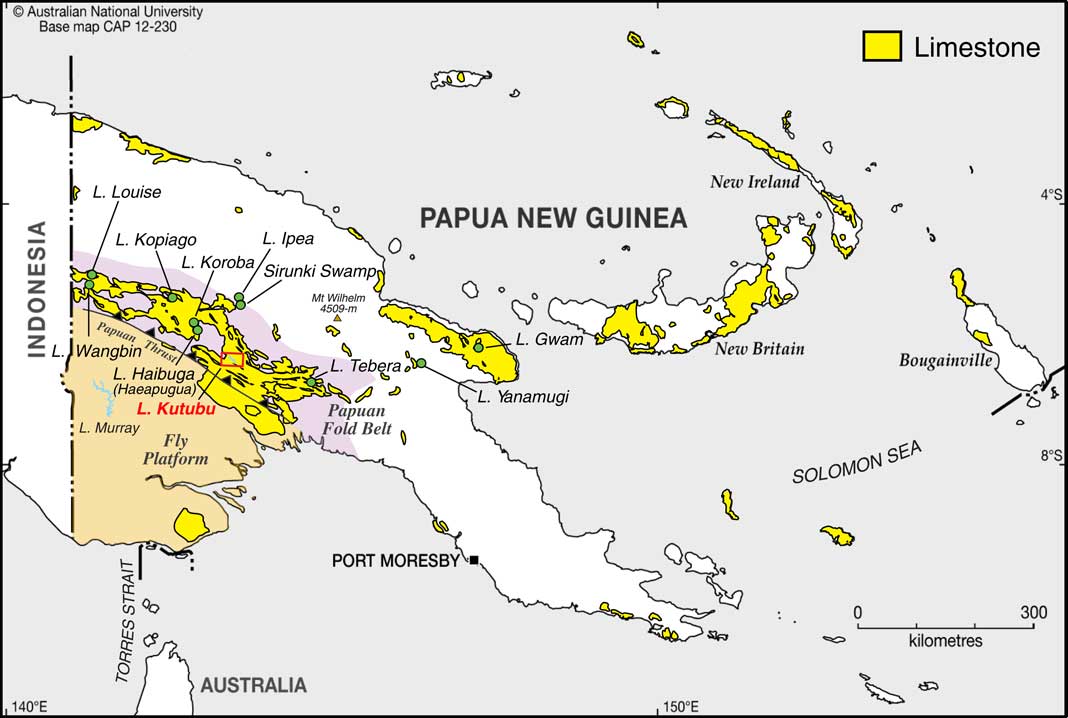
The main island of PNG has been formed by long-continued interaction between the Australian Plate in the southwest, and the Pacific Plate in the northeast. The 14C reservoir effect in PNG is, therefore, mainly a result of the high occurrence of limestone areas in this country (Figure 6).
Limestone areas in Papua New Guinea, and the freshwater lakes on the mainland that are known to or may have a 14C reservoir effect. The Papuan Fold Belt (purple), Fly Platform (yellow), and the intervening Papuan Thrust are indicated (from Williamson and Hancock 2005), as are areas of PNG with outcropping limestone in brown, modified from D’Addario (Reference D’Addario, Dow and Swoboda1975).
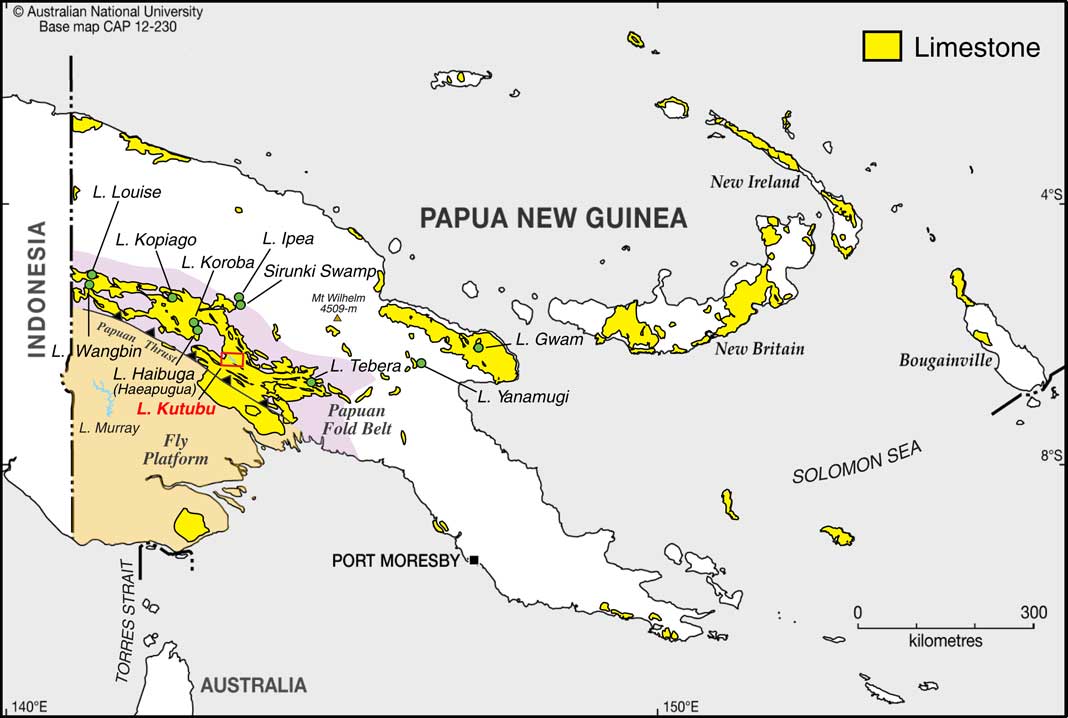
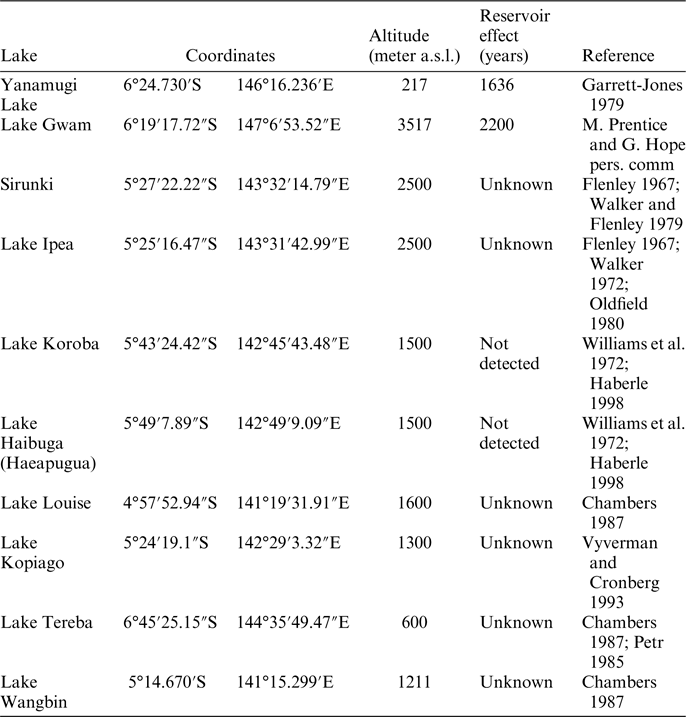
The highest occurrence of limestone is in the Papuan Fold Belt (Figure 6). This area was inundated in the early Miocene and shallow-water shelf limestone was deposited throughout the early and middle Miocene (Dow Reference Dow1977). Table 6 presents a list of lakes within limestone bedrock areas, or lakes within drainage areas containing limestone (Figure 6, Supplementary Material). We consider them to require further 14C reservoir studies in order to produce a reliable age-depth model to support palaeoecological research.
List of freshwater lakes in Papua New Guinea suspected or known to have a reservoir effect in sediments (based on Figure 6 map).

The 14C reservoir effect in PNG is not a problem confined to limestone-rich catchments. Other rock units, especially in the Papuan Fold Belt, have calcareous and/or carbonaceous components (i.e. Bain et al. Reference Bain and Mackenzie DE1975) where CaCO3-rich groundwaters are circulating freely. The Papuan Fold Belt has outcropping coal and shales with petroleum potential that may generate a 14C reservoir effect (Brown and Robinson Reference Brown and Robinson1982). Old organic deposits, like peat bogs, can also cause a reservoir effect (Kilian et al. Reference Kilian, van Gee and van der Plicht2000).
Lake Kutubu Reservoir Age Offset and Worldwide Comparisons
When comparing Lake Kutubu to freshwater lakes elsewhere in the world, its reservoir age offset is similar to other limestone lakes, higher than limestone-free areas, and lower than lakes of glacial influence. In the Tibetan Plateau, for example, the reservoir effect in lakes was reported to be mostly in the range from 1000 to 3000 yr (Mischke et al. Reference Mischke, Weynell, Zhang and Wiechert2013). Permian limestones, Permian to Neogene clastic rocks and Quaternary unconsolidated sediments dominate the catchment (Wang and Yang Reference Wang and Yang2004).
Queechy Lake in New York, a small lake lying on the Stockbridge marble (Paleozoic limestone) has shown a reservoir offset age of 2200 yr. The lake lacks inlets and receives its water by seepage through the limestone and the overlying glacial drift (Deevey Reference Deevey1954).
In the carbonate rocks (limestone and dolomite) and carbonaceous rocks (lignite, coal, and shale) of central North America, reservoir age offsets have been reported from 0 to 8000 yr, with an offset age of 500–2000 yr commonly found. In this region, much of this old carbonaceous material is in glacial drift that is redeposited in lake sediments as silt-sized particles (Grim et al. Reference Grimm, Maher and Nelson2009).
Langvatnet Lake in Nordenskild Land in Svalbard, a Norwegian archipelago between mainland Norway and the North Pole, has shown 14C reservoir offset ages of 1000 and 3000 yr when modern aquatic and terrestrial vegetation dates were paired. The reservoir effect stems from the lakes’ bedrock, which is dominated by the Carboniferous Billefjord group of sedimentary rocks, including abundant limestone and dolomite as well as coal seams (Snyder et al. Reference Snyder, Miller, Werner, Jull and Stafford1994).
A 1500 year 14C offset age was reported for Lake Qinghai, the largest inland water body in China. The reservoir effect in this lake also comes from its watershed which is partly underlain by late-Paleozoic limestone (Yu et al. Reference Yu, Shen and Coleman2007).
Lakes without major influence from limestone usually have a lower offset age than lakes receiving waters from a limestone catchment. For example, Lake Chala in Africa has a reservoir offset age of 200 yr, which is caused by a variable contribution of old terrestrial organic matter eroded from soils, and controlled mainly by changes in vegetation cover within the crater basin (Blaaw et al. 2011).
Glacial lakes have the highest variability in the reservoir age offset error, because they have more environmental variables playing a role in the distribution of 14C within lakes. In Lake Trowbridge, in Antarctic, a 14C offset of ca. 18,000 yr has been reported. This large reservoir effect is believed to result from the direct input of old CO2 from glacial meltwater (Hall and Henderson Reference Hall and Henderson2001). For lakes in the dry valleys of Antarctica, 14C offset reservoir ages have been reported between 2700 yr and 20,000 yr. The 14C reservoir effect in these lakes is primarily derived from subsurface melt of adjacent glaciers (Hendy and Hall Reference Hendy and Hall2006).
Future Directions for Studies in Lake Kutubu
In future studies in Lake Kutubu, we recommend: (1) application of tephrostratigraphy to complement 14C dating, (2) application of the Fletcher et al. Reference Fletcher, Zielhofer, Mischke, Bryant, Xu and Fink2017 approach to dating pollen samples in carbonate rich lake environments, (3) the use of terrestrial macrofossils, (4) the collection and dating of extant snail shells and terrestrial plants from lake shore or islands at the same time as sediments are collected, (5) avoid collection of cores in the littoral zone where there is high frequency of Chara spp. and (6) avoid collection of cores close to any stream inlet.
Although only two tephras were recorded in our 1 m cores from Lake Kutubu, at least two tephras are expected to be found in deeper samples. Based on the available information on tephras occurring in Kuk Swamp, 130 km north east of Lake Kutubu (Blong et al. Reference Blong, Wagner and Golson2017a), at least two tephras may occur below Olgaboli in Lake Kutubu: Kim (3980–3630 cal yr BP) and Ep (18,480–14,920 cal yr BP).
The collection of cores far from any inlet to the lake is recommended to avoid the influence of additional carbon outside the local catchment. If lake cores need to be collected close to the inlet, dating the top samples using both 210Pb and 14C dating methods is recommended to determine the reservoir effect as a function of depth in the core.
CONCLUSION
The distribution of calcareous rocks in Papua New Guinea favours a 14C reservoir effect in freshwater lakes. This study has produced a reliable 14C-based chronology for the 4500-cal BP sediment record of Lake Kutubu, allowing future studies in this lake as key archives of past climate and environmental change in PNG. The reservoir age offset has been estimated through paired 14C dates and 210Pb and tephras.
Differences in reservoir age offset varied around the lake and within depth, demonstrating the need to verify the 14C reservoir effect in all parts of the lake where sediments are used to produce historical studies. We recommend consideration of the inputs of external sources of carbon in lakes via inlets, which can require more proxies for refining the correction of the 14C reservoir effect.
The use of tephras and terrestrial plants to correct for the 14C reservoir effect has been successfully applied in this study, demonstrating the potential of tephra as chronomarkers of PNG palaeoecological events. Other lakes in PNG are likely to require corrections for 14C reservoir effect: Yanamugi Lake, Lake Gwam, Sirunki, Lake Ipea, Lake Koroba, Lake Haibuga, Lake Louise, Lake Kopiago, and Lake Tereba.
The widespread distribution of calcareous and/or carbonaceous bedrock lithologies in PNG, coupled with the overall lack of recognition that 14C reservoir effects may have had an influencing effect on previously published chronologies suggests that care is required in interpreting previously published age data and in the acquisition of future data. A multimethod approach similar to that adopted in this study is recommended.
The disentangling the reservoir effect in freshwater lakes of PNG is of high importance for future acquisition of long sediment cores and corresponding palaeoclimatic records from such lake systems will inevitably lead to advances in our overall understanding of the tempo and magnitude of tropical climate variability in the western Pacific realm. To our knowledge, this is the first study to address the 14C reservoir effect in a freshwater lake in PNG.
ACKNOWLEDGMENTS
The Lake Kutubu Project was funded by the Department of Archaeology and Natural History and the Radiocarbon Laboratory at the ANU. Lead-210 analyses were funded by the Australian Institute for Nuclear Science and Engineering (AINSE) grants AINGRA08028 and AINGRA10113 obtained by S.G.H. We thank Quan Hua for his insightful help on the reservoir calculations and suggestions to improve this manuscript and Ana Claudia Catelan for helping the production of the PNG limestone map. We thank the local Foe-Fasu landowners, WWF (Moro Office, PNG) and Oil Search, Limited (Moro) for assistance in the field. L.S. was financed by a postdoctoral fellowship funded by the ANU. We thank Andrew Henderson from Newcastle University (UK) for help in the field. We also thank the editor of Radiocarbon and the reviewers for their perceptive comments that helped us improve the paper. No conflict of interest is reported for this manuscript.
Supplementary material
To view supplementary material for this article, please visit https://doi.org/10.1017/RDC.2018.49