Introduction
The family Balsaminaceae is a mid-sized family of flowering plants, comprising about 1000 species in just two genera (Mabberley, Reference Mabberley2008). Hydrocera Blume, from Sri Lanka, India to Java, South Borneo and Sulawesi, is monotypic; all other species belong to Impatiens L., primarily an Old World genus distributed throughout much of tropical Africa, India, Southwest Asia and Japan (Grey-Wilson, Reference Grey-Wilson1980). In India the genus is represented by more than 203 taxa, mainly distributed in three major centres of diversity: the Western Himalayas, Northeast India, and the Western Ghats. Each of these areas is a centre of radiation for a particular group of species (Hooker, Reference Hooker1908; Gamble, Reference Gamble1915; Vivekananthan et al., Reference Vivekananthan, Rathakrishnan, Swaminathan, Ghara, Hajra, Nair and Daniel1997). Of the 90 species in Peninsular India, more than 80 are endemic and are confined to the Western Ghats (Rajalal et al., Reference Rajalal, Pandurangan and Pushpangadan1996). In India Impatiens section Scapigerae Hook.f. & Thomson, with 19 known species, is restricted to the latter area and belongs to the Western Ghats–Sri Lanka Hotspot of Biodiversity (Bhaskar, Reference Bhaskar1981, Reference Bhaskar2006; Bhaskar & Razi, Reference Bhaskar and Razi1983; Vivekananthan et al., Reference Vivekananthan, Rathakrishnan, Swaminathan, Ghara, Hajra, Nair and Daniel1997; Viswanathan & Manikandan, Reference Viswanathan and Manikandan2003). Classification within the section is mainly based on the lobes of the lateral petals, the spur of the lip and the dorsal auricle on the lateral petals. Among the 15 species with three-lobed lateral petals Impatiens agumbeana Bhaskar & Razi, I. barberi Hook.f., I. crenata Bedd., I. laticornis C.E.C.Fisch., I. lawsonii Hook.f., I. modesta Wight, I. nilgirica C.E.C.Fisch. and I. tirunelvelica M.B.Viswan. & Manik. have a spur less than 1 cm long.
The Wayanad District of Kerala forms a biodiversity-rich area in the Nilgiri phytogeographical region of the Western Ghats. During an exploration of the flowering plants there, 21 species of Impatiens were collected in various habitats (Ratheesh Narayanan, Reference Ratheesh Narayanan2010). One specimen, with a spur less than 5 mm long, was collected from high-altitude rock crevices in the grassland and is quite distinct from the hitherto known scapigerous species. It is described and illustrated here as new.
Species Description
Impatiens mohana Ratheesh, Sujana & Anil, sp. nov.Fig. 1.
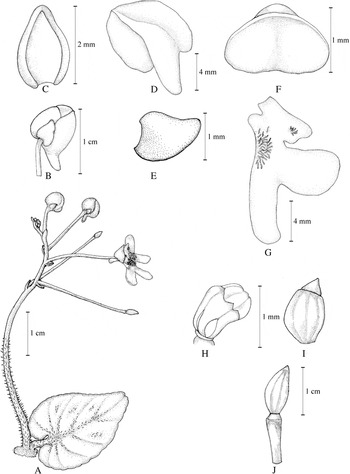
Fig. 1.Impatiens mohana Ratheesh, Sujana & Anil. A, habit; B, flower bud; C, bract; D, lower sepal; E, lateral sepal; F, dorsal petal; G, lateral united petal; H, anthers; I, ovary; J, fruit.

Impatienti modestae similis foliis ovato-cordatis, petalis lateralibus 3-lobatis, calcare minus 5 mm longo, capsulo ellipsoideo, sed pedunculis in parte inferiore 2/3 trichomatibus multicellularibus, floribus roseis, calcare stricto cylindrico, petalis lateralibus basi lobo minore, seminibus granulatis contra pedunculis glabris, floribus albis, calcare recurvato, petalis lateralibus subaequalibus basaliter lobo magno, seminibus pubescentibus differt. – Type: India, Kerala, Wayanad District, Aranamala Hills, c.1700 m, rock crevices in grassland, 17 viii 2006, M.K. Ratheesh Narayanan 2451 (holo CALI; iso MSSFootnote 1).

Scapigerous perennial herbs, lithophytic, 8–15 cm tall, rhizome tuberous, tubers whitish. Leaves 1–3, radical, petiolate, membranous, 4–8 × 3–4 cm, lamina ovate, slightly inequilateral, attenuate, margins bristly crenate, serrate, base deeply cordate, apex obtusely rounded or notched, 3–5 nerved, adaxially pale brown, abaxially deep pink, with multicellular trichomes on both surfaces; petiole 3–5 cm long, yellowish green, trichomatous. Inflorescence a racemose scape, unbranched; peduncles longer than the leaves, 12–18 cm long, 6 to 12-flowered, villous with multicellular trichomes and yellowish green in the lower 2/3, distally glabrous and pinkish streaked, flowers distal, 1.4–1.6 × 0.7–1 cm, pink with white margins, bracts fleshy, broadly ovate, c.4 × 2 mm, concave, obtuse, pale greenish with pink streaks, glabrous; pedicel longer than the flower, 2–3 cm long, elongating in fruit. Lateral sepals fleshy, broadly ovate, c.1.7 × 1.5 mm, apex rounded, glabrous, pinkish with white dots; lower sepal broadly ovate, c.4 × 3.5 mm, white, glabrous; spur cylindric, 3.7–4 mm long, white. Dorsal petal elliptic-orbicular, 2–3 × 3–4 mm, broader than long, saccate, dorsally with a projection, glabrous, white margins wavy; lateral united petals 3-lobed, c.1.2 cm long, deep pink with a tuft of pink and yellow hairs a little above the base; basal lobes smaller, broadly oblong, with tuft of yellow hairs at the centre, c.2 × 2 mm, middle lobe larger, broadly oblong, c.5 × 4 mm long, distal lobe narrowly oblong, straight, c.4 × 2 mm. Stamens 5, connate; filaments white with pink tinge above, anthers pale blue. Ovary pale yellowish green, elliptic, acute at apex, glabrous. Capsule broadly ellipsoid, 0.9–1 cm long, acute; seeds many, minute, testa white, granulate.
Distribution. Endemic to the Aranamala Hills, Wayanad District, Kerala, India.
Habitat and ecology. Dripping shady rock crevices in grassy slopes at an altitude of 1600–1800 m.
Phenology. Flowering is from July with a peak in August. Fruit maturing in September.
Etymology. The specific epithet ‘mohana’ is derived from the Malayalam word ‘mohanam’ indicating the very beautiful pink flowers of the plant.
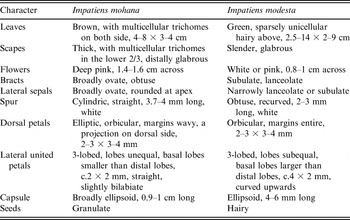
Taxonomic note. Impatiens mohana is similar to I. modesta in its ovate-cordate leaves, three-lobed lateral united petals, a spur less than 5 mm long and an ellipsoid capsule, but differs in having peduncles with multicellular trichomes in the lower 2/3, pink flowers, a straight, cylindrical spur, unequal lateral united petals with a smaller lobe basally, and granulate seed. Impatiens modesta, by contrast, has glabrous peduncles, white (rarely pink) flowers, a recurved spur, subequal lateral united petals with a large basal lobe, and hairy seeds. Impatiens modesta is a succulent epiphyte on wet moss-covered trees or is lithophytic in damp shady areas in evergreen forests at an altitude of 1200–2000 m in the southern Western Ghats. However, Impatiens mohana is found on very wet shady rock crevices in grassy slopes at an altitude of 1600–1800 m. A more detailed morphological comparison of these two species is given in Table 1.
Comparison between Impatiens mohana and Impatiens modesta

Additional specimens examined. India. Kerala, Wayanad District, Aranamala Hills, c.1800 m, 20 viii 2009, M.K. Ratheesh Narayanan 5232 (MSSH).
Acknowledgements
The authors are grateful to the Executive Director of M. S. Swaminathan Research Foundation, Chennai, India for providing facilities and support. We thank Mr M. D. Theuerkauf, Gurukula Botanical Sanctuary and Dr Anil Zakharia for expert comments. The logistics provided by the Kerala Forest Department for the fieldwork are also gratefully acknowledged. Sincere thanks are expressed to Dr J. F. Veldkamp, Netherlands Centre for Biodiversity Naturalis (section NHN) for critical remarks and the Latin diagnosis, and to Ms V. R. Volga and Ms V. Mini, staff of the Community Agrobiodiversity Centre, for their support.